ABSTRACT
Background: There are debates on representation and generalizability of previous
randomized controlled trials about anti-dementia agents in the oldest old population. In this context, we aimed to investigate the efficacy and safety of anti-dementia agents in the very elderly patients with dementia.
Methods: We conducted a retrospective study of patients with dementia 1) who were 85 years or older, 2) got started anti-dementia agents, and 3) went through follow-up evaluation about one year thereafter. As a control, patients with dementia who were less than 85 years old with similar inclusion criteria were randomly selected during the same period. The adverse drug effects and discontinuation rates were investigated with self-reported complaint after starting or increasing anti-dementia drugs. For efficacy outcome, we also analyzed the change in neuropsychological results during follow-up period.
Results: A total of 77 dementia patients who were at least 85 years were enrolled. As a control group, 78 patients with dementia who were younger than 85 was analyzed. The adverse drug effects were observed in 26 (33.3%) patients in the younger old and in 26 (33.8%) in the oldest old (P = 0.095). Twenty-one patients (26.9%) in the younger old group and 13 patients (16.9%) in the oldest old group discontinued their medication (P = 0.131). There were no differences between the two groups about changes of Mini-Mental State Examination and Instrumental Activity of Daily Living scores over time.
Conclusion: The use of anti-dementia agents in the oldest old dementia patients may be safe and effective as the younger old dementia patients.
Keywords: Dementia; Oldest Old; Anti-dementia Medication; Adverse Effects; Efficacy;
Alzheimer Disease
INTRODUCTION
The oldest old population, defined as 85 years or older, is fast growing segment of the world- wide population. The prevalence of dementia increases with age,1 therefore it is expected that the number of the oldest old dementia patients also increase markedly.2 Based on large epidemiological studies, dementia prevalence ranges from 18% to 38% among those aged 85 and older, and from 28% to 44% among those aged 90 and older.2-4
Original Article
Received: Oct 11, 2017 Accepted: Feb 27, 2018 Address for Correspondence:
A-Hyun Cho, MD, PhD
Department of Neurology, The Catholic University of Korea, Yeouido St. Mary's Hospital, College of Medicine, The Catholic University of Korea, 10, 63-ro,
Yeongdeungpo-gu, Seoul 07345, Korea.
E-mail: [email protected]
© 2018 The Korean Academy of Medical Sciences.
This is an Open Access article distributed under the terms of the Creative Commons Attribution Non-Commercial License (https://
creativecommons.org/licenses/by-nc/4.0/) which permits unrestricted non-commercial use, distribution, and reproduction in any medium, provided the original work is properly cited.
ORCID iDs Eun-Ye Lim
https://orcid.org/0000-0002-4972-7070 Dong-Won Yang
https://orcid.org/0000-0002-4733-7298 Jung-Seok Kim
https://orcid.org/0000-0002-8343-305X A-Hyun Cho
https://orcid.org/0000-0003-2506-0408 Funding
This research was supported by Basic Science Research Program through the National Research Foundation of Korea (NRF) funded by the Ministry of Education, Science and Technology (No. 2012R1A1B5000477).
Eun-Ye Lim ,1 Dong-Won Yang ,2 Jung-Seok Kim ,2 and A-Hyun Cho 1
1 Department of Neurology, The Catholic University of Korea, Yeouido St. Mary's Hospital, College of Medicine, The Catholic University of Korea, Seoul, Korea
2 Department of Neurology, The Catholic University of Korea, Seoul St. Mary's Hospital, College of Medicine, The Catholic University of Korea, Seoul, Korea
Safety and Efficacy of Anti-dementia Agents in the Extremely Elderly
Patients with Dementia
Neurology & Neuroscience
Disclosure
The authors have no potential conflicts of interest to disclose.
Author Contributions
Conceptualization: Cho AH. Data curation:
Kim JS, Lim EY. Investigation: Lim EY. Writing - original draft: Lim EY. Writing - review &
editing: Cho AH, Yang DW.
However, in majority of clinical trials of dementia, the oldest old people are
underrepresented.5 In previous randomized controlled trials (RCTs), the proportions of the oldest old participants (at least 85 years) were less than half and those of younger participants (under 65 years of age) were over four times greater than real-life Alzheimer dementia (AD).6 Most of the oldest old patients have multiple comorbidity such as diabetes, cardiovascular disease and have concomitant drugs. These have been important factors for the exclusion of the oldest old people from their clinical trials.
The neuropathology of dementia among the oldest old has been reported to be quite different from that of the younger old patients.7 They showed that the association between AD pathology and dementia diminished significantly with age and multiple pathologies are more common in the oldest old dementia patients.7-9 A recent large autopsy study demonstrated that AD plus vascular disease appears to be the most common type of mixed pathology in the oldest old.10 Others reported that the prevalence of TAR DNA protein-43 (TDP-43)-associated hippocampal sclerosis dramatically increase in oldest old people.11 These pathologic
differences suggest that, the effectiveness of anti-dementia drugs (cholinesterase inhibitors and N-methyl-D-aspartate antagonist) might be different in the oldest old dementia patients that were already proven to be effective in AD.12-15
Drug diffusion, distribution and particularly elimination decline with age.16 Thus, it is expected that oldest old patients might have more drug adverse effects. Actually, one study recently reported on the safety and tolerability of donepezil in a large cohort of older patients with dementia, including 116 patients aged 85 to 90 years. They reported that higher rates of diarrhea and urinary tract infections with increasing age regardless of dose.17 For this reason, some clinicians mind the use of anti-dementia drugs in the oldest old dementia patients. It is very important to verify that the effectiveness and tolerability of anti-dementia drugs in oldest old dementia patients in clinical practice.
In this context, we investigated the efficacy and adverse effects of anti-dementia drugs in the oldest old dementia patients with comparison to the younger old dementia patients.
METHODS
We retrospectively included patients who were 85 years or older, were diagnosed as dementia, got started anti-dementia agents and went through follow-up neuropsychological evaluation at least once. As a control, patients with dementia who were less than 85 years old with similar inclusion criteria were randomly selected during the same period. We excluded the patients with neurological, psychiatric or systemic illness that might affect cognition and be reversible cause. Individuals with brain lesion that were related to cognition such as large artery infarctions, brain tumors, normal pressure hydrocephalus were also excluded.
Clinical variables such as age, sex, risk factors (hypertension, diabetes, hyperlipidemia, cardiovascular disease, previous stroke history) were obtained by medical record review. All participants underwent medical history interview, physical and neurologic examination, screening laboratory test including vitamin B12, folate levels, syphilis serology, thyroid function tests and brain magnetic resonance images. The apolipoprotein E (APOE) genotype was determined in some patients.
Baseline cognitive function was assessed by the Korean Mini-Mental State Examination (K-MMSE) and neuropsychological test named Seoul Neuropsychological Screening Battery (SNSB). Dementia severity was assessed by clinical dementia rating (CDR) and CDR Sum of Box (CDR-SOB) scores. The Seoul-instrumental activities of daily living (S-IADL) and neuropsychological inventory (NPI) scores were also evaluated.
Dementia was diagnosed according to Diagnostic and Statistical Manual of Mental Disorders, 4th edition (DSM-IV). Anti-dementia drugs were prescribed according to the physician's discretion. The medications used are donepezil, rivastigmine capsule, rivastigmine patch, galantamine, and memantine.
Follow-up neuropsychological tests were performed 12 months after the initial examination.
The K-MMSE and CDR were performed at all times, but CDR-SOB, S-IADL, NPI were performed in limited patients. We investigated the adverse effects that occurred until next visit after starting or increasing medication by self-reported complaint in medical record.
We categorized them into six representative adverse effects identified in previous studies as follows: nausea/vomiting, diarrhea, skin rash, anorexia, dizziness, insomnia, and confusion.6 We also evaluated the discontinuation rates which was determined when clinician changed or stopped anti-dementia drugs. We analyzed the changes of neuropsychological test results to compare the drug efficacy between the two groups over 2 years.
Statistical analysis
We compared baseline demographic characteristics and neuropsychological test results using χ2 tests and Fisher's exact tests for categorical variables and t-tests for continuous variables.
The rates of drug adverse effect and discontinuation were examined using analysis of χ2 tests.
A mixed-effect modeling analysis was used, as a sensitivity analysis to address missing data and the time course of treatment effect; analysis was based on the observed case data, with no imputation of missing values. All statistical analyses were performed using SPSS version 18 (SPSS Inc., Chicago, IL, USA), and a P < 0.05 was considered significant.
Ethics statement
The present study protocol was reviewed and approved by Institutional Review Board of The Catholic University of Korea, Yeouido St. Mary's Hospital (IRB No. SC16RISI0121). Informed consent was waived because of the retrospective study design.
RESULTS
Baseline characteristics and initial neuropsychological tests
A total of 77 patients were enrolled in the oldest old dementia patients group. As a control, 78 patients who were less than 85 years old were randomly selected during the same period.
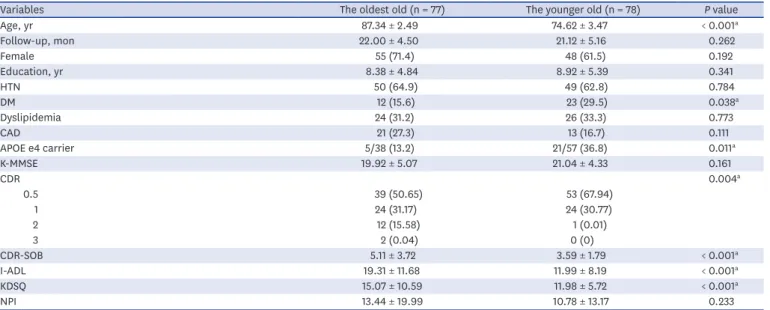
The demographics and baseline characteristics are shown in Table 1. The mean age was 87.34 ± 2.49 years (mean, standard deviation [SD]) in the oldest old and 74.62 ± 3.47 years in the younger old group. The mean follow-up duration was 22.00 ± 4.50 months (mean, SD) in the oldest old and 21.12 ± 5.16 months in the younger old group (P = 0.262). There was no difference in the sex, education, hypertension, hyperlipidemia, and cardiovascular disease history. The diabetes was more prevalent in the younger old group (12 [15.6%] vs. 23 [29.5%], P = 0.038) the older old vs.
the younger old. The APOE genotype was evaluated in 38 patients in the oldest old group and 57 patients in the younger old group. The proportion of APOE e4 carrier was significantly higher in the younger old group (5/38 [13.2%] vs. 21/57 [36.8%], P = 0.011).
The baseline neuropsychological tests are also shown in Table 1. The moderate to severe dementia patients, defined as CDR score 2 or more, were significantly higher in the oldest old group (13 [16.88%] vs. 1 [1.28%], the oldest old vs. the younger old, P < 0.001). The S-IADL scores was also higher in the oldest old group, suggesting that they had poor quality of daily activity (19.31 ± 11.68 vs. 11.99 ± 8.19, P < 0.001). There were no differences in K-MMSE and NPI scores.
The safety of anti-dementia drugs
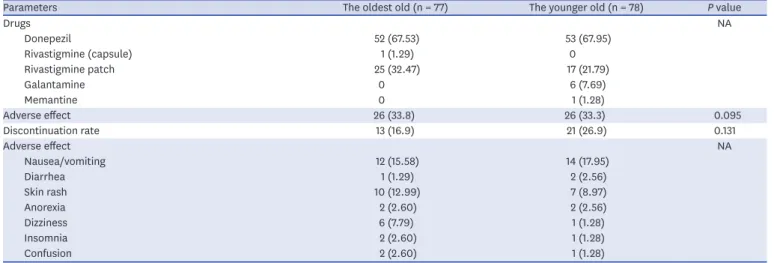
The initially prescribed anti-dementia drugs were shown in Table 2. Donepezil was the most commonly used drug in both groups. The rivastigmine patch was prescribed more frequently in the younger old group.
Adverse effects were observed in 26 patients (33.3%) in the younger old group and 26 patients (33.8%) in the oldest old group (P = 0.095). There was no significant difference in drug adverse effect rates between the two groups. The most frequent adverse effect was gastrointestinal discomfort such as nausea and vomiting. The skin rash was prevalent in rivastigmine patch users.
The discontinuation rate was also similar in both groups (21 [26.9%] vs. 13 [16.9%], P < 0.131).
The efficacy of anti-dementia drugs
Fig. 1 shows the changes in the neuropsychological test results over time. Due to our retrospective study design, there were missing data of 8 patients (3 in the younger old, 5 in the oldest old) in the CDR-SOB, 15 patients (6, 9) in the NPI scores and 22 patients (11, 11) in the Activity of Daily Living (ADL) scores.
Table 1. Baseline characteristics and initial neuropsychological findings
Variables The oldest old (n = 77) The younger old (n = 78) P value
Age, yr 87.34 ± 2.49 74.62 ± 3.47 < 0.001a
Follow-up, mon 22.00 ± 4.50 21.12 ± 5.16 0.262
Female 55 (71.4) 48 (61.5) 0.192
Education, yr 8.38 ± 4.84 8.92 ± 5.39 0.341
HTN 50 (64.9) 49 (62.8) 0.784
DM 12 (15.6) 23 (29.5) 0.038a
Dyslipidemia 24 (31.2) 26 (33.3) 0.773
CAD 21 (27.3) 13 (16.7) 0.111
APOE e4 carrier 5/38 (13.2) 21/57 (36.8) 0.011a
K-MMSE 19.92 ± 5.07 21.04 ± 4.33 0.161
CDR 0.004a
0.5 39 (50.65) 53 (67.94)
1 24 (31.17) 24 (30.77)
2 12 (15.58) 1 (0.01)
3 2 (0.04) 0 (0)
CDR-SOB 5.11 ± 3.72 3.59 ± 1.79 < 0.001a
I-ADL 19.31 ± 11.68 11.99 ± 8.19 < 0.001a
KDSQ 15.07 ± 10.59 11.98 ± 5.72 < 0.001a
NPI 13.44 ± 19.99 10.78 ± 13.17 0.233
Data are presented as means ± standard deviation (range) or number (%). Statistical analysis was performed by using analysis of covariance and χ2 test.
HTN = hypertension, DM = diabetes mellitus, CAD = coronary artery disease, APOE = apolipoprotein E, K-MMSE = Korean Mini-Mental State Examination, CDR = clinical dementia rating, CDR-SOB = CDR sum of box, I-ADL = Instrumental Activity of Daily Living, KDSQ = Korean Dementia Screening Questionnaire, NPI = neuropsychological inventory.
aP < 0.05, P values of significant difference between the oldest old group and the younger old group.
Cognitive impairment, based on the mean (SD) change in MMSE scores were progressed in both groups during two years (P = 0.001). However, there was no difference in the degree of changes in MMSE scores between two groups (P = 0.737). Functional impairment, based on mean (SD) changes in the CDR-SOB and Instrumental Activity of Daily Living (I-ADL) scores was progressed in both groups during two years (P < 0.001). But, the degree of changes was Table 2. The use of anti-dementia drugs and the development of adverse effect
Parameters The oldest old (n = 77) The younger old (n = 78) P value
Drugs NA
Donepezil 52 (67.53) 53 (67.95)
Rivastigmine (capsule) 1 (1.29) 0
Rivastigmine patch 25 (32.47) 17 (21.79)
Galantamine 0 6 (7.69)
Memantine 0 1 (1.28)
Adverse effect 26 (33.8) 26 (33.3) 0.095
Discontinuation rate 13 (16.9) 21 (26.9) 0.131
Adverse effect NA
Nausea/vomiting 12 (15.58) 14 (17.95)
Diarrhea 1 (1.29) 2 (2.56)
Skin rash 10 (12.99) 7 (8.97)
Anorexia 2 (2.60) 2 (2.56)
Dizziness 6 (7.79) 1 (1.28)
Insomnia 2 (2.60) 1 (1.28)
Confusion 2 (2.60) 1 (1.28)
Data are presented as number (%). Statistical analysis was performed by using analysis of covariance and χ2 test.
NA = not applicable.
16.000 19.000 20.000
18.000
A MMSE Group effect P value = 0.241
Time effect P value < 0.001 Interaction P value = 0.737
Baseline Year 1 Year 2
17.000 21.000 22.000
21.038
19.921
19.936
18.816 18.078
17.845
0 2.000 4.000
CDR-SOB
B Group effect P value = 0.015
Time effect P value < 0.001 Interaction P value = 0.645
Baseline Year 1 Year 2
6.000 8.000
5.105
3.591
5.894
4.311
6.352 5.586
0 15.000 20.000
10.000
I-ADL
C Group effect P value < 0.001
Time effect P value < 0.001 Interaction P value = 0.129
Baseline Year 1 Year 2
5.000 25.000 30.000
0 15.000 20.000
10.000
D NPI Group effect P value = 0.491
Time effect P value = 0.003 Interaction P value = 0.876
Baseline Year 1 Year 2
5.000 25.000
13.440 10.780
17.940
10.330
18.390 16.400 19.310
11.990
24.740
14.900
21.950
Younger old Oldest old
Fig. 1. The changes in neuropsychological scores over time. There was no difference in the degree of changes in MMSE scores (A), CDR-SOB (B), I-ADL (C), and NPI (D) between two groups. Statistical analysis was performed by using mixed-effect modeling analysis.
MMSE = Mini-Mental Status Examination, CDR-SOB = clinical dementia rating sum of box, I-ADL = Instrumental Activity of Daily Living, NPI = neuropsychological inventory.
similar in both groups (CDR-SOB; P = 0.645, I-ADL; P = 0.129). The changes of NPI scores were also similar in both groups (P = 0.876).
DISCUSSION
In patients who were 85 years or older, the use of anti-dementia drugs was similarly safe and effective compared to those less than 85. Generally, it could be presumed that the adverse effects would be higher in the elderly because of their weak physiology related to chronological age and comorbidity. However, in our real clinical practice, there was no difference. Our cautious prescription of medication, prudent selection of beneficiary might explain such results. According to Cochrane database of systemic review, the side effects of cholinesterase inhibitors (ChEIs) were about 10%–25% and the drug discontinuation rate were about 6%–16% in previous randomized clinical trials.18 Compared to those results, our study showed higher adverse effect and discontinuation rates. In clinical trials, the patients that have comorbidity such as coronary artery disease, chronic kidney disease and that take a lot of drugs are all excluded. Therefore, we expected that the adverse effect might be more prevalent in real clinical practice which includes more elderly population.
Regarding the efficacy of anti-dementia drugs in patients who were 85 years or older, the temporal change of cognition and quality of life was not different compared to those less than 85. According to our results, the efficacy results of anti-dementia drugs may be still applied in the extremely elderly groups in whom, clinical trials could not show clear evidence yet.
In addition, we could observe the characteristics of cognitive decline in oldest olds compared to younger olds. Although not statistically significant, the K-MMSE and functional scales scores in younger old group more rapidly decline compared to the oldest old group. Our results are in line with the previous studies which reported that the progression rate of Alzheimer disease in oldest old patients was slower than that in younger old patients.19 In the baseline neuropsychological test results, the K-MMSE scores were similar in the two groups. However, the functional scale (CDR, I-ADL) scores were higher in the oldest old which means poorer functional state in the oldest old group. Most of the oldest old dementia patients have non-cognitive physical (sensory, musculoskeletal) and medical co-morbidities which contribute to functional decline. Therefore, non-cognitive physical and medical co- morbidities should be taken into consideration when we evaluate the dementia severity in oldest old dementia patients.
Severe functional impairment in the oldest old dementia but similar safety and efficacy of anti-dementia drugs in this study warrants the prescription of anti-dementia drugs in the oldest old. They may get more benefit than those younger.
Regarding APOE e4 genotype, it was more prevalent in the younger old group in our study. This finding consists with previous studies which showed that the Alzheimer disease pathology was less associated with dementia in the oldest old patients.7 The Vantaa 85+ Study reported no increased incidence of dementia among oldest old APOE ε4 allele carriers compared with non-carriers.19 The diabetes was prevalent in the younger old group of our study. The diabetes was known to be associated with more extensive vascular pathology and increased dementia risk
during life.20 This study evaluated the characteristics of the patients who were diagnosed as dementia for the first time after 85 years. In other words, these people are those who have been up to 85 years of old without dementia. We assume that the people who have diabetes might be diagnosed with dementia at earlier time if they have similar Alzheimer pathology.
There are several unavoidable limitations in our study. At first, we evaluated the drug efficacy by comparing with the younger old group who took the drugs, not comparing with the oldest old patients who did not take drugs because of our retrospective study design. Second, the drug side effect was not evaluated by a questionnaire survey but self-reported complaints of the patients through charts review. This may raise the possibility of underestimation. Third, the neuropsychological test could not be obtained with a consistent protocol. This is also the limitation caused by a retrospective design. However, our study has strength because this is the first study to assess the safety and efficacy of anti-dementia drugs in the oldest old dementia patients at our real clinical practice.
In conclusion, we showed that the safe and effective use of anti-dementia drugs in the oldest old compared to those younger. With the increasing population of the elderly, the strong clinical evidence through a prospective study is required.
REFERENCES
1. Jorm AF, Jolley D. The incidence of dementia: a meta-analysis. Neurology 1998;51(3):728-33.
PUBMED | CROSSREF
2. Corrada MM, Brookmeyer R, Berlau D, Paganini-Hill A, Kawas CH. Prevalence of dementia after age 90 results from the 90+ study. Neurology 2008;71(5):337-43.
PUBMED | CROSSREF
3. Heeren TJ, Lagaay AM, Hijmans W, Rooymans HG. Prevalence of dementia in the ‘oldest old’of a Dutch community. J Am Geriatr Soc 1991;39(8):755-9.
PUBMED | CROSSREF
4. Ebly EM, Parhad IM, Hogan DB, Fung TS. Prevalence and types of dementia in the very old results from the Canadian Study of Health and Aging. Neurology 1994;44(9):1593-600.
PUBMED | CROSSREF
5. Schoenmaker N, Van Gool WA. The age gap between patients in clinical studies and in the general population: a pitfall for dementia research. Lancet Neurol 2004;3(10):627-30.
PUBMED | CROSSREF
6. Leinonen A, Koponen M, Hartikainen S. Systematic review: representativeness of participants in RCTs of acetylcholinesterase inhibitors. PLoS One 2015;10(5):e0124500.
PUBMED | CROSSREF
7. Chen LW. Age, neuropathology, and dementia. N Engl J Med 2009;361(11):1118.
PUBMED | CROSSREF
8. Haroutunian V, Schnaider-Beeri M, Schmeidler J, Wysocki M, Purohit DP, Perl DP, et al. Role of the neuropathology of Alzheimer disease in dementia in the oldest-old. Arch Neurol 2008;65(9):1211-7.
PUBMED | CROSSREF
9. James BD, Bennett DA, Boyle PA, Leurgans S, Schneider JA. Dementia from Alzheimer disease and mixed pathologies in the oldest old. JAMA 2012;307(17):1798-800.
PUBMED | CROSSREF
10. Corrada MM, Sonnen JA, Kim RC, Kawas CH. Microinfarcts are common and strongly related to dementia in the oldest-old: the 90+ study. Alzheimers Dement 2016;12(8):900-8.
PUBMED | CROSSREF
11. Kawas CH, Kim RC, Sonnen JA, Bullain SS, Trieu T, Corrada MM. Multiple pathologies are common and related to dementia in the oldest-old: the 90+ study. Neurology 2015;85(6):535-42.
PUBMED | CROSSREF
12. Courtney C, Farrell D, Gray R, Hills R, Lynch L, Sellwood E, et al. Long-term donepezil treatment in 565 patients with Alzheimer's disease (AD2000): randomised double-blind trial. Lancet 2004;363(9427):2105-15.
PUBMED | CROSSREF
13. Rösler M, Anand R, Cicin-Sain A, Gauthier S, Agid Y, Dal-Bianco P, et al. Efficacy and safety of rivastigmine in patients with Alzheimer's disease: international randomised controlled trial. BMJ 1999;318(7184):633-8.
PUBMED | CROSSREF
14. Winblad B, Grossberg G, Frölich L, Farlow M, Zechner S, Nagel J, et al. IDEAL: a 6-month, double-blind, placebo-controlled study of the first skin patch for Alzheimer disease. Neurology 2007;69(4 Suppl 1):S14-22.
PUBMED | CROSSREF
15. Loy C, Schneider L. Galantamine for Alzheimer's disease and mild cognitive impairment. Cochrane Database Syst Rev 2006;(1):CD001747.
PUBMED | CROSSREF
16. Merle L, Laroche ML, Dantoine T, Charmes JP. Predicting and preventing adverse drug reactions in the very old. Drugs Aging 2005;22(5):375-92.
PUBMED | CROSSREF
17. Farlow M, Veloso F, Moline M, Yardley J, Brand-Schieber E, Bibbiani F, et al. Safety and tolerability of donepezil 23 mg in moderate to severe Alzheimer's disease. BMC Neurol 2011;11:57.
PUBMED | CROSSREF
18. Kaduszkiewicz H, Zimmermann T, Beck-Bornholdt HP, van den Bussche H. Cholinesterase inhibitors for patients with Alzheimer's disease: systematic review of randomised clinical trials. BMJ 2005;331(7512):321-7.
PUBMED | CROSSREF
19. Juva K, Verkkoniemi A, Viramo P, Polvikoski T, Kainulainen K, Kontula K, et al. APOE epsilon4 does not predict mortality, cognitive decline, or dementia in the oldest old. Neurology 2000;54(2):412-5.
PUBMED | CROSSREF
20. Ahtiluoto S, Polvikoski T, Peltonen M, Solomon A, Tuomilehto J, Winblad B, et al. Diabetes, Alzheimer disease, and vascular dementia: a population-based neuropathologic study. Neurology 2010;75(13):1195-202.
PUBMED | CROSSREF