Differences in Hands-off Time According to the Position of a Second Rescuer When Switching Compression in Pre-hospital Cardiopulmonary Resuscitation Provided by Two Bystanders:
A Randomized, Controlled, Parallel Study
The change of compressing personnel will inevitably accompany hands off time when cardiopulmonary resuscitation (CPR) is performed by two or more rescuers. The present study assessed whether changing compression by a second rescuer located on the opposite side (OS) of the first rescuer can reduce hands-off time compared to CPR on the same side (SS) when CPR is performed by two rescuers. The scenario of this randomized, controlled, parallel simulation study was compression-only CPR by two laypersons in a pre-hospital situation. Considering sex ratio, 64 participants were matched up in 32 teams equally divided into two gender groups, i.e., homogenous or heterogeneous. Each team was finally allocated to one of two study groups according to the position of changing compression (SS or OS). Every team performed chest compression for 8 min and 10 sec, with chest compression changed every 2 min. The primary endpoint was cumulative hands-off time. Cumulative hands-off time of the SS group was about 2 sec longer than the OS group, and was significant (6.6 ± 2.6 sec vs. 4.5 ± 1.5 sec, P = 0.005). The range of hands off time of the SS group was wider than for the OS group. The mean hands-off times of each rescuer turn significantly shortened with increasing number of turns (P = 0.005). A subgroup analysis in which cumulative hands-off time was divided into three subgroups in 5-sec intervals revealed that about 70% of the SS group was included in subgroups with delayed hands-off time ≥ 5 sec, with only 25% of the OS group included in these subgroups (P = 0.033). Changing compression at the OS of each rescuer reduced hands-off time compared to the SS in prehospital hands-only CPR provided by two bystanders.
Keywords: Cardiopulmonary Resuscitation; Manikins Yong Hwan Kim,1 Jun Ho Lee,1
Dong Woo Lee,1 Kwang Won Cho,1 Mun Ju Kang,1 Yang Weon Kim,2 Kyoung Yul Lee,3 Young Hwan Lee,4 Jin Joo Kim,5 and Seong Youn Hwang1
1Department of Emergency Medicine, Samsung Changwon Hospital, Sungkyunkwan University School of Medicine, Changwon; 2Department of Emergency Medicine, Inje University, Busan Paik Hospital, Busan; 3Department of Physical Education, Kyungnam University, Changwon; 4Departments of Emergency Medicine, Hallym University Sacred Heart Hospital, Hallym University, Anyang;
5Department of Emergency Medicine, Gachon University Gil Hospital, Incheon, Korea Received: 23 July 2014
Accepted: 22 May 2015 Address for Correspondence:
Seong Youn Hwang, MD
Department of Emergency Medicine, Samsung Changwon Hospital, Sungkyunkwan University School of Medicine, 158 Paryong-ro, Masanhoewon-gu, Changwon 630-723, Korea Tel: +82.55-290-6560, Fax: +82.55-290-6117
E-mail: [email protected]
http://dx.doi.org/10.3346/jkms.2015.30.9.1347 • J Korean Med Sci 2015; 30: 1347-1353
INTRODUCTION
Interruptions of chest compressions during cardiopulmonary resuscitation (CPR), termed the hands-off time, should be kept as short as possible (1, 2). Minimal hands-off time increases survival of out-of-hospital cardiopulmonary arrest (3).
The importance of minimizing hands-off time during the performance of CPR is included in the current guidelines. Ac- cording to the 2010 update of the American Heart Association (AHA) guidelines, rescuers should consider switching compres- sors during any intervention associated with appropriate inter- ruptions in chest compressions, such as when an automated external defibrillator (AED) is delivering a shock. The guidelines recommend that every effort be made to accomplish this switch in < 5 sec.
If the two rescuers are positioned on either side of the patient,
one rescuer will be ready and waiting to relieve the working compressor every 2 min (4). However, the duration and the ef- fect of these interruptions on CPR during switching compres- sors are unclear. Also, there is no specific published evidence for rescuer switch position during the change of compressors. It may be that interrupted chest compression is more likely when the compressors are on the same side (SS) of the patient, since a change in position of the rescuers is necessary, as compared to rescuers positioned on the opposite side (OS) of the patient.
In the latter arrangement, chest compression of the second res- cuer could resume immediately after the other rescuer stops, since the change requires only a hands-off of the previous res- cuer.
On the contrary, position change of compressors on the SS may prolong the hands-off time as compared to that of the OS.
The present study investigated this hypothesis.
Emergency & Critical Care Medicine
MATERIALS AND METHODS Design
This study was a randomized, controlled, parallel mannequin study investigating SS and OS methods of change of compres- sors.
Subjects
This study was conducted at Kyungnam University from May 2013 to June 2013. Ninety-three first-year university students with various majors encompassing 22 departments were re- cruited through announcements at liberal arts classes. No in- centive was offered. Participation was voluntary and partici- pants had never learned CPR. Before the test, a basic life sup- port (BLS) training course was provided to all participants. All instructors were AHA-certified and an emergency physician supervised all training classes as the lead instructor. The train- ing course was autonomously designed to guide practice ac- cording to the AHA guideline. BLS training consisted of a 1-hr theoretical lecture with general BLS, 1-hr demonstration of hands-only CPR and two CPR rescuers, and a 2-hr practice for BLS training. The course instructors were not aware of the goals of this study while teaching the class. After all training was com- plete, the study was explained to participants, and written con-
sent was obtained from all subjects. Age, gender, height, and weight of the participants were recorded. All training was con- ducted in the university gymnasium, but study tests were con- ducted in a classroom.
Study protocol
This study sought to reflect the situation of out-of-hospital car- diac arrest (OHCA) before activation of the Emergency Medical Service System. Accordingly, the study had several assumptions.
The first was that laypersons would use only compression-only CPR in OHCA. The second was the male-to-female ratio of the laypersons was equal. Thirdly, when CPR was performed by two rescuers, the probability that the CPR team consisted of ei- ther males or females, or one of each was equal. In a real CPR situation, rescuers may be heterogeneous concerning gender.
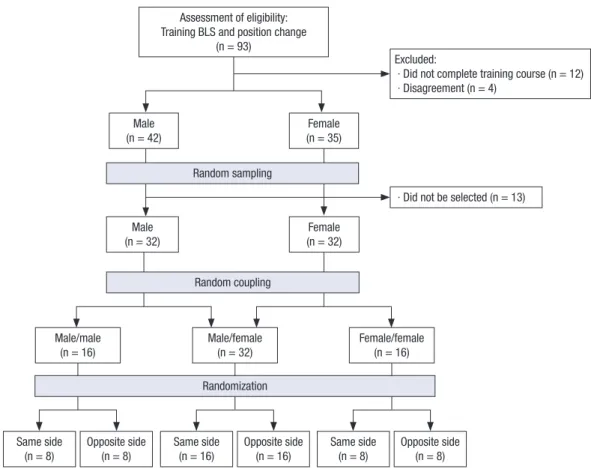
This may detract from the teamwork necessary for success due to differences in communication and the capability to properly deliver CPR. These factors bias the study hypothesis. Under these assumptions, after exclusion of persons who did not meet the aforementioned assumptions, 64 of 77 participants were first randomly selected by chance and thereafter were assigned to one of three groups: both male, both female, and one of each gender (Fig. 1). Each homogenous gender group consisted of eight teams of two and the heterogeneous group consisted of
Excluded:
· Did not complete training course (n = 12) · Disagreement (n = 4)
Male (n = 32)
Same side (n = 8)
Opposite side (n = 8)
Same side (n = 16)
Opposite side (n = 16)
Same side (n = 8)
Opposite side (n = 8) Female
(n = 32)
· Did not be selected (n = 13) Random sampling
Random coupling
Randomization Male/male
(n = 16)
Male/female (n = 32)
Female/female (n = 16) Male
(n = 42) Female
(n = 35) Assessment of eligibility:
Training BLS and position change (n = 93)
Fig. 1. Flow diagram of the study.
16 teams of two. The participants were allocated to their team by opening an opaque, sealed envelope that contained a num- ber from 1-32 that was generated randomly (http://www.ran- dom.org). In this selection process, 13 participants whose enve- lopes were empty were excluded. Those drawing numbers from 1-16 and 17-32 were allocated to a gender-homogenous or gen- der-heterogeneous team. The number of teams was set to re- duce bias and was adjusted to give a 1:1 ratio of the three gen- der combinations. Then, all teams were randomly allocated to the SS or OS method of compressor change. This allocation was also determined randomly by opening sequentially numbered, opaque, sealed envelopes. It contained one of two letters, A and B. Two letters were randomized in a size-4 block, with A on the same side and B on the opposite side. The test CPR scenario was continuous chest compression by two lay rescuers as a team.
The participants were advised to minimize interruptions of chest compression during the person-to-person change (no longer than 5 sec). Each participant was asked to perform CPR using the Resusci Anne® Skill Reporter manikin located on the floor, which was connected to a laptop with the Laerdal PC Skill Re- porting System Program (Laerdal Medical Corporation, Stra- vanger, Norway). Chest compression was conducted for 8 min, 10 sec with personnel change every 2 min. Participants were asked to provide chest compressions at a rate of 100 per min. A metronome was set at the appropriate frequency to standardize the rate of compressions. The data collector had a stop watch, and the operator directed participants at the appropriate time to change over. But, the time on the watch was blinded to par- ticipants. Before commencing, participants were informed whe- ther they would alternate in SS or OS position every 2 min, but were not told the total duration of the scenario. Hands-off time was collected by analyzing the graph produced by the Laerdal PC Skill Reporting System. Hands-off time was defined as the interval from the flat point of the graph after compression re- lease to the initial point of the steepest gradient of the graph by the next effective compression (Fig. 2). Other values indicating the quality of chest compressions collected by the Laerdal PC Skill Reporting System were mean compression depth, rate of compressions per min, proportion of abnormal chest recoil, proportion of abnormal hand placement, total number of com- pression, and adequate compression/total compression. Here-
after, the person performing compression is referred to as the compressor.
Statistical analyses
Data are presented as mean ± standard deviation, median with interquartile range, or range. Differences between the two groups were tested using the independent two-sample t-test or the Mann- Whitney U-test for continuous variables. The data were analyz- ed using the Repeated Measures Analysis of Variance for a re- peated-measures procedure. This method was utilized to eval- uate the differences between two groups (i.e., SS vs. OS) and in- teraction of group over time (i.e., order of turn). A P value < 0.05 was considered statistically significant. Data were analyzed us- ing SPSS version 21.0 (SPSS, Chicago, IL, USA). Based on the results of a small pilot study, we expected an average cumula- tive hands-off time difference of 2 sec with a standard deviation of ± 2 sec between same side compressors change and oppo- site side compressors change. To show this difference with an alpha error of 0.05 and a power of 80%, a minimum of at least 32 pairs of participants was needed.
Ethics statement
This study was approved by the institutional review board of Samsung Changwon Hospital, Sungkyunkwan University School of Medicine (IRB No. 2013-SCMC-019-00).
RESULTS
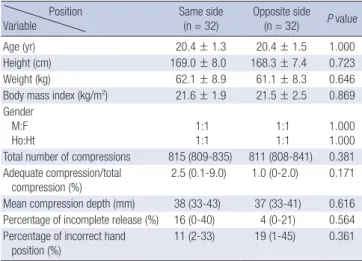
Ninety-three participants were recruited. Twenty-nine were ex- cluded. Of those, 12 were incomplete trainees, four did not pro- vide consent and 13 were not selected in both simple random samples. Finally, 64 participants were enrolled (Fig. 1). The de-
Table 1. Demographic and baseline characteristics of participants Position
Variable Same side
(n = 32) Opposite side (n = 32) P value
Age (yr) 20.4 ± 1.3 20.4 ± 1.5 1.000
Height (cm) 169.0 ± 8.0 168.3 ± 7.4 0.723
Weight (kg) 62.1 ± 8.9 61.1 ± 8.3 0.646
Body mass index (kg/m2) 21.6 ± 1.9 21.5 ± 2.5 0.869 Gender
M:F
Ho:Ht 1:1
1:1 1:1
1:1 1.000
1.000 Total number of compressions 815 (809-835) 811 (808-841) 0.381 Adequate compression/total
compression (%) 2.5 (0.1-9.0) 1.0 (0-2.0) 0.171 Mean compression depth (mm) 38 (33-43) 37 (33-41) 0.616 Percentage of incomplete release (%) 16 (0-40) 4 (0-21) 0.564 Percentage of incorrect hand
position (%) 11 (2-33) 19 (1-45) 0.361
Data are expressed as means with standard deviations or medians with interquartile ranges. M and F; male and female, respectively. Ho and Ht; homogenous and hetero- geneous gender group, respectively. Homogenous gender group consisted of males or females only, heterogeneous of one male and one female.
Fig. 2. An example measurement of hands-off time from a graph recorded in skill re- port program. In this case, the interruption indicated at the hands-off time notation and hands-off time is 0.78 sec.
01:59 50
02:04 Hands-off time
mographic characteristics of the participants allocated in the two groups of same and opposite side are shown in Table 1. No significant differences in age, height, weight, body mass index, gender distribution, or other baseline characteristics were evi- dent between the two groups.
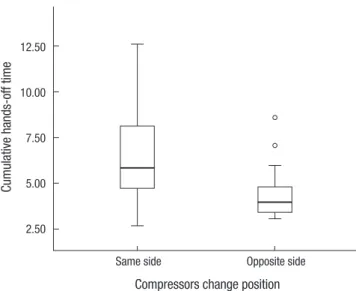
The mean cumulative hands-off time measured over the en- tire observation period was significantly different between the two groups. That of the SS group was about 2 sec longer than the OS group (6.6 ± 2.6 sec vs. 4.5 ± 1.5 sec, P = 0.005). The data of the SS change group was distributed diffusely, but that of the OS group was distributed more densely (Fig. 3).
Subgroup analyses for turns are presented in Table 2 and Fig.
4. Mean hands-off times of each turn ranged from 1.4-1.9 sec for the SS group and 1.1-1.4 sec for the OS group. Both times declined significantly with time (P = 0.005). However, the de- clining patterns of these mean hands-off times did not differ between the two groups (P = 0.278). On the other hand, the dif-
ferences of mean hands-off times between two groups for each turn ranged from 0.3-0.7 sec. Of those, those of the second and third turns were significant (P = 0.001 and P = 0.021, respective- ly), and seemed to account mainly for the difference of mean cumulative hands-off times between those two groups. Divid- ing cumulative hands-off time into three subgroups by 5-sec intervals revealed significant differences between the SS and OS methods as shown in Table 2 (P = 0.033). In the SS group, two-thirds of participants were included in the two subgroups with more delayed hands-off time (> 5 sec). Of those, more than 10% had severely delayed hands-off times (> 10 sec). In the OS group, three-fourths of participants had hands-off times < 5 sec and there was no case that was included in the subgroup with severely delayed hands-off time.
DISCUSSION
To our knowledge, this study is the first to evaluate the differ- ence between SS and OS compressor change methods concern- ing hands-off time during CPR. There are three main findings.
Chest compression change time at the opposite side of the oth- er rescuer was shorter than at the same side. Interruption length varied considerably between cases. A learning curve for com- pression change performance existed. These findings highlight the need to stress the importance of short pauses and to teach the OS compressor change method.
The length of the pause during the change from one rescuer to another was very short, irrespective of the method used. But, stopping chest compressions for even a short time requires fur- ther compressions to re-establish brain and coronary perfusion, and can be detrimental to outcome (5-10). Studies in animal models of cardiac arrest have found that the probability of suc- cessful resuscitation was greatly reduced when the protocol in- cluded a pause in compressions longer than a certain threshold Fig. 3. Box plot for cumulative hands-off time (second) in two compressor change
methods.
Cumulative hands-off time
Compressors change position
Same side Opposite side
12.50
10.00
7.50
5.00
2.50
Table 2. Comparison of hands-off time between the two different compressor change methods
Same side Opposite side P value Turn
1st 2nd 3rd 4th Cumulative
1.9 ± 1.1 (0.7-4.3) 1.7 ± 0.6 (0.4-2.8) 1.7 ± 0.9 (0.8-3.9) 1.4 ± 0.6 (0.5-2.5) 6.6 ± 2.6 (2.7-12.6)
1.4 ± 0.5 (0.7-2.7) 1.0 ± 0.4 (0.6-2.0) 1.1 ± 0.3 (0.7-2.0) 1.1 ± 0.6 (0.4-2.5) 4.5 ± 1.5 (3.1-8.6)
0.083 0.001 0.024 0.105 0.005 Cumulative hands-off time
≤ 5 5-10 > 10 Total
5 (31.3) 9 (56.3) 2 (12.5) 16 (100.0)
12 (75.0) 4 (25.0) 0 (0.0) 16 (100.0)
0.033
Data are expressed as seconds or frequencies. Time (sec) is expressed as mean ± standard deviation; values in parentheses are ranges or percentiles. Difference among turns was significant (P = 0.005). However, interaction between group and turn was not significant (P = 0.278).
(sec)
Fig. 4. Error bar graph showing mean ± standard deviation of hands-off time for each tested compressor change. The closed and open circles indicate hands-off time mea- sured at OS and SS method, respectively. *P = 0.001, †P = 0.024.
Hands-off time (sec)
Order of turn over time
1 2 3 4 2.5
2.0
1.5
1.0
0.5
0
* †
length (11-13). Edelson et al. (14, 15) showed that halting com- pressions for more than 10 sec to administer a shock reduced the likelihood of effective defibrillation. In other animal mod- els, any delay of more than 15 sec compromised the outcome of the resuscitation, which was thought to be due to a loss of coro- nary perfusion pressure (15, 16). In our study, changing rescu- ers in the SS scenario interrupted chest compressions for only a mean period of 1.6 sec, which was 0.5 sec longer than the inter- ruption for the OS. The relevance of this additional short delay in human subjects is unknown. Based on the 2010 AHA guide- lines suggesting hands-off time less than 5 sec, the delay likely has no clinical significance. However, previous animal studies showed that hands-off time of 5 sec may be too long to main- tain stable hemodynamic conditions during CPR (17, 18). In these studies, the aortic diastolic pressures and coronary perfu- sion pressures fell dramatically from their maximal pressures during the 2 rescue breaths, which lasted only 2-4 sec intervals between chest compressions, and it took at least several seconds to restore the maximal pressures after resuming chest compres- sion. Therefore, reducing the mean hands-off time by 0.5 sec in the OS, although seemingly trivial, means not only reducing hands-off time but can also help to protect against possible he- modynamic instability resulting from the time delay.
Cumulative pauses in uncontrolled situations may also be of concern. During real CPR situations, especially in advanced cardiac life support (ACLS), the CPR leader could co-ordinate rescuer change, with an audible or visible feedback being help- ful (4, 19, 20). However, when BLS is performed outside of the hospital, coordinator or feedback devices may not always be available, so hands-off time may be more prolonged in uncon- trolled situations (20). Also, in well-controlled ACLS situations, several instances of switching compressors would be likely. Mi- nimizing duration of this pause will help enable the benefits of alternating providers from fatigue to outweigh any negative im- pact of the pause.
We observed a wide range of interruption lengths, ranging from 0.4-4.3 sec, when changing compressors. Mean hands-off time of our study was shorter than the 2.8 sec reported in a pre- vious manikin study that evaluated the difference in interrup- tion time between 1-min switching and 2-min switching (15, 20). These short interruptions demonstrate that it is possible to keep the pause brief in the real CPR setting, and suggest that additional training and different compressors change methods might lead to a reduced mean (13). Although it is unknown what caused the longer recorded interruptions, we speculate that in- appropriate team work or unknown environmental factors may have contributed. Jiang et al. (21) reported that some pauses for necessary manipulation, such as transfer, assessment of CPR, defibrillation, intubation, or switch compression could be re- duced by more appropriate training. Further studies involving audio or video recording of compressors change would help
elucidate common causes of long interruptions.
Whether the rescuer’s gender influences the quality of exter- nal chest compression is controversial (22-25). Participants were matched up by gender, since men and women typically differ in aspects of physical fitness, such as strength and quickness.
The difference may be a confounder. Other factors including age, height and weight could be biases. We tried to control for these confounding factors as well as gender. However, it appears as though all the factors did not produce significant differences between the two groups (i.e., SS vs. OS). Their relevance as sourc- es of bias seems trivial.
On the other hand, a recent study reported the effect on the quality of chest compression by side preference in single rescu- er CPR (26). Compression from either side of the patient did not hinder the quality of compression. Therefore, it may not matter which side of the patient that the compressor is positioned. How- ever, the prior study involved CPR administered by a single res- cuer and could not verify the impact of rescuer’s side preference on hands-off time, which inevitably occurs when two people are involved in the CPR.
This study is subject to the limitations of a manikin study. A manikin is an imperfect representation of the human body, al- though some confounding factors were controlled by random allocation. A simulated cardiac arrest situation is not same as an actual one. Therefore differences in rescuer attitude between two situations may also play a role. Secondly, a cross-over de- sign would have been more appropriate than a parallel design to control confounding factors, such as age, height, weight and gender. Thirdly, although the BLS training course was strictly conducted, the quality of CPR performed by the participant was relatively poor. Potential explanations for this limitation may include that the participants had just taken a 4-hr course, that they were all novices for CPR, and that the study proceeded right after BLS education. These might have hindered participant skill acquisition and performance of CPR. Most of the poor chest compression was manifest in chest compression depth. Fatigue in the rescuer can contribute to the quality of chest compression (27-30). The 8-min study time could have been too long time for novices who would likely fatigue sooner than well-trained providers. Therefore, this simulation study was likely less reli- able in the real life, health care provider setting and ACLS, and needs to be confirmed in simulated patients by well-trained providers. Fourth, the hands-off time when switching compres- sion was automatically measured by skill reporting system soft- ware but collecting data was performed by a single operator. So, though the data might be valid, it might be less reliable. Fifth, the operator indicated when participants should change. It is possible that this might force or encourage them to change their role quickly. However, because the time on the watch was blind- ed to them, the bias seemed to be small. As another limitation, our study was not fully blinded, as participants were informed
of the objective of the study prior to their participation. Prior to the arrival of emergency medical service personnel, chest com- pression is generally performed by laypersons, most of which are untrained rescuers. Novices may be more suitable for the evaluation of purely hands-off time. All participants in the pres- ent study were novices, and so were not familiar with the study itself as well as with CPR. Inevitably, we needed to inform them briefly on the process of the study to help in their progress.
This study found significant reduction of hands-off time, when alternating compression at OS compared to SS in pre-hospital CPR scenario provided by two bystanders. Therefore, it seems reasonable to alternate chest compression providers at either side to minimize interruptions of chest compressions, if there is plenty of room in the pre-hospital setting. However, this result does not necessarily mean more prompt resumption of sponta- neous circulation or favorable neurologic outcome, and further studies may be needed before real-life application.
DISCLOSURE
The authors have no conflicts of interest to disclose.
AUTHOR CONTRIBUTION
Conception and coordination of the study: Kim YH, Hwang SY.
Design of ethical issues: Lee KY. Acquisition of data: Lee DW.
Data review: Lee DW, Kang MJ, Cho KW, Lee JH. Statistical anal- ysis: Hwang SY, Kim YH. Manuscript preparation: Kim JJ, Lee YH, Kim YW, Kim YH. Manuscript approval: all authors.
ORCID
Yong Hwan Kim http://orcid.org/0000-0003-1459-1086 Jun Ho Lee http://orcid.org/0000-0001-5779-5156 Dong Woo Lee http://orcid.org/0000-0002-4571-9137 Kwang Won Cho http://orcid.org/0000-0001-6764-2954 Mun Ju Kang http://orcid.org/0000-0001-7211-6107 Yang Weon Kim http://orcid.org/0000-0001-65808789 Kyoung Yul Lee http://orcid.org/0000-0002-9444-394X Young Hwan Lee http://orcid.org/0000-0002-8952-098X Jin Joo Kim http://orcid.org/0000-0002-5678-2019 Seong Youn Hwang http://orcid.org/0000-0003-3713-7855 REFERENCES
1. Deakin CD, Nolan JP, Soar J, Sunde K, Koster RW, Smith GB, Perkins GD. European Resuscitation Council Guidelines for Resuscitation 2010 Section 4. Adult advanced life support. Resuscitation 2010; 81: 1305-52.
2. Neumar RW, Otto CW, Link MS, Kronick SL, Shuster M, Callaway CW, Kudenchuk PJ, Ornato JP, McNally B, Silvers SM, et al. Part 8: adult ad- vanced cardiovascular life support: 2010 American Heart Association
Guidelines for Cardiopulmonary Resuscitation and Emergency Cardio- vascular Care. Circulation 2010; 122: S729-67.
3. Bobrow BJ, Clark LL, Ewy GA, Chikani V, Sanders AB, Berg RA, Richman PB, Kern KB. Minimally interrupted cardiac resuscitation by emergency medical services for out-of-hospital cardiac arrest. JAMA 2008; 299: 1158- 65.
4. Berg RA, Hemphill R, Abella BS, Aufderheide TP, Cave DM, Hazinski MF, Lerner EB, Rea TD, Sayre MR, Swor RA. Part 5: adult basic life sup- port: 2010 American Heart Association Guidelines for Cardiopulmonary Resuscitation and Emergency Cardiovascular Care. Circulation 2010;
122: S685-705.
5. Abella BS, Sandbo N, Vassilatos P, Alvarado JP, O’Hearn N, Wigder HN, Hoffman P, Tynus K, Vanden Hoek TL, Becker LB. Chest compression rates during cardiopulmonary resuscitation are suboptimal: a prospec- tive study during in-hospital cardiac arrest. Circulation 2005; 111: 428- 34.
6. Fries M, Tang W. How does interruption of cardiopulmonary resuscita- tion affect survival from cardiac arrest? Curr Opin Crit Care 2005; 11:
200-3.
7. Valenzuela TD, Kern KB, Clark LL, Berg RA, Berg MD, Berg DD, Hilwig RW, Otto CW, Newburn D, Ewy GA. Interruptions of chest compressions during emergency medical systems resuscitation. Circulation 2005; 112:
1259-65.
8. Wik L. Rediscovering the importance of chest compressions to improve the outcome from cardiac arrest. Resuscitation 2003; 58: 267-9.
9. Kern KB. Limiting interruptions of chest compressions during cardiopul- monary resuscitation. Resuscitation 2003; 58: 273-4.
10. Ilper H, Kunz T, Pfleger H, Schalk R, Byhahn C, Ackermann H, Breit- kreutz R. Comparative quality analysis of hands-off time in simulated basic and advanced life support following European Resuscitation Coun- cil 2000 and 2005 guidelines. Emerg Med J 2012; 29: 95-9.
11. Walcott GP, Melnick SB, Walker RG, Banville I, Chapman FW, Killing- sworth CR, Ideker RE. Effect of timing and duration of a single chest com- pression pause on short-term survival following prolonged ventricular fibrillation. Resuscitation 2009; 80: 458-62.
12. Yu T, Weil MH, Tang W, Sun S, Klouche K, Povoas H, Bisera J. Adverse outcomes of interrupted precordial compression during automated defi- brillation. Circulation 2002; 106: 368-72.
13. Yost D, Phillips RH, Gonzales L, Lick CJ, Satterlee P, Levy M, Barger J, Dodson P, Poggi S, Wojcik K, et al. Assessment of CPR interruptions from transthoracic impedance during use of the LUCAS mechanical chest com- pression system. Resuscitation 2012; 83: 961-5.
14. Edelson DP, Abella BS, Kramer-Johansen J, Wik L, Myklebust H, Barry AM, Merchant RM, Hoek TL, Steen PA, Becker LB. Effects of compres- sion depth and pre-shock pauses predict defibrillation failure during cardiac arrest. Resuscitation 2006; 71: 137-45.
15. Manders S, Geijsel FE. Alternating providers during continuous chest compressions for cardiac arrest: every minute or every two minutes? Re- suscitation 2009; 80: 1015-8.
16. Sato Y, Weil MH, Sun S, Tang W, Xie J, Noc M, Bisera J. Adverse effects of interrupting precordial compression during cardiopulmonary resuscita- tion. Crit Care Med 1997; 25: 733-6.
17. Kern KB, Hilwig RW, Berg RA, Ewy GA. Efficacy of chest compression- only BLS CPR in the presence of an occluded airway. Resuscitation 1998;
39: 179-88.
18. Berg RA, Sanders AB, Kern KB, Hilwig RW, Heidenreich JW, Porter ME, Ewy GA. Adverse hemodynamic effects of interrupting chest compressions for rescue breathing during cardiopulmonary resuscitation for ventricu- lar fibrillation cardiac arrest. Circulation 2001; 104: 2465-70.
19. Yang CW, Wang HC, Chiang WC, Hsu CW, Chang WT, Yen ZS, Ko PC, Ma MH, Chen SC, Chang SC. Interactive video instruction improves the quality of dispatcher-assisted chest compression-only cardiopulmonary resuscitation in simulated cardiac arrests. Crit Care Med 2009; 37: 490-5.
20. Hong DY, Park SO, Lee KR, Baek KJ, Shin DH. A different rescuer chang- ing strategy between 30:2 cardiopulmonary resuscitation and hands-on- ly cardiopulmonary resuscitation that considers rescuer factors: a ran- domised cross-over simulation study with a time-dependent analysis.
Resuscitation 2012; 83: 353-9.
21. Jiang C, Zhao Y, Chen Z, Chen S, Yang X. Improving cardiopulmonary resuscitation in the emergency department by real-time video recording and regular feedback learning. Resuscitation 2010; 81: 1664-9.
22. Lucía A, de las Heras JF, Pérez M, Elvira JC, Carvajal A, Álvarez AJ, Chich- arro JL The importance of physical fitness in the performance of ade- quate cardiopulmonary resuscitation. Chest 1999; 115: 158-64.
23. Hansen D, Vranckx P, Broekmans T, Eijnde BO, Beckers W, Vandekerck- hove P, Broos P, Dendale P. Physical fitness affects the quality of single operator cardiocerebral resuscitation in healthcare professionals. Eur J Emerg Med 2012; 19: 28-34.
24. Russo SG, Neumann P, Reinhardt S, Timmermann A, Niklas A, Quintel M, Eich CB. Impact of physical fitness and biometric data on the quality of external chest compression: a randomised, crossover trial. BMC Emerg Med 2011; 11: 20.
25. Miles DS, Underwood PD Jr, Nolan DJ, Frey MA, Gotshall RW. Meta- bolic, hemodynamic, and respiratory responses to performing cardio- pulmonary resuscitation. Can J Appl Sport Sci 1984; 9: 141-7.
26. Jones CM, Thorne CJ, Colter PS, Macrae A, Brown GA, Hulme J. Rescu- ers may vary their side of approach to a casualty without impact on car- diopulmonary resuscitation performance. Emerg Med J 2013; 30: 74-5.
27. Heidenreich JW, Berg RA, Higdon TA, Ewy GA, Kern KB, Sanders AB.
Rescuer fatigue: standard versus continuous chest-compression cardio- pulmonary resuscitation. Acad Emerg Med 2006; 13: 1020-6.
28. Ashton A, McCluskey A, Gwinnutt CL, Keenan AM. Effect of rescuer fa- tigue on performance of continuous external chest compressions over 3 min. Resuscitation 2002; 55: 151-5.
29. Ochoa FJ, Ramalle-Gómara E, Lisa V, Saralegui I. The effect of rescuer fa- tigue on the quality of chest compressions. Resuscitation 1998; 37: 149- 52.
30. Min MK, Yeom SR, Ryu JH, Kim YI, Park MR, Han SK, Lee SH, Cho SJ. A 10-s rest improves chest compression quality during hands-only cardio- pulmonary resuscitation: a prospective, randomized crossover study us- ing a manikin model. Resuscitation 2013; 84: 1279-84.