Serotype Distribution and Antimicrobial Susceptibilities of
Invasive Streptococcus pneumoniae Isolates from Adults in Korea from 1997 to 2012
In Republic of Korea, a 7-valent pneumococcal conjugated vaccine (PCV7) was licensed for use in infants in 2003, and 13-valent PCV (PCV13) replaced it since 2010. We investigated trends in serotype distribution and antibiotic susceptibility of pneumococcal isolates from adult patients with invasive pneumococcal diseases (IPD). Invasive pneumococcal isolates from adult patients of ≥ 16 years of age were collected from 1997 to 2012. Serotypes of the isolates were determined by the Quellung reaction. Distribution of serotypes was analyzed according to the vaccine types. Antibiotic susceptibility was tested by using E-test strips. A total of 272 invasive pneumococcal isolates were included. The most common serotypes were serotype 19F (8.5%, 23/272), and serotype 3 (8.1%, 22/272), and 24.6%
(67/272) of the isolates were of non-vaccine serotypes. Of the 272 isolates, 2.6% (7/272) were penicillin MICs of ≥ 4 µg/mL. The proportion of the PCV13 serotypes decreased from 63.3% (50/79) in 1997-2003 to 48.6% (17/35) in 2011-2012, whereas that of non-vaccine serotypes was 26.6% (21/79) and 25.7% (9/35), respectively, for the same periods. The proportion of the PCV13 serotypes showed a decreasing trend among adult patients with IPD over the study period.
Keywords: Streptococcus pneumoniae; Pneumococcal Vaccines; Serotypes; Microbial Sensitivity Tests
Chung Jong Kim,1 Jin-Su Song,1 Su-Jin Choi,1 Kyoung Ho Song,1 Pyeong Gyun Choe,1 Wan Beom Park,1 Ji Hwan Bang,1 Eu Suk Kim,1
Sang Won Park,1 Hong Bin Kim,1 Nam-Joong Kim,1 Eui-Chong Kim,2 and Myoung-don Oh1
1Department of Internal Medicine, Seoul National University College of Medicine, Seoul, Korea;
2Department of Laboratory Medicine, Seoul National University College of Medicine, Seoul, Korea Received: 2 October 2015
Accepted: 17 February 2016 Address for Correspondence:
Myoung-don Oh, MD
Department of Internal Medicine, Seoul National University College of Medicine, 103 Daehak-ro, Jongno-gu, Seoul 03080, Korea
E-mail: [email protected]
http://dx.doi.org/10.3346/jkms.2016.31.5.715 • J Korean Med Sci 2016; 31: 715-723
INTRODUCTION
Streptococcus pneumoniae is a major cause of pneumonia, men- ingitis, and bacteremia, and causing considerable morbidity and mortality (1). S. pneumoniae accounts for more deaths world- wide than any other single pathogen, and the World Health Or- ganization estimates that 1.6 million die of disease due to S. pneu- moniae each year (2). S. pneumoniae has a capsular polysac- charide, which is the major virulence factor in invasive pneu- mococcal disease (IPD). The chemical composition of capsular polysaccharide varies among strains, resulting in the genera- tion of multiple pneumococcal serotypes. Each serotype shows distinct serological and immunological responses (3,4), and 94 serotypes have been identified to date (5,6).
The epidemiology of pneumococcal serotypes is constantly changing due to natural fluctuations (6) and the selective pres- sure from antibiotic and vaccine use (7-10). A number of multi- valent pneumococcal vaccines have been developed to reduce the burden of disease caused by specific pneumococcal sero- types (11,12). In Korea, PCV7 (include serotype 4, 6B, 9V, 14, 18C, 19F, 23F) was licensed for use in infants in November 2003, and PCV10 (include PCV7 serotypes plus serotype 1, 5, 7F) and PCV13 (include PCV10 serotypes plus serotype 3, 6A, 19A) replaced it
in March 2010, whereas 23-valent pneumococcal polysaccha- ride vaccine (PPSV23) was introduced as a national immuniza- tion program for 65 years of age or older since November 2013.
Therefore, monitoring of serotype distribution and antibiotic susceptibility is necessary for national strategy for prevention and treatment of IPD (13). The aim of this study was to provide serotype and antibiotic resistance data on invasive pneumo- coccal isolates from adult patients.
MATERIALS AND METHODS Isolates
We collected all isolates of S. pneumoniae from blood or cere- brospinal fluid at the Seoul National University Hospital from January 1997 to December 2012. Clinical features of the patients, including demographic characteristics and treatment outcomes, were collected by reviewing the medical records. Primary site of infection was classified according to the patient’s clinical find- ings; pneumonia was defined as the presence of respiratory symp- toms, new infiltrates on chest radiography, and isolation of S.
pneumoniae from blood culture; meningitis was defined as the presence of cerebrospinal fluid pleocytosis and isolation of S.
pneumoniae from blood or cerebrospinal fluid culture; primary Infectious Diseases, Microbiology & Parasitology
bacteremia was defined as isolation of S. pneumoniae from blood culture without any primary foci of infections.
In Korea, PCV7 was licensed for use in infants in November 2003, and PCV10 and PCV13 replaced it in March 2010. There- fore, the 16-year study period was divided into the three study periods of 1997-2003, 2004-2010, and 2011-2012.
Non-vaccine serotypes were defined as the serotypes that were not included in PCV13 or in PPSV23.
Serotype determination and antibiotic susceptibility testing
Pneumococcal serotype was determined by the Quellung reac- tion. Pneumococcal capsular anti-sera were obtained from Stat- ens Serum Institute (Copenhagen, Denmark), and the check- board method was used for interpretation of the results.
Minimal inhibitory concentrations (MICs) of antibiotics aga- inst all the pneumococcal isolates were determined using E- test strips (AB Biodisk, Solna, Sweden). Antibiotic susceptibility was defined as susceptible, intermediate, and resistant, accord- ing to the breakpoints recommended by Clinical and Laborato- ry Standard Institute (2013) (14); for penicillin, non-susceptible isolates were defined as minimum inhibitory concentration
≥ 0.12 µg/mL for meningitis, and MIC ≥ 4 µg/mL for non-men- ingitis. For ceftriaxone, non-susceptible isolates were defined as cefotaxime MIC ≥ 1 µg/mL for meningitis, and MIC ≥ 2 µg/
mL for non-meningitis.
Statistical analysis
Statistical analysis was performed using SPSS 19.0 (SPSS, Chi- cago, IL, USA). In trend analysis among 3 periods, P for trend analysis was used. χ2 test was used in proportion comparison.
RESULTS
Baseline characteristics and demographic findings A total of 331 S. pneumoniae were isolated from blood or cere- brospinal fluid during 1997-2012 at our institution. Among these, 48 isolates were not stored, and 11 isolates were not identified as S. pneumoniae by optochin test. After exclusion of these iso- lates, a total of 272 isolates from 272 patients with IPD were in- cluded in the study. Of these isolates, 98.5% (268/272) were iso- lated from blood culture, 1.5% (4/272) from cerebrospinal fluid culture.
Of the 272 patients, 24.6% (67/272) were 16-49 years of age, 40.1% (109/272) were 50-64 years of age, and 35.3% (96/272) were 65 years of age or older. Seventy-nine isolates were col- lected during the study period of 1997-2003, 158 isolates during 2004-2010, and 35 isolates during 2011-2012.
Clinical characteristics of invasive pneumococcal diseases Clinical characteristics of the 272 patients with IPD are shown
in Table 1. The most common primary site of infection was pneu- monia (52.6%, 143/272), followed by primary bacteremia (21.3%, 58/272) and meningitis (10.3%, 28/272). Sixty-nine (25.4%) pa- tients died within 30 days after the onset of IPD. Thirty-day all- cause mortality rate was 32.9% in pneumonia, 22.4% in primary bacteremia, and 14.3% in meningitis.
Distribution of pneumococcal serotypes
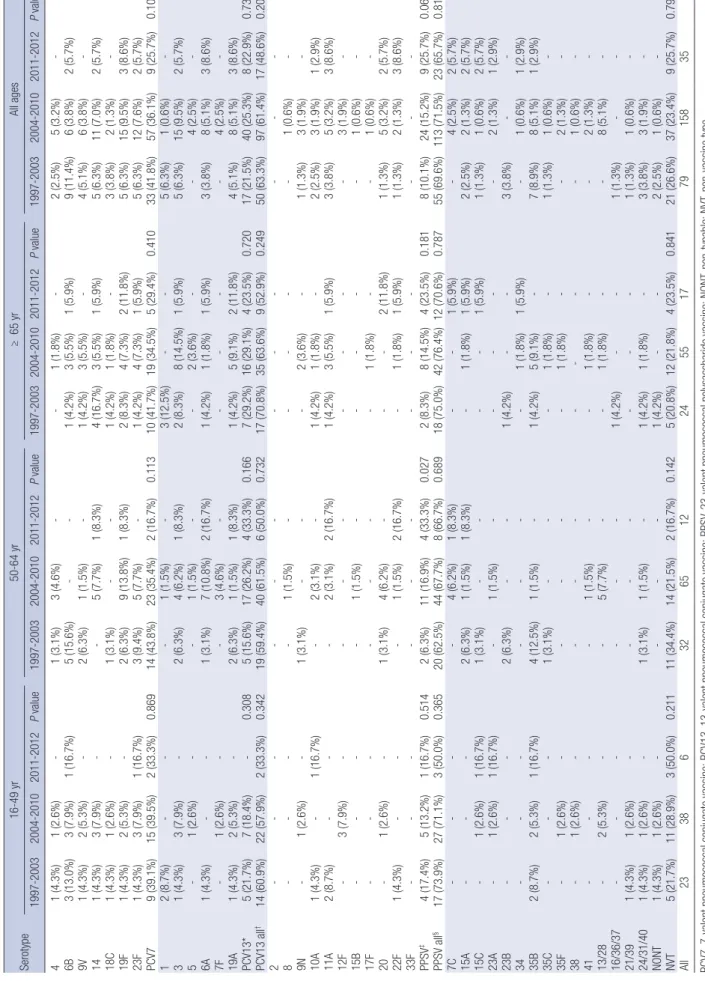
The serotype distribution of 272 invasive pneumococcal iso- lates is shown in Table 2. Overall, the most common serotype was serotype 19F (8.5%, 23/272), followed by serotype 3 (8.1%, 22/272), and serotype 23F (7.0%, 19/272). The PCV7 serotypes accounted for 36.4% (99/272), the PCV13 serotypes for 60.3%
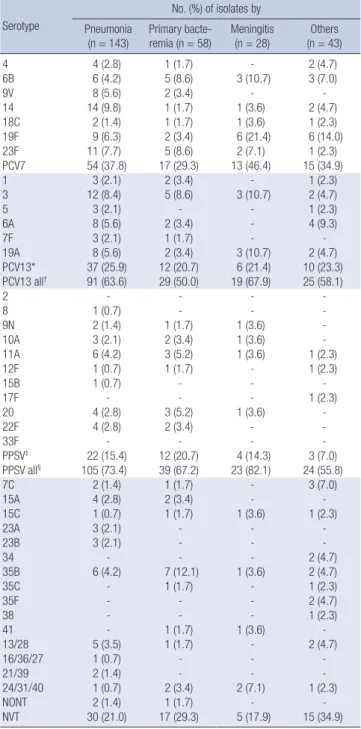
(164/272), the PPSV23 serotypes for 75.4% (205/272), and non- vaccine serotypes for 24.6% (67/272) of the 272 isolates. Sero- type 19F was frequently isolated on 50-64 years of age (12/109, 11.0%) and 65 years of age or older (8/96, 8.3%), but relatively scarce in 16-49 years of age (3/67, 4.5%). On the other hand, se- rotype 23F was more frequent in 16-49 years of age (5/67, 7.5%) and 50-64 years of age (8/109, 7.3%). Of 143 isolates from pa- tients with pneumonia, serotype 14 was the most prevalent, ac- counting for 9.7% (14/143), followed by serotypes 3 (8.4%, 12/
143) and 23F (7.7%, 11/143). Among the 28 isolates from pati- ents with meningitis, serotype 19F was the most common (21.4%, 6/28), and serotypes 3, 6B, and 19A were found in three cases each (Table 3). Among the 69 patients who died within 30 days, serotype 19F accounted for eight (11.6%) cases, serotype 3 for seven (10.1%) cases, and serotype 14 and 35B were found in six (8.7%) cases each.
Between the period 1997-2003 and 2004-2010, the propor- Table 1. Baseline characteristics of 272 patients with invasive pneumococcal diseases
Characteristics No. (%) of patients
Male/female 190 (69.9)/82 (30.1)
Mean age, mean (± SD) 16-49 yr
50-64 yr Over 65 yr
57.5 ( ± 13.9) 67 (24.6) 109 (40.1) 96 (35.3) Primary site of infection
Pneumonia Meningitis
Gastrointestinal tract or biliary origin Primary bacteremia
Spontaneous bacterial peritonitis Others*
143 (52.6) 28 (10.3) 8 (2.9) 58 (21.3) 20 (7.4) 15 (5.5) Mortality
7-day mortality
30-day mortality 45 (16.5)
69 (25.4) Years
1997-2003 2004-2010 2011-2012
79 (29.0) 158 (58.1) 35 (12.9) SD, standard deviation.
*Other sites of infection: pyogenic spondylitis, 4; surgical site infection, 3; burn wound infection, 2; brain abscess, 2; sacroilitis, 1; parotitidis, 1; endophthalmitis, 1; toxic epidermal necrolysis wound infection, 1.
Table 2. Serotype/serogroup distribution of 272 invasive pneumococcal isolates according to age group and study periods Serotype16-49 yr50-64 yr≥ 65 yrAll ages 1997-20032004-20102011-2012P value1997-20032004-20102011-2012P value1997-20032004-20102011-2012P value1997-20032004-20102011-2012P value 41 (4.3%)1 (2.6%)-1 (3.1%)3 (4.6%)--1 (1.8%)-2 (2.5%)5 (3.2%)- 6B3 (13.0%)3 (7.9%)1 (16.7%)5 (15.6%)--1 (4.2%)3 (5.5%)1 (5.9%)9 (11.4%)6 (3.8%)2 (5.7%) 9V1 (4.3%)2 (5.3%)-2 (6.3%)1 (1.5%)-1 (4.2%)3 (5.5%)-4 (5.1%)6 (3.8%)- 141 (4.3%)3 (7.9%)--5 (7.7%)1 (8.3%)4 (16.7%)3 (5.5%)1 (5.9%)5 (6.3%)11 (7.0%)2 (5.7%) 18C1 (4.3%)1 (2.6%)-1 (3.1%)--1 (4.2%)1 (1.8%)-3 (3.8%)2 (1.3%)- 19F1 (4.3%)2 (5.3%)-2 (6.3%)9 (13.8%)1 (8.3%)2 (8.3%)4 (7.3%)2 (11.8%)5 (6.3%)15 (9.5%)3 (8.6%) 23F1 (4.3%)3 (7.9%)1 (16.7%)3 (9.4%)5 (7.7%)-1 (4.2%)4 (7.3%)1 (5.9%)5 (6.3%)12 (7.6%)2 (5.7%) PCV79 (39.1%)15 (39.5%)2 (33.3%)0.86914 (43.8%)23 (35.4%)2 (16.7%)0.11310 (41.7%)19 (34.5%)5 (29.4%)0.41033 (41.8%)57 (36.1%)9 (25.7%)0.109 12 (8.7%)---1 (1.5%)-3 (12.5%)--5 (6.3%)1 (0.6%)- 31 (4.3%)3 (7.9%)-2 (6.3%)4 (6.2%)1 (8.3%)2 (8.3%)8 (14.5%)1 (5.9%)5 (6.3%)15 (9.5%)2 (5.7%) 5-1 (2.6%)--1 (1.5%)--2 (3.6%)--4 (2.5%)- 6A1 (4.3%)--1 (3.1%)7 (10.8%)2 (16.7%)1 (4.2%)1 (1.8%)1 (5.9%)3 (3.8%)8 (5.1%)3 (8.6%) 7F-1 (2.6%)--3 (4.6%)-----4 (2.5%)- 19A1 (4.3%)2 (5.3%)-2 (6.3%)1 (1.5%)1 (8.3%)1 (4.2%)5 (9.1%)2 (11.8%)4 (5.1%)8 (5.1%)3 (8.6%) PCV13*5 (21.7%)7 (18.4%)-0.3085 (15.6%)17 (26.2%)4 (33.3%)0.1667 (29.2%)16 (29.1%)4 (23.5%)0.72017 (21.5%)40 (25.3%)8 (22.9%)0.732 PCV13 all†14 (60.9%)22 (57.9%)2 (33.3%)0.34219 (59.4%)40 (61.5%)6 (50.0%)0.73217 (70.8%)35 (63.6%)9 (52.9%)0.24950 (63.3%)97 (61.4%)17 (48.6%)0.202 2------------ 8----1 (1.5%)-----1 (0.6%)- 9N-1 (2.6%)-1 (3.1%)---2 (3.6%)-1 (1.3%)3 (1.9%)- 10A1 (4.3%)-1 (16.7%)-2 (3.1%)-1 (4.2%)1 (1.8%)-2 (2.5%)3 (1.9%)1 (2.9%) 11A2 (8.7%)---2 (3.1%)2 (16.7%)1 (4.2%)3 (5.5%)1 (5.9%)3 (3.8%)5 (3.2%)3 (8.6%) 12F-3 (7.9%)--------3 (1.9%)- 15B----1 (1.5%)-----1 (0.6%)- 17F-------1 (1.8%)--1 (0.6%)- 20-1 (2.6%)-1 (3.1%)4 (6.2%)---2 (11.8%)1 (1.3%)5 (3.2%)2 (5.7%) 22F1 (4.3%)---1 (1.5%)2 (16.7%)-1 (1.8%)1 (5.9%)1 (1.3%)2 (1.3%)3 (8.6%) 33F------------ PPSV‡4 (17.4%)5 (13.2%)1 (16.7%)0.5142 (6.3%)11 (16.9%)4 (33.3%)0.0272 (8.3%)8 (14.5%)4 (23.5%)0.1818 (10.1%)24 (15.2%)9 (25.7%)0.069 PPSV all§17 (73.9%)27 (71.1%)3 (50.0%)0.36520 (62.5%)44 (67.7%)8 (66.7%)0.68918 (75.0%)42 (76.4%)12 (70.6%)0.78755 (69.6%)113 (71.5%)23 (65.7%)0.816 7C----4 (6.2%)1 (8.3%)--1 (5.9%)-4 (2.5%)2 (5.7%) 15A---2 (6.3%)1 (1.5%)1 (8.3%)-1 (1.8%)1 (5.9%)2 (2.5%)2 (1.3%)2 (5.7%) 15C-1 (2.6%)1 (16.7%)1 (3.1%)----1 (5.9%)1 (1.3%)1 (0.6%)2 (5.7%) 23A-1 (2.6%)1 (16.7%)-1 (1.5%)-----2 (1.3%)1 (2.9%) 23B---2 (6.3%)--1 (4.2%)--3 (3.8%)-- 34-------1 (1.8%)1 (5.9%)-1 (0.6%)1 (2.9%) 35B2 (8.7%)2 (5.3%)1 (16.7%)4 (12.5%)1 (1.5%)-1 (4.2%)5 (9.1%)-7 (8.9%)8 (5.1%)1 (2.9%) 35C---1 (3.1%)---1 (1.8%)-1 (1.3%)1 (0.6%)- 35F-1 (2.6%)-----1 (1.8%)--2 (1.3%)- 38-1 (2.6%)--------1 (0.6%)- 41----1 (1.5%)--1 (1.8%)--2 (1.3%)- 13/28-2 (5.3%)--5 (7.7%)--1 (1.8%)--8 (5.1%)- 16/36/37------1 (4.2%)--1 (1.3%)-- 21/391 (4.3%)1 (2.6%)-------1 (1.3%)1 (0.6%)- 24/31/401 (4.3%)1 (2.6%)-1 (3.1%)1 (1.5%)-1 (4.2%)1 (1.8%)-3 (3.8%)3 (1.9%)- NONT1 (4.3%)1 (2.6%)----1 (4.2%)--2 (2.5%)1 (0.6%)- NVT5 (21.7%)11 (28.9%)3 (50.0%)0.21111 (34.4%)14 (21.5%)2 (16.7%)0.1425 (20.8%)12 (21.8%)4 (23.5%)0.84121 (26.6%)37 (23.4%)9 (25.7%)0.795 All233863265122455177915835 PCV7, 7-valent pneumococcal conjugate vaccine; PCV13, 13-valent pneumococcal conjugate vaccine; PPSV, 23-valent pneumococcal polysaccharide vaccine; NONT, non-typable; NVT, non-vaccine type. *Serotypes that were included exclusively in PCV13; †Serotypes included in PCV13; ‡Serotypes that were included exclusively in PPSV23; §Serotypes included in PPSV23.
tion of PCV 7 serotypes were decreased but not statistically sig- nificant (41.8% vs. 36.1%, P = 0.394). The change of proportion of PCV 7 serotypes were also not significant in each age group.
In patients 16-49 years of age, the proportion of the PCV13 se- rotypes decreased from 60.9% (14/23) in 1997-2003 to 33.3%
(2/6) in 2011-2012 (P = 0.342). In contrast, the proportion of non-vaccine serotypes increased from 21.7% (5/23) in 1997-
2003, to 50.0% (3/6) in 2011-2012. In patients 50-64 years of age, non-vaccine type was decreased from 34.4% in 1997-2003 to 16.7% in 2011-2012 (P = 0.142), whereas PPSV23 serotypes were increased from 6.3% in 1997-2003 to 33.3% in 2011-2012 (P = 0.027). In patients 65 years of age or older, the proportion of the PCV13 serotypes also decreased from 70.8% (17/24) in 1997- 2003, to 52.9% (9/17) in 2011-2012 (P = 0.249). In contrast, the proportion of non-vaccine serotypes was 20.8% (5/24) in 1997- 2003, and 23.5% (4/17) in 2011-2012 (P = 0.841) in patients 65 years of age or older. Overall, non-PCV13 serotypes accounted for 39.7% (108/272), and non-vaccine serotypes accounted for 24.6% (67/272).
Antimicrobial susceptibility
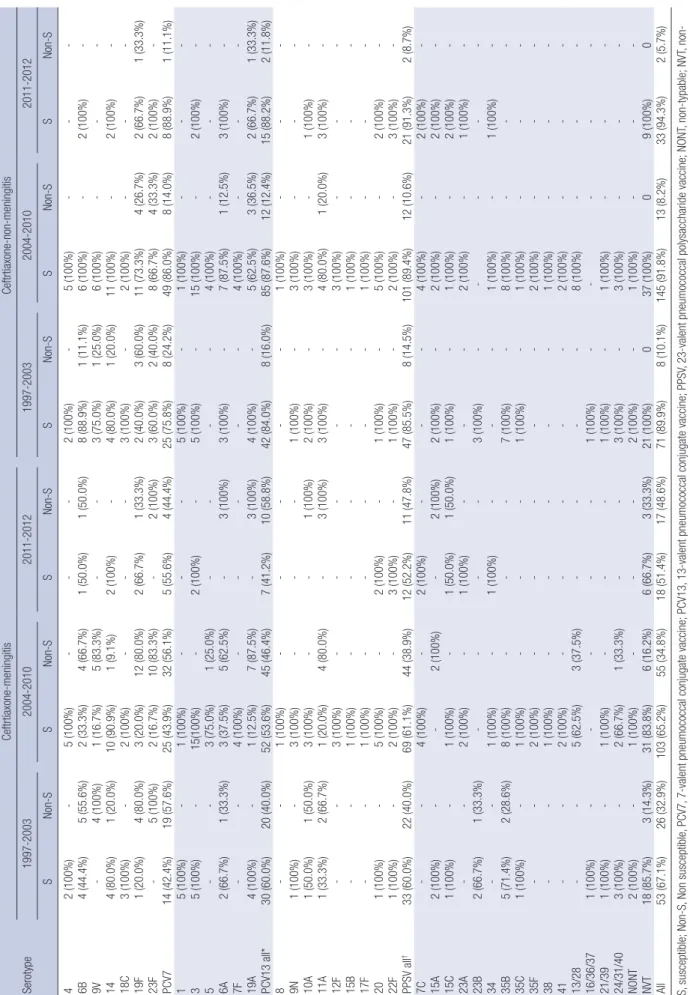
Antimicrobial susceptibilities are shown in Table 4. Of the 272 invasive pneumococcal isolates, 79.8% (217/272) were suscep- tible, 17.6% (48/272) were intermediate, and 2.6% (7/272) were resistant to penicillin by non-meningitis breakpoint, whereas 91.5% (249/272) were susceptible, 7.7% (21/272) were interme- diate, and 0.7% (2/272) were resistant to ceftriaxone by non-men- ingitis breakpoint.
Of the 108 isolates of non-PCV13 serotypes, 5.6% (6/108) were non-susceptible to penicillin, whereas 0.9% (1/108) was non- susceptible to ceftriaxone by non-meningitis breakpoint.
Penicillin non-susceptible (i.e. resistant plus intermediate) rate was 16.5% (13/79) for the study period of 1997 to 2003, 20.9%
(33/158) for the study period of 2004 to 2010, and 25.7% (9/35) for the study period of 2011 to 2012 (P = 0.467). On the other hand, ceftriaxone non-susceptible rate was 10.1% (8/79), 8.2%
(13/158), and 5.7% (2/35) for the same study periods, respec- tively (P = 0.429).
Among the isolates of non-vaccine serotypes, 4.5% were non- susceptible to penicillin, but all were susceptible to ceftriaxone.
The proportion of penicillin non-susceptible isolates was over 80% for serotypes 6B, 9V, 14, 19F, 23F, 6A, 19A, 11A, and 35B (Ta- ble 5).
DISCUSSION
We analyzed the serotype distribution of pneumococcal isolates from adult patients with IPD in Korea. The most common sero- type was 19F, followed by serotypes 3 and 23F. After the license of PCV7 for use in infants in 2003, proportion of the PCV sero- types decreased in adult patients from 63.3% in 1997-2003 to 48.6% in 2011-2012. As the PCV13 has not been used until re- cently and PPSV23 immunization rate was low in the elderly in Korea (0.8% and 15.4% in 2010 and 2012 respectively) (15,16), and that in children has been increasing from 40.3% in 2005 to 74.3% in 2010 (17), it seems that pneumococcal vaccination in children might result in the changes of serotype distribution in the adult population.
Table 3. Distribution of serotype/serogroup of 272 invasive pneumococcal isolates according to primary site of infection and study periods
Serotype
No. (%) of isolates by Pneumonia
(n = 143) Primary bacte-
remia (n = 58) Meningitis
(n = 28) Others (n = 43)
4 4 (2.8) 1 (1.7) - 2 (4.7)
6B 6 (4.2) 5 (8.6) 3 (10.7) 3 (7.0)
9V 8 (5.6) 2 (3.4) - -
14 14 (9.8) 1 (1.7) 1 (3.6) 2 (4.7)
18C 2 (1.4) 1 (1.7) 1 (3.6) 1 (2.3)
19F 9 (6.3) 2 (3.4) 6 (21.4) 6 (14.0)
23F 11 (7.7) 5 (8.6) 2 (7.1) 1 (2.3)
PCV7 54 (37.8) 17 (29.3) 13 (46.4) 15 (34.9)
1 3 (2.1) 2 (3.4) - 1 (2.3)
3 12 (8.4) 5 (8.6) 3 (10.7) 2 (4.7)
5 3 (2.1) - - 1 (2.3)
6A 8 (5.6) 2 (3.4) - 4 (9.3)
7F 3 (2.1) 1 (1.7) - -
19A 8 (5.6) 2 (3.4) 3 (10.7) 2 (4.7)
PCV13* 37 (25.9) 12 (20.7) 6 (21.4) 10 (23.3)
PCV13 all† 91 (63.6) 29 (50.0) 19 (67.9) 25 (58.1)
2 - - - -
8 1 (0.7) - - -
9N 2 (1.4) 1 (1.7) 1 (3.6) -
10A 3 (2.1) 2 (3.4) 1 (3.6) -
11A 6 (4.2) 3 (5.2) 1 (3.6) 1 (2.3)
12F 1 (0.7) 1 (1.7) - 1 (2.3)
15B 1 (0.7) - - -
17F - - - 1 (2.3)
20 4 (2.8) 3 (5.2) 1 (3.6) -
22F 4 (2.8) 2 (3.4) - -
33F - - - -
PPSV‡ 22 (15.4) 12 (20.7) 4 (14.3) 3 (7.0)
PPSV all§ 105 (73.4) 39 (67.2) 23 (82.1) 24 (55.8)
7C 2 (1.4) 1 (1.7) - 3 (7.0)
15A 4 (2.8) 2 (3.4) - -
15C 1 (0.7) 1 (1.7) 1 (3.6) 1 (2.3)
23A 3 (2.1) - - -
23B 3 (2.1) - - -
34 - - - 2 (4.7)
35B 6 (4.2) 7 (12.1) 1 (3.6) 2 (4.7)
35C - 1 (1.7) - 1 (2.3)
35F - - - 2 (4.7)
38 - - - 1 (2.3)
41 - 1 (1.7) 1 (3.6) -
13/28 5 (3.5) 1 (1.7) - 2 (4.7)
16/36/27 1 (0.7) - - -
21/39 2 (1.4) - - -
24/31/40 1 (0.7) 2 (3.4) 2 (7.1) 1 (2.3)
NONT 2 (1.4) 1 (1.7) - -
NVT 30 (21.0) 17 (29.3) 5 (17.9) 15 (34.9)
PCV7, 7-valent pneumococcal conjugate vaccine; PCV13, 13-valent pneumococcal conjugate vaccine; PPSV, 23-valent pneumococcal polysaccharide vaccine; NONT, non-typable; NVT, non-vaccine type.
*Serotypes that were included exclusively in PCV13; †Serotypes included in PCV13;
‡Serotypes that were included exclusively in PPSV23; §Serotypes included in PPSV23.
Table 4. Susceptibility to penicillin among 272 invasive pneumococcal isolates according to the serotypes and period of isolation SerotypePenicillin-meningitisPenicillin-non-meningitis 1997-20032004-20102011-20121997-20032004-20102011-2012 SNon-SSNon-SSNon-SSNon-SSNon-SSNon-S 42 (100%)-5 (100%)---2 (100%)-5 (100%)--- 6B-9 (100%)-6 (100%)-2 (100%)7 (77.8%)2 (22.2%)6 (100%)-1 (50.0%)1 (50.0%) 9V-4 (100%)-6 (100%)--2 (50.0%)2 (50.0%)3 (50.0%)3 (50.0%)-- 14-5 (100%)1 (9.1%)10 (90.9%)-2 (100%)5 (100%)-11 (100%)-2 (100%)- 18C2 (66.7%)1 (33.3%)2 (100%)---3 (100%)-2 (100%)--- 19F-5 (100%)1 (6.7%)14 (93.3%)-3 (100%)1 (20.0%)4 (80.0%)5 (33.3%)10 (66.7%)2 (66.7%)1 (33.3%) 23F-5 (100%)1 (8.3%)11 (91.7%)-2 (100%)1 (20.0%)4 (80.0%)6 (50.0%)6 (50.0%)1 (50.0%)1 (50.0%) PCV74 (12.1%)29 (87.9%)10 (17.5%)47 (82.5%)-9 (100%)21 (63.6%)12 (36.4%)38 (66.7%)19 (33.3%)6 (66.7%)3 (33.3%) 15 (100%)-1 (100%)---5 (100%)-1 (100%)--- 35 (100%)-15 (100%)-2 (100%)-5 (100%)-15 (100%)-2 (100%)- 5--3 (75.0%)1 (25.0%)----4 (100%)--- 6A2 (66.7%)1 (33.3%)-8 (100%)-3 (100%)3 (100%)-5 (62.5%)3 (37.5%)2 (66.7%)1 (33.3%) 7F--4 (100%)-----4 (100%)--- 19A1 (25.0%)3 (75.0%)-8 (100%)-3 (100%)3 (75.0%)1 (25.0%)1 (12.5%)7 (87.5%)-3 (100%) PCV13 all*17 (34.0%)33 (66.0%)33 (34.0%)64 (66.0%)2 (11.8%)15 (88.2%)37 (74.0%)13 (26.0%)68 (70.1%)29 (29.9%)10 (58.8%)7 (41.2%) 8--1 (100%)-----1 (100%)--- 9N1 (100%)-3 (100%)---1 (100%)-3 (100%)--- 10A1 (50.0%)1 (50.0%)1 (33.3%)2 (66.7%)-1 (100%)2 (100%)-3 (100%)-1 (100%)- 11A-3 (100%)1 (20.0%)4 (80.0%)-3 (100%)3 (100%)-4 (80.0%)1 (20.0%)1 (33.3%)2 (66.7%) 12F--3 (100%)-----3 (100%)--- 15B--1 (100%)-----1 (100%)--- 17F--1 (100%)-----1 (100%)--- 201 (100%)-5 (100%)-2 (100%)-1 (100%)-5 (100%)-2 (100%)- 22F1 (100%)-2 (100%)-2 (66.7%)1 (33.3%)1 (100%)-2 (100%)-3 (100%)- PPSV all†19 (34.5%)36 (65.5%)51 (45.1%)62 (54.9%)6 (26.1%)17 (73.9%)42 (76.4%)13 (23.6%)86 (76.1%)27 (23.9%)15 (62.5%)8 (34.8%) 7C--4 (100%)-2 (100%)---4 (100%)-2 (100%)- 15A2 (100%)--2 (100%)-2 (100%)2 (100%)-1 (50.0%)1 (50.0%)2 (100%)- 15C1 (100%)--1 (100%)-2 (100%)1 (100%)-1 (100%)-2 (100%)- 23A---2 (100%)-1 (100%)--2 (100%)-1 (100%)- 23B-3 (100%)----3 (100%)----- 34---1 (100%)-1 (100%)--1 (100%)-1 (100%)- 35B-7 (100%)-8 (100%)-1 (100%)7 (100%)-8 (100%)-1 (100%)- 35C1 (100%)-1 (100%)---1 (100%)-1 (100%)--- 35F--2 (100%)-----2 (100%)--- 38--1 (100%)-----1 (100%)--- 41--2 (100%)-----2 (100%)--- 13/28--3 (37.5%)5 (62.5%)----7 (87.5%)1 (12.5%)-- 16/36/37-1 (100%)----1 (100%)----- 21/391 (100%)-1 (100%)---1 (100%)-1 (100%)--- 24/31/403 (100%)-1 (33.3%)2 (66.7%)-3 (100%)-2 (66.7%)1 (33.3%)-- NONT-2 (100%)1 (100%)---2 (100%)-1 (100%)--- NVT8 (38.1%)13 (61.9%)16 (43.2%)21 (56.8%)2 (22.2%)7 (77.8%)21 (100%)-34 (91.9%)3 (8.1%)9 (100%)- All29 (36.7%)50 (63.3%)67 (42.4%)91 (57.6%)8 (22.9%)27 (77.1%)66 (83.5%)13 (16.5%)125 (79.1%)33 (20.9%)26 (74.3%)9 (25.7%) S, susceptible; Non-S, Non susceptible, PCV7, 7-valent pneumococcal conjugate vaccine; PCV13, 13-valent pneumococcal conjugate vaccine; PPSV, 23-valent pneumococcal polysaccharide vaccine; NONT, non-typable; NVT, non- vaccine type. *Serotypes included in PCV13; †Serotypes included in PPSV23.
Table 5. Susceptibility to ceftriaxone among 272 invasive pneumococcal isolates according to the serotypes and period of isolation Serotype
Ceftrtiaxone-meningitisCeftrtiaxone-non-meningitis 1997-20032004-20102011-20121997-20032004-20102011-2012 SNon-SSNon-SSNon-SSNon-SSNon-SSNon-S 42 (100%)-5 (100%)---2 (100%)-5 (100%)--- 6B4 (44.4%)5 (55.6%)2 (33.3%)4 (66.7%)1 (50.0%)1 (50.0%)8 (88.9%)1 (11.1%)6 (100%)-2 (100%)- 9V-4 (100%)1 (16.7%)5 (83.3%)--3 (75.0%)1 (25.0%)6 (100%)--- 144 (80.0%)1 (20.0%)10 (90.9%)1 (9.1%)2 (100%)-4 (80.0%)1 (20.0%)11 (100%)-2 (100%)- 18C3 (100%)-2 (100%)---3 (100%)-2 (100%)--- 19F1 (20.0%)4 (80.0%)3 (20.0%)12 (80.0%)2 (66.7%)1 (33.3%)2 (40.0%)3 (60.0%)11 (73.3%)4 (26.7%)2 (66.7%)1 (33.3%) 23F-5 (100%)2 (16.7%)10 (83.3%)-2 (100%)3 (60.0%)2 (40.0%)8 (66.7%)4 (33.3%)2 (100%)- PCV714 (42.4%)19 (57.6%)25 (43.9%)32 (56.1%)5 (55.6%)4 (44.4%)25 (75.8%)8 (24.2%)49 (86.0%)8 (14.0%)8 (88.9%)1 (11.1%) 15 (100%)-1 (100%)---5 (100%)-1 (100%)--- 35 (100%)-15(100%)-2 (100%)-5 (100%)-15 (100%)-2 (100%)- 5--3 (75.0%)1 (25.0%)----4 (100%)--- 6A2 (66.7%)1 (33.3%)3 (37.5%)5 (62.5%)-3 (100%)3 (100%)-7 (87.5%)1 (12.5%)3 (100%)- 7F--4 (100%)-----4 (100%)--- 19A4 (100%)-1 (12.5%)7 (87.5%)-3 (100%)4 (100%)-5 (62.5%)3 (36.5%)2 (66.7%)1 (33.3%) PCV13 all*30 (60.0%)20 (40.0%)52 (53.6%)45 (46.4%)7 (41.2%)10 (58.8%)42 (84.0%)8 (16.0%)85 (87.6%)12 (12.4%)15 (88.2%)2 (11.8%) 8--1 (100%)-----1 (100%)--- 9N1 (100%)-3 (100%)---1 (100%)-3 (100%)--- 10A1 (50.0%)1 (50.0%)3 (100%)--1 (100%)2 (100%)-3 (100%)-1 (100%)- 11A1 (33.3%)2 (66.7%)1 (20.0%)4 (80.0%)-3 (100%)3 (100%)-4 (80.0%)1 (20.0%)3 (100%)- 12F--3 (100%)-----3 (100%)--- 15B--1 (100%)-----1 (100%)--- 17F--1 (100%)-----1 (100%)--- 201 (100%)-5 (100%)-2 (100%)-1 (100%)-5 (100%)-2 (100%)- 22F1 (100%)-2 (100%)-3 (100%)-1 (100%)-2 (100%)-3 (100%)- PPSV all†33 (60.0%)22 (40.0%)69 (61.1%)44 (38.9%)12 (52.2%)11 (47.8%)47 (85.5%)8 (14.5%)101 (89.4%)12 (10.6%)21 (91.3%)2 (8.7%) 7C--4 (100%)-2 (100%)---4 (100%)-2 (100%)- 15A2 (100%)--2 (100%)-2 (100%)2 (100%)-2 (100%)-2 (100%)- 15C1 (100%)-1 (100%)-1 (50.0%)1 (50.0%)1 (100%)-1 (100%)-2 (100%)- 23A--2 (100%)-1 (100%)---2 (100%)-1 (100%)- 23B2 (66.7%)1 (33.3%)----3 (100%)----- 34--1 (100%)-1 (100%)---1 (100%)-1 (100%)- 35B5 (71.4%)2 (28.6%)8 (100%)---7 (100%)-8 (100%)--- 35C1 (100%)-1 (100%)---1 (100%)-1 (100%)--- 35F--2 (100%)-----2 (100%)--- 38--1 (100%)-----1 (100%)--- 41--2 (100%)-----2 (100%)--- 13/28--5 (62.5%)3 (37.5%)----8 (100%)--- 16/36/371 (100%)-----1 (100%)----- 21/391 (100%)-1 (100%)---1 (100%)-1 (100%)--- 24/31/403 (100%)-2 (66.7%)1 (33.3%)--3 (100%)-3 (100%)--- NONT2 (100%)-1 (100%)---2 (100%)-1 (100%)--- NVT18 (85.7%)3 (14.3%)31 (83.8%)6 (16.2%)6 (66.7%)3 (33.3%)21 (100%)037 (100%)09 (100%)0 All53 (67.1%)26 (32.9%)103 (65.2%)55 (34.8%)18 (51.4%)17 (48.6%)71 (89.9%)8 (10.1%)145 (91.8%)13 (8.2%)33 (94.3%)2 (5.7%) S, susceptible; Non-S, Non susceptible, PCV7, 7-valent pneumococcal conjugate vaccine; PCV13, 13-valent pneumococcal conjugate vaccine; PPSV, 23-valent pneumococcal polysaccharide vaccine; NONT, non-typable; NVT, non- vaccine type. *Serotypes included in PCV13; †Serotypes included in PPSV23.
Lee et al. (18) also reported serotype distribution of invasive pneumococci isolated from 1996 to 2008 in Korea. In their study, 116 isolates were collected from patients 65 years of age or old- er, and the most prevalent serotypes were serotype 3 (16.4%, 19/116), serotype 19F (10.3%, 12/116), and serotype 11A (9.5%, 11/116). They also showed modest decrease in the proportion of the PCV 7 serotypes in patients 65 years of age or older, from 40.9% of the pneumococci isolated in 1996-1999, to 33.3% in 2007-2008.
Our data suggest that serotype distribution may differ among age groups, and it can be influenced by vaccine usage. Follow- ing introduction of pneumococcal vaccine, the incidence of S.
pneumoniae infection by the vaccine serotypes is expected to decrease. Serotype replacement of nasopharyngeal colonizers after introduction of pneumococcal vaccines has been investi- gated extensively (19). However, studies on serotype replace- ment in IPD showed inconsistent results; some studies report- ed serotype replacement to non-vaccine serotypes (20-23), while others did not (24,25). A recent study assessed the influence of PCV7 vaccination in the pediatric population in Korea (26); the frequency of the PCV7 serotypes decreased, while that of the PCV13 serotypes increased, after introduction of the optional use of PCV7 vaccine (10). However, in our study, influence of PCV7 was not shown between period 1997-2003 and 2004-2010.
It is probably because that the effect of introduction of certain vaccine is turned up a few years later, due to vaccine coverage rate and difference in direct versus indirect effect in different age group (27). These delay in serotype change according to age group was also shown in other country (28). In the USA, after introduction of PCV13, the incidence of the PCV13 serotypes decreased, while that of non-PCV13 serotypes increased (9). In our study, the proportion of the PCV13 serotypes decreased since introduction of the PCV13 vaccine in patients younger than 50 years of age, whereas this trend was not seen in patients 50 years of age and older. Because PCV13 coverage rate in chil- dren is slowly starting increasing after introduction of national immunization program (67% in 2011, 76% in 2012, and 83% in 2013) (29), the changing trend of PCV13 serotype would be chan- ging few years after. Moreover, the frequencies of IPD by the PPSV23 serotypes differed between the two adult age groups.
The reason for the differences between the two age groups is unclear.
In our study, 36% of all isolates were non-susceptible to peni- cillin, whereas 45.7% of the isolates of the PCV13 serotypes were non-susceptible to penicillin. Serotypes 19F, 19A, and 23F, which were frequently isolated, showed higher rate of non-susceptible to penicillin and ceftriaxone than did the other serotypes. This high non-susceptibility in isolates of these serotypes was re- ported previously in a pediatric (10) and an adult (30) popula- tion in Korea. Other studies from Asian countries also showed similar results (31-33). The difference in antibiotic resistance
rate might be due to the regional difference in the distribution of serotypes. However, same serotypes showed marked differ- ence in antibiotic susceptibility among different countries (34), and therefore differences in serotype distribution itself cannot explain the differences in antibiotic resistance rates. As the se- rotypes with high rate of non-susceptible to penicillin, such as 19F, 19A and 23F, are prevalent in Korea, pneumococcal vacci- nation may play an important role in preventing antibiotic-re- sistant IPD.
Proportions of non-vaccine serotypes were highly variable among studies, ranging from 1.7% to 22.8% (18,35-39). Our study showed that non-vaccine serotypes accounted for 24.6% of all invasive isolates. This high proportion of non-vaccine serotypes is in line with the result of a study from Korea, reporting 22.8%
(10). Among these non-vaccine serotypes, serotype 15A, 15C, 35B, and serogroup 13/28 were most prevalent, accounting for half of the non-vaccine type isolates, and also showed high rates of antibiotic resistance. In a previous study of an adult popula- tion in Korea, serotypes 15A, 13, 15C, and 35B were the most common non-vaccine serotypes (18), and the results were in line with ours. In contrast to high proportion of non-vaccine se- rotypes in Korea, the proportion of non-PCV13 serotypes was similar to those reported from other countries, such as Japan, Ireland, Spain, and Southeast Asia (35-39).
There were a few limitations to our study. First, pneumococ- cal vaccination history was not available for most of our patients.
However, because the pneumococcal vaccination rate is very low among Korean adults until 2010 (16), most of them presum- ably had not been vaccinated against S. pneumoniae. Second, the pneumococcal isolates were collected from a single center, and therefore our results may not be extrapolated to a general population. As our institute is a university-affiliated referral hos- pital, our study population might include more immunocom- promised patients than that in other studies. Third, the third period (2011-2012) was too short to find the variation of sero- type change after introduction of PCV13. It needs at least five years to find the changing patterns, if we consider the time lag of PCV introduction and serotype changes. Therefore, further studies should be performed after sufficient periods after intro- duction of PCV13 to find the effect of this vaccine.
In conclusion, we investigated serotype distribution of inva- sive pneumococcal isolates from adult patients. Pneumococci with serotypes of the PCV13 showed a decreasing trend over the study period of 1997 to 2012. More than 20% of invasive pneu- mococci were non-vaccine type. These findings should be con- sidered in future national policy on prevention and control of invasive pneumococcal disease.
DISCLOSURE
The authors have no potential conflicts of interest to disclose.
AUTHOR CONTRIBUTION
Concept and design of study: Song JS, Song KH, Park WB, Bang JH, Kim ES, Park SW, Kim HB, Kim NJ, Oh MD. Acquisition of data: Kim CJ, Song JS, Choi SJ, Kim EC. Laboratory work: Kim CJ, Song JS, Choi SJ, Kim EC. Analysis and interpretation of data:
Kim CJ, Song KH, Choe PG, Park WB, Bang JH, Kim ES, Park SW, Kim HB, Kim NJ, Oh MD. Manuscript preparation: Kim CJ, Oh MD. Manuscript approval: all authors.
ORCID
Chung-Jong Kim http://orcid.org/0000-0002-9987-6533 Su-Jin Choi http://orcid.org/0000-0001-8732-3950 Kyoung-Ho Song http://orcid.org/0000-0002-4517-3840 Pyeong Gyun Choe http://orcid.org/0000-0001-6794-7918 Wan Beom Park http://orcid.org/0000-0003-0022-9625 Ji Hwan Bang http://orcid.org/0000-0002-7628-1182 Eu Suk Kim http://orcid.org/0000-0001-7132-0157 Sang Won Park http://orcid.org/0000-0002-0550-1897 Hong Bin Kim http://orcid.org/0000-0001-6262-372X Nam Joong Kim http://orcid.org/0000-0001-6793-9467 Myoung-don Oh http://orcid.org/0000-0002-2344-7695 REFERENCES
1. Kwong JC, Crowcroft NS, Campitelli MA, Ratnasingham S, Daneman N, Deeks SL, Manuel DG. Ontario Burden of Infectious Disease Study. To- ronto: Institute for Clinical Evaluative Sciences; Ontario Agency for Health Protection and Promotion, 2010.
2. All Party Parliamentary Group for Child Health and Vaccine Preventable Diseases (GB). Improving Global Health by Preventing Pneumococcal Disease. London: All Party Parliamentary Group for Child Health and Vaccine Preventable Diseases, 2008, p1-35.
3. Weinberger DM, Trzciński K, Lu YJ, Bogaert D, Brandes A, Galagan J, An- derson PW, Malley R, Lipsitch M. Pneumococcal capsular polysaccharide structure predicts serotype prevalence. PLoS Pathog 2009; 5: e1000476.
4. Brueggemann AB, Griffiths DT, Meats E, Peto T, Crook DW, Spratt BG.
Clonal relationships between invasive and carriage Streptococcus pneu- moniae and serotype- and clone-specific differences in invasive disease potential. J Infect Dis 2003; 187: 1424-32.
5. Henrichsen J. Six newly recognized types of Streptococcus pneumoniae.
J Clin Microbiol 1995; 33: 2759-62.
6. Harboe ZB, Benfield TL, Valentiner-Branth P, Hjuler T, Lambertsen L, Kal- toft M, Krogfelt K, Slotved HC, Christensen JJ, Konradsen HB. Temporal trends in invasive pneumococcal disease and pneumococcal serotypes over 7 decades. Clin Infect Dis 2010; 50: 329-37.
7. Navarro Torné A, Dias JG, Quinten C, Hruba F, Busana MC, Lopalco PL, Gauci AJ, Pastore-Celentano L; ECDC country experts for pneumococcal disease. European enhanced surveillance of invasive pneumococcal dis- ease in 2010: data from 26 European countries in the post-heptavalent conjugate vaccine era. Vaccine 2014; 32: 3644-50.
8. Rosen JB, Thomas AR, Lexau CA, Reingold A, Hadler JL, Harrison LH,
Bennett NM, Schaffner W, Farley MM, Beall BW, et al. Geographic varia- tion in invasive pneumococcal disease following pneumococcal conju- gate vaccine introduction in the United States. Clin Infect Dis 2011; 53:
137-43.
9. Mendes RE, Costello AJ, Jacobs MR, Biek D, Critchley IA, Jones RN. Sero- type distribution and antimicrobial susceptibility of USA Streptococcus pneumoniae isolates collected prior to and post introduction of 13-valent pneumococcal conjugate vaccine. Diagn Microbiol Infect Dis 2014; 80:
19-25.
10. Cho EY, Lee H, Choi EH, Kim YJ, Eun BW, Cho YK, Kim YK, Jo DS, Lee HS, Lee J, et al. Serotype distribution and antibiotic resistance of Streptococ- cus pneumoniae isolated from invasive infections after optional use of the 7-valent conjugate vaccine in Korea, 2006-2010. Diagn Microbiol In- fect Dis 2014; 78: 481-6.
11. Dagan R, Melamed R, Muallem M, Piglansky L, Greenberg D, Abramson O, Mendelman PM, Bohidar N, Yagupsky P. Reduction of nasopharyngeal carriage of pneumococci during the second year of life by a heptavalent conjugate pneumococcal vaccine. J Infect Dis 1996; 174: 1271-8.
12. Black S, Shinefield H, Fireman B, Lewis E, Ray P, Hansen JR, Elvin L, En- sor KM, Hackell J, Siber G, et al. Efficacy, safety and immunogenicity of heptavalent pneumococcal conjugate vaccine in children. Pediatr Infect Dis J 2000; 19: 187-95.
13. Song JY, Nahm MH, Moseley MA. Clinical implications of pneumococcal serotypes: invasive disease potential, clinical presentations, and antibiot- ic resistance. J Korean Med Sci 2013; 28: 4-15.
14. Clinical and Laboratory Standards Institute (US). Performance Standards for Antimicrobial Susceptibility Testing: Twenty-First Informational Sup- plement (M100-S21). Wayne, PA: Clinical and Laboratory Standards In- stitute, 2011.
15. Kim ES, Shin JK, Oh HK. Elderly immunization program against invasive pneumococcal disease in Korea, 2013. Public Health Wkly Rep 2013; 7:
182-6.
16. Lim J, Eom CS, Kim S, Ke S, Cho B. Pneumococcal vaccination rate among elderly in South Korea. J Korean Geriatr Soc 2010; 14: 18-24.
17. Choe YJ, Yang JJ, Park SK, Choi EH, Lee HJ. Comparative estimation of coverage between national immunization program vaccines and non- NIP vaccines in Korea. J Korean Med Sci 2013; 28: 1283-8.
18. Lee S, Bae S, Lee KJ, Yu JY, Kang Y. Changes in serotype prevalence and antimicrobial resistance among invasive Streptococcus pneumoniae iso- lates in Korea, 1996-2008. J Med Microbiol 2013; 62: 1204-10.
19. Weinberger DM, Malley R, Lipsitch M. Serotype replacement in disease after pneumococcal vaccination. Lancet 2011; 378: 1962-73.
20. Pilishvili T, Lexau C, Farley MM, Hadler J, Harrison LH, Bennett NM, Re- ingold A, Thomas A, Schaffner W, Craig AS, et al. Sustained reductions in invasive pneumococcal disease in the era of conjugate vaccine. J Infect Dis 2010; 201: 32-41.
21. Guevara M, Barricarte A, Gil-Setas A, García-Irure JJ, Beristain X, Torroba L, Petit A, Polo Vigas ME, Aguinaga A, Castilla J. Changing epidemiology of invasive pneumococcal disease following increased coverage with the heptavalent conjugate vaccine in Navarre, Spain. Clin Microbiol Infect 2009; 15: 1013-9.
22. Fenoll A, Granizo JJ, Aguilar L, Giménez MJ, Aragoneses-Fenoll L, Han- quet G, Casal J, Tarragó D. Temporal trends of invasive Streptococcus pneu- moniae serotypes and antimicrobial resistance patterns in Spain from 1979 to 2007. J Clin Microbiol 2009; 47: 1012-20.