© Korean Powder Metallurgy Institute 1298
-Characteristics of Nanostructured WO
3-CuO Powder Mixture
Produced by Ball Milling
Hossein Azimi1a, Eltefat Ahmadi1b, S. M. Mehdi. Hadavi1c 1 A. M. T. Research Center, Tehran, Iran
a[email protected], b[email protected], c[email protected]
Abstract
In the present work, the influence of the ball-milling time, milling atmosphere and weight ratio of ball to powder on characteristics of WO3-CuO was studied. Results show that, the grain sizes of the WO3 and CuO in the ball-milled powder
mixture were significantly decreased with increasing the milling time. Those of each oxide ball–milled in Argon and Hexane atmosphere for 30 and 20 hour were about 98 and 84 nm, respectively. After milling of 20 hour in Hexane as PCA, the powder had a homogeneously mixed structure and the average size of WO3–CuO powders was determined to about 230nm. Keywords: WO3-CuO, nanocomposite, ball milling, milling time, hexane
1. Introduction
It has been reported that the homogenous W-Cu nanocomposite powder can be fabricated by hydrogen reduction of ball milled WO3-CuO powders [1-3]. Recently, mechanochemical processes which consist of ball milling and subsequent hydrogen reduction of WO3-CuO mixture has also been investigated. [2-5]. This paper aims to elucidate the WO3-CuO milling characteristics such as milling time, atmosphere and weight ratio of ball to powder. The influence of the ball-milling times from 1 to 30 hour, milling atmosphere such as Argon and Hexane, weight ratio of ball to powder and powder characteristics of WO3-CuO was studied.
2. Experimental and Results
Chemical composition of powders are given in Table.1 TABLE 1. Chemical composition of WO3 and CuO powders (wt%.)
Powder PbFe Ca Cl SO4 size
WO3
0.002 0.001 0.03 0.05 0.01 1.82µm CuO
0.03 0.01 0.2- 0.05 1.5µm
WO3-CuO powder mixtures were ball-milled in argon atmosphere for 1-30 and in hexane as PCA for 10-20 hours. Ball milling carried out in stainless steel jar and balls. The diameter of used balls was 5 mm and ball to powder weight ratio was 16:1. Ball milling was performed at a rotational speed of 500 rpm in Planetary ball mill. SEM and XRD were employed to analyse the microstructural characteristics of powder mixtures prepared by milling.
Fig. 1 shows the XRD patterns of dry milled WO3-CuO
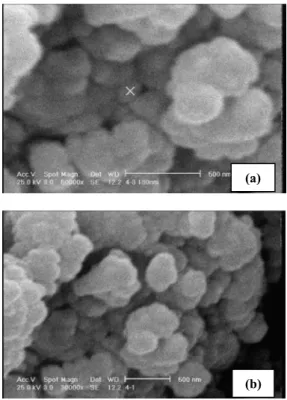
powder mixture. Fig. 2 shows the XRD patterns of wet milled oxide powders. It can be seen from Figures 1 and 2 that the peak of WO3-CuO were distinguished and the peak of WO3 was considered broadened. After 30 hours milling, CuO peaks nearly disappeared due to refinement of grains. The grain sizes of the WO3 and CuO in dry mill were significantly decreased with increasing the milling time. The peak of CuWO4 is indicated in XRD pattern (Fig. 1), showing that CuWO4 was formed after 10 hour milling. Formation of CuWO4 during mechanical milling was reported by other researchers [6]. It is reported that in relationally long milling time, inter-diffusion of oxides leads to formation of CuWO4 spinel phase. The mean particle size of ball milled for 20 h in Argon atmosphere and Hexane is 130 and 84 nm, respectively. For short milling duration, agglomerated particle size is about 230 nm in both milling methods. After 30 h dry milling in Argon atmosphere, the size of the milled particles is about 98 nm. The morphology of the ball-milled powder in dry atmosphere for 20 and 30 h is shown in Fig. 3. As clearly seen from Fig. 3 a and Fig. 3b, agglomerated particles of WO3-CuO are about 130 and 98 nm in size for powder mixtures with milling time of 20 and 30 h, respectively. Fig.
Fig. 1 XRD patterns of dry milled WO3-CuO mixtures
2006 POWDER METALLURGY World Congress
© Korean Powder Metallurgy Institute 1299
-Fig. 2 XRD patterns of wet milled WO3-CuO mixtures
Fig. 3 SEM microstructures of ball milled WO3-CuO powder mixtures in Argon, a- 20 h and b- 30 h 4 shows the morphology of wet milled powders. During the ball milling of WO3-CuO in hexane atmosphere, the hexane PCA acts as a lubricant, therefore, the surface of WO3 and CuO particles has been continuously cleaned thus cold welding of particles reduced. Compared with dry milling (Fig. 3), probably, enhancement of particle size reduction and powder hemogenity is because of dominance of fracture mechanism during wet milling in presence of hexane PCA.
Fig. 4 SEM microstructures of ball milled WO3-CuO powder mixtures in Argon, a- 15 h and b- 20 h
3. Summary
The current investigation shows that production of WO3- CuO nanostructured powder by 30h dry milling and 20h wet milling in Hexane is possible. It was found that, use of Hexane as PCA, not only causes the achievement of nanostructured powders in shorter times but also induces more homogeneity of powders in mixture. Powder homo-geneity is important factor on further hydrogen reduction and consolidation process. Dominated mechanism during milling in Hexane PCA was fracture. The mean particle size of 30 h dry and 20 h wet milled powders were about 98 and 84 nm, respectively
4. References
1. D. G. Kim, G. S. Kim, M. J. Suk, S. T. Oh, Scripta Matrialia, 51 (2004) 677-681.
2. D. G. Kim, K. H. Min, S. Y. Chang, S. T. Oh, C. H. Lee and Y. D. Kim, Materials Science and Engineering A, 399(2005) 326- 331.
3. W. S. Shim, D. G. Kim, T. Sekino, J. W. Noh, Journal of Ceramic Process Research, 3 (2002), 109-113.
4. Y. Li, X. Qu, Z. Zheng, C. Lei, , International Journal of RM & HM, 21 (2003) 259-264.
5. Y. F. Zhang, L. Lu, S. M. Yap, Journal of Materials Processing Technology, 89-90 (1999) 260-265.
6. E. S. Yoon, J. S. Lee, S. T. Oh, B. K. Kim, International Journal of RM & HM, 20 (2002) 201-206.
(b) (a)
(a)