2017, Vol. 61, No. 4
Printed in the Republic of Korea https://doi.org/10.5012/jkcs.2017.61.4.151
A Simple, Efficient, Catalyst-Free and Solvent-Less Microwave-Assisted Process for N-Cbz Protection of Several Amines
Zineb Aouf, Rachida Mansouri, Salah Lakrout, Malika Berredjem, and Nour-Eddine Aouf*
Laboratory of Applied Organic Chemistry, Bioorganic Chemistry Group, Department of Chemistry, Sciences Faculty, - Badji Mokhtar - Annaba University, Box 12, 23000 Annaba, Algeria
*E-mail: [email protected]; [email protected] (Received March 28, 2017; Accepted June 15, 2017)
ABSTRACT. A simple, green and chemo-selective method for the N-benzyloxycarbonylation of amines, β-amino alcohols, α- amino esters and sulfonamides has been developed under microwave irradiation. Good to excellent yields of the N-benzyloxy- carbamates compounds were obtained in short times without any side products.
Key words: Amine, Benzyl chloroformate (Cbz-Cl), Protection, Microwave-assisted, Solvent-free
INTRODUCTION
The presence of amine functionality in a large variety of biologically active compounds makes protection/cleavage of the amino group frequently necessary in synthetic organic and medicinal chemistry.1
More than 350 protecting groups for amines are described in literature, the amines can be protecting in many forms such as imines, enamines, carbamates and sulfonyl deriv- atives.2
The benzyloxycarbonyl motif is very useful for the pro- tection of the amine function in poly-functional molecules.3 This is due to its stability in acidic/basic conditions, orthogo- nality vis-a-vis other protecting groups and its easy removal by catalytic hydrogenation without any secondary reaction.4
Many protocols are available in various works present the protection of amines derivatives with the Cbz group.
Among these methods: the use of β-cyclodextrin in aque- ous medium,5 lithium hexamethydisilazane (LiHMDS) as base in THF-HMPA,6 tetrabutylammonium bromide (TBAB),7 silica-sulfuric acid as a catalyst under solvent-free con- ditions,8 La(NO3)·6H2O,9 the use of molecular iodine10 using ionic liquid tetrapropylammonium L-prolinate ([TPA] [L-Pro]) as a reaction medium,11 in micellar media,12 the use of PEG- 600 as a recyclable catalyst,13 reaction on a solid surface14 and Amberlyst-15 under solvent-free conditions.15 However, most of the reported methods suffer from various draw- backs such as the use of organic solvents and highly basic conditions, relatively high reaction temperatures and tedious work-up procedures.
In the last few years, the application of microwave (MW) in organic transformations has become more and more
scientist’s interest.16 Introduced in 1986 by Gedye17 and Guigere,18 MW irradiation offers a cleaner and easier pathway compared to conventional methods, it has several advan- tages such as high temperature homogeneity, instantaneous and rapid heating, allowing the progress of reactions with- out solvent with a maximal efficiency.19
In continuation of our work toward the development of new, greener and useful methods in the field of the chem- istry of protecting groups,20−22 we report herein the suc- cessful use of microwave irradiation for the selective benzyloxycabonylation of various amine derivatives.
EXPERIMENTAL Instruments and Materials
All reagents and solvents were of commercial quality and used without further purification. All reactions were carried out in a SAMSUNG microwave oven type M1610N, 230−50 Hz, and 2450 Hz MW at 50 °C. All reaction were monitored by TLC on Silica gel Merck 60 F254 (Art. 5554) percolated aluminum plates and were developed by spraying with Ninhydrine solution. Melting points were determined in open capillary tubes on an electrothermal apparatus and uncorrected. Mass spectra were recorded on a SHIMADZU QP 1100 Ex mass spectrometer. IR spectra were recorded on a Perkin-Elmer FT-600 spectrometer. Proton nuclear mag- netic resonance were determined 250 or 400 MHz Brücker spectrometer using CDCl3 as a solvent and TMS as an internal standard. Chemical shifts are reported in δ units (ppm).
All coupling constants (J) are reported in Hertz. Multi- plicity is indicated as s (singlet), d (doublet), t (triplet), q (quartet), m (multiplet) and combination these signals.
Typical experimental procedure of N-benzyloxycar- bonylation protection on amines derivatives promoted by microwave irradiation
Benzylcholoroformate Cbz-Cl (1 mmol) was added to amine (1 mmol) and the mixture was subjected to the micro- wave irradiation (100W) for the appropriate time (tables 2, 3, 4 and 5). After completion of the reaction (monitored by TLC) dichloromethane: methanol (98/2), the reaction mixture was treating with n-hexane (15–20 mL) and was allowed to stand at room temperature overnight. The solid products were collected by filtration, washed with n-hexane and dried to give the N-Cbz derivatives in good to excellent yields. During the reaction, the formation of hydrogen chlo- ride (gas) was observed, confirming the protection of all amines structures proposal.
N-Carbobenzyloxyaniline (1a)
White solid; Yield 98%; m.p. 68-69 oC; Rf 0.86 (DCM- MeOH 98/2); MSEI (m/z) 228 [M+1]+ ; IR (KBr): υ max/
cm−1 3272.62 (N-H), 2953.42 (C-H), 1690.64 (C=O), 1564.89 (C=C), 1445.21 (C-N); 1H NMR (400 MHz, CDCl3) δ 5.23 (s, 2H, CH2-Ph), 6.76 (s, 1H, NH), 7.30-7.42 (m, 10H, H-Ar); 13C NMR (100 MHz, CDCl3) δ 67.1, 118.8, 123.6, 128.4, 128.5, 128.6, 128.7, 129.0, 129.2, 136.1, 137.9, 153.4.
N-Carbobenzyloxybenzylamine (2a)
White solid; Yield 97%; m.p. 72-75 ºC; Rf 0.86 (DCM- MeOH 98/2); IR (KBr): υ max/cm−1 3324.29 (N-H), 3032.90 (C-H), 1687.61 (C=O), 1543.36 (C=C), 1453 (C-N); 1H NMR (250 MHz, CDCl3) δ 4.45 (s, 2H, CH2-NH), 5.25 (s, 2H, CH2-Ph), 7.40-7.70 (m, 10H, H-Ar); 13C NMR (60 MHz, CDCl3) δ 45.1, 66.8, 126.9, 126.7, 127.1, 127.6, 128.5, 128.9, 136.1, 137.9, 152.6.
N-Carbobenzyloxy-4-methoxyaniline (4a)
Brown pale solid; Yield 94%; m.p. 84.5-90.8 ºC; Rf 0.50 (DCM-MeOH 98/2); MSEI(m/z) 258.1 [M+1]+; IR (KBr): υ max/cm−1 3307.42 (N-H), 3010.20 (C-H), 1699.57 (C=O), 1513.29 (C=C), 1454.04 (C-N); 1H NMR (400 MHz, CDCl3) δ 3.77 (s, 3H, CH3-O), 5.19 (s, 2H, CH2-Ph), 6.64 (s, 1H, NH), 6.83-6.88 (2d, J = 8.0 Hz, 2H, H-Ar), 7.26−7.42 (m, 7H, H-Ar); 13C NMR (100 MHz, CDCl3) δ 55.5, 66.9, 114.3, 120.7, 128.3, 128.4, 128.6, 130.8, 136.2, 153.8.
N-Carbobenzyloxy-2-methoxyaniline (5a)
Oil; Yield 94%; Rf 0.55 (DCM-MeOH 98/2); IR (KBr):
ν/cm−1 3425.99 (N-H), 2838.60 (C-H), 1732.91 (C=O), 1580.21 (C=C), 1435.61 (C-N); 1H NMR (400 MHz, CDCl3) δ 3.85 (s, 3H, CH3-O), 5.22 (s, 2H, CH2-Ph), 6.85−6.87 (2d, J = 6.0 Hz, 1H, H-Ar), 6.97-7.02 (m, 2H, H-Ar), 7.26−7.45 (m, 6H, H-Ar), 8.1 (s, 1H, NH); 13C NMR (100 MHz, CDCl3) δ 55.7, 67.0, 110.1, 118.4, 121.3, 122.9, 127.7, 128.4, 128.7,
136.4, 147.8, 153.4.
N-Carbobenzyloxyurea (9a)
White crystal; Yield 87%; m.p. 135-138 ºC; Rf 0.54 (DCM- MeOH 98/2); MSEI (m/z) 193.0 [M-1]+ ; IR (KBr): υ max/cm−1 3418.05 (N-H), 3334.74 (N-H), 3273.46 (N-H), 3035.46 (C-H), 1693.39 (C=O), 1403.46 (C-N); 1H NMR (400 MHz, CDCl3) δ 4.78 (br s, 2H, NH2), 5.10 (s, 2H, CH2-Ph), 7.20−7.36 (m, 5H, H-Ar); 13C NMR (100 MHz, CDCl3) δ 67.1, 128.3, 128.7, 136.4, 156.9.
N-Carbobenzyloxydiphenylamine (10a)
Pale yellow solid; Yield 85%; m.p. 101.8−108.9oC; Rf 0.85 (DCM-MeOH 98/2); MSEI (m/z) 304.2 [M+1]+; IR (KBr): υ max/cm−1 2969.09 (C-H), 1707.50 (C=O), 1591.89 (C=C), 1455 (C-N); 1H NMR (400 MHz, CDCl3) δ 5.22 (s, 2H, CH2-Ph), 7.19−7.31 (m, 15H, H-Ar); 13C NMR (100 MHz, CDCl3) δ 67.6, 126.3, 127.1, 127.8, 128.1, 128.5, 129.1, 136.5, 142.7, 154.8.
N-Carbobenzyloxymorpholine (12a)
White solid; Yield 88%; m.p. 47−49 °C; Rf 0.40 (DCM- MeOH 98/2); IR (KBr): υ max/cm−1 2978 (C-H), 1703.01 (C=O), 1545.20 (C=C), 1427.97 (C-N); 1H NMR (400 MHz, CDCl3) δ 3.48 (t, J = 4.9 Hz, 4H, 2CH2-O), 3.65 (br s, 4H, 2CH2-N), 5.14 (s, 2H, CH2-Ph), 7.26−7.37 (m, 5H, H-Ar);
13C NMR (100 MHz, CDCl3) δ 44.1, 66.5, 67.2, 128.0, 128.1, 128.5, 136.4, 155.2.
N-Carbobenzyloxyphenylpiperazine (13a)
White solid; yield 86%; m.p. 71-73 °C; Rf 0.55 (DCM- MeOH 98/2); MSEI (m/z) 297.2 [M+1]+; IR (KBr): υ max/
cm−1 2964.81 (C-H), 1703.01 (C=O), 1591.89 (C=C), 1455.51 (C-N); 1H NMR (400 MHz, CDCl3) δ 3.16 (br s, 4H, 2CH2- N-CO), 3.66 (t, J = 5.2 Hz, 4H, 2CH2-N-Ph), 5.2 (s, 2H, CH2-Ph), 6.89−7.39 (m, 10H, H-Ar); 13C NMR (100 MHz, CDCl3) δ 44.0, 49.6, 67.4, 116.9, 120.6, 128.1, 128.2, 128.7, 129.4, 151.3, 155.4.
N-Carbobenzyloxypropylamine (16a)
White crystal; Yield 93%; m.p. 36.5−40.1 ºC; Rf 0.56 (DCM-MeOH 98/2); MSEI (m/z) 194.1 [M+1]+; IR (KBr): υ max/cm−1 3322.01 (N-H), 2934.67 (C-H), 1687.92 (C=O), 1541.03 (C=C), 1457.73 (C-N); 1H NMR (400 MHz, CDCl3) δ 0.91 (t, J = 7.6 Hz, 3H, CH3), 1.48 (m, 2H, CH2-CH3), 3.13 (q, J = 6.8 Hz, 2H, CH2-NH), 4.73 (br s, 1H, NH), 5.1 (s, 2H, CH2-Ph), 7.21-7.36 (m, 5H, H-Ar); 13C NMR (100 MHz, CDCl3) δ 11.3, 23.4, 43.01, 66.8, 128.2, 128.7, 136.9, 156.6.
N-Carbobenzyloxycyclohexylamine (18a)
White solid; Yield 91%; m.p. 64−67 ºC; Rf 0.50 (DCM- MeOH 98/2); MSEI (m/z) 233 [M]+; IR (KBr): υ max/cm−1 3319.88 (N-H), 2931.08 (C-H), 1686.93 (C=O), 1541.63 (C=C), 1311.19 (C-N); 1H NMR (400 MHz, CDCl3) δ
1.08−1.95 (m, 10H, CH2), 3.49−3.52 (m, 1H, CH-NH), 4.61 (br s, 1H, NH), 5.09 (s, 2H, CH2-Ph), 7.25–7.40 (m, 5H, H-Ar); 13C NMR (100 MHz, CDCl3) δ 24.9, 25.7, 33.6, 50.1, 66.6, 128.2, 128.3, 128.7, 136.9, 155.7.
(S)-N-Carbobenzyloxyphenylalaninol (1b)
White solid; Yield 85%; m.p. 49−52oC; Rf 0.40 (DCM- MeOH 98/2); IR (KBr): υ max/cm−1 3352.64 (N-H, O-H), 2931.69 (C-H), 1699.70 (C=O), 1539 (C=C), 1475.25 (C- N); 1H NMR (400 MHz, CDCl3) δ 2.36 (br s, 1H, O-H), 2.76 (d, J = 12.0 Hz, 2H, *C-CH2-Ph), 3.47 (dd, J1= 8.0 Hz, J2= 12.0 Hz, 2H, CH2-OH), 3.86 (br s, 1H, *C-H), 4.99 (s, 1H, N-H), 5.02 (s, 2H, O-CH2-Ph), 7.10−7.30 (m, 10H, H- Ar); 13C NMR (100 MHz, CDCl3) δ 37.4, 54.2, 64.0, 66.9, 126.7, 128.2, 128.3, 128.6, 128.7, 129.4, 136.4, 137.7, 156.6.
(S)-N-Carbobenzyloxyvalinol (2b)
White solid; Yield 83%; m.p. 53.7−55.1oC; Rf 0.33 (DCM- MeOH 98/2); MSEI (m/z) 259.7 [M+Na]+; IR (KBr): υ max/
cm−1 3307 (N-H, O-H), 2958.69 (C-H), 1684.39 (C=O), 1544.88 (C=C), 1469.84 (C-N); 1H NMR (400 MHz, CDCl3) δ 0.94−0.98 (2d, J1= 6.8 Hz, J2= 10.8 Hz, 6H, 2CH3), 1.84−1.89 (m, 1H, CH-i-pro), 2.18 (br s, 1H, O-H), 3.50−3.51 (m, 1H, *CH), 3.64−3.70 (m, 2H, CH2-OH), 5.11 (s, 2H, CH2-Ph), 7.26−7.36 (m, 5H, H-Ar); 13C NMR (100 MHz, CDCl3) δ 18.7, 19.7, 29.4, 58.8, 64.1, 67.1, 128.2, 128.3, 128.7, 136.6, 157.3.
(S)-N-Carbobenzyloxyphenylalaninemethylester (2c) White solid; Yield 85%; m.p. 86−88oC; Rf 0.59 (DCM- MeOH 98/2); MSEI (m/z) 312 [M+1]+; IR (KBr): υ max/cm−1 3340.94 (N-H), 3064.45 (C-H), 1723.98 (C=O), 1521.84 (C=C), 1498.66 (C-N); 1H NMR (400 MHz, CDCl3) δ 3.04 (2dd, J1 = 6.0 Hz, J2= 12.0 Hz, 2H, CH2-C*), 3.71 (s, 3H, CH3-O), 4.62−4.68 (m, 1H, *C-H), 5.04 (s, 1H, CH2-Ph), 5.19−5.21 (m, 1H, NH), 7.07−7.36 (m, 10H, H-Ar); 13C NMR (400 MHz, CDCl3) δ 38.4, 52.4, 55.0, 67.1, 127.3, 128.2, 128.3, 128.7, 128.7, 129.4, 135.8, 136.4, 155.7, 177.1.
(S)-N-Carbobenzyloxyprolineethylester (3c) Oil; Yield 80%; Rf 0.59 (DCM-MeOH 98/2); MSEI (m/z) 278.1 [M+1]+; IR (KBr): υ max/cm−1 2981.16 (C-H), 1745.10 (C=O), 1708.99 (C=O), 1542.42 (C=C), 1416.79 (C-N);
1H NMR (400 MHz, CDCl3, 1:1 mixture of rotamers) δ 1.13 (t, 3H, J = 7.2 Hz, CH3-CH2), 1.26 (t, 3H, J = 7.2 Hz, CH3- CH2), 1.88−2.23 (m, 4H, CH2-CH2-C*), 3.49−3.63 (m, 2H, CH2-N), 4.00−4.09 (m, 1H, CH2-CH3), 4.19 (q, J = 7.1 Hz, 1H, CH2-CH3), 4.32 (dd, 1H, J1= 8.6 Hz J2= 3.2 Hz, *CH), 5.13−5.15 (m, 2H, CH2-Ar), 7.29−7.35 (m, 5H, H-Ar);
13C NMR (100 MHz, CDCl3 mixture of rotamers) δ 14.1, 14.2, 23.6, 24.3, 30.0, 31.0, 46.5, 47.0, 59.1, 59.4, 61.1, 61.2, 67.0, 127.8, 127.9, 128.4, 128.5, 136.7, 136.9, 154.4, 156.0, 172.7, 172.9.
(S)-N-Carbobenzyloxyleucineethylester (4c) Oil. Yield 82%. Rf 0.57 (DCM-MeOH 98/2). MSEI (m/
z) 294.1 [M+1]+; IR (KBr): υ max/cm-1 3342.19 (N-H), 2958.52 (C-H), 1722.51 (C=O), 1530.75 (C=C), 1370.25 (C-N). 1H NMR (400 MHz, CDCl3) δ : 0.92 (d, J = 6.4 Hz, 6H, 2CH3), 1.26 (t, J = 7.2 Hz, 3H, CH3-CH2), 1.48−1.55 (m, 1H, CH-i-pro), 1.60−1.76 (m, 2H, CH2-C*), 4.21 (q, J = 7.2, 2H, CH2-CH3), 4.35−4.41 (m, 1H, *CH), 5.11 (s, 2H, CH2-Ph), 5.20−5.21 (m, 1H, NH), 7.30−7.40 (m, 5H, H-Ar);
13C NMR (100 MHz, CDCl3) δ 14.2, 22.0, 22.9, 24.9, 42.0, 52.7, 61.4, 67.0, 128.1, 128.2, 128.6, 136.5, 156.1, 173.2.
(S)-Benzyl-N-(1-hydroxy-3-methylbutan-2-yl) sulfa- moylcarbamate (2d)23,24
White solid; Yield 80%; m.p. 135°C; Rf 0.37 (DCM/MeOH:
98/2); MSEI (m/z) 339.05 [M +Na]+; IR (KBr): υ max/cm−1 3523 (O-H), 3277 (N-H), 1717 (C=O), 1463.74 (C-N), 1160.30 and 1330.15 (SO2); 1H NMR (400 MHz, CDCl3) δ 0.90 (2d, J = 8.4 Hz, 6H, 2CH3), 1.83−1.88 (m, 1H, CH), 3.23−3.27 (m, 1H, *CH), 3.52−3.62 (2dd, J1= 6.5 Hz, J2= 4.0 Hz, Jgem =11.7 Hz, 2H, CH2-OH), 5.16 (s, 2H, O-CH2), 5.49 (d, J = 7.6 Hz, 1H, NH-*CH), 7.34−7.39 (m, 5H, H-Ar), 8.01 (s, 1H, NH); 13C NMR (100 MHz, CDCl3) δ 17.4, 18.0, 24.2, 55.0, 64.7, 68.6, 128.6, 128.7, 129.4, 134.5, 151.9.
(S)-Benzyl-N-(1-hydroxy-4-methylpentan-2-yl) sulfa- moylcarbamate (3d)23,24
White solid; Yield 82%; m.p. 121oC; Rf 0.34 (DCM/MeOH:
98/2); MSEI (m/z) 353.17 [M +Na]+; IR (KBr): υ max/cm−1 3538.42 (O-H), 3290.02 (N-H), 1695.12 (C=O), 1455.63 (C-N), 1175.56 and 1345.20 (SO2); 1H NMR (400 MHz, CDCl3) δ 0.85 (2d, J = 5.4 Hz, 6H, 2CH3), 1.24−1.37 (m, 2H, CH2), 1.67−1.70 (m, 1H, *CH), 3.41−3.63 (2dd, J1= 5.4 Hz, J2= 3.3 Hz, Jgem = 11.3 Hz, 2H, CH2-OH), 3.48− 3.51 (m, 1H, *CH), 5.15 (s, 2H, CH2-Ph), 5.48 (d, J = 8.0 Hz, 1H, NH-*CH), 7.35−7.42 (m, 5H, H-Ar), 8.06 (s, 1H, NH);
13C NMR (100 MHz, CDCl3) δ 22.0, 22.8, 24.3, 40.9, 55.0, 64.7, 68.6, 128.7, 128.8, 128.9, 134.7, 151.8.
RESULTS AND DISCUSSION
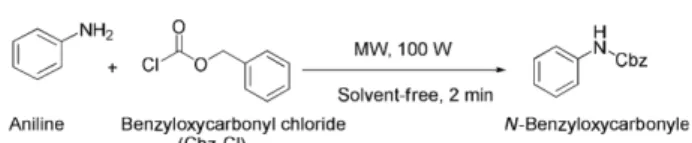
For model reaction, 1 mmol of aniline was reacted with 1 mmol of benzyl chloroformate (Cbz-Cl) in dichloromethane as a solvent, under microwave irradiation with the absence of any catalyst, the expected N-carbobenzyloxyaniline was obtained in 85% yield within just 6 minutes. In order to further investigate the efficiency of our method and to study the effect of MW irradiation on our reaction, we repeat the reaction in the absence of solvent; the result was a better product yield within shorter reaction time (Scheme 1). The yield is optimal in solvent-free conditions.
To find the optimum value of microwave irradiation for the Cbz protection of amines, we have tested the solvent- less reaction of aniline (1 mmol) with Cbz chloride (1 mmol) under various irradiation values. The best results were obtained at 100 and 200 Watts (Table 1). Excellent yields were obtained after 2 minutes.
To investigate the influence of solvent, we decided to carry out the reaction using CH3CN, THF, CH2Cl2, AcOEt, methanol and water as reaction media but no significant improvement of the yield was observed even after half an hour of reaction time.
After the optimization of the reaction conditions and encouraged by the experimental results, we extended the N-Cbz protection to a series of structurally diverse amines under microwave irradiation at 100W (Scheme 2) (Table 2, entries 1a−18a).
As can be seen from Table 2, the protection of primary and secondary, aliphatic and aromatic amines afford their corresponding N-Cbz protected derivatives within 2-5 min in 82−98% yield. The thin-layer chromatography (TLC) analy- sis of the crude mixture revealed the formation of a new product less polar than the starting amine. Purification of the crude product by crystallization in n-hexane gave the N-Cbz carbamates in good to excellent yields (Table 2).
From aromatic amines, the nature of the substituents, the electron-donating or withdrawing groups such as OMe, NO2, F, Cl, do not have a significant influence on the time Scheme 1. Microwave-assisted protection of aniline.
Table 1. Influence of irradiationa
Entry Irradiation/W Time (min)
1 100 2
2 200 2
3 300 /
4 450 /
5 600 /
aReaction conditions: aniline, 1 mmol; Cbz-Cl, 1 mmol; no use of catalyst; solvent free; yield, 98%
Scheme 2. Microwave-assisted protection of various structurally amines.
Table 2. N-Benzyloxycarbonylation of amines under microwave irradiation
Entry Amine Compound Time (min)Yield (%)
1a 2 98
2a 2 97
3a 2 90
4a 2 94
5a 2 94
6a 3 90
7a 3 91
8a 5 88
9a 3 87
10a 4 85
11a 4 82
12a 4 88
13a 4 86
14a 4 84
15a 3 87
16a 2 93
17a 2 92
18a 2 91
NH2 H
NCbz
NH2 N
H Cbz
NH2 N
H Cbz
NH2
MeO
HN MeO
Cbz
NH2
OMe
HN Cbz OMe NH2
F HN
F Cbz
NH2
Cl
HN Cl
Cbz
NH2
O2N
HN O2N
Cbz
NH2
H2N O
NH H2N
O Cbz
HN NCbz
NH N Cbz
NH
O O
NCbz
NH
N N
NCbz
NH NCbz
NH2 N
H Cbz NH2
NH Cbz NH
Cbz
NH2
NH2 H
N Cbz
and the yields of the reaction. Surprisingly, only the mono N-Cbz derivative was observed for urea substrate (entry 9a) derivative without formation of the bis N-Cbz deriv- ative, in spite of the symmetry of the substrate. We think that the reactivity of the second nitrogen, we believe that the benzyloxycarbonylation of the first nitrogen affects the second and so makes it unreactive.
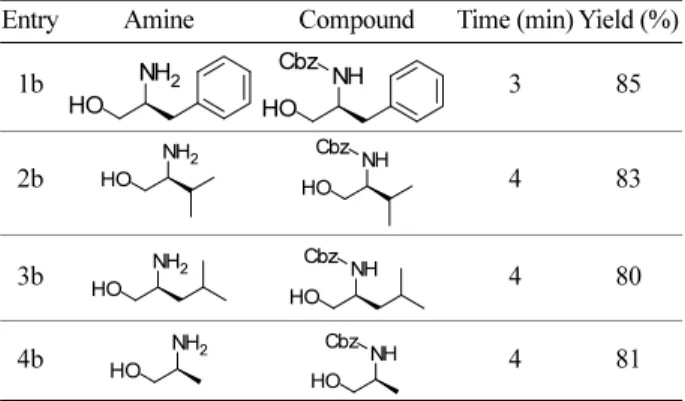
In order to exploit the chemo-selectivity of this method, we attempted the N-benzyloxycarbonylation of β-amino alcohols (Scheme 3), alaninol, valinol, leucinol and phe- nylalaninol (Table 3, entries 1b−4b). In all cases, only the N-Cbz protected compounds were obtained, without any competitive formation of O-Cbz compounds, this proto- col showed an excellent chemo-selectivity.
To explore the limits of this procedure, a range of α- amino esters were reacted with Cbz-Cl under the same reaction conditions (Table 4, entries 1c−4c). The reactions were completed (as monitored by TLC) after 3-4 minutes.
In all cases, the amino esters were converted into their cor- responding N-Cbz derivatives in good yields.
In particular, the NMR spectroscopy of the entry 3c shows a doubling of some signals due to the existence of two major
rotamers in agreement with literature for the Fmoc group.25 (Fig. 1).
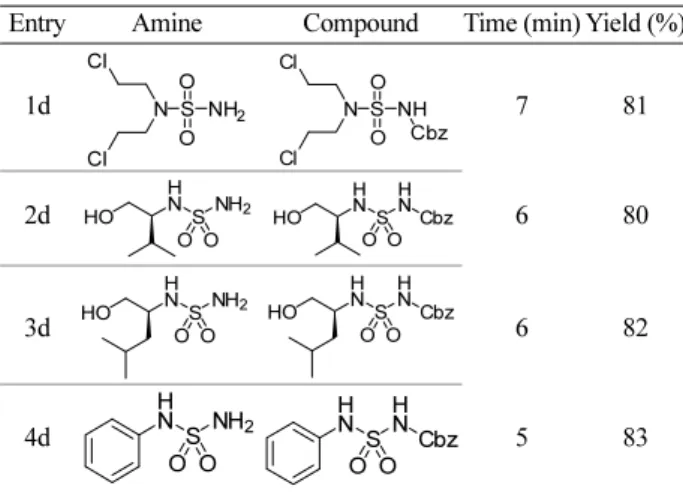
To increase the scope of this reaction, we prolonged this study to sulfonamides (Scheme 5) and were tested to ver- ify the region-selectivity. The results showed that the ben- zyloxycarbonylation occurred at the primary amine and no bis N-Cbz formation was observed. All N-protected sulfonamides were obtained in good yields (Table 5, entries 1d–4d).
All N-Cbz products structures were characterized by the different spectral methods (1H, 13C NMR, IR and MS). In the 1H NMR, The resulting carbamates are confirmed by the appearance of a singlet between 4.5 and 5.2 ppm cor- responding to methylene protons (OCH2).
In the 13C NMR, the benzylic carbon of the Cbz group appeared at 68 ppm. In infrared spectra, the presence of absorption band at 1678−1700 cm−1 (CO carbamate) approves all the protected structures.
Scheme 3. Microwave-assisted protection of β-amino alcohols.
Table 3. N-Benzyloxycarbonylation of β-amino alcohol under micro- wave irradiation
Entry Amine Compound Time (min) Yield (%)
1b 3 85
2b 4 83
3b 4 80
4b 4 81
NH2
HO HO NH
Cbz
NH2
HO NH
HO Cbz
NH2
HO NH
HO Cbz
NH2
HO HO NH
Cbz
Scheme 4. Microwave-assisted benzyloxycarbonylation of α-amino esters.
Figure 1. The two major rotamers of proline amino ester.
Table 4. N-Benzyloxycarbonylation of α-amino esters under micro- wave irradiation
Entry Amine Compound Time (min) Yield (%)
1c 3 85
2c 3 85
3c 4 80
4c 4 82
OMe O H2N
OMe H O
Cbz N
OMe O H2N
OMe H O
Cbz N
OEt H O
N OEt
O N Cbz
OEt
H2N O OEt
H O CbzN
Scheme 5. Microwave-assisted benzyloxycarbonylation of sul- fonamides.
The fragmentation in mass spectrometry in different mode of ionization on (ESI) shows loss of the benzyl group (91%) and shows the molecular peak with a relative inten- sity.
CONCLUSION
In conclusion, we have described an efficient and mild approach for the microwave-assisted benzyloxycarbon- ylation of amine functionality in various chemical scaffolds.
The main advantages of our method include the absence of any solvent and catalyst in the reaction, easy work up, no side reaction, facile isolation of products, excellent yields.
Further work is ongoing to explore the use of alternative energy sources in protecting groups. We believe that our process will find its use in the peptides chemistry.
Acknowledgments. We are thankful to Prof. Jacques Lebreton, from the University of Nantes, France for spec- tral characterization (NMR, SM) of the products. Contri- butions from Dr. Aïcha Amira, and Master students: Houria Bentoumi and Hanene Zerkout are gratefully appreciated.
Publication cost of this paper was supported by the Korean Chemical Society.
REFERENCES
1. Wuts, P. G. M.; Greene, T. W. Greene’s Protective Groups in Organic Synthesis, 4th ed, Wiley: New York, 2007.
2. Kocienski, P. J. Protecting Groups, 3rd ed, George Thieme
Verlage: New York, 2004.
3. Kim, T. H.; Chun, J. C. Bull. Kor. Chem. Soc. 2003, 24, 157.
4. Sajiki, H. Tetrahedron Lett. 1995, 36, 3465.
5. Kumar, V. P.; Reddy, M. S.; Narender, M.; Surendra, K.;
Nageswar, Y. V. D.; Rama Rao, K. Tetrahedron Lett. 2006, 47, 6393.
6. Hernandez, J. N.; Martin, V. S. J. Org. Chem. 2004, 69, 3590.
7. Babu, K. S.; Rao, V. R. S.; Rao, R. R.; Babu, S. S.; Reo, J. M. Can. J. Chem. 2009, 87, 393.
8. Gawante, M. B.; Polshettiwar, V. R.; Varma, S.; Jawaram, R. V. Tetrahedron Lett. 2006, 48, 8170.
9. Mahesh, K. C.; Narasimhulu, M.; Reddy, T. S.; Venkateswarlu, N. S. A. Tetrahedron Lett. 2007, 48, 55.
10. Varala, R.; Enugala, R.; Adapa, S. R. J. Iran. Chem. Soc.
2007, 4, 370.
11. Suryakiran, N.; Mahesh, K. C.; Ramesh, D.; Paul, S. J. J.;
Venkateswarlu, Y. Tetrahedron Lett. 2008, 49, 2607.
12. Shkhande, J.; Gawande, M. B.; Jayaram, R. V. Tetrahedron Lett. 2008, 49, 4799.
13. Zhang, C. L.; Zhang, D. F.; Zhao, H. Y.; Lin, Z. Y.;
Huang Chin, H. H. Chem. Lett. 2012, 23, 789.
14. Yadav, V. K.; Babu, K. G. J. Org. Chem. 2004, 69, 577.
15. Bora, P. P.; Vanlaldinpuia, K.; Rokhum, L.; Bez, G. Synth.
Commu. 2011, 41, 2674.
16. Larhed, M.; Olofsson, K. Micowave Methods in Organic Synthesis, Sringger-Verlag: Berlin, Heidelderg, 2006.
17. Gedye, R.; Smith, F.; Westaway, K.; Ali, H.; Baldisera, L.;
Laberge, L.; Rousell, J. Tetrahedron Lett. 1986, 27, 279.
18. Guiguere, R. J.; Bray, T. L.; Duncun, S. M.; Majetich, G.
Tetrahedron Lett. 1986, 27, 4954.
19. K’tir, H.; Amira, A.; Berredjem, M.; Aouf, N.-E. Chem.
Lett. 2014, 43, 851.
20. Lakrout, S.; K’tir, H.; Amira, A.; Berredjem, M.; Aouf, N.-E., RSC. Adv. 2014, 4, 16027.
21. Ouarna, S.; K’tir, H.; Lakrout, S.; Ghorab, H.; Aouf, Z.;
Berredjem, M.; Aouf, N.-E., J. Orient. Chem. 2015, 31, 2.
22. Mansouri, R.; Aouf, Z.; Lakrout, S.; Berredjem, M.; Aouf, N-E. J. Braz. Chem. Soc. 2016, 3, 546.
23. Amira, A. Ph. D. Thesis, Synthèse, Réactivité et Evaluation de l’Activité Biologique d’Hétérocycles Azotés : Conception de Nouveaux Agents Alkylants & Protection N-Boc d’Amines Assistée par Ultrasons, Badji Mokhtar-Annaba University, 2015.
24. Amira, A.; K’tir, H.; Becheker, I.; Ouarna, S.; Inguimbert, N.; Berredjem, H.; Berredjem, M.; Aouf, N.-E. Der. Pharma.
Chemica. 2015, 7, 213.
25. Höck, S.; Martib, R.; Riedla, R.; Simeunovicc, M. CHIMIA, 2010, 64, 200.
Table 5. N-Benzyloxycarbonylation of sulfonamides under micro- wave irradiation
Entry Amine Compound Time (min) Yield (%)
1d 7 81
2d 6 80
3d 6 82
4d 5 83
S NH2 O O N Cl
Cl
S NH O O N Cl
Cl Cbz
SNH2 HN
HO O O S
HN HN
HO O O Cbz
SNH2 HN
HO O O S
HN HN
HO O O Cbz
SNH2
HN
O O S
HN HN
O O Cbz