Corresponding author: Jung, Sun Young
College of Nursing, Catholic University of Daegu, 3056-6 Daemyeong 4-dong, Nam-gu, Daegu 705-718, Korea.
Tel: +82-53-650-4977, Fax: +82-53-650-4392, E-mail: [email protected]
- This study was supported by the National Research Foundation of Korea fund in 2011(NRF-2011-0014636).
Received: Oct 23, 2014 | Revised: Nov 26, 2014 | Accepted: Dec 20, 2014
This is an open access article distributed under the terms of the Creative Commons Attribution Non-Commercial License (http://creativecommons.org/licenses/
by-nc/3.0), which permits unrestricted non-commercial use, distribution, and reproduction in any medium, provided the original work is properly cited.
Development of Expert Competency Model for Preventing Adolescent Addictive Behavior and Educational Needs
of Psychiatric Mental Health Nurses
Park, Hyun Sook · Jung, Sun Young
College of Nursing, The Research Institute of Nursing Science, Catholic University of Daegu, Daegu, Korea
Purpose: This study was conducted to develop an expert competency model for preventing adolescent addictive behavior and to analyze educational needs of psychiatric mental health nurses in Korea. Methods: The process involved competency modeling using to the expert’s delphi construction and analyzing validity using to the devel- opment of the expert competency scale. Participants were 441 experts and 137 psychiatric mental health nurses in 2 cities. Results: The expert competency model for preventing adolescent addictive behavior included positive self-worth, capability of adolescents comprehension, environment comprehension capability of adolescent, capa- bility of inner motivation, perception of personal competency, communication skills with adolescent, addiction comprehension capability, and addiction management skills. The developed expert competency scale demon- strates good reliability and validity. Psychiatric mental health nurses’ highest educational needs from expert com- petency scale were addiction management skills and communication skills with adolescents. Conclusion: The study findings indicate that the expert competency model for preventing adolescent addictive behavior has good validity and reliability when applied to adolescents. It provides the first step toward developing an education pro- gram or guidelines for experts including psychiatric mental health nurses.
Key Words: Competency, Adolescent, Addictive behavior, Educational needs
INTRODUCTION
Adolescent addictive behaviors use continues to be a grave societal concern[1]. Adolescent who have addic- tive behaviors are at risk for many adverse consequen- ces, including delinquency, poor academic achievement, employment problems and criminal and violent beha- viors[2]. And most addictive behaviors such as gambling and alcohol abuse are a gateway other addictive beha- viors or perhaps an enhancer of existing addictive beha- vior[3]. Also the problem of adolescent behavior can be connected to an adult problem[4], so the prevention in- terventions against youth addictive behaviors are needed.
The important one of the predictors for prevent ado- lescent addictive behaviors was the reported one of the
predictors for social support such as positive communi- cation with parents, peer and social group[5,6]. And the proper human resources for facilitator for adolescent addiction prevention was experts roles in school and community[7]. Park and Jung[7] found that we con- cludes that plan for the integration of the family, school, and community systems are a promotion of the roles, a feedback to strengthen the roles, sharing of awareness of problems, and constant effort to secure policy sup- port. Thus, community's the most important roles for pre- vent adolescent addictive behavior were professional therapy and support by experts. Therefore, we must be watched with deep concern to expert competency for prevent adolescent addictive behavior. However, no studies of which we are aware have examined expect- ancies as expert competency for prevent adolescent ad-
dictive behavior.
Competency modeling is considered what to know expert competency for preventing adolescent addictive behavior. Competency modeling is an important in- novation that it is way to get organization to pay atten- tion to job-related information and employee skill in management of employees[8]. And competency model- ing are usually directly linked to work objectives and strategies and may consider future work requirement ei- ther directly or indirectly[9]. Competency models can play many in human resource system and nursing edu- cation[6,8,10]. For example, executive development and coaching programs often have a competency model foundation[9,11]. And the best practice in competency modeling are analyzing competency information, or- ganizing competency information, and using competen- cy information[9,11]. There are other methods that are unique to competency modeling by behavioral event in- terview[11]. However, a competency modeling was us- ing additional unique methods by the expert's delphi me- thod[9,11]. The expert's delphi method of competency modeling was using to definite experts's competency - knowledge, skill, abilities, motivation, beliefs, values and interests - and oriented work role requirements and edu- cation[12,13]. So we can be used to identify expert com- petency for preventing adolescent addictive behavior and to provide an education plan to reinforcement the experts' competency.
Educational needs analysis of competency is a way what to reinforcement the experts' competency. Many research in education[13-15] and counseling[16] was consisted to experts' training programs according to an- alyse educational need of competency. And the studies about the global health education[17] and the psychi- atric mental health nurse for mental illness care was per- formed some researchers. However, no studies of which we are aware have consisted to education program for experts such as psychiatric mental health nurses com- petency for preventing adolescent addictive behavior.
In this study, we want to develop the expert com- petency model for preventing adolescent addictive be- havior by the expert's delphi method and to analyse val- idity in he expert competency model. And this study tries to analyse educational needs of psychiatric mental health nurses about the expert competency for prevent- ing adolescent addictive behavior, and to provide a base for psychiatric mental health nurses to reinforcement the competency for adolescents' mental health. The purpose of this study was to develop the expert competency mod- el for prevent adolescent's addictive behavior and to
analyse educational needs of psychiatric mental health nurses that will identify a education problem to psychi- atric mental health nurses in Korea.
METHODS
1. Methodology
1) Development of expert competency model for prevent- ing adolescent addictive behavior
(1) Delphi for panelists
The study was exploratory and descriptive. Its goals were to collect expert competency for preventing adoles- cent addictive behavior. First, A Classic Delphi technique with three iterations [10] via web delivery was utilized.
Panelists were those with acknowledged expertise in adolescents' mental health management or counselor.
Panelists consisted of 3 psychiatrists, 3 professors of nurs- ing, 5 psychiatric mental health nurses, 5 clinical psychol- ogists, 5 counselor teachers, 2 social workers.
y Round 1
The first started with an open-ended questionnaire to get opinions about the competency of expert com- petency for preventing adolescent addictive behavior.
From the data, themes were extracted for developing core competences for round 2 and 3. Open-ended ques- tionnaire is “What is the competency of expert com- petency for preventing adolescent addictive behavior?
And please definition to it.” Panelists were asked to give as clear description of each idea as possibles by e-mail.
Data analysis was undertaken by two members of the research team to identify key concepts and themes. The first survey was developed 74 competencies in 5 catego- ries-knowledge, skill, motivation, trait, and self-con- cept[10].
y Round 2
The second round was a structured questionnaire with items in categories and sub-categories along the lines just explained. Panel members rated the items in Round 1, using a five-point Likert-type scale from 1 point “not very important” to 5 point “very important”. The second survey was developed 120 items in 6 competencies- capability of adolescents comprehension, positive self- worth, capability of inner motivation, communication skills with adolescent, problem solving skills, and addic- tion management skills. The 120 items was developed 6 competencies definition and concepts from 74 compe- tencies' definition by experts' statements in round 1.
y Round 3
The third round was surveyed content validity about the 120 items from the second round by panel members.
Panel members rated the items in round 2, using a four- point Likert-type scale from 1 point “not very appro- priate” to 4 point “very appropriate” in order to deter- mine content validity index. 79 items was selected ac- cording to the above .83 by index of content vali- dation[18].
(2) Validity test of competency model
This study was selected to develop scale-experts' com- petency scale for preventing adolescent addictive be- havior - for validity test. The data collection was conduc- ted during March, 2013 for performing this procedures.
Sample sizes needed to be considered at least 2 to 10 times the number of questions[19], therefore, 445 ex- perts on adolescence. Sampling method was conveni- ence sampling. The setting for this study was 4 hospitals, 2 counselling centers, 4 middle and high schools and 3 mental health centers in 4 cities in South Korea. Experts consisted of psychiatrists, nurses, psychiatric mental health nurses, clinical psychologists, counselor teachers, social workers. Informed consent was obtained prior to participation from experts on adolescence. The ques- tionnaires took 30 minutes to complete. Excluding the incomplete questionnaires, data from 441 experts on adolescence were collected and used for analysis.
2) Educational needs of psychiatric mental health nurses about expert competencies
The second study had two scales per item of experts' competencies-importance and current level of compe- tency. Each competency was rated as to how important it was for psychiatric mental health nurses to have and the current competency level. Level of importance of the competency and current competency were rated us- ing a five-point Likert-type scale by mental health nur- ses. The data collection was conducted during Novem- ber, 2013. Educational Needs of psychiatric mental health nurses about experts' competencies was analyzed by for- mula about educational needs[15,20].
Educational needs=
∑ ×
PNC: Importance of the competency PCL: Current competency
PNC: Mean about importance of the competency N: number of participation
Informed consent was obtained prior to participation from psychiatric mental health nurses. The question- naires took 20 minutes to complete. Excluding the in- complete questionnaires, data from 137 psychiatric men- tal health nurses were collected and used for analysis.
The setting for this study was 4 hospitals and 4 mental health centers in 4 cities in South Korea.
2. Data analysis
The analysis were carried out using SPSS version 20.0 for Windows. Descriptive statistics were used to analyze the characteristics of the sample. Principal component analyses evaluated factor structure using varimax rota- tions. Cronbach's ⍺ evaluated internal consistency for the items comprising the experts' competencies. Educa- tional needs of psychiatric mental health nurses about experts' competencies was used to analyze formula about educational needs.
RESULTS
1. Expert competency model for preventing adoles- cent addictive behavior
1) General characteristics of the subject
The participants in this study were 156 (35.4%) male and 285 (64.6%) female. The participants were also div- ided into 12 (2.7%) psychiatrists, 10 (2.3%) professors of nursing, 122 (27.7%) mental health advanced practice nurse specialists of mental health nursing, 141 (31.9%) clinical psychologists, 105 (23.8%) counselor teachers, 51 (11.6%) social workers. Duration of work experience were 203 (46.0%) above ten years and 238 (54.0%) un- der ten years. 245 (55.6%) experts were religious and 196 (44.4%) experts did not have any religion.
2) Exploratory factor analysis, construct validity
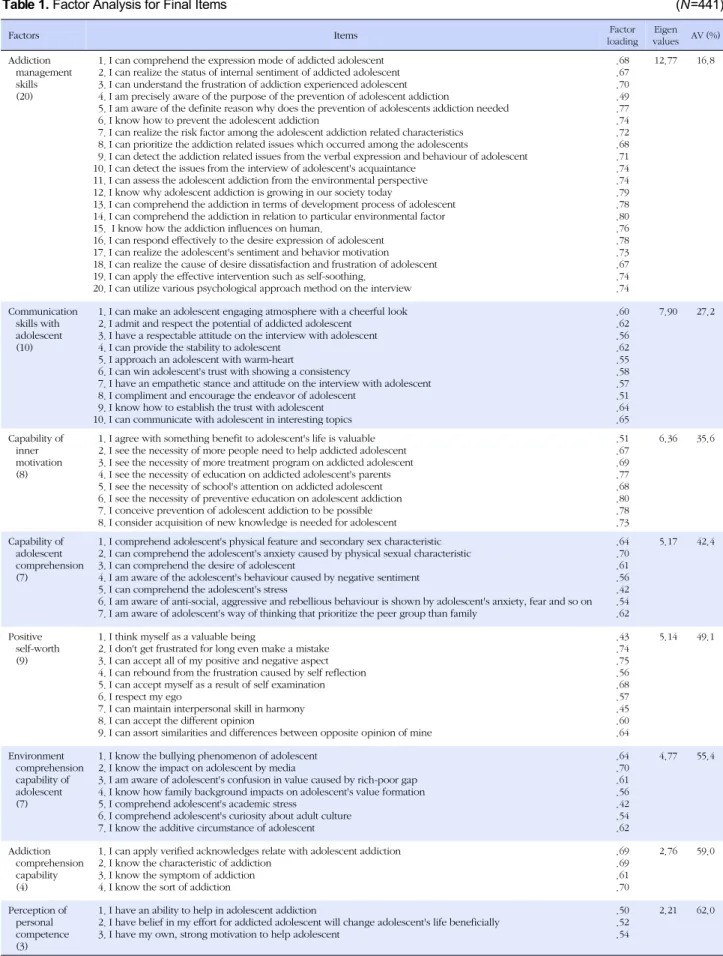
Construct validity was supported in the factor analy- sis. The Kaiser-Meyer-Olkin measure of sampling ad- equacy was .93. Bartlett's test of sphericity was statisti- cally signigicant (p<.001), showing that there were some relationships among the variables. The factors were sub- jected to varimax rotation to maximize the dispersion of the loadings within factors so that loading a smaller number of variables more highly into each factor results in a more interpretable cluster of factors[21].
Factor analysis showed that a eight-factor was the most appropriate approach. 68 items had factor loading greater than 0.4 in total 79 items. The basic assumptions
were satisfied with the value of factor loading[19]. And these eight-factors explained 62.0% of the variance.
Factor 1 (addiction management skills) accounted for 16.8% of the variance (eigen value=12.77), factor 2 (com- munication skills with adolescents) accounted for 27.2%
of the accumulative variance (eigen value=7.90), factor 3 (capability of inner motivation) accounted for 35.6%
of the accumulative variance (eigen value=6.36), factor 4 (capability of adolescent comprehension) accounted for 42.4% of the accumulative variance (eigen value=
5.17), factor 5 (positive self-worth) accounted for 49.1%
of the accumulative variance (eigen value=5.14), factor 6 (environment comprehension capability of adolescent) accounted for 55.4% of the accumulative variance (eigen value=4.77), factor 7 (addiction comprehension capa- bility) accounted for 59.0% of the accumulative var- iance (eigen value=2.76), and factor 8 (perception of personal competence) accounted for 62.0% of the accu- mulative variance (eigen value=2.21). Factor 1 had 20 items, factor 2 had 10 items, factor 3 had 8 items, factor 4 had 7 items, factor 5 had 9 items, factor 6 had 7 items, factor 7 had 4 items and factor 8 had 3 items. Factor loadings are shown in Table 1 factor analysis for final items.
3) Reliability of the scale
Cronbach's ⍺ for the overall scale was .94. Reliability was also found for each of the four subscales: Factor 1 ad- diction management skills (Cronbach's ⍺=.92); Factor 2 communication skills with adolescents (Cronbach's ⍺
=.91); Factor 3 capability of inner motivation (Cronbach's
⍺=.89); Factor 4 capability of adolescent comprehension (Cronbach's ⍺=.85); Factor 5 positive self-worth (Cron- bach's ⍺=.83); Factor 6 environment comprehension ca- pability of adolescent (Cronbach's ⍺=.83); Factor 7 ad- diction comprehension capability (Cronbach's ⍺=.82);
Factor 8 perception of personal competence (Cronbach's
⍺=.85).
4) Expert competency model for preventing adolescent ad- dictive behavior
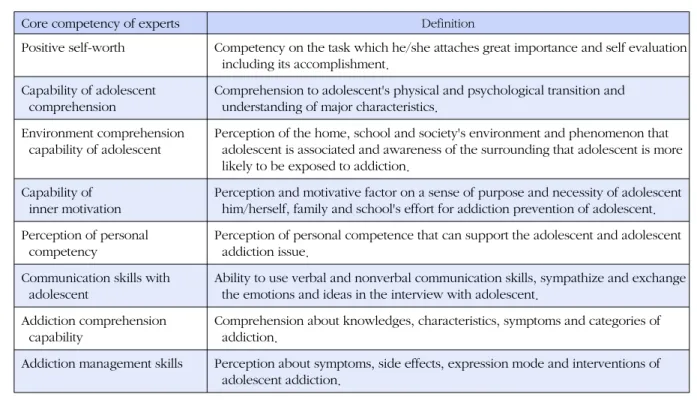
Expert competency model for preventing adolescent addictive behavior were positive self-worth, capability of adolescents comprehension, environment compre- hension capability of adolescent, capability of inner motivation, perception of personal competency, com- munication skills with adolescent, addiction compre- hension capability, and addiction management skills.
Positive self-worth means competency on the task which he/she attaches great importance and self evaluation
including its accomplishment. Capability of adolescents comprehension means comprehension to adolescent's physical and psychological transition and understand- ing of major characteristics. Environment comprehen- sion capability of adolescent means perception of the home, school and society's environment and phenom- enon that adolescent is associated and awareness of the surrounding that adolescent is more likely to be ex- posed to addiction. Capability of inner motivation means perception and motivative factor on a sense of purpose and necessity of adolescent him/herself, fam- ily and school's effort for addiction prevention of adoles- cent. Perception of personal competency is that can support the adolescent and adolescent addiction issue.
Communication skills with adolescent means ability to use verbal and nonverbal communication skills, sym- pathize and exchange the emotions and ideas in the in- terview with adolescent. Addiction comprehension ca- pability means comprehension about knowledges, cha- racteristics, symptoms and categories of addiction. Ad- diction management skills means perception about symp- toms, side effects, expression mode and interventions of adolescent addiction (Figure 1).
2. Educational Needs of Psychiatric Mental Health Nurses about Experts' Competencies
1) General characteristics of the subject
The participants in this study were 19 (13.9%) male and 118 (86.1%) female. Duration of work experience were 49 (35.8%) above ten years and 88 (64.2%) under ten years. 77 (56.2%) nurses were religious and 60 (43.8
%) nurses did not have any religion.
2) Educational needs of psychiatric mental health nurses about expert competencies
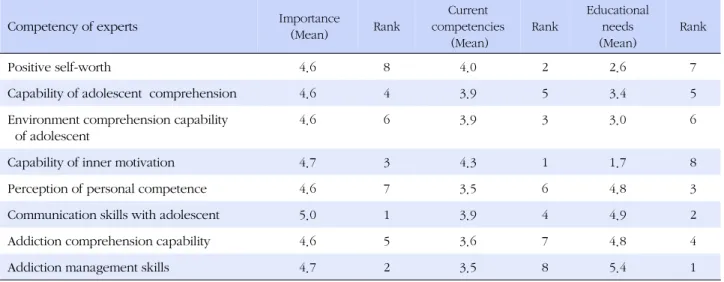
Educational needs of psychiatric mental health nur- ses about expert competencies for preventing adoles- cent addictive behavior are shown in Table 2 and Fi- gure 2. First, importance about competency of experts was ranked communication skills with adolescents (Mean=5.0), addiction management skills (Mean=4.7), capability of inner motivation (Mean=4.7), capability of adolescent comprehension (Mean=4.6), addiction comprehension capability (Mean=4.6), environment comprehension capability of adolescent (Mean=4.6), perception of personal competency (Mean=4.6), positive self-worth (Mean=4.6). Second, current com- petencies about competency of experts was ranked capability of inner motivation (Mean=4.3), positive
Table 1. Factor Analysis for Final Items (N=441)
Factors Items Factor
loading Eigen values AV (%) Addiction
management skills (20)
1. I can comprehend the expression mode of addicted adolescent 2. I can realize the status of internal sentiment of addicted adolescent 3. I can understand the frustration of addiction experienced adolescent 4. I am precisely aware of the purpose of the prevention of adolescent addiction
5. I am aware of the definite reason why does the prevention of adolescents addiction needed 6. I know how to prevent the adolescent addiction
7. I can realize the risk factor among the adolescent addiction related characteristics 8. I can prioritize the addiction related issues which occurred among the adolescents
9. I can detect the addiction related issues from the verbal expression and behaviour of adolescent 10. I can detect the issues from the interview of adolescent's acquaintance
11. I can assess the adolescent addiction from the environmental perspective 12. I know why adolescent addiction is growing in our society today
13. I can comprehend the addiction in terms of development process of adolescent 14. I can comprehend the addiction in relation to particular environmental factor 15. I know how the addiction influences on human.
16. I can respond effectively to the desire expression of adolescent 17. I can realize the adolescent's sentiment and behavior motivation 18. I can realize the cause of desire dissatisfaction and frustration of adolescent 19. I can apply the effective intervention such as self-soothing.
20. I can utilize various psychological approach method on the interview
.68 .67 .70 .49 .77 .74 .72 .68 .71 .74 .74 .79 .78 .80 .76 .78 .73 .67 .74 .74
12.77 16.8
Communication skills with adolescent (10)
1. I can make an adolescent engaging atmosphere with a cheerful look 2. I admit and respect the potential of addicted adolescent
3. I have a respectable attitude on the interview with adolescent 4. I can provide the stability to adolescent
5. I approach an adolescent with warm-heart
6. I can win adolescent's trust with showing a consistency
7. I have an empathetic stance and attitude on the interview with adolescent 8. I compliment and encourage the endeavor of adolescent
9. I know how to establish the trust with adolescent 10. I can communicate with adolescent in interesting topics
.60 .62 .56 .62 .55 .58 .57 .51 .64 .65
7.90 27.2
Capability of inner motivation (8)
1. I agree with something benefit to adolescent's life is valuable 2. I see the necessity of more people need to help addicted adolescent 3. I see the necessity of more treatment program on addicted adolescent 4. I see the necessity of education on addicted adolescent's parents 5. I see the necessity of school's attention on addicted adolescent 6. I see the necessity of preventive education on adolescent addiction 7. I conceive prevention of adolescent addiction to be possible 8. I consider acquisition of new knowledge is needed for adolescent
.51 .67 .69 .77 .68 .80 .78 .73
6.36 35.6
Capability of adolescent comprehension (7)
1. I comprehend adolescent's physical feature and secondary sex characteristic 2. I can comprehend the adolescent's anxiety caused by physical sexual characteristic 3. I can comprehend the desire of adolescent
4. I am aware of the adolescent's behaviour caused by negative sentiment 5. I can comprehend the adolescent's stress
6. I am aware of anti-social, aggressive and rebellious behaviour is shown by adolescent's anxiety, fear and so on 7. I am aware of adolescent's way of thinking that prioritize the peer group than family
.64 .70 .61 .56 .42 .54 .62
5.17 42.4
Positive self-worth (9)
1. I think myself as a valuable being
2. I don't get frustrated for long even make a mistake 3. I can accept all of my positive and negative aspect 4. I can rebound from the frustration caused by self reflection 5. I can accept myself as a result of self examination 6. I respect my ego
7. I can maintain interpersonal skill in harmony 8. I can accept the different opinion
9. I can assort similarities and differences between opposite opinion of mine
.43 .74 .75 .56 .68 .57 .45 .60 .64
5.14 49.1
Environment comprehension capability of adolescent (7)
1. I know the bullying phenomenon of adolescent 2. I know the impact on adolescent by media
3. I am aware of adolescent's confusion in value caused by rich-poor gap 4. I know how family background impacts on adolescent's value formation 5. I comprehend adolescent's academic stress
6. I comprehend adolescent's curiosity about adult culture 7. I know the additive circumstance of adolescent
.64 .70 .61 .56 .42 .54 .62
4.77 55.4
Addiction comprehension capability (4)
1. I can apply verified acknowledges relate with adolescent addiction 2. I know the characteristic of addiction
3. I know the symptom of addiction 4. I know the sort of addiction
.69 .69 .61 .70
2.76 59.0
Perception of personal competence (3)
1. I have an ability to help in adolescent addiction
2. I have belief in my effort for addicted adolescent will change adolescent's life beneficially 3. I have my own, strong motivation to help adolescent
.50 .52 .54
2.21 62.0
AV=Accumulative variance
Core competency of experts Definition
Positive self-worth Competency on the task which he/she attaches great importance and self evaluation including its accomplishment.
Capability of adolescent comprehension
Comprehension to adolescent's physical and psychological transition and understanding of major characteristics.
Environment comprehension capability of adolescent
Perception of the home, school and society's environment and phenomenon that adolescent is associated and awareness of the surrounding that adolescent is more likely to be exposed to addiction.
Capability of inner motivation
Perception and motivative factor on a sense of purpose and necessity of adolescent him/herself, family and school's effort for addiction prevention of adolescent.
Perception of personal competency
Perception of personal competence that can support the adolescent and adolescent addiction issue.
Communication skills with adolescent
Ability to use verbal and nonverbal communication skills, sympathize and exchange the emotions and ideas in the interview with adolescent.
Addiction comprehension capability
Comprehension about knowledges, characteristics, symptoms and categories of addiction.
Addiction management skills Perception about symptoms, side effects, expression mode and interventions of adolescent addiction.
Figure 1. Expert competency model.
self-worth (Mean=4.0), environment comprehension capability of adolescent (Mean=3.9), communication skills with adolescents (Mean=3.9), capability of ado- lescent comprehension (Mean=3.9), perception of personal competency (Mean=3.5), addiction compre- hension capability (Mean=3.6), addiction management skills (Mean=3.5).
Last, educational needs about competency of experts was ranked addiction management skills (Mean=5.4), communication skills with adolescents (Mean=4.9), per- ception of personal competency (Mean=4.8), addiction comprehension capability (Mean=4.8), capability of ado- lescent comprehension (Mean=3.4), environment com- prehension capability of adolescent (Mean=3.0), positive self-worth (Mean=2.6), capability of inner motivation (Mean=1.7).
DISCUSSION
This study was designed to the expert competency model for prevent adolescent addictive behavior. This study examined the validity of the expert competency model for prevent adolescent's addictive behavior. Also this study was designed to analyse educational needs of psychiatric mental health nurses that will identify educa- tion problem to psychiatric mental health nurses in Korea.
First, the expert competency model for preventing
adolescent's addictive behavior were positive self-worth, capability of adolescents comprehension, environment comprehension capability of adolescent, capability of inner motivation, perception of personal competency, communication skills with adolescent, addiction compre- hension capability, and addiction management skills.
These competences are appropriate because there are included to the competency' sub-concept as knowledge, skill, abilities, motivation, beliefs, values and interests [11]. And experts to have these competences will effec- tivity manage to preventing adolescents' addictive beha- viors. Experts will try to reinforcement these competen- cies and to consider that competencies for preventing adolescent addictive behavior defined by the addiction prevention core competency model are as follows: posi- tive self-worth, self-control skill, time management skill, reality perception skill, risk coping skill, positive com- munication with parents, positive communication with peer or social group[6].
Second, this study was selected to develop scale - ex- pert competency scale for prevent adolescent addictive behavior - for validity test. Validity pertains to determine whether a scale instrument is able to make an accurate scale[22]. In this study, we used content, and construct validity.
Content validity measures the comprehensiveness and representativeness of the content of a scale[22]. Lynn[18]
and Kadioglu[22] has proposed that a content validity in-
Table 2. Educational Needs of Psychiatric Mental Health Nurses (N=137)
Competency of experts Importance
(Mean) Rank
Current competencies
(Mean)
Rank
Educational needs (Mean)
Rank
Positive self-worth 4.6 8 4.0 2 2.6 7
Capability of adolescent comprehension 4.6 4 3.9 5 3.4 5
Environment comprehension capability of adolescent
4.6 6 3.9 3 3.0 6
Capability of inner motivation 4.7 3 4.3 1 1.7 8
Perception of personal competence 4.6 7 3.5 6 4.8 3
Communication skills with adolescent 5.0 1 3.9 4 4.9 2
Addiction comprehension capability 4.6 5 3.6 7 4.8 4
Addiction management skills 4.7 2 3.5 8 5.4 1
Figure 2. Educational needs of psychiatric mental health nurses.
dex of at least 83% is required for an acceptable level of content validity. In our study, the overall content val- idity index was 83.0%, which signified that the scale has a good content validity.
Construct validity of competency model is based on the extent to which a test measures a theoretical con- struct or trait[23]. In this study, we excluded five items from the original scale. However, the factor load was
above the set point of .40 for all selected items. The number of items for the four sub-scales which were pos- itive self-worth, capability of adolescents comprehen- sion, environment comprehension capability of adoles- cent, capability of inner motivation, perception of per- sonal competency, communication skills with adoles- cent, addiction comprehension capability, and addic- tion management skills was 3~20. Therefore, the basic
assumptions were satisfied with the number of items for each of the factors and should be included in at least three or more variables[19]. Subscales were used in this study because there was a difference in the number of questions. To determine the mean score in each sub- scale, further research on expert competences is neces- sary to obtain and analyze, and compare. But limita- tions of our study convergent validity isn't performed because there are no related variables.
In our study, Cronbach's ⍺ for the overall scale was .94. To measure the social scientific concept of the tool using questionnaires, Ryu[24] suggests that reliable con- fidence should be more than 0.70. This study resulted in a 0.90 confidence rating and so therefore, the reliability of the developed scale in this study should not be ne- glected. The high level of internal consistency for the entire scale indicated that computing the total score is appropriate and useful for research assisting in planning a education for expert competency program. However, because the data used in this study was cross-sectional in nature, it does not assess the sensitivity of the scale to changes over time. Future studies need to determine the test-retest reliability of the 75-item scale, whether or not the scores change over time and where it is sensitive to change date in this scale, due especially to the result of a successful experts' education program.
Last, psychiatric mental health nurses' educational needs about competency of experts was ranked addic- tion management skills, communication skills with ado- lescents, perception of personal competency, addiction comprehension capability, capability of adolescent com- prehension, environment comprehension capability of adolescent, positive self-worth, capability of inner moti- vation. In a study about educational needs of group work supervision according to careers of grout workers, the competences of high educational needs were group dynamics and the competences of low educational needs was interaction and communication[16]. So psychiatric mental health nurses were perceived that they haven't enough management and communication skills for their clients manage. According to the psychiatric mental health nurses' educational needs about competency of experts it is considered to develop competency-based education program for preventing adolescent addictive behavior.
The findings should be viewed in light of the limi- tation of the study. The results can be only generalized to 2 cities in Korea. In other words, it may not be fully generalized to the Korean adolescent' mental health ex- perts population. And another limitation is that the se-
lected competency modeling was experts' delphi meth- od what do not considered to the classic method with behavior event interviews. And in this study, it was ana- lyzed mental health nurse's educational needs about ex- perts' competency that it was not considered to the psy- chiatric mental health nurses' clinical levels. Despite the limitations, the present findings suggest the scale is an appropriate one for develop experts' competency mod- el for prevent adolescent addictive behavior. This devel- oped expert competency model and scale can improve the understanding level of the experts' current com- petences. Also, the competency model and scale can be used to evaluate prevention as well as experts' educa- tion programs for prevent adolescent addictive behavior in Korea.
This developed expert competency model and scale have a great validity and reliability which can evaluate characteristics of experts. Using the competency model and scale developed in this study suggests that we need to develop education program to reinforcement com- petences for manage to adolescents. In this study, a use- ful tool was developed to assess experts' competences among school, community center and medical center in Korea. The study suggests to develop effective educa- tion program based on expert competency model and educational needs for psychiatric mental health nurses.
CONCLUSION
The purpose of this study was to develop a the expert competency model for prevent adolescent addictive be- havior and to analyse educational needs of psychiatric mental health nurses that will identify education prob- lem to psychiatric mental health nurses in Korea.
In this study, the competency model and scale for ex- perts have a significant validity and reliability, suggest- ing that there are a useful tool to assess competences level among experts for adolescents' mental health in Korea. More importantly, it provides the first step to- ward developing a education program or guideline for experts include psychiatric mental health nurses.
REFERENCES
1. Clark H, Ringwalt CL, Shamblen SR, Hanley SM. Project SUCESS' effect on substance use-related attitudes and behav- iors: a randomized controlled trial in alternative high schools.
J Drug Educ. 2011;41(1):17-44.
http://dx.doi.org/10.2190/DE.41.1.b
2. Ellickson PL, Tucker JS, Klein DJ, Saner H. Antecedents and
outcomes of marijuana use initiation during adolescence.
Prev Med. 2004;39(5):976-84.
http://dx.doi.org/10.1016/j.ypmed.2004.04.013
3. Hyder AA, Juul NH. Games, gambling, and children: applying the precautionary principle for child health. J Child Adolesc Psychiatr Nurs. 2008;21(4):202-4.
http://dx.doi.org/10.1111/j.1744-6171.2008.00155.x
4. Eaton DK, Kann L, Kinchen S, Shanklin S, Ross J, Hawkins J, et al. Youth risk behavior surveillance-United States, 2007.
MMWR Surveill Summ. 2008;57(4):1-131.
5. Hardoon KK, Gupta R, Derevensky JL. Psychosocial variables associated with adolescent gambling. Psychol Addict Behav.
2004;18(2):170-9.
http://dx.doi.org/10.1037/0893-164X.18.2.170
6. Park HS, Jung SY. Construction of the addiction prevention core competency model for preventing addictive behavior in adolescents. J Korean Acad Nurs. 2013;43(6):714-25.
http://dx.doi.org/10.4040/jkan.2013.43.6.714
7. Park HS, Jung SY. A study on the role and efficient integration of school, family, and community for adolescents' addiction prevention. J Ment Sci. 2013;1:44-58.
8. Calhoun JG, Dollett L, Sinioris ME, Wainio JA, Butler PW, Griffith JR, et al. Development of an interprofessional com- petency model for healthcare leadership. J Healthcare Manag.
2008;53(6):375-90.
9. Campion MA, Fink AA, Ruggeberg BJ, Carr L, Pillips GM, Odman RB. Doing competencies well: best practices in com- petency modeling. Pers Psychol. 2011;64:225-62.
http://dxdoi.org/10.1111/j.1744-6570.2010.01207.x
10. Spencer LM, Spencer SM. Competence at work. Seoul: PSI Consulting; 2005. 452 p.
11. Shippmann JS, Ash RA, Batjtista M, Carr L, Eyde L, Hesketh B, et al. The practice of competency modeling. Pers Psychol.
2000;53:703-40.
12. Brannick MT, Levine EL, Morgeson FP. Job and work analy- sis: methods, research, and application in human resource management. 2nd ed. Los Angeles, CA: Sage; 2012. 360 p.
13. Lee YF, Altschuld JW, Hung HL. Practices and challenges in educational program evaluation in the Asia-Pacific region: re- sults of a delphi study. Eval Program Plann. 2008;31:368-75.
http://www.dx.doi.org/10.1016/j.evalprogplan.2008.08.003 14. Kim YI. Educational needs analysis of job competencies for
elementary invention teachers. J Korean Pract Arts Educ.
2014;27(1):201-18.
15. Park KM, Lee KN. Case research on educational needs of en- gineering students about program outcomes (PO). J Eng Educ Res. 2011;14(3):38-44.
16. Lee MS, Kwon KI. Need assessment on educational contents of group work supervision according to careers of group workers. Korea J Couns. 2009;10(2):911-31.
17. Bozorgmehr K, Schubert K, Menzel-Severing J, Tinnemann P.
Global health education: a cross-sectional study among Ger- man medical students to identify needs, deficits and potential benefits (Part 1 of 2: mobility patterns & educational needs and demands). BMC Med Educ. 2010;10(66):1-20.
http://dxdoi.org/10.1186/1472-6920-10-66
18. Lynn MR. Determination and quantification of content validi- ty. Nurs Res. 1986;35:382-5.
19. Lee HS, Kim Y. Korean SPSS 10.0 guide for the beginner. Seoul:
Bubmoonsa; 2002. 420 p.
20. Maultsby CD. In service needs of agricultural science teachers in area I, II, and IV. [master's thesis]. [Texas]: Tech University;
1997. 245 p.
21. Field A. Discovering statistics using SPSS for Windows. Lon- don: Sage; 2000. 512 p.
22. Kadioglu H, Sisman FN, Ergun A. Reliability and validity of the Turkish version of children's somatization inventory. Asian Nurs Res. 2012:6:9-12.
http://www.dx.doi.org/10.1016/j.anr.2012.02.004.
23. Habor J, Lobiondo-Wood G, editors. Reliability and validity.
Nursing research. 6th ed. Missouri: Mosby Elsevier; 2006.
399 p.
24. Ryu CS. SPSS 14.0 for windows. 5th ed. Seoul: Elite; 2006.
529 p.