Background: The purpose of this study was to investigate the clinical efficacy of Korean medicine combination treatments for recurring back pain after medical procedures.
Methods: This was a retrospective study performed on 311 patients admitted to Daejoen Jaseng hospital who were diagnosed with lumbar spine herniated intervertebral discs. The patients were divided into 2 groups according to whether or not they had undergone at least one medical procedure on the lumbar spine.
They were assessed with Numeric Rating Scale (NRS), Oswestry Disability Index (ODI) and EuroQol-5 Dimensions Index (EQ-5D) before and after treatment.
Results: Patients who experienced a medical procedure on the lumbar spine in the prehospital phase (Group A), statistically significantly improved EQ-5D and ODI scores. The NRS scores also decreased however it was not statistically significant. Patients who had not undergone a medical procedure on the lumbar spine in the prehospital phase (Group B) had statistically significantly improved ODI and NRS scores. The average EQ- 5D score decreased however, there was no statistically significant difference before and after scores in Group B.
There was no statistically significant difference in variation in EQ-5D, ODI, and NRS scores before and after treatment between the groups.
Conclusion: The results of this study indicated that even after a bilateral procedure and surgery, when pain in patients with lumbar spine herniated intervertebral disc did not decrease, (as in failed back surgery syndrome), Korean medicine combination treatment of postoperative pain was helpful and there was improvement in daily life.
©2019 Korean Acupuncture & Moxibustion Medicine Society. This is an open access article under the CC BY- NC-ND license (http://creativecommons.org/licenses/by-nc-nd/4.0/).
Article history:
Submitted: July 25, 2019 Revised: September 6, 2019 Accepted: September 24, 2019 Keywords:
acupuncture, failed back surgery syndrome, Korean traditional medicine, pain.
https://doi.org/10.13045/jar.2019.00171 pISSN 2586-288X eISSN 2586-2898
Original Article
Efficacy of Korean Medicine Combination Treatments for Recurrent Back Pain after Medical Procedures: A Retrospective Study
Wu-Jin Jeong 1, *, Je-Heon Noh 1 , Hyo-Seung Huh 1 , Sun-Ho Lee 1 , Sun-A Kim 2 , Min-Kyung Kim 2 , Ji-Ae Roh 3 , Ji-Won Lee 3
1 Department of Acupuncture & Moxibustion Medicine, Daejeon Jaseng hospital of Korean Medicine, Daejeon, Korea 2 Department of Korean Medicine Obstetrics and Gynecology, Daejeon Jaseng hospital of Korean Medicine, Daejeon, Korea 3 Department of Korean Internal Medicine, Daejeon Jaseng hospital of Korean Medicine, Daejeon, Korea
ABSTRACT
Journal of Acupuncture Research
Journal homepage: http://www.e-jar.org
Introduction
Low back pain (LBP) is a common clinical condition. Between 80% and 90% of people experience LBP at least once in their lives and they often repeat the recurrence and treatment process.
Most LBP is caused by functional abnormalities in the spine or by spinal disorders, and the most common cause is degenerative changes in the intervertebral plate [1]. A lumbar spine herniated intervertebral disc (LHIVD) is one of the common causes of LBP.
In the 2017 Health Insurance Statistical Yearbook, the category
“Other intervertebral disc disorder (M51)”, which is equivalent to HIVD, was found to be the 15
thmost expensive condition regarding medical care, and the 5th most common in terms of high rates of hospitalization [2].
LHIVD is a neurological disorder that usually causes degenerative changes in the lower lumbar vertebrae intervertebral discs or ruptures of the central, inner, or outer fibers of the fibrillary due to external forces. This may cause some or all of the disc to slip, compressing the peritoneal or nerve root, which results in radiative pain, sensory degradation, or weakness in the compressed neuromuscular regions [1,3].
Treatments can be divided into surgical treatment and conservative treatment [4]. Conservative treatment alone showed an improvement in the rate of symptoms of more than 80%, and only 5-10% of cases failed to respond to conservative treatment and required surgery [5]. In the studies of back pain surgery, sufficient pain improvement was not achieved in 30% of patients who received single lumbar segment surgery [6], and only 34% of
* Corresponding author.
Department of Acupuncture & Moxibustion Medicine, Daejeon Jaseng hospital of Korean Medicine, Daejeon, Korea E-mail: [email protected]
ORCID: Wu-Jin Jeong https://orcid.org/0000-0002-5285-4337
©2019 Korean Acupuncture & Moxibustion Medicine Society. This is an open access article under the CC BY-NC-ND license (http://creativecommons.org/licenses/by-nc-
nd/4.0/).
the reoperation patients who had a high incidence of postoperative pain after the first operation, reported successful results with at least 50% experiencing continuous pain relief and satisfaction with the results [7]. Additionally, difficulties with successive reoperations have been reported where the success rate dropped to 15% after the 3
rdback operation, and 5% after the 4
thback operation [8]. In a 10-22-year follow up study by Yorimitsu et al on the outcomes of discectomy for lumbar herniated nucleus pulposus (HNP), it was reported that 74.6% of patients had residual LBP and 12% required reoperations [9]. Park and Kim reported that 75%
of study patients (n = 186) received medical care within 2 years of surgery because of pain, and 35% of those patients required reoperation [10].
Consequently, interest in conservative treatment for LHIVD is increasing, and there have been many studies on the effects of Korean medical combination treatment for LHIVD. Korean medical combination treatment for LHIVD is a representative conser vative treatment which includes acupuncture, pharmacopuncture, cupping, moxibustion, herbal medicine, acupotomy and other herbal treatments. Observational studies have reported on the degree of improvement after inpatient Korean medical combination treatment [11], the effect of acupotomy on LHIVD [12], and the effects of bee venom and Shinbaro pharmacopuncture treatment on LHIVD [13]. Many studies have shown significant effects of Korean medical combination treatment for LHIVD.
However, there are few quantitative studies that have been carried out to determine whether outcomes for patients who have received Korean medicine combination treatment after receiving medical procedures, are as good as those with no experience with combination treatment. In this current study, 311 patients who were diagnosed with LHIVD from November 2016 to December 2017 at the Daejeon Jaseng hospital, received traditional Korean medicine treatment. Patients were divided into 2 groups according to whether they had received at least one medical procedure on the lumbar spine or no procedures, and the status of the 2 groups at both admission and discharge was compared.
Materials and Methods Patients
From November 28
th, 2016 to December 23
rd, 2017, there were a total of 353 patients enrolled in this study who were hospitalized at the Daejeon Jaseng hospital after being diagnosed with lumbar spine and other intervertebral disc disorders accompanied by neurosis.
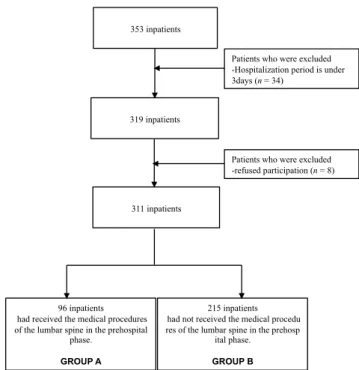
The exclusion criteria included those who were diagnosed with a severe disease that could cause spinal pain (such as malignant tumors, spinal fractures, spinal infections, inflammatory spondylitis, and mami syndrome), chronic diseases (such as pathological neuropathy, and fibrous root disease) that could interfere with interpretation of the treatment results, progressive neurological defects or neurological symptoms, unstable conditions for acupuncture treatment, and current immunological disorders. Of the 353 patients,. there were 34 who were discharged from hospital within 3 days, and 8 who did not respond to the survey upon being discharged . This left 311 patients in the study population. Of these 311 patients, 96 (Group A) had back-related medical procedures before hospitalization and 215 (Group B) did not (Fig. 1).
This study was approved by the Institutional Review Board of Jaseng hospital of Korean Medicine. We adhered to commonly accepted research ethics when carrying out this study.
Methods
As a retrospective study, the medical records of 311 patients who received inpatient treatments for LHIVD at Daejeon Jaseng hospital were collected and analyzed. All statistics from this study were analyzed using SPSS 25.0 Windows (IBM Corp., Armonk, USA) software, and details from the medical records that were collected are as follows:
1) Gender and age 2) Onset date
3) Administration date, discharge date, hospitalization period (days)
4) Whether or not back-related medical procedures were received before hospitalization
5) Comorbidities
6) Physical examination before and after treatment 7) L-spine magnetic resonance imaging (MRI) scans
8) Scores from the numeric rating scale (NRS), Oswestry disability index (ODI) and EuroQol-5 dimensions index (EQ- 5D), before and after treatment
Treatments
Patients were treated with acupuncture, pharmacopuncture, chuna therapy, herbal medicine therapy, and physical therapy. All treatments were performed by one or two Korean medicine doctors (KMDs) who worked in of Jaseng hospital of Korean Medicine and they were not involved in the evaluation of this study. Score evaluations were performed by another KMD.
Acupuncture treatment
Each patient received acupuncture twice a day using disposable stainless-steel needles that were sized 0.25 × 40 mm
2or 0.30 × 60 mm
2(Dongbang Inc. Ltd., Boryeong, Korea). The acupuncture points that were used were at Yoyanggwan (GV3), Myeongmun (GV4), Sinsu (BL23), Gihaesu (BL24), Daejangsu (BL25),
Fig. 1. Flow Chart.
353 inpatients
319 inpatients
311 inpatients
Patients who were excluded -Hospitalization period is under 3days (n = 34)
Patients who were excluded -refused participation (n = 8)
96 inpatients had received the medical procedures of the lumbar spine in the prehospital
phase.
GROUP A
215 inpatients had not received the medical procedu res of the lumbar spine in the prehosp
ital phase.
GROUP B Fig1. Flow Chart
Gwanwonsu (BL26), and EX-B2 (Hwata Hyeopcheok) [14], and the Ashi points of the lumbar, pelvis and lower limbs were also employed. The mean holding time was 15 minutes twice a day, and the mean depth of the needle insertion was at least 20 mm.
Acupuncture was combined with infra-red therapy. Electrical stimulation was performed at 2 acupuncture points using a low- frequency treatment device STN-330 (Stratek, Anyang, Korea) at 1-30 Hz. Electrical stimulation was used to generate a sufficient intensity of muscle contraction, without the patient feeling pain. Two Korean medicine doctors performed the acupuncture treatments once every morning and afternoon from the day of admission.
Pharmacopuncture treatment
Shinbaro pharmacopuncture (from the Jaseng Pharmacopuncture Medicinal Research Institute) was performed by adding and removing medicines of Cheongpa-jeon [15], which control dampness and eliminate swelling, strengthen muscle and bone, improve blood circulation, remove wind energy, and control pain.
Bee venom pharmacopuncture (the saline: bee venom ratio was 10,000:1) was applied after a negative hypersensitivity skin test.
Physical examination and radiological images were used as the basis for pharmacopuncture treatments. A total of 1 mL Shinbaro or bee venom pharmacopuncture was injected into the left EX- B2 point, and 1 mL was injected into the right EX-B2 (Hwata Hyeopcheok) point, at the spinal level with the most severe pain.
Pharmacopuncture needles were inserted directly into the skin to a depth of 0.5-1 cm, and each acupuncture point was injected with approximately 0.2 mL to a total of 0.5-1 mL using a disposable syringe (1 mL, 26 G × 1.5 syringe; CPL Co. Ltd., Gyeonggi, Korea).
To prevent infection, the treatment area was disinfected with a povidone solution (10%). The number of treatments was consistent on a daily basis from the day of hospitalization.
Chuna treatment
Chuna treatment, such as the flexion-distraction technique, lumbar extension technique, lateral extension rotation technique, and lateral lumbar correction technique, were performed 5 to 7 times a week from the day of admission.
Herbal medicine therapy
Shinbaro herbal medicines (Jaseng hospital prescriptions) were given to patients with LHIVD. Cheongpa-jeon [15] and Cheongshinbaro-hwan were taken 3 times a day, 30 minutes after each meal, from the day of admission.
Other treatments
Manual therapy, traction therapy, or herbal fumigate hot pack was selected individually for each patient’s treatment according to their condition 5 to 7 times a week, from the day of admission.
Evaluation indexes
Patients completed the EQ-5D, NRS, and ODI tests on both the day of admission and the day of discharge.
EQ-5D
The EQ-5D, which was developed by the EuroQol group, measures the health-related quality of life to assess patients’ health status by asking questions about physical and mental well-being and healthy mobility [16]. It is one of the most widely used tools to measure the quality of life. The higher the quality of life, the higher the total score.
NRS The NRS is used to assess the level of pain a patient is experiencing which is quantified by a 0 to 10 scale where a score of zero is pain-free, and a score of 10 is the most severe pain a patient can experience. The visual analog scale (VAS) is similar, but it does not necessarily require vision or motor skills, so measuring with NRS was a little more useful and easier to implement [17].
ODI The ODI is a survey that assesses the patient’s degree of functional disability in daily life, and it consists of 10 questions with 6 choices each, corresponding to 0-5 points. The scores for each item are added, divided by 50, and then multiplied by 100 to calculate the degree of disability. The Korean version of the ODI was used in this study, the reliability and validity of which have been verified [18,19].
Statistical analyses
Statistical analyses were performed using the Statistical Program for Social Science v. 25.0 for Windows program (IBM Corp., Armonk, USA). Measurements were expressed as the mean ± SD. To compare the homogeneity between groups, a Chi-squared analysis was used for gender and the comorbidities distribution, hypesthesia, and muscle weakness. An independent two sample t-test was used for age, height, weight and days of hospitalization.
To compare differences in the general characteristics and EQ- 5D, ODI, and NRS scores between the 2 groups, an independent two sample t-test was carried out. A paired t-test was used to compare variations in EQ-5D, ODI, and NRS scores before and after hospitalization for each group. p < 0.05 were considered to be statistically significant.
Results
General characteristics of patients
Group A (n = 96) consisted of 46 women and 50 men who had previously had back-related medical procedures, with an average age of 49.22 ± 14.26 years. The mean height of Group A was 166.36
± 10.48 cm and their mean weight was 69.01 ± 14.64 kg. Group B (n = 215) consisted of 121 women and 94 men who did not receive a medical procedure, with an average age of 45.99 ± 12.65 years. The mean height of Group B was 164.42 ± 14.48 cm and their mean weight was 66.36 ± 13.88 kg. The mean hospitalization period was 19.93 ± 13.33 days in Group A, and 18.66 ± 24.59 days in Group B. Group A patients were significantly older than patients in Group B (p < 0.05). Otherwise, other demographics and patient characteristics were broadly similar between the 2 groups (Table 1).
Comorbidities of patients
The distribution ratio of patients with hypertension, diabetes mellitus, depression, cardiovascular disease, and gastrointestinal disease was greater in Group A than in Group B, although there were no statistically significant differences between groups (Table 2).
Hypesthesia and muscle weakness in the legs of patients before treatment
There was no statistically significant difference between groups regarding muscle weakness (p = 0.196) but hypesthesia was statistically significantly different between the groups (p = 0.018;
Table 3). Patients with hypesthesia comprised of 25.0% in Group
A and 14.0% in Group B. Patients with muscle weakness in the leg
area comprised of 21.9% in Group A and 15.8% in Group B.
Types of medical procedure
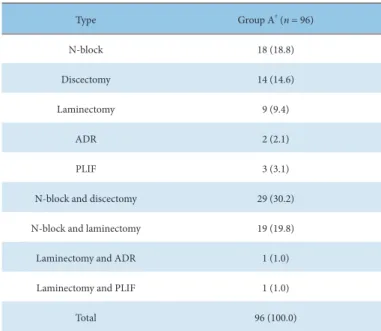
The types of medical procedure which patients in Group A had received before admission were nerve block (N-block), discectomy, laminectomy, artificial disc replacement (ADR) and posterior lumbar interbody fusion (PLIF).
There were many patients who had received more than one procedure. There were patients who had received n-block and discectomy (n = 29) or n-block and laminectomy (n = 19). In
addition, a patient had received a laminectomy and ADR and another patient had received a laminectomy and PLIF (Table 4).
Distribution of L-spine MRI findings
The number of herniated discs ranged from 1 to 5. In Group A, 14 patients had 1 herniated disc (14.4%), 29 patients (29.9%) had 2 herniated discs, 25 patients (25.8%) had 3 herniated discs, 3 patients (18.6%) had 3 herniated discs and 10 patients’s (10.3%)
Age (y)
§Gender
||Height (cm)
§Weight (kg)
§Days of hospitalization period
§Female Male
Group A
†(n = 96) 49.22 ± 14.26 46 50 166.36 ± 10.48 69.01 ± 14.64 19.93 ± 13.33
Group B
‡(n = 215) 45.99 ± 12.65 121 94 164.42 ± 14.48 66.36 ± 13.88 18.66 ± 24.59
p 0.047
*0.172 0.237 0.128 0.634
Data are presented as mean ± SD
*
p < 0.05.
†Group A, Patients had received the medical procedure of the lumbar spine in the prehospital phase.
‡
Group B, Patients had not received the medical procedure of the lumbar spine in the prehospital phase.
§
Statistical significance was evaluated by independent two samples t-test.
||
Statistical significance was evaluated by Chi-square test.
Table 1. General Characteristics of Subjects.
Comorbidity Group A
†(n = 96) Group B
‡(n = 215) p
Hypertension 11 (11.5) 21 (9.8) 0.650
Diabetes mellitus 7 (7.3) 10 (4.7) 0.344
Depression 2 (2.1) 1 (0.5) 0.177
Cardiovascular disease 10 (10.4) 12 (5.6) 0.124
Respiratory disease 2 (2.1) 6 (2.8) 0.716
Gastrointestinal disease 10 (10.4) 22 (10.2) 0.961
Data are presented as n (%).
Statistical significance was evaluated by Chi-square test.
†
Group A, Patients had received the medical procedure of the lumbar spine in the prehospital phase.
‡
Group B, Patients had not received the medical procedure of the lumbar spine in the prehospital phase.
Table 2. Comorbidities of Subjects.
Group A
†(n = 96) Group B
‡(n = 215) p
Hypesthesia 24 (25.0) 30 (14.0) 0.018
*Muscle weakness 21 (21.9) 34 (15.8) 0.196
Data are presented as n (%).
Statistical significance was evaluated by Chi-square test.
* p < 0.05.
†Group A, Patients had received the medical procedure of the lumbar spine in the prehospital phase.
‡Group B, Patients had not received the medical procedure of the lumbar spine in the prehospital phase.
Table 3. Hypesthesia and Muscle Weakness in the Leg Area of Subjects at Pretreatment.
L-spine discs were all herniated. In Group B, 39 patients had 1 herniated disc (18.1%), 64 patients (29.8%) had 2 herniated discs, 53 patients (24.7%) had 3 herniated discs, 42 patients (19.5%) had 3 herniated discs and 16 patients’s (7.4%) L-spine discs were all herniated.
Type Group A
†(n = 96)
N-block 18 (18.8)
Discectomy 14 (14.6)
Laminectomy 9 (9.4)
ADR 2 (2.1)
PLIF 3 (3.1)
N-block and discectomy 29 (30.2)
N-block and laminectomy 19 (19.8)
Laminectomy and ADR 1 (1.0)
Laminectomy and PLIF 1 (1.0)
Total 96 (100.0)
Data are presented as n (%).
†
Group A, Patients had received the medical procedure of the lumbar spine in the prehospital phase.
N-block, nerve block; ADR, artificial disc replacement; PLIF, posterior lumbar interbody fusion.
Table 4. Types of Medical Procedures Done to Group A at Pretreatment.
Group A
†(n = 96) Group B
‡(n = 215)
Number
1 14 (14.4) 39 (18.1)
2 29 (29.9) 64 (29.8)
3 25 (25.8) 53 (24.7)
4 18 (18.6) 42 (19.5)
5 10 (10.3) 16 (7.4)
Grade
Bulging 6 (6.2) 19 (8.8)
Protrusion 22 (22.7) 73 (34.0)
Extrusion 68 (70.1) 123 (57.2)
Position
L1/2 1 (1.0) 4 (1.9)
L2/3 3 (3.1) 4 (1.9)
L3/4 10 (10.3) 15 (7.0)
L4/5 45 (46.4) 92 (42.8)
L5/S1 36 (37.1) 99 (46.1)
Data are presented as n (%).
†
Group A, Patients had received the medical procedure of the lumbar spine in the prehospital phase.
‡
Group B, Patients had not received the medical procedure of the lumbar spine in the prehospital phase.
MRI, magnetic resonance imaging.
Table 5. Distribution of L-spine MRI Findings.
In both groups, the majority of patients had the most severe grade (extrusion) in the distribution of the L-SPINE [57.2%
(Group B)-70.1% (Group A)]. In Group A, there was 1 patient (1.0%) who had the most severe herniated disc at position L1/2 ,3 patients (10.3%) at position L2/3, 10 patients (10.3%) at position L3/4, 45 patients (46.4%) at position L4/5, and 36 patients (37.1%) at position L5/S1. In Group B, there were 4 patients (1.9%) who had severe herniated discs at position L1/2, 4 patients (1.9%) at position L2/3, 15 patients (7.0%) at position L3/4, 92 patients (42.8%) at position L4/5, and 99 patients (46.1%) at position L5/S1 (Table 5).
Comparisons of EQ-5D, ODI, and NRS scores
Differences in EQ-5D, ODI, and NRS scores at pretreatment between groups A and B
At pretreatment, the mean EQ-5D score of Group A was 0.57 ± 0.24, and the mean EQ-5D of Group B was 0.85 ± 3.37. The mean ODI score of Group A was 49.08 ± 18.23 and the mean ODI score of Group B was 45.44 ± 17.71. The mean NRS of Group A was 6.71
± 4.09 and the mean NRS of Group B was 6.56 ± 4.34. There were no statistically significant differences between the groups (Table 6).
Differences in EQ-5D, ODI, and NRS scores before and after treatment in Group A
The A statistically significant improvement in Group A EQ-5D
scores was shown between pre- and post-treatment (0.57 ± 0.24
to 0.66 ± 0.25; p = 0.000). There was a significant improvement
in Group A ODI scores pre- and post-treatment (49.08 ± 18.23
to 36.74 ± 19.17; p = 0.000). The average NRS score was not
statistically significantly different in Group A pre- and post-
treatment (p = 0.212; Table 7).
Variation Group A
†(n = 96) Group B
‡(n = 215) p
EQ-5D -0.10 ± 0.28 0.09 ± 3.38 0.581
ODI 12.33 ± 17.16 15.62 ± 16.59 0.111
NRS 2.95 ± 4.19 2.82 ± 2.73 0.738
Data are presented as means ± SD.
Statistical significance was evaluated by independent two samples t-test.
†
Group A, Patients had received the medical procedure of the lumbar spine in the prehospital phase.
‡
Group B, Patients had not received the medical procedure of the lumbar spine in the prehospital phase.
EQ-5D, EuroQol-5Dimension; NRS, numerical rating scale; ODI, Oswestry disability index.
Table 9. Differences of Variation in EQ-5D, ODI, and NRS Before and After Treatment Between Group A and Group B.
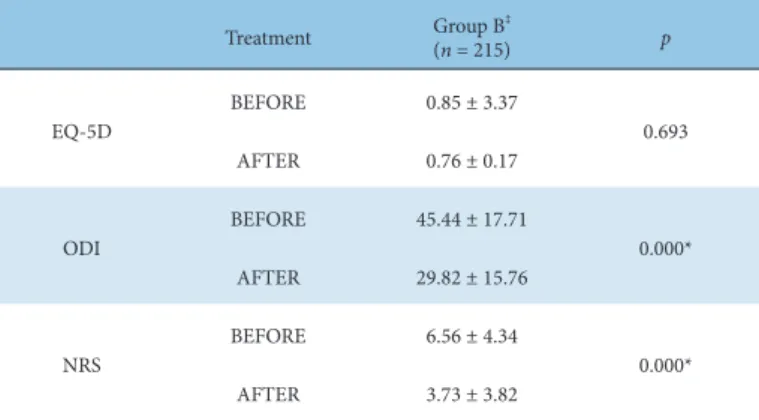
Treatment Group B
‡(n = 215) p
EQ-5D BEFORE 0.85 ± 3.37
0.693
AFTER 0.76 ± 0.17
ODI
BEFORE 45.44 ± 17.71
0.000*
AFTER 29.82 ± 15.76
NRS BEFORE 6.56 ± 4.34
0.000*
AFTER 3.73 ± 3.82
Data are presented as means ± SD.
Statistical significance was evaluated by independent two samples t-test.
*
p < 0.05.
‡
Group B, Patients had not received the medical procedure of the lumbar spine in the prehospital phase.
EQ-5D, EuroQol-5Dimension; NRS, numerical rating scale; ODI, Oswestry disability index.
Table 8. Differences in EQ5D, ODI, and NRS Before and After Treatment in Group B.
Treatment Group A
†(n = 96) p
EQ-5D
BEFORE 0.57 ± 0.24
0.000 *
AFTER 0.66 ± 0.25
ODI BEFORE 49.08 ± 18.23
0.000 *
AFTER 36.74 ± 19.17
NRS
BEFORE 6.71 ± 4.09
0.212
AFTER 3.76 ± 1.56
Data are presented as means ± SD.
Statistical significance was evaluated by independent two samples t-test.
*
p < 0.05.
†
Group A, Patients had received the medical procedure of the lumbar spine in the prehospital phase.
EQ-5D, EuroQol-5Dimension; NRS, numerical rating scale; ODI, Oswestry disability index.
Table 7. Differences in EQ5D, ODI, and NRS Before and After Treatment in Group A.
Differences in EQ-5D, ODI, and NRS scores before and after treatment in Group B
The average EQ-5D score was not statistically significantly different in the scores for Group B pre- and post-treatment (p = 0.693). The improvement in ODI scores in Group B pre- and post- treatment (45.44 ± 17.71 to 29.82 ± 15.76) showed a statistically significant decrease (p = 0.000). The change in NRS scores for group B between before and after treatment (6.56 ± 4.34 to 3.73 ± 3.82) showed a statistically significant decrease (p = 0.000; Table 8).
Differences of variation in EQ-5D, ODI, and NRS scores before and after treatment between groups A and B
The difference between EQ-5D scores before and after treatment were -0.10 ± 0.28 in Group A, and 0.09 ± 3.38 in Group B. The difference between ODI scores before and after treatment were 12.33 ± 17.16 in Group A, and 15.62 ± 16.59 in Group B. The difference between NRS scores before and after treatment were 2.95
± 4.19 in Group A, and 2.82 ± 2.73 in Group B. Each variation of all scores showed no statistically significant differences between the groups (Table 9).
Discussion
LHIVD is a condition in which annulus fibrosus of the vertebral disc is ruptured allowing the inside of the disc to herniate or bulge.
This places pressure around the spinal cord or nerve root creating pain that may radiate or cause an inflammatory reaction around the nerve causing pain through the back, buttocks and lower limbs.
The number of people who suffer with LHIVD typically increases with old age. This may be due to fibroids that degenerated over time causing them to be more susceptible to rupture, an increased risk of falls or narrowing of the disc space caused by everyday life (such as lifting, moving, and sitting for a long time) which may lead to dislocation of the intervertebral discs [20].
Recommended treatments for LHIVD include surgery and conservative treatments (such as transforaminal epidural steroid injections) [21]. However, these injections have been linked to various serious adverse events such as dural puncture and infections [22]. In addition, acute pain after lumbar surgery remains a common problem. The incidence of moderate or severe pain is high on the first postoperative day (ranging between 30%
and 64%) [23].
Pretreatment Group A
†(n = 96) Group B
‡(n = 215) p
EQ-5D 0.57 ± 0.24 0.85 ± 3.37 0.402
ODI 49.08 ± 18.23 45.44 ± 17.71 0.099
NRS 6.71 ± 4.09 6.56 ± 4.34 0.775
Data are presented as means ± SD.
Statistics significance was evaluated by independent two samples t-test.
†
Group A, Patients had received the medical procedure of the lumbar spine in the prehospital phase.
‡