• 검색 결과가 없습니다.

The Effects of Liquid Butadiene Rubber and Resins as Processing Aids on the Physical Properties of SSBR/Silica Compounds

N/A
N/A
Protected

Academic year: 2021

Share "The Effects of Liquid Butadiene Rubber and Resins as Processing Aids on the Physical Properties of SSBR/Silica Compounds"

Copied!
11
0
0

로드 중.... (전체 텍스트 보기)

전체 글

(1)

DOI: https://doi.org/10.7473/EC.2020.55.4.289

The Effects of Liquid Butadiene Rubber and Resins as Processing Aids on the Physical Properties of SSBR/Silica Compounds

Muhammet Iz, Donghyuk Kim, Kiwon Hwang, Woong Kim, Gyeongchan Ryu, Sanghoon Song, and Wonho Kim

Department of Polymer Science & Chemical Engineering, Pusan National University, Busan 46241, Republic of Korea (Received October 12, 2020, Revised October 23, 2020, Accepted October 29, 2020)

Abstract: Highly aromatic (HA) oils are common processing aids used in tire tread compounds. However, they often bleed and evaporate from the vulcanizates during tire use. Thus, the mechanical and dynamical properties of the tire decrease.

To overcome this problem, we investigated nonfunctionalized liquid butadiene rubber (LBR-305, Kuraray) and center-func- tionalized liquid butadiene rubber (C-LqBR), polymerized by anionic polymerization. In addition to the liquid butadiene rubbers, p-tert-octylphenol (P-Resin) and C5 hydrocarbon (H-Resin) tackifier resins, which can induce entanglement of rub- ber compounds, were researched as a processing aid to solve the bleeding problem. Liquid butadiene rubbers have sig- nificantly reduced extraction loss by crosslinking with the main rubber chain. They have also increased the abrasion resistance and showed similar or better mechanical and dynamical properties against HA oils. However, resin compounds did not show differences in extraction loss compared to HA oil compounds; instead, they showed increased wet traction.

Keywords: tire, processing aids, liquid rubber, resin, bleeding

Introduction

Tire tread is the designed for key properties of tire which are fuel efficiency, abrasion resistance and wet grip perfor- mance. Furthermore, tire tread mainly provides contact area between road surface and tire. Styrene butadiene rubber (SBR) is the most commonly used rubber for tire tread.

1

The purpose of developing SBR compound for the tire tread is the achieve excellent mechanical and physical properties for using various application regions and long term. However, under the thermal, mechanical degradation and using for long term, the properties of tire tread decrease.

2-8

This degradation of tread compound can makes the product softened or hard- ened depend on the conditions.

4-6

The most common reason why properties of tire tread decrease is the processing oils which obtained from petroleum crude.

Processing oils are the one of key additives at rubber com- pound which can reduce the cost, increase processability, save energy and increase the filler dispersion. However, this processing oils can often evaporate or bleed from rubber compound that can decrease the rubber properties. Further-

more, these bleedings can be harmful for environment.

9

Highly aromatic oils are most commonly used processing oils for tire industry owing to their compatibility. And, the among of highly aromatic oils, Treated Distillate Aromatic Extract (TDAE) is the more preferred oil because of its high compatibility with SBR.

10-11

In order to increase tire life, the HA oils must be replaced by different processing aids which can keep the properties of tire for long term.

Research study which has recently reported shows, using liquid rubbers as a processing aid provides sufficient mech- anical properties and maintain for long term at SBR based compound, which determined by extraction test.

12

Liquid rubbers are low molecular weight processing aids which have appreciable viscous flow at room temperature. They can be crosslinked with the main rubber chain during the vulcani- zation process.

13

Liquid rubbers can be polymerized by using living anionic polymerization techniques which have great superiorities such as allows to control microstructure like vinyl content and also capable to indicates low polydispersity index (PDI). When used the liquid rubber as a processing aid, these controllable properties have a major impact on deter- mining the general characteristics of rubber compound.

One of important property of liquid rubbers is, it can cus-

Corresponding author E-mail: [email protected]

(2)

tomize by functionalization by living chain termination.

14

After commercially introduced that silane-terminated liquid polybutadienes are used as a silane functionalized low molec- ular weight processing aid for tire technology, it has well reported at previous researches.

15-19

These functional groups based on silane technology are capable to provide same reac- tion structure as coupling agents.

Resins are another low molecular weight processing aid with high glass transition temperatures which are commonly used in tire industry because of good compatibility with tire elastomers.

20

And some of them called as a tackifiers which build a tack between layers of green tire at uncured stage and assembling process. Tack is related with existing of movable chain ends which are merge at room temperature under small pressure and show resistance to stress if an attempt to sep- arate layers again. This tack may also affect viscoelastic properties of rubber compound.

21-24

In this study as a liquid rubber non-functionalized poly- butadiene (N-LqBR), center functionalized polybutadiene (C-LqBR); as a resin p-tert-octylphenolic resin (P-Resin) and C5 hydrocarbon resin (H-Resin) have used to find solution for bleeding of processing oils from tire tread. Furthermore, properties of tire compound such as vulcanizate structure, mechanical properties, viscoelastic properties and abrasion resistances were also evaluated.

Experimental

1. Materials

1.1. Polymerization

The materials which used for polymerization are cyclo- hexane (99%, Samchun chemical Co.) as solvent, n-butyl lithium as an initiator (2.0 mol/L in cyclohexane, Sigma Aldrich), 1,3-butadiene (Kumho Petrochemical Co.) as a monomer, anisole (99%, Samchun chemical Co.) as a mod- ifier, for coupling agent tetraethyl orthosilicate (TEOS) (98%,

Sigma-Aldrich). And benzyl alcohol (Junsei, guaranteed reagent) was used as a termination agent.

1.2. Compounding

Materials which used in this study; SSBR 5220M (Kumho Petrochemical Co., styrene content: 26.5 wt%, vinyl content:

26 wt%, non-oil extended), silica (Ultrasil 7000GR, Evonik), bis-[3-(triethoxysilyl)-propyl]-tetrasulfide (TESPT) as silane coupling agent. As a processing oil; treated distillate aromatic extracted (TDAE, T

g

: -48

o

C), center functionalized liquid butadiene rubber (C-LqBR, T

g

: -93

o

C), non-functionalized liquid butadiene rubber (N-LqBR “LBR-305, Kuraray”, T

g

: -95

o

C), alkyl phenolic resin (P-Resin “p-tert-octlyphenol”, softening point 95

o

C~100

o

C, T

g

: 56

o

C KORESIN), hydro- carbon resin (H-Resin “C5”, softening point 95.8

o

C, T

g

: 58

o

C) were used. Other additives include zinc oxide (ZnO), steric acid (CH

3

(CH

2

)

16

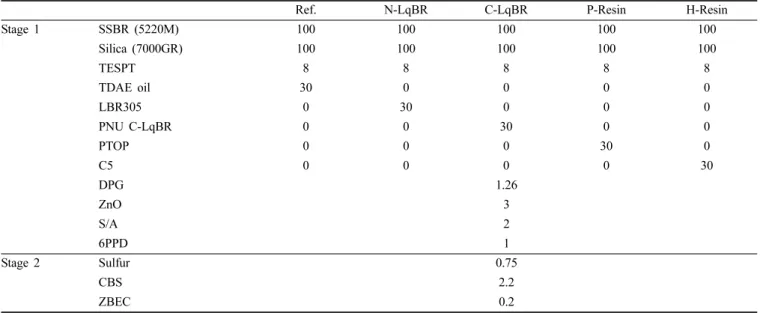
COOH), antioxidant N-(1,3-dimethyl butyl) -N-phenyl-p-phenylenediamine (6PPD) was used in the com- pound. Sulfur, n-cyclohexyl benzothiazyl-2-sulfenamide (CBS) and 1,3-diphenylguanidine (DPG) were used as vulcanization agents. Table 1 shows the information about processing aids.

1.3. Polymerization of C-LqBR

Center functionalized liquid butadiene rubber (C-LqBR) was polymerized by anionic polymerization at 50

o

C. For polymerization the C-LqBR, at first, non-functionalized liq- uid butadiene rubber was polymerized by anionic polymer- ization at 50

o

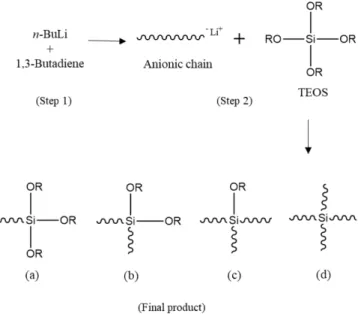
C by adding cyclohexane, anisole, 1,3 butadiene and n-butyllithium to reactor. The amount of N-butyllithium (initiator) was used to control molecular weight of liquid butadiene rubber. Hereupon, TEOS diluted with cyclohexane added to synthesize C-LqBR. Lastly, benzyl alcohol added to terminate polymerization reaction.

1.4. Manufacture of compounds and vulcanizates

1.5. Mixing procedure

Table 1. Properties of Processing Aids

Properties TDAE N-LqBR

(Kuraray) C-LqBR H-Resin

(C-5) P-Resin

(p-tert-octylphenol)

M

n

(g/mol) - 26,000 24,000 - -

M

w

(g/mol) 600 - - 2,800 2,000

PDI - 1.08 1.1 - -

Vinyl content wt% - 10 14 - -

T

g

(

o

C) -48 -95 -93 58 56

(3)

Compounds were prepared using an internal mixer (kneader, 300 mL) based on the formulation shown in Table 2. The mixing procedure is shown in Table 3. The dump tem- perature was set at 150

o

C~155

o

C and the filler factor was set at 70% of the mixer capacity. The input unit was adminis- tered on a rubber basis with the parts per hundred rubber (phr). For 2nd stage, masterbatches from 1st stage had been mixed with curatives at 50

o

C initial temperature.

2. Measurements

2.1. Characterization of C-LqBR

1

H-Nuclear magnetic resonance spectroscopy (

1

H NMR;

Varian, Unity Plus 300 spectrometer, Garden State Scientific, USA) was used to determine the vinyl content and functional groups in liquid butadiene rubber.

Molecular weight and molecular weight distribution were

measured by gel permeation chromatography (GPC, Shi- madzu, Japan). GPC was measured using solvent delivery unit, reflective index detector and three types of column (Stryagel column (HT 6E, 10 µm, 7.8 mm × 300 mm), styra- gel column (HMW 7, 1520 µm, 7.8 mm × 300 mm) and styragel column (HMW 6E, 1520 µm, 7.8 mm × 300 mm).

Calibration of GPC were prepared by using polystyrene stan- dard.

2.2. Payne effect

Storage modulus was measured by the rubber process ana- lyzer 2000 (RPA 2000) from Alpha Technologies (Hudson, OH, USA) at 60

o

C and between 0.28%~40.04% strain range.

2.3. Mooney viscosity

Processability of rubber was evaluated by Mooney vis- cometer (Vluchem IND, Korea) according to ASTM D1646 Table 2. Compound Formulation

Ref. N-LqBR C-LqBR P-Resin H-Resin

Stage 1 SSBR (5220M) 100 100 100 100 100

Silica (7000GR) 100 100 100 100 100

TESPT 8 8 8 8 8

TDAE oil 30 0 0 0 0

LBR305 0 30 0 0 0

PNU C-LqBR 0 0 30 0 0

PTOP 0 0 0 30 0

C5 0 0 0 0 30

DPG 1.26

ZnO 3

S/A 2

6PPD 1

Stage 2 Sulfur 0.75

CBS 2.2

ZBEC 0.2

Table 3. Mixing Procedure

Time Action rpm

Stage 1 0-40″ Rubber mixing 20

40″ - 1′ 40″ Silica ½ + Silane ½ + DPG ½ + Oil ½ 40 1′ 40″ - 2′ 40″ Silica ½ + Silane ½ + DPG ½ + Oil ½ 40

2′ 40″ - 7′ 40″ Add ZnO, Stearic acid, 6PPD 50

Dump at 150

o

C~155

o

C

Stage 2 0 - 20″ Add master batch from 1

st

stage 20

20″ - 2′ Add curatives 40

Dump at 60

o

C~70

o

C 40

(4)

at 100

o

C and 2 rpm rotor speed. (ML

1+4

@100

o

C)

2.4. Cure characteristics

Compound cure characteristic was measured by moving die rheometer (MDR, ALR-3, TOYOSEIKI, Japan) under 160

o

C for 30 mins at oscillation angle of ± 1° to determine optimized vulcanization time.

2.5. Solvent extraction and crosslink density

Vulcanizates samples were prepared in 10 mm × 10 mm

× 2 mm sizes and immersed to 30 mL THF for two days then, 30 mL hexane for 1 days to determine organic extraction mass. After drying at the room temperature for 1day weight loss gives organic extraction loss. Hereafter, the samples were immersed to toluene for 24 hours and weighed again to determine crosslink density. Crosslink density was calcu- lated by using Flory-Rehner equation (1).

(1)

V : Crosslink density (mol/g)

M

c

: average molecular weight between crosslink points (g/mol)

V

r

: the volume fraction of rubber in the swollen gel at equilibrium

V

s

: the molar volume of solvent (cm

3

/mol) ρ : the density of the rubber sample (g/cm

3

) χ : the polymer-solvent interaction parameter

V

r

value at the Flory-Rehner Equation was obtained from the equation (2)

W

d

: Weight of dried sample after swelling W

f

: Weight of filler in sample

W

s

: Weight of sample after swelling ρ

s

: Solvent density

ρ

r

: Rubber density

2.6. Mechanical properties

Mechanical properties which are tensile strength, elonga- tion at break and the modulus were tested by universal testing

machine (UTM, Model: KSU-05M-C, KSU Co, Korea).

Specimens were prepared according to ASTM D412 which is 100 mm × 25 mm × 2 mm sized.

2.7. Abrasion loss

Abrasion resistance was measured by Deutsche Industrie Normen (DIN, 53516) wear tester machine. The samples which were used had made into a cylinder sizes 16 mm × 8 mm. Samples are weighed before and after testing on emery cloth then calculated to abrasion loss.

2.8. Dynamic viscoelastic properties

Dynamic viscoelastic properties were measured by strain- controlled rheometer (ARES-G2, TA Instrument) at -60

o

C to 70

o

C, frequency of 10 Hz, 0.5% strain and solid torsion mode.

Results and Discussion

1. Characterization of C-LqBR

Reaction mechanism of C-LqBR which explained in Fig- ure 1 shows that it is possible to make four different type functionalized liquid butadiene.

25

Molecular weight and molecular weight distribution were determined by GPC and shown in Figure 2. Determination has done at two steps.

First, during the polymerization, the sample (aliquot) had been taken before adding coupling agent and measured the V = 1 2M --- = ln 1 V

c

 –

r

 V + +

r

V

r2

2

r

V

0

V

r1/3

V

r

--- 2

 – 

 

--- –

V

r

=

W

d

– W

f

r

--- W

d

– W

f

r

--- W

s

– W

d

s

--- +

---

Figure 1. Polymerization mechanism of center functionalized

liquid butadiene (C-LqBR)

(5)

molecular weight and then after adding coupling agent another sample (final) had been taken to determine molecular weight. Determination of those two samples are shown in Table 4. Increasing molecular weight to two times verify us polymerization reaction is prone to create final product (b) in Figure 1. Additionally, microstructure of C-LqBR was

determined by

1

H-NMR and shown in Figure 3. Liquid poly- butadiene contains 1,2 vinyl group which showed peak at 4.2~5,1 (d) and 1,4 addition of polybutadiene at 5,1~5,7 (c).

Considering the peaks in Figure 3 the vinyl content in final C-LqBR have calculated as 14%. Also, ethoxy peaks at 3.75~3.80 (e) from Figure 3 verify C-LqBR successfully functionalized.

2. Payne effect

Payne effect can describe as the difference of storage mod- ulus (G’) at low and high strains which represents dispersion of silica in rubber compounds.

26

Usually, high difference of storage modulus between high strain and low strain shows strong filler-filler interaction.

27

In this study, the storage mod- ulus was measured by the rubber process analyzer 2000 Figure 2. GPC curve of center functionalized liquid butadiene (C-

LqBR).

Figure 3. Nuclear magnetic resonance spectrometer (

1

H-NMR) peaks of center functionalized liquid butadiene (C-LqBR).

Table 4. Characteristics of Center Functionalized Liquid Butadiene Rubber (C-LqBR)

Aliquot Final

Mn (g/mol) 12,000 24,000

PDI 1.1 1.1

Vinyl content (%) - 14

Figure 4. The shear storage modulus (G’) of liquid butadiene compounds compare to TDAE compound.

Figure 5. The shear storage modulus (G’) of resin compounds

compare to TDAE compound.

(6)

(RPA 2000) from Alpha Technologies (Hudson, OH, USA) at 60

o

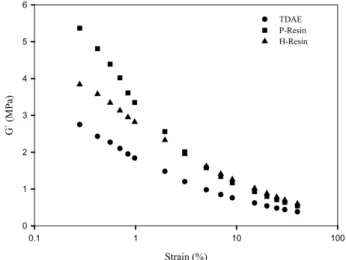
C and shown in Figure 4&5. Table 5 shows ΔG’ value of compounds. N-LqBR and C-LqBR compounds are show- ing lower ΔG’ value than TDAE compound. Processing oils are the lubricants which are basically lowering the intermo- lecular interactions. However, liquid butadiene rubbers and main polymer of compound (SBR) have similar structure which increase the possibility of lubrication. Liquid butadi- ene rubbers can also improve the silica dispersion due to the increased viscosity compared to TDAE oil. Furthermore, ethoxy groups of C-LqBR can react with the silanol groups on silica surface and reduce the polarity of silica, which improves the dispersion of silica. Thus C-LqBR compound shows lower ΔG’ value than N-LqBR compound.

In the case of resin including compounds, they show higher ΔG’ value than TDAE compound. Resins that we have used in our research are solid materials when the temperature below 95

o

C~100

o

C and the temperature of test condition of RPA is 60

o

C, thus, resin compounds show high G’ values at low strain.

28

Besides, -OH group of phenolic resin forms hydrogen bond network.

29

When the filler dispersed in the rubber, it forms weak chemical interaction between filler par- ticles. This filler-filler network can be broken under the strain. But in the case of P-Resin, -OH groups additionally form hydrogen bonds with the silica surface and increase storage modulus at low strain. This property of P-Resin may cause to high storage modulus than H-Resin.

3. Cure characteristics and Mooney viscosity

Cure characteristics which were measured by moving die rheometer are shown in Figures 6 and 7. ΔT (T

max

– T

min

) has described difference between maximum torque and min- imum torque, and ΔT is very commonly related to crosslink density, which means high ΔT indicates high crosslink den- sity.

30

However, ethoxy groups of C-LqBR can react with the silanol groups on silica surface and increases the filler rubber interaction, which increases ΔT of rubber. H-Resin used compound has similar ΔT value as a TDAE compound which doesn’t show crosslink reaction from the MDR data on the

other side P-Resin used compound shows lower ΔT than TDAE compound. P-Resin and H-Resin are the tackifiers which provide tack at uncured stage. Tacky stocks often cause air entrapment in the building process which can lead to cure defects.

31

In the case of phenolic resin polar-polar interaction between polar accelerators and polar group of phenolic resin cause the partial loss of accelerators and decreases the cured properties.

From the molecular weight difference between TDAE oil and liquid butadiene rubbers we can expect that liquid buta- diene rubber used compounds may have higher Mooney vis- cosity. Table 6 shows that, liquid butadiene rubbers show similar Mooney viscosity as TDAE oil; even though, liquid butadiene rubbers have higher molecular weight than the TDAE oil, structure similarity between liquid butadiene rub- bers and SBR increases the lubrication and lower the Mooney viscosity. Although resins have not so higher molec- ular weight than TDAE oil, they have higher Mooney vis- Table 5. Storage Modulus Differences between Large and Small

Strain

Compound TDAE N-LqBR C-LqBR P-Resin H-Resin

△G’ (MPa)

(0.28%-40.04%) 2.37 1.55 1.01 4.83 3.24

Figure 6. Cure characteristics of liquid butadiene compounds.

Figure 7. Cure characteristics of resin compounds.

(7)

cosity than TDAE oil compound. Resins have high softening point which is between 95

o

C~100

o

C; test condition of Mooney viscosity is (100

o

C), not enough to heat the resins.

Thus, resin compounds have higher Mooney viscosity.

4. Crosslink density and solvent extraction

There are two factors which affect the crosslink density of vulcanizate rubber; filler-rubber interactions and chemical crosslinks.

32

The sum of these two factors can be defined as a total crosslink density. During the vulcanization, the liquid butadiene rubbers consume sulfur which decreases the cross- link density of rubber compound. This is the reason why N- LqBR and C-LqBR compounds have less crosslink density.

Figure 8 shows the crosslink density of C-LqBR compound increases with functional groups. Ethoxy groups of C-LqBR react with the silanol group on silica surface and it increases the filler rubber interaction which effects crosslink density.

In the case of resin compounds, H-Resin compound shows similar crosslink density as the TDAE compound; unlike H- Resin compound, P-Resin compound has less crosslink den- sity because of the partial loss of accelerators.

It has known that TDAE oil has bleeding problem from the rubber compound which decreases the properties. The extraction test verified crosslink reaction between liquid

butadiene rubbers and SBR which prevents the bleeding in compounds as shown in Figure 9. Extraction loss difference between liquid butadiene rubbers, caused by the silanization reaction of functional groups of C-LqBR. Unless the liquid butadiene rubbers, resins show similar crosslink density value as TDAE oil which means they don’t have crosslink reaction with main rubber. Thus, resin compounds have similar weight loss as TDAE oil compound.

5. Mechanical properties and DIN abrasion loss

The mechanical properties of compounds which measured by universal testing machine and DIN abrasion loss values are shown in Figure 10&11 and Table 7. Usually, mechanical properties and crosslink density of the compounds show sim- ilar behavior.

33

And modulus at 300% elongation (M

300%

) is most commonly related with filler rubber interaction.

34

Liq- uid butadiene rubber compounds show lower modulus at M

300%

than TDAE oil compound as expected from crosslink density. However, unlike the liquid butadiene rubber com- pounds, resin compounds show different trends. Although, the H-Resin compound has similar crosslink density as TDAE compound, when comparing the cure characteristics and mechanical properties of H-Resin, it can be seen that T

max

and M

300%

values of H-Resin compound higher than the Table 6. Cure Characteristics and Mooney Viscosity of Compounds

Compound Mooney viscosity

(ML

1+4

@100ºC) T

min

(N-m) T

max

(N-m) ΔT

(N-m) t

10

(min:s) t

90

(min:s)

TDAE 108 0.44 2.06 1.62 01:58 06:34

N-LqBR 106 0.48 1.66 1.18 01:10 06:51

C-LqBR 108 0.42 1.69 1.27 01:32 06:51

P-Resin 134 0.42 1.89 1.47 01:43 07:21

H-Resin Over range 0.60 2.22 1.62 01:06 07:49

Figure 8. Crosslink density of rubber compounds.

Figure 9. Weight loss of rubber compounds after extraction.

(8)

TDAE oil compound. This may be caused by characteristics of H-Resin. Furthermore, due to partial loss of accelerator effect from cure state and less crosslink density in Figure 8 resulted as low mechanical property for P-Resin compound.

Commonly abrasion loss increases with increasing glassy transition temperature

35

; resin compounds have higher T

g

than the other compounds that caused higher abrasion loss.

Between two resin compounds, H-Resin compound has higher crosslink density which decreases abrasion loss. Thus, H-Resin compound has better abrasion resistance than P- Resin compound.

34

LqBRs have much lower T

g

than the TDAE oil and resins which resulted as less abrasion loss.

Furthermore, the reason why C-LqBR has better abrasion resistance than N-LqBR is caused from higher crosslink den- sity.

6. Dynamic viscoelastic properties

Results of dynamic viscoelastic properties are shown in Figure 12&13 and Table 8. Dynamic viscoelastic properties are mostly related with the tire performance. Loss modulus (G”) is a loss factor at low temperature conditions (0

o

C- 20

o

C) which indicates the wet traction; higher value of G”

higher the wet traction.

36

During the repeated deformation, the energy applied to rubber is converted into heat as the result of destruction and regeneration of filler networks, because of this, the temperature of rolling tire rises up to 60- 80

o

C. So, Tan δ at 60

o

C can represent rolling resistance of tire.

37

Hysteresis has been known the main reason of energy loss in tire tread compound.

38

Table 8 verify the N-LqBR and Figure 10. Mechanical properties of liquid butadiene compounds. Figure 11. Mechanical properties of resin compounds.

Table 7. Mechanical Properties of Compounds

Compound M

100%

(kgf/cm

2

) M

300%

(kgf/cm

2

) Elongation at

break (%) Tensile strength

(kgf/cm

2

) DIN abrasion loss

(mg) T

g

(

o

C)

TDAE 29 132 459 225 81 -35

N-LqBR 25 106 463 183 74 -43

C-LqBR 25 112 440 188 71 -43

P-Resin 34 116 595 238 144 -29

H-Resin 43 170 375 218 114 -27

Figure 12. Tan δ curves of the vulcanizates dependent on the

temperature; liquid butadiene rubber compounds.

(9)

C-LqBR compounds with free chain ends which are visu- alized in Figure 14, have higher rolling resistance which cause the hysteresis at compound compare to TDAE com- pound.

Another main reason which causes the hysteresis is filler dispersion; the filler-filler network is relatively weak and breaks easily under the influence strain which causes energy losses, that means better filler dispersion better rolling resis- tance.

39

From the Payne effect results; resin compounds have high filler-filler interaction, bad dispersion which cause higher rolling resistance than the other compounds.

Resins are processing aids which have high glass transition temperature (T

g

). Higher T

g

of resin at Table 8 can higher T

g

of rubber compound and increases the energy dissipation, thus resin compounds have higher wet traction.

40,41

Incom- patible resin forms secondary peak in the range of the resin T

g

in the vulcanizates as it can be seen in Figure 13. So, this poor compatibility resin forms separated phase at compound.

Phase separation can increase the hysteresis and cause the bad rolling resistance at resin compound.

20

This effect can be seen at P-Resin compound.

It has indicated that softer compounds with higher resil-

ience, had higher friction on ice road in the temperature range of -30

o

C to 0

o

C. The rubber compounds with low T

g

were recommended for the best traction performance of tread compounds on ice and snow road.

42

Table 8 shows that liquid butadiene rubbers have lowest storage modulus (G’) values which indicates snow traction, because of their low T

g

prop- erties. Also, at the low temperatures processing oils can migrate or bleed out from the rubber; so, tire tread gets stiffer and low temperature performance decreases.

9

Liquid buta- diene rubbers crosslink the main polymer, prevent the extraction loss.

Conclusion

In this study different type processing aids were used to reduce migration and evaluate the physical properties of SSBR/silica compounds. Two different type of liquid buta- diene rubbers and two different resins were applied. Solvent extraction test showed excellent results that crosslinkable liq- uid butadiene rubbers reduce extraction loss from the com- pounds. Liquid butadiene rubbers not only reduce the extraction but also increase abrasion resistance and filler dis- persion. Furthermore, liquid butadiene rubbers keep elasticity properties of tire and provide long life time at low tempera- ture conditions which is important for snow tire.

Resins are processing aids with high glass transition tem- perature which can also called as a tackifier. Tack is related with easily movable chain ends that occurs, entanglement under small pressure to resist separation at rubber compound but unlike the liquid butadiene rubber compounds, resin com- pounds do not show chemical interaction. Compared to TDAE compound, they have shown similar extraction and crosslink density results. High T

g

of resin increased abrasion loss but resin compounds showed better wet traction than the TDAE compound.

Figure 13. Tan δ curves of the vulcanizates dependent on the temperature; resin compounds.

Figure 14. Liquid butadiene rubber structures.

Table 8. Viscoelastic Properties of Vulcanizates from Liquid Butadiene Rubber and Resin Compounds

Compound

traction Snow Rolling

resistance Wet

traction G’@-30℃

(MPa) tan δ

60℃ G”@0℃

(MPa)

Ref. 130 0.120 6.6

LqBR 67 0.188 5.2

C-LqBR 54 0.185 4.4

P-Resin 446 0.224 17

H-Resin 396 0.176 11.4

(10)

Acknowledgments

This work was supported from Minister of Trade, Industry and Energy Grant funded by Korean Government [Project Number 20010851], Republic of Korea.

References

1. A. Petchkaew, “Implications of non-carcinogenic pah-free extender oils in natural rubber-based tire compounds” Enschede, University of Twente, (2015).

2. W. Schnabel, “Polymer degradation, principles and practical applications”, Hanser Munchen, 87, 838 (1983).

3. Li, G. Yang, and J. L. Koenig, “A review of rubber oxidation”, Rubber Chem. Technol., 78, 355 (2005).

4. T. Nakazono, A. Ozaki, and A. Matsumoto, “Phase separation and thermal aging behavior of styrene‐butadiene rubber vul- canizates using liquid polymers as plasticizers studied by dif- ferential scanning calorimetry and dynamic mechanical spectroscopy”, J. Appl. Polym. Sci., 120, 434 (2010).

5. A. Ahagon, M. Kida, and H. Kaidou, “Aging of tire parts during service. I. Types of aging in heavy-duty tires”, Rubber Chem. Technol., 63, 683 (1990).

6. H. Kaidou and A. Asahiro, “Aging of tire parts during ser- vice. II. Aging of belt-skim rubbers in passenger tires”, Rub- ber Chem. Technol., 63, 698 (1990).

7. A. Santoso, U. Giese, and R. H. Schuster, “Investigations on initial stage of aging of tire rubbers by chemiluminescence spectroscopy”, Rubber Chem. Technol., 80, 762 (2007).

8. K. R. J. Ellwood, J. Baldwin, and D. R. Bauer, “Numerical simulation of thermal oxidation in automotive tires”, Rubber Chem. Technol., 79, 249 (2006).

9. J. K. Hirata, S. Kuhawara, B. K. Chapman, and D. Kilian,

“Effects of crosslinkable plasticizers”, RFP International, 6, 212 (2011).

10. The Swedish National Chemicals Inspectorate, “HA oil in automotives tyres”, KEMI Reports, (2003).

11. A. Petchkaew, K. Sahakaro, and J. Noordermeer, “Petroleum- based safe process oils in NR, SBR and their blends: study on unfilled compounds part II properties”, Kautsch. Gummi Kunstst., 66, 21 (2013).

12. T. Nakazono and A. Matsumoto, “Mechanical properties and thermal aging behavior of styrene‐butadiene rubbers vulca- nized using liquid diene polymers as the plasticizer”, J. Appl.

Polym. Sci., 118, 2314 (2010).

13. S. Fabien and K. H. Steven, “Silane-terminated liquid poly- (butadienes) in tread formulations: a mechanistic study”, Rub- ber Chem. Technol., (2020). https://doi.org/10.5254/rct.20.80359 14. D. French, “Functionally terminated butadiene polymers”,

Rubber Chem. Technol., 42, 71 (1969).

15. Cray Valley, Technical Data Sheet, Ricont 603, (2017), http:/

/www.crayvalley.com/docs/tds/ricon-603-.pdf?sfvrsn¼2.

16. Evonik, “Less fuel and lower CO

2

emissions with POLY- VEST

®

ST Tires”, (2017), https://corporate.evonik.com/en/

media/press_releases/Pages/article.aspx?articleId¼100233.

17. R. Herpich, Bayer Corp., U.S. Patent 0,082,333 (2002).

18. H. Takuya, Sumitomo Rubber Ind., J. Patent 2,005,146,115 (2003).

19. S. Satoyuki, Yokohama Rubber Co. Ltd., J. Patent 2,005,350,603 (2005).

20. M. T. Arigo, “Using Impera performance resins to expand the magic triangle for tire tread compounds”, Rubber World, 25, 260 (2019).

21. M. Sherriff, R. W. Knibbs, and P. G. Langley, “Mechanism for the action of tackifying resins in pressure‐sensitive adhe- sives”, J. Appl. Polym. Sci., 17, 2423 (1973).

22. D. W. Aubrey and M. Sherriff, “Viscoelasticity of rubber‐resin mixtures”, J. Polym. Sci., Polym. Chem. Ed., 16, 2631 (1978).

23. D. W. Aubrey and M. Sherriff, “Peel adhesion and viscoelas- ticity of rubber–resin blends”, J. Polym. Sci., Polym. Chem.

Ed., 18, 2597 (1980).

24. F. W. Barlow, “Rubber Compounding: Principles, Materials, and Techniques”, ed. by Marcel Dekker, Inc., p.209, Newyork, (1988).

25. B. Seo, K. Kim, and H. Lee, “Effect of styrene-butadiene rub- ber with different macrostructures and functional groups on the dispersion of silica in the compounds”, Macromol. Res., 23, 4663 (2015).

26. A. R. Payne, “The dynamic properties of carbon black loaded natural rubber vulcanizates. Part II”, J. Appl. Polym. Sci., 6, 57 (1962).

27. C. G. Robertson, “Flocculation in elastomeric polymers con- taining nanoparticles: Jamming and the new concept of fictive dynamic strain”, Rubber Chem. Technol., 88, 463 (2015).

28. W. Thaijaroen, “Effect of tackifiers on mechanical and dynamic properties of carbon‐black‐filled NR vulcanizates”, Polymer Engineering & Science 51, 2465 (2011).

29. G. R. Hamed, “Tack and Green Strength of Elastomeric Mate- rials”, Rubber Chem. Technol., 54, 576 (1981).

30. S. Choi, “Improvement of properties of silica-filled natural rubber compounds using polychloroprene”, J. Appl. Polym.

Sci., 83, 2609 (2002).

31. K. Kumar, “Influence of tackifiers and nanoclays on autohe- sive tack of brominated isobutylene-co-p-methylstyrene elas- tomer”, Diss. IIT Kharagpur, (2010).

32. J. Lee, N. Park, S. Lim, B. Ahn, W. Kim, H. Moon, H. Paik,

and W. Kim, “Influence of the silanes on the crosslink density

and crosslink structure of silica-filled solution styrene butadi-

(11)

ene rubber compounds”, Compos. Interface., 24, 711 (2017).

33. K. Hwang, H. Mun, and W. Kim, “Effect of Reversible Addi- tion-Fragmentation Transfer Emulsion Styrene Butadiene Rubber (RAFT ESBR) on the Properties of Carbon Black- Filled Compounds”, Polymer, 12, 933 (2020).

34. J. Lee, B. Ahn, W. Kim, H. Moon, H. Paik, and W. Kim, “The effect of accelerator contents on the vulcanizate structures of SSBR/silica vulcanizates”, Compos. Interface., 24, 563 (2017).

35. A.F. Halasa, J. Prentis, B. Hsu, and C. Jasiunas, “High vinly- higy styrene solution SBR”, Polymer, 46, 4166 (2005).

36. S. Maghami, “Silica-Filled Tire Tread Compounds: An Inves- tigation into the Viscoelastic Properties of the Rubber Com- pounds and Their Relation to Tire Performance”, Enschede, University of Twente, (2016).

37. B. Ahn, N. Park, D. Kim, and W. Kim, “Influence of end- functionalized solution styrene–butadiene rubber on silica-

filled vulcanizates with various silica–silane systems”, Rub- ber Chem. Technol., 92, 364 (2019).

38. R. Bond and G. F. Morton, “A taylor-made polymer for tyre application”, Polymer, 25, 132 (1984).

39. E. Cichomski, “Influence of Silica-Polymer Bond Micro- structure on Tire-Performance Indicators”, Kautsch. Gummi Kunstst., 68, 38 (2015).

40. G. Heinrich, “The dynamics of tire tread compounds and their relationship to wet skid behavior”, Phys. Polym Network, 16, 26 (1992).

41. G. Heinrich and H. B. Dulmer, “Wet skid properties of filled rubbers and the rubber-glass transition”, Rubber Chem. Tech- nol., 71, 53 (1998).

42. F. Shingo, “Analysis of ice and snow traction of tread mate-

rial”, Rubber Chem. Technol., 69, 648 (1996).

수치

Table  1.  Properties  of  Processing  Aids
Table  3.  Mixing  Procedure
Figure  1.  Polymerization  mechanism  of  center  functionalized liquid  butadiene  (C-LqBR)
Figure  5.  The  shear  storage  modulus  (G’)  of  resin  compounds compare  to  TDAE  compound.
+5

참조

관련 문서

And that result interpreted that water hydrolysis of adhesive resin cause porphyrin value loss, so that adhesive resin was degradated.. Thus, by using the

Fabrication and Optical Properties of Polysiloxane Hybrimer Resin Using Oligohydrosiloxane 1 (OPH 1).. Fabrication and Optical Properties of Polysiloxane Hybrimer

difference depending upon health state of the family (p=.000). In conclusion, the family's depression had positive correlation with burden as well as physical and

The effect of flowable resin composite on microleakage and internal voids in class II composite restorations.. Roberts HW, Charlton DG,

In an effort to develop a new method to remove nitrogen, this study examined the effects of C/N ratio, carbon source and nitrogen concentration on

Currently, the method of radioactive strontium( 90 Sr) analysis uses the nitric acid method and resin method.. The act of nitric acid method and

The purpose of this study was to evaluate the microleakage of composite resins(Filtek ™ Z250), resin-reinforced glass ionomer cements (Fuji II LC ® ), and traditional

Paladent 20 used in this study is heat-polymerized PMMA resin of which physical or clinical properties are excellent. Another favorable property of PMMA resin has been