INTRODUCTION
There are several methods to evaluate the healthcare situ- ation of a nation. Among them, infant mortality rate and neo- natal mortality rate can be one of the important indicators.
These two are closely related to each other and reducing the neonatal mortality rate is essential in reducing the infant mor- tality rate.
The infant mortality rate in Korea have decreased remark- ably up to 7.7 per 1000 in 1996 from 61.8 per 1000 in 1965 (1). It was 3.8 in Japan and 7.8 in the U.S.A. in 1996 respec- tively (1). It is still around 100 in developing countries. Since the deaths during neonatal period makes up over 50% of total deaths in infancy, neonatal care is critical in reducing infant mortality rate.
Premature infants, who are born in less than 37 weeks of gestational age (2, 3), make up about 8% of total births on average. By birth weight, infants under 2,500 g are catego- rized as low birth weight infants (LBWI). Among these LBWIs, those under 1,500 g are categorized as very low birth weight infants (VLBWI), and infants under 1,000 g as extreme- ly low birth weight infants (ELBWI) (2, 3) Both LBWIs and premature infants are considered high-risk infants because most premature infants are LBWI. These infants need special care and treatments such as neonatal intensive care because they have high morbidity and mortality rates. Therefore, man- aging these premature infants and LBWIs to survive without
complication will ultimately be the most important method in reducing neonatal mortality rate.
In neonatology, the survival condition for premature infant is considered to be gestation over 23-24 weeks and a birth weight more than 500 grams. When a premature infant meets this condition, it has possibilities of survival and should be given appropriate treatments. Recent treatments for the micro- preemies, infants who weigh 500 to 1,000 grams have been increased their chance of survival.
It has been 40 yr since neonatology was introduced in Korea as a subdivision of pediatrics and focused on the care of pre- mature infants. The mortality rate of premature infants was high at the beginning because of poor machines and equip- ment as well as under-trained staffs, but it has gone down a lot for the past 40 yr due to improvement in these poor con- ditions. For the last several decades, in neonatal care, especial- ly in care for premature infants, the survival rates of premature infants have improved thanks to the development of incuba- tor care, mechanical ventilator (e.g., conventional and high frequency ventilator) and special medication (e.g., exogenous artificial pulmonary surfactant, nitric oxide), and improve- ment of intensive care units. As a result the survival rates of VLBWI and ELBWI are also increasing (4, 5).
When the survival rates and the prognosis of premature infants are discussed, studies on LBWI and VLBWI are gen- erally used. Survival rates and mortality rates of LBWI and VLBWI have been reported in journals of pediatrics and obstet-
Young-Min Bae, Chong-Woo Bae
Department of Pediatrics, College of Medicine, Kyunghee University, Seoul, Korea
Address for correspondence Chong-Woo Bae, M.D.
Department of Pediatrics, Kyunhee University Hospital, 1 Hoiki-dong, Dongdamun-gu, Seoul 130-702, Korea
Tel : +82.2-958-8304, Fax : +82.2-969-4311 E-mail : [email protected]
27
The Changes in the Mortality Rates of Low Birth Weight Infant and Very Low Birth Weight Infant in Korea over the Past 40 Years
Total 36 reports on the mortality rates (MRs) of low birth weight infants (LBWI) and very LBWI (VLBWI) in Korea from the 1967 through 2001 were analyzed. We com- pared the changes in the MR by 5 and 10-yr interval. The MRs observed by 5-yr intervals from the early 1960s through the 1990s have drastically decreased. The MRs of LBWI are as follows: 23.1% and 23.6% in the 1960s, 17.3% and 16.8% in the 1970s, 14.1% and 14.4% in the 1980s, and 8.1% in the early 1990s. The MRs of VLBWI have also fallen and were reported as follows: 68.2% and 63.7% in the 1960s, 55.8% and 57.6% in the 1970s, 56.2% and 48.1% in the 1980s, 33.5% and 24.5% in the 1990s, and 11.7% in the early 2000s. In every 10-yr period, the MRs of LBWI have decreased from 23.4% in 1960, to 17.0% in 1970, to 14.2% in 1980, and to 8.1% in 1990. The MRs of VLBWI also have decreased from 66.2% in 1960, to 56.7% in 1970, to 50.8% in 1980, to 32.9% in 1990, and to 11.7% in 2000. The MR of LBWI and VLBWI has gone down remarkably due to improvements in neona- tology in Korea as shown above.
Key Words : Survival Rate; Mortality; Infant, Low Birth Weight; Infant, Very Low Birth Weight; Infant, Premature; Infant, Newborn; Infant; Korea
Received : 21 July 2003 Accepted : 22 October 2003
28 Y.-M. Bae, C.-W. Bae
rics since the 1960s in Korea.
In this study, reports on survival of premature infants over the last 40 yr were analyzed, and changes in mortality rate of LBWI and VLBWI were compared in both 5-yr and 10- yr intervals. This study was conducted to evaluate the progress of premature infant care and to compare it with that of devel- oped countries such as the U.S.A. and Japan.
MATERIALS AND METHODS
Reports on the survival rates and the mortality rates of
LBWI and VLBWI in Korea from the 1960s through 2001 were compared, and the results from a total of 36 related reports (6-41) were combined and analyzed.
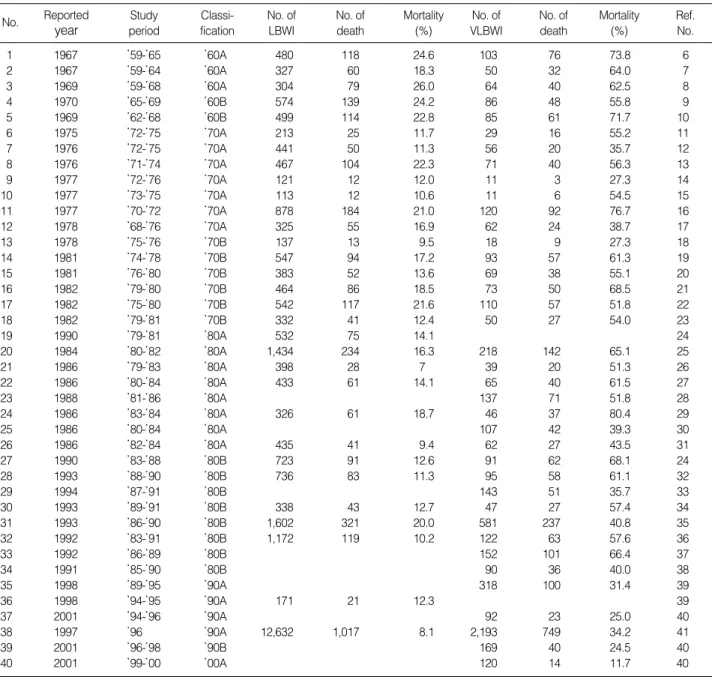
Table 1 shows the number of births and deaths of LBWI and VLBWI from the 36 reports (6-41). First, the samples were divided into LBWI and VLBWI, and the number of deaths among LBWI and VLBWI were estimated in 5-yr intervals and in 10-yr intervals. Then, the numbers of deaths of LBWI and VLBWI were converted into percentages against the numbers of total LBWI or VLBWI, respectively.
The number of LBWI in the second half of the 1990s and the first half of the 2000s was not reported, therefore, is not
No. Reported year
Study period
Classi- fication
No. of LBWI
No. of death
Mortality (%)
No. of VLBWI
No. of death
Mortality (%)
Ref.
No.
1 1967 ’59-’65 ’60A 480 118 24.6 103 76 73.8 6
2 1967 ’59-’64 ’60A 327 60 18.3 50 32 64.0 7
3 1969 ’59-’68 ’60A 304 79 26.0 64 40 62.5 8
4 1970 ’65-’69 ’60B 574 139 24.2 86 48 55.8 9
5 1969 ’62-’68 ’60B 499 114 22.8 85 61 71.7 10
6 1975 ’72-’75 ’70A 213 25 11.7 29 16 55.2 11
7 1976 ’72-’75 ’70A 441 50 11.3 56 20 35.7 12
8 1976 ’71-’74 ’70A 467 104 22.3 71 40 56.3 13
9 1977 ’72-’76 ’70A 121 12 12.0 11 3 27.3 14
10 1977 ’73-’75 ’70A 113 12 10.6 11 6 54.5 15
11 1977 ’70-’72 ’70A 878 184 21.0 120 92 76.7 16
12 1978 ’68-’76 ’70A 325 55 16.9 62 24 38.7 17
13 1978 ’75-’76 ’70B 137 13 9.5 18 9 27.3 18
14 1981 ’74-’78 ’70B 547 94 17.2 93 57 61.3 19
15 1981 ’76-’80 ’70B 383 52 13.6 69 38 55.1 20
16 1982 ’79-’80 ’70B 464 86 18.5 73 50 68.5 21
17 1982 ’75-’80 ’70B 542 117 21.6 110 57 51.8 22
18 1982 ’79-’81 ’70B 332 41 12.4 50 27 54.0 23
19 1990 ’79-’81 ’80A 532 75 14.1 24
20 1984 ’80-’82 ’80A 1,434 234 16.3 218 142 65.1 25
21 1986 ’79-’83 ’80A 398 28 7 39 20 51.3 26
22 1986 ’80-’84 ’80A 433 61 14.1 65 40 61.5 27
23 1988 ’81-’86 ’80A 137 71 51.8 28
24 1986 ’83-’84 ’80A 326 61 18.7 46 37 80.4 29
25 1986 ’80-’84 ’80A 107 42 39.3 30
26 1986 ’82-’84 ’80A 435 41 9.4 62 27 43.5 31
27 1990 ’83-’88 ’80B 723 91 12.6 91 62 68.1 24
28 1993 ’88-’90 ’80B 736 83 11.3 95 58 61.1 32
29 1994 ’87-’91 ’80B 143 51 35.7 33
30 1993 ’89-’91 ’80B 338 43 12.7 47 27 57.4 34
31 1993 ’86-’90 ’80B 1,602 321 20.0 581 237 40.8 35
32 1992 ’83-’91 ’80B 1,172 119 10.2 122 63 57.6 36
33 1992 ’86-’89 ’80B 152 101 66.4 37
34 1991 ’85-’90 ’80B 90 36 40.0 38
35 1998 ’89-’95 ’90A 318 100 31.4 39
36 1998 ’94-’95 ’90A 171 21 12.3 39
37 2001 ’94-’96 ’90A 92 23 25.0 40
38 1997 ’96 ’90A 12,632 1,017 8.1 2,193 749 34.2 41
39 2001 ’96-’98 ’90B 169 40 24.5 40
40 2001 ’99-’00 ’00A 120 14 11.7 40
Table 1.Summary of reports in mortality of low birth weight infant (LBWL) and very low birth weight infant (VLBWI) during last forty years (1960-2001) in Korea
A, first half of the decade; B, second half of the decade.
included in this study.
RESULTS
Mortality rate changes of LBWI and VLBWI by 5-yr intervals
As shown in Fig. 1, the mortality rates of LBWI in the first half and the second half of the 1960s was 23.1 and 23.6%
respectively. Those numbers drastically decreased to 17.3%
and 16.8% in the 1970s, 14.1% and 14.4% in the 1980s, and 8.1% in the early 1990s.
In Fig. 1, the mortality rates of VLBWI were 68.2% and 63.7% in the early and late 1970s respectively. These num- bers also fell over the last 40 yr to 55.8% and 57.6% in the 1970s, to 56.2% and 48.1% in the 1980s, to 33.5% and 24.5% in the 1990s, and to 11.7% in the early 2000s.
Mortality rate changes of LBWI and VLBWI by 10-yr intervals
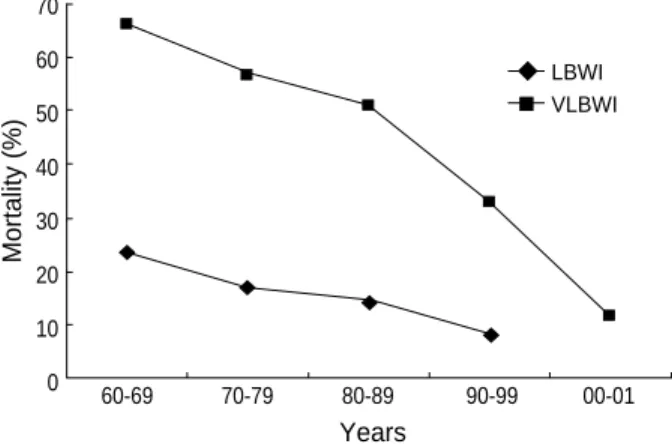
Fig. 2 shows the changes in mortality rates of LBWI and VLBWI by 10-yr intervals. The mortality rates of LBWI were 23.4% in the 1960s, 17.0% in the 1970s, 14.2% in the 1980s, and 8.1% in the 1990s. Those of VLBWI were 66.2% in the 1960s, 56.8% in the 1970s, 50.8% in the 1980s, 32.9% in the 1990s and 11.7% in the 2000s. As shown above, the mor- tality rates have fallen quite dramatically over the last 40 yr.
DISCUSSION
According to the definition used by the World Health Or- ganization (WHO) (2, 3), neonates are categorized based on their gestational ages. That is, a premature infant or preterm infant is born in less than 37 weeks of gestation, a term infant
in 37-41 weeks, and a post-term infant in over 42 weeks. In terms of birth weight, an infant under 2,500 g is categorized as a LBWI. Among these LBWIs, an infant under 1,500 g is categorized as a VLBWI, and an infant under 1,000 g as an extremely low birth weight infant (ELBWI) (2, 3). Even th- ough post-term infants, premature infants and LBWI all are high-risk neonates, VLBWI is the main target of neonatal intensive care because VLBWI has especially high mortality rates.
In order to reduce infant mortality rate, improvement in neonatal mortality rates should be the priority, and it is essen- tial to improve the survival rates of premature infants, espe- cially those of LBWI and VLBWI. Thanks to the recent im- provement in neonatal intensive care units, care for premature infants have been improving. This intensive care is the focus in the care of LBWI and VLBWI, and this improvement in the care for premature infants is ultimately contributed to the improvement of neonatal prognosis.
The purpose of this study is to find out how much the mor- tality rates of LBWI and VLBWI have changed and improved in Korea based on analysis of the reports from the past 40 yr.
Discussing the progress of neonatal care in Korea, the first separate neonatal unit was opened in the 1960s and began to take care of neonates independently. In the 1970s, a special- ized room for the care of premature infants was opened. In the 1980s, neonatal intensive care units were established to give focused treatment for high-risk infants and premature infants, and mechanical ventilator care and incubator care became widespread. Since 1990, the use of artificial surfactant replace- ment therapy became common in treating respiratory distress syndrome, which is the most serious disease for premature infants because its morbidity and mortality rates are the high- est of the diseases of premature infants. Pulmonary surfactant replacement therapy reduced mortality rates and improved prognosis for premature infants. In 2000, opening the new millennium, management of neonates and premature infants reached toadies situation with the help of evolution of system
Mortality (%)
Years
LBWI VLBWI 80
70 60 50 40 30 20 10 0
60A 60B 70A 70B 80A 80B 90A 90B 00A
Fig. 1.Changes of mortality in 5-yr interval of low birth weight infant (LBWI) and very low birth weight infant (VLBWI) in Korea. A, first half of the decade; B, second half of the decade.
Mortality (%)
Years
LBWI VLBWI 70
60 50 40 30 20 10
0 60-69 70-79 80-89 90-99 00-01
Fig. 2.Changes of mortality in 10-yr interval of low birth weight (LBWI) infant and very low birth weight infant (VLBWI) in Korea.
30 Y.-M. Bae, C.-W. Bae
and quality improvement of staff, spaces, medicine, ma- chines, and skills (4, 5).
This progress of neonatology and the improvement of skills, new drugs, and equipment resulted in the decrease in the mor- tality rates of LBWI, as shown above. The mortality rates of 23.1% in the first half of the 1960s and 23.6% in the second half of the 1960s fell to 8.1% in the 1990s. In 10-yr intervals, the mortality rate of 8.1% in the 1990s shows conspicuous progress in the improvement of mortality rate, compared to 23.4% in the 1960s. The mortality rates of VLBWI in the first half and the second half of the 1960s were 68.2% and 63.7%, respectively. Their numbers decreased by a lot to 11.7% in the first half of the 2000s. In the 10-yr intervals, 66.2% in the 1960s went down to 11.7% in the 2000s.
Based on the analysis of this study, the mortality rates were compared with the those of the U.S.A. and Japan. The changes of VLBWI survival rates in Korea, the U.S.A., and Japan in the 1980s and 1990s, shown in Fig. 3, are as follows: 30% in Korea, 79% in Japan, and 72% in the U.S.A. in 1985; 64%
in Korea, 86% in Japan, and 82% in the U.S.A. in 1990; 72%
in Korea, 89% in Japan, and 86% in the U.S.A. in 1995 (4, 5, 42). The survival rate in Korea has not reached that of the developed countries yet. However, in 2000 the survival rate for VLBWIs reached 88% in one hospital. Such progress is very encouraging, although based only on the results of a single hospital.
According to the report from the Korean Society of Neona- tology in 2002, the frequency of LBWI and VLBWI in 2001 among 109,316 births in 74 hospitals in Korea was 7.5% and 1.4%, respectively (43). The Korean Statistics Office reported that the number of births was 570,000 in 2001 (44). There- fore, it can be estimated that there are 42,750 LBWI and 7,980 VLBWI each year. To improve the survival rates, appro- priate intensive care for neonates is necessary. For these, the various efforts to improve not only the prognosis of premature infants but also that of LBWI and VLBWI should be followed from improvement of staffs and equipment in neonatal inten- sive care units, to diverse support systems in societies, to the
change of attitude to premature infants, to teamwork, etc.
As the result shows, the progress in the management of LBWI and VLBWI over the past 40 yr was noticeable in Korea; however, it has not reached the level of the U.S.A. or Japan yet. The limitation of survival of a premature infant is a minimum of a 23-24 weeks of gestational period and a min- imum of 500 g of birth weight. We need to make an effort to reduce the infant and neonatal mortality rates by the improved treatment of micro-preemies who are born after 23-24 weeks of gestational period or with 500 g of birth weight.
In conclusion, hospitals began to have neonatal nursery units in the 1960s and premature infant care units in the 1970s in Korea. Neonatal intensive care units were established and mechanical ventilator care became available in the 1980s. Arti- ficial surfactant replacement therapy for respiratory distress syndrome has been used since the 1990s. With the adoption of these measures, the mortality rate of LBWI and VLBWI has gone down remarkably over the last 40 yr. The decrease in mortality rates of LBWI and VLBWI due to the progress of neonatology is very encouraging since the recent rates are comparable to those of developed countries such as Japan and the U.S.A. We need to make further efforts to reduce the mor- tality rates of all infants by reducing mortality rates of LBWI and VLBWI.
REFERENCES
1. Hong CE. Textbook of pediatrics 7th ed. Seoul: Korean Textbook Co, 2001: 15-21.
2. World Heath Organization (WHO). Prevention of perinatal morbid- ity and mortality. Public Health Papers No. 42, Geneva, WHO, 1969.
3. World Heath Organization (WHO). Methodology of reporting and analysis of perinatal and maternal morbidity and mortality. Recom- mendations of World Heath Organization, Expert Committee, Bris- tol, WHO, 1972.
4. Bae CW. Neonatal viability, morbidity, mortality and outcome of very low birth weight infant. J Korean Pediatr Soc 2000; 43: 1-12.
5. Bae CW. Recent advances of mortality, morbidity and outcome in very low birth weight infant in Korea. Korean J Perinatol 2000; 11:
131-41.
6. Kim BK, Kim JH, Kim KJ, Choi BJ, Yun DJ. Fetal and neonatal mortality and neonatal morbidity. J Korean Pediatr Soc 1967; 10:
145-52.
7. Kim JW, Lee KS. Statistical observation on the causes of birth and death in the premature infants. J Korean Pediatr Soc 1967; 10: 467- 73.
8. Park TK, Yoo YD, Sohn KC, Lee KS. A clinical observation for the premature infants. J Korean Pediatr Soc 1969; 12: 307-14.
9. Han RT, Pi SY, Ko KW. Statistical observation for prematurity and low birth weight infant. J Korean Pediatr Soc 1970; 13: 683-8.
10. Kim YS. Statistical study of the maternal mortality and the perinatal mortality. Korean J Obstet Gynecol 1969; 12: 215-23.
11. Choo BY. Statistical observation on neonates. J Korean Pediatr Soc
Survival Rate (%)
Korea Japan U.S.A.
1985 100
90 80 70 60 50 40 30 20 10 0
Fig. 3.Comparison of survival rate of very low birth weight infant (VLBWI) in Korea, Japan, and U.S.A.
1990 1995
1975; 18: 917-27.
12. Jo JH, Chung WK. Neonatal mortality in newborn nursery. J Korean Pediatr Soc 1976; 18: 576-83.
13. Lee HK, Kim CK. Statistical and clinical observation for prematuri- ty and low birth weight infant. J Korean Pediatr Soc 1976; 19: 835-42.
14. Nam SD, Lee IB, Kim HK, Lee HC, Ra CS. Clinical observation for low birth weight infant. J Korean Pediatr Soc 1977; 20: 532-9.
15. Kim JH. Clinical and statistical observation on neonates. J Korean Pediatr Soc 1977; 20: 365-76.
16. Lee SI. A statistical study of prematurity and low birth weight. J Kore- an Pediatr Soc 1977; 20: 347-56.
17. Kong KS, Suk JW, Ahn DH, Sohn KC. A clinical observation on the premature and low birth weight infants. J Korean Pediatr Soc 1978;
21: 792-8.
18. Lee KD, Lee HS, Yun CK. Clinical observation on prematurity and low birth weight. J Korean Pediatr Soc 1978; 21: 176-81.
19. Park MK, Kim CH, Lee SJ, Lee K. Early neonatal mortality rate; neo- natal factors. J Korean Pediatr Soc 1981; 24: 920-7.
20. Lee CO, Koh EH, Sin SM, Lee SJ. Clinical and statistical observation for low birth weight infants. J Korean Pediatr Soc 1981; 24: 1142-8.
21. Kim KN, Kim JW, Cho KH, Kwak YH. Clinical observation for pre- maturity and low birth weight infant. J Korean Pediatr Soc 1982; 25:
1197-201.
22. Chang SH, Kim YG, Huh C, Lim BK, Kim JS. Clinical study of low birth weight infants. J Korean Pediatr Soc 1982; 25: 898-904.
23. Chun SH, Moon SW, Park SK, Kim JJ, Shin DH. Clinical and sta- tistical observation for low birth weight infants. J Korean Pediatr Soc 1982; 25: 429-35.
24. Kang HJ, Joo NH, Byun SO, Oh JS. Statistical observation on neonate.
J Korean Pediatr Soc 1990; 33: 1037-47.
25. Suh BK, Lee DK, Lee BC. Neonatal mortality rate. J Korean Pediatr Soc 1984; 27: 425-31.
26. Kim KU, Moon MS, Koh SY, Lee DW, Lee SJ. Clinical observation for low birth infant. J Korean Pediatr Soc 1986; 29: 18-25.
27. Shim WS, Kim YT. Early neonatal mortality rate in newborn nurs- ery. J Korean Pediatr Soc 1986; 29: 1087-93.
28. Kim SJ, Namgung R, Lee C, Han DG. The result of intensive care on the very low birth weight infants (1,001-1,500 gm). J Korean Pediatr Soc 1988; 31: 29-39.
29. Sohn KY, Hwang CG, Kim KB. Clinical and statistical observation
for low birth weight infants. J Korean Pediatr Soc 1986; 29: 411-9.
30. Kim RA, Kim YJ, Kim KH, Lee K. Clinical observation on very low birth weight infants. J Korean Pediatr Soc 1986; 29: 26-31.
31. Kim SM, Choi KC, Jeong SJ. Clinical and statistical observation for prematurity and low birth weight infants. J Kyung Hee Univ Med Cent 1986; 2: 11-7.
32. Park DI, Kim CG, Hwang JB, Han CH, Chung HL, Kwon YD. Sta- tistical observation on neonate. J Korean Pediatr Soc 1993; 36: 1080- 92.
33. Choi SY, Jang DY, Lee OK, Kim WS. Clinical study on very low birth weight infants. J Korean Pediatr Soc 1994; 37: 628-35.
34. Lee HJ, Kwon SW, Byun SO, Oh JS. Clinical observation for low birth weight infants. J Korean Pediatr Soc 1993; 36: 928-34.
35. Jeon SS, Lee WM, Choi YS, Seo SS. Clinical survey of very low birth weight infant. J Korean Pediatr Soc 1988; 31: 1120-5.
36. Kang SA, Choi JK, Oh YK. Statistical study on the incidence and mortality rate of low birth weight infant. J Korean Pediatr Soc 1992;
35: 1690-5.
37. Lee JS, Yeo MY, Lim BH, Lee SG. Clinical observation on very low birth weight infants. J Korean Pediatr Soc 1992; 35: 44-9.
38. Park SS, Jung JH, Lee DH, Lee SJ. Clinical and statistical observa- tion for very low birth weight infants. J Korean Pediatr Soc 1991; 34:
1629-39.
39. Kim KS. Survival limit of very low birth weight infant. Korean J Peri- natol 1998; 39-41.
40. Shim JW, Kim KS, Kim MH, Chang YS, Kang IS, Park WS, Lee MH, Lee SI, Lee HJ. Changes in the outcomes of very low birth weight infants. The 51st Annual Autumn Meeting. Korean Pediatr Soc 2001:
154.
41. Bae CW, Kim MH, Chun CS, Lee C, Moon SJ, Yoo BH, Lim BK, Lee SG, Choi YY, Byun SH, Choi AH, Pi SY, Han DG, Yun CK. Ne- onatal Statistics of Korea in 1996: collective results of live births, neona- tal mortality, and incidence of discharge against medical advice at 64 hospitals. J Korean Soc Neonatol 1997; 4: 153-69.
42. Vermont Oxford Network 1996 Database Summary. Vermont Oxford Network. 1997: [email protected]
43. Shin SM, Choi YY. Statistical analysis of newborn in Korea. The 9th Annual Autumn Meeting. Korean Soc Neonatol 2002; 53.
44. Statistical Report. Korea National Statistical Office. 2001: http://www.
nso.go.kr