This is an Open Access article distributed under the terms of the Creative Commons Attribution License (http://creativecommons.org/licenses/by/4.0) which permits unrestricted use, distribution, and reproduction in any medium, provided the original work is properly cited.
Copyright © 2021 Korean Society of Women Health Nursing
Development and application of a couple-centered antenatal education program in Korea
Minseon Koh
1, Jisoon Kim
2, Hyeji Yoo
3, Sun A Kim
3, Sukhee Ahn
31
College of Nursing, Yeoju Institute of Technology, Yeoju, Korea
2
Department of Nursing, Woosong University, Daejeon, Korea
3
College of Nursing, Chungnam National University, Daejeon, Korea
Purpose: This study was conducted to develop a couple-centered antenatal education program and
to test the program’s feasibility.
Methods: With a preliminary-experimental study design, 33 pregnant couples who were expecting
their first child participated in this study. The program consisted of four sessions (1 hour/session/
week) of education and counseling. Data were collected before and after the intervention from Sep- tember 2018 to April 2019 at a women’s hospital in Daejeon, Korea, with demographic data forms, the Edinburgh Postnatal Depression Scale, Perceived Stress Scale, Maternal-Fetal Attachment Scale, Korean Newborn Care Confidence Scale, Wijma Delivery Expectancy/Experience Questionnaire, and Dyadic Adjustment Scale-10.
Results: The pregnant women and their husbands were on average 32.30±3.10 and 33.21±6.25
years old, respectively. The mean marriage duration was 2.34±1.63 years, the gestational age was 31.30±2.66 weeks, and 78.8% of the couples had a planned pregnancy. After the program, both the pregnant women and their husbands showed significant improvements in attachment to the fetus and confidence in providing infant care. Prenatal depression, prenatal stress, and fear of childbirth in pregnant women significantly decreased after completing the program. However, the dyadic adjust- ment score did not change significantly either in the pregnant women or their husbands.
Conclusion: A couple-centered antenatal education program seems to be effective for couples ad-
justing to parenthood, but further studies should explore ways to have a positive impact on couples’
relationships.
Keywords: Marriage; Parents; Pregnant woman; Prenatal education; Spouses
Introduction
Parenthood begins with having the first child; pregnancy is a time of preparation, and the postpartum period is a time of change in the marital relationship due to the new parental role [1]. Anxiety, depression, and changes in marital relationships during pregnancy are associated with the fear of childbirth [2] and an increased risk of preterm birth and low birthweight [3]. The needs and chal- lenges, birth experiences, and changes in roles and relationships of
pISSN 2287-1640 · eISSN 2093-7695Korean J Women Health Nurs 2021;27(2):141-152 https://doi.org/10.4069/kjwhn.2021.06.20
Received: April 28, 2021 Revised: June 19, 2021 Accepted: June 20, 2021 Corresponding author:
Sukhee Ahn
College of Nursing, Chungnam National University, 266 Munhwa- ro, Jung-gu, Daejeon 35015, Korea Tel: +82-42-580-8324
E-mail: [email protected] This article is based on the doctoral dissertation of the first author (Minseon Koh) from Chungnam National University.
pregnant women cause maternal stress [4]. In their husbands, negative emotions and fears related to the father identity and fa- ther role lead to stress [5], and mothers and fathers adapt differ- ently to parenthood due to their different experiences of pregnan- cy and childbirth [6]. Therefore, prenatal education programs need to provide information for both prospective fathers and mothers [7].
Worsening of the marital relationship has a negative effect on
attachment to the fetus, as well as the process of adapting to
changes in the marital relationship during the transition period [8]. Conversely, higher satisfaction in the marital relationship during pregnancy and maintenance of a good relationship im- prove adaptation to the parental role in the postpartum period [9]. Preparing for the parental role together and maintaining the marital relationship facilitate the parental transition process [10].
In a gender-equal society, there is little difference in the roles of mothers and fathers as parents; therefore, gender-equal prenatal education should be provided when fathers participate in preg- nancy and childrearing [11,12].
Mercer [13] theorized that during the process of becoming a mother, the family is a dynamic system that includes mother-fa- ther, maternal-fetal, and paternal-fetal interactions, and that the role of the mother is affected by the interactions of the mother with the father and baby. However, this framework leaves the fa- ther as a supporter to help his partner become a mother, over- looking the process of becoming a father; this has led to a ten- dency for husbands to be alienated from prenatal education [13].
The process of parental change is an experience shared by cou- ples [14] and an inter-couple process [15], meaning that a com- prehensive approach is needed in the process of becoming par- ents for both pregnant women and their husbands. Therefore, the theory of becoming a mother by Mercer [13] needs to be ex- panded to an approach to becoming parents that includes both spouses. In addition, prenatal education that includes communi- cation and mutual support is effective in promoting adaptation in the marital relationship during the transition period [16]. A recent meta-analysis of the effects of psychoeducation for couples com- bining the parental aspect and couple-relationship education also reported that such interventions reduce negative effects, such as postpartum depression, on the maternal and paternal side, and improve couple-relationship satisfaction [17]. The authors argued that couple-centered prenatal education is more effective if it
combines elements of the parental role and marital relationship [16].
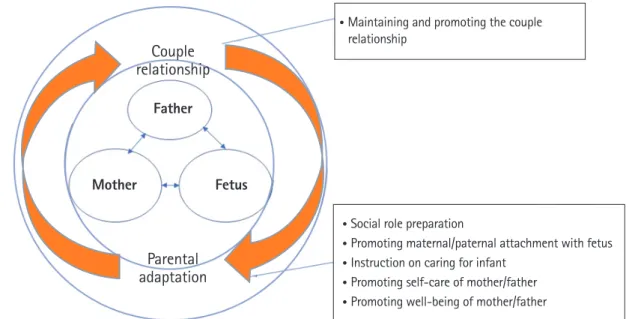
Most prenatal education in Korea (hereafter, Korea) is provid- ed for only pregnant women (64.4%), with a focus on delivery, breastfeeding, and infant care; meanwhile, very few studies have explored interventions dealing with mother-father interactions or couple relationships [18], leaving a gap in the literature that needs to be addressed. Interventions for pregnant couples who are transitioning to parenthood are needed to help couples adapt to becoming parents and to address the couple relationship. The purpose of this study was to develop a couple-centered antenatal education program to help couples better adapt to becoming par- ents and to address aspects of the couple relationship, and then to confirm its effectiveness and applicability based on Mercer’s theory of becoming a mother [13] (Figure 1).
The hypotheses of this study were as follows.
1) Pregnant couples who participate in the couple-centered ante- natal education program will have a better adaptation to be- coming parents, as shown by measures including prenatal de- pression, prenatal stress, fetal attachment, newborn-care con- fidence, and mother’s fear of childbirth.
2) Pregnant couples who participate in the couple-centered ante- natal education program will improve their adaptation to the couple relationship, as measured by the couple’s dyadic ad- justment.
Methods
Ethics statement:
This study approved was by the Institutional Review Board of Chungnam National University (201806-SB- 063-01). Informed consent was obtained from the partici- pants.
Summary statement
• What is already known about this topic?
Couple-centered prenatal education is more effective if it combines elements dealing with the parental role and the marital re- lationship, such as communication and mutual support. However, the effects of such interventions need to be confirmed.
• What this paper adds
This study developed a couple-centered antenatal education program incorporating a model of becoming parents and showed its effec- tiveness and feasibility.
• Implications for practice, education, and/or policy
The couple-centered antenatal education program presented herein was effective for couples adjusting to parenthood; therefore,
this comprehensive program can be implemented in maternity practice.
Study design and setting
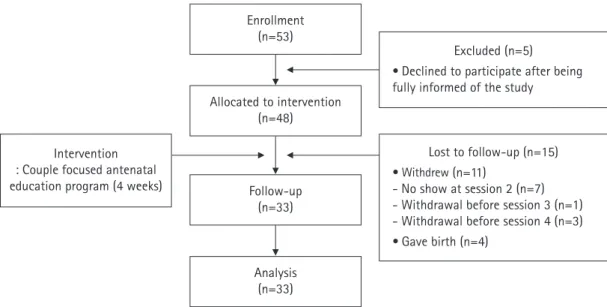
The couple-centered antenatal program was developed by the first author through multiple stages of program development, as shown in Figure 2. This program was delivered by the first author and a midwife at a women’s hospital in Daejeon, Korea, with a single-group pretest-posttest study design from September 2018
to April 2019. A member of the research team explained the study and the possibility of participation to couples in the outpa- tient waiting room. If they voluntarily agreed to participate, they received information about the program schedule, a preliminary survey was conducted, and a follow-up investigation was con- ducted immediately after they finished the fourth session of the
Figure 1. Conceptual framework of pregnant couple’s becoming parents.Figure 2. Development process of the couple-centered antenatal education program.
• Maintaining and promoting the couple relationship
• Social role preparation
• Promoting maternal/paternal attachment with fetus
• Instruction on caring for infant
• Promoting self-care of mother/father
• Promoting well-being of mother/father
Step 1 Preparation for development Researcher preparation
• Maternal nursing/newborn child nursing experience
• Research in maternity nursing
• Personal psychology and family counseling certificate acquistion
• Health, psychology and marital relationship counseling experience with pregnant women and mothers
Step 2 Literature review Review of prior research and confirmation of theoretical basis
Step 3 Program development Couple-centered antenatal education program for becoming parents - focused on couple relationship, maternal-fetal, paternal-
fetal interaction
Step 4 Expert review and
confirmation Midwife (1), nurses (8) and maternity and women's health nursing faculty (2), review of women's health research team (8)
Couple relationship
Father
Mother Fetus
Parental
adaptation
program (1 hour/session/week).
Participants
The study participants were married couples, including women who were pregnant with their first child at 28–34 weeks of gesta- tion, because couples who answered that they were well prepared in the third trimester were found to adapt well in the postpartum period [19]. Since this prenatal educational program targeted low-risk segments of the general population, pregnant women who had complications (such as gestational diabetes, hyperten- sion, or placental and cervical problems) or multiple pregnancies were excluded; additionally, couples were excluded if either the pregnant woman or the husband had any other health problems.
The required sample size was calculated based on effect sizes (d) of 1.71 and 0.47 for a childbirth education pilot study aimed at preventing fear of childbirth and depression, respectively, among pregnant women [20]. For the effect size (d) of 0.47 for depression, a significance level of 0.05 (one-tailed), and a statisti- cal power of 0.80, a sample of at least 30 people was required.
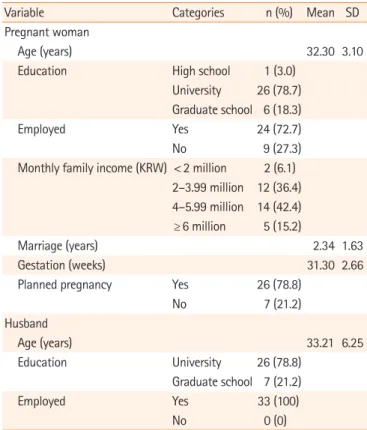
This study therefore recruited 48 couples, of which 11 couples either withdrew from the study or did not present to a scheduled appointment) and four couples gave birth during the interven- tion period, meaning that 33 couples participated in the pretest, the intervention program, and the posttest (Figure 3). This study followed the Transparent Reporting of Evaluations with Nonran- domized Designs (TREND) statement [21] to improve the re- porting quality of nonrandomized evaluations of behavioral in- terventions.
Intervention program Program development
A couple-centered antenatal education program was developed to help couples’ adaptation to become parents and their relation- ship. The environmental interaction model [22] of the process of becoming a mother was used as a theoretical basis for the educa- tional program. A couple-centered psychoeducation method was selected according to the results of a previous study [23].
Through a critical evaluation of various studies [16-18,20,24-29]
of effective nursing interventions to help parental adaptation and couple relationships, the content and methods of the program were specifically constructed. In order to confirm the validity of the content of the educational program, the initially developed program was reviewed by experts, including nurses and midwives in women’s hospitals, maternity and women’s health nursing pro- fessors, and women’s health researchers. In addition, after listen- ing to the opinions of women who had experienced pregnancy and childbirth within the past 3 years, content related to the hus- band’s pregnancy experience and massage was added to the in- tervention program (Figure 2).
Program content
The couple-centered antenatal education program applied in this study (Table 1) had two main content areas: adaptation of the couple relationship [16-17,23] and becoming parents for couples [13,22]. The content on couple-relationship adaptation included emotional intimacy, support, respect, empathy, gratitude, and emotional exchange between couples from pregnancy to the
Figure 3. Flow diagram of the study.
Enrollment (n=53)
Follow-up (n=33) Allocated to intervention
(n=48) Intervention
: Couple focused antenatal education program (4 weeks)
Excluded (n=5)
• Declined to participate after being fully informed of the study
Lost to follow-up (n=15)
• Withdrew (n=11)
- No show at session 2 (n=7) - Withdrawal before session 3 (n=1) - Withdrawal before session 4 (n=3)
• Gave birth (n=4) Analysis
(n=33)
postpartum period as ways to deal with marital problems and difficulties. The content dealing with becoming parents included promoting well-being in response to physical and mental chang- es, discomfort, depression, and stress, self-care, parental-fetal at- tachment, preparation for normal delivery, and preparation for the parenting role (e.g., newborn baby care and breastfeeding).
Each session set 2 to 3 specific goals for couples, such as so- cial-role preparation, instructions on infant caregiving, and the
promotion of fetal attachment, self-care, and well-being.
Application of the program
Two nurses (a women’s health nurse and a midwife/breastfeed- ing expert) provided the educational program in four sessions, each of which lasted for 1 hour in the childbirth education room of the hospital. The size of each intervention group was decided based on couples’ needs, with the education provided to one to
Table 1. The couple-centered antenatal education programGoal based on the ecological
interaction model Methods Content
Session 1: Becoming happy parents (1 hour by a midwife) Social-role preparation Education, information,
practice, Q&A Happy environment, relieving stress, and participation of the husband Attachment promotion: parental-fetal
attachment Talking and singing with finger movement for the fetus
Self-care promotion: preparation for a
normal delivery Education, information,
practice, Q&A Normal delivery process and husband roles
Method of how to breathe, relax, and massage to relieve the pain Session 2: Becoming competent parents (1 hour by a midwife)
Social-role preparation Education, information, Q&A Newborn care in growth and development, normal reflex reactions, and getting used to baby signals, father–child care
Infant-caregiving instruction Education, information, Q&A Advantages of breastfeeding (for mother and baby), and breastfeeding method, baby’s signals, and deep breastfeeding (latch and positioning)
Practice, Q&A Breast massage and breastfeeding, holding a baby, feeding and burping, sooth- ing a crying baby, changing diapers, bathing, and managing the umbilical cord Session 3: Becoming a happy couple and family (1 hour by a women’s health nurse)
Well-being promotion Education, information,
conversation, Q&A 1. Physical and mental changes in the pregnant woman and her husband 2. Check the mother’s and father’s situations during the perinatal period and talk
about each other’s difficulties and how to help, and how to maintain the marital relationship
Experience 1. Husbands wear pregnancy simulator vest
Conversation practice 1. Identify usual communication patterns, and practice positive self-assertive communication
Self-care promotion Education, information,
Conversation, Q&A 1. Physical changes, and discomfort of pregnant women, and caution and self- care methods, importance of spousal support during the third trimester 2. Prenatal and postpartum depression, stress related to the parental transition
in couples, the importance of mutual support for couples, and self-care for couples, express their feelings with each other on parental transition Session 4: Becoming a happier couple (1 hour by a women’s health nurse)
Well-being promotion Education, information,
conversation practice, Q&A 1. Understanding and empathy between spouses, and the effects of the virtuous cycle of expressing gratitude and empathy
2. Identifying common marital problems in parents and discuss current marital problems or difficulties
3. Characteristics of well-adapting parents, the positive effects of hugging, and consideration for each other
Conversation practice 1.Thank-you messages (conversations and letter-writing) 2.Talk about what they want from others
Social-role preparation Education, information,
conversation Q&A 1. Importance of accepting and adapting to parenthood in a positive manner 2. Talking about the difficulties, burdens, and fears of childbirth
three couples at a time. The teaching method consisted of face- to-face education and counseling. Throughout the session, we provided education and information to help the couples discuss these topics, allocated time to practice skills such as expressing one’s own emotions and effective conversation techniques, and provided time for questions and answers. In addition, a small gift was presented to encourage participants to continue participat- ing in the program, and periodic text messages were sent as re- minders before scheduled appointments and to express apprecia- tion for the participants’ participation.
Measurements
The study variables were measured before and after the educa- tional program to test the program’s effectiveness. The researcher explained to the couple how to answer each questionnaire and asked them to respond separately to prevent couple-related dy- namics from affecting the responses. The measures for adapta- tion to becoming parents were prenatal depression and stress for the parents themselves, parental-fetal attachment for the paren- tal-fetal relationship, newborn-care confidence for becoming parents, and fear of childbirth for mother’s childbirth prepara- tion, while dyadic adjustment was used to measure adaptation of the couple relationship.
Prenatal depression
Depression in pregnant couples was measured using the Korean version of the Edinburgh Postnatal Depression Scale [30], which was translated by Kim et al. [31] and is one of the most widely used tools for assessing perinatal depression in both women and men [32]. The scale contains 10 items. Each item is scored on a 4-point Likert scale (0, no; 3, most of the time), and the total score thus ranges from 0 to 30. Scores above 10 are considered to indicate depression in Korea [31]. The reliability of the original instrument was indicated by a Cronbach’s α of 0.87 [30]; in the present study, Cronbach’s α was 0.77–0.78 in the pregnant wom- en and 0.56–0.63 in their husbands.
Stress
Stress in pregnant couples was measured using the Korean ver- sion of the Perceived Stress Scale [33], which was translated by Park and Seo [34]. The scale contains 10 items. Each item is scoredon a 5-point Likert scale (0, never; 4, very often); thus, the total score ranges from 0 to 40. The reliability of the original in- strument was indicated by a Cronbach’s α of 0.84–0.86 [33]; in the present study, Cronbach’s α was 0.78–0.83 in the pregnant women and 0.79–0.82 in their husbands.
Parental-fetal attachment
Parental-fetal attachment was measured using the Korean version of the Maternal-Fetal Attachment Scale [35], which was translat- ed by Kim [36]. The scale contains 25 items. Each item is scored on a 4-point Likert scale (1, never; 4, always) and the total score therefore ranges from 25 to 100. A higher score indicates a higher degree of fetal attachment [36]. Since this is a tool for measuring maternal-fetal attachment, paternal attachment was measured by reframing questions 22, 23, and 24 for a husband as dealing with pride and concern about his pregnant wife [36]. The reliability of the original tool was indicated by a Cronbach’s α of .84 [35]; in the present study, Cronbach’s α was 0.94–0.95 for maternal-fetal attachment and 0.93–0.94 for paternal-fetal attachment in the present study.
Newborn-care confidence
Confidence in caring for newborns was measured using a self-re- port questionnaire [37]. The 22-item scale is scored on a 5-point Likert scale (0, very uncertain; 5, very confident), and the total score thus ranges from 22 to 110. A higher score indicates higher confidence in raising newborns. The reliability of the original in- strument was indicated by a Cronbach’s α of 0.84 [37]; in the present, Cronbach’s α was 0.94–0.96 in the pregnant women and 0.95–0.97 in their husbands.
Maternal fear of childbirth
Childbirth fear in pregnant women was measured using the Ko- rean version of the Wijma Delivery Expectancy Questionnaire (version A) [38] before delivery, which was translated by Park et al. [39]. The scale contains 33 items, each of which is scored on a 5-point Likert scale (1, not at all; 5, extremely); therefore, the to- tal score ranges from 33 to 165. Higher scores indicate greater fear. The reliability of the original instrument was indicated by a Cronbach’s α of 0.87 [38]; in the present study, Cronbach’s α was 0.91–0.93.
Couple’s dyadic adjustment
Marital adaptability was measured using the Dyadic Adjustment Scale (DAS)-10 [40], which is a shortened Korean form of the DAS reported by Cho, Choi, Oh, and Kwon [41] that has demon- strated reliability and validity. The scale contains 10 items. Items are scored from 0 to 5 or 6 on a 5- or 6-point Likert (0: not at all;
5: always; and/or 6: perfectly), and the total score thus ranges
from 0 to 51. Higher scores indicate higher marital satisfaction,
and a cut-off point is 32 or higher is used as a categorical measure
of marital satisfaction [40]. The reliability of the DAS-10 was in-
dicated by a Cronbach’s α of 0.83 [41]; in the present study, Cron-
bach’s α was 0.77–0.83 in the pregnant women and 0.68–0.83 in their husbands.
General characteristics
Information was gathered on participants’ age, educational back- ground, occupation, marriage duration, family income, whether the pregnancy was planned, gestational age, and lactation plan.
Program satisfaction survey
Participants were asked about their satisfaction with the overall program content, the topic that they most enjoyed among the four sessions of the program, any material that they thought was missing or could have been supplemented, perceptions regarding any other educational content that would be needed in pregnan- cy and childbirth education, and the educational content that they desired in postnatal education programs.
Statistical analysis
The effect of the intervention in a single group was analyzed us- ing the one-tailed paired t-test using IBM SPSS ver. 25.0 (IBM Corp., Armonk, NY, USA).
Results
General characteristics
The pregnant women were 32.30±3.10 years of age (mean±stan- dard deviation), and their husbands were 33.21±6.25 years of age.
Almost all of the pregnant women (97.0%) and all of their hus- bands had at least a college education, 72.7% of the pregnant women and all of their husbands were employed, and 42.4% of the families had a monthly family income of 4–5 million Korean won (approximately 3,500–4,400 US dollars). The average mar- riage duration was 2.34±1.63 years, the average gestational age at the time of recruitment was 31.30±2.66 weeks, and 78.8% of the participants had a planned pregnancy (Table 2).
Changes in parental adaptation and dyadic adjustment of couples
Prenatal depression and stress
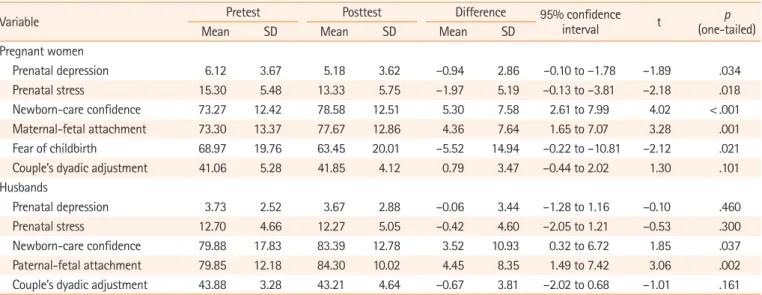
The score for prenatal depression of the pregnant women de- creased significantly from 6.12± 3.67 before the intervention to 5.18± 3.62 after the intervention (t= –1.89, p=.034). The score of the husbands decreased from 3.73± 2.52 to 3.67± 2.88, but this change was not significant (t= –0.10, p=.460). The stress score of the pregnant women decreased significantly from 15.30± 5.48 to 13.33± 5.75 (t= –2.18, p=.018), while their hus-
bands showed a non-significant decrease from 12.70± 4.66 to 12.27± 5.05 (t= –0.53, p=.300).
Parental-fetal attachment
The score for maternal-fetal attachment increased significantly from 73.30±13.37 to 77.67±12.86 (t=3.28, p=.001), as did that for paternal-fetal attachment, from 79.85±12.18 to 84.30±10.02 (t=3.06, p=.002).
Newborn-care confidence
The score for confidence in providing newborn care increased sig- nificantly from 73.27 ±12.42 to 78.58 ±12.51 in the pregnant women (t=4.02, p<.001) and from 79.88±17.83 to 83.39±12.78 in their husbands (t=1.85, p=.037).
Maternal fear of childbirth
Pregnant women’s score for fear of childbirth decreased significant- ly from 68.97±19.76 before the intervention to 63.45±20.01 after the intervention (t=–2.12, p=.021).
Couples’ dyadic adjustment
The score for marital adaptability increased from 41.06± 5.28
Table 2. Demographic characteristics of the pregnant couples
(N=33)
Variable Categories n (%) Mean SD
Pregnant woman
Age (years) 32.30 3.10
Education High school 1 (3.0)
University 26 (78.7) Graduate school 6 (18.3)
Employed Yes 24 (72.7)
No 9 (27.3)
Monthly family income (KRW) < 2 million 2 (6.1) 2–3.99 million 12 (36.4) 4–5.99 million 14 (42.4)
≥ 6 million 5 (15.2)
Marriage (years) 2.34 1.63
Gestation (weeks) 31.30 2.66
Planned pregnancy Yes 26 (78.8)
No 7 (21.2)
Husband
Age (years) 33.21 6.25
Education University 26 (78.8)
Graduate school 7 (21.2)
Employed Yes 33 (100)
No 0 (0)
KRW: Korean won (1 million KRW is approximately 900 US dollars).
before the intervention to 41.86 ± 4.12 after the intervention among pregnant women, but this change was not statistically sig- nificant (t= 1.30 p=.101). Their husbands’ scores decreased by 0.67 ± 3.81, from 43.88 ± 3.28 before the intervention to 43.21± 4.64 after the intervention, but this change was likewise not statistically significant (t= –1.01, p=.161) (Table 3).
Program adherence and applicability
Over the four sessions, two of the 33 couples were absent once, due to the difficulty of moving to another city and the poor con- dition of the pregnant woman on the day of the session. Educa- tional videos were provided to the couples who were absent, and after watching they gave their impressions as well as their answers to questions. The program completion rate was 100% when eval- uated based on the pregnant couples participating in three of the four sessions, corresponding to a 78% attendance criterion.
After completing the prenatal education program, 50.0% of the participants were very satisfied, and 41.4% were satisfied. Satis- faction with the educational topics was highest for newborn care (54.8%), followed by preparation for childbirth (25.0%), com- munication within couples (12.4%), and adaptation to the preg- nancy and postpartum periods (7.8%).
Discussion
Development of the couple-centered antenatal education program
This study is the first in Korea to apply couple-centered educa- tion in mainstream prenatal education to help adaptation to par- enthood in terms of both the marital relationship and the paren-
tal role. A unique aspect of the program is that the educational content was well-balanced in terms of adaptation to the parental role and interactions between spouses. In addition, the present study contributes to the expansion of nursing theory and the for- mation of a body of knowledge in nursing science by construct- ing a theoretical model of becoming parents for pregnant couples based on the theory of becoming a mother and the intervention effects [22].
The content related to parental adaptation dealt with physical, emotional, and relational changes during pregnancy and postpar- tum, childbirth preparation, and newborn care. Content related to maintaining the couple relationship was also included, since the couple relationship serves as an important psychological ba- sis for the couple to perform the parental role together [42]. This enabled the pregnant women and their husbands to prepare for becoming parents during pregnancy, while meeting the demands of pregnancy, childbirth, and the postpartum period. This ap- proach reflects the fact that fathers are also active in preparing for parental change and have increased expectations [10,12]. Ac- cordingly, the beneficiaries of education were both mothers and fathers, and the program was designed to help them maintain a mutually supportive relationship through dialogue and sympathy for understanding each other and physically and mentally pre- paring for parenthood.
The education on couple-relationship adaptation included emotional intimacy, support, respect, empathy, and emotional exchange between partners after pregnancy and childbirth. This program was offered at an appropriate time for couples to partici- pate together. On-site participation was chosen based on evi- dence that this setting is effective and that participants prefer to
Table 3. Effectiveness of the couple-centered antenatal education intervention (N=33)
Variable Pretest Posttest Difference 95% confidence
interval t p
(one-tailed)
Mean SD Mean SD Mean SD
Pregnant women
Prenatal depression 6.12 3.67 5.18 3.62 –0.94 2.86 –0.10 to –1.78 –1.89 .034
Prenatal stress 15.30 5.48 13.33 5.75 –1.97 5.19 –0.13 to –3.81 –2.18 .018
Newborn-care confidence 73.27 12.42 78.58 12.51 5.30 7.58 2.61 to 7.99 4.02 < .001
Maternal-fetal attachment 73.30 13.37 77.67 12.86 4.36 7.64 1.65 to 7.07 3.28 .001
Fear of childbirth 68.97 19.76 63.45 20.01 –5.52 14.94 –0.22 to –10.81 –2.12 .021
Couple’s dyadic adjustment 41.06 5.28 41.85 4.12 0.79 3.47 –0.44 to 2.02 1.30 .101
Husbands
Prenatal depression 3.73 2.52 3.67 2.88 –0.06 3.44 –1.28 to 1.16 –0.10 .460
Prenatal stress 12.70 4.66 12.27 5.05 –0.42 4.60 –2.05 to 1.21 –0.53 .300
Newborn-care confidence 79.88 17.83 83.39 12.78 3.52 10.93 0.32 to 6.72 1.85 .037
Paternal-fetal attachment 79.85 12.18 84.30 10.02 4.45 8.35 1.49 to 7.42 3.06 .002
Couple’s dyadic adjustment 43.88 3.28 43.21 4.64 –0.67 3.81 –2.02 to 0.68 –1.01 .161