사회 안전망을 위한 위기관리시스템 설계
Design of Emergency Management System for Societal Security Network
김윤호*, 강희조*
Yoon–Ho Kim
*, Hee-Jo Kang
*요 약
산업화가 고도화 되면서 인류는 자연재해는 물론이고 기술적 실수, 금융문제 등, 다양한 위기를 경험하고 있 다. 국제표준에 근거한 위기관리 시스템 설계는 조직이 예방, 대비 및 대응을 강화시킬 수 있는 가능성을 점진 적으로 증가시킬 수 있는 기본 틀을 제공해 준다. 본 연구에서는 사회 안전망을 위한 다양한 분야의 위기관리 시스템 설계를 소개하였다. 먼저 ISO/TC223의 역할과 현재 진행 중인 표준화 이슈들을 정리하였고 잠재적 위험 을 저감시키며 조직의 회복력을 증가시킬 수 있는 효과적인 위기관리 시스템을 설계하였다.
Abstract
In accelerating the industrialization, human being have been frequently experiencing man-made crisis such as technology failures, financial problem as well as natural disaster. Emergency management system based on international standard can provide an organization with a framework for continual improvement to increase the possibility of enhancing anticipation, prevention and response as well. In this paper, we introduced the emergency management system design of various organizations for societal security network. In the first, the main role of ISO/TC223 is reviewed and then, current issues of under going standardization in ISO are also addressed. Finally, we have designed a efficient disaster prevention system to minimize the potential risk as well as to improve the organizational resilience.
Key words : 국제표준(international standard), 사회안전(societal security), 국제표준화기구(ISO), 위기관리시스템(emergency management system), 재난상태(disaster status)
* 목원대학교 컴퓨터공학부 교수 ‧ 제1저자 (First Author) : 김윤호 ‧ 투고일자 : 2012년 10월 5일
‧ 심사(수정)일자 : 2012년 10월 5일 (수정일자 : 2012년 10월 26일) ‧ 게재일자 : 2012년 10월 30일
I. Introduction
Beyond the ubiquitous society, what kinds of key terms are to be expected in the future life style? The answers, may be, are summarized as “smart”, “security”
and “sustainability”. However, in recent years, there have been lots of highly consequential natural and man-made
disasters. The increasing risks of widespread disruption
arising from such incidents as natural and man-made
disasters, technological accidents, and emerging disease
have threatened the integrity of critical societal assets,
functions and infrastructure as well. These incidents
should be demonstrated that organizations must prepare
themselves to prevent minimize and control the adverse
한국항행학회 논문지 제16권 제5호 2012년 10월 880
consequences of these incidents [1][2].
Societal security considers and integrates a range of interconnected disciplines, such as risk management, crisis management, emergency management with its essential tools as crises communication and command and control, security management, disaster management and resilience. In addition, societal security covers a wide range of integrated activities such as preparedness, assessment, prevention, mitigation, response, etc.
In this paper, societal security standardization trend and current issues related with global standard of ISO/TC 223 in each countries have introduced. We have also intended to design the effective disaster management system to improve the possibility of enhancing anticipation as well as response.
Ⅱ. The role of ISO/TC223 societal security
International Standard enhances an organization’s capacity to take appropriate actions to identify opportunities and to ensure the organization’s continued viability. ISO, world wide symbol, the International Organization for Standardization is a non-government organization that forms a bridge between the public and private sectors. It is closely associate with the International Electro-technical Commission(IEC).
Many of it's member institutes, however, are part of the governmental structure of their countries, or are mandated by their government. On the other hand, other members of have their roots uniquely in private sector, having been set up by national partnership of industry associations [1]. The work of preparing International Standards is formally carried out through ISO technical committees. The main task of technical committees is to prepare International Standards. Draft International Standards adopted by the technical committees are circulated to the member bodies for voting. One of the well developed ISO bodies are the ISO 9000 family of standards which are related with ‘quality management’
and the other is ISO 14000 family of standards which addressed ‘environmental management’.
ISO/TC223 is one of the main group which is responsible for doing international standardization that provide protection from and response to risk of unintentionally and intentionally as well. This committee not only deals with naturally caused crises and disasters that disrupt and have consequences on societal function but also use an all-hazards perspective covering the phases of emergency and crisis management before, during, and after a societal security incident.
The scope of TC223 was defined as international standardization in the area of societal security, aimed at increasing crisis and continuity management and capabilities through technical, human and management approaches as well as operational functionality.
According to [2], the main objective of TC223 is to locate key technical domains and technologies that are surely candidates for standardization process within TC223. A series of ISO/TC223 standards is being developed [3] that will enhance societal resilience from various perspectives:
- ISO 22300, Vocabulary
- ISO 22301, Preparedness and continuity management systems – Requirements
- ISO 22311, Video surveillance for interoperability - ISO 22320, Command and control, information, coordination and cooperation for emergency management –Requirements
- ISO 22322, Public warning
- ISO 22397, Private and public partnerships - ISO 22398, Guidelines for exercises and testing - ISO 22399, Guideline for incident preparedness and operational continuity management.
The expected benefits of the work from ISO/TC223 are as follows[2]:
- provision of International Standards to enhance all actors capacity in society to handle all phases before, during and after an disruptive events;
- increased preparedness and continuity management
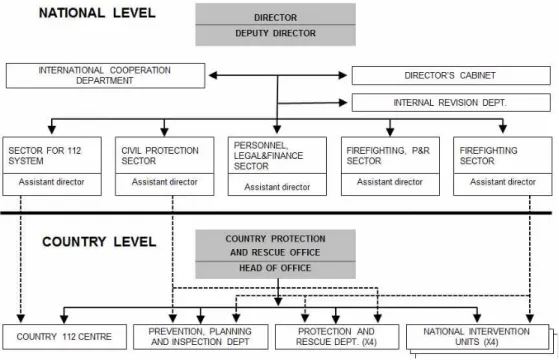
그림 1. EU 크로아티아 국가의 위기관리계획 조직도
Fig. 1. Civil emergency planning organizational structure of Croatia in EU
그림 2. ISO/TC223 권고안의 의사결정 과정
Fig. 2. Decision making process based on ISO/TC223 recommendation
culture and best practices within organizations;
- reduced risks and consequences of accidental , intentional and natural events;
- enhanced deployment, integration and interoperability of procedures, systems and technologies;
- increased level of cooperation and coordination; and - increased public awareness and public warning.
Ⅲ. The design of emergency management system in each organizations
Societal security, as an important culture trait or geographical features, have become prevalent topics recently because of its explosively emerging real-world problems, such as natural or man-made emergence, crisis and disaster. For these reason, many countries have been devote lots of efforts to overcome their critical hazards.
The trend in current civil emergency planning is relatively simple and clear: large scale disaster demand enormous resources from various field of knowledge.
Consequently, effective emergency management requires
that all the various stakeholders around the world are
한국항행학회 논문지 제16권 제5호 2012년 10월 882
coordinated, can share situation reports, and coordinate decision-making.
International civil emergency planning(CEP) in NATO/EAPC provides NATO with essential civilian expertise and capabilities in the fields of terrorism preparedness, and disaster response and protecting critical infrastructure [5]. Fig. 1. gives an overview of Croatia’s CEP organizational structure. The national protection and rescue directorate is divide into several sectors. The central national administration consist of the directors office, the international cooperation department and the internal revision department and five sectors. Some important and crucial informations/commands are delivered to the country level which can be operated interactively with national level. Basically, this structure is similar to the ISO/TC223 standard recommendation of decision making processing as illustrated in Fig. 2. [6][7].
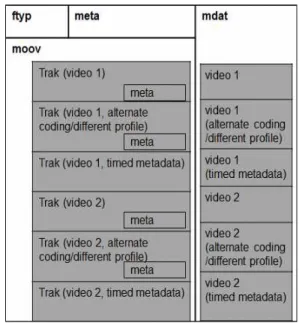
As we described in Chap. Ⅱ, ISO technical committee 223 has been interested as well as worked in various fields such as code sharing, video-surveillance, emergency capability assessment and public warning system [8]. Video-surveillance is a important device in disaster prevention, crisis management, and forensic applications as well. In the societal security system, CCTV system which usually consist of H/W, S/W and human elements is a minimum requirement in collecting data from given locations. The document of ISO/DIS 22311 included in video-surveillance specifies the exchange format and minimum technical requirement that establish a proper level of digital quality and contain all the context information(metadata) necessary for their processing Fig. 3. The implementation of this document should be also contain a widely available OS independent tools which allow for minimal processing of received files by societal security organizations.
그림 3. 비디오 감시 데이터의 기능 블럭 Fig. 3. Functional blocks of a video-surveillance data
Another main issue of emergency management in societal security is establishing a public warning system which is applicable to all organizations involved in preparation and issuing public warning responding to incidents on international, national or regional level.
그림 4. 일반적인 공공경보 시스템 Fig. 4. Generalized public warning system
The preparation and dissemination of public warning
is based on the two functions; dissemination of warning
and monitoring of hazard Fig. 4. [9]. With respect to the
message transmission phase, it could be also consist of a
alert message and notification message.
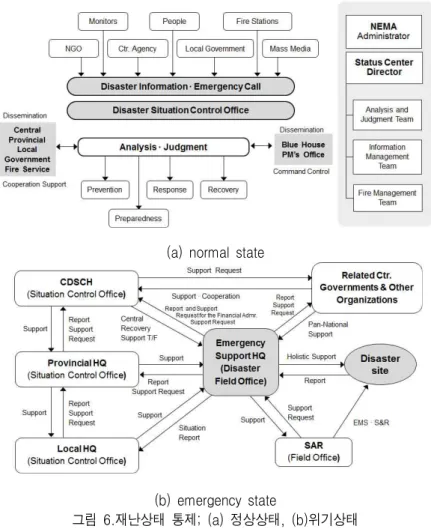
(a) normal state
(b) emergency state
그림 6.재난상태 통제; (a) 정상상태, (b)위기상태
Fig. 6. Disaster status control; (a) normal state, (b) emergency state 그림 5. 기술적 역량의 개관
Fig. 5. Holistic process for technological capabilities
Technological capabilities is a branch of prevention or incident preparedness process in emergency management
system. Most particularly, this procedure emulate the know-how of expert in the domain of activity for which the artifact is built [4]. Modeling each of the layer in Fig.
5. poses specific requirements. In the Fig. 5, however, both lower sophistication models and higher-up layers of knowledge artifacts follow the rule that the main objects of procedure are:
- Hazard analysis - Strategic goals - Training and testing - Capabilities review
Fig. 6. illustrates the basic information flow of
national emergency management association(NEMA) to
control the disaster situation. The main roles of NEMA
is not only to strengthen policy deliberation and general
coordination through the integration of disaster-related
operational system but to heighten disaster prevention
awareness and to strengthen preventive investment[10]. It
한국항행학회 논문지 제16권 제5호 2012년 10월 884
also have another mission to strengthen regional self-governing bodies’ disaster management capabilities and public-private cooperation.
Ⅳ. Conclusions
The International Standard enhances an organization’s capacity to take proper actions to assure the organization’s continued viability. The principal aims of designing international standard is that it can be integrated with safety, quality and other operational management system within an organization. A well designed management system could be satisfy the requirements of all other standards. In this approach, we reviewed the scope of TC223 which is responsible for designing societal security in ISO, and considered the under going standardization issues. In addition, we have designed a efficient disaster prevention system which is able to minimize the potential risk and to improve the organizational resilience. Consequently, our conjecture is that completely designed disaster prevention system does not exist. Rather, because of various conditions through the community culture to the geographic location of the globe, it is doubtful that fully trained management system can be found. The question of arriving at adaptable solution by utilizing ISO based standardization remains open.
Reference
[1] http://www.iso.org/iso.
[2] ISO, “ISO/TC223 N 259 Revised business plan for ISO/TC223, societal security”, March, 2011.
[3] S. Tangen, “Enhancing societal resilience”, ISO Focus, March, 2009.
[4] ISO, “ISO/T 223/Ad-hoc group on societal security technological capabilities first report”, March, 2009.
[5] H. Lindberg, International CEP Handbook 2009, Swedish civil contingencies agency, 2009.
[6] Y. H. Kim, “Business continuity planning for disaster
preparedness of IT enterprise”, Proceedings of the 2009 KIIT Summer Conference, May, 2009.
[7] Y. H. Kim, “International standardization trend toward promoting the societal security”, Proceedings of the 2010 KIIT Summer Conference, May, 2010.
[8] KATS, “ The 5th international Meeting of ISO/TC 223 Societal Security”, 2008.
[9] ISO, “ISO/TC223 N 202 Societal security –Emergency management-Public warning”, 2010, 7.
[10] http://www.nema.go.kr.
김 윤 호 (Yoon-Ho Kim)
received the M.S. degree in electronic engineering from Kyung-Hee Univ.
in 1986, and the ph.D. degree in electronic engineering in 1992 from Chong-Ju Univ., respectively. In 1992, he joined the faculty member of the Mokwon Univ.. He is currently a professor in the Dept. of Computer Engineering, Mokwon Univ. From 2005 to 2006, he was with Univ. of Auckland, where he served as a research fellow. He has been working as Korea Delegate in ISO/TC223 since 2008.
His research interests focus on image processing, including pattern recognition, computer vision, IT policy. He is a member of the IEEE, and IEEE Computer Society, IEEK, KICS and KIIT.
강희조( Heau-Jo Kang)
received his Ph. D. degree in Aviation Electronic Engineering from Hankuk Aviation University in 1994. In 2003 he joined the faculty of Mokwon University where he is currently a professor in the Division of Computer Engineering. His research interests include business continuity planning, risk analysis, prevention, homeland security, electromagnetic pulse(EMP), emergency management, smart home networking, visible light communication, UWB, EMI/EMC, mobile communication systems, multimedia communication systems, etc.