• 검색 결과가 없습니다.

A study on performance-based evaluation system for NATM tunnels in use: development of evaluation model and validation

N/A
N/A
Protected

Academic year: 2021

Share "A study on performance-based evaluation system for NATM tunnels in use: development of evaluation model and validation"

Copied!
14
0
0

로드 중.... (전체 텍스트 보기)

전체 글

(1)

OPEN ACCESS Journal of Korean Tunnelling and Underground Space Association 22(1)107-120(2020)

https://doi.org/10.9711/KTAJ.2020.22.1.107

eISSN: 2287-4747 pISSN: 2233-8292

Received December 16, 2019 Revised January 2, 2020 Accepted January 3, 2020

This is an Open Access article distributed under the terms of the Creative Commons Attribution Non-Commercial License (http://creativecommons.org/

licenses/by-nc/4.0/) which permits unrestricted non- commercial use, distribution, and reproduction in any medium, provided the original work is properly cited.

ⓒ2020, Korean Tunnelling and Underground

연구: 평가모형 개발 및 검증

문준식

1

ㆍ김홍균

2*

ㆍ안재욱

3

ㆍ이종건

4

1

정회원, 경북대학교 토목공학과 교수

2

정회원, 한국시설안전공단 지반안전실 부장

3

비회원, 한국시설안전공단 지반안전실 과장

4

비회원, 한국시설안전공단 지반안전실 부장

A study on performance-based evaluation system for NATM tunnels in use:

development of evaluation model and validation

Joon-Shik Moon

1

ㆍHong-Kyoon Kim

2*

ㆍJai-Wook An

3

ㆍJong-Gun Lee

4

1

Associate Professor, Dept. of Civil Engineering, Kyungpook National University

2

General Manager, Dept. of Ground Safety, KISTEC

3

Manager, Dept. of Ground Safety, KISTEC

4

General Manager, Dept. of Ground Safety, KISTEC

*Corresponding Author : Hong-Kyoon Kim, [email protected]

Abstract

In a performance-based evaluation of structures in use, the current performance is assessed by summing up the weighting of the evaluation indices for each performance.

In this study, to suggest a performance-based evaluation technique for NATM tunnels in use, the performance evaluation indices were derived by examining the characteristics and similarities of each index developed from previous study. The weighting of the evaluation indices was derived by calculating the relative importance of each evaluation indices from the AHP analysis. In order to develop a quantitative evaluation model, grading criteria for each performance index was derived through literature review, and performance evaluation tables for road and railway tunnels were presented. In order to verify the significance of the proposed performance evaluation model, the correlation analysis was performed between each evaluation index and the final evaluation result. In the correlation analysis, the survey data measured through precision safety diagnosis in the tunnel in use was applied. It may be said that the proposed evaluation indices, weighting, criteria and evaluation models for tunnels in use can be applied to the performance-based maintenance system of tunnels.

Keywords: NATM tunnel, Performance evaluation, Multi-criteria decision method,

Correlation analysis

(2)

초 록

공용중인 시설물의 성능기반 평가에서 보유 성능은 성능별 평가지표를 유목화 한 후 각 성능에 대한 평가지표의 중요도 를 고려하여 가중평균하여 평가한다. 본 연구에서는 NATM 터널의 성능기반 평가기법을 제시하기 위해 이전 연구에서 도출된 평가지표의 지표별 특성과 유사성 등을 분석하여 최종 평가지표를 도출하였다. 평가지표별로 상대적 중요도를 산출하여 평가지표의 가중치를 도출하였다. 정량적인 평가모형을 개발하기 위하여 지표별 성능등급 평가기준을 관련 문헌 및 선행연구 분석을 통해 도출하고, 도로 및 철도 터널의 유지관리 시 적용할 수 있는 성능평가표를 제시하였다. 제 시된 성능평가 모형의 유의미함을 제시된 평가표를 실제 공용중인 터널에서 정밀안전진단을 통하여 측정된 조사자료에 적용하여 각 평가지표와 최종 평가결과와의 상관분석을 실시함으로써 검증하였다. 본 연구에서 제시된 공용중인 터널의 성능평가를 위한 평가지표, 가중치, 그리고 용도별 평가모형은 추후 터널의 성능중심 유지관리 체계에 적용되어 유지관 리 전략 수립 시 활용될 수 있을 것으로 판단된다.

주요어: NATM터널, 성능평가, 다기준 의사결정 기법, 상관성 분석

1. 서 론

국내 주요 기반시설물은 1970년대 고도 성장기를 거치며 단기간에 집중 구축되었으며, 그에 따라 노후화도 급 속하게 진행 중이다(MOLIT, 2017). 기반시설의 노후화는 사용자의 편의를 감소시킬 뿐만 아니라 안전까지 위협 할 수 있어 최근 정부는 기반시설물의 노후화에 대비하여 기반시설물의 관리체계를 규정하는 관련법안을 제정하 는 등 다양한 노력을 기울이고 있다(MOLIT, 2019). 미국, 영국, 일본 등 선진국들은 우리나라의 이러한 노력에 앞서 국가 차원의 대책을 마련하고 필요한 국가재정을 투입하고 있다(ICEE, 2016).

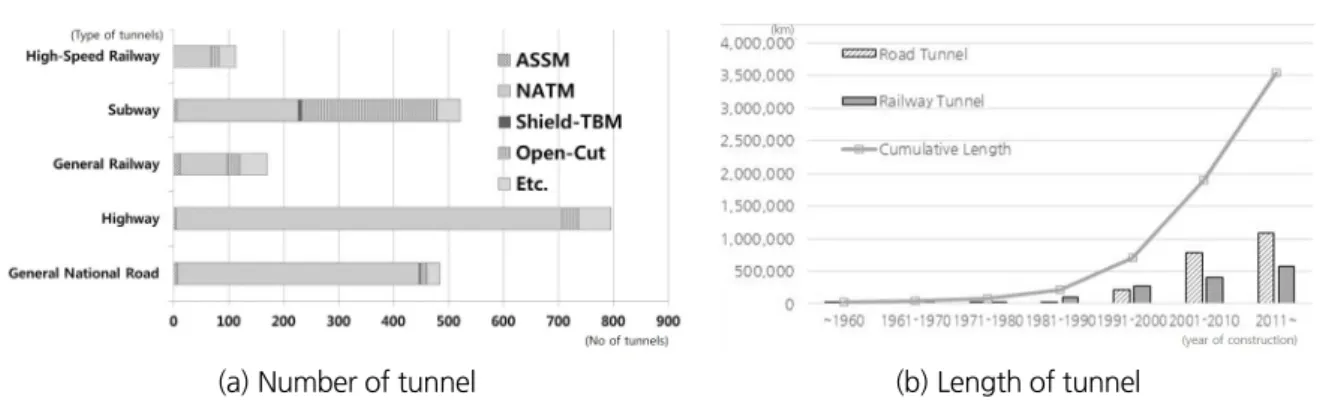
한편 우리나라의 경우, 산지가 많은 지형적 조건으로 인하여 터널이 도로 및 철도 등과 같은 기반시설물의 주요 구성요소로 자리매김하고 있다. 국내 공용중인 터널은 비교적 양호한 지질조건으로 인하여 대다수의 터널이 NATM 으로 시공되었으며, 터널의 수량은 연차별로 지속적으로 증가하고 있어 시설물의 노후화와 대비하여 체 계적인 유지관리가 필요한 실정이다(Fig. 1).

시설물을 유지관리 하는데 있어 한정된 예산으로 최적의 효과를 얻기 위해서는 시설물의 목적, 용량 및 사용 환경 등 다양한 요인을 고려하여 현재 보유하고 있는 시설물의 성능을 다각적으로 평가할 필요가 있다(Kang and Lee, 2013 ; Lee et al., 2015).

본 연구에서는 시설물의 유지관리단계에서 적용 가능하고 국내실정에 적합한 성능기반 평가체계를 구축하기

위하여, 기존 수행된 연구결과(An and Kim, 2016)를 기반으로 NATM으로 시공된 도로 및 철도 터널을 대상으

로 성능중심의 평가모형을 도출하였으며(Fig. 2), 도출된 평가모형의 적정성을 검증하기 위하여 실제 공용중인

터널의 정밀안전진단 조사자료를 기반으로 상관분석을 실시하였다.

(3)

(a) Number of tunnel (b) Length of tunnel Fig. 1. Change in the tunnel in the South Korea

Fig. 2. Concept of performance evaluation for tunnels in use

2. 이론적 배경

2.1 델파이 기법(Delphi-method)

델파이 기법은 동일한 패널을 대상으로 반복적인 설문을 실시하고 각 패널로부터 도출된 결과를 공유함으로서

설문의 횟수가 반복됨에 따라 분산된 의견의 합의점을 도출하는 집단의 의견을 조정통합하는 방법이다.

(4)

델파이 기법에서 전문가 집단인 패널의 규모에 대한 명확한 규정은 없으나, 결과의 신뢰도와 패널 크기 간에는 함수관계가 성립하며, 패널의 수가 13명 이상일 때에는 전후 질문지 간의 과정 신뢰도(process reliability)는 전혀 문제가 되지 않으며, 평균 0.80 이상의 높은 상관관계를 보인다(Na, 1999).

델파이 설문 결과의 타당도(Content Validity)는 내용타당도 비율(Content Validity Ratio, CVR)을 사용하여 검증한다. CVR 값은 패널의 수에 따라 최소값을 제시하고 있으며, 최소값 이상이 되었을 때 전문가들의 의견에 대한 내용타당도가 있는 것으로 판단한다. 내용타당도는 다음 식 (1)에 의해 산정되며, 이때,  는 타당하다고 응 답한 패널의 수이며 N은 연구에 참여한 전체 델파이 패널의 수를 의미한다(Lawshe, 1975).

  

  

     

(1)

합의도는 4분편차와 중앙값( ) 을 이용하여 3/4분위수( ) 와 1/4분위수( ) 사이의 값을 도식화함으로써 응답자들 사이의 합의가 이루어졌는가를 검증하는 방법으로 다음 식 (2)에 의해 산정된다(Kim, 2015).

    

   

(2)

2.2 AHP (Analytic Hierarchy Process) method

AHP (Analytic Hierarchy Process) 기법은 계량적 접근이 어려운 분야의 의사결정을 하는 경우 경험을 조직화, 구조화 및 체계화하여 평가요소의 가중치를 설정하는 방법으로, 의사결정단계에서 수학적 모형으로 적합하도록 고안된 기법이다(Saaty and Vargas, 2001). 즉, 의사결정문제에 대해 대안 간의 상호비교를 통해 귀납적방법과 연역적 방법을 조합한 통합적 방법으로 해결해 나갈 수 있도록 고안된 기법으로, 평가요소들을 계층화하고 쌍대 비교(Paired comparison)를 실시하여 상대적중요도를 결정하는 방법이라고 할 수 있다(Park, 2009).

본 기법을 통하여 공용중인 시설물의 평가 시 가중치를 도출한 선행연구를 살펴보면, Sung et al. (2013)은 쉴

드 TBM 터널의 성능평가기준 및 유지관리 매뉴얼을 개발하기 위하여 기존 국내외 터널의 유지관리 체계를 분석

하고 AHP 분석을 활용하여 쉴드 TBM 터널의 평가지표별 가중치를 제시하였으며, Kimura et al. (2012)은 공용

중인 철도터널을 대상으로 성능중심 평가방법을 제안하였으며, 제안된 평가방법은 터널과 관련된 성능을 총 7개

( 사용자 안전성, 사용성, 구조적 안전성, 내구성, 관리의 용이성, 유지관리성, 주변영향)의 카테고리로 분류하였

으며, 각 성능의 평가지표의 가중치를 결정하기 위하여 AHP 분석을 활용하였다.

(5)

2.3 상관분석(Correlation analysis)

상관분석(Correlation analysis)은 연속형인 두 변수간의 선형적 관계를 검정하는 통계기법이다. 본 연구에서 는 피어슨 상관계수(Pearson's correlation coefficient)를 활용하였는데, 이는 두 변수 간의 공분산(Covariance)분 석에서 시작한다. 공분산이란 두 개 변수의 개별 관측값들이 평균으로부터 얼마나 산포되어 있는가를 나타내는 것으로 공분산의 값이 양의 값(+)이면 한 변수(x)의 값이 증가할 때 다른 변수의 값(y)도 증가함을 의미하며, 다음 식 (3)에 의해 계산된다.

Cov        (3)

피어슨 상관계수(R)는 표준화된 공분산 값으로 공분산을 각 변량의 표준편차로 나누어 표준화한 값이다. 공분 산과 마찬가지로 R의 값이 양의 값(+)이면 두 변수가 같은 방향으로 변화하고 있음을 의미하며 다음 식 (4)~(7)과 같이 계산된다.

      

 

(4)

          (5)

          (6)

              (7)

R 값은 -1≤R≤+1의 범위를 가지며, R=1인 경우 완전한 상관관계를 의미하고 R=0이면 두 변수는 완전히독립

적임을 의미한다. 일반적으로 R값에 대한 선형관계는 다음 Table 1과 같이 해석된다(Lee et al., 2016).

(6)

Table 1. Linear relationship of the R value

│R│ 0≤│R│<0.1 0.1≤│R│<0.3 0.3≤│R│<0.7 0.7≤│R│≤1.0

Linear relationship No Weak Distinct Strong

3. 평가모형의 개발

3.1 성능평가지표의 도출

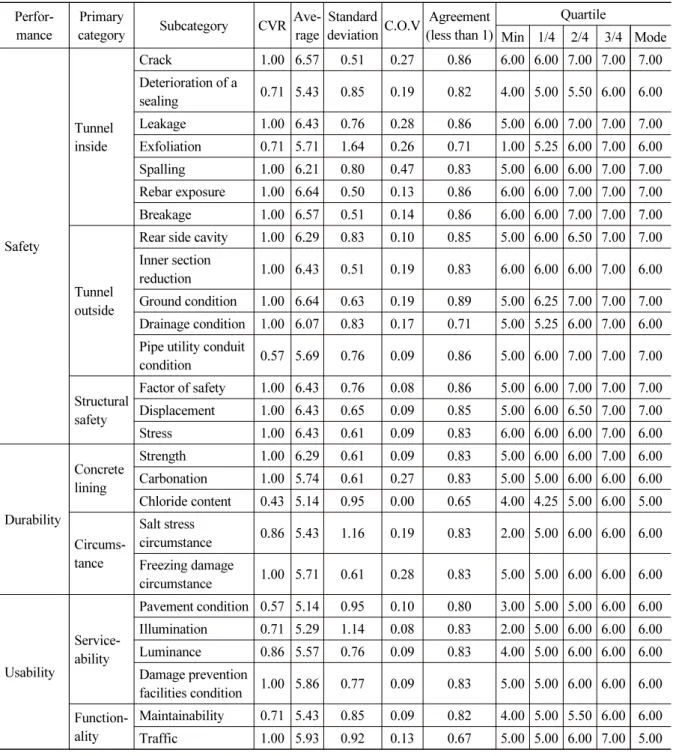
본 연구에서는 터널의 성능별 평가지표를 도출하기 위하여 국내 ‧ 외 터널 평가지침, 가이드라인 및 기준과 연 구사례 등을 조사 분석하여, 총 47개의 예비 성능평가지표를 도출하였다. 성능은 안전성능, 내구성능, 사용성능 으로 분류되며 이 중 안전성능에 대한 평가지표는 25개로 가장 많은 항목이 도출되었고 내구성능과 사용성능 평 가지표는 11개로 각각 분석되었다. 문헌자료 분석결과를 통하여 도출된 예비 성능평가지표를 기반으로 14명의 전문가 패널에게 Fig. 3의 절차에 따라 총 3차례 델파이 설문을 실시하였다.

Fig. 3. Flow diagram of the delphi-survey

터널의 성능평가지표를 선정하기 위하여 총 3차례의 델파이 설문을 통하여 도출된 성능평가지표는 전문가 집

단토론을 거쳐 일부 중복성이 존재하는 지표와 현실적으로 조사가 불가능한 지표 등을 수정 보완하여 최종적으

로 총 26개(안전성능 15개, 내구성능 5개, 사용성능 6개)의 성능평가지표를 Table 2와 같이 선정하였다.

(7)

Table 2. Results of performance evaluation indices derivation by 3 times Delphi-survey Perfor-

mance

Primary

category Subcategory CVR Ave- rage

Standard

deviation C.O.V Agreement (less than 1)

Quartile

Min 1/4 2/4 3/4 Mode

Safety

Tunnel inside

Crack 1.00 6.57 0.51 0.27 0.86 6.00 6.00 7.00 7.00 7.00 Deterioration of a

sealing 0.71 5.43 0.85 0.19 0.82 4.00 5.00 5.50 6.00 6.00 Leakage 1.00 6.43 0.76 0.28 0.86 5.00 6.00 7.00 7.00 7.00 Exfoliation 0.71 5.71 1.64 0.26 0.71 1.00 5.25 6.00 7.00 6.00 Spalling 1.00 6.21 0.80 0.47 0.83 5.00 6.00 6.00 7.00 7.00 Rebar exposure 1.00 6.64 0.50 0.13 0.86 6.00 6.00 7.00 7.00 7.00 Breakage 1.00 6.57 0.51 0.14 0.86 6.00 6.00 7.00 7.00 7.00

Tunnel outside

Rear side cavity 1.00 6.29 0.83 0.10 0.85 5.00 6.00 6.50 7.00 7.00 Inner section

reduction 1.00 6.43 0.51 0.19 0.83 6.00 6.00 6.00 7.00 6.00 Ground condition 1.00 6.64 0.63 0.19 0.89 5.00 6.25 7.00 7.00 7.00 Drainage condition 1.00 6.07 0.83 0.17 0.71 5.00 5.25 6.00 7.00 6.00 Pipe utility conduit

condition 0.57 5.69 0.76 0.09 0.86 5.00 6.00 7.00 7.00 7.00 Structural

safety

Factor of safety 1.00 6.43 0.76 0.08 0.86 5.00 6.00 7.00 7.00 7.00 Displacement 1.00 6.43 0.65 0.09 0.85 5.00 6.00 6.50 7.00 7.00 Stress 1.00 6.43 0.61 0.09 0.83 6.00 6.00 6.00 7.00 6.00

Durability

Concrete lining

Strength 1.00 6.29 0.61 0.09 0.83 5.00 6.00 6.00 7.00 6.00 Carbonation 1.00 5.74 0.61 0.27 0.83 5.00 5.00 6.00 6.00 6.00 Chloride content 0.43 5.14 0.95 0.00 0.65 4.00 4.25 5.00 6.00 5.00

Circums- tance

Salt stress

circumstance 0.86 5.43 1.16 0.19 0.83 2.00 5.00 6.00 6.00 6.00 Freezing damage

circumstance 1.00 5.71 0.61 0.28 0.83 5.00 5.00 6.00 6.00 6.00

Usability

Service- ability

Pavement condition 0.57 5.14 0.95 0.10 0.80 3.00 5.00 5.00 6.00 6.00 Illumination 0.71 5.29 1.14 0.08 0.83 2.00 5.00 6.00 6.00 6.00 Luminance 0.86 5.57 0.76 0.09 0.83 4.00 5.00 6.00 6.00 6.00 Damage prevention

facilities condition 1.00 5.86 0.77 0.09 0.83 5.00 5.00 6.00 6.00 6.00 Function-

ality

Maintainability 0.71 5.43 0.85 0.09 0.82 4.00 5.00 5.50 6.00 6.00

Traffic 1.00 5.93 0.92 0.13 0.67 5.00 5.00 6.00 7.00 5.00

(8)

3.2 가중치 도출

평가지표별 가중치를 도출하기 위하여 관련분야 경력 최소15년 이상의 터널분야 전문가(Table 3)를 대상으로 AHP 분석을 실시하였다.

Table 3. Consist of the panels for AHP analysis

Ages Career Work field

Fifty Forty Thirty 15~20 years Over 20 years Research Industry Academia

8 6 1 10 5 12 2 1

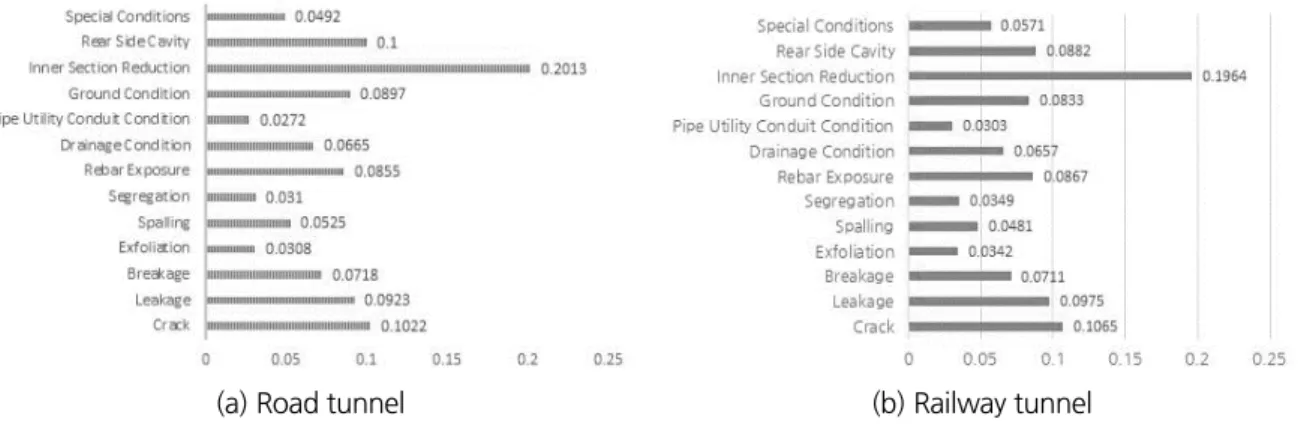
설문에 참여한 각 전문가의 응답에 대한 일관성 비율이 0.15 이하인 것을 확인하였으며, 해당 응답을 활용하여 평가지표 간에 상대적 중요도 분석을 실시하였다(Fig. 4). 분석결과, 터널 안전성에 직접적으로 영향을 주는 내공 단면 축소여부, 균열, 누수, 배면공동, 지반상태 등이 도로 및 철도터널에서 모두 상대적으로 중요한 지표로 분석 되었다.

(a) Road tunnel (b) Railway tunnel

Fig. 4. Weight for the each evaluating item of tunnel

반면에, 터널의 주요부재인 콘크리트 라이닝 재질이 사용기간이나 사용환경영향 등에 따라 열화됨에 따라 발 생되는 박리, 박락, 재료분리와 같은 부재의 재질열화관련 지표와 터널의 구조적 안전성에 직접적인 영향이 적은 공동구상태는 다른 지표에 비하여 상대적으로 중요도가 낮은 것으로 분석되었다.

한편, 도로 및 철도 터널의 각 평가지표별 중요도를 비교하였을 때, 우선순위가 유사한 것을 확인할 수 있었는

데, 이는 구조적 안전성을 주요부재인 라이닝의 상태변화를 통하여 평가하는 상태안전성 측면에서는 터널의 용

도의 영향이 다소 미비한 것으로 판단되었다.

(9)

3.3 평가모형 제안

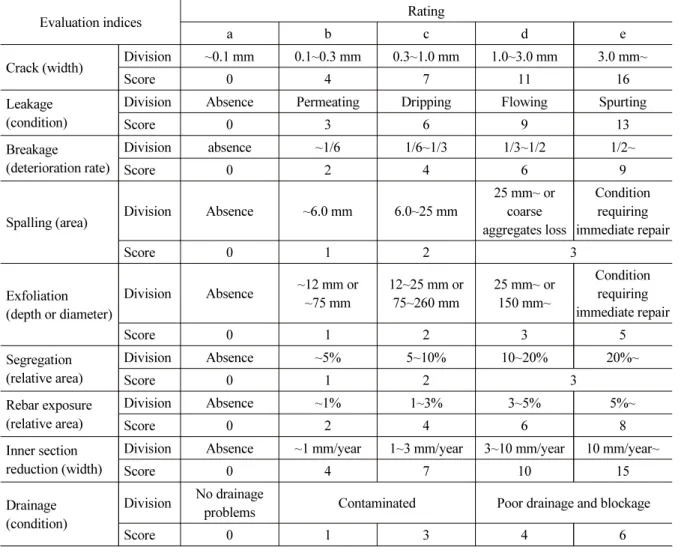
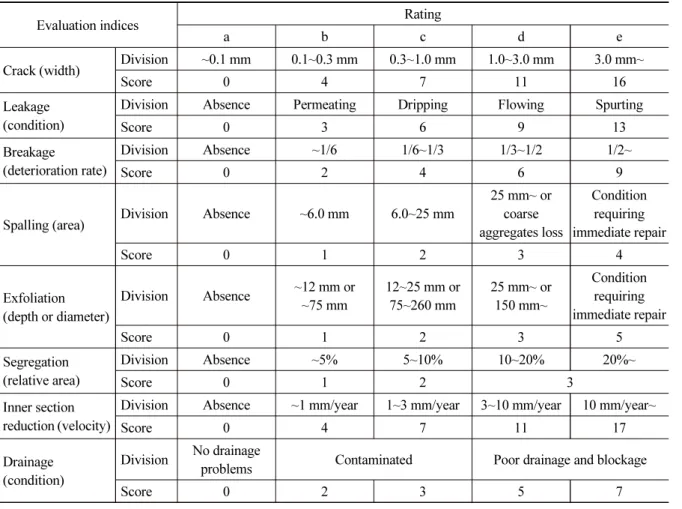
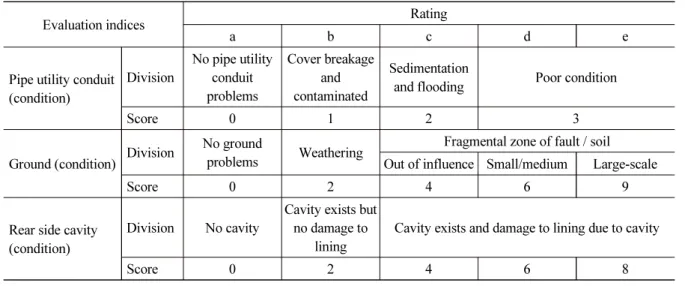
AHP 분석을 통해 도출된 가중치는 각 평가지표가 해당 성능을 평가하는데 있어 내재할 수 있는 최대가중치로 볼 수 있다. 또한, 가중치를 활용한 정량적 평가방식의 평가모형에서 중요한 것은 각 평가항목의 지표(a~e)는 최 종 평가결과(A~E)와 반드시 연계될 필요가 있다는 것이다. 예를 들어, NATM으로 시공된 도로터널에서 모든 평 가항목에서 b의 지표에 해당하는 점수로 평가가 되었다면, 최종 평가결과가 B로 산출되는 것이 타당한 것이라고 할 수 있다. 따라서, 각 평가지표의 가중치(weight)에 평가지표의 지표별(a~e) 결함지수 최대값을 곱하여 지표별 배점을 최종적으로 산출하였다. 또한 각 평가지표의 등급화를 위한 세부 평가기준은 관련 문헌자료 및 국내외 평 가체계의 세부기준 등을 비교 분석하여 구성하고, 앞서 도출된 평가지표, 가중치와 조합하여 도로 및 철도 터널에 대한 평가표를 제시하였다(Tables 4~5).

Table 4. Performance evaluation table for road tunnel (NATM)

Evaluation indices Rating

a b c d e

Crack (width) Division ~0.1 mm 0.1~0.3 mm 0.3~1.0 mm 1.0~3.0 mm 3.0 mm~

Score 0 4 7 11 16

Leakage (condition)

Division Absence Permeating Dripping Flowing Spurting

Score 0 3 6 9 13

Breakage (deterioration rate)

Division absence ~1/6 1/6~1/3 1/3~1/2 1/2~

Score 0 2 4 6 9

Spalling (area) Division Absence ~6.0 mm 6.0~25 mm

25 mm~ or coarse aggregates loss

Condition requiring immediate repair

Score 0 1 2 3

Exfoliation (depth or diameter)

Division Absence ~12 mm or

~75 mm

12~25 mm or 75~260 mm

25 mm~ or 150 mm~

Condition requiring immediate repair

Score 0 1 2 3 5

Segregation (relative area)

Division Absence ~5% 5~10% 10~20% 20%~

Score 0 1 2 3

Rebar exposure (relative area)

Division Absence ~1% 1~3% 3~5% 5%~

Score 0 2 4 6 8

Inner section reduction (width)

Division Absence ~1 mm/year 1~3 mm/year 3~10 mm/year 10 mm/year~

Score 0 4 7 10 15

Drainage (condition)

Division No drainage

problems Contaminated Poor drainage and blockage

Score 0 1 3 4 6

(10)

Table 4. Performance evaluation table for road tunnel (NATM) (continue)

Evaluation indices Rating

a b c d e

Pipe utility conduit (condition)

Division

No pipe utility conduit problems

Cover breakage and contaminated

Sedimentation

and flooding Poor condition

Score 0 1 2

Ground (condition) Division No ground

problems Weathering Fragmental zone of fault / soil Out of influence Small/medium Large-scale

Score 0 2 3 5 7

Rear side cavity (condition)

Division No cavity

Cavity exists but no damage to

lining

Cavity exists and damage to lining due to cavity

Score 0 2 4 6 8

Table 5. Performance evaluation table for railway tunnel (NATM)

Evaluation indices Rating

a b c d e

Crack (width) Division ~0.1 mm 0.1~0.3 mm 0.3~1.0 mm 1.0~3.0 mm 3.0 mm~

Score 0 4 7 11 16

Leakage (condition)

Division Absence Permeating Dripping Flowing Spurting

Score 0 3 6 9 13

Breakage (deterioration rate)

Division Absence ~1/6 1/6~1/3 1/3~1/2 1/2~

Score 0 2 4 6 9

Spalling (area) Division Absence ~6.0 mm 6.0~25 mm

25 mm~ or coarse aggregates loss

Condition requiring immediate repair

Score 0 1 2 3 4

Exfoliation (depth or diameter)

Division Absence ~12 mm or

~75 mm

12~25 mm or 75~260 mm

25 mm~ or 150 mm~

Condition requiring immediate repair

Score 0 1 2 3 5

Segregation (relative area)

Division Absence ~5% 5~10% 10~20% 20%~

Score 0 1 2 3

Inner section reduction (velocity)

Division Absence ~1 mm/year 1~3 mm/year 3~10 mm/year 10 mm/year~

Score 0 4 7 11 17

Drainage Division No drainage

problems Contaminated Poor drainage and blockage

(11)

Table 5. Performance evaluation table for railway tunnel (NATM) (continue)

Evaluation indices Rating

a b c d e

Pipe utility conduit (condition)

Division

No pipe utility conduit problems

Cover breakage and contaminated

Sedimentation

and flooding Poor condition

Score 0 1 2 3

Ground (condition) Division No ground

problems Weathering Fragmental zone of fault / soil Out of influence Small/medium Large-scale

Score 0 2 4 6 9

Rear side cavity (condition)

Division No cavity

Cavity exists but no damage to

lining

Cavity exists and damage to lining due to cavity

Score 0 2 4 6 8

4. 평가모형의 검증

본 연구에서 제안된 터널 종류별 평가모형의 적정성을 검증하기 위하여 성능의 평가항목과 최종 평가결과의 상관분석(Correlation analysis)를 실시하였다. 상관분석에 활용된 데이터는 최근 10년간 한국시설안전공단에서 수행한 정밀안전진단 결과를 활용하였으며(Table 6), 분석방법에는 피어슨 상관계수(R)을 이용하여 통계분석을 실시하였다.

Table 6. Results of correlation analysis

Type of tunnel Tunnel method Average length (m) Average ages (years) Defect index (average)

Road tunnel NATM 2,730 16.3 0.247

Railway tunnel NATM 5,150 17.2 0.248

통계분석 시, 각 성능의 세부 평가지표를 독립변수(independent variable)로, 최종적으로 터널별로 평가된 결 함지수를(defect index)를 종속변수(defendant variable)로 설정하였다. 단, 내공단면 변형여부, 공동구 상태, 배 면공동유무, 특수조건 등 신규로 제안되거나, 시설물별로 해당 값이 없어 결측 값으로 분석되는 평가항목은 본 분 석에서 제외하였다.

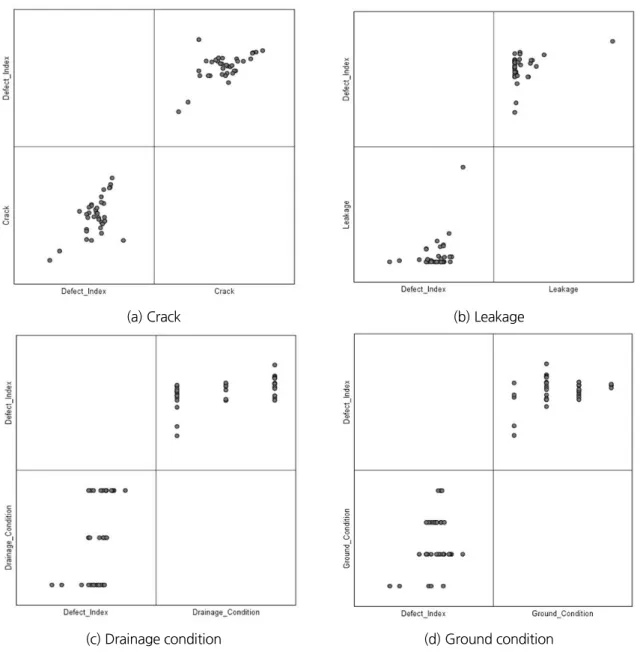
SPSS 통계패키지를 활용하여 상관분석을 실시한 결과, 균열, 누수, 배수상태 및 지반상태 평가지표는 최종 평

가결과와 ‘뚜렷한 상관관계’로 분석되어 해당평가 지표, 가중치 및 평가방법은 통계적으로 유의미한 결과를 도출

하는 것으로 판단되었다(Fig. 5).

(12)

(a) Crack (b) Leakage

(c) Drainage condition (d) Ground condition

Fig. 5. Scatter plot matrix

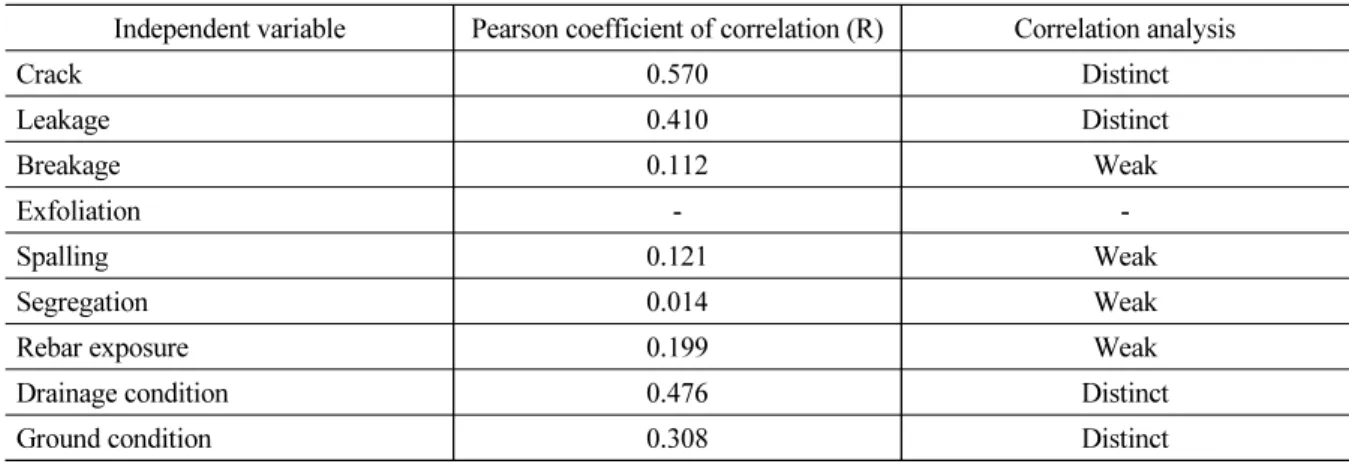
반면에 주요부재의 재질열화와 연관된 파손, 박리, 박락, 재료분리 및 철근노출 지표는 상관분석 결과 최종결

과와 상대적으로는 낮은 상관관계로 분석되었는데(Table 7), 이는 평가대상이 된 터널이 비교적 최근에 시공된

신생터널로서 공용기간 증가에 따른 재질열화를 관측하기에는 한계가 있어, 이번 연구에서는 다소 낮은 상관관

계를 나타낸 것으로 분석되었다. 추후 공용기간이 증가된 후 조사한 자료를 활용하여 추가분석이 필요한 것으로

판단된다.

(13)

Table 7. Results of correlation analysis

Independent variable Pearson coefficient of correlation (R) Correlation analysis

Crack 0.570 Distinct

Leakage 0.410 Distinct

Breakage 0.112 Weak

Exfoliation - -

Spalling 0.121 Weak

Segregation 0.014 Weak

Rebar exposure 0.199 Weak

Drainage condition 0.476 Distinct

Ground condition 0.308 Distinct

5. 결 론

본 연구에서는 NATM으로 시공된 도로 및 철도터널의 성능중심 평가체계를 개발하기 위하여 관련 문헌과 선 행연구를 분석하여 성능별 예비평가지표를 도출하고, 터널분야 전문가를 대상으로 델파이 조사 및 전문가 집단 토론을 실시하여 성능별 평가지표를 도출하였다. 또한 터널의 성능평가에 있어 성능평가지표별 중요도를 평가하 기 위하여 AHP 분석을 실시하다. 마지막으로 제시된 평가모형의 유의미함을 평가하기 위하여 상관분석을 실시 하였다. 본 연구의 주요 결론을 요약하면 다음과 같다.

1. 공용중인 터널의 성능은 안전성능, 내구성능, 사용성능으로 구분하여 평가 가능하며 총 3차례에 걸친 델파이 조사 및 전문가 집단토론을 통해 47개의 예비평가지표 중 총 26개(안전성능: 15개, 내구성능 5개, 사용성능: 6 개)의 평가지표를 도출하였다.

2. AHP 분석을 통한 성능평가지표별 중요도를 평가한 결과, 내공단면 축소여부, 균열, 누수, 배면공동, 지반상태 등이 도로 및 철도터널에서 모두 상대적으로 중요한 지표로 분석되었으며, 평가지표별 가중치를 기반으로 NATM 으로 시공된 도로터널 및 철도터널의 상태안전성 평가표를 제안하였다.

3. 제시된 평가표를 실제 공용중인 터널에서 정밀안전진단을 통하여 측정된 조사자료에 적용하여 각 평가지표 와 최종 평가결과와의 상관분석을 실시하였으며, 그 결과 균열, 누수, 배수상태 및 지반상태 평가지표에서 뚜 렷한 상관성을 보였다.

감사의 글

본 연구는 국토교통과학기술진흥원에서 지원하는 “SOC 유지관리체계 선진화 방안 및 유형별성능중심 평가

기법 개발사업(과제번호 16SCIP-C079148-03-000000)의 지원으로 수행되었습니다. 이에 감사드립니다.

(14)

저자 기여도

문준식은 연구 개념을 설계하고, 김홍균은 데이터 분석 및 원고 작성을 하였고, 안재욱은 데이터 수집 및 선행 연구 분석을 하였고, 이종건은 데이터 검증을 하였다.

References

1. An, J.W., Kim, H.K., (2016), “Developments of performance-based assessment technique for existing tunnels”, Journal of Korean Tunnelling and Underground Space Association, Vol. 18, No. 6, pp. 525-533.

2. ICEE (2016), World construction now, ICEE Knowledge Report Series, Institute of Construction and Environment Engineering, Vol. 4-3, pp. 3-6.

3. Kang, S.H., Lee, Y.H., (2013), Understanding the infrastructure assessment system in developed countries and introduction plan, Construction & Economy Research Institute of Korea, pp. 49.

4. Kim, B.W. (2015), Delphi analysis method, Kims Information, pp. 1-81.

5. Kimura, S., Kitani, T., Koizumi, A. (2012), “Development of performance-based tunnel evaluation meth- odology and performance evaluation of existing railway tunnels”, Journal of Transportation Technologies, Vol. 2, pp. 113-128.

6. Lawshe, C.H. (1975), “A quatitative approach to content validity”, Personnel Psychology, Vol. 28, No. 4, pp. 563-575.

7. Lee, J.G., Heo, I.Y., Kang, C.K., Ryu, H.S., Chang, B.S. (2016), “Study on performance-based evaluation method for rock slopes: deduction of weight and validation- based on the AHP method and correlation analysis”, Tunnel and Underground Space, Vol. 26, No. 5, pp. 431-440.

8. Lee, J.G., Suk, J.W., Kim, H.K., Kim, Y.S., Moon, J.S. (2015), “A study on performance-based evaluation method for rock slopes: deduction of evaluation factors”, Tunnel and Underground Space Vol. 25, No. 1, pp. 86-96.

9. MOLIT (2017), The 4th master plan for safety and maintenance of facility, Ministry of Construction and Transportation, pp. 1-3.

10. MOLIT (2019), The comprehensive measures to strengthen sustainable infrastructure safety, Ministry of Construction and Transportation, pp. 4-26.

11. Na, S.I. (1999), “A study on the contents of general agricultural education for elementary, middle and high school students in the information society”, Journal of Korean Agricultural Education, Vol. 31, No. 1, pp. 26.

12. Park, Y.S. (2009), Decisions by AHP: Theory and Practice, Kyo-Woo-Sa, Seoul, pp. 1-288.

13. Saaty, T.L., Vargas, L.G. (2001), Models, Methods, Concepts & Applications of the Analytic Hierarchy Process, Kluwer Academic Publishers, Boston, pp. 1-25.

14. Sung, J.H. (2013), A special tunnel excavation (shield tunnel) performance criteria and maintenance

manual development, Korea Infrastructure Safety and Technology Corporation, pp. 1-419.

수치

Fig. 2. Concept of performance evaluation for tunnels in use
Fig. 3. Flow diagram of the delphi-survey
Table 2. Results of performance evaluation indices derivation by 3 times Delphi-survey
Fig. 4. Weight for the each evaluating item of tunnel
+6

참조

관련 문서

Histologic evaluation of early human bone response to different implant surfaces2. Histologic evaluation of human bone integration on machined and

Based on the result of such assessment, this study attempted to establish a basis for establishment of physical epidemiology research evaluation system

▪ Local temperature of PMSM can be calculated through thermal resistance model and heat generation model, presenting the cooling performance thermal

Performance evaluation of Volume PTV based on Affine Performance evaluation of Volume PTV based on Affine Performance evaluation of Volume PTV based on Affine Performance

There are a lot of institutions for evaluation in the world, for example, Legislative Evaluation in the Continental Legal System, Regulatory Impact Analysis

On-line formative evaluation supporting system was implemented using Linux, Apache Web Server, PHP, MySQL and etc.. It provides platform for improving

Therefore, in this study, based on the media facade expression characteristics and expression techniques, evaluation factors through satisfaction analysis on

“Evaluation of R&amp;D investments in wind power in Korea using real option.” Renewable and Sustainable Energy Reviews. &#34;Real Option Valuation of a Wind Power Project Based