• 검색 결과가 없습니다.

Analysis of Obesity and Sarcopenia among COPD Patients in Korea

N/A
N/A
Protected

Academic year: 2021

Share "Analysis of Obesity and Sarcopenia among COPD Patients in Korea"

Copied!
9
0
0

로드 중.... (전체 텍스트 보기)

전체 글

(1)

ISSN 2288-1069 (Online)

http://dx.doi.org/10.12925/jkocs.2020.37.3.604

Analysis of Obesity and Sarcopenia among COPD Patients in Korea

Yoonsuk Jekal

Department of Physical Education, Jeju National University (Received June 7, 2020; Revised June 26, 2020; Accepted June 29, 2020)

한국 COPD 환자의 비만도와 근감소증 분석

제갈윤석

제주대학교 체육교육과, 교수

(2020년 6월 7일 접수: 2020년 6월 26일 수정: 2020년 6월 29일 채택)

Abstract : The purpose of this study is to analyze the level of obesity and sarcopenia among chronic obstructive pulmonary disease(COPD) patients in Korea. The current study recruited 75 patients with COPD who visited the department of respiratory medicine at J University Hospital in J-do. Height, body weight, waist circumference, and hip circumference were measured, and body composition, muscle strength, and flexibility were assessed. The levels of obesity were classified with body mass index(BMI), waist-hip circumference ratio(WHR) and percent body fat, and sarcopenia was classified with the value of skeletal muscle mass and muscle strength by Asian Working Group for Sarcopenia. In results, it was found that the level of obesity was very high as 43% by BMI, 88% by WHR, and 64% by percent body fat. The lower level of muscle strength was 15.50% in males and 23.50% in females. The lower level of muscle mass was 24.10% in males and .00% in females. Males who had one sarcopenia factors were 22.40%, and females were 23.50%, respectively. Males with sarcopenia were 6.90%, and females were .00%. In conclusion, regular resistance exercise is essential not only for the development of motor skills, but also for the normalization of skeletal muscle function and prevention of muscle dystrophy among COPD patients.

Keywords : chronic obstructive pulmonary disease(COPD), muscle mass, muscle strength, obesity, sarcopenia



Corresponding author

(E-mail: [email protected])

(2)

1. Introduction

Chronic obstructive pulmonary disease (COPD), caused by various risk factors such as smoking, air pollution, occupational exposure, and genetics, is chronically poor in airflow and generally worsens over time[1].

There are several symptoms such as shortness of breath, cough, sputum, hypoxemia or hypertension among patients with COPD[2].

The number of patients with COPD worldwide increased from 227 million (10.7%) in the 1990s to 384 million (11.7%) in 2010[3]. As of 2016, 19.6% of men in Korea and 5.8% of women were COPD, and the prevalence of men was 3 times higher than that of women, and the prevalence of men in their 60s was 4 times higher than women. COPD is the seventh leading cause of death in Korea[4,5].

Sarcopenia refers to a decrease in muscle mass or muscle strength caused by aging[6].

Myopathy began in 1989 with the term 'Sarcopenia' by Irwin Rosenberg and has evolved into a clinical diagnosis that classifies myopathy[7]. Myopathy has become a problem due to clinical muscle protein dynamics, a decrease in metabolic rate, oxidizing ability, and limitations in daily living ability such as increase in body fat[8].

The criteria for classification of muscular dystrophy was first proposed in 2010 by the European Working Group on Sarcopenia in Older People, the European Committee for Assessment of Anabolic Disease[9]. The Asian Working Group for Sarcopenia, the Asian muscular dystrophy evaluation committee, reported a muscle reduction diagnostic algorithm of the relationship between walking ability and grip strength[10].

People with COPD may develop various accompanying diseases such as hypertension, diabetes, metabolic syndrome, mental illness, and osteoporosis[11-13]. The onset of concomitant disease occurs independently of COPD, but may increase the risk of developing COPD. Patients with COPD are

exposed to the risk of muscular dystrophy or fat accumulation because the time spent participating in physical activity decreases and the sedentary life increases relatively due to respiratory disorder[14]. The symptoms of COPD, which are frequently complained, were considered to be due to difficulty in breathing and increased gastrointestinal dysfunction due to airflow obstruction and dynamic hyperinflation. However, many recent studies have shown that skeletal muscle malfunction itself contributes significantly, regardless of lung function[15-17].

Studies on the analysis of obesity and sarcopenia among COPD patients in Korea are very limited. Therefore, the purpose of this study is to analyze the obesity and sarcopenia among Korean COPD patients.

2. Methods

2.1. Participants

This study selected 75 patients with COPD who visited the department of respiratory medicine at J University Hospital in J-do.

Patients with COPD who have been diagnosed with moderate expiratory volume at 1 second (FEV1) ratio, FEV1/FVC<70%, moderate air flow limit compared to forced vital capacity (FVC) through pulmonary lung measurement.

The participants of this study had no orthopedic disease with no participation limitations in the physical strength measurement conducted in the study, no communication problems, adjustable chronic disease, and prepared for medical emergencies and accidents

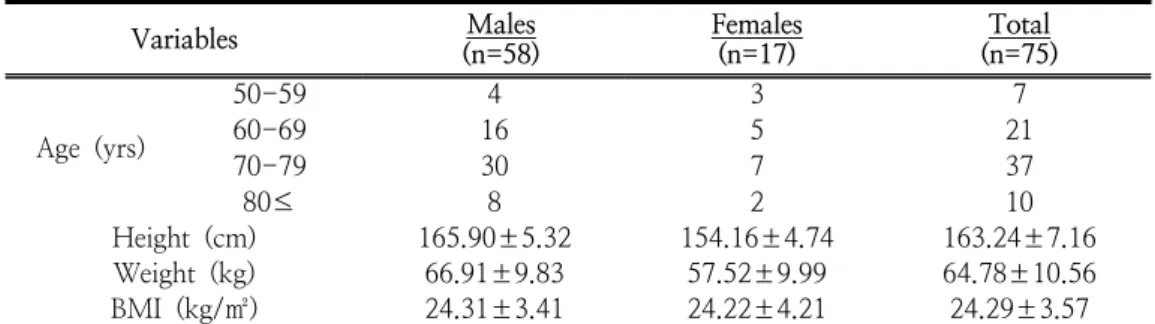
<Table 1>. All study participants understood the research content, procedure, purpose, etc., and completed a study agreement. This study was deliberated by J University Ethics Review Committee(IRB).

For the safety of the participants during the

examination period, all experiments were

constructed and executed after prior discussion

with the attending physician, and immediately

(3)

Table 2. Diagnosis of Sarcopenia

Muscle Mass Muscle Strength

AWGS (2014)

SMM/height

2

(BIA)

≤8.87kg/m

2

(male)

≤6.42kg/m

2

(female)

&

Grip strength:

< 26kg(male)

< 18kg(female) AWGS: Asian Working Group for Sarcopenia,

BIA: bioelectric impedance anaysis, SMM: Skeletal muscle mass Table 1. Participants Characteristics

Variables Males

(n=58)

Females (n=17)

Total (n=75)

Age (yrs)

50-59 4 3 7

60-69 16 5 21

70-79 30 7 37

80≤ 8 2 10

Height (cm) 165.90±5.32 154.16±4.74 163.24±7.16

Weight (kg) 66.91±9.83 57.52±9.99 64.78±10.56

BMI (kg/㎡) 24.31±3.41 24.22±4.21 24.29±3.57

BMI: Body Mass Index

stopped when respiratory complaints or abnormal symptoms were observed during the examination. In addition, in preparation for emergency accidents that may occur during the inspection, a close emergency contact network with medical personnel in the hospital was established to prepare for various accidents.

2.2. Assessments

In order to measure height and weight, JENIX(Dongsan Zenix, Korea) was used, and to analyze body composition, Inbody 270 (Biospace Co., Korea) was used.

Waist circumference refers to the minimum circumference of the abdomen, and the arm was relaxed with the thinnest circumference between the iliac ridge line and the midline boundary line between the ribs 12 and measured at normal breath. The waist circumference measured the lower most bone of the ribs and the middle area above the hip bone with the scale of the anthropometric tape measure in 0.1cm. Hip circumference is a measure of the apparent pelvic size. The hip

circumference was measured with an anthropometric tape measure after subtracting the force from the hip to the thickest part that connects the most prominent part of the back of the buttocks with the pubic joint and the upper part of the opponent in 0.1cm.

For the muscular strength, a gripping force meter(T.K.K. 5101, Japan) was used to measure grip strength(GS), and a back strength meter(T.K.K. 5102 Japan) was used to measure back strength (BS). Flexibility was measured using a left refractometer(T.K.K.

5103, Japan), maintaining and recording the motion of sitting and reaching(SR) for 1-2 seconds in the state of maximum bending.

Sarcopenia was diagnosed according to the Asian Working Groups for Sarcopenia<Table 2>[10].

2.3. Statistical Analysis

The processing of all measured data in this

study was analyzed using the SPSS (Statistical

Package for the Social Sciences) 22.0 statistical

program. The mean, standard deviation,

(4)

Table 3. The Level of Obesity among Participants

Variables Males

(n=58)

Females (n=17)

Total (n=75)

BMI (kg/m

2

) 24.31±3.41 24.22±4.21 24.29±3.57

WC (cm) 91.64±8.93 87.20±9.47 90.63±9.18

HC (cm) 96.36±6.69 93.90±6.25 95.80±6.63

WHR (%) .95±.06 .92±.06 .95±.06

WHtR (%) .55±.06 .57±.06 .56±.06

BFM (kg) 18.11±6.44 19.88±7.84 18.51±6.76

PBF (%) 26.49±7.18 33.41±8.08 28.06±7.89

LBM (kg) 48.80±5.96 37.64±3.59 46.27±7.23

SMM (kg) 26.94±3.66 20.17±2.19 25.41±4.42

Date presented as the Mean±Standard Deviation.

BFM: body fat mass BMI: body mass index, HC: hip circumference, LBM: lean body mass, PBF: percent body fat, SMM: skeletal muscle mass, WC: waist circumference, WHR: waist–hip circumference ratio, WHtR: waist circumference to height ratio

frequency(%), and median for each measurement item of 75 subjects were calculated. To analyze the correlation between obesity and fitness level in COPD patients, Pearson's Correlation was conducted. Independent t-test method was used to compare obesity and physical fitness levels by gender. The significance level for the hypothesis test was set to p<.05.

3. The Results

3.1. The results of the participants' body composition and physical fitness levels <Table 3> shows the results of measuring the body composition of male and female COPD patients. The body mass index was overweight in 24.31±3.41 for men and 24.22±4.21 for women. The waist circumference was 91.64±8.93 for male and 87.20±9.47 for female. Body fat percentage was obese for both males 26.49±7.18 and females 33.41±8.08. The waist circumference and hip circumference were both males .95±.06 and females .92±.06.

<Table 4> shows the results of physical fitness of male and female COPD patients.

The grip strength was 32.95±6.24 for males

and 22.44±6.19 for females, and the relative grip strength was 49.65±9.00 for males and 39.98±12.88 for females. The muscular strength was 77.58±24.39 for males and 66.00±22.41 for females, and the relative muscular strength was 116.86±35.96 for males and 116.86±42.61 for females. The flexibility was males -.84±9.98 and females 8.72±

11.46.

<Table 5> shows the results of analyzing the frequency of diagnosis criteria for male and female COPD patients. In the obesity diagnosis criteria, the body mass index was 5.20% for men with low weight, 29.30% for normal, 22.40% for overweight, and 43.10% for obesity. Females were classified as underweight 11.80%, normal 29.40%, overweight 21.30%, and obese 42.70%. Based on waist circumference, male obesity was classified as 60.30% and female obesity as 52.90%.

According to body fat percentage, male obesity was classified as 58.60% and female obesity was 82.40%.

The criteria for diagnosing muscular

dystrophy risk factors were 15.50% for males

and 23.50% for females. The skeletal muscle

index was categorized as 24.10% for males

and 0.00% for females.

(5)

Table 4. The Level of Physical Fitness among Participants

Variables Males

(n=58)

Females (n=17)

Total (n=75)

LGS (kg) 32.37±6.33 21.41±6.07 29.89±7.76

RGS (kg) 33.52±7.35 23.48±6.61 31.25±8.31

GS (kg) 32.95±6.24 22.44±6.19 30.57±7.61

GS/wt (%) 49.65±9.00 39.98±12.88 47.46±10.72

BS (kg) 77.58±24.39 66.00±22.41 70.10±26.45

BS/wt (%) 116.86±35.96 116.86±42.61 108.27±37.78

SR (cm) -.84±9.98 8.72±11.46 1.33±11.01

Date presented as the Mean±Standard Deviation.

BS: back strength, BS/wt: back strength/weight, LGS: left grip strength, GS: grip strength, GS/wt: grip strength/weight, RGS: right grip strength, SR: sit and reach, SU: sit–up

Table 5. Frequency of Obesity and Sarcopenia Factors

Variables Cut-points

Males (n=58)

Females (n=17)

Total (n=75)

n % n % n %

BMI (kg/m

2

)

18.5>

18.5∼22.9 23∼25

25≤

3 17 13 25

5.20 29.30 22.40 43.10

2 5 3 7

11.80 29.40 17.60 40.99

5 22 16 32

6.70 29.30 21.30 42.70 WC (cm) ≥90(males)

≥85(females) 35 60.30 9 52.90 44 58.70

WHR (%) ≥.90(males)

≥.85(females) 50 86.20 16 94.80 66 88.00

PBF (%) ≥25(males)

≥30(females) 34 58.60 14 82.40 48 64.00

GS (kg) <26(males)

<18(females) 9 15.50 4 23.50 13 17.33

SMM/Ht

2

≤8.87(males)

≤6.42(females) 14 24.10 0 0.00 14 18.67

BMI: body mass index, GS:grip strength, PBF: percent body fat, SMM/Ht

2

: skeletal muscle mass/height

2

, WC: waist circumference, WHR: waist-hip ratio

3.2. The correlation between body composition and physical fitness levels

<Table 6> shows the correlation between obesity and fitness level. As a result of the analysis, GS/wt and BS/wt showed a significant negative correlation with BFM, PBF, BMI, WC, HC, and WHtR, and SMM and LBM had a significant positive correlation with LGS, RGS, BS.

3.3. The frequency of sarcopenia factors

<Table 7> shows the results of the

frequency(prevalence) of muscular dystrophy in

male and female COPD patients. The lower

level of muscular strength was 15.50% in

males and 23.50% in females. The lower level

of muscle mass was 24.10% in males and

.00% in females.

(6)

Table 6. Correlation between Levels of Obesity and Physical Fitness Correlation R

p value LGS RGS GS GS/wt BS BS/wt SR

BFM .092

.490

.201 .130

.165 .215

-.463

<.001

<.001 .999

-.365 .005

.006 .966

WHR .055

.680

.059 .659

.063 .638

-.237 .073

-.065 .628

-.217 .102

.146 .274

PBF -.028

.835

.033 .808

.005 .970

-.444

<.001

-.124 .354

-.390 .002

-.047 .724

SMM .485

<.001

.604

<.001

.602

<.001

.019 .886

.485

<.001

.143 .284

.248 .060

BMI .150

.262

.264 .045

.232 .080

-.461

<.001

.101 .453

-.291 .026

.204 .124

LBM .455

<.001

.581

<.001

.573

<.001

-.015 .913

.453

<.001

.108 .418

.238 .073

WC .054

.688

.147 .271

.114 .394

-.526

<.001

-.043 .749

-.400 .002

.092 .490

HC .021

.878

.139 .298

.092 .490

-.531

<.001

.004 .974

-.441 .001

-.010 .940

WHtR -.089

.507

-.027 .840

-.061 .649

-.577

<.001

-.163 .220

-.441 .001

.119 .375 BS: back strength, BS/wt: back strength/weight, BFM: body fat mass BMI: body mass index, LBM: lean body mass, LGS: left grip strength, GS: grip strength, GS/wt: grip strength/weight, HC: hip circumference, PBF: percent body fat, RGS: right grip strength, SR: sit and reach, SU:

sit–up, SMM: skeletal muscle mass, WC: waist circumference, WHR: waist –hip ratio, WHtR:

waist circumference to height ratio,

Table 7. Frequency of Sarcopenia Factors Sarcopenia Factors

n (%)

Males (n=58)

Females (n=17)

Total (n=75)

Muscle Strength 9 (15.50) 4 (23.50) 13 (17.33)

Muscle Mass 14 (24.10) 0 (.00) 14 (18.67)

Sarcopenia

Sarcopenia Factors Zero 41 (70.70) 13 (76.50) 54 (72.00)

Sarcopenia Factors One 13 (22.40) 4 (23.50) 17 (22.67)

Sarcopenia 4 (6.90) 0 (.00) 4 (5.33)

Males who had no sarcopenia factors were 70.70%, and females were 76.50%. Males who had one sarcopenia factors were 22.40%, and females were 23.50%, respectively. Males with sarcopenia were 6.90%, and females were .00%.

4. Discussions

The purpose of this study is to analyze the obesity level and sarcopenia among patients with COPD in Korea.

In the current study, the obesity level was

analyzed by setting the body mass index, waist

(7)

circumference, and body fat percentage criterion suggested by the Korean Society for Obesity. The muscle mass divided by the square of the height was set as the Asian Standard for Sarcopenia using the measurement index presented by the Asian Working Group For Sarcopenia(AWGS)[10].

COPD is commonly found in middle-aged and older people and is associated with muscle loss. Aging can also affect muscle mass and obesity[18]. Therefore, it is not clear whether obesity is associated with chronic obstructive pulmonary disease or due to aging.

As a result of analyzing obesity in the current study, it was found that the level of obesity was very high as 43% by body mass index, 88% by waist-hip circumference ratio, and 64% by body fat percentage. In general, the risk of developing obesity is increased in patients with COPD as a result of a reduced level of physical activities in daily life in these patients compared with healthy age-matched counterparts[14].

Additionally, patients with COPD who were treated by gluco-corticosteroids may be at increased risk of abdominal obesity as a result of gluco-corticoid mediated redistribution of stored energy and the stimulatory effect on intake[19].

In the relationship between pulmonary function and metabolic syndrome, diabetes is associated with decreased pulmonary function, and abnormalities in the endothelial cell system are associated with respiratory disease, metabolic syndrome, and cardiovascular disease[11,12]. Increased mast cell-derived inflammatory cells and inflammatory responses can lead to insulin resistance and increase the risk of cardiovascular disease associated with obesity, and the prevalence of metabolic syndrome was high in COPD patients[11].

Therefore, obesity management in COPD patients is essential for the prevention of metabolic diseases.

In the current study, the prevalence of muscular dysfunction was 15.50% for males and 23.50% for females, and was classified as 24.10% for males and 0.00% for females based on muscle mass among COPD patients.

Males with abnormalities based on muscle mass or muscle strength were 22.40%, and females were 23.50%. In overall, the prevalence of sarcopenia with abnormal both muscle mass and muscle strength were 6.90%

for males and 0.00% for females among this study COPD patients.

COPD patients have weakened motor skills due to decreased pulmonary function.

Gradually lung disease progresses, respiratory symptoms, systemic inflammation, nutritional deficiencies, weight loss, muscular atrophy, skeletal muscle dysfunction, cardiovascular disease, and psychological anxiety may worsen[12, 13].

Conventionally, COPD patients has a common symptom as breathing difficulties and weakening of exercise ability due to airflow obstruction and increase in breathing times due to dynamic hyper-expansion and impairment of gas exchange[1]. Recently, it has been reported that irrespective of function, skeletal muscle function itself contributes significantly.

Skeletal muscle dysfunction seen in these patients is chronic inactivity, corticosteroid drugs, nutritional deficiencies, hypoxia, aging, smoking, systemic inflammation, oxidative stress, apoptosis, and ubiquitin-proteosome rather than one factor[16-18]. It is caused by the interaction of systemic and local factors such as pathway activation.

Respiratory rehabilitation training is generally used as a non-medical treatment method for patients with chronic obstructive pulmonary disease. In conclusion, COPD patients are essential not only for the development of motor skills, but also for the normalization of skeletal muscle function and prevention of muscular dystrophy.

(8)

5. Conclusions

The purpose of this study is to analyze the level of obesity and sarcopenia among COPD patients in Korea. It was found that the level of obesity was very high as 43% by body mass index, 88% by waist-hip circumference ratio, and 64% by percent body fat. The lower level of muscle strength was 15.50% in males and 23.50% in females. The lower level of muscle mass was 24.10% in males and .00% in females. Males who had one sarcopenia factors were 22.40%, and females were 23.50%, respectively. In conclusion, regular resistance exercise is essential not only for the development of motor skills, but also for the normalization of skeletal muscle function and prevention of muscular dystrophy among COPD patients.

Acknowledgements

This work was supported by the Ministry of Education of the Republic of Korea and the National Research Foundation of Korea(NRF-2017S1A5A2A01027033), and this research was supported by the 2019 scientific promotion program funded by Jeju National University.

References

1. Teramoto S., "COPD pathogenesis from the viewpoint of risk factors", Intern.

Med. , Vol.46, No2, pp. 77-79,(2007).

2. Lopez-Campo J. L., Calero C., Quintana- Gallego E., "Symptom variability in COPD: a narrative review", Int. J. Chron.

Obstruct. Pulmon. Dis. , Vol.8, pp.231- 238,(2013).

3. Adeloye D., Chua S., Lee C., Basquill C., Papana A., Theodoratou E., Nair H., Gasevic D., Sridhar D., Campbell H., Chan K. Y., Sheikh A., Rudan I.; Global

Health Epidemiology Reference Group (GHERG), "Global and regional estimates of COPD prevalence: Systematic review and meta-analysis", J. Glob. Health , Vol.5, No.2, pp.020415,(2015).

4. Korean Centers for Disease Control and Prevention, "Korean Health Statistics 2016:

The Seventh Korea National Health and Nutrition Examination Survey (KNHANES VII-1)", Retrieved December, 2017, from http://knhanes.cdc.go.kr/

5. Korean Health Statistics, "Death-Cause Statistics 2015",(2016).

6. Harris T., "Muscle mass and strength:

relation to function in population studies", J. Nutr. , Vol.127, Suppl.5, pp.1004S- 1006S,(1997).

7. Rosenberg H. I., "Sarcopenia: origins and clinical relevance", Clin. Geriatr. Med ., No.3, pp.337-339,(2011).

8. Kenney W. L., Wilmore J., Costill D.,

"Physiology of Sport and Exercise 6th Edition", Human Kinetics ,(2015).

9. Cruz-Jentoft A. J., Baeyens J. P., Bauer J.

M., Boirie Y., Cederholm T., Landi F., Martin F. C., Michel J., Rolland Y., Schneider S. M., Topinková E., Vandewoude M., Zamboni M., European Working Group on Sarcopenia in Older People, "Sarcopenia: European consensus on definition and diagnosis: report of the European Working Group on Sarcopenia in Older People", Age Ageing , Vol.39, No.4, pp.412-423,(2010).

10. Chen L., Liu L., Woo J., Assantachai P., Auyeung T., Bahyah K. S., Chou M., Chen L., Hsu P., Krairit O., Lee J. S. W., Lee W., Lee Y., Liang C., Limpawattana P., Lin C., Peng L., Satake S., Suzuki T., Won C. W., Wu C., Wu S., Zhang T., Zeng P., Akishita M., Arai H., "Sarcopenia in Asia: Consensus report of the Asian Working Group for Sarcopenia", J. Am.

Med. Dir. Assoc ., Vol.15, No.2, pp.95-101,(2014).

11. Mannino D. M., Thorn D., Swensen A.,

(9)

Holguin F., "Prevalence and outcomes of diabetes, hypertension and cardiovascular disease in COPD", Eur. Respir. J ., Vol.32, No.4, pp.962-969,(2008).

12. Tselebis A., Pachi A., Ilias I., Kosmas E., Bratis D., Moussas G., Tzanakis N.,

"Strategies to improve anxiety and depression in patients with COPD: a mental health perspective", Neuropsychiatr.

Dis. Treat ., No.12, pp.297-328,(2016).

13. Biskobing D. M., "COPD and osteoporosis", Chest, Vol.121, No.2, pp.609-620,(2002).

14. Kim H. C., Lee G. D., Hwang Y. S.,

"Skeletal muscle dysfunction in patients with chronic obstructive pulmonary disease", Tuberculosis and Respiratory Diseases, Vol.68, No.3, pp.125-139,(2010).

15. Casaburi R., Gosselink R., Decramer M., Dekhuijzen R. P. N., Fournier M., Lewis M I., "Skeletal muscle dysfunction in chronic obstructive pulmonary disease: a statement of the American Thoracic Society and European Respiratory Society", Am. J. Respir. Crit. Care. Med., Vol.159, pp.S1-40,(1999).

16. Maltais F., LeBlanc P., Jobin J., Casaburi R., "Peripheral muscle dysfunction in chronic obstructive pulmonary disease", Clin. Chest. Med., Vol.21, pp.665-677, (2000).

17. Gosker H. R., Wouters E. F., van der Vusse G. J., Schols A. M., "Skeletal muscle dysfunction in chronic obstructive pulmonary disease and chronic heart failure: underlying mechanisms and therapy perspectives", Am. J. Clin. Nutr., Vol.71, pp.1033-1047,(2000).

18. Franssen F. M., O'Donnell D. E., Goossens G. H., Blaak E. E., Schols A. M.,

"Obesity and the lung: 5. Obesity and COPD", Thorax. Vol.63, No.12, pp.1110- 1117,(2008).

19. Pitta F., Troosters T., Spruit M. A., et al.,

"Characteristics of physical activities in

daily life in chronic obstructive pulmonary

disease", Am. J. Respir. Crit. Care. Med.,

Vol.171, pp.972–977,(2005).

수치

Table  2.  Diagnosis  of  Sarcopenia
Table  3.  The  Level  of  Obesity  among  Participants    Variables Males (n=58) Females(n=17) Total (n=75) BMI  (kg/m 2 ) 24.31±3.41 24.22±4.21 24.29±3.57 WC  (cm) 91.64±8.93 87.20±9.47 90.63±9.18 HC  (cm) 96.36±6.69 93.90±6.25 95.80±6.63 WHR  (%) .95±.0
Table  4.  The  Level  of  Physical  Fitness  among  Participants  Variables Males (n=58) Females(n=17) Total (n=75) LGS  (kg) 32.37±6.33 21.41±6.07 29.89±7.76 RGS  (kg) 33.52±7.35 23.48±6.61 31.25±8.31 GS  (kg) 32.95±6.24 22.44±6.19 30.57±7.61 GS/wt  (%)
Table  7.  Frequency  of  Sarcopenia  Factors Sarcopenia  Factors n  (%) Males (n=58) Females(n=17) Total (n=75) Muscle  Strength 9  (15.50) 4  (23.50) 13  (17.33) Muscle  Mass 14  (24.10) 0  (.00) 14  (18.67) Sarcopenia

참조

관련 문서

Results: The risk factors for sarcopenia chosen by both methods were body mass index (BMI) and duration of moderate physical activity; those for sarcopenic obesity were sex, BMI,

AUC, area under the curve; BIAWHR, waist to hip ratio estimated by bioelectric impedance analysis; WC, waist circumference; WHR, waist to hip ratio; BMI, Body

Results: The body composition values (weight, body mass index [BMI], skeletal muscle mass, percent body fat, basal metabolic rate, waist-hip ratio, visceral fat area)

Abbreviation: MHNO, metabolically healthy non obesity; MHO, metabolically healthy obesity; MUO, metabolically unhealthy obesity; BMI, body mass index;

AD prevalence exhibited a U-shape trend in relation to body mass index (BMI), waist circumference (WC), and total body fat (BF) percentage, especially in young adult women..

BMI, body mass index; WC, waist circumference; LF/TF, leg fat to total fat; SBP, systolic blood pressure; DBP, diastolic blood pressure; FBG, fast- ing blood glucose;

Conclusion: Blood leptin concentrations are related to parameters such as percent body fat, waist circumference, BMI, body fat mass, insulin, TG, HOMA-IR in type 2 diabetics.

Com- parison of body mass index (BMI), body adiposity index (BAI), waist circumference (WC), waist-to-hip ratio (WHR) and waist-to-height ratio (WHtR) as predictors of