Abstract
The matrix metalloproteinases (MMPs) play a key role in the normal physiology of connective tissue during development, morphogenesis, and wound healing. Dysregulation of their activity has been implicated in numerous diseases including encephalopathy and the process of bone loss. Thus, MMPs may play a role in the encephalopathy and post-transplantation bone disease by immunosuppressive drugs such as cyclosporine (CsA) and tacrolimus. Gelatin zymography of MMP-9 and MMP-2 was performed in the glioma cells and osteoblast after CsA or tacrolimus treatment. Glioma cells or rat osteoblast ROS17/2.8 cells were treated with CsA or tacrolimus to make final concentration from 2 to 250 μM. After incubation, gelatin zymography of MMP-9 and MMP-2 was performed. And the density for the MMP bands were measured using luminescent image analyzer system. Both MMP-9 and MMP-2 activities in the osteoblast cells were decreased depending on the concentration of CsA or tacrolimus. MMP-2 activity was increased after CsA or tacrolimus treatment in the glioma cells. However, MMP-9 activities were decreased after CsA or tacrolimus treatment in the glioma cells. These results indicate that dysregulation of MMPs in the osteoblast and in the glioma cells by immunosuppressive drugs may one of the contributing factors in post-transplantation bone disease and in the encephalopathy by tacrolimus or cyclosporine.
Key Words :
Cyclosporine, MMP-2, MMP-9, TacrolimusCorresponding Author: Kyo Cheol Mun, M.D., Department of Biochemistry, Keimyung University School of Medicine 1095 Dalgubeol-daero, Dalseo-gu, Daegu 704-701, Korea
Tel : +82-53-580-3851 E-mail : [email protected]
Department of Biochemistry, Keimyung University School of Medicine, Daegu, Korea
Kyo Cheol Mun, M.D.
Effect of Immunosuppressive Drugs on the Metalloproteinase in the
Glioma Cells and Osteoblasts
Introduction
Immunosuppressive drugs are widely used in t h e t h e r a p y o f o r g a n r e j e c t i o n i n p o s t- transplantation patients, and in the treatment of several autoimmune diseases [1-3]. Among the immunosuppressive drugs, cyclosporineA (CsA) and tacrolimus, are possess numerous side effects including post-transplantation bone disease, most notably, osteoporosis and osteopenia [4-7]. Despite the considerable attention to the CsA and tacrolimus, the mechanism by which CsA and tacrolimus causes bone loss remains unclear. And after the organ transplantation, some patients suffer from mild neurological symptoms such as tremor to severe complications including seizures and encephalopathy [8]. However, the mechanism by which CsA and tacrolimus causes encephalopathy remains unclear.
The matrix metalloproteinases (MMPs) are zinc- dependent endopeptidases which belong to the metzincin family. They degrade extracellular matrix macromolecules in cell environment and therefore play a key role in the normal physiology of c o n n e c t i v e t i s s u e d u r i n g d e v e l o p m e n t, morphogenesis, and wound healing [9-11]. The dysregulation of their activity has been implicated in numerous diseases including arthritis, cancer development, tumor metastasis, and atherosclerosis [12,13].
Increased activity of MMP-9 is responsible for the decreased proliferation and the reduction of the number of cells synthesizing new osteoid matrix and thus contributing to the process of bone loss [5]. And MMPs are also known to play in the function of the blood-brain-barrier, in the acute encephalopathy following prolonged febrile seizures with neurological sequelae, and in the febrile seizure or encephalopathy in influenza virus infection [10,11].
To investigate the possible mechanism of the
p o s t-t r a n s p l a n t a t i o n b o n e d i s e a s e a n d encephalopathy by immunosuppressive drugs such as CsA and tacrolimus, the effects on the metalloproteinase in osteoblastic ROS 17/2.8 cells and in the glioma cells after CsA or tacrolimus treatment was studied.
Materials and Methods
1. Osteoblast culture
Rat osteoblast ROS17/2.8 cells were cultured in Dulbecco’s modified Eagle’s medium (GibcoBRL, Grand Island, NY, USA) supplemented with 10%
fetal bovine serum (Hyclone; Logan, UT) and 100 μg/ml penicillin-streptomycin (100 U/ml) (GibcoBRL; Grand Island, NY, USA). Cells were grown in 10-cm diameter culture plates in a humidified atmosphere of CO2/air (5%/95%) at 37℃. Cells were treated with CsA (Novartis Pharma Stein AG; Stein, Switzerland)at dif ferent concentrations for 24h after plating of cells.
2. Glioma cell culture
Rat glioma cells (Korean Cell Line Bank; Seoul, Korea) were cultured in Dulbecco’s modified Eagle’s medium (WelGENE; Daegu, Korea) supplemented with 10% fetal bovine serum ( W e l G E N E ; D a e g u , K o r e a ) a n d 1 % penicillin‐streptomycin (HyClone; Logan, UT, USA). Cells were grown in 10‐cm diameter culture plates in a humidified atmosphere of CO2/air (5%/95%) at 37℃.
3. Treatment of CsA or tacrolimus
Rat osteoblast ROS17/2.8 cells or glioma cells were seeded in 6-well plate at a density of 2×10⁵
cells/well, and then were treated with CsA or tacrolimus (Astellas Pharma, Ireland, Co. Kerry, Ireland) to make final concentration from 2 to 250 uM, and incubated for 24 hours.
4. Gelatin zymography
Gelatin zymography of MMP-9 and MMP-2 was performed as follows; samples were subjected to electrophoresis on 7.5% SDS-PAGE co-polymerized with gelatin (0.2%) as the substrate. After electrophoresis was complete, the gel was incubated at 37℃ for 24 hour in 1 M Tris-HCl buffer, pH 7.6, containing 1M CaCl2. The gels were stained with 0.5% Coomassie Brilliant BlueG-250, and destained with 10% acetic acid. Gelatinolyitc activities were detected as unstained bands against the background of Coomassie blue stained gelatin.
The density for the MMP bands was measured using luminescent image analyzer system (LAS- 3000, Fuji Film, Tokyo, Japan).
Results
The density for MMP-9 and MMP-2 bands after
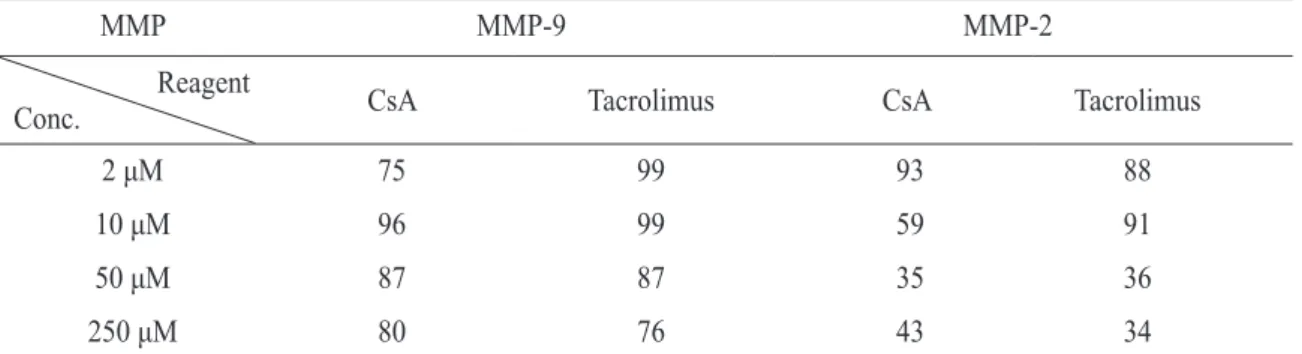
gelatin zymography in osteoblast was expressed in table 1. Both MMP-9 and MMP-2 activities were decreased depending on the concentration of CsA or tacrolimus.
The density for MMP-9 and MMP-2 bands after gelatin zymography in glioma cells was expressed in table 2. MMP-2 activity was increased after CsA or tacrolimus treatment. However, MMP-9 activities were decreased after CsA or tacrolimus treatment.
Discussion
Type IV collagenases (gelatinases) are members of the family of MMPs and are thought to play an important role in degradation of extracellular components. The gelatinase subclass can be divided into gelatinase-A (MMP-2) and gelatinase-B (MMP-9) and they are capable of degrading types IV and V collagens, elastin, and gelatin [14-16].
The reduction in bone mineral density after organ transplantation results in post-transplantation bone disease and remains an unsolved problem [4].
Calcineurin inhibitors such as cyclosporine and tacrolimus, have serious effects causing rapid and severe bone loss in animal models and humans
Table 1. Effect of immunosuppressant on the metalloproteinase in osteoblasts
MMP MMP-9 MMP-2
Reagent
Conc. CsA Tacrolimus CsA Tacrolimus
2 μM 75 99 93 88
10 μM 96 99 59 91
50 μM 87 87 35 36
250 μM 80 76 43 34
The density for the MMP bands were measured using luminescent image analyzer system (LAS-3000, Fuji Film, Tokyo, Japan). The density of the control was calculated as 100%. Conc; concentration of the immunosuppressants, CsA; cyclosporine A, MMP; matrix metalloproteinase.
[5,6]. A connection with the long-term application of nonglucocorticoidal immunosuppressants is the subject of controversial discussion [4]. The author hypothesized that CsA and tacrolimus have an influence on the skeletal system on the cellular level by dysregulation of the MMPs. In this study, both MMP-9 and MMP-2 activities were decreased depending on the concentration of CsA or tacrolimus.
And among the several immunosuppressants used after the organ transplantation, tacrolimus and cyclosporine which are known calcineurin inhibitors can cause neurological side effects [8].
According to Rosendal et al. [17], twenty percent of the patients immunosuppressed with CsA develop neurological side ef fects such as tremor, paresthesias, headache, seizures, visual disorders, paresis, and coma. And Kiemeneij et al. [18]
reported a tacrolimus encephalopathy. However, the mechanisms of encephalopathy by CsA and tacrolimus are not fully understood. In this study, MMP-2 activity was increased after CsA or tacrolimus treatment. However, MMP-9 activities were decreased after CsA or tacrolimus treatment.
These results suggest that CsA and tacrolimus may play a role in post-transplantation bone
disease by inhibiting MMP activity in osteoblasts.
And the dysregulation of the MMP-2 and MMP-9 by tacrolimus or cyclosporine may one of the contributing factors in the encephalopathy by tacrolimus or cyclosporine.
Summary
The dysregulation of MMP activity has been implicated in numerous diseases including encephalopathy and the process of bone loss.
Thus, MMPs may play a role in the encephalopathy and post-transplantation bone disease by immuno- suppressive drugs such as CsA and tacrolimus.
Glioma cells or rat osteoblast ROS17/2.8 cells were treated with CsA or tacrolimus to make final concentration from 2 to 250 μM. After incubation, gelatin zymography of MMP-9 and MMP-2 was performed. And the density for the MMP bands were measured using luminescent image analyzer system. Both MMP-9 and MMP-2 activities in the osteoblast cells were decreased depend on the concentration of CsA or tacrolimus. MMP-2 activity was increased after CsA or tacrolimus treatment in the glioma cells. However, MMP-9 activities were Table 2. Effect of immunosuppressant on the metalloproteinase in glioma cells.
MMP MMP-9 MMP-2
Reagent
Conc. CsA Tacrolimus CsA Tacrolimus
2 μM 80 102 108 125
10 μM 90 90 119 112
50 μM 79 86 123 101
250 μM 90 82 101 102
The density for the MMP bands were measured using luminescent image analyzer system (LAS-3000, Fuji Film, Tokyo, Japan). The density of the control was calculated as 100%. Conc; concentration of the immunosuppressants, CsA; cyclosporine A, MMP; matrix metalloproteinase.
decreased after CsA or tacrolimus treatment in the g l i o m a c e l l s. T h e s e r e s u l t s i n d i c a t e t h a t dysregulation of MMPs in the osteoblast and in the glioma cells by immunosuppressive drugs may one of the contributing factors in post-transplantation bone disease and in the encephalopathy by tacrolimus or cyclosporine.
References
1. Katz IA, Epstein S. Posttransplantation bone disease. J Bone Miner Res 1992;7:123-6.
2. ten Berge RJ. Treatment of autoimmune diseases and vasculitides with immunosuppressive drugs. Neth J Med 2002;60:298-9.
3. De Jesus A, Talal N. Practical use of immuno- suppressive drugs in autoimmune rheumatic diseases.
Crit Care Med 1990;18:S132-7.
4. Krocker D, Perka C, Tuischer J, Funk J, Tohtz S, Buttgereit F, et al. Effects of tacrolimus, cyclosporin A and sirolimus on MG63 cells. Transpl Int 2006;19:563- 9.
5. Fornoni A, Cornacchia F, Howard GA, Roos BA, Striker GE, Striker LJ. Cyclosporin A affects extracellular matrix synthesis and degradation by mouse MC3T3-E1 osteoblasts in vitro. Nephrol Dial Transplant 2001;16:500-5.
6. Tamler R, Epstein S. Nonsteroid immune modulators and bone disease. Ann N Y Acad Sci 2006;1068:284-96.
7. Sun L, Blair HC, Peng Y, Zaidi N, Adebanjo OA, Wu XB, et al. Calcineurin regulates bone formation by the osteoblast. Proc Natl Acad Sci USA 2005;102:17130-5.
8. Chegounchi M, Hanna MG, Neild GH. Progressive
neurological disease induced by tacrolimus in a renal transplant recipient: case presentation. BMC Nephrol 2006;7:7.
9. Mott JD, Werb Z. Regulation of matrix biology by matrix metalloproteinases. Curr Opin Cell Biol 2004;16:558-64.
10. Visse R, Nagase H. Matrix metalloproteinases and tissue inhibitors of metalloproteinases: structure, function, and biochemistry. Circ Res 2003;92:827-39.
11. Woessner JF, Jr. The family of matrix metallo- proteinases. Ann NY Acad Sci 1994;732:11-21.
12. Murphy G, Knauper V, Atkinson S, Butler G, English W, Hutton M, et al. Matrix metalloproteinases in arthritic disease. Arthritis Res 2002;4 Suppl 3:S39-49.
13. Itoh Y, Nagase H. Matrix metalloproteinases in cancer.
Essays Biochem 2002;38:21-36.
14. M a t r i s i a n L M . T h e m a t r i x - d e g r a d i n g metalloproteinases. Bioessays 1992;14:455-63.
15. Woessner JF, Jr. Matrix metalloproteinases and their inhibitors in connective tissue remodeling. FASEB J 1991;5:2145-54.
16. Murphy G, Docherty AJ. The matrix metallo- proteinases and their inhibitors. Am J Respir Cell Mol Biol 1992;7:120-5.
17. Rosendal F, Bjarkam CR, Larsen M, Hansen HE, Madsen M, Sorensen JC, et al. Does chronic low-dose treatment with cyclosporine influence the brain? A histopathological study in pigs. Transplant Proc 2005;37:3305-8.
18. Kiemeneij IM, de Leeuw FE, Ramos LM, van Gijn J.
Acute headache as a presenting symptom of tacrolimus encephalopathy. J Neurol Neurosurg Psychiatry 2003;74:1126-7.