http://dx.doi.org/10.3350/cmh.2014.20.2.137 Clinical and Molecular Hepatology 2014;20:137-150
Review
INTRODUCTION
With the development of electronic publication, the volume of medical literature published yearly exceeds what can be reviewed by experts, and studies with conflicting results on the same topic are commonplace. This situation can make it difficult to draw definitive conclusions, and so a systematic review (SR) provides the best and most trustworthy objective analysis of the existing
evidence.
In an SR, the primary research within a specific topic is collected, the evidence is filtered based on systematically estab- lished criteria, the information quality is evaluated, the data are analyzed, and a comprehensive conclusion is drawn with mini- mized bias. SRs were originally considered to lack originality and to be of little significance, but the advent of evidence-based medi- cine (EBM) has led to evolution of the field to focus on the thera-
Overview and recent trends of systematic reviews and meta-analyses in hepatology
Gaeun Kim
1and Soon Koo Baik
21Department of Nursing, Keimyung University College of Nursing, Daegu; 2Department of Internal Medicine, Yonsei University Wonju College of Medicine, Wonju, Korea
Corresponding author : Gaeun Kim
Department of Nursing, Keimyung University College of Nursing, 1095 Dalgubelo-daero, Daegu 704-701, Korea
Tel. +82-53-580-3920, Fax. +82-53-580-3916 E-mail; [email protected]
Co-Corresponding author : Soon Koo Baik
Division of Gastroenterology and Hepatology, Department of Internal Medicine, Yonsei University, Wonju College of Medicine, 162 Ilsan-ro, Wonju 220-701, Korea
Tel. +82-33-741-1223, Fax. +82-33-741-1228 E-mail; [email protected]
Abbreviations:
AHRQ, Agency for healthcare research and quality; AMSTAR, Assess the methodological quality or systematic review; CDC, Consensus development conference; CPG, Clinical practice guideline; DB, Database; EBM, Evidence based medicine; HBV, Hepatitis B virus; HCC, Hepatocellular carcinoma; HCV, Hepatitis C virus; MA, Meta-analysis; NAFLD, non-alcoholic fatty liver disease; PICO, Patient, intervention, comparator, outcome; PRISMA, Preferred reporting items for systematic review and meta-analysis; QUADAS, Quality assessment of diagnostic accuracy studies; RoB, risk of bias; SIGN, Scottish intercollegiate guideline network; SR, Systematic review
Received : May. 14, 2014 / Accepted : May. 29, 2014
A systematic review (SR) is a research methodology that involves a comprehensive search for and analysis of relevant studies on a specific topic. A strict and objective research process is conducted that comprises a systematic and comprehensive literature search in accordance with predetermined inclusion/exclusion criteria, and an assessment of the risk of bias of the selected literature. SRs require a multidisciplinary approach that necessitates cooperation with clinical experts, methodologists, other experts, and statisticians. A meta-analysis (MA) is a statistical method of quantitatively synthesizing data, where possible, from the primary literature selected for the SR. Review articles differ from SRs in that they lack a systematic methodology such as a literature search, selection of studies according to strict criteria, assessment of risk bias, and synthesis of the study results. The importance of evidence-based medicine (EBM) in the decision-making for public policy has recently been increasing thanks to the realization that it should be based on scientific research data.
SRs and MAs are essential for EBM strategy and evidence-based clinical practice guidelines. This review addresses the current trends in SRs and MAs in the field of hepatology via a search of recently published articles in the Cochrane Library and Ovid-MEDLINE. (Clin Mol Hepatol 2014;20:137-150)
Keywords: Meta-analysis; Systematic review; Hepatology
peutic effects, intervention effects, diagnostic accuracy, and expansion into diverse topics such as disease prognosis, incidence, policy, and qualitative research.
The popularity of SRs increased markedly with the establish- ment of the Cochrane Center to celebrate the Scottish scholar Archie Cochrane. Established in the UK in 1992, this center stressed the necessity of EBM, and approximately 8,000 reviews had been published by 2010, a dramatic increase from the several hundred yearly publications up to 1990. SRs have been increas- ingly used in Korea since 2008, not only in the scientific literature but also in investigations of national healthcare policy and organi- zation to guide the inclusion of new health technology assessment within insurance coverage.
While Korean health-care experts are increasingly aware of SRs, they remain poorly used in the clinical field compared to other countries. The findings are reviewed by the Evidence-Based Prac- tice Center of the Agency for Healthcare Research and Quality within the US Department of Health and Human Services, and are applied to clinical practice guidelines following consensus devel- opment conferences held by the National Institutes for Health;
results produced in the UK by the Scottish Intercollegiate Guide- lines Network (SIGN), National Institute for Health and Clinical Excellence, and National Coordinating Centre for Health Tech- nology Assessment are also applied clinically.
This article introduces the general concept and overall process of the SR with the aim of encouraging SR generation and clinical application. In addition, the trends of SRs in the hepatology field during 2013 and 2014 are considered, using the Cochrane Library and Ovid-MEDLINE databases (DBs).
Overview of the SR and meta-analysis
An SR involves searching for studies that are appropriate to the specific topic of the research, choosing them using clear and reproducible methods, and then designing and characterizing the individual primary studies. A strategy is then used to minimize bias and random error in individual studies, and then a summary of all of the included primary studies is generated. While a narrative review considers the existing literature based on experts’ subjec- tive viewpoints, the SR applies a distinct methodology to existing studies that is scientific and objective, and which has particularly narrowed subjects to suggest generalized estimations. In this process, when researchers can use a quantitative method, meta- analysis (MA), for synthesizing the primary studies. Statistical synthesis of the data is an optional part of an SR; in other words,
statistical pooling is not always needed, or indeed may not be possible, and qualitative synthesis or descriptive (narrative) synthesis is used instead.
The SR requires a process of defining the review question, searching for studies, selecting studies and collecting (retrieving) data, assessing the risk of bias in the included studies, analyzing data, undertaking an MA, and interpreting results. The procedure is described in detail below.
In common with other studies, the subject of an SR of a clinical topic must be medically meaningful. Furthermore, the field of the subject must include unmet needs such as uncertain evidence or differential views on specific subjects. Once a review question for the study topic has been chosen and a protocol for the study has been written, the researchers need to clarify and focus the review question using PICO: P-patients, populations, problems (how the focus patient groups will be managed); I-interventions, index test (which interventions or results from the diagnostic test will be evaluated); C-comparators, comparison, control (what parameters will be compared); and O-outcomes (which outcome variables will be researched).
After the specific review question has been chosen, the researchers must select the main search terms following the PICO process, and then browse the literature by establishing search strategies such as the range of the literature search and deciding which DB(s) to use. The three main (core) bibliographic DBs- Cochrane Library, Ovid-MEDLINE, and EMBASE-are generally considered to be the most important sources for literature searches.1 Depending on the characteristics of the review topic and DBs, the following may also be used: Web of Science, DARE, PsycINFO, ERIC, CANCERLIT, AMED, and CINAHL. The main domestic search providers in Korea, which may also be used, are KoreaMed, KMbase, NDSL, KSITI, and KISS. The researchers must also establish a sensitive and specific search strategy. Most DBs can be searched using standardized subject terms (e.g., MeSH and EMTREE) assigned by indexers, which are useful. In order to be as comprehensive as possible, it is necessary when designing a search strategy to include a wide range of free-text terms for each of the selected concepts. A search strategy should build up controlled vocabulary terms, text words, synonyms, Boolean oper- ators (AND, OR, and NOT), truncation or wild cards (*, ?, and $), and a suitable search filter. A standardized process is thus performed for selecting studies with suitable inclusion/exclusion criteria. The assessment of study eligibility and extraction of data from the included studies should be conducted by at least two people, independently.
After selecting the studies, their validity should be assessed by evaluating the risk of bias in their results (i.e., the risk that they will overestimate or underestimate the true intervention effect).
Studies for which the conclusions are not based on valid and objective evidence, or for which the validity of the methodology is not robust, cannot provide reliable answers to the SR question.
Various types of tool are used to evaluate study quality. The repre- sentative quality-assessment tools are the risk of bias (Cochrane Library) and checklists (SIGN); however, Quality Assessment of Diagnostic Accuracy Studies and the Newcastle-Ottawa Scale are also used.
Data should be collected for analysis from the individual studies, and should include not only the general information of publish year, authors, study design, and participant characteristics, but also interventions, outcome results, main findings, and conclu- sions.
After extracting the data, MA methods allow quantification of the direction, size, and consistency of any effects. If suitable numerical data are not available for MA, or if MA is considered inappropriate, then these may be formulated by narrative, descrip- tive, or qualitative synthesis. MA is a process of composing comprehensive reasoning by a weighted averaged summary esti- mation of interventions by integrating effect sizes (e.g., mean difference, relative risk, odds ratio, and number needed to treat) that were extracted from the primary study results. Researchers can conduct an MA using the Review Manager program provided by the Cochrane group. They may also use other statistical soft- ware such as SAS, STATA, comprehensive MA, and R.
When conducting the MA, the researchers should examine whether quantitative pooling is appropriate for the analysis by considering the heterogeneity of the individual studies. If there is a high degree of heterogeneity, the researchers could perform a subgroup analysis or meta-regression for reasons of the heteroge- neity. An SR assumes homogeneity of the primary studies, and so if there is heterogeneity in the included primary studies, integra- tion of the effects will be inappropriate. Furthermore, if the reason for the heterogeneity cannot be fully explained, the validity of the findings of the SR could be more limited.
Furthermore, it is possible that only statistically significant results are reported in the searched literature. The researchers therefore need to examine the publication bias using, for example, funnel plots. Methodological corrections can sometimes be applied if there is a high risk of publication bias.
SRs and MAs should be performed using the processes described above, by referring either to the ‘reporting guidelines’
presented by the Preferred Reporting Items for Systematic Review and Meta-Analysis (PRISMA) group,2 or the quality-evaluating Measurement Tool to Assess the Methodological Quality or Systematic Review (AMSTAR).3
Recent trends of SRs and MAs in hepatology
A search for the SRs and MAs written in the field of hepatology during 2013 and 2014 yielded about 30 studies published in the Cochrane Library, about 120 studies from Ovid-MEDLINE, or about 100 studies if those on the pancreas and biliary tract are excluded.
Hepatology is being actively studied using SR and MA method- ology in the UK, China, the USA, the Netherlands, and Germany, and similar methodologies are being used in Canada, Ireland, Greece, Thailand, Switzerland, France, Saudi Arabia, Italy, Romania, UK, Egypt, Canada, Denmark, Australia, Brazil, Mexico, Qatar, Japan, Taiwan, Iran, Poland, and Croatia. The most reviewed interventions/index tests in SRs and MAs are the comparisons between treatment medicines or interventions, the accuracy of diagnosis, and prevalence. The main populations of the enrolled patients are hepatocellular carcinoma (HCC), hepatitis C virus (HCV), and liver transplantation, followed by hepatic fibrosis, liver cirrhosis, hepatitis B virus (HBV), nonalcoholic fatty liver disease (NAFLD), and liver failure. The literature is summa- rized herein according to the disorder.
HBV
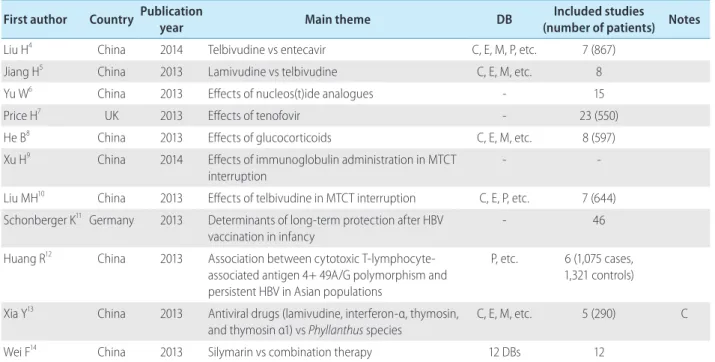
Nine of 11 SRs related to HBV were conducted in China, with the remainder performed in Germany and the UK. Almost all compared the effects of medicine, safety, and efficacy. Only four studies used a core DB (Table 1).
The review topics comprised the relative effects of telbivudine and entecavir in chronic HBV patients,4 the effects of lamivudine and telbivudine,5 the effects of nucleos(t)ide analogs,6 the effects of tenofovir in HBV/HIV coinfected patients,7 the effects of gluco- corticoids,8 the effects of immunoglobulin administration and antiviral treatment in mother-to-child transmission (MTCT) inter- ruption,9 and the efficacy of telbivudine in MTCT interruption.10 There were also several reviews about determinants of long-term protection after hepatitis B vaccination in infancy,11 and the asso- ciation between persistent HBV infection and cytotoxic T-lympho- cyte-associated antigen 4 +49A/G polymorphism in an Asian population.12
HCV
There were 31 studies about HCV infection, comprising 11 studies about the safety and efficacy of medicines, 6 studies about prevalence or epidemiology, 3 studies of the predictors of patient compliance or response to treatment, 7 on the effects of education, and 4 studies about relationships with other disorders (e.g., thyroid dysfunction, HIV, retinopathy, and Schistosomiasis mansoni). Unlike HBV, there were only two studies from China, while eight were performed in the USA, and the rest were from Canada, the UK, Germany, the Netherlands, Brazil, France, Ireland, Denmark, Qatar, Saudi Arabia, Romania, Australia, and Thailand.
Only 26.6% (8/30) of the studies used a core DB, and only 16.6%
(5/30) of the studies were published in the Cochrane Library, Hepatology, Hepatogastroenterology, or Liver International.
Furthermore, some of the studies used inadequate methodologies in that they did not refer to the PRISMA reporting guidelines or AMSTAR (Table 2).
The current gold standard of HCV treatment is the combination therapy with pegylated interferon-α (a weekly subcutaneous injec- tion) and ribavirin (administered orally).15 There were SR and MA reviews comparing the benefits and harms of pegylated interferon plus ribavirin and interferon plus ribavirin,16 the safety and effects of pegylated interferon α-2a or α-2b plus ribavirin,17,18 the efficacy of adding statins to interferon α plus ribavirin,19 the relative effi-
cacy among boceprevir and telaprevir,20 comparison of the efficacy and safety of telaprevir,21 the comparative effectiveness of anti- viral treatment,22 antiviral therapy (interferon-α plus cyclosporine A and tacrolimus) for recurrent HCV after liver transplantation,23 and interferon for interferon-nonresponding and relapsing patients with chronic HCV.24 Moreover, there were studies on the effects of nitazoxanide (a synthetic nitrothiazolyl-salicylamide derivative and an antiprotozoal agent),25 and the association between 25-hydroxyvi- tamin D and a sustained virological response (SVR).26
With regard to HCV prevalence or epidemiology, new estimates of age-specific antibodies to HCV seroprevalence27 and HCV prev- alence in prisons and other closed settings28 have been published (in Global Epidemiology and Hepatology, respectively). Studies of HCV prevalence have also been conducted in Europe, Egypt, Asia, and Saudi Arabia.29-32
In addition, there were reviews of interleukin-28B polymorphism as a predictor of SVR in patients with chronic HCV treated with triple therapy,33 treatment of HCV among people who inject drugs,34 and the positive ratio of specific antibodies to F protein in serum samples from chronic HCV using an enzyme-linked immu- nosorbent assay.35 Reviews of research into psychological, life- style, and social predictors of HCV treatment response36 have been published in Liver International, and reviews about patient adherence to antiviral treatment37 and the effects of education interventions38 have also been published.
Table 1. Systematic review (SR) and meta-analysis (MA) of hepatitis B virus (HBV) First author Country Publication
year Main theme DB Included studies
(number of patients) Notes
Liu H4 China 2014 Telbivudine vs entecavir C, E, M, P, etc. 7 (867)
Jiang H5 China 2013 Lamivudine vs telbivudine C, E, M, etc. 8
Yu W6 China 2013 Effects of nucleos(t)ide analogues - 15
Price H7 UK 2013 Effects of tenofovir - 23 (550)
He B8 China 2013 Effects of glucocorticoids C, E, M, etc. 8 (597)
Xu H9 China 2014 Effects of immunoglobulin administration in MTCT interruption
- -
Liu MH10 China 2013 Effects of telbivudine in MTCT interruption C, E, P, etc. 7 (644) Schonberger K11 Germany 2013 Determinants of long-term protection after HBV
vaccination in infancy - 46
Huang R12 China 2013 Association between cytotoxic T-lymphocyte- associated antigen 4+ 49A/G polymorphism and persistent HBV in Asian populations
P, etc. 6 (1,075 cases, 1,321 controls) Xia Y13 China 2013 Antiviral drugs (lamivudine, interferon-α, thymosin,
and thymosin α1) vs Phyllanthus species
C, E, M, etc. 5 (290) C
Wei F14 China 2013 Silymarin vs combination therapy 12 DBs 12
DB, database; C, Cochrane Library; E, EMBASE; M, Ovid-MEDLINE; P, PubMed; MTCT, mother-to-child transmission.
Table 2. SR and MA of HCV First authorCountryPublication yearMain themeDBIncluded studies (number of patients)Notes Hauser G16 Croatia2014Pegylated IFN plus ribavirin vs IFN plus ribavirinC, E, M, etc.27 (5,938)C Druyts E17 Canada2013Pegylated IFN-α2a or 2b plus ribavirinC, E, M, etc.8 Flori N18 France2013Pegylated IFN-α2a and ribavirin vs pegylated IFN-α2b and ribavirinC, E, M, etc.26 (18,260) Zhu Q19 China2013Efficacy of adding statins to IFN-α and ribavirin-5 Kieran J20 Ireland2013Relative efficacies of boceprevir and telaprevir-10 Goralczyk AD21 Germany2013Efficacy of telaprevir-7 (3,505) Chou R22 USA2013Comparative effectiveness of antiviral treatmentC, E, M, etc.- Rabie R23 Canada2013A ntiviral therapy for recurrent HCV after liver transplantation: IFN-α plus cyclosporine A vs tacrolimus-18 Koretz RL24 USA2013IFN for IFN-nonresponding and relapsing patients with chronic HCV-7 (1,676)C Nikolova K25 Denmark2014Effects of nitazoxanideC, E, M, etc.7 (538)C Villar LM26 Brazil2013Association between 25-hydroxyvitamin D and SVR-7 (2,120) Mohd Hanafiah K27 USA2013 New estimates of age-specific antibody to HCV seroprevalence-232Hepatology Larney S28 USA2013 HCV prevalence in prisons and other closed settings--Hepatology Hahne SJ29 Netherlands2013Prevalence of HBV and HCV in Europe-124 Mohanoud YA30 Qatar2013Epidemiology of HCV in EgyptE, P150 Nguyen LH31 USA2013 HCV infection in Asian patientsP99 Abozaid SM32 Saudi Arabia2013Prevailing HCV genotypes in Saudi Arabia-18 (2,277) Bota S33 Romania2013Interleukin-28B polymorphism as a predictor of SVRC, E, M, P, etc.5 (1,641) Aspinall EJ34 UK2013Treatment of HCV in people who inject drugsC, E, M11 Liu J35 China2013Accuracy of diagnosis of specific antibodies to F protein-16 Sublett VA36 Australia2013Psychological, lifestyle, and social predictors of HCV treatment response-34Liver International Lieveld FI37 Netherlands2013Patient adherence to antiviral treatmentC, E, P19 Shah HA38 Canada2013Effects of educational interventions-14 Nair Kesavachandran C39 Germany2013Frequency of thyroid dysfunctions during IFN-α treatment-- Davies A40 UK2013Outcomes of treatment-naïve HCV patients coinfected with HIVE, M40 (5,339) Raza A41 USA2013IFN-associated retinopathy during the treatment of chronic HCV-21 Van-Lume DS42 Brazil2013Association between Schistosomiasis mansoni and HCVC, M13 Dimova RB43 USA2013Determinants of HCV treatment completion and efficacy in drug users-36 (2,866) Cottrell EB44 USA2013Comparison strategy for risk reduction in mother-to-infant transmission of HCVC, M18 Ingsathit A45 Thailand2013Survival advantage of kidney transplantation over dialysis in patients with HCVE, M, etc.9 (1,734) Chou R46 USA2013Effects of HCV screening in asymptomatic adults without known liver enzyme abnormalitiesC, E, M, etc.- IFN, interferon; SVR, sustained virological response.
There were reviews of the relationship with other disorders such as thyroid dysfunction during single and combination therapy of interferon-α,39 outcomes of treatment-naïve HCV patients coin- fected with HIV,40 interferon‐associated retinopathy during the treatment of chronic HCV,41 and the association between Schisto- somiasis mansoni infection and HCV.42 Moreover, there were studies about the determinants of HCV treatment completion and efficacy in drug users,43 the effects of mode of delivery, labor management strategies, and breastfeeding practices on risk reduction for mother-to-infant transmission of HCV,44 the survival advantage of kidney transplantation over dialysis in patients with HCV,45 and the benefit and harms of HCV screening in asymptom- atic adults.46
NAFLD/AFLD
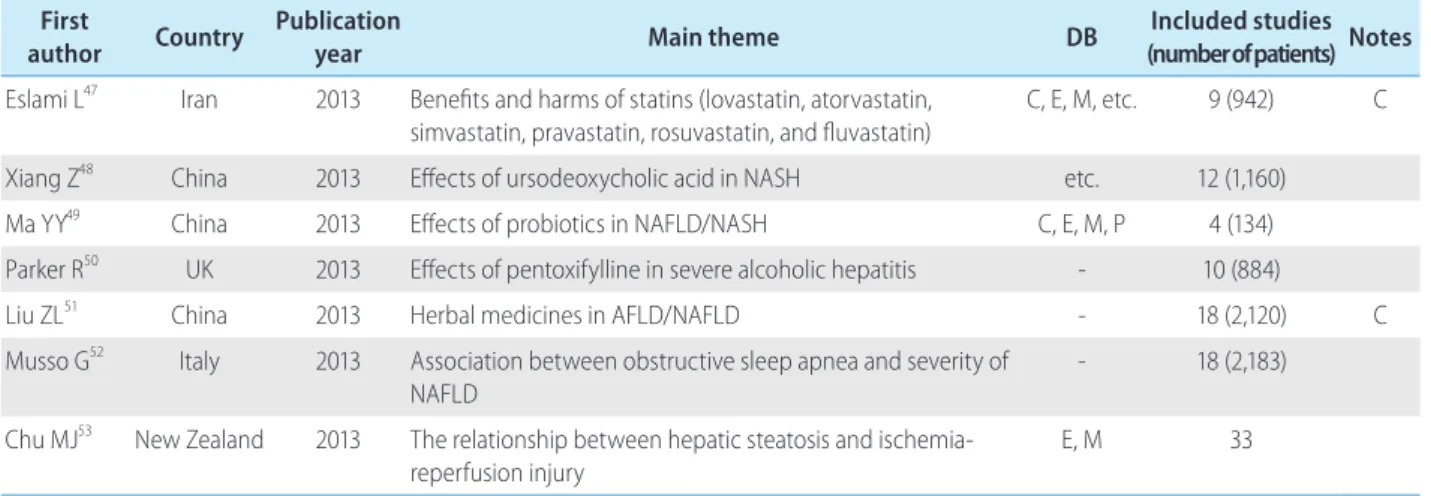
The search for reviews of NAFLD and nonalcoholic steatohepa- titis yielded three reviews from China, and one each from the UK, Iran, Italy, and New Zealand. Only two (28.6%) of these studies used a core DB (Table 3). Four (57.1%) of the reviews observed at the efficacy of medicines such as of statins (lovastatin, atorvas- tatin, simvastatin, pravastatin, rosuvastatin, and fluvastatin),47 ursodeoxycholic acid,48 probiotics,49 and pentoxifylline,50 and one (14.3%) compared the benefits and harms of herbal medicines in NAFLD/AFLD (alcoholic fatty liver disease) patients.51 The remaining two reviews focused on the association between obstructive sleep apnea and the presence and severity of NAFLD52 and the relationship between hepatic steatosis and hepatic isch- emia reperfusion injury.53
Liver cirrhosis and hepatic fibrosis
There were more reviews on the accuracy of diagnosis than on the effects of intervention for cirrhosis patients. Three reviews were from China, two were from the USA, and there was one each from Romania and Egypt. Two of the reviews (28.6%) were published in a major journal, and two (28.6%) used core DB (Table 4).
Reviews on acoustic-radiation-force impulse elastography and transient elastography were published in Liver International.54,55 In addition, there were reviews on the diagnostic accuracy of using the Fibroscan device (for transient elastography) and the aspartate aminotransferase/platelet ratio index,56 the effects of entecavir and lamivudine for hepatitis-B-decompensated cirrhosis,57 and a comparison of laparoscopic splenectomy with or without devascu- larization of the stomach for liver cirrhosis and portal hyperten- sion.58
Hepatic encephalopathy
There were three reviews focusing on hepatic encephalopathy patients, two of which were from Denmark (Table 5). These reviews were on the effects of dopamine agents and placebo or no intervention,59 the effects of oral zinc,60 and the effects of oral branched-chain amino acids (BCAA).61
Liver failure
There were three reviews on liver failure patients, among which only one was published in a major journal; none of the reviews
Table 3. SR and MA of NAFLD/AFLD First
author Country Publication
year Main theme DB Included studies
(number of patients) Notes Eslami L47 Iran 2013 Benefits and harms of statins (lovastatin, atorvastatin,
simvastatin, pravastatin, rosuvastatin, and fluvastatin) C, E, M, etc. 9 (942) C
Xiang Z48 China 2013 Effects of ursodeoxycholic acid in NASH etc. 12 (1,160)
Ma YY49 China 2013 Effects of probiotics in NAFLD/NASH C, E, M, P 4 (134)
Parker R50 UK 2013 Effects of pentoxifylline in severe alcoholic hepatitis - 10 (884)
Liu ZL51 China 2013 Herbal medicines in AFLD/NAFLD - 18 (2,120) C
Musso G52 Italy 2013 Association between obstructive sleep apnea and severity of
NAFLD - 18 (2,183)
Chu MJ53 New Zealand 2013 The relationship between hepatic steatosis and ischemia-
reperfusion injury E, M 33
NASH, nonalcoholic steatohepatitis.
used a core DB (Table 6). The three reviews concerned the prog- nostic indicators of acute-on-chronic liver failure and their predic- tive value for mortality,62 echocardiography in chronic liver disease,63 and the efficacy and safety of nucleos(t)ide analogs in the treatment of HBV-related acute-on-chronic liver failure.64
HCC
There were 34 SRs about HCC patients, comprising 11 reviews on the effects of surgical method, 6 reviews on the diagnostic accuracy of various tools [e.g., contrast-enhanced ultrasound (CEUS) and diffusion-weighted imaging (DWI)], 8 reviews of trans- catheter arterial chemoembolization (TACE), and 6 reviews about the efficacy of medicines such as statins and steroids. Twelve of the reviews came from China, 5 from the UK, 4 from the USA, 3
from the Netherlands, 2 each from Germany and Canada, and 1 each from Italy, Australia, Egypt, and Switzerland. Of the 34 reviews, 9 (26.5%) were published in a major journal and 12 (35.3%) used a core DB (Table 7).
A review of the diagnostic accuracy of CEUS for the differentia- tion of benign and malignant focal liver lesions was published in Liver International,65 and a review of the accuracy of DWI compared with conventional contrast-enhanced magnetic reso- nance imaging for the detection of HCC, aimed at chronic liver disease patients, was published in the Journal of Gastroenterology and Hepatology.66 In addition, there were reviews about the prog- nostic usability of microvascular invasion after resection or liver transplantation in HCC67 and the diagnostic accuracy of Ras-asso- ciation domain family 1A promoter methylation,68 the diagnostic accuracy of circulating tumor-cell detection in gastric cancer and
Table 4. SR and MA of liver cirrhosis and hepatic fibrosis First author Country Publication
year Main theme DB Included studies
(number of patients) Notes Shi KQ54 China 2013 Diagnostic accuracy of transient elastography C, E, P, etc. 18 (3,644) Liver
International Bota S55 Romania 2013 Acoustic-radiation-force impulse elastography vs
transient elastography
C, E, M, P, etc.
13 (1,163) Liver International Abd El Rihim AY56 Egypt 2013 Diagnostic accuracy of Fibroscan device and APRI - 23 (Fibroscan), 20 (APRI)
Ye XG57 China 2013 Effects of entecavir and lamivudine for hepatitis-B-
decompensated cirrhosis E, M, P, etc. 13 (873)
Chen XD58 China 2013 Laparoscopic splenectomy with or without devascularization of the stomach for liver cirrhosis and portal hypertension
E, P 16 (651)
APRI, aspartate aminotransferase/platelet ratio index.
Table 5. SR and MA of hepatic encephalopathy First author Country Publication
year Main theme DB Included studies
(number of patients) Notes Junker AE59 Denmark 2014 Dopamine agents vs placebo or no intervention C, E, M, etc. 5 (144) C
Chavez-Tapia NC60 Mexico 2013 Effects of oral zinc C, E, M 4 (233)
Gluud LL61 Denmark 2013 Effects of oral branched-chain amino acids - 8 (382)
Table 6. SR and MA of liver failure
First author Country Publication
year Main theme DB Included studies
(number of patients) Notes Wlodzimirow KA62 Netherlands 2013 Prognostic indicators of acute-on-chronic liver
failure and their predictive value for mortality
E, M 19 Liver
International
Mota VG63 Brazil 2013 Echocardiography in chronic liver disease P, etc. 22
Yu S64 China 2013 Efficacy and safety of nucleos(t)ide analogs - 5
Table 7. SR and MA of HCC First authorCountryPublica- tion yearMain themeDBIncluded studies (number of patients)Notes Friedrich-Rust M65 Germany2013Contrast-enhanced ultrasound for the differentiation of benign and malignant focal liver lesions-45 (8,147)Liver International Wu LM66 China2013Diagnostic accuracy of DWIE, M9 (476)Journal of Gastroenterology and Hepatology Rodriguez- Peralvarez M67UK2013Microvascular invasion in HCC-20 Zhao ZH68China2013Diagnostic accuracy of Ras-association domain family 1A promoter methylation-7 (HCC 302 cases, CLD 250 cases) Gao P69 China2013Diagnostic accuracy of circulating tumor cell detection in gastric cancer and HCCC, E, M, etc.10 (577) Xu Y70 China2013Three common functional polymorphisms in microRNA encoding genes on the susceptibility to HCCE, P, etc.10 (3,437) Weis S71 Germany2013Radiofrequency (thermal) ablation vs no intervention or other interventionsC, E, M, etc.11 (1,819)C Cucchetti A72Italy2013Surgical resection vs radiofrequency ablation-- Duan C73 China2013Radiofrequency ablation vs hepatic resection for the treatment of early-stage HCCC, E, M, P,12 Lin NC74 Japan2013Laparoscopic vs open liver resectionM29 Rao AM75 UK2013Laparoscopic vs open liver resectionC, E, M, etc.-C Yin Z76China2013Laparoscopic vs open hepatectomyE, P, etc.15 (1,238) Ho CM77 China2013Effects of robotic liver resectionP19 (217) Taefi A78 USA2013Surgical resection vs liver transplantC, E, M, etc.-C Aubin JM79 Canada2013Liver resection for metastatic melanomaC, E, M, etc.22 (579) Chan DL80Australia2013Clinical efficacy and predictors of outcomes of repeat hepatectomy for recurrent HCC-22 (1,125) Coolsen MM81 Netherlands2013Effects of enhanced recovery after surgery or fast-track protocols in liver surgeryC, E, M, P6 Grant RC82 Canada2013Living- vs deceased-donor liver transplantation for HCC-12 Morgan RL83 USA2013Comparison between the response to HCV therapy and the development of HCCC, E, M, etc.30 Gu L84China2014Effects of TACE combined with local ablative therapy vs monotherapy-15 (2,120) Abdel-Rahman O85 Egypt2013Combination TACE plus sorafenib for the management of unresectable HCCC, E, M, P, etc.17 van Lienden KP86 Netherlands2013Effects of PVE before liver resection/preoperative PVE C, E, M44 (1,791) O’Neill S87 UK2013Effects of ischemic preconditioning in liver resection-11 (669) Sanjay P88UK2013Hemostatic and biliostatic efficacy of fibrin sealants in elective liver surgeryE, M, P10 (1,225) Ding H89 China2013Fibrin sealant after liver resectionC, E, P, etc.11 Simillis C90 UK2014Comparison of benefits and harms of different methods to decrease blood loss during liver resectionC, E, M, etc.9 (617)C Duffy A91 USA2013Hemorrhagic events in HCC treated with antiangiogenic therapies--Hepatology Singh S92USA2013Association between statins and reduced risk of HCCE, M, etc.10 (4,298 cases)Gastroenterology Singh S93 USA2013Antidiabetic medications and the risk of HCCE, M, etc.10 (22,650 cases) Huang TS94 Taiwan2013Effects of adjuvant IFN therapy after curative treatment for patients with viral hepatitis‐related HCCC, E, M, etc.9 (942) Wang J95 China2013Adjuvant therapy after potentially curative treatment for HCC-8 Li H96China2013Preoperative steroid administration in liver resection--Hepatogastroenterology Orci LA97 Switzerland2013Effect of perioperative steroids on ischemia-reperfusion injury and the surgical stress response in patients undergoing liver resectionC, E, M6 Mpabanzi L98 Netherlands2013Surrogate endpoints in liver surgeryP49 Ren W99 China2013Prevalence and risk factors of HCC in Budd-Chiari syndromeP16 HCC, hepatocellular carcinoma; DWI, diffusion-weighted imaging; PVE, portal vein embolization; TACE, transcatheter arterial chemoembolization.
HCC,69 and the effects of three common functional polymorphisms in microRNA-encoding genes on the susceptibility to HCC.70
Some of the reviews compared the surgical method of radiofre- quency (thermal) ablation and other interventions,71 surgical resec- tion and radiofrequency ablation,72 radiofrequency ablation and hepatic resection for the treatment of early-stage HCC,73 and lapa- roscopic and open liver resection,74-76 while others looked at robotic liver resection,77 the benefits and harms of surgical resec- tion vs liver transplant,78 living-donor vs deceased-donor liver transplantation for HCC,82 and the relationship between the responses to HCV therapy and the development of HCC.83
With regard to interventions, there are reviews about TACE:
comparison of the effects of TACE combined with local ablative therapy vs monotherapy,84 the effects of combination TACE plus sorafenib for the management of unresectable HCC,85 and the indications, technique, and outcome of portal vein embolization before liver resection/preoperative portal vein embolization.86
Liver transplantation
There were six reviews about liver transplant patients, 50% of which were published in a major journal. However, all of these studies were written by the same author (Table 8). They covered the benefits and harms of antiviral interventions on liver transplant patients with recurrent graft infection due to HCV,100 the benefits and harms of prophylactic antiviral therapy for the prevention of chronic HCV while undergoing liver transplantation,101 compari- sons of methods of preventing bacterial sepsis and wound compli- cations after liver transplantation,102 the use of high genetic barrier nucleos(t)ide analog(s) for prophylaxis from HBV recurrence after liver transplantation,103 as well as the association between cyto-
kine gene polymorphisms and graft rejection in liver transplanta- tion104 and a comparison of the Celsior and Custodiol solutions for liver transplantation in adults.105
CONCLUSION
The SR constitutes the most important research method in EBM, and SRs are widely used worldwide for establishing national health-care policies. SRs can relay information with minimal bias by summarizing the available evidence, and by collecting small- scale studies, enhancing the reliability of the conclusions, increasing the potential for general application, increasing the sample number, and reducing the risk of type 2 errors. Individual studies are limited in scope, whereas SRs can determine the treat- ment efficacy among various population groups. Expanding the subject scope allows generalization to larger populations and determination of the appropriate target group. In addition, by veri- fying the treatment effectiveness without requiring additional studies, SRs can speed up the clinical introduction of effective remedies. For these reasons, in the last 20 years the SR has become a critical component of both quantitative and method- ological medical research.
However, there remain many challenges in incorporating SR clinically. Although SRs are viewed as providing a higher level of evidence and with greater confidence than individual studies, since the quality of individual studies included varies, SRs and their clinical applications require close inspection. Over 50% of SRs and MAs that are published in major journals have employed inappropriate methodology.
Accepting the results of a statistical analysis without also exam- Table 8. SR and MA of liver transplantation
First author Country Publication
year Main theme DB Included studies
(number of patients) Notes Gurusamy KS100 UK 2013 Antiviral interventions for liver transplant patients C, E, M, etc. 17 (36) C Gurusamy KS101 UK 2013 Antiviral prophylaxis for the prevention of chronic HCV in
patients undergoing liver transplantation
C, E, M, etc. 12 (501) C Gurusamy KS102 UK 2014 Methods of preventing bacterial sepsis and wound
complications after liver transplantation C, E, M, etc. 7 (614) C Cholongitas E103 Greece 2013 High genetic barrier nucleos(t)ide analog(s) for prophylaxis
from HBV recurrence after liver transplantation
- 17 (519)
Rattanasiri S104 Thailand 2013 Association between cytokine gene polymorphisms and
graft rejection in liver transplantation - 12
Lema Zuluaga GL105
Colombia 2013 Comparison of the Celsior and Custodiol solutions for liver transplantation in adults
C, E, M, etc. 4
ining the clinical implications is a grave error; data assessment and the clinical significance must be determined through the collaboration between clinical experts, and any conclusions must fully reflect the consensus of the entire field. The clinical utility is enhanced when the decision to incorporate new treatments is made after weighing both the benefits and risks relative to existing technology.
The future production and utilization of objective evidence concerning medical technology, intervention, and diagnosis requires SRs and MAs that are performed through guided meth- odology when unclear or controversial evidence exists. Despite this limitation, high-quality SRs and MAs can facilitate EBM, mini- mize financial waste, and assist in policy decision-making. The evidence assessment and the evidence-securing process by SR and MA as detailed in this review will increase in the field of hepa- tology.
Conflicts of Interest
The authors have no conflicts to disclose.
REFERENCES
1. Higgins JPT, Green S. Cochrane Handbook for Systematic Reviews of Interventions. Version 5.1.0. updated March 2011. handbook web site, < http://handbook.cochrane.org/>. Accessed 2014.
2. Liberati A, Altman DG, Tetzlaff J, Mulrow C, Gøtzsche PC, Ioannidis JP, et al. The PRISMA statement for reporting systematic reviews and meta-analyses of studies that evaluate health care interven- tions : explanation and elaboration. J Clin Epidemiol 2009;62:e1- e34.
3. Shea BJ, Grimshaw JM, Wells G, Boers M, Andersson N, Hamel C, et al. Development of AMSTAR : A measurement tool to assess the methodological quality of systematic review. BMC med res meth- odol 2007;7:10.
4. Liu H, Wang X, Wan G, Yang Z, Zeng H. Telbivudine versus ente- cavir for nucleos(t)ide-naive HBeAg-positive chronic hepatitis B: a meta-analysis. Am J Med Sci 2014;347:131-138.
5. Jiang H, Wang J, Zhao W. Lamivudine versus telbivudine in the treatment of chronic hepatitis B: a systematic review and meta- analysis. Eur J Clin Microbiol Infect Dis 2013;32:11-18.
6. Yu W, Zhao C, Shen C, Wang Y, Lu H, Fan J. The efficacy and safety of Nucleos(t)ide analogues in patients with spontaneous acute exacerbation of chronic hepatitis B: a systematic review and meta- analysis. PLoS One 2013;8:e65952.
7. Price H, Dunn D, Pillay D, Bani-Sadr F, de Vries-Sluijs T, Jain MK, et
al. Suppression of HBV by tenofovir in HBV/HIV coinfected patients:
a systematic review and meta-analysis. PLoS One 2013;8:e68152.
8. He B, Zhang Y, Lü MH, Cao YL, Fan YH, Deng JQ, et al. Gluco- corticoids can increase the survival rate of patients with severe viral hepatitis B: a meta-analysis. Eur J Gastroenterol Hepatol 2013;25:926-934.
9. Xu H, Zeng T, Liu JY, Lei Y, Zhong S, ShengYJ, et al. Measures to reduce mother-to-child transmission of Hepatitis B virus in China: a meta-analysis. Dig Dis Sci 2013;59:242-258.
10. Liu MH, Sheng YJ, Liu JY, Hu HD, Zhang QF, Ren H. Efficacy of tel- bivudine on interruption of hepatitis B virus vertical transmission: a meta-analysis. Ann Saudi Med 2013;33:169-176
11. Schönberger K, Riedel C, Rückinger S, Mansmann U, Jilg W, Kries- RV. Determinants of long-term protection after hepatitis B vaccina- tion in infancy: a meta-analysis. Pediatr Infect Dis J 2013;32:307- 313.
12. Huang R, Hao Y, Fan Y, Yang C, Wu K, Cao S, et al. Association between cytotoxic T-lymphocyte-associated antigen 4 +49A/G polymorphism and persistent hepatitis B virus infection in the Asian population: evidence from the current studies. Genet Test Mol Bio- markers 2013;17:601-606.
13. Xia Y, Luo H, Liu JP, Gluud C. Phyllanthus species versus antiviral drugs for chronic hepatitis B virus infection. Cochrane Database Syst Rev 2013;4:CD009004.
14. Wei F, Liu SK, Liu XY, Li ZJ, Li B, Zhou YL, et al. Meta-analysis:
silymarin and its combination therapy for the treatment of chronic hepatitis B. Eur J Clin Microbiol Infect Dis 2013;32:657-669.
15. The Korean Association for the Study of the Liver (KASL). KASL clinical practice guidelines: management of hepatitis C. KASL web site, <http://www.kasl.org/down_guide/2013_guideline_HCV.pdf
>. Accessed 2014.
16. Hauser G, Awad T, Brok J, Thorlund K, Stimac D, Mabrouk M, et al. Peginterferon plus ribavirin versus interferon plus ribavirin for chronic hepatitis C. Cochrane Database Syst Rev 2014;2:CD005441.
17. Druyts E, Thorlund K, Wu P, Kanters S, Yaya S, Cooper CL, et al.
Efficacy and safety of pegylated interferon alfa-2a or alfa-2b plus ribavirin for the treatment of chronic hepatitis C in children and adolescents: a systematic review and meta-analysis. Clin Infect Dis 2013;56:961-967.
18. Flori N, Funakoshi N, Duny Y, Valats JC, Bismuth M, Christophorou D, et al. Pegylated interferon-α2a and ribavirin versus pegylated interferon-α2b and ribavirin in chronic hepatitis C : a meta-analysis.
Drugs 2013;73:263-277.
19. Zhu Q, Li N, Han Q, Zhang P, Yang C, Zeng X, et al. Statin therapy improves response to interferon alfa and ribavirin in chronic hepatitis C: a systematic review and meta-analysis. Antiviral Res 2013;98:373-379.
20. Kieran J, Schmitz S, O’Leary A, Walsh C, Bergin C, Norris S, et al.
The relative efficacy of boceprevir and telaprevir in the treatment of hepatitis C virus genotype 1. Clin Infect Dis 2013;56:228-235.
21. Goralczyk AD, Cameron S, Amanzada A. Treatment of chronic HCV genotype 1 infection with telaprevir: a Bayesian mixed treatment comparison of fixed-length and response-guided treatment regi- mens in treatment-naïve and–experienced patients. BMC Gastro- enterol 2013;13:148.
22. Chou R, Hartung D, Rahman B, Wasson N, Cottrell EB, Fu R.
Comparative effectiveness of antiviral treatment for hepatitis C virus infection in adults: a systematic review. Ann Intern Med 2013;158:114-123.
23. Rabie R, Mumtaz K, Penner EL. Efficacy of antiviral therapy for hep- atitis C after liver transplantation with cyclosporine and tacrolimus:
a systematic review and meta-analysis. Liver Transpl 2013;19:36- 48.
24. Koretz RL, Pleguezuelo M, Arvaniti V, Barrera Baena P, Ciria R, Gurusamy KS, et al. Interferon for interferon nonresponding and relapsing patients with chronic hepatitis C. Cochrane Database Syst Rev 2013;1:CD003617.
25. Nikolova K, Gluud C, Grevstad B, Jakobsen JC. Nitazoxanide for chronic hepatitis C. Cochrane Database Syst Rev 2014;4:CD009182.
26. Villar LM, Del Campo JA, Ranchal I, Lampe E, Romero-Gomez M.
Association between vitamin D and hepatitis C virus infection: A meta-analysis. World J Gastroenterol 2013;19:5917-5924.
27. Mohd Hanafiah K, Groeger J, Flaxman AD, Wiersma ST. Global epidemiology of hepatitis C virus infection: New estimates of age‐
specific antibody to HCV seroprevalence. Hepatology 2013;57:1333- 1342.
28. Larney S, Kopinski H, Beckwith CG, Zaller ND, Jarlais DD, Hagan H, et al. Incidence and prevalence of hepatitis C in prisons and other closed settings: Results of a systematic review and meta‐analysis.
Hepatology 2013;58:1215-1224.
29. Hahné SJ, Veldhuijzen IK, Wiessing L, Lim TA, Salminen M, LaarMv.
Infection with hepatitis B and C virus in Europe: a systematic review of prevalence and cost-effectiveness of screening. BMC Infect Dis 2013;13:181.
30. Mohamoud YA, Mumtaz GR, Riome S, Miller D, Abu-Raddad LJ.
The epidemiology of hepatitis C virus in Egypt: a systematic review and data synthesis. BMC infect dis 2013;13:288.
31. Nguyen LH, Nguyen MH. Systematic review: Asian patients with chronic hepatitis C infection. Aliment Pharmacol Ther 2013;37:921- 936.
32. Abozaid SM, Shoukri M, Al-Qahtani A, Al-Ahdala MN. Prevailing genotypes of hepatitis C virus in Saudi Arabia: a systematic analysis of evidence. Ann Saudi Med 2013;33:1-5.
33. Bota S, Sporea I, Şirli R, Neghină AM, Popescu A, Străin M. Role of interleukin-28B polymorphism as a predictor of sustained virologi- cal response in patients with chronic hepatitis C treated with triple
therapy: a systematic review and meta-analysis. Clin Drug Investig 2013;33:325-331.
34. Aspinall EJ, Corson S, Doyle JS, Grebely J, Hutchinson SJ, Dore GJ, et al. Treatment of hepatitis C virus infection among people who are actively injecting drugs: a systematic review and meta-analysis.
Clin Infect Dis 2013;57(Suppl 2):S80-S89.
35. Liu J, Yu W, Liu S. Positive ratio of specific antibodies to F protein in serum samples from chronic HCV-infected patients using an enzyme-linked immunosorbent assay: systematic review and meta- analysis. Eur J Gastroenterol Hepatol 2013;25:1152-1158.
36. Sublette VA, Douglas MW, McCaffery K, George J, Perry KN. Psy- chological, lifestyle and social predictors of hepatitis C treatment response: a systematic review. Liver Int 2013;33:894-903.
37. Lieveld FI, van Vlerken LG, Siersema PD, Van Erpecum KJ. Patient adherence to antiviral treatment for chronic hepatitis B and C: a systematic review. Ann Hepatol 2013;12:380-391.
38. Shah HA, Abu–Amara M. Education provides significant benefits to patients with hepatitis B virus or hepatitis C virus infection: a systematic review. Clin Gastroenterol Hepatol 2013;11:922-933.
39. Nair Kesavachandran C, Haamann F, Nienhaus A. Frequency of thyroid dysfunctions during interferon alpha treatment of single and combination therapy in hepatitis C virus-infected patients: a systematic review based analysis. PLoS One 2013;8:e55364.
40. Davies A, Singh KP, Shubber Z, Mills EJ, Cooke G, Ford N. Treat- ment Outcomes of Treatment-Naïve Hepatitis C Patients co-infected with HIV: a systematic review and meta-analysis of observational cohorts. PLoS One 2013;8:e55373.
41. Raza A, Mittal S, Sood GK. Interferon‐associated retinopathy dur- ing the treatment of chronic hepatitis C: a systematic review. J Viral Hepat 2013;20:593-599.
42. Van-Lume DS, Albuquerque Mde F, Souza AI, Domingues AL, Lopes EP, Morais CN, et al. Association between Schistosomiasis mansoni and hepatitis C: systematic review. Rev Saude Publica 2013;47:414- 24.
43. Dimova RB, Zeremski M, Jacobson IM, Hagan H, Des Jarlais DC, Talal AH. Determinants of hepatitis C virus treatment completion and efficacy in drug users assessed by meta-analysis. Clin Infect Dis 2013;56:806-816.
44. Cottrell EB, Chou R, Wasson N, Rahman B, Guise JM. Reducing risk for mother-to-infant transmission of hepatitis C virus: a systematic review for the U.S. Preventive Services Task Force. Ann Intern Med 2013;158:109-113.
45. Ingsathit A, Kamanamool N, Thakkinstian A, Sumethkul V. Survival advantage of kidney transplantation over dialysis in patients with hepatitis C: a systematic review and meta-analysis. Transplantation 2013;95:943-948.
46. Chou R, Cottrell EB, Wasson N, Rahman B, Guise JM. Screening for hepatitis C virus infection in adults: a systematic review for the U.S.
Preventive Services Task Force. Ann Intern Med 2013;158:101-108.
47. Eslami L, Merat S, Malekzadeh R, Nasseri-Moghaddam S, Aramin H. Statins for non-alcoholic fatty liver disease and non-alcoholic steatohepatitis. Cochrane Database Syst Rev 2013;12:CD008623.
48. Xiang Z, Chen YP, Ma KF, Ye YF, Zheng L, Yang YD, et al. The role of ursodeoxycholic acid in non-alcoholic steatohepatitis: a system- atic review. BMC Gastroenterol 2013;13:140.
49. Ma YY, Li L, Yu CH, Shen Z, Chen LH, Li YM. Effects of probiotics on nonalcoholic fatty liver disease: a meta-analysis. World J Gastro- enterol 2013;19:6911-6918.
50. Parker R, Armstrong MJ, Corbett C, Rowe IA, Houlihan DD. Sys- tematic review: pentoxifylline for the treatment of severe alcoholic hepatitis. Aliment pharmacol Ther 2013;37:845-854.
51. Liu ZL, Xie LZ, Zhu J, Li GQ, Grant SJ, Liu JP. Herbal medicines for fatty liver diseases. Cochrane Database Syst Rev 2013;8:CD009059.
52. Musso G, Cassader M, Olivetti C, Rosina F, Carbone G, Gambino R.
Association of obstructive sleep apnoea with the presence and se- verity of non-alcoholic fatty liver disease. A systematic review and meta-analysis. Obes Rev 2013;14:417-431.
53. Chu MJ, Hickey AJ, Phillips AR, Bartlett AS. The impact of hepatic steatosis on hepatic ischemia-reperfusion injury in experimental studies: a systematic review. Biomed Res Int 2013;2013:192029.
54. Shi KQ, Fan YC, Pan ZZ, Lin XF, Liu WY, Chen YP, et al. Transient elastography: a meta‐analysis of diagnostic accuracy in evaluation of portal hypertension in chronic liver disease. Liver Int 2013;33:62- 71.
55. Bota S, Herkner H, Sporea I, Salzl P, Sirli R, Neghina AM, et al.
Meta‐analysis: ARFI elastography versus transient elastography for the evaluation of liver fibrosis. Liver Int 2013;33:1138-1147.
56. Abd El Rihim AY, Omar RF, Fathalah W, El Attar I, Hafez HA, Ibrahim W. Role of fibroscan and APRI in detection of liver fibro- sis: a systematic review and meta-analysis. Arab J Gastroenterol 2013;14:44-50.
57. Ye XG, Su QM. Effects of entecavir and lamivudine for hepatitis B decompensated cirrhosis: meta-analysis. World J Gastroenterol 2013;19:6665-6678.
58. Chen XD, He FQ, Yang L, Yu YY, Zhou ZG. Laparoscopic splenec- tomy with or without devascularization of the stomach for liver cirrhosis and portal hypertension: a systematic review. ANZ J Surg 2013;83:122-128.
59. Junker AE, Als-Nielsen B, Gluud C, Gluud LL. Dopamine agents for hepatic encephalopathy. Cochrane Database Syst Rev 2014;2:CD003047.
60. Chavez-Tapia NC, Cesar-Arce A, Barrientos-Gutiérrez T, Villegas- López FA, Méndez-Sanchez N, Uribe M. A systematic review and meta-analysis of the use of oral zinc in the treatment of hepatic encephalopathy. Nutr J 2013;12:74.
61. Gluud LL, Dam G, Borre M, Les I, Cordoba J, Marchesini G, et
al. Oral branched-chain amino acids have a beneficial effect on manifestations of hepatic encephalopathy in a systematic re- view with meta-analyses of randomized controlled trials. J Nutr 2013;143:1263-1268.
62. Wlodzimirow KA, Eslami S, Abu-Hanna A, Nieuwoudt M, Chamu- leau RA. A systematic review on prognostic indicators of acute on chronic liver failure and their predictive value for mortality. Liver Int 2013;33:40-52.
63. Mota VG, Markman Filho B. Echocardiography in chronic liver dis- ease: systematic review. Arq Bras Cardiol 2013;100:376-385.
64. Yu S, Jianqin H, Wei W, Jianrong H, Yida Y, Jifang S, et al. The effi- cacy and safety of nucleos(t)ide analogues in the treatment of HBV- related acute-on-chronic liver failure: a meta-analysis. Ann Hepatol 2013;12:364-372.
65. Friedrich-Rust M, Klopffleisch T, Nierhoff J, Herrmann E, Vermehren J, Schneider MD, et al. Contrast‐Enhanced Ultrasound for the dif- ferentiation of benign and malignant focal liver lesions: a meta‐
analysis. Liver Int 2013;33:739-755.
66. Wu LM, Xu JR, Lu Q, Hua J, Chen J, Hu J. A pooled analysis of diffu- sion‐weighted imaging in the diagnosis of hepatocellular carcinoma in chronic liver diseases. J Gastroenterology Hepatol 2013;28:227- 234.
67. Rodríguez-Perálvarez M, Luong TV, Andreana L, Meyer T, Dhillon AP, Burroughs AK. A systematic review of microvascular invasion in hepatocellular carcinoma: diagnostic and prognostic variability. Ann Surg Oncol 2013;20:325-339.
68. Zhao ZH, Fan YC, Yang Y, Wang K. Association between Ras asso- ciation domain family 1A promoter methylation and hepatocellular carcinoma: a meta-analysis. World J Gastroenterol 2013;19:7189- 7196.
69. Gao P, Jiao SC, Bai L, Wang H, Jing FF, Yang JL. Detection of cir- culating tumour cells in gastric and hepatocellular carcinoma: a systematic review. J Int Med Res 2013;41:923-933.
70. Xu Y, Li L, Xiang X, Wang H, Cai W, Xie J, et al. Three common functional polymorphisms in microRNA encoding genes in the susceptibility to hepatocellular carcinoma: a systematic review and meta-analysis. Gene 2013;527:584-593.
71. Weis S, Franke A, Mössner J, Jakobsen JC, Schoppmeyer K. Radio- frequency (thermal) ablation versus no intervention or other inter- ventions for hepatocellular carcinoma. Cochrane Database Syst Rev 2013;12:CD003046.
72. Cucchetti A, Piscaglia F, Cescon M, Ercolani G, Pinna AD. System- atic review of surgical resection vs radiofrequency ablation for he- patocellular carcinoma. World J Gastroenterol 2013;19:4106-4118.
73. Duan C, Liu M, Zhang Z, Ma K, Bie P. Radiofrequency ablation ver- sus hepatic resection for the treatment of early-stage hepatocellular carcinoma meeting Milan criteria: a systematic review and meta- analysis. World J Surg Oncol 2013;11:190.
74. Lin NC, Nitta H, Wakabayashi G. Laparoscopic major hepatectomy:
a systematic literature review and comparison of 3 techniques. Ann Surg 2013;257:205-213.
75. Rao AM, Ahmed I. Laparotscopic versus open liver resection for benign and malignant hepatic lesions in adults. Cochrane Database Syst Rev 2013;5:CD010162.
76. Yin Z, Liu C, Chen Y, Bai Y, Shang C, Yin R, et al. Timing of hepatec- tomy in resectable synchronous colorectal liver metastases (SCRLM):
Simultaneous or delayed? Hepatology 2013;57:2346-2357.
77. Ho CM, Wakabayashi G, Nitta H, Ito N, Hasegawa Y, Takahara T. Systematic review of robotic liver resection. Surg Endosc 2013;27:732-739.
78. Aubin JM, Rekman J, Vandenbroucke-Menu F, Lapointe R, Fairfull- Smith RJ, Mimeault R, et al. Systematic review and meta‐analysis of liver resection for metastatic melanoma. Br J Surg 2013;100:1138- 1147.
79. Taefi A, Abrishami A, Nasseri-Moghaddam S, Eghtesad B, Sher- man M. Surgical resection versus liver transplant for patients with hepatocellular carcinoma. Cochrane Database Syst Rev 2013;6:CD006935.
80. Chan DL, Morris DL, Chua TC. Clinical efficacy and predictors of outcomes of repeat hepatectomy for recurrent hepatocellular carci- noma - a systematic review. SurgOncol 2013;22:e23-e30.
81. Coolsen MM, Wong-Lun-Hing EM, van Dam RM, van der Wilt AA, Slim K, Lassen K, et al. A systematic review of outcomes in patients undergoing liver surgery in an enhanced recovery after surgery pathways. HPB (Oxford) 2013;15:245-251.
82. Grant RC, Sandhu L, Dixon PR, Greig PD, Grant DR, McGilvray ID.
Living vs. deceased donor liver transplantation for hepatocellular carcinoma: a systematic review and meta‐analysis. Clin Transplant 2013;27:140-147.
83. Morgan RL, Baack B, Smith BD, Yartel A, Pitasi M, Falck-Ytter Y.
Eradication of hepatitis C virus infection and the development of hepatocellular carcinoma: a meta-analysis of observational studies.
Ann Intern Med 2013;158:329-337.
84. Gu L, Liu H, Fan L, Lv Y, Cui Z, Luo Y, et al. Treatment outcomes of transcatheter arterial chemoembolization combined with local ablative therapy versus monotherapy in hepatocellular carcinoma: a meta-analysis. J Cancer Res Clin Oncol 2014;140:199-210.
85. Abdel-Rahman O, Elsayed ZA. Combination trans arterial che- moembolization (TACE) plus sorafenib for the management of unresectable hepatocellular carcinoma: a systematic review of the literature. Dig Dis Sci 2013;58:3389-3396.
86. van Lienden KP, van den Esschert JW, de Graaf W, Bipat S, Lameris JS, van Gulik TM, et al. Portal vein embolization before liver resec- tion: a systematic review. Cardiovasc Intervent Radiol 2013;36:25- 34.
87. O’Neill S, Leuschner S, McNally SJ, Garden OJ, Wigmore SJ, Harri-
son EM. Meta‐analysis of ischaemic preconditioning for liver resec- tions. Br J Surg 2013;100:1689-1700.
88. Sanjay P, Watt DG, Wigmore SJ. Systematic review and meta- analysis of haemostatic and biliostatic efficacy of fibrin sealants in elective liver surgery. J Gastrointest Surg 2013;17:829-836.
89. Ding H, Yuan JQ, Zhou JH, Zheng XY, Ye P, Mao C, et al. Systematic review and meta-analysis of application of fibrin sealant after liver resection. Curr Med Res Opin 2013;29:387-394.
90. Simillis C, Li T, Vaughan J, Becker LA, Davidson BR, Gurusamy KS.
Methods to decrease blood loss during liver resection: a network meta‐analysis. Cochrane Database Syst Rev 2014;4:CD010683.
91. Duffy A, Wilkerson J, Greten TF. Hemorrhagic events in hepatocel- lular carcinoma patients treated with antiangiogenic therapies.
Hepatology 2013;57:1068-1077.
92. Singh S, Singh PP, Singh AG, Murad MH, Sanchez W. Statins are as- sociated with a reduced risk of hepatocellular cancer: a systematic review and meta-analysis. Gastroenterology 2013;144:323-332.
93. Singh S, Singh PP, Singh AG, Murad MH, Sanchez W. Anti-diabetic medications and the risk of hepatocellular cancer: a systematic re- view and meta-analysis. Am J Gastroenterol 2013;108:881-891.
94. Huang TS, Shyu YC, Chen HY, Yuan SS, Shih JN, Chen PJ. A system- atic review and meta‐analysis of adjuvant interferon therapy after curative treatment for patients with viral hepatitis‐related hepato- cellular carcinoma. J Viral Hepat 2013;20:729-743.
95. Wang J, He XD, Yao N, Liang WJ, Zhang YC. A meta-analysis of adjuvant therapy after potentially curative treatment for hepatocel- lular carcinoma. Can J Gastroenterol 2013;27:351-363.
96. Li H, Wei Y, Li B. Preoperative steroid administration in liver resec- tion: a systematic review and meta-analysis. Hepatogastroenterol- ogy 2013;60:160-169.
97. Orci LA, Toso C, Mentha G, Morel P, Majno PE. Systematic review and meta-analysis of the effect of perioperative steroids on isch- aemia-reperfusion injury and surgical stress response in patients undergoing liver resection. Br J Surg 2013;100:600-609.
98. Mpabanzi L, van Mierlo KM, Malagó M, Dejong CH, Lytras D, Olde Damink SW. Surrogate endpoints in liver surgery related trials: a systematic review of the literature. HPB (Oxford) 2013;15:327-336.
99. Ren W, Qi X, Yang Z, Han G, Fan D. Prevalence and risk factors of hepatocellular carcinoma in Budd-Chiari syndrome: a systematic review. Eur J Gastroenterol Hepatol 2013;25:830-841.
100. Gurusamy KS, Tsochatzis E, Toon CD, Xirouchakis E, Burroughs AK, Davidson BR. Antiviral interventions for liver transplant patients with recurrent graft infection due to hepatitis C virus. Cochrane Database Syst Rev 2013;12:CD006803.
101. Gurusamy KS, Tsochatzis E, Toon CD, Davidson BR, Burroughs AK.
Antiviral prophylaxis for the prevention of chronic hepatitis C virus in patients undergoing liver transplantation. Cochrane Database Syst Rev 2013;12:CD006573.
102. Gurusamy KS, Nagendran M, Davidson BR. Methods of preventing bacterial sepsis and wound complications after liver transplanta- tion. Cochrane Database Syst Rev 2014;3:CD006660.
103. Cholongitas E, Papatheodoridis GV. High genetic barrier nucleos (t) ide analogue (s) for prophylaxis from hepatitis B virus recurrence after liver transplantation: a systematic review. Am J Transplant 2013;13:353-362.
104. Rattanasiri S, McDaniel DO, McEvoy M, Anothaisintawee T, Sob-
honslidsuk A, Attia J, et al. The association between cytokine gene polymorphisms and graft rejection in liver transplantation: a sys- tematic review and meta-analysis. Transpl Immunol 2013;28:62-70.
105. Lema Zuluaga GL, Serna Agudelo RE, Zuleta Tobón JJ. Preservation solutions for liver transplantation in adults: celsior versus custodiol:
a systematic review and meta-analysis with an indirect comparison of randomized trials. Transplant Proc 2013;45:25-32.