Mathematical Models of Competitive Adsorption of Inorganic Anions in Soils
Kyo Suk Lee, Dong Sung Lee, Jae Bong Lee, Rhee Na Joo, Myong Yun Lee, and Doug Young Chung*
Department of Bio-environmental Chemistry College of Agriculture and Life Science Chungnam National University, Daejon, 34134, Korea
(Received: November 13 2015, Revised: November 26 2015, Accepted: December 2 2015)
Competition among anion species in solution for same sorption sites and soil surface can be of major significance in determining the effective mobility of any potentially adsorbing species. Major soil anion species include OH-, F-, Cl-, HCO3-
, CO3-
, NO3-
, SO42-
, and PO43-
. And some micro nutrients such as boron and molybdenum exist as H2BO3-
and MoO42-
, as do some heavy metals such as chrome and arsenic as CrO42-
and HAsO42-. Pesticides such as 2,4,5-T and 2,4-D also exist as anions. Many anion species are retained by more complex mechanisms than the simple electrostatic attractions involved in most cation adsorption reactions. In binary system composed of two anions, the adsorption of one anion is influenced by the other anion due to the competition for the available and limited binding sites in soil constituents. The specifically adsorbed anions may compete more effectively for sorption sites than that of nonspecifically adsorbed anion. In this study, we aim to evaluate the mathematical models to determine the magnitude of concentration variations in adsorption due to competitive interactions between anions introduced to a system in binary mixtures.
Key words: Anion, Competitive Adsorption, Model, Soil
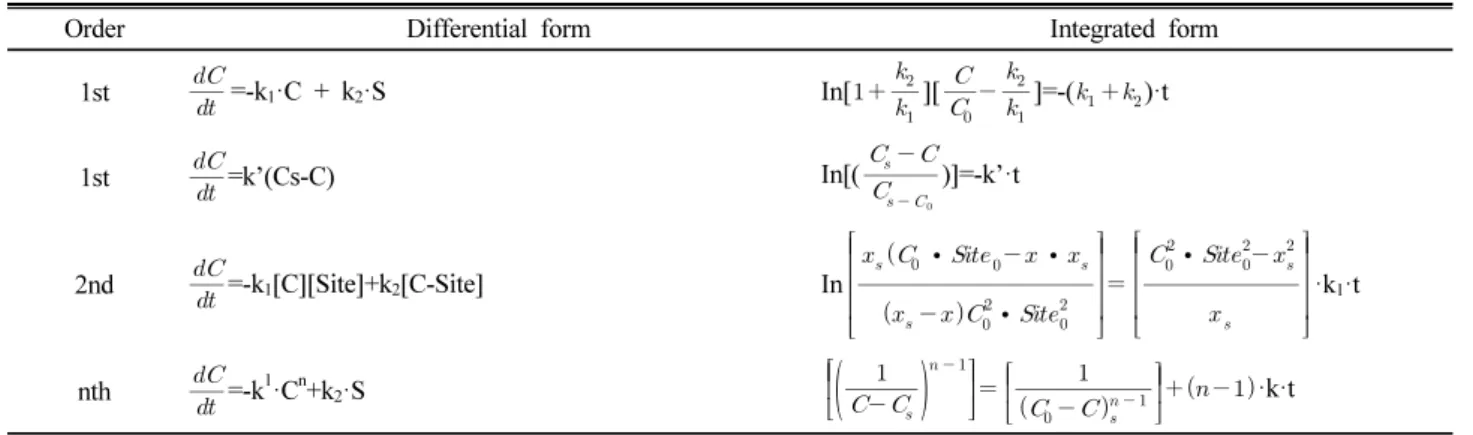
Summary of single-reaction models describing retention and release reactions in soil : reversible.
Order Differential form Integrated form
1st
=-k1·C + k2·S In[
][
]=-()·t
1st
=k’(Cs-C) In[(
)]=-k’·t
2nd
=-k1[C][Site]+k2[C-Site] In
∙∙ ∙
∙
·k1·tnth
=-k1·Cn+k2·S
·k·t
1)
*Corresponding author: Phone: +82428216739, Fax: +82428216731, E-mail: [email protected]
§Acknowledgement: This study was carried out with the support of “Research Program for Agricultural Science & Technology Development (Project No. PJ01086102)”, National Academy of Agricultural Science, Rural Development Administration, Republic of Korea.
Introduction
The mobility of anions in the aquatic environment is typically regulated by adsorption at the solid/water interface and by competition among various anion species for surface binding sites. The magnitude of these competitive interactions must be determined to predict and model anion migration (Wu et al., 2002). Competition between anions for sorption sites in soils occurs whenever a mixed fertilizer or pollutants are added to soil. Competition between anions involves not only physical competition for adsorption sites but also electrical effects which are the consequence of the changes in surface charge. However, the study of competitive adsorption of specifically adsorbed anions illustrates some of the difficulties which arise in interpretation of reactions at oxide/aqueous solution interfaces (Chung, 1993). At least two factors prevented a simple analysis of the reactions. First, at any pH value the maximum amount of adsorbate taken up at the surface depends on the identity of the anion, i.e., the adsorption envelopes are different for different anions. Second, it was necessary to postulate that the sites are of three kinds, common sites where both competitors can be adsorbed, sites where only one of the competitors can be adsorbed, and sites where only the other can be adsorbed.
Specific adsorption between competitive anions at aqueous solution/oxide interfaces involves formation of coordination complexes on the surface of oxide (Hingston et al., 1971).
The oxide surface contains sites common to anions on which competitive adsorption takes place and sites on which only one or the other anion is able to adsorb. The number of sites at which competition takes place is almost equal to the number of sites available to the anions with the maximum adsorption in the presence of the competitors.
However, there is a tendency for the number of sites for adsorption to decrease or increase with changing pH.
Hingston et al. (1971) postulated that about 50 % of the total site occupied by adsorption from the mixtures of phosphate and arsenate do not exceed the sites which are occupied by the ion having the lowest adsorption in the absence of a competitor. The adsorption reactions are also mediated by the presence of protons, either on the oxide surfaces as a result of the normal charging process at pH values more acid than point of zero charge (Atkinson et al., 1971), or derived by dissociation of the conjugate acid of the anion (Hingston et al., 1971) when it is co-ordinated with the metal ion in the oxide surface.
There is considerable evidence of competition for the adsorption sites between organic ligands and inorganic anions, showing that adsorption of one species is reduced by the presence of a second species in binary systems (Hingston et al., 1971; Murali and Aylmore, 1983a,b Roy
and Griffin, 1986; Manning and Goldberg, 1997). Both organic and inorganic ions are capable of competing for sorption sites on soils. Potential competing chemical species include: phosphate, sulfate, selenite, molybdate, arsenate, bicarbonate, oxalate, citrate, and different phenols among the anions. Swenson et al. (1949) observed that certain organic acids were effective in reducing P sorption by iron and aluminum. It has become clear that there are many similarities among the adsorption reactions of different anions, and results obtained with one anion are an indication of what may happen with another anion. The present study was undertaken to understand that Mathematical models of competitive adsorption and their application can be used to determine the competitive adsorption of anions in binary solute mixtures for predicting the mobility of anions and a better understanding of the factors controlling anion availability in soils.
Mathematical models of competitive adsorotion To fully comprehend adsorption mechanisms of anions in soil, a knowledge of the rate equations or rate law explaining the reaction system is required. A number of reactions have been employed to describe the kinetics of reactions in clay minerals and soils (Sparks and Jardine, 1981, 1987, 1989). These have included the first-order, second-order, Elovich, and zero-order reactions.
For a miscible displacement, the adsorption rate coeffi- cient (Ka) defined for each flow rate in the system is constant if the rate of adsorption of an anion onto a colloidal surface follows first-order kinetics (Sparks et al., 1981). The forms of some equations for adsorption kinetics using a miscible displacement technique are given in Tables 1 and 2.
Under simple dynamic (time-dependent) adsorption models, the commonly used linear, Freundlich, and Langmuir-type isotherms are given by Eqs (1) to (4);
∂
∂ S
t
Ka C Kd S
= ⋅ − ⋅ (Eq. 1)
∂
∂ S
t
Ka Cn Kd S
= ⋅ − ⋅ (Eq. 2)
∂
∂ S
t
Ka C Q S Kd S
= ⋅ ⋅( − −) ⋅ (Eq. 3)
∂
∂ S
t
Ka C Q Kd S Km C
= ⋅ ⋅ − ⋅ ⋅ +(1 ⋅ ) (Eq. 4)
where
Table 1. Summary of single-reaction models describing retention and release reactions in soil : reversible.
Order Differential form Integrated form
1st
=-k1·C + k2·S In[
][
]=-()·t
1st
=k’(Cs-C) In[(
)]=-k’·t
2nd
=-k1[C][Site]+k2[C-Site] In
∙∙ ∙
∙
·k1·tnth
=-k1·Cn+k2·S
·k·t
S = concentration of metal retained by soil, mg kg-1 or mol kg-1. Site = total concentration of reaction sites on soil, mg kg-1 or mol kg-1. C-Site = concentration of metal-site complexes, mg kg-1 or mol kg-1. C = concentration of metal in solution mg, L-1 or mol L-1.
Co and Siteo = initial concentrations of reactants.
Cs = steady state concentrations of metal in solution.
x = Co - C.
xs = Co - Cs.
k, k', k1, k2 are rate coefficients for kinetic models.
k' is the rate coefficient for the approach to steady state in the reversible 1st- and nth-order kinetics models.
n = reaction order.
a and b in the integrated irreversible 2nd-order kinetic model are stoichmetric coefficients.
Table 2. Summary of single-reaction models describing retention and release reactions in soils: irreversible.
Order Differential form Integrated form
1st
=-k·C In C=In Co-k·t
2nd
=-k·[C][Site] In(C/Site)=In
∙∙ ∙∙nth
=-k·Cn
·k·tS = Concentration of metal retained by soil, mg kg-1 or mol kg-1. Site = total concentration of reaction sites on soil, mg kg-1 or mol kg-1. C-Site = concentration of metal-site complexes, mg kg-1 or mol kg-1. C = concentration of metal in solution mg, L-1 or mol L-1.
Co and Siteo = initial concentrations of reactants.
Cs = steady state concentrations of metal in solution.
x = Co -C.
xs = Co - Cs.
k, k', k1, k2 are rate coefficients for kinetic models.
k' is the rate coefficient for the approach to steady state in the reversible 1st- and nth-order kinetics models.
n = reaction order.
a and b in the integrated irreversible 2nd-order kinetic model are stoichmetric coefficients.
Ka and Kd = adsorption and desorption rate constant Km = equilibrium distribution coefficient (= Ka/Kd) S = amount of anion adsorbed
C = concentration of anion in solution phase n = Freundlich component
Q = maximum content sorbed.
However, it is difficult to describe competition between anions using these simpler models that have been shown to describe many aspects of the behavior of ions added singly to soil. It is because competition involves more than simple competition between anions for adsorption sites; it also involves the electrostatic consequences of the reaction between a surface and an ion. Reaction with an anion
makes the surface more negative (Barrow, 1989) and, therefore, less favorable for reaction with another anion.
This effect has not been included in simpler models.
In most of the relevant literature, multicomponent adsorption has been quantified through Langmuir-type isotherms (Harter and Baker, 1977; Wu, 2000, 2002;
Manning and Goldberg, 1996; Murali and Aylmore, 1983;
Violante, 1991). Murali and Aylmore (1983a,b) described Langmuir- and Freundlich-type multicomponent isotherm equations, some of which have been applied to describe the adsorption of trace-level organic solutes by activated carbon.
An application of Langmuir-type isotherms (Murali and Aylmore, 1983a,b; Cho, 1985) to estimate the adsorption of multicomponent adsorption, particularly for a binary system, is given by reactions (Eq. 5) and (Eq. 6).
S K C Q
i i K Ci
j i i
=1 Σ+ (Eq. 5)
where, i and j refer to the ith and jth species, respectively
Case 1. Extremely low effective concentrations (SiSj << Q)
Si Ki Ci Q= ⋅ ⋅ (Eq. 6)
This suggests that at a low surface charge, the effects of competition are insignificant.
(SjKj.Cj >> 1 or S1 + S2 = Q). (Eq. 7)
Case 2. Binary system, high concentration. Under the conditions of near total surface charge,
S K C Q
1 1K C1
1 1
1
= ⋅ ⋅
+ ⋅ and S
K C Q
2 2K C2
1 1
1
= ⋅ ⋅
+ ⋅ . (Eq. 8)
Case 3. Binary system, one species stronger than the other, we obtain :
1 + K1. C-1 +K2 C2 = 1 + K1. C1. (Eq. 9)
Thus
S K C Q
1 1K C1
1 1
= 1 ⋅ ⋅
+ ⋅ and S K C Q
2 2K C2
1 1
= 1 ⋅ ⋅
+ ⋅ . (Eq. 10)
The dynamic form of Langmuir-type adsorption equations in representing multiple-species adsorption in soil can be generalized as
∂
∂ S
t
Kai Ci Q S Kdi Si
i = ⋅ ⋅[ −∑j j]− ⋅ . (Eq. 11)
Note that contrary to the equation of Sheindorf et al.
(year), Fritz-Schundler equations predict the possibility of the competition even when single-species isotherms are linear.
Roy et al. (1986) applied a multicomponent Freundlich- type equation, the Sheindorf- Rebhun-Sheintuch (SRS) equation (Sheindorf et al., 1981), to the adsorption of binary-solute mixtures containing arsenate-phosphate, and arsenate-molybdate. The associated competitive coefficient for each solute-soil system was viewed as a measurement of the relative affinity each soil has for a particular anion from an anionic mixture. Their expression of a competitive adsorption coefficient can be written for the adsorption of solute 1 from a binary mixture as
( / )x m ij=K Cifi⋅ ⋅(∑A Cij⋅ j)⋅[( / ) ]1ni −1 (Eq. 12)
where
( / )x m ij = the amount of solute 1 adsorbed in the presence of solute 2,
C1 and C2 = the equilibrium concentrations of solutes 1 and 2,
Kfi and n = the Freundlich constants, vis S = KfC1/n
and the aij term is defined as a competitive coefficient by Sheindorf et al. (1981).
where
aij = (Bi/Cj)- Ci/Cj, (Eq. 13)
aji = (Bj/Ci)- Cj/Cj, (Eq. 14)
Bi = (Kfi.Ci/Si)ni/(ni-1). (Eq. 15)
Discussion
The adsorption isotherms derived from ion exchange expressions corresponding to different exchange pairs were used to construct the source and sink terms of the transport equations. The models reviewed may seem complex, there are, in fact, simplifications of reality. To predict the movement of anions in soils, the effects of competitive adsorption among anions are seldom accounted for in the simpler mathematical models used. Therefore, a more complex model would be required if the reaction were to be followed by competing anions for sorption sites through time. This is because many anions that react with soil
continue to react for a very long period. Therefore, we need to develop the mathematical model for the description of multi-solute-adsorption based on the nature of the competing species in a given soil conditions including such factors as pH, solution concentration, and so on. Parti- cularly, the associated competitive coefficient for each solute-soil system should be viewed as a measurement of the relative affinity each soil has for a particular anion from an anionic mixture.
References
Atkinson, R., A. M. Posner, and J. P. Quirk. 1971. Kinetics of heterogeneous isotopic exchange reactions: Derivation of an Elovich equation. Proc. R. Soc. London. Ser.A. 324:247- 256.
Barrow, N.J. 1989. Testing a mechanistic model. IX. com- petition between anions for sorption. J. Soil Sci. 40:415-425 Cho, C.M. 1985. Ionic transport in soil with ion-exchange
reaction. Soil Sci. Soc. Am. J. 49:1379-1386.
Chung, D.Y. 1993. Competitive adsorption and transport of sulfate and oxalic acid in Cecil Bt soil. (Ph. D Thesis) Harter. R.D., and D.E. Baker. 1977. Applications and mis-
applications of the Langmuir equation to soil adsorption phenomena. Soil Sci. Soc. Am. J. 41:1077-1080.
Hingston, F.J., A.M. Posner, and J.P. Quirk. 1971. Competitive adsorption of negatively charged ligand on oxide surfaces.
Disc. Faraday. Soc. 52:334-342.
Manning, B.A. and S. Goldberg. 1996. Modeling Competitive Adsorption of Arsenate with Phosphate and Molybdate on Oxide Minerals. Soil Sci. Soc. Am. J. 60:121-131 Murali, V., and L.A.G. Aylmore. 1983a. Competitive adsorp-
tion during solute transport in soils. 1. In mathematical models. Soil Sci. 135:143-150.
Murali, V., and L.A.G. Aylmore. 1983b. Competitive adsorption during solute transport in soils. 2. Simulations of competitive adsorption. Soil Sci. 135:203-213.
Roy, W.R., J.J. Hassett, and R.A. Griffin. 1986. Competitive coefficients for the adsorption of arsenate, molybdate and phosphate mixtures by soils. Soil. Sci. Soc. Am. J. 50:1176- 1182.
Sheindorf, C.M., R. Rebhun, and M. Sheintuch. 1981. A Freundlich type multicomponent isotherm. J. Colliod. Interface Sci. 79:136-142.
Sparks, D.L. 1987. Kinetics of soil chemical processes: Past progress and future needs, in Future Developments in Soil Science Research, edited by L. L. Boersma et al., pp. 61-73.
Soil. Sci. Soc. Am., Madison, Wis.
Sparks, D.L. 1989. Kinetics of ionic reactions in clay minerals and soils. Adv. Agron. 38:231-266.
Sparks, D.L., and P.M. Jardine. 1981. Thermodynamics of potassium exchange in soil using a kinetics approach. Soil Sci. Soc. Am. J. 45:1094-1099.
Swenson, R.M., C.V. Cole, and D.H. Sieling. 1949. Fixation of phosphate by iron and aluminum and replacement by organic acid and inorganic anions. Soil Sci. 67:3-22.
Violante, A., C. Colombom and A. Buondononno. 1991.
Competitive desorption of phosphate and oxalate by aluminum oxides. Soil Sci. Soc. Am. J. 55:65-70
Wu, C-.H, C-.Y. Kuo, C-.F. Lin, S-.L. Lo. 2002. Modeling competitive adsorption of molybdate, sulfate, selenate, and selenite using a Freundlich-type multi- component isotherm.
Chemosphere 47:283-292.