IntroductIon
The genus Liobagrus belonging to the family Am- blycipitidae includes currently 13 species in the world (Nelson et al., 2016), of which five endemic species are reported in the Korean Peninsula: L. andersoni (Regan, 1908), L. obesus (Son et al., 1987), L. mediadiposalis (Mori, 1936), L. somjinensis (Park and Kim, 2010) and L. hyeongsanensis (Kim et al., 2015). Except for two species, L. andersoni and L. obesus that have a distinct geological isolation with limited water systems, L. me
diadiposalis has a wide distribution throughout streams, which led to morphological problems. Recently, with re- examination of all populations for L. mediadiposalis, two new species, L. somjinensis and L. hyeongsanensis, were reported (Park and Kim, 2010; Kim et al., 2015). The former has been known only from western and southern rivers or coasts such as Geogeum Island, Somjingang, Yeongsangang, Dongingang, and Tamjingang Rivers, whereas the latter from Hyeongsangang and Taehwagang
Rivers, and Daejongcheon Stream (Kim, 2013).
The karyotype analysis in teleost plays an important role in taxonomic and genetic studies (Gold et al., 1990), showing its own unique genetic trait that has a specific pattern of chromosomal rearrangements within different evolutionary lines (Chiarelli and Capanna, 1973). The or- der Siluriformes of Liobagrus, has a variety of chromo- some number, 2n=28~132, but most species are within 2n=56±2 (LeGrande, 1981). Also, the XX/XY heter- omorphy (Chen et al., 2008) and cytogenetic analysis (Wang et al., 2011) have been studied in L. marginatus and L. marginatoides. Meanwhile, for Korean Liobagrus, the diploid chromosome number of L. andersoni and L.
obesus are 28, 20, respectively (Son and Lee, 1989). L.
mediadiposalis and L. somjinensis have chromosome of the same number, 2n=42 but the both showed a different karyotype (Kim, 2013; Cho and Park, 2016). Kim (2013) described L. hyeongsanensis, formerly Liobagrus sp. 1, may have sex chromosomes due to an unmatched pair in its males. Therefore, this study will be focused on the chromosome number and karyotype of L. hyeongsanensis as part of acquisition of basic data for phylogenetic and evolutionary information of the genus Korean Liobagrus.
— 89 — http://www.fishkorea.or.kr
* Corresponding author: Jong Young Park Tel: 82-63-270-3344, Fax: 82-63-270-3362, E-mail: [email protected]
ISSn: 1225-8598 (Print), 2288-3371 (online)
accepted: June 15, 2017
Karyotype Analysis of an Endemic Korean Torrent Catfish Liobagrus hyeongsanensis (Siluriformes: Amblycipitidae)
By Yun Jeong Cho and Jong Young Park*
Department of Biological Sciences and Institute for Biodiversity Research, College of Natural Sciences, Chonbuk National University, Jeonju 54896, Republic of Korea
ABSTRACT For the karyotype analysis of Liobagrus hyeongsanensis, an endemic Korean torrent catfish, ten females and five males were used from Yangbuk-myeon, Gyeongju-si, Gyeongsangbuk- do, Korea. the diploid number of chromosomes was 42, and its karyotype consisted of 30 metacentrics and 12 submetacentrics; 84 Fn (fundamental number), with having no polyploidy and sexual dimorphism. the chromosome number was the same as other closely-related species, L. mediadiposalis and L. somjinensis, but their karyotypes showed a clear difference by species.
Such result may be related to chromosomal rearrangements by robertsonian rearrangement with geographical isolation.
Key words: Liobagrus hyeongsanensis, chromosome, karyotype, Korea
MaterIalS and MethodS
15 specimens (10 females, 5 males) of Liobagrus hyeong
sanensis were collected in Daejongcheon of Yangbuk- myeon, Gyeongju-si, Gyeongsangbuk-do, Republic of Korea (35°49ʹ58ʺ N, 129°24ʹ41ʺ E), where the holotype specimen is distributed, from May to June 2016, ranging 51 to 90 mm in standard length. The specimens are kept alive and transported to the laboratory at Department of Biological Sciences, Chonbuk National University. For chromosomal and karyotype analysis, 1% concanavalin A solution was injected into the abdominal cavity at a dose of 0.1 mL per 1 g body weight for individuals anes- thetized with MS222 (Woogenebng, Korea) after identi- fying the male and female. After 24 hours, a colchicine solution of 0.1 mL of 0.05% was injected to intraabdom- inal cavity. After 2~3 hours, each specimen’s kidney was dissected out and minced with slide glass, and then the minced cells were transferred to a hypotonic solution (0.075 M KCl) of an incubator at 28℃ for 30 minutes.
The minced cells were gathered by centrifugation at 1,100 rpm, for 10 mins and fixed in a fresh chilled Carnoy’s solution (Methanol : Acetic acid in 3 : 1 ratio). The cells obtained from the above procedure were settled on the slide according to the flame drying method (Ojima et al., 1972). The slides were stained with 4% Giemsa solution for 8 minutes, and washed by distilled water, and dried at room temperature. The treated slides were observed on metaphase spreads with microscope (Carl Zeiss, AX10, Germany). Karyotype analysis was based on general methods suggested by Levan et al. (1964) and Arai and Kobayasi (1973).
reSultS and dIScuSSIon
The chromosome number for total 15 specimens ex- perimented (10 females and 5 males) is 40 to 44 from 43~48 counted metaphase spreads, of which number 42 is the highest frequency (Table 1). The chromosome number comes to 2n=42. Cells different from 2n=42
may be probably caused by losses during preparation or addition from nearby cells. Such count measure method is easily seen in other fishes (Kim et al., 1999). Based on the arm ratio analysis of the chromosomes, the karyotype formula consists of 15 pairs of metacentric chromosomes and 6 pairs of submetacentric chromosomes (Fig. 1) with the number of fundamental chromosome arms, FN=84.
Total arm length and arm ratio of the chromosome are 1.37~3.91 and 1.28~2.23, respectively (Table 2). Sex chromosomes were not observed, being suggested the existence of heteromorphic chromosomes (Kim, 2013).
In fish, the genetic determinants of sex are situated on autosomal or sex chromosome (Devlin and Nagahama, 2002) and sex chromosomes have been known only in approximately 10% of about 1,700 species (Arkhipchuk,
Table 1. The chromosome number of Liobagrus hyeongsanensis from Yangbuk-myeon, Gyeongju-si, Gyeongsangbuk-do, Korea
No. of samples Sex No. of metaphase counted Frequency of chromosome number
40 41 42 43 44
10 5 Female
Male 43
48 6
5 8
4 23
32 5
5 1
2
Total 91 11 12 55 10 3
Fig. 1. Metaphase plate (above) and karyotype (below) of Liobagrus
hyeongsanensis from Yangbuk-myeon, Gyeongju-si, Gyeongsang-
buk-do, Korea. M, metacentric; SM, submetacentric. Bar=5 μm.
1995; Devlin and Nagahama, 2002). Meanwhile, heter- omorphic chromosomes in Liobagrus were found in L.
mariginatus and L. styani (Chen et al., 2008). Wang et al.
(2011) also reported that L. marginatoides of Qingyijiang and Mingjiang in China has heteromorphic chromosome and chromosome variation. To confirm whether L. hyeo
ngsanensis owns sex chromosome, additional methods will be applied in the future, including chromomycin A 3
and fluorescence in situ hybridization with Giemsa.
Until now, the chromosome number for four of five species in Korea has been reported: L. andersoni (2n=
28), L. obesus (2n=20), L. mediadiposalis (2n=42), and L. somjinensis (2n=42) (Son and Lee, 1989; Kim, 2013;
Cho and Park, 2016, Table 3). Through this study, the other species L. hyeongsanensis is revealed to have 2n=
42. According to Kim (2013), the karyotype formula of Liobagrus sp. 1, currently L. hyeongsanensis, is comprised
of 14 pairs of metacentric and 7 pairs of submetacentric that is different from our data showing 15 pairs of meta- centric and 6 pairs of submetacentric. In general, the same number of chromosomes in many fishes is considered to be the same species. In the case that there are a karyotype variation, however, it has been known as different species (Miler and Walter, 1972). Such phenomena showed well in some Korean cobitid fishes that have chromosome of the same number (2n=50). But as their karyotypes are different, they were considered as separate species (Kim and Lee, 1986; Kim and Park, 2002; Kim and Kim, 2008), saying karyotype variation may play a crucial role in classifying fishes. For example, the diploid chromosome number of Iksookimia koreensis and I. longicorpa were the same, 50, whereas their karyotypes are different: the former 22msm-28stt and the latter 20msm-30stt, respec- tively. This variation is said to be caused by centric fis-
Table 2. The average length and classification of the chromosome of Liobagrus hyeongsanensis from Yangbuk-myeon, Gyeongju-si, Gyeong- sangbuk-do, Korea
No. of chromosome pair Average length (μm)
Arm ratio Type*
Total Short arm Long arm
1 2 3 4 5 6 7 8 10 9 12 11 13 14 15 16 17 18 19 20 21
3.91±0.31 3.46±0.29 3.22±0.35 2.85±0.39 2.61±0.32 2.44±0.32 2.27±0.31 2.13±0.30 2.05±0.28 1.98±0.24 1.89±0.26 1.81±0.23 1.73±0.23 1.61±0.25 1.37±0.24 3.45±0.34 2.75±0.41 2.22±0.26 1.95±0.30 1.82±0.29 1.34±0.19
1.63 1.53 1.42 1.26 1.08 1.01 0.93 0.88 0.89 0.84 0.84 0.77 0.73 0.70 0.59 1.08 0.94 0.70 0.65 0.60 0.45
2.28 2.00 1.79 1.59 1.54 1.43 1.33 1.25 1.16 1.14 1.05 1.04 1.00 0.91 0.78 2.33 1.81 1.52 1.30 1.22 0.89
1.41±0.15 1.28±0.17 1.30±0.20 1.28±0.23 1.43±0.19 1.43±0.14 1.44±0.17 1.42±0.21 1.32±0.17 1.35±0.19 1.28±0.17 1.37±0.22 1.38±0.13 1.30±0.19 1.33±0.17 2.11±0.39 1.96±0.31 2.23±0.42 2.02±0.24 2.03±0.26 1.95±0.17
M M M M M M M M M M M M M M SM M SM SM SM SM SM Based on the measurement of seven karyotyped cells.
*M: metacentric, SM: submetacentric.
Table 3. A comparison in the chromosome constitution of the genus Liobagrus in Korea
Species 2N Karyotypic formular FN Localities Reference
L. andersoni L. obesus L. mediadiposalis L. somjinensis L. hyeongsanensis
28 20 42 42 42
18m-10sm 20m 26m-16sm 28m-14sm 30m-12sm
56 40 84 84 84
Han River Kum River Nakdong River Yochen Daejongcheon
Son and Lee (1989)
Son and Lee (1989)
Son and Lee (1989)
Cho and Park (2016)
Present study
sion and fusion of Robertsonian translocation such as pericentric inversion (de Oliveira et al., 2009). Such chro- mosomal rearrangements were shown in the X chromo- some of L. marginatus and L. styani on the metacentric chromosomes and submetacentric chromosomes (Chen et al., 2008). Consequently, it means that the relation be- tween a clear or distinctive morphological difference as a separate species and its chromosome analysis does not reflect the same results consistently in species level.
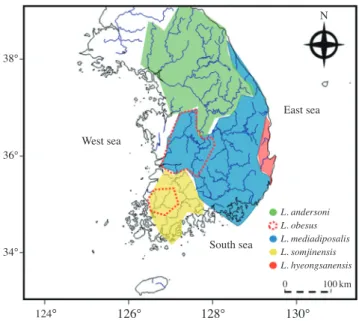
The genus Liobagrus in Korea shows a distinct geo- graphic isolation respectively: L. andersoni in Hangang and Imjingang Rivers water system; L. obesus in Geum- gang, Yeongsangang and Mangyunggang Rivers water system; L. mediadiposalis in Geumgang and Nackdong- gang Rivers water system; L. somjinensis in Seomjingang, Yeongsangang, Dongjingang and Tamjingang Rivers;
and L. hyeongsanensis in Hyeongsangang, Taehwagang Rivers and Daejongcheon Stream (Kim et al., 2015, Fig.
2). Cytochrome b gene analysis suggests that L. hyeong
sanensis originated from L. mediadiposalis, followed by L. somjinensis (Kim, 2013). Such allopatric speciation may lead the three species to undergo chromosomal re- arrangements that have the same chromosome number but different karyotype. Chromosomal evolution and spe- ciation in such three closely related species still remain questionable and then various approach methods would be required, with karyotype analyses using banding and genetic diversity study.
reFerenceS
Arai, R. and H. Kobayasi. 1973. A chromosome study on thirteen species of Japanese gobiid fishes. Japan. J. Ichthyol., 20:
Arkhipchuk, V.V. 1995. Role of chromosomal and genome muta- 1-6.
tions in the evolution of bony fishes. Hydrobiol. J., 31: 55- 65.
Chen, J., Y. Fu, D. Xiang, G. Zhao, H. Long, J. Liu and Q. Yu.
2008. XX/XY heteromorphic sex chromosome systems in two bullhead catfish species, Liobagrus marginatus and L.
styani (Amblycipitidae, Siluriformes). Cytogenet. Genome Res., 122: 169-174.
Chiarelli, A.B. and E. Capanna. 1973. Cytotaxonomy and vertebrate evolution. Academic press Inc., New York, pp. 205-232.
Cho, Y.J. and J.Y. Park. 2016. Karyotype analysis of Liobagrus somjinensis, an endemic species in Korea. Korean J. Ich- thyol., 28: 175-178. (in Korean)
de Oliveira, R.R., E. Feldberg, M.B. dos Anjos and J. Zuanon. 2009.
Mechanisms of chromosomal evolution and its possible relation to natural history characteristics in Ancistrus catfish (Siluriformes: Loricariidae). J. Fish Biol., 75: 2209-2225.
Devlin, R.H. and Y. Nagahama. 2002. Sex determination and sex differentiation in fish: an overview of genetic, physiological and environmental influences. Aquaculture, 208: 191-364.
Gold, J.R., Y.C. Li, N.S. Shipley and P.K. Powers. 1990. Improved methods for working with fish chromosomes with a review of metaphase chromosome banding. J. Fish. Biol., 37: 563- 575.
Kim, I.S. and J.H. Lee. 1986. A chromosomal study on the genus Cobitis (Pisces: Cobitidae) in the southern part of Korea.
Korean J. Ichthyol., 19: 257-264. (in Korean)
Kim, I.S. and J.Y. Park. 2002. Freshwater fishes of Korea. Kyo-Hak Publishing Go. Ltd., Korea. p. 451. (in Korean)
Kim, I.S. and E.J. Kim. 2008. Karyotype of dwarf loach, Kichul
choia brevifasciata (Pisces: Cobitidae) from Korea. Korean J. Ichthyol., 20: 61-65.
Kim, S.H. 2013. Taxonomic revision of the genus Liobagrus (Si- luriformes: Amblycipitidae) from Korea. Doctoral Thesis, Chonbuk National University, pp. 65-78. (in Korean) Kim, S.H., H.S. Kim and J.Y. Park. 2015. A new species of torrent
catfish, Liobagrus hyeongsanensis (Teleostei: Siluriformes:
Amblycipitidae), from Korea. Zootaxa, 4007: 267-275.
LeGrande, W.H. 1981. Chromosomal evolution in north American catfishes (Siluriformes: Ictaluridae) with particular empha- sis on the Madtoms, Noturus. Copeia, pp. 35-52.
Levan, A., K. Fredga and A.A. Sandberg. 1964. Nomenclature for centromeric position on chromosomes. Hereditas., 52: 201- Miller, R.R. and V. Walter. 1972. A new genus of cyprinodontid fish 220.
from Nuevo Leon, Mexico. Contr. Sci. Nat. Hist. Mus. Los Angeles Country, 223: 1-13.
Fig. 2. A schematic distribution of the genus Liobagrus in Korea.
38°
36°
34°
124 ° 126° 128° 130°
West sea
East sea N
South sea
0 100 km
L. andersoni
L. obesus
L. mediadiposalis
L. somjinensis
L. hyeongsanensis
Mori, T. 1936. Description on new genera and three new species of Siluroidae from Chosen. Zoological Magazine, 48: 671- 675, pl. 24. (in Japanese)
Nelson, J.S., T.C. Grande and M.V.H. Wilson. 2016. Fishes of the world (5th ed). John Wiley & Sons, New York, p. 224.
Ojima, Y., M. Hayashi and K. Ueno. 1972. Cytogenetic studies in lower vertebrates X. karyotype and DNA studies in 15 spe- cies of Japanese Cyprinidae. Japan. J. Genet., 47: 431-440.
Park, J.Y. and S.H. Kim. 2010. Liobagrus somjinensis, a new spe- cies of torrent catfish (Siluriformes: Amblycipitidae) from Korea. Ichthyol. Explor. Freshwaters, 21: 345-352.
Regan, C.T. 1908. On freshwater fishes from Corea. Proceedings of the Zoological Society of London, 1908: 59-63.
Son, Y.M., I.S. Kim and I.Y. Choo. 1987. A new species of torrent catfish, Liobagrus obesus from Korea. Korean Journal of Limnology, 20: 21-29.
Son, Y.M. and J.H. Lee. 1989. Karyotypes of genus Liobagrus (Pi- sces: Amblycipitidae) in Korea. Korean J. Ichthyol., 1: 64- 72. (in Korean)
Wang, B.P., J. Chen, J.D. Liu, N. Liu and Q.X. Yu. 2011. Discrimi- nating two races of Liobagrus marginatoides by cytogenetic analysis. J. Fish Biol., 78: 2080-2084.
한국 퉁가리속 고유종 동방자가사리 Liobagrus hyeongsanensis의 핵형 분석
조윤정