Article
사일리지 제조를 위한 유산균 탐색 및 특성연구
노유미 ・ 이관형 ・ 박인철 ・ 김완규 ・ 한병학 ・ 유재홍 ・ 안재형*
국립농업과학원 농업미생물과
Isolation and characterization of lactic acid bacteria for use as silage additives
Yu-Mi Ro, Gwan-Hyeong Lee, InCheol Park, Wan-Gyu Kim, Byeong-Hak Han, Jaehong You, and Jae-Hyung Ahn*
Agricultural Microbiology Division, National Institute of Agricultural Sciences, Rural Development Administration (RDA), Wanju 55365, Republic of Korea
(Received October 25, 2016; Revised November 21, 2016; Accepted November 22, 2016)
ABSTRACT: Sixteen lactic acid bacterial strains were isolated from silage and cow dung samples, and characterized to identify their potential as silage additives. They were identified as the members of the genera Lactobacillus, Enterococcus, and Weissella, and clustered into nine groups based on the sequences of the genes for 16S rRNA, RNA polymerase alpha subunit, 60-kDa heat shock protein, and phenylalanyl-tRNA synthase alpha subunit. Among them, the three strains which were genetically similar to L. plantarum showed the fastest growth and pH decrease in MRS and rye extract media, the highest numbers of available carbohydrates, and the widest ranges of pH, temperature, and salinity for growth. In addition, they showed no amplified DNA products in the PCR examination targeting the genes for the production of biogenic amines, and the MRS media where they had been cultured showed relatively high inhibition effect against the growth of silage-spoiling microorganisms, including fungi, yeast, and clostridia. The results suggest that these strains are good candidates for silage additives. However, the rye extract media where the lactic acid bacteria had been cultured had no effect on or stimulated the growth of the silage-spoiling microorganisms, and the causes must be established for the practical use of the lactic acid bacteria as silage additives.
Key words: antimicrobial activity, lactic acid bacteria, silage
*For correspondence.
E-mail: [email protected];
Tel.: +82-63-238-3045; Fax: +82-63-238-3834
정부는 높은 해외 의존에 따른 사료 수급 불안을 해소하고 고품질의 사료를 공급하기 위한 방법으로서 풀사료의 생산 및 이용의 확대를 추진해 왔다. 그러나 풀사료 자급률은 2000년 부터 2015년까지 80%내에 머물러 있는 실정이다. 이는 국내 산 풀사료가 가격 경쟁력은 높으나 가소화양분 총량이 수입산 에 비해 낮고 높은 수분함량으로 인한 부패 등의 문제가 발생 하기 때문인 것으로 분석되었다(MAFRA, 2016).
고품질의 사일리지(silage) 생산은 국내산 풀사료의 경쟁 력을 높이기 위한 방법이 될 수 있다. 사일리지는 수분을 포함 한 풀사료를 혐기성 조건에서 보관하면서 부패를 막는 사료 의 보존 방식이다. 사일리지 제조에서 가장 중요한 역할을 하
는 유산균은 혐기성 조건에서 용해성 탄수화물(Water-soluble carbohydrates, WSC)을 유산으로 전환하여 풀사료의 pH를 약 4 수준으로 낮추는 역할을 한다. 이렇게 낮아진 pH 조건에서 클로스트리디움 등 다른 부패균들의 성장을 억제함으로써 영 양분 손실을 감소시키고 풀사료의 장기 보존을 가능하게 한다 (Dunière et al., 2013).
유산균들은 사일리지 제조 과정에서 자연적으로 발생하기 도 하지만 인위적으로 첨가해 줄 경우 발효속도를 증가시킬 수 있는 것으로 알려져 있다(Dunière et al., 2013; Jin et al., 2015).
과거에는 사일리지에 첨가하는 유산균으로서 Lactobacillus plantarum을 선호하였다. 그 이유는 이 종의 성장이 빠르고 육 탄당으로부터 비교적 강산인 유산만을 생산함으로써 pH를 낮게 유지할 수 있기 때문이다(Dunière et al., 2013; Wilkinson and Davies, 2013). 그러나 1) 생산된 다량의 유산은 효모와
Table 1. PCR primers and conditions used in this study
PCR
aPrimers PCR condition Reference
16S rRNA 27f: AGAGTTTGATCATGGCTCAG
1492r: TAGGGTTACCTTGTTACGACTT
30 cycles of 94°C for 1 min 55°C for1 min 72°C for 1 min 30 sec
Tohno et al. (2012)
rep (GTG)
5: GTGGTGGTGGTGGTG
30 cycles of 94°C for 1 min 50°C for 1 min 72°C for 2 min
Gevers et al. (2001)
rpoA rpoA-21-F: ATGATYGARTTTGAAAAACC
rpoA-23-R: ACHGTRTTRATDCCDGCRCG
30 cycles of 95°C for 1 min 55°C for1 min 15 sec 72°C for 1 min 15 sec
Zou et al. (2013)
hsp60 H279: GAATTCGAIIIIIGCIGGIGAYGGIACIACIAC H280: CGCGGGATCCYKIYKITCICCRAAICCIGGIGCYTT
40 cycles of 95°C for 30 sec 37°C for 30 sec 72°C for 1 min
Blaiotta et al. (2008)
pheS pheS-21-F: CAYCCNGCHCGYGAYATGC
pheS-22-R: CCWARVCCRAARGCAAARCC
30 cycles of 95°C for 1 min 55°C for1 min 15 sec 72°C for 1 min 15 sec
Zou et al. (2013)
a
All reactions were preceded by an initial denaturation of 94°C for 5 min and followed by a final extension of 72°C for 5 min.
곰팡이의 탄소원이 될 수 있고, 2) 빠른 pH 저하에 의해 이용 되지 못한 WSC의 증가 역시 효모와 곰팡이의 성장을 촉진할 수 있으며, 3) 저해 효과가 유산보다 높은 초산과 프로피온 산 생성이 억제되어 사일리지 개봉 후 효모와 곰팡이의 생장을 촉진할 수 있음이 보고되었다(Weinberg and Muck, 1996).
이에 유산 외에 초산을 생성할 수 있는 L. buchneri 등이 사일 리지 개봉 후 부패균의 억제에 더 큰 역할을 한다는 연구결과 가 발표되었다(Filya, 2003; Kleinschmit and Kung Jr., 2006).
그러나 이러한 결과는 항상 일관적이지는 않다(Kang et al., 2009).
또한 최근 연구에 따르면 식물세포벽 구성물질인 페룰산 (ferulic acid)을 가수분해하는 유산균을 첨가함으로써 가축의 사료 이용 효율을 높일 수 있음이 보고되었다(Addah et al., 2012; Jin et al., 2015).
반면 국내에서는 사일리지 첨가제로서 유산균에 대한 연 구가 많지 않으며 대부분 L. plantarum에 한정되어 있다(Kim et al., 2008, 2009, 2010). 본 연구에서는 이용 가능한 사일리 지 첨가 유산균의 범위를 확대하고자 전국에 산재하는 사일 리지로부터 다양한 유산균을 분리하고 이들의 특성을 조사 함으로써 새로운 사일리지 첨가제로서의 가능성을 검토하 였다.
재료 및 방법
균주 수집
2015년 6월 충주, 이천, 춘천, 사천, 보은, 영동 지역의 축사 에 방문하여 축사 바닥의 우분과 급이 중인 사일리지로부터 시료를 채취하여 지퍼백에 넣고 아이스박스에 담아 실험실로 이송하였다. 이 사일리지와 우분 시료를 인산염 완충액에 적 절히 희석하여 유산균 표준배지인 deMan Rogosa Sharpe 배지 (MRS, pH 6.5, Difco) 및 Lactobacillus Selection 배지(LBS, pH 5.5, Difco)에 도말하였다. 혐기챔버(DG250, Don Whitley Scientific)에서 28°C로 배양하면서 성장속도가 빠른 균 위주 로 동일 배지에 계대 배양 후 순수 분리하였으며, 시중에 판매 되는 유산균 첨가제 중 C사 제품(CL 균주)을 비교 균주로 사용 하였다.
유전학적 특성
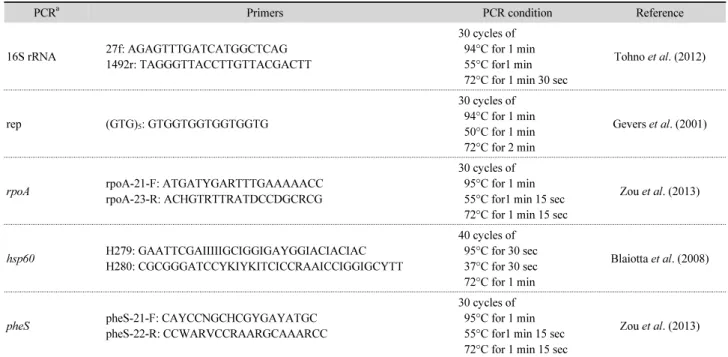
유전학적 특성 분석을 위한 PCR 프라이머 및 반응조건을 Table 1에 나타내었다. 균주의 동정 및 동일 여부 확인을 위해 16S rRNA 유전자 PCR 및 rep-PCR을 수행하였으며 선발된 균주에 대하여 RNA polymerase alpha subunit, 60-kDa heat shock protein, phenylalanyl-tRNA synthase alpha subunit 유 전자(rpoA, hsp60, pheS)의 염기서열을 분석하였다. PCR 반 응액은 총 25 µl였으며 1× green buffer (Promega), 1.5 mM
MgCl
2
,1 mg/ml Bovine serum albumin, 4종의 dNTP 각각 0.2 mM, 0.625 units GoTaq DNA polymerase (Promega), 0.4 µM 의 정방향 및 역방향 프라이머, 1 µl의 DNA 시료로 구성되었 다. 계통도 분석은 MEGA6 program에서 ClustalX와 Neighbor- Joining 방법을 이용하여 작성하였다(Tamura et al., 2013).생리・생화학적 특성
특별한 언급이 없을 경우 모든 실험은 혐기 조건에서 수행 하였으며 질소 가스 또는 혐기팩(AnaeroGen, Oxoid)을 이용 하여 혐기조건을 조성하였다. 선발된 균주의 생장 능력을 평 가하기 위하여 MRS broth에 28°C, 150 rpm으로 24시간 배양 후 동일 배지에 흡광도(OD
600
)가 약 0.1이 되도록 접종하였다.48시간 동안 배양하면서 흡광도와 pH를 측정하여 성장곡선 을 그렸다. 또한 쌀보리 추출배지(2016년에 추수한 쌀보리를 1 cm 이하로 파쇄한 후 900 ml 증류수에 180 g 첨가, 50°C에서 2시간 가온 후 상등액을 0.45 µm 필터로 여과)에 동일하게 접 종하여 성장곡선을 그렸다.
온도, 염분, pH에 따른 생장변화는 96-well plate를 이용하 여 수행하였다. 온도에 따른 생장변화는 MRS broth에서 28°C, 1일 배양한 배양액 5 µl를 96-well plate에 분주한 MRS broth 100 µl에 첨가한 후 다양한 온도에서 정치 배양하면서 Spectra Max M2 (Molecular Device)로 흡광도를 측정하여 분석하였 다. 염분의 영향은 MRS broth에 NaCl을 0~12% 첨가한 배지 를, pH의 영향은 MRS broth의 pH를 HCl과 NaOH로 1~13으 로 조절한 배지를 사용하여 위와 동일한 방법으로 접종 및 배 양하였으며 온도는 28°C로 고정하였다. 탄수화물 이용 여부 는 API 50 CHL (bioMérieux)을 이용하여 분석하였으며 바이 오제닉 아민(biogenic amine) 생성 여부는 Fadhlaoui-Zid 등 (2012)의 방법대로 PCR을 수행하여 조사하였다. 유산의 이성 질체 종류는 D-/L-lactic acid kit (R-Biopharm)을 사용하여 결 정하였으며 가스발생 여부는 MRS broth 10 ml에 24시간 배양 후 1 ml 이상 가스발생시 양성으로 간주하였다. 페룰산 에스테 라아제 생산 여부는 Liu 등(2016)의 방법대로 ethyl ferulate를 포함하는 MRS 배지에서 투명환 생성 여부를 이용하여 판단 하였다.
항균활성 분석
이전 연구에 기초하여 사일리지 부패균으로서 곰팡이인 Fusarium graminearum KACC 41040, Aspergillus fumigatus KACC 41016, Penicillium roqueforti KACC 47196, 효모인 Candida glabrata KCTC 7219, Pichia anomala KCTC 17625, 혐기성 세균인 Clostridium tyrobutyricum KCTC 5387을 선발
하였다(Cheli et al., 2013; Dunière et al., 2013). CL 균주를 포 함한 유산균 17 균주를 modified MRS (mMRS, 1 L 당 peptone 10 g, beef extract 10 g, yeast extract 5 g, glucose 20 g, K
2
HPO2
2 g, pH 6.5) broth 배지에서 28°C, 48시간 동안 혐기성 조건으 로 배양한 후 0.2 µm 멸균필터로 여과하였다. MRS에 포함된 polysorbate 80, sodium acetate, ammonium citrate, magnesium sulfate, manganese sulfate는 곰팡이와 효모의 성장을 억제할 수 있기 때문에 배제하였다. 이 배양액 80 µl와 2배 농축한 Reinforced Clostridium Medium (RCM, pH 6.8, C. tyrobutyricum 의 경우) 또는 Potato Dextrose Broth (PDB, pH 4.5, 나머지 미 생물) 100 µl를 혼합한 후 위 사일리지 부패균을 멸균한 0.85%
NaCl 용액에 적당히 희석한 현탁액 20 µl를 접종하였다. 96-well plate에서 28°C 정치 배양하면서 시간에 따른 성장을 흡광도 를 측정하여 관찰하였다. C. tyrobutyricum은 96-well plate를 anaerobic jar (MGC)에 넣은 후 AnaeroGen (Oxoid)과 함께 배 양했으며 다른 미생물들은 호기성으로 배양하였다. 또한 위에 서 수행한 쌀보리 추출배지 배양액(60시간 배양)을 mMRS 대 신 사용하여 동일한 실험을 수행하였다.
흡광도가 0.5가 될 때가지 걸린 시간을 저해 정도 비교를 위 한 척도로 사용하였으며 OD
600
=0.5에 가장 가까운 두 점을 이 용하여 계산하였다. 저해시간 간 차이의 유의성은 MS 엑셀 2010의 t-test를 이용하여 결정하였다.mMRS와 쌀보리 추출배지 배양액의 발효산물은 RI 검출기 및 Diode array (210 nm)가 부착된 HPLC (Dionex Ultimate 300) 를 이용하여 분석하였으며 분리칼럼은 Aminex 87H column (300 × 10 mm, Bio-Rad), 이동상은 0.01 N H
2
SO4
, 유속은 0.5 ml/min이었으며 칼럼온도는 40°C를 유지하였다.결과 및 고찰
유전학적 특성
순수 분리된 총 86균주 중 63균주가 알려진 유산균의 16S rRNA 유전자와 97% 이상 일치하였고 이 63균주에 대하여 rep-PCR 및 전기영동을 수행하여 그 밴드 패턴을 비교하였다.
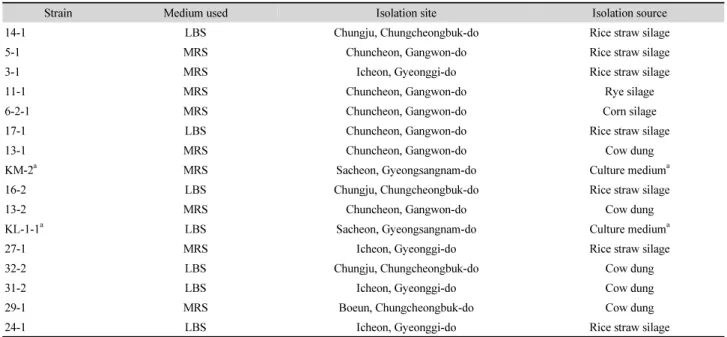
16S rRNA 유전자 염기서열과 rep-PCR 밴드 패턴의 차이에 기반하여 서로 다른 16균주를 선발하였으며 이들의 출처를 Table 2에 나타내었다. 16 균주는 L. plantarum, L. brevis, L.
buchneri, L. coryniformis, L. harbinensis, L. casei, L. acidipiscis, Enterococcus hirae, Weissella paramesenteroides의 16S rRNA 유전자 염기서열과 99% 이상의 유사도를 보였으며 그 유사도 에 따라 9개의 그룹으로 구분되었다(Fig. 1). 상용 균주 CL은
Table 2. Isolation media and sources of the selected lactic acid bacterial strains
Strain Medium used Isolation site Isolation source
14-1 LBS Chungju, Chungcheongbuk-do Rice straw silage
5-1 MRS Chuncheon, Gangwon-do Rice straw silage
3-1 MRS Icheon, Gyeonggi-do Rice straw silage
11-1 MRS Chuncheon, Gangwon-do Rye silage
6-2-1 MRS Chuncheon, Gangwon-do Corn silage
17-1 LBS Chuncheon, Gangwon-do Rice straw silage
13-1 MRS Chuncheon, Gangwon-do Cow dung
KM-2
aMRS Sacheon, Gyeongsangnam-do Culture medium
a16-2 LBS Chungju, Chungcheongbuk-do Rice straw silage
13-2 MRS Chuncheon, Gangwon-do Cow dung
KL-1-1
aLBS Sacheon, Gyeongsangnam-do Culture medium
a27-1 MRS Icheon, Gyeonggi-do Rice straw silage
32-2 LBS Chungju, Chungcheongbuk-do Cow dung
31-2 LBS Icheon, Gyeonggi-do Cow dung
29-1 MRS Boeun, Chungcheongbuk-do Cow dung
24-1 LBS Icheon, Gyeonggi-do Rice straw silage
a
Donated by a farmer
Fig. 1. Phylogenetic tree of the selected lactic acid bacterial strains based on the 16S rRNA genes (GenBank accession numbers).
(A) (B)
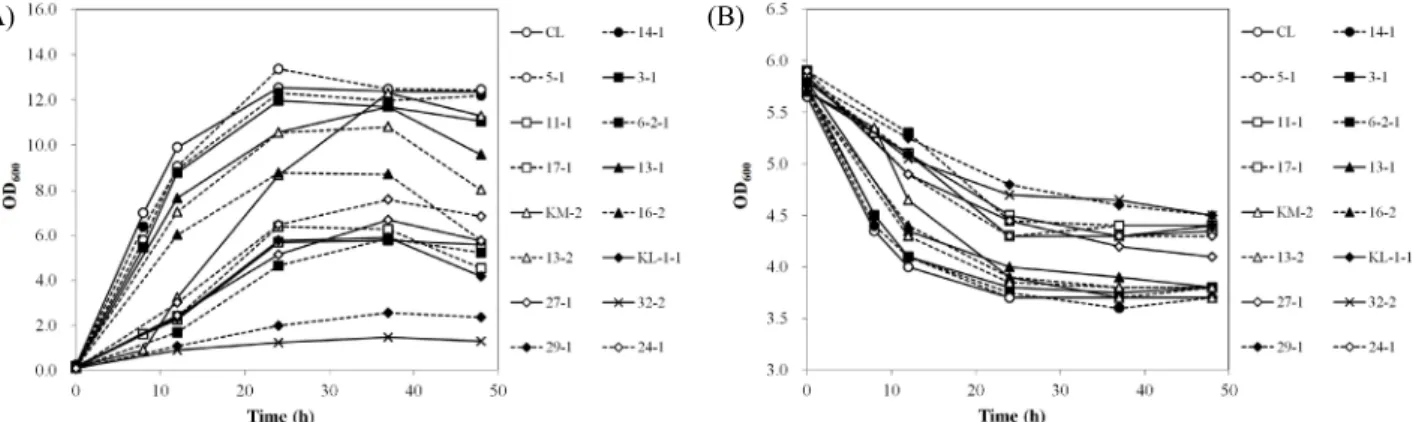
Fig. 2. Growth (A) and pH variation (B) of the selected lactic acid bacterial strains in MRS broth. Values are means of duplicates.
(A) (B)
Fig. 3. Growth (A) and pH variation (B) of the selected lactic acid bacterial strains in rye extract medium. Values are means of duplicates.
L. plantarum이 포함된 그룹 G1에 속하였고, 16균주 중 14-1, 5-1, 3-1 균주가 이 그룹에 포함되었다. 그룹 G1에 속하는 균주 들은 모두 볏짚 사일리지로부터 분리되었으며 그룹 G8의 Enterococcus 속으로 분류된 균주들은 모두 우분으로부터 분 리되어 분류군에 따라 선호하는 서식 환경이 존재하는 것으로 추정된다. rpoA, hsp60, pheS 유전자 염기서열을 이용하여 계 통수를 작성했을 때 상위 클러스터에서는 변동이 있었지만 최 하위 클러스터에서는 모두 동일한 9개의 그룹으로 묶이는 것 을 관찰할 수 있었다. 선발된 유산균들과 유전학적으로 높은 유사도를 나타낸 L. plantarum (Jeong et al., 2000; Magnusson et al., 2003; Saarisalo et al., 2007b), L. brevis (Falguni et al., 2010), L. buchneri (Kleinschmit and Kung Jr, 2006), L.
coryniformis (Magnusson and Schnürer, 2001), L. casei (Magnusson et al., 2003), E. faecium (Marcinakova et al., 2008)은 기존 연구에서 항균활성 및 사일리지 첨가제로서 우 수성이 관찰된 유산균 종이다.
선발된 유산균들의 유전자 염기서열은 NCBI GenBank에 제 출했으며 수납번호는 16S rRNA 유전자는 KX499347~62, rpoA
유전자는 KX816609~624, hsp60 유전자는 KX808502~17, pheS 유전자는 KX816593~608이다.
생리․ 생화학적 특성
선발된 유산균들을 MRS broth와 쌀보리 추출배지에 접 종했을 때 균주에 따라 성장속도 및 pH 저하 속도에 차이를 보였다(Figs. 2 and 3). MRS 배지와 쌀보리 추출배지 모두에 서 그룹 G1에 속하는 균주들의 성장속도와 pH 저하속도가 가 장 빨랐으며 이는 Jeong 등(2000)이 L. plantarum 균주의 성장 속도 및 pH 저하 속도가 가장 빨랐다고 보고한 결과와 일치한 다. 그룹 G1에 속하는 균주들은 MRS 배지와 쌀보리 추출배지 의 pH를 24시간 내에 약 3.7까지 감소시켰다. G1 균주들보다 늦지만 그룹 G4의 13-1과 G6의 13-2 및 16-2 균주들도 37시간 내에 pH를 약 3.8까지 감소시켰다. L. plantarum과 함께 G4와 G6에 포함된 L. coryniformis와 L. casei는 특정 조건에서만 유산 외의 유기산을 생성하는 편성 이상 발효(facultatively heterofermentative) 유산균이며(Hammes and Hertel, 2009), 절대 이상발효(absolutely heterofermentative)를 하는 유산균
Table 3. Carbohydrate utilization of the selected lactic acid bacterial strains based on API 50CHL test
G1 G2 G3 G4 G5 G6 G7 G8 G9
CL 14-1 5-1 3-1 11-1 6-2-1 17-1 13-1 KM-2 16-2 13-2 KL-1-1 27-1 32-2 31-2 29-1 24-1
D-Arabinose - - - - - - - - w - - - - - - - -
L-Arabinose + + + + + + + - + - - - + - - - +
D-Xylose - - - - + + + - + - - - - - - - -
D-Adonitol - - - - - - - - - + + - - - - - -
D-Galactose + + + + + + w + + + + + + + + + +
D-Mannose + + + + - + + + + + + + + + + + +
Rhamnose + - - - - - - - - - - - + - - - -
Inositol - - - - - - - - - w - - - - - - -
Manitol + + + + - - - + - + + + + - - - w
Sorbitol + + + + - - - - - + + + - - - - +
α-Methyl-d-mannoside - + + - - - - - - - - - + - - - -
α-Methyl-d-glucoside - - - - w + + - + w w + + - - - +
Amygdalin + + + + - + + + + - + + + + + + +
Arbutin + + + + - + - + + - + + + + + + +
Esculin + + + + - + + + + + + + + + + + +
Salicin + + + + - + - + + + + + + + + + +
Cellobiose + + + + + + - + + - + + + + + + +
Lactose + + + + + + + + w - - - + + + + +
Melibiose + + + + + + + + + - - - - + + + +
Sucrose + + + + - + + + + + + + - + + + +
Trehalose + + + + - + + + + + + + + + + + +
Inulin - - - + - - - - - - - - - - - - -
Melezitose + + + + - + + - - + + + - - - - +
Raffinose + + + + - + - + - - - - - - - - +
Starch - - - - - - - - w - - - - - - - -
Gentiobiose + + + + - + + + + - - - + + + + +
D-Turanose + + + - - - w - - + + + - - - - +
D-Tagatose - - - - - - - - + + + + + - - + -
D-Arabitol w - - - - - - - - - - - - - - - -
Gluconate + + + + w + + - + + + + - - - - +
2-Keto-gluconate - - + - + - + - w - - - - - - - +
5-Keto-gluconate - - - - - - + - - - - - - - - - -
Number of +/w 21 20 21 19 8 18 17 14 20 15 17 16 16 12 12 13 21
+, positive; -, negative; w, weakly positive
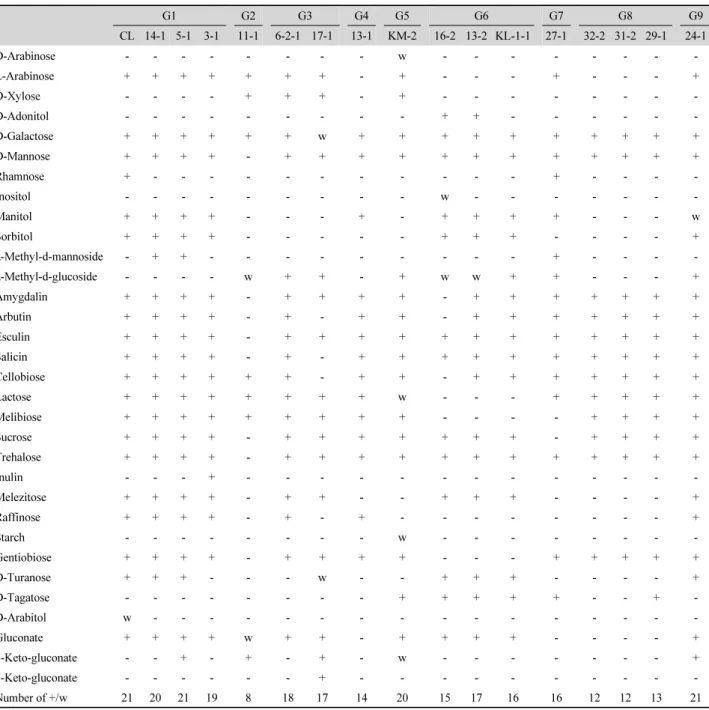
에 비해 비교적 강산인 유산만을 생산함으로써 pH를 더 낮게 유지할 것으로 예상된다. 선발 균주들의 당 이용성은 그룹별 로 차이를 보였으며 그룹 G1, G5, G9에 속하는 유산균들이 상 대적으로 많은 종류의 당을 이용하였다(Table 3). 그러나 오탄 당인 자일로즈는 L. brevis, L. buchneri, L. harbinensis를 포함 하는 그룹 G2, G3, G5에 속하는 균주들만 이용할 수 있었다.
이는 상기 표준균주들의 성질과 일치하는 결과이다(Miyamoto et al., 2005; Hammes and Hertel, 2009).
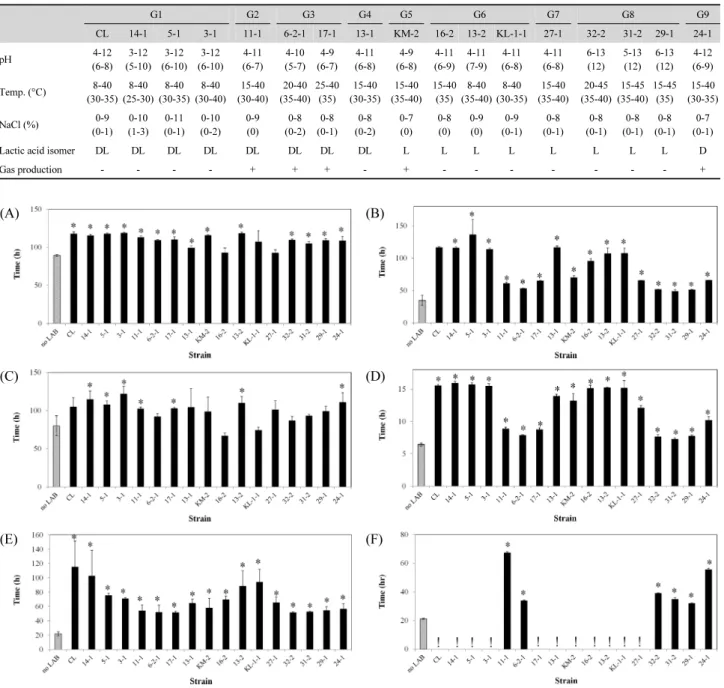
MRS broth에서 pH, 온도, 염분에 따른 성장을 비교했을 때 대체로 G1에 속하는 균주들이 성장 가능한 pH, 온도, 염분 범 위가 가장 넓었다(Table 4). 특히 G1에 속하는 14-1, 5-1, 3-1 균 주는 pH 3, 배양온도 8도, NaCl 10%에서도 성장하는 것으로 나타나 다양한 환경에서 생장할 수 있을 것으로 추정된다. 가 스 생성은 그룹 G2, 3, 5, 9에 속하는 균주에서만 관찰되었다 (Table 4). 바이오제닉 아민은 미생물의 발효과정 중에 생성되 는 물질로서 과잉으로 섭취되었을 때 인체 및 가축에 유해한
Table 4. The Growth characteristics of the selected lactic acid bacterial strains (optimum condition)
G1 G2 G3 G4 G5 G6 G7 G8 G9
CL 14-1 5-1 3-1 11-1 6-2-1 17-1 13-1 KM-2 16-2 13-2 KL-1-1 27-1 32-2 31-2 29-1 24-1
pH 4-12
(6-8) 3-12 (5-10)
3-12 (6-10)
3-12 (6-10)
4-11 (6-7)
4-10 (5-7)
4-9 (6-7)
4-11 (6-8)
4-9 (6-8)
4-11 (6-9)
4-11 (7-9)
4-11 (6-8)
4-11 (6-8)
6-13 (12)
5-13 (12)
6-13 (12)
4-12 (6-9)
Temp. (°C) 8-40
(30-35) 8-40 (25-30)
8-40 (30-35)
8-40 (30-40)
15-40 (30-40)
20-40 (35-40)
25-40 (35)
15-40 (30-35)
15-40 (35-40)
15-40 (35)
8-40 (35-40)
8-40 (30-35)
15-40 (35-40)
20-45 (35-40)
15-45 (35-40)
15-45 (35)
15-40 (30-35)
NaCl (%) 0-9
(0-1) 0-10 (1-3)
0-11 (0-1)
0-10 (0-2)
0-9 (0)
0-8 (0-2)
0-8 (0-1)
0-8 (0-2)
0-7 (0)
0-8 (0)
0-9 (0)
0-9 (0-1)
0-8 (0-1)
0-8 (0-1)
0-8 (0-1)
0-8 (0-1)
0-7 (0-1)
Lactic acid isomer DL DL DL DL DL DL DL DL L L L L L L L L D
Gas production - - - - + + + - + - - - - - - - +
(A) (B)
(C) (D)
(E) (F)
Fig. 4. The time to take to reach OD
600=0.5 when Fusarium graminearum KACC 41040 (A), Aspergillus fumigatus KACC 41016 (B), Penicillium roqueforti KACC 47196 (C), Candida glabrata KCTC 7219 (D), Pichia anomala KCTC 17625 (E), and Clostridium tyrobutyricum KCTC 5387 (F) were grown in PDB (fungi and yeast) or RCM (clostridium) combined with mMRS broth in which the lactic acid bacterial stains had grown for 48 h. “No LAB” represents the case where the mMRS broth had not been inoculated with the lactic acid bacterial strains. Error bars indicate standard deviations (n=3) and asterisks indicate that the time is significantly different ( P≤0.05) from that for “No LAB”. The symbol “!” indicates no growth of the corresponding microorganism for 110 h.
영향을 미칠 수 있다(Cho et al., 2006; Dunière et al., 2013).
PCR 방법으로 조사했을 때 모든 균주는 바이오제닉 아민을 생성할 수 있는 유전자를 가지고 있지 않은 것으로 나타났다.
또한 모든 균주는 페룰산 에스테라아제 활성이 없는 것으로 나타났다.
항균활성 분석
유산균을 배양했던 mMRS가 포함된 배지에 사일리지 부패 균을 접종하고 시간에 따른 흡광도를 측정했을 때 흡광도가 0.5에 도달할 때까지 걸린 시간을 Fig. 4에 나타내었다. 유산균 을 배양한 mMRS 배지를 첨가할 경우 유산균을 접종하지 않 은 mMRS 배지에 비해 곰팡이, 효모, 클로스트리디움의 성장
(A) (B)
(C) (D)
(E) (F)
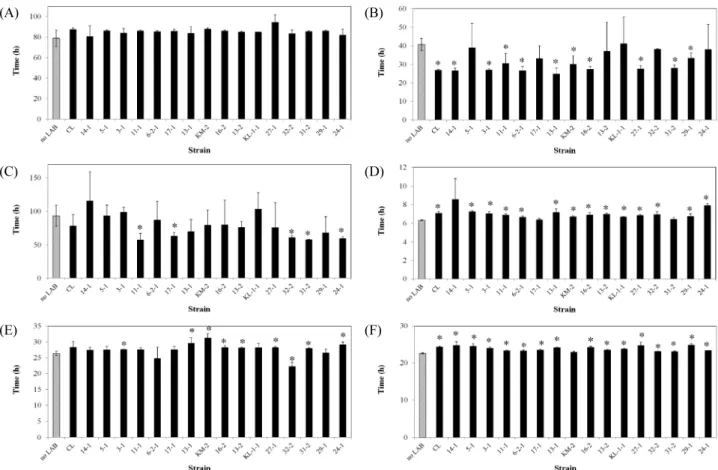
Fig. 5. The same experiments to those in Fig. 4 except that the PDB or RCM medium was combined with the rye extract medium instead of mMRS broth, in which the lactic acid bacterial strains had grown for 60 h.
이 대부분 지연되거나 억제되었다(Fig. 4의 막대그래프에서 * 또는 !가 표시된 균주). 특히 C. tyrobutyricum의 경우 대부분 의 유산균에 대하여 110시간 동안 성장이 완전히 억제되었다 (Fig. 4F). 선발된 유산균 중 그룹 G1에 속하는 균주들(CL, 14-1, 5-1, 3-1)은 모든 사일리지 부패균에 대하여 상대적으로 높은 저해를 나타냈다. 반면 G4 (11-1), G6 (6-2-1, 17-1), G8 (32-2, 31-2, 29-1), G9 (24-1)에 속하는 균주들은 저해 정도가 상대적으로 낮았다. 그러나 쌀보리 추출배지를 이용한 항균실 험에서는 사일리지 부패균의 성장은 유의한 차이가 없거나 (Fig. 5A) 오히려 촉진되었으며(Fig. 5B and C) 유의한 차이가 있는 경우에도 mMRS에 비해 그 저해도가 낮은 것으로 나타 났다(Fig. 5D, E, F).
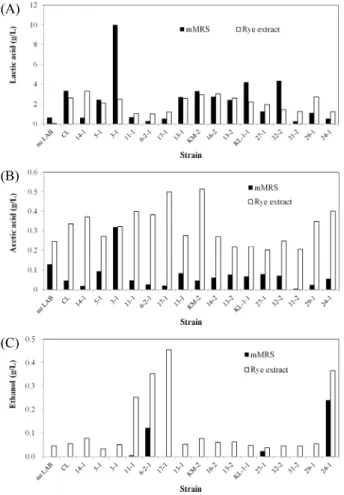
mMRS 배양액과 쌀보리 추출배지 배양액의 pH 차이는 -0.3~+0.4의 범위로 pH 차이가 이러한 저해 정도의 차이를 일 으킨 원인은 아닌 것으로 추정된다. 유기산 및 알콜 농도가 그 원인인지 조사하기 위해 HPLC 분석을 수행하였다(Fig. 6). 배 양액의 유산 농도는 0.3~10.0 g/L로 다양했으며 그룹 G1 (CL, 14-1, 5-1, 3-1), G4 (13-1), G5 (KM-2), G6 (16-2, 13-2, KL-1-1)
에 속하는 균주들이 상대적으로 많은 유산을 생산하였다(Fig.
6A). 배지 종류에 따른 일관된 차이는 관찰되지 않았다. 초산 은 mMRS 배지에서는 거의 생성되지 않았으며(no LAB에 비 해 낮음) 쌀보리 추출배지에서는 그룹 G2 (11-1), G3 (6-2-1, 17-1), G5 (KM-2), G9 (24-1)에 속하는 균주들의 생산량이 높 은 것으로 나타났다(Fig. 6B). 에탄올의 경우에도 그룹 G5 (KM-2)를 제외하면 유사한 경향이 나타났다(Fig. 6C). 초산과 에탄올이 쌀보리 추출배지에서 사일리지 부패균의 성장을 촉 진한 인자로 생각되지 않으며 크로마토그램 상에서 mMRS 배 양액에서만 특이적으로 나타나는 피크를 발견할 수 없었다.
이는 유기산이나 알코올 외에 박테이로신이나 과산화수소와 같은 다른 항균활성 물질이 사일리지 부패균 저해에 관여했음 을 시사한다(Magnusson et al., 2003).
사일리지 첨가제로서 평가
전국에서 채취한 사일리지 및 우분 시료로부터 유산균을 분리하고 이들의 생리생화학적 성질과 항균활성을 조사한 결 과 유전학적으로 L. plantarum과 유사한 그룹 G1에 속하는 균
(A)
(B)
(C)
Fig. 6. Fermentation products of the selected lactic acid bacterial strains in mMRS or rye extract medium. ‘no LAB’ indicates the values when the fresh media were analyzed.
주들이 MRS 배지와 쌀보리 추출배지에서 pH 저하 속도가 가 장 빨랐으며 성장 가능한 pH, 온도, 염분 범위가 상대적으로 넓었고, MRS 배지 이용 시 사일리지 부패균에 대한 항균활성 이 가장 높았다. 이는 다양한 사일리지 및 우분 시료로부터 우 수 유산균을 선발했던 이전 연구 결과(Saarisalo et al., 2007a;
Kim et al., 2008, 2009, 2010; Valan Arasu et al., 2014)와 일치 한다. 위 결과는 이 그룹에 속하는 균주들을 사일리지 첨가제 로 사용할 경우 다양한 환경 조건에서 생존하면서 사일리지의 pH를 빠르게 감소시키고 사일리지 부패균들의 성장을 억제 할 수 있음을 나타낸다. 또한 이 균주들은 바이오제닉 아민 생 성을 위한 유전자를 보유하고 있지 않아 발효 시 가축에 유해 한 물질을 생산하지 않을 것으로 판단된다.
그러나 G1 그룹을 포함한 모든 선발 유산균들의 쌀보리 추 출배지 배양액은 사일리지 저해균들의 성장에 큰 영향을 미치 지 않거나 오히려 촉진시켰다. 이는 L. plantarum 균주 처리가 사일리지 개봉 후 효모의 성장을 촉진한 이전 연구 결과(Cai et
al., 1999; Filya, 2003)와 일치하면서 L. buchneri가 사일리지 의 호기적 안정도를 향상시킨 연구 결과와는 상이한 결과이다 (Filya, 2003; Kleinschmit and Kung Jr, 2006). 쌀보리 추출배 지가 실제 사일리지에서 유산균들의 효과를 반영하고 있고 사 일리지 개봉 후 발생하는 부패는 사일리지의 품질을 감소시키 는 중요한 인자임을 고려할 때 향후 쌀보리 추출배지에서 항 균활성이 감소한 원인 및 대책 연구가 시급할 것으로 판단된 다. 유산균의 항균활성에 영향을 미치는 인자로서 균 성장 정 도(Todorov, 2008) 또는 배지 종류(Dave and Shah, 1997;
Avonts et al., 2004)가 제시되었으며 향후 이에 대한 연구가 필 요할 것으로 생각된다.
또한 본 연구에서 분리된 유산균들은 모두 페룰산 에스테 라아제 활성이 없었는데 이러한 식물 세포벽 분해능은 사일리 지가 특히 돼지 등 비반추동물에게 급이될 경우 중요한 역할 을 할 것으로 판단되므로 향후 이 능력을 갖는 균주의 발굴이 필요할 것이다.
그룹 G2 (11-1), G3 (6-2-1, 17-1), G5 (KM-2)에 속하는 균 주들은 모두 자일로즈를 이용할 수 있고(Table 3) 가스를 생산 하며(Table 4) 초산 및 에탄올 생성이 높다는(Fig. 6B and C) 공 통점을 가지고 있다. 자일로즈는 식물세포벽을 이루는 헤미셀 룰로즈의 주성분 중 하나로 사일리지에 헤미셀룰로즈를 분해 할 수 있는 미생물을 접종할 경우 사일리지 내부에서 자일로 즈가 생성될 것으로 예상된다. 위 그룹에 속하는 유산균들은 MRS 배지 및 쌀보리 추출배지에서 pH 저하속도 및 항균 활성 이 상대적으로 낮았지만 자일로즈가 존재할 경우 이로부터 초 산 및 에탄올을 생성하여 사일리지의 항균활성을 높일 수 있 을 것으로 예상된다.
적 요
전국에서 채취한 사일리지 및 우분 시료로부터 사일리지 첨 가제로 사용하기 위한 유산균을 순수 분리하고 그 특성을 조사 하였다. MRS 배지에서 성장 속도를 기반으로 16개의 유산균 균 주를 순수 분리하였으며 이들은 16S rRNA, RNA polymerase alpha subunit, 60-kDa heat shock protein, phenylalanyl-tRNA synthase alpha subunit 유전자 염기서열에 기반하여 Lactobacillus, Enterococcus, Weissella 속으로 동정되었다. 16균주 중 L.
plantarum과 유전적으로 높은 유사도를 보인 균주들은 MRS 배지와 쌀보리 추출배지에서 가장 빠른 성장 및 pH 저하를 나 타냈으며 이용 가능한 당 종류 및 생장 가능한 pH, 온도, 염분 범위가 상대적으로 넓었다. 또한 이 균주들은 PCR 검사 결과
바이오제닉 아민 생성을 위한 유전자가 없었으며 그 MRS 배 지 배양액은 사일리지 부패균에 대한 저해 효과가 상대적으로 큰 것으로 나타나 이 균주들이 우수한 사일리지 첨가제로 사 용될 수 있을 것으로 판단된다. 그러나 분리된 모든 유산균들 의 쌀보리 추출배지 배양액은 사일리지 부패균의 성장에 큰 영향을 미치지 않거나 오히려 촉진시켰으며 선발된 유산균들 을 사일리지 제조에 사용하기 위하여 그 원인 구명과 대책 마 련이 필요할 것으로 판단된다.
감사의 말
본 연구는 2016년 농촌진흥청 공동연구사업(과제번호:
PJ01121204)에 의해 수행되었습니다.
References