Introduction
In Korea, 74 species of Cyprinidae are recog- nized (Kim et al., 2005a, b). The chromosome numbers of about 50 species belonging to the Cyprinidae family have been reported previously (Lee et al., 1983; Ueno and Ojima, 1984; Lee et al., 1984; Yu et al., 1987; Kim and Park, 2002;
Gozukara and Cavas, 2004). Comparsion of kary- otypes between related taxa has been expected to be a helpful tool to solve problems in systematics and phylogenetic studies. The primitive karyo- type of cyprinid fishes may be inferred as being 2n==50.
In the Korean peninsula, the subfamily Cul- trinae has been reported by four species (Uchida, 1939; Berg, 1949; Kim and Lee, 1985, 1986). This paper presents the chromosome numbers and the karyotypes of Culter brevicauda and Erythro- culter erythropterus.
Materials and Methods
Two species used in this study were collected in Andong Lake (C. brevicauda) and Chungju Lake (E. erythropterus) during July 2007. The specimens were brought alive to the laboratory, where the gills were fixed and preserved in Carnoy’s fluids for study by the air-drying me- thod (Park and Song, 2006). Morphological fea- tures of the chromosomes used to compare karyo- types were the total lengths and the relative lengths of the chromosomes, as well as the posi- tions of their centromeres (primary constrictions).
Nomenclature of chromosome morphological types follows Levan et al. (1964). To estimate the NF value, the chromosomes of the group meta- and submetacentric were scored as bi-armed and the chromosomes of the group acrocentric as uni- armed. Voucher specimens of the two species used in this investigation have been placed in the Department of Parasitology, Kwandong Uni- versity College of Medicine, Korea.
Korean J. Ichthyol. 19(3), 253~257, 2007
Karyotypes of Two Species of Cultrinae (Cyprinidae) from Korea
Ho Bok Song and Gab Man Park1,*
Division of Life Sciences, College of Natural Sciences, Kangwon National University, Chuncheon 200-701, Korea
1Department of Parasitology, Kwandong University College of Medicine, Gangneung 210-701, Korea
The chromosome numbers of two species (Culter brevicauda and Erythroculter erythropterus) of Korean Cultrinae are investigated. In two species, the mitotic chro- mosomes from 24 groups with two chromosomes each indicated that it is a diploid.
Their karyotypes and total length of chromosomes were slightly different from each other. The karyotype of C. brevicauda and E. erthropterus is 2n == 48 (7M++ 10SM++7ST), FN==96 and 2n==48 (6M++10SM++8ST), FN==96. Observed chromosomes of C. brevicauda and E. erythropterus ranged from 5.4 to 2.2µµm and 6.1 to 2.3µµm in length, respectively.
Key words : diploid chromosomes, Cyprinidae, Culter brevicauda, Erythroculter erythropterus, karyotypes, Korea
*Corresponding author: [email protected]
─
─ 253 ──
Results
1. C. brevicauda
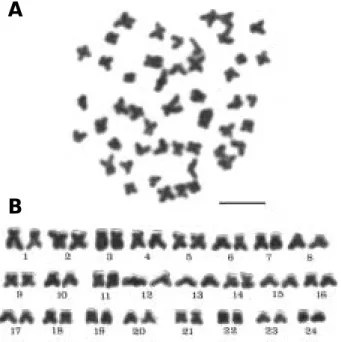
A microphotograph of somatic metaphase chro- mosomes and the karyogram are shown in Fig. 1 and measurements of the chromosomes in Table
1. The diploid chromosome number was 48 (FN== 96). The somatic complement consisted of 7 pairs metacentric, 10 pairs submetacentric and 7 pairs subtelocentric chromosomes. Total length of each chromosome ranged from 2.2 to 5.4µm, and rela- tive length of each chromosome ranged from 6.14 to 2.53 (Table 1). Mean total length of the meta- phase chromosomes in haploid complement was 84.76±3.10µm (mean±SD; Table 1).
2. E. erythropterus
A microphotograph of somatic metaphase chro- mosomes and the karyogram are shown in Fig. 2 and measurements of the chromosomes in Table 2. The diploid chromosome number was 48 (FN== 96). The somatic complement consisted of 6 pairs metacentric, 10 pairs submetacentric and 8 pairs subtelocentric chromosomes. Total length of each chromosome ranged from 2.3 to 6.1µm, and rela- tive length of each chromosome ranged from 6.90 to 2.62 (Table 2). Mean total length of the meta-
254 H.B. Song and G.M. Park
Table 1. Relative lengths and total lengths (µm) of chro- mosomes of Culter brevicauda*
Chromosome no. RL±SD TL±SD Type
1 6.14±0.31 5.40±0.23 SM
2 5.85±0.22 5.14±0.30 M
3 5.59±0.16 4.92±0.12 SM
4 5.39±0.14 4.74±0.21 SM
5 5.15±0.21 4.53±0.12 M
6 4.82±0.30 4.24±0.13 SM
7 4.63±0.21 4.07±0.09 SM
8 4.46±0.16 3.92±0.17 SM
9 4.33±0.17 3.81±0.10 M
10 4.30±0.13 3.78±0.12 SM
11 4.06±0.12 3.57±0.13 M
12 3.93±0.27 3.46±0.11 ST
13 3.85±0.13 3.39±0.12 ST
14 3.73±0.13 3.28±0.09 M
15 3.46±0.09 3.04±0.12 ST
16 3.33±0.15 2.93±0.09 SM
17 3.23±0.14 2.84±0.11 ST
18 3.22±0.13 2.83±0.08 M
19 3.17±0.10 2.79±0.10 ST
20 2.93±0.11 2.58±0.12 ST
21 2.85±0.12 2.51±0.16 M
22 2.76±0.19 2.43±0.12 SM
23 2.65±0.19 2.33±0.09 ST
24 2.53±0.19 2.23±0.07 SM
*Based on measurement of two karyotyped cells. RL±SD, rela- tive length of the chromosome (percentage of the total length of the autosomes in diploid); TL, total length of the autosomes in diploid; SD, standard deviation; M, metacentric chromosomes;
SM, submetacentric chromosomes; ST, subtelocentric chromo- somes.
Fig. 1. A, Metaphase chromosome of Culter brevicauda;
B, Karyotype constructed from A. Scale bar indi- cates 10µm.
Fig. 2. A, Metaphase chromosome of Erythroculter eryth- ropterus; B, Karyotype constructed from A. Scale bar indicates 10µm.
A
B
A
B
phase chromosomes in haploid complement was 83.90±3.86µm (mean±SD; Table 1).
Discussion
Detailed studies of chromosome morphology and population cytology of the present fishes are very little can be said on systematics based on the karyotypes other than chromosome numbers.
In fact modern cytogenetic techniques have only recently been adopted for studies of fishes. Chro- mosomal information on a total of 300 species from cyprinid fishes (Lee et al., 1983, 1984; Yu et al., 1987; Song and Park, 2005).
Yu et al. (1987) have been reported that the di- ploid chromosome numbers were found to be 2n
==50 and 2n==48, amounting to 43% and 33%
respectively of all the cyprinid fishes karyotyped in China. Also, in the Korean cyprinid species, 53 species have been karyologically investigated, 2n range from 44 to 76 (Song and Park, 2005). The most frequent chromosome number were 2n==50 and 2n==48, amounting to 60% and 21% respec- tively. For the present study, two species of Cult-
rinae have 2n==48 chromosomes.
As all of the organism’s genomic DNA residues in its chromosomes, chromosome size and num- ber will reflect the size of the whole genome.
Despite this, less attention has been paid to the length of the mitotic metaphase chromosomes or the total length than to the chromosome num- bers of fishes. In this study, the total length of chromosomes of two Cultrinae species was very similar, which measured 84.76±3.10µm and 83.90±3.86µm , respectively.
Though the chromosome number is the same between these two species, the karyotype is diffe- rent. C. brevicauda has 7 pairs of M, 10 pairs of SM and 7 pairs of ST, whereas E. erythropterus has 6 pairs of M, 10 pairs of SM and 8 pairs of ST. Fundamental number (FN) for 10 subfam- ilies of Cyprinidae in China have been calculated and range from 68 to 254. In this study, C. brevi- cauda and E. erythropterus was 96, respectively.
Recent molecular studies in fishes have provid- ed gene sequences in fishes which are clarifying taxonomic relationships (Eah et al., 2006; Song and Park, 2006). Finally, the future accumulation of the chromosomal information on the pisces with modern techniques will aid in elucidation and clarification of these tentative characteriza- tions.
Acknowledgements
This work was supported by Kwandong Uni- versity Research Fund of 2007.
References
Berg, L.S. 1949. Freshwater fishes of the USSR and adja- cent countries III. Guide fauna U.S.S.R. Nors, 30 : 927- 1382. (In Russian, Translations available, 1962-1965, Smithson, Instit. by Israel Prog. Sci. Tranl.)
Eah, J.Y., J.H. Yoo, T.W. Kang, M.S. Kim and C.B. Kim.
2006. Molecular phylogeny and distribution of far Eas- tern Oryzias latipes based on mitochondrial cytochrome b gene sequence. Kor. J. Ichthyol., 8 : 12~19.
Gozukara, S.E. and T. Cavas. 2004. A karyological analysis of Garra rufa (Heckel, 1843) (Pisces, Cyprinidae) from the eastern Mediterranean River basin in Turkey. Turk.
J. Vet. Anim. Sci., 28 : 497~500.
Kim, I.S. and C.L. Lee. 1985. On the fishes of the genera Culter and Erythroculter (Cyprinidae, Pisces) from Korea. Korean J. Lim., 18 : 67~72.
Kim, I.S. and C.L. Lee. 1986. Scientific name and identifi- cation of two species of genus Hemiculter (Cyprinidae)
Karyotypes of Two Species of Cultrinae 255
Table 2. Relative lengths and total lengths (µm) of chro- mosomes of Erythroculter erythropterus*
Chromosome no. RL±SD TL±SD TYPE
1 6.90±0.60 6.07±0.30 SM
2 6.13±0.28 5.38±0.24 M
3 5.60±0.12 4.92±0.31 SM
4 5.08±0.36 4.46±0.22 SM
5 4.34±0.42 3.81±0.22 SM
6 4.26±0.14 3.74±0.14 M
7 4.21±0.22 3.70±0.16 SM
8 4.14±0.13 3.64±0.12 SM
9 4.09±0.14 3.59±0.20 ST
10 4.02±0.21 3.53±0.12 M
11 3.96±0.22 3.48±0.15 SM
12 3.89±0.16 3.42±0.11 M
13 3.80±0.08 3.34±0.16 SM
14 3.61±0.12 3.17±0.12 SM
15 3.57±0.16 3.14±0.09 ST
16 3.52±0.13 3.09±0.13 ST
17 3.46±0.15 3.04±0.15 ST
18 3.37±0.17 2.96±0.11 ST
19 3.29±0.13 2.89±0.15 ST
20 3.05±0.16 2.68±0.12 M
21 3.00±0.12 2.64±0.08 ST
22 3.20±0.10 2.51±0.13 M
23 2.73±0.22 2.40±0.16 SM
24 2.62±0.14 2.30±0.17 ST
*Based on measurement of two karyotyped cells
한국산 강준치아과(Cultrinae) 2종의 핵형분석 송 호 복∙박 갑 만1,*
강원대학교 자연과학대학, 생명과학부, 1관동대학교 의과대학 기생충학교실
한국산 강준치아과 (Cultrinae)의 백조어와 강준치 2종의 염색체 수 및 핵형 분석을 실시하였 다. 백조어와 강준치의 염색체 수 및 핵형은 2n==48 (7M++10SM++7ST), FN==96 그리고 2n==48 (6M++10SM++8ST), FN==96으로 밝혀졌다. 염색체의 크기는 백조어에서 가장 큰 염색체 쌍과 가 장 작은 염색체 쌍은 각각 5.4µm와 2.2µm였으며, 강준치의 경우 6.1µm와 2.3µm를 보였다.
in Korea. Korean J. Lim., 19 : 11~17.
Kim, I.S. and J.Y. Park. 2002. Freshwater fishes of Korea.
Kyo-Hak Pub., 465 pp.
Kim, I.S., M.K. Oh and K. Hosoya. 2005a. A new species of Cyprinid fish, Zacco koreanus with redescription of Z.
temmincki (Cyprinidae) from Korea. Kor. J. Ichthyol., 17 : 1~7.
Kim, I.S., Y. Choi, C.L. Lee, B.J. Kim and J.H. Kim. 2005b.
Illustrated book of Korean fishes. Kyohak Pub., Seoul, 615 pp.
Lee, H.Y., H.Y. Chai, S.K. Jeon and H.S. Lee. 1983. The karyotype analysis on 29 species of fresh water fish in Korea. Bull. Inst. Basic., Inha Univ., Vol., 4 : 79~93.
Lee, H.Y., H.S. Lee, J.W. Cho and Y.O. Lee. 1984. The karyotype ananysis on 21 species of fresh-water fish in Korea (ll). Bull. Inst. Basic., Inha Univ., Vol., 5 : 125~
140.
Levan, A., K. Fredga and A.A. Sandberg. 1964. Nomencla- ture for centromeric position on chromosomes. Here- ditas., 52 : 201~220.
Park, G.M. and H.B. Song. 2006. Karyotypes of five species in Odontobutidae and Cottidae in Korea. Kor. J. Ich- thyol., 18 : 155~162.
Song, H.B. and G.M. Park. 2005. Karyotypes of three species of Gobiobotia (Pisces: Cyprinidae) in Korea.
Kor. J. Ichthyol., 17 : 159~166.
Song, H.B. and G.M. Park. 2006. A molecular genetic varia- tion among intra-populations of Korean Shiner, Cor- eoleuciscus splendidus Mori (Cyprinidae). Kor. J. Ich- thyol., 18 : 78~86.
Uchida, K. 1939. The fishes of Tyosen. Part 1. Nematog- nathi, Eventognathi. Bull. Fish. Exp. Sta. Gov. Gener.
Tyosen. 6. 458 pp.
Ueno, K. and Y. Ojima. 1984. A chromosome study of nine species of korean cyprinid fish. Japan. J. Ichthyol., 31 : 33~344.
Yu, X., T. Zhou, K. Li, Y. Li and M. Zhou. 1987. On the kar- yosystematics of cyprinid fishes and a summary of fish chromosome studies in China. Genetica., 72 : 225~
236.
256 H.B. Song and G.M. Park
Received : July 17, 2007 Accepted : September 3, 2007