Introduction
Since the dark chub Zacco temminckii was described for the first time as Leuciscus tem- minckii by Temminck and Schlegel (1846) from Japan, it has been known as the most common species in the freshwaters of Japan, Korea and China mainland. Jordan and Starks (1905) first reported Z. temminckii based on several speci- mens from Busan, Korea, and reported that the Korean specimens seemed to differ from those of Japan in having a little darker coloration and a more diffused lateral band. Uchida (1939) pro- vided informations on morphometric characters, ecology, life history, and distributions of the species under the scientific name “Zacco tem- mincki” based on specimens from several popu- lations in Korea. Subsequently, Z. temminkii specimens from Korea have been reported to have some variations in lateral line scales and
coloration of the anterolateral sides of the body (Choi et al., 1990; Kim, 1997). Yang and Min (1987, 1989) recognized two different enzyme types, MM(A) and MS(B), of Zacco temminckii.
Recently, Z. temminckii of Japan has been divided into two types, A and B, based on the number of branched anal rays and lateral line scales (Hosoya, 2002). Thereafter Hosoya et al.
(2003) identified type A and type B as Z. sieboldii and Z. temminckii, respectively, and redescribed the two species in detail with diagnostic charac- ters. Based on such information on the delimita- tion of Z. temminckii, we discovered that Z. tem- minckii specimens from Korea included an un- described species. Herein, we describe it as a dis- tinct new species and compare it with Z. temmin- ckii and Z. sieboldii.
Materials and Methods
Most specimens investigated in this study were
A New Species of Cyprinid Fish, Zacco koreanus with Redescription of Z. temminckii (Cyprinidae) from Korea
Ik-Soo Kim*, Min-Ki Oh and Kazumi Hosoya
1Faculty of Biological Sciences, Chonbuk National University, Jeonju 561-756, Republic of Korea,
1Department of Fisheries, Faculty of Agriculture, Kinki University, Nara 631-8505, Japan
A new chub, Zacco koreanus sp. nov., is described on the basis of 104 specimens from six localities in Korea. The new species is distinguished from other Zacco species by the following characteristics: 9�10 scales above lateral line to dorsal fin origin, yellowish anterolateral side of body, no hemicircular red blotch on the upper margin of the eyes, reddish anterior margin of pectoral fin, larger orbit diameter and narrow interorbital width. The new species is widely distributed in the most streams of Korea, except the Yeongsan R., while Zacco temminckii is restricted in the Dongjin R., Yeongsan R., Seomjin R., Tamjin R. and Nakdong R. in Korea. When the two species occurred sympatrically in the same stream, Z. koreanus sp. nov.
prefered mostly rapid lotic environments while Z. temminckii inhabited lentic ones.
The Korean Z. temminckii was redescribed herein. A key to the Zacco species of Korea and Japan is provided.
Key words : Cyprinidae, dark chub, Zacco temminckii, Zacco koreanus sp. nov., Korea
*Corresponding author: [email protected]
─
─ 1 ──
collected by the Korean authors in several Korean streams and deposited at the Faculty of Biologi- cal Sciences, Chonbuk National University, Chon- ju, Korea (CNUC). Some paratypes are deposited in the Department of Fisheries, Kinki Univer- sity, Nara, Japan (FKUN) and the California Academy of Sciences, San Francisco, USA (CAS).
Methods of counting and measuring followed Hubbs and Lagler (1964). The nuptial coloration in the breeding season were observed from color photographs of the samples collected using cast nets. Counts of fin rays and total vertebrae in- cluding Weberian apparatus were carried out us- ing soft X-ray.
Zacco koreanus sp. nov.
(English name: korean chub) (New Korean name: cham-gal-gyeo-ni)
(Table 1, Fig. 1 and Fig. 2A)
Holotype. CNUC 36074, male, 106.6 mm SL (standard length), Han River, Haoan-ri, Hong- cheon-eup, Hongcheon-gun, Gangwon-do, Ko- rea, Aug. 8, 2003, M.K. Oh.
Paratypes. CNUC 36064~36068, 3 males and 2 females, 92.0~108.4 mm SL, same collection data of holotype; FKUN 33764~33768, 3 males and 2 females, 89.5~105.5 mm SL, Geum River, Daebul-ri, Jucheon-myeon, Jinan-gun, Jeol- labuk-do, Korea, Aug. 9, 2003, M.K. Oh; CNUC 36114~36118, 3 males and 2 females, 95.7~100.7 mm SL, Mangyong River, Sincheon-ri, Soyang- myeon, Jeollabuk-do, Korea, Aug. 9, 2003, M.K.
Oh; CNUC 36179~36183, 2 males and 3 females, 85.2~102.1 mm SL, Nakdong River, Sannae- myeon, Namwon-si, Jeollabuk-do, Korea, Aug.
5, 2003, M.K. Oh; CAS 221356, 3 males and 2 females, 106.6~113.8 mm SL, Seomjin River, Maryeong-myeon, Jinan-gun, Jeollabuk-do, Korea, Aug. 11, 2003, M.K. Oh.
Diagnosis. Zacco koreanus is distinguished by its color pattern with yellowish anterolateral body side and no hemicircular red blotch on the upper margin of the eyes. It can be distinguished by having 9~10 scales above lateral line to the dorsal fin origin.
Description. Dorsal fin rays iii 7, anal fin rays iii 10, pectoral fin rays i 14(15), pelvic fin rays ii 8, caudal fin rays i 9,8 i, lateral line scales 44~49, scale above lateral line 9~10, scales below lateral line 4, vertebrae 42~44, gill rakers 9~10, pharyn- geal teeth 1, 3, 5-5, 3, 1. Proportional measurements and meristic counts are shown in Table 1.
Body elongated, well compressed outline from occiput to nuchal region gradually ascending upward. Head moderately compressed, its length slightly short. No maxillary barbel. Maxillary extending backward reaching near vertical line through front margin of the eyes. Posterior margin of operculum slightly roundish. Anterior tip of snout slightly pointed forming a triangle.
Eyes moderately large, 28.4 (23.2~33.6)% in head length, located at a midlateral position or slightly higher. Interorbital width nearly 1.2 times orbit diameter. Dorsal fin moderate, its origin somewhat behind ventral insertion and nearer to caudal fin base than tip of snout. Anal fin prolonged, triangular in shape and reaching backward to caudal fin base when squeezed.
Posterior margin of caudal fin slightly forked.
Lateral line scales complete and curved ven- trally.
Dorsal half bluish brown, ventral half grayish, with a bluish brown longitudinal band along body sides from shoulder to base of caudal fin, anteriorly narrow and posteriorly wide. Largest recorded size 139.5 mm (CNUC 34552).
Coloration in life. Body color of the young and adults in the non-breeding season are dark grayish on the back and gradually lighter towar- ds the abdomen, with a bluish black longitudi- nal band. They have no hemicircular red blotch on the upper margin of the eyes. Mature males are tinged with yellowish on the anterolateral sides of the body and reddish on ventral parts in the breeding season. The anterior margin of the pectoral fin is colored reddish with yellow ground ventrally. The anal and caudal fin are yellowish.
The dorsal fin is tinged with yellowish on the upper half, blackish on the lower part, and reddish on the anterior margin (Fig. 2A).
Fig. 1. Zacco koreanus sp. nov. Holotype from the Han River, Hongcheon, Korea. CNUC 36074, male, 106.6 mm SL.
10 mm
Sexual dimorphisms. In breeding season, males have nuptial tubercles with two rows from the tip of snout to the front margin of the eyes,
with one row on the suborbital, mandible, lower part of cheek and on rays of the anal fin. Females have a weakly developed tubercles and an un-
Table 1. Proportional measurements and meristic counts of Zacco koreanus sp. nov., Z. temminckii and Z. sieboldii from Korea and Japan
Korea Japan
Characters Z. koreanus sp. nov. Z. temminckii Z. temminckii Z. sieboldii Holotype Paratypes Non-types Non-types Non-types Non-types
Number of specimens 1 25 78 77 10 10
Standard length (mm) 106.6 85.2~113.8 67.4~121.3 75~173.0 63.0~112.0 66.1~102.2 Measurements in SL*(%)
Head length 26.6 25.3~28.3 25.9~30.6 23.0~31.4 28.0~30.6 23.6~30.7
(26.9±0.7) (27.1±0.8) (28.4±1.2) (29.4±0.9) (28.2±1.9)
Body depth 24.9 21.8~26.5 20.1~28.8 20.6~27.0 11.9~25.7 21.9~24.8
(24.3±1.3) (24.1±1.5) (23.9±1.3) (22.8±3.9) (23.7±1.1) Length of caudal peduncle 16.6 14.6~18.6 15.4~19.2 12.2~25.6 16.8~20.0 16.8~20.2 (16.7±1.1) (17.3±0.9) (17.6±1.6) (18.2±1.1) (18.8±0.9) Depth of caudal peduncle 9.9 9.5~12.6 8.9~11.7 7.3~15.6 10.5~11.4 10.3~11.5 (10.2±0.6) (10.2±0.5) (10.1±0.8) (10.8±0.3) (10.8±0.3)
Predorsal length 52.9 50.5~56.3 48.6~60.9 49.3~55.4 51.1~54.2 50.0~55.1
(52.8±1.4) (53.2±1.4) (53.1±1.2) (52.7±1.1) (52.7±1.5)
Preanal length 67.3 66.8~73.6 62.8~80.6 66.5~74.0 68.6~74.8 68.8~72.0
(69.5±2.0) (70.3±2.1) (70.9±1.7) (71.3±2.1) (70.4±1.1) Preventral length 48.8 48.4~52.8 48.1~58.3 48.3~53.9 49.2~54.0 49.7~52.1 (50.2±1.3) (50.7±1.3) (51.2±1.1) (51.4±1.5) (50.9±0.7) Dorsal origin to caudal base 51.1 47.6~53.4 46.9~56.6 47.6~54.1 47.6~52.6 48.4~51.4 (50.8±1.5) (50.3±1.4) (50.2±1.3) (50.0±1.4) (50.0±0.9) Length of dorsal fin base 14.7 10.8~14.1 10.0~13.6 10.1~13.7 10.2~12.4 9.9~11.7 (12.4±1.2) (11.8±0.8) (11.4±0.8) (11.4±0.8) (10.9±0.6) Length of anal fin base 18.9 13.3~19.5 12.5~17.6 11.8~17.6 13.3~14.9 12.5~14.5 (15.9±1.9) (14.5±1.0) (13.9±1.3) (13.8±0.5) (13.2±0.6) Measurements in HL*(%)
Snout length 32.4 30.7~35.5 29.9~36.3 24.1~41.0 31.1~36.0 31.1~41.4
(33.8±1.2) (33.6±1.1) (33.8±2.2) (33.0±1.6) (33.6±2.9) Interorbital width 34.5 32.2~38.3 29.8~38.0 31.8~43.3 33.3~36.7 34.7~47.0 (34.9±1.5) (33.9±1.6) (36.9±2.7) (35.0±1.2) (38.8±3.5)
Orbit diameter 27.5 23.2~30.0 24.7~33.6 19.0~31.9 23.4~29.0 21.0~27.6
(27.1±1.8) (28.9±1.9) (24.3±2.9) (25.9±2.0) (24.1±2.0)
IW* / OD* 1.3 1.1~1.6 1.0~1.5 1.2~2.2 1.2~1.5 1.4~1.9
(1.3±0.1) (1.2±0.1) (1.6±0.3) (1.4±0.1) (1.6±0.2) Counts
Dorsal fin rays iii 7 iii 7 iii 7 iii 7 iii 7 iii 7
Anal fin rays iii 10 iii 10 iii 10 iii 10 iii 10 iii 9
Pectoral fin rays i 14 i 14(15) i 14(15) i 14(15) i 14 i 13
Pelvic fin rays ii 8 ii 8 ii 8 ii 8 ii 8 ii 7
Principal caudal fin rays i 9,8 i i 9,8 i i 9,8 i i 9,8 i i 9,8 i i 9,8 i
Lateral line scales 46 44~49 43~52 46~53 47~53 54~61
Gill raker - (8)9~10 (8)9~10 11~12 (10)11 (10)11
Scales above lateral line 9 9~10 9~10 11~12 11(12) 13~15
Scales below lateral line 4 4 4(3) 4(5) 4~5 4~5
Vertebrae 43 42~44 41~45 42~45 42~44 42
*SL: standard length, HL: head length, IW: interorbital width, OD: orbit diameter, ( ): mean±SD
clear nuptial coloration. The anal fin rays of mal- es are prolonged and triangular.
Distribution and habitat. Z. koreanus sp.
nov. is widely distributed in the following rivers of Korea : Han R., Geum R., Mangyong R., Dongjin R., Tamjin R., Seomjin R., Nakdong R.
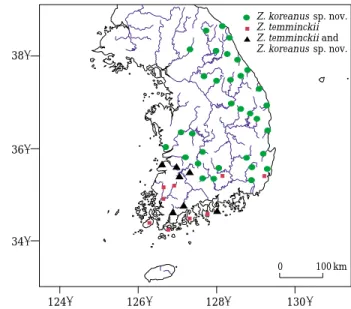
and most streams flowing into the eastern coast of Korea (Fig. 3). They commonly inhabit rapid lotic waters along the upper and middle courses of the streams.
Etymology. The name koreanus refers to the geographical occurrence of the species in Korea.
Remarks. Yang and Min (1989) reported two types of Mdh of Z. temminckii in Korea and gave a hint that the two types might each represent distinct species, but they did not provide any morphological characteristics. However, through morphological investigations of extensive collec- tions on the Korean dark chub, the two types, MM and MS of Mdh-1, are recognized as Z. tem- minckii and Z. koreanus sp. nov., respectively.
And the color plates of “Z. temmincki” (Choi et al., 1990; Kim, 1997) are also considered by those of Zacco koreanus sp. nov. The Korean form of dark chub (Hosoya et al., 2003) is described as Z.
koreanus sp. nov., and is distinguished from Z.
temminckii and Z. sieboldii of Japan based on the anterolateral body sides having a brilliant
yellow color.
The new species is very similar to Z. temmin- ckii, but it is distinguished from that species by the following characters: 9~10 scales above lateral line (vs. 11~12 in Z. temminckii), larger orbit diameter orbit (mean 28.4: 23.2~33.6% HL vs. mean 24.3: 19.0~31.9%), no hemicircular red blotch on the upper margin of the eyes (vs. pre- sent), yellowish anterolateral body sides in bre- eding season (vs. reddish) and reddish anterior margin of pectoral fin in mature males (vs. yel- lowish). Molecular biological studies are requir- ed for evaluating their relationships.
Zacco temminckii
(Temminck and Schlegel, 1846) (English name: dark chub) (Korean name: gal-gyeo-ni)
(Table 1 and Fig. 2B)
Materials examined. CNUC 36144~36163, 75.0~127.5 mm SL, Seomjin River, Jeongsan-ri, Bokheung-myeon, Sunchang-gun, Jeollabuk- do, Korea, Aug. 10, 2003, M.K. Oh; CNUC 361- 88~36204, 79.6~168.4 mm SL, Tamjin River, Gidong-ri, Busan-myeon, Jangheung-gun, Jeol- lanam-do, Korea, Aug. 6, 2003, M.K. Oh; CNUC 36205~36224, 102.1~173.0 mm SL, Do-ngjin River, Yongsan-dong, Jeongeu-si, Jeollabuk-do, Korea, Aug. 10, 2003, M.K. Oh; CNUC 36225~
36224, 84.5~160.7 mm SL, Yeongsan River,
Fig. 2. Nuptial coloration of Z. koreanus sp. nov. (A), Han R., paratype (CNUC 36064), male and Z. tem- minckii (B), Tamjin R., non-type (CNUC 36189), male. Bar indicates 10 mm.
130 128
126 124
34�
36�
38�
0 100 km
Z. koreanus sp. nov.
Z. temminckii Z. temminckii and Z. koreanus sp. nov.
� � � �
Fig. 3. The geographical distribution patterns of Z. kor- eanus sp. nov. and Z. temminckii from Korea.
A
B
Ssangwoon-ri, Bukha-myeon, Jangseong-gun, Jeollanam-do, Korea, Aug. 6, 2003, M.K. Oh.
Diagnosis. Z. temminckii is distinguished from Z. koreanus sp. nov. by the combination of the following characters: 11~12 scales above lateral line to dorsal fin origin; interorbital width nearly 1.6 times orbit diameter; conspicuous he- micircular red blotch on the upper margin of the eyes; anterolateral side of body reddish; anterior margin of pectoral fin yellowish when alive.
Description. Dorsal fin rays iii 7, anal fin rays iii 10, pectoral fin rays i 14(15), pelvic fin rays ii 8, caudal fin rays i 9,8 i, lateral line scales 46~
53, scales above lateral line 11~12 and scales below lateral line 4(5), vertebrae 42~45, gill rak- ers 11~12, pharyngeal teeth 1, 3, 5-5, 3, 1. Pro- portional measurements and meristic counts are shown in Table 1.
Body elongated and moderately compressed, head moderately compressed. No maxillary bar- bel. Maxillary extending backward reaching near vertical line through front margin of the eyes.
Outline from chin to nape somewhat convex. Pos- terior margin of operculum roundish. Anterior tip of snout roundish. Deep bluish longitudinal band extending from shoulder to base of caudal fin.
Largest recorded size 173.0 mm (CNUC 36208).
Coloration in life. Anterolateral side of body and ventral region reddish, overall head region yellowish. Dorsal part grayish. Lower part of ma- ndible reddish black. Conspicuous hemicircular red blotch on the upper margin of the eyes. Ant- erior margin of pectoral fin yellowish. Paired fins and caudal fin yellowish. Black bands present on anal fin membrane. Upper half of dorsal fin yel- lowish red; lower half blackish and anterior mar- gin reddish (Fig. 2B).
Sexual dimorphisms. In breeding season, males have nuptial tubercles in two rows from tip of snout to front margin of the eyes. In the region of the suborbital, mandible, and lower part of cheek, nuptial tubercles are also arranged in one row. In females, the nuptial tubercles of head region are weakly developed. On the anal fin rays and caudal peduncle, nuptial tubercles are distinctive in males but absent in females. In males, the anal fin ray is prolonged reaching the base of the caudal fin.
Distribution and habitat. Z. temminckii is restricted in the southern part of Korea to the Yeongsan, Seomjin, Tamjin and Nakdong River (Fig. 3). It is also distributed in Japan. The spec- ies inhabits upper and middle courses of streams
and prefers lentic waters.
Remarks. Z. temminckii of Japan was classi- fied into type A and B (Hosoya, 2002), but was subsequently redescribed as two valid species, Z.
sieboldii for the specimens with 9 branched anal fin rays and lateral scales more than 53, and Z.
temminckii for the specimens with 10 branched anal fin rays and lateral scales less than 52 (Hosoya et al., 2003). Because Z. temminckii was clearly redefined from Z. sieboldii by the number of lateral line scales, branched anal fin rays, and color patterns on sides of the body, the Korean Z.
temminckii had to be checked for its meristic ch- aracters. During investigations on alive speci- mens of the Korean Z. temminckii, the two color types of red and yellow were recognized. Subse- quently, we realized that the red type was well in accord with Z. temminckii, however the yellow type was distinguished from the red type in the number of scales above lateral line. As described above, all specimens of the yellow type investi- gated were distinguished as a valid new species, Z. koreanus, which was known to be widely dis- tributed throughout the country except in the Yeongsan River. As shown in Table 1, the speci- mens of Z. temminckii from Korea are well in accord with those of Japan in the investigated characteristics, however it is distinguished from Z. sieboldii in the number of anal fin rays, later- al line scales, and scales above the lateral line.
Key to the species of the genus Zacco in Korea and Japan
A1 A series of irregular vertical bands present on both sides of the body; scales above lateral line not more than 9
∙∙∙∙∙∙∙∙∙∙∙∙∙∙∙∙∙∙∙Z. platypus A2 A dark brown longitudinal band present along
midline on both sides of the body; scales above lateral line not less than 9
∙∙∙∙∙∙∙∙∙∙∙∙∙∙∙B B1 Longitudinal band anteriorly narrow and
posteriorly wide from vertical line through dorsal fin origin; anal fin rays iii 9, number of lateral line scales not less than 54; scales above lateral line not less than 13
∙∙∙∙∙∙∙∙∙∙∙∙∙∙∙∙∙∙∙∙∙∙∙∙∙∙∙∙∙∙∙∙∙∙∙∙∙∙∙∙∙∙∙∙∙∙∙∙∙∙∙∙∙∙∙∙∙∙∙∙∙∙∙∙∙∙∙∙∙∙
Z. sieboldii B2 Longitudinal band equally wide from the
shoulder to caudal fin base; anal fin ray,
iii 10; number of lateral line scales not more
than 53; scales above lateral line not more
than 12
∙∙∙∙∙∙∙∙∙∙∙∙∙∙∙∙∙∙∙∙∙∙∙∙∙∙∙∙∙∙∙∙∙∙∙∙∙∙∙∙∙∙∙∙∙∙∙∙∙∙∙∙∙∙∙C
C1 Scales above lateral line 11~12; conspicuous
hemicircular red blotch on the upper margin
of the eyes; anterolateral body sides reddish
in alive specimens; anterior margin of pec- toral fin yellow
∙∙∙∙∙∙∙∙∙∙∙∙∙∙∙∙∙∙∙∙∙∙∙∙Z. temminckii C2 Scales above lateral line 9~10; no hemicir-
cular red blotch on the upper margin of the eyes; anterolateral sides of body yellowish in alive specimens; anterior margin of pectoral fin red
∙∙∙∙∙∙∙∙∙∙∙∙∙∙∙∙∙∙∙∙∙∙∙∙∙∙∙Z. koreanus sp. nov.
Comparative materials
Zacco koreanus CNUC 36069~36073, 36075
~36083, 14 specimens, 70.0~108.5 mm SL, Han River, Haoan-ri, Hongcheon-eup, Hongche-on- gun, Kangwon-do, Korea, Aug. 8, 2003, M.K. Oh;
CNUC 36084~36087, 36093~36103, 15 sp- ecimens, 76.0~103.6 mm SL, Geum River, Dae- bul-ri, Jucheon-myeon, Jinan-gun, Jeolla-buk- do, Korea, Aug. 9, 2003, M.K. Oh; CNUC 36104
~36113, 36119~36123, 15 specimens, 79.5~
101.1 mm SL, Mangyong River, Sinchon-ri, So- yang-myeon, Jeollabuk-do, Korea, Aug. 9, 2003, M.K. Oh; CNUC 36164~36178, 15 specimens, 73.0~92.5 mm SL, Nakdong River, Sannae-my- eon, Namwon-shi, Jeollabuk-do, Korea, Aug. 5, 2003, M.K. Oh; CNUC 36124~36126, 36132~
36143, 15 specimens, 96.0~70.8 mm SL, Seomjin River, Maryong-myeon, Jinnan-gun, Jeollabuk- do, Korea, Aug. 11, 2003, M.K. Oh; CNUC 36184
~36187, 76.1~121.3 mm SL, 4 specimens, Tam- jin River, Gidong-ri, Busan-myeon, Jangheung -gun, Jeollanam-do, Korea, Aug. 6, 2003, M.K.
Oh.
Zacco temminckii of Japan CNUC 36391~
36395, 5 specimens, 93.3~106.6 mm, The tribu- tary of Seobang-cheon Stream, Japan, Aug. 22, 2003, K. Hosoya; CNUC 36396~36400, 5 speci- mens, 63.0~97.2 mm, Bojeseon-cheon Stream, Japan, Sep. 28, 2003, K. Hosoya.
Zacco sieboldii of Japan CNUC 36401~36407, 7 specimens, 66.1~102.2 mm, Bohyunsa-cheon Stream, Japan, Sep. 19, 2003, K. Hosoya; CNUC 364081~36410, 3 specimens, 87.0~96.0 mm, Bo- hyunsa-cheon Stream, Japan, Oct. 23, 2003, K.
Hosoya.
Acknowledgements
We sincerely thank Dr. Tomio Iwamoto of the
California Academy of Sciences, USA for critical review of the initial manuscript and various suggestions. We thank Prof. J.Y. Park (CNUC) for providing an available information on Korean dark chub and Dr. H. Yang for assistance in col- lecting samples from the all around Korea. We thank all of the ichthyological laboratory mem- bers of CNUC for their assistance in the field- work. This study was partly supported by the Core University Program between the KOSEF and JSPS on Fisheries Sciences.
References
Choi, K.C., S.R. Jeon, I.S. Kim and Y.M. Son. 1990.
Coloured illustrations of the freshwater fishes of Korea.
Hyangmoonsa, Seoul. 277 pp. (in Korean)
Hosoya, K., H. Ashiwa, M. Watanabe, K. Mizuguchi and T.
Okazaki. 2003. Zacco sieboldii, a species distinct from Zacoo temminckii (Cyprinidae). Ichthyol. Res., 50 : 1~8.
Hosoya, K. 2002. Cyprinidae. In Nakabo T. (ed) Fishes of Japan with pictoral keys to the species, English edition.
Tokai University Press, Tokyo, pp. 253~272, 1464~1- 467.
Hubbs, C.L. and K.F. Lagler. 1964. Fishes of the Great Lakes region. Univ. of Press. Ann Arbor. 213 pp.
Jordan, D.S. and E.C. Starks. 1905. On a collection of fishes made in Korea, by Louis Jouy, with descriptions of new species. Proceedings U.S. National Museum, Vol. X X XIII, no. 1391 : 193~212.
Kim, I.S. 1997. Illustrated encyclopedia of fauna and flora of Korea. Vol. 37. Freshwater fishes. Ministry of Education. 629 pp. 49 color pls. (in Korean)
Temminck, G.J. and H. Schlegel. 1846. Pisces, in Siebold’s Fauna Japonica. Lugduni Batavorum, Leiden. pp.
210~211.
Uchida, K. 1939. Freshwater fishes of Tyosen (Korea). Part I. Nematognathii and Eventognathii. Bull. Fish Exp.
Stn. 458 pp. (in Japanese).
Yang, S.Y. and M.S. Min. 1987. Evolutionary study on the dark chub (Zacco) IV. Genetic variation, morphology and artificial hybridization. Korean J. Zool., 30(4) : 417~431. (in Korean).
Yang, S.Y. and M.S. Min. 1989. Evolutionary study on the dark chub (Zacco temmincki) geographic distribution and seasonal variation of two allelomorphs of MDH.
Korean J. Zool., 32 : 232~241. (in Korean).
Received: December 4, 2004 Accepted: February 28, 2005
한국산 피라미속 어류 1 신종 Zacco koreanus 기재와 갈겨니 Z. temminckii 의 재기재
김 익 수*∙오 민 기∙ Kazumi Hosoya
1전북대학교 자연과학대학 생물학과, Department of Fisheries, Faculty of Agriculture, Kinki University, Nara 631-8505, Japan
우리나라 영산강을 제외한 남부의 여러 하천에서 채집된 갈겨니로 알려진 표본 가운데 체측상 부비늘 수가9~10개이고, 체측 전반부가 노란색을 띠고, 동공상단에 붉은색 반점이 없으며, 가슴 지느러미 앞쪽 가장자리는 붉은색을 띤 104개의 개체들은 전형적인 갈겨니 Zacco temminckii와 잘 구별되어, 신종 Zacco koreanus로 기재하고 새로운 국명을 “참갈겨니”로 지칭하여 갈겨니 Z.
temminckii와 비교하였다. 갈겨니는 영산강, 동진강, 섬진강, 탐진강, 낙동강의 우리나라 남부에서 만 분포하지만, 참갈겨니는 영산강을 제외한 대부분의 하천에 분포한다. 이 두 종이 혼서하는 수 역에서는 갈겨니는 주로 정수역에 서식하지만 참갈겨니는 비교적 빠른 유수역을 선호하였다. 한 국과 일본의 피라미속 어류의 종 검색표를 제시하였다.