96
©The Korean Society of Food Science and Technology
고추종실유 및 산초유의 투여가 흰쥐의 혈청 및
간장 지질농도에 미치는 영향
윤덕효·최용순
1,∗
강원대학교 BT특성화학부대학 생명공학부
1강원대학교 부설생명공학연구소
Influence of Red Pepper (Capsicum annuum L.) Seed Oil and Sancho
(Zanthoxylum schinifolium) Seed Oil on Serum and Liver Lipids
Profiles in Rats
Deuk-Hyo Yoon and Yong-Soon Choi1,∗
Division of Biotechnology, College of Bioscience and Biotechnology, Kangwon National University
1
Institute of Bioscience and Biotechnology, Kangwon National University
Abstract Pungent oils are fat sources that determine the taste, flavor, and satiety of foods. They are also energy sources and regulators of lipid metabolism in humans. The present study was performed to evaluate the effects of red pepper (Capsicum annuum L.) seed oil (RPO) and sancho (Zanthoxylum schinifolium) seed oil (SCO) as pungent oils on the lipid profiles of rats fed on hypercholesterolemic diets (0.12% cholesterol), as compared to common soybean oil (SBO). There were large differences in the n-6/n-3 fatty acid ratios of the experimental oils (SBO: 8.8, SCO: 1.2, RPO: 70.1). Serum cholesterol concentrations were higher in the RPO groups than in the other groups; whereas ratios of HDL-cholesterol/total cholesterol were lower in the RPO groups. On the other hand, liver cholesterol levels were markedly higher in the SCO groups than in the RPO groups, with the SBO groups having intermediate levels; these largely reflected cholesterol ester content differences in the rat livers. It is possible that the different serum cholesterol responses observed in the RPO and SCO groups might have been related to differences in the n-6/n-3 fatty acid ratio rather than the polyunsaturated fatty acids/saturated fatty acids ratio. Serum triacylglycerol concentrations were lower in the SCO groups as compared to the other groups. Overall, the results showed a hypocholesterolemic effect for sancho seed oil as compared to red pepper seed oil in rats fed diets containing 0.12% cholesterol.
Key words: red pepper seed oil, sancho (Zanthoxylum schinifolium) seed oil, cholesterol, rats
서
론
향신료는 식품의 향과 맛을 결정할 뿐 아니라 신체대사에 영 향을 주는 중요한 식이요소중 하나다(1, 2). 한편, 식이지방은 에 너지원으로서뿐 아니라 필수 지방산, 지용성 비타민 또는 향이나 조직감을 향상시켜 포만감이나 미각을 향상시키는 여러 생리적 인 기능과, 체내 지질대사를 조절하는 조절물질로 작용한다(3). 이러한 측면에서 특유의 향과 맛을 지닌 고추종실유나 산초유는 에너지원이나 대사조절물질로서뿐 아니라 식품의 맛이나 향 또 는 포만감을 결정할 수 있는 중요한 지방질원으로 간주될 수 있 다(4-7). 이와 관련하여 고추종실유는 향신성 식용유로서 상품화 되어 판매되고 있으나, 산초유는 아직 가내가공수준으로 소량 생 산되고 있다. 일반적으로 고추종실유나 산초유는 볶은 후 기계적인 방법으 로 착유하는데, 고유의 향기성분과 더불어 볶는 동안 생성된 특 유의 성분이 가미된다(8,9). 이 식용유의 맛은 맵고, 자극적이어 서 주로 음식의 맛을 마무리하는 향신료로 쓰인다. 산초(Zanthoxylum schinifolium)는 고추가 이용되기 이전의 향신 료의 하나로 강원도지역에서는 열매를 이용하여 지방을 착유하 거나, 분말 향신료나 절임으로 이용되고 있다. 한편 같은 산초과(Rutaceae)로서 초피나무(Zanthoxylum piperitum)의 과피는 향신료
로서뿐 아니라 방향성 건위, 소염, 이뇨, 구충제 등의 약제로서 이용되어 왔다(10,11). 한편, 고추(Capsicum annuum L.)의 매운 맛 을 결정하는 capsaicin의 함량은 품종에 따라 변화하며, 체중 감 소나 중성지질 저하 등의 효과가 보고되었다(12-14). 혈청콜레스테롤 농도의 상승은 사람을 비롯한 동물연구에서 순 환기계 질환 발생의 위험인자로 알려져 왔으며, 식이지방은 지질 농도의 중요한 조절인자임이 밝혀져 왔다(3,15). 그러나 일반 식 이지방과는 달리 향신성 지방의 지질대사 조절기능은 거의 보고 되지 않았는데, 이는 산초유나 고추종실유가 국내에서 소비되며, 용도에 제한이 있기 때문으로 보인다. Kang(16)은 흰쥐에서 들기
*Corresponding author: Yong-Soon Choi, Division of Biotechnol-ogy, College of Bioscience and BiotechnolBiotechnol-ogy, Kangwon National University, Chuncheon 200-701, Korea
Tel: 82-10-3913-3747 Fax:82-33-250-6482
E-mail:[email protected]
름에 비하여 고추종실유의 혈청지질 상승효과를 보고한 바 있으 며, Ko와 Han(17)은 한국산 초피 및 산초열매의 화학성분을 계 통적으로 분석하여 보고하였다. 한편, Cha 등(18)은 마우스에서 산초유 투여시 지방산조성의 변화를 관찰한 바 있으나, 아직까지 산초유의 혈청지질농도의 응답에 관한 연구는 보고된 바 없다. 따라서 본 연구에서는 향신성 식용유로서 산초유와 고추종실유 를 흰쥐에 투여하여 지질농도에 미치는 영향을 검토하여 보고하 고자 한다.
재료
및
방법
시료대두유(soybean oil, SBO) 및 고추종실유(red pepper seed oil,
RPO)는 시중 슈퍼마켓에서 구입하였으며, 산초유(Zanthoxylum schinifolium seed oil, SCO)는 자가 생산 농가(Pyeongchang, Koea)에서 구입하였다.
실험동물 및 식이
동물사료는 AIN-93(19) 식이조성에 준하여 조제하였으며, 콜레 스테롤을 0.12% 첨가하였다: corn starch; 39.7486%, casein;
20.0%, dextronized corn starch; 13.2%, Sucrose; 9.88%, experi-mental oil(대두유, 산초유, 고추종실유, 각각); 7.0%, Alphacel; 5.0%, mineral MX); 3.5%, vitamin mix(AIN-93-VX); 1.0%, L-cystine; 0.3%, choline bitartrate; 0.25%; tert-BHT; 0.0014%, cholesterol; 0.12%.
실험동물은 5주령의 specific pathogen free 수컷
Sprague-Daw-ley계의 흰쥐(Dae Han Biolink Co., LTD, Eumseong, Korea)를
구입하여 사육용 사료(Superfeed, Wonju, Korea)로 일주일간 적응 시킨 후, 7 마리씩 대두유 섭취군(이하 대두유군 또는 SBO), 산 초유 섭취군(산초유군, SCO), 고추종실유 섭취군(고추유군, RPO) 군으로 나누었다. 사육실의 온도는 22 ± 2oC였으며, 12시간 간격 으로 점등과 소등을 하였다. 실험기간동안 물 및 사료는 자유 섭 식하였다. 분변은 실험이 끝나기 5일전 2일 동안 채취하여 동결 건조하였다. 4주가 지난 후 12시간 절식하여 decapitation하였다. 혈액은 30분간 실온에 방치한 후 원심분리하여 혈청을 분리하였 다. 간장은 적출하여 분석시까지 -80o C에서 보관하였다. 시험방법 식이지방의 지방산조성은 BF3-methanol용액으로 methylation한
후 gas chromatography로 분석하였다(Table 1)(20). 요오드가는
Wijs법으로 측정하였다(21). 불검화물(unsaponifiable matter)은 시
료를 검화한 후 추출하여 산출하였다(22). 스테롤(3-OH-α-sterols) 의 함량은 효소법으로 측정하였으며(23), capsaicin함량은 HPLC 로 측정하였다(24).
혈청콜레스테롤, high density lipoprotein-cholesterol(HDL-C), 중 성지질, oxaloacetate transaminase(GOT) 및
glutamate-pyruvate transaminase(GPT) 활성 및 glucose 농도는 진단키트 (Asan Pharmaceutical, Seoul, Korea) 를 이용하여 매뉴얼에 따라
측정하였다. 간장지질은 Folch의 방법에 따라 정제 추출하였다
(25). 간장 총콜레스테롤 및 유리콜레스테롤은 Sperry-Webb의 방
법(26)에 따라서 측정하였으며, 중성지질은 Fletcher의 방법(27)에 따라 분석하였다. 분변중 담즙산은 t-butanol:H2O(1:1) 용액으로 추
출하여 분석키트(Bile acids Diagnostic Kits, Sigma, St. Louis,
MO, USA)를 이용하여 측정하였다(28). 실험결과는 ANOVA에 의
하여 분석한 후 p<0.05 수준에서 LSD-test 로 유의성을 검정하였 다.
결과
및
고찰
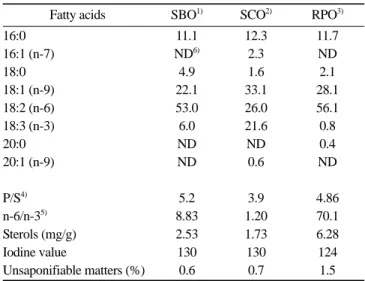
사람이나 동물의 연구결과로부터 섭취하는 지방의 불포화지방 산/포화지방산의 비율(P/S비), n-6/n-3비, 식이 콜레스테롤량은 궁 극적으로 혈청콜레스테롤 농도의 결정하는 조절인자로 알려져 왔 다(2,12,15,29-33). 본 연구는 흰쥐에서 고추유와 산초유에 대한 혈청콜레스테롤의 응답에 차이가 있음을 보여준다. 동물이 섭취한 지방의 지방산조성을 Table 2에 나타내었다. 대 두유, 산초유와 고추유의 P/S비의 함량의 비는 3.87-5.2의 범위인 데 비하여 α-linolenic acid의 함량은 산초유 21.6%, 대두유 6.0%, 고추유 0.8% 수준으로 큰 차이를 보였다. 지방원의 n-6/n-3 지방 산비는 산초유 1.2, 대두유 8.8, 고추유 70.1로 지방원간 큰 차이 를 보였다. Ko와 Han(17)은 산초과피와 산초씨앗의 지방산의 조 성에 차이가 있음을 보고하였으며, 본 실험에서 산초유는 산초 과피와 씨앗을 시료로 하여 얻었다. 실험에 사용한 식용유의 불 검화물량에 큰 차이는 없었다. 일부 연구자들은 흰쥐에서의 capsaicin투여에 의한 혈청콜레스 테롤 저하효과는 콜레스테롤이 식이에 첨가하였을 때 현저하였 음을 보고하였다(12-16). Kawada 등(12)은 고콜레스테롤식(1.0%Table 1. Conditions of gas-chromatography for fatty acid analysis
Column Stabilwax
®
(Crossbonded® Carbowax®-PEG) 30 m×0.25 mm ID×0.25μm df Carrier gas flow rate 1.0 mL/min
Oven temp.
initial 140o C (3 min) ascending temperature rate 5o
C/min final 250o C (10 min) Inj. temp. 250o C Det. temp. 260o C
Table 2. Physico-chemical properties and fatty acid composition of SBO, SCO and RPO (unit: %)
Fatty acids SBO1)
SCO2) RPO3) 16:0 11.1 12.3 11.7 16:1 (n-7) ND6) 2.3 ND 18:0 4.9 1.6 2.1 18:1 (n-9) 22.1 33.1 28.1 18:2 (n-6) 53.0 26.0 56.1 18:3 (n-3) 6.0 21.6 0.8 20:0 ND ND 0.4 20:1 (n-9) ND 0.6 ND P/S4) 5.2 3.9 4.86 n-6/n-35) 8.83 1.20 70.1 Sterols (mg/g) 2.53 1.73 6.28 Iodine value 130 130 124 Unsaponifiable matters (%) 0.6 0.7 1.5
1)SBO: soybean oil 2)SCO:sancho oil 3)RPO: red pepper seed oil
4)the ratio of polyunsaturated fatty acids to saturated fatty acids 5)the ratio of linoleic acid to α-linolenic acid
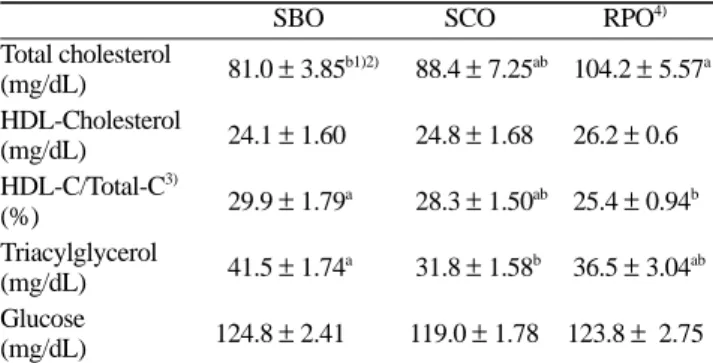
cholesterol)을 섭취한 흰쥐에 capsiate 또는 합성 capsaicin을 투여 시 혈청콜레스테롤 및 중성지질 저하효과를 확인하였다. 그러므 로 0.12% 콜레스테롤을 첨가한 사료를 섭취한 흰쥐에서 고추유 에 함유된 capsaicin의 지질대사 조절효과를 기대할 수 있을 것 이다. 고추유중 capsaicin량은 품종에 따라 변화하며, 한국산 고추 유중 capsaicin은 0.06-0.08% 수준이나 정제에 따라 변화한다(4,34). 본 실험에서 사용한 고추유의 capsaicin 함량은 0.032% 수준이었 다. 사료에 첨가된 고추종실유의 함량이 7.0%임을 고려하면 사 료중 capsacin 함량은 0.002% 수준이었으나, 혈청콜레스테롤 농 도는 오히려 상승하는 결과를 보여 주었다. 이러한 결과는 capsaicin 의 지질저하효과를 다른 식이요인이 상쇄하거나 또는 감소시킨 효과로 예측하여 볼 수 있을 것이다. Table 3은 실험기간동안 식이섭취량 및 체중변화를 보여주고 있다. 각 군간 체중증가에 유의한 차이는 없었으나, 식이 섭취량 은 산초유군이 다른 군보다 낮았다. 반면 간장무게는 산초유군이 높고 고추유군이 낮았으며, 대두유군은 중간값을 보였다. 산초유 군에서의 식이섭취량의 감소가 기호성이나 또는 어떤 미확인 성 분에 기인되는지는 본 연구에서 확인하지 못하였다. Table 4는 혈청지질 농도 및 혈당 농도를 보여주고 있다. 혈청 총콜레스테롤(total-cholesterol, TC) 농도는 고추유군이 대두유군보 다 유의하게 높았으며, 산초유군은 중간을 보였다. HDL-C농도는 군간 차이가 없었으나, HDL-C/TC비는 대두유군이 높았으며, 고 추유군이 유의하게 낮았다. 중성지질 농도는 대두유군에서 높았 으며, 산초유군에서 낮은 농도를 보였다. 혈청 HDL-C/TC 농도비 는 동맥경화발생을 예측하는 유용한 지표로 활용된다(15). 본 실험에서의 대두유, 산초유, 고추유의 불포화지방산/포화지 방산비(P/S비)는 3.9-5.2의 범위였으나, n-6/n-3비는 큰 차이를 보 인다. 결과적으로 식이군의 혈청 콜레스테롤 농도는 P/S비보다는 n-6/n-3비의 차이에 크게 의존한 것으로 사료된다. 이와 관련하여, Lee 등(29)은 흰쥐에서 식이지방의 n-6/n-3비가 P/S비(적어도 1.2 이상의 조건하에서는)보다 혈청 콜레스테롤 농도를 결정하는 조 절인자일 수 있음을 지적한 바 있다. Table 5는 간장지질농도를 보여주고 있다. 간장 TC농도는 산 초유군>대두유군>고추유군 순으로 낮았으며, 산초유군과 고추유 군 사이에 유의한 차이를 보였다. 콜레스테롤 에스테르(cholesteryl ester, CE) 함량 역시 TC농도와 비슷한 경향의 군간 차이를 나타 내었다. 결과적으로 군간 CE/TC의 비는 Fig. 1에서 보는 바와 같 이 산초유군이 높았으며, 대두유군과 고추유군간 차이는 없었다. 중성지질농도는 고추유군에서 낮았다. 한편, 산초의 유효성분과는 달리, 산초유에 함유 가능한 유효 성분은 알려져 있지 않다(6,35). Park 등(36)은
초피나무(Zanthox-ylum pipericum DC)로부터 분리한 성분중 hydroxy-β-sanshool은
β-sanshool 이나 γ-sanshool에 비하여 in vitro 상에서 acyl CoA:
cholesterol acyltransferase-1(ACAT-1) 및 ACAT-2에 대한 낮은 저
해효과를 보고하였다. 최근 Iseli 등(37)은 산초열매에서 hydroxy-β-sanshool 성분을 보고한 바 있다. 마우스에서 ACAT-2는 VLDL 을 구성하는 CE의 합성을 조절하므로, ACAT의 저해는 혈청 콜 레스테롤 농도를 감소시킬 것이다(38,39). 간장에서 지방산의 종
Table 3. Growth parameters and food intake in rats
SBO SCO RPO4)
Initial body weight
(g) 221.8± 3.67
1) 220.6± 3.34 220.4± 3.66 Body weight gain
(g/week) 221.3± 2.30 219.5± 2.40 222.1± 1.20 Food intake2) (g/day) 221.0± 0.50 a3)219.6± 0.30b 221.0± 0.30a Liver weight (g/100g B.W.) 23.11± 0.59 ab 223.27± 0.083a 23.02± 0.038b 1)Mean±S.E. of 7 rats.
2)Rats were fed cholesterolemic diets (0.12%) containing soybean oil
(SBO), sancho oil (SCO) or red pepper seed oil (RPO) as fat sources for 4 weeks.
3)Values in a line without common superscript letters denote
significant difference (p < 0.05).
4)See Table 2 for abbreviations.
Table 4. Concentration of serum lipids and glucose in rats
SBO SCO RPO4)
Total cholesterol (mg/dL) 181.0± 3.85 b1)2) 88.4± 7.25ab 104.2± 5.57a HDL-Cholesterol (mg/dL) 124.1± 1.60 24.8± 1.68 26.2 ± 0.6 HDL-C/Total-C3) (%) 129.9± 1.79 a 28.3± 1.50ab 25.4± 0.94b Triacylglycerol (mg/dL) 141.5± 1.74 a 31.8± 1.58b 36.5± 3.04ab Glucose (mg/dL) 124.8± 2.41 119.0± 1.78 123.8 ± 2.75 1)Mean±S.E. of 7 rats.
2)Values in a line without common superscript letters denote
signifi-cant difference (p < 0.05).
3)HDL-C/Total-C: HDL-cholesterol/total-cholesterol 4)See Table 2 for abbreviations.
Table 5. Concentration of hepatic lipids in rats
SBO SCO RPO3)
Total cholesterol (mg/g) 14.0± 0.54 b1)2) 16.6± 0.95a 13.5± 0.40b Cholesteryl esters (mg/g) 11.9± 0.60 b 14.5± 0.97a 11.5± 0.39b Triacylglycerol (mg/g) 13.5± 1.93 a 10.3± 1.35ab 10.0± 0.90b 1)Mean±S.E. of 7 rats.
2)Values in a line without common superscript letters denote significant
difference (p < 0.05).
3)See Table 2 for abbreviations.
Fig. 1. The ratio of hepatic cholesteryl ester to total cholesterol in the rats
Mean± S.E. of 7 rats. a,b
Values without common superscript letters denote significant difference (p < 0.05).
류는 ACAT 활성을 결정하는 주요인자로 알려져 있다(40). 본 연 구에서 산초유군은 대두유군과 비슷한 수준의 혈청콜레스테롤 농 도이나, 대두유와는 달리 산초유에 의한 간장 콜레스테롤 에스테 르의 상승 유도는 흥미로운 결과이다. 본 연구에서 혈청 중성지질의 함량은 산초유군이 대두유군이 나 고추유군보다 현저하게 낮았다. 반면, 간장 TC를 비롯한 CE 함량은 산초유군에서 가장 높은 농도를 나타내었다. 이미 보고된 바와 같이, α-linolenic acid에 의해 VLDL의 분비가 감소한다면, VLDL합성에 이용될 CE는 간장에 축적되어질 것이며, 상대적으 로 혈액중 콜레스테롤과 중성지질의 농도는 감소할 것이다(29, 33, 37). Lee 등(29)은 흰쥐에서 n-3 지방산의 증가에 따른 중성 지질 감소효과는 n-6/n-3비가 5이하일 때 분명하였음을 관찰한 바 있다. 본 연구에서의 산초유 및 고추유의 n-6/n-3비는 각각 1.20 과 70.1이었다.
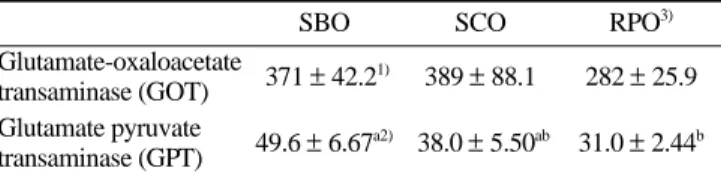
혈청중 GOT 및 GPT 활성을 Table 6에 나타내었다. GOT 활 성에 군간 차이는 없었으나, GPT 활성은 대두유군보다 고추종실 유나 산초유에서 낮았다. 이러한 결과로 보아 향신유로서 고추종 실유나 산초유 섭취에 의한 간장손상의 가능성은 없는 것으로 보 여진다(41). 한편 분변의 중량 및 분변으로 배설되는 담즙산량에 군간 차이는 없어, 배설된 담즙산량이 혈청콜레스테롤농도에 직 접적인 영향을 주는 것으로 보이지 않는다(대두유군; 26.1 ± 1.65μmol/day, 산초유군; 26.6 ± 2.22 μmol/day, 고추종실유군; 24.0± 2.40 μmol/day). 결론적으로, 흰쥐에서 고추종실유는 대두유에 비하여 혈청 콜 레스테롤 상승효과를 보였으며, 산초유는 중간정도의 효과를 나 타내었다. 산초유는 대두유보다 간장내 콜레스테롤 에스테르의 축적을 유도하였다. 이러한 결과는 적어도 흰쥐에서 산초유는 고 추종실유보다 혈청 콜레스테롤 농도를 감소하는 효과가 있음을 시사한다.
요
약
향신성 식용유는 에너지원이나 대사조절물질로서뿐 아니라 식 품의 맛이나 향 또는 포만감을 결정하는 지방이다. 본 연구는 0.12% 콜레스테롤 식이를 한 흰쥐에서 대두유를 대조로 하여 향 신성 식용유(고추종실유, 산초유)에 의한 지질농도의 조절효과를 평가하였다. 사료중 n-6/n-3 지방산의 비는 8.8:1.2:70.1 (대두유:산 초유:고추종실유)로 큰 차이가 있었다. 혈청콜레스테롤 농도는 고 추종실유 섭취군에서 다른 군보다 높았으나, HDL-cholesterol/total-cholesterol 비는 고추종실유 섭취군에서 낮았다. 혈청중성지질 농 도는 다른 군에 비하여 산초유 섭취군에서 낮았다. 반면에 간장 콜레스테롤 농도는 고추종실유 섭취군보다 산초유 섭취군에서 높 았다. 이러한 응답은 식이지방에 의한 혈청 콜레스테롤 농도의 응답은 조직간 콜레스테롤 분배의 차이에 기인되는 듯하다. 결론 적으로 본 연구는 콜레스테롤 함유식이를 한 흰쥐에서 고추종실 유는 대두유에 비하여 콜레스테롤상승효과를 보여준 반면, 산초 유는 중간적 효과를 보여주었다.문
헌
1. Srinivasan K. Spices as influencers of body metabolism: An over-view of three decades of research. Food Res. Int. 38: 77-86 (2005) 2. Iwai K, Yazawa A, Watanabe T. Roles as metabolic regulators of
the non-nutrients, capsaicin and capsiate, supplement to diets. P. Jpn. Acad. B-phys. 79: 207-212 (2003)
3. Gurr MI, Harwood JL, Frayn KN. Lipid Biochemistry. 5th ed.
Blackwell Science Ltd., Oxford, UK. pp. 127-169 (2002)
4. Choi YJ, Ko YS. Studies on the lipid components of red pepper seed oil. J. Korean Home Econo. 28: 31-36 (1990)
5. Lee JI, Ryu SN. Omega-3 fatty acid resource crops in Korea. Korean J. Breed. 26: 89-96 (1994)
6. Lee JW. Volatile flavor components of Korean sancho fruit and tree (Zanthoxylum schinfolium). Korean J. Food Nutr. 11: 493-498 (1998)
7. Koo BS, Kim DS. Development of the seasoning oil for replac-ing red pepper seed oil: Manufacturreplac-ing of red pepper seasonreplac-ing oil. Korean J. Food Preserv. 11: 142-147 (2004)
8. Choi YJ, Ko YS. Studies on the variation of physico-chemical characteristics during storage and frying. Korean J. Soc. Food Sci. 6: 67-75 (1990)
9. Kim S, Park J, Hwang IK. Changes in FA composition and anti-oxidative activity of pigment extracts from Korean red pepper powder (Capsicum annuum L.) during the processing conditions. J Am. Oil Chem. Soc. 79: 1267-1270 (2002)
10. Lee HY, An R, Na M, Park JY, Lee KS, Kim YH, Bae KH. Quality evaluation of Zanthoxyli Fructus. Korean. J. Pharmacogn. 33: 45-48 (2002)
11. Lim JP. Herb Medicinal Pharmacognosy. Shinil Publishing Co., Seoul. Korea pp. 204-205 (2003)
12. Kawada T, Hakihara KI, Iwai K. Effects of capsaicin on lipid metabolism in rats fed a high fat diet. J. Nutr. 116: 1272-1278 (1986)
13. Tani Y, Fujioka T, Sumioka M, Furuichi Y, Hamada H, Watanabe T. Effects of capsinoid on serum and liver lipids in hyperlipi-demic rats. J. Nutr. Sci. Vitaminol. 50: 351-355 (2004)
14. Kempaiah RK, Manjunatha H, Srinivasan K. Protective effect of dietary capsaicin on induced oxidation of low-density lipoprotein in rats. Mol. Cell Biochem. 275: 7-13 (2005)
15. Grundy SM. Cholesterol and coronary heart disease-A new era. J. Am. Med. Assoc. 256: 2849-2858 (1986).
16. Kang JO. The effect of fat and oil differently composed of ω-3 and ω-6 polyunsaturated fatty acids on lipid metabolism of rats. J. Korean Soc. Food Nutr. 18: 338-347 (1989)
17. Ko YS, Han HJ. Chemical constituents of Korean chopi
(Zan-thoxylum piperitum) and sancho (Zan(Zan-thoxylum schinifolium).
Korean J. Food Sci. Technol. 28: 19-27 (1996)
18. Cha JY, Shin SR, Cho YS. Fatty acid composition of serum and liver in mice and sancho (Zanthoxylum schinifolium) seed oil, Korean J. Postharv. Sci. Technol. 7: 308-312 (2000)
19. Reeves PG, Nielsen FH, Fahey GC Jr. AlN-93 purified diets for laboratory rodents: Final report of the American Institute of Nutrition ad hoc writing committee on the reformulation of the AIN-76A rodent diets. J. Nutr. 123: 1939-1951 (1993)
20. Technical Note. Improving the analysis of fatty acid methyl esters using retention time locked methods and retention time databases. Agilent Technologies. www. agilent.com/chem. Accessed Oct. 1, 2006
21. AOAC. Official Methods of Analysis of AOAC Intl. 16th ed.
Method 28.023. Association of Official Analytical Communities, Arlington, VA, USA (1995)
22. AOCS. Official Methods and Recommended Practices of the American Oil Chemists Society. Ca 6A-40. 3rd ed. AOCS Press,
Champaign, IL, USA. (1988)
Table 6. Concentration of serum GOT and GPT activities in rats (Karmen unit)
SBO SCO RPO3)
Glutamate-oxaloacetate transaminase (GOT) 371± 42.2 1) 389± 88.1 282± 25.9 Glutamate pyruvate transaminase (GPT) 49.6± 6.67 a2) 38.0± 5.50ab 31.0± 2.44b 1)Mean± S.E. of 7 rats.
2)a,bValues in a line without common superscript letters denote significant
difference (p < 0.05).
23. Kritchevsky D, Tepper SA. Assay of plant sterols by use of cho-lesterol oxidase. Clin. Chem. 25: 1464-1465 (1979)
24. Kozukue N, Han JS, Kozukue E, Lee SJ, Kim JA, Lee KR, Levin CE, Friedman M. Analysis of eight capsaicinoids in pep-pers and pepper-containing foods by high-performance liquid chromatography and liquid chromatography-mass spectrometry. J. Agr. Food Chem. 53: 9172-9181 (2005)
25. Folch J, Lees M, Slone-Stanley GH. A simple method for the isolation and purification of total lipids from animal tissues. J. Biol. Chem. 226: 497-509 (1957)
26. Sperry WM, Webb M. A revision of the Schoenheimer-Sperry method for cholesterol determination. J. Biol. Chem. 187: 97-106 (1950)
27. Fletcher MJ. A colorimetric method for the estimating serum trig-lycerides. Clin. Chim. Acta 22: 393-397 (1968)
28. Van der Meer R, de Vries H, Glatz JFC. t-Butanol extraction of feces: A rapid procedure for enzymic determination of fecal bile acids. pp. 113-119. In: Cholesterol Metabolism in Health and Dis-ease. Beynen AC, Geelen MJH, Katan MB, Schouten JA (eds). Ponsen & Looijen, Wagennigen, Netherlands (1985)
29. Lee JH, Fukumoto M, Nishida H, Ikeda I, Sugano M. The inter-related effects of n-6/n-3 and polyunsaturated/saturated ratios of dietary fats on the regulation of lipid metabolism in rats. J. Nutr. 119: 1893-1899 (1989)
30. Choi YS, Ide T, Sugano M. Age-related changes in the regulation of cholesterol metabolism in rats. Exp. Gerontol. 22: 339-349 (1987) 31. Wijendran V, Hayes KC. Dietary n-6 and n-3 fatty acid balance
and cardiovascular health. Annu. Rev. Nutr. 24: 597-615 (2004) 32. Daviglus ML, Lioyd-Jones DM, Pirzada A. Preventing
cardiovas-cular disease in the 21st century: Therapeutic and preventive
implications of current evidence. Am. J. Cardiovasc. Drugs 6: 87-101 (2006)
33. Wahrburg U. What are the health effects of fat? Eur. J. Nutr. (S1) 43: 6-11 (2004)
34. Kim BJ, Ahn MS. The physico-chemical properties of Korean red pepper seed oil by species and dried methods. Korean J. Soc. Food Sci. 14: 375-379 (1998)
35. Youn KS, Hong JH, Choi YH. Optimization for extraction of
sancho (Zanthoxylum schinifolium) extraction using supercritical
carbon dioxide. Food Eng. Prog. 10: 207-213 (2006)
36. Park YD, Lee WS, An S, Jeong TS. Human acyl-CoA: Choles-terol acyltransferase inhibitory activities of aliphatic acid amides from Zanthoxylum piperitum DC. Biol. Pharm. Bull. 30: 205-207 (2007)
37. Iseli V, Potterat O, Hagmann L, Egli J, Hamburger M. Character-ization of the pungent principles and the essential oil of
Zanthoy-lum schinifolium pericarp. Pharmazie 62: 396-400 (2007)
38. Lee RG, Shah R, Sawyer JK, Hamilton RL, Parks JS, Rudel LL. ACAT2 contributes cholesteryl esters to newly secreted VLDL, whereas LCAT adds cholesteryl ester to LDL in mice. J. Lipid Res. 46: 1205-1212 (2005)
39. Chang TY, Chang CCY, Lin S, Yu C, Li BL, Miyazaki A. Roles of acyl-coenzyme A: Cholesterol acyltransferase-1 and -2. Curr. Opin. Lipidol. 12: 289-296 (2001)
40. Lee JY, Carr TP. Dietary fatty acids regulate acyl-CoA: Choles-terol acyltransferase and cytosolic cholesteryl ester hydrolase in hamsters. J. Nutr. 134: 3239-3244 (2004)
41. Kim YK. Changes in the lipid composition and some enzyme activities in the rat liver as affected by diets. Korean J. Nutr. 6: 15-19 (1973)