Relationship between Selected Metal Concentrations in Korean Raspberry (Rubus coreanus) Plant and Different Chemical Fractions of the Metals in Soil
Byung-Koo Ahn, Jang-Choon Lee1, Soo-Gon Han, and Jin-Ho Lee2*
Jeollabuk-do Agricultural Research and Extension Services, Iksan 570-704, Korea
1Department of Infrastructure Civil Engineering, Chonbuk National University, Jeonju 561-756, Korea
2Department of Bioenvironmental Chemistry, Chonbuk National University, Jeonju 561-756, Korea
The applications of chemical fertilizers and various types of organic materials may cause heavy metal accumulation in soil. In this study, we conducted to investigate the relationship between the different chemical forms of heavy metals such as Cr, Cd, Pb, Cu, Ni, and Zn retained in soil and the metal concentrations in Korean raspberry plant. Forty five soil samples were collected from 2 to 6 years old Korean raspberry cultivation fields (RCFs), Gochang, Korea, to determine total, exchangeable (1.0 M MgCl2-extractable), DTPA-extractable metal contents. The leaves and fruits of raspberry plant were sampled at harvest stage. Total metal contents in soils ranged from 0.87 mg kg-1 to 66.82 mg kg-1.Exchangeable and DTPA-extractable metals ranged between 0.02 and 0.67 mg kg-1 and between 0.05 mg kg-1 and 7.07 mg kg-1, respectively. The metal concentrations in the plant leaf and fruit determined on a dry-basis were between 1.30 mg kg-1 and 38.82 mg kg-1 and between 0.05 mg kg-1 and 21.51 mg kg-1, respectively, but Cd and Pb were not detected in the leaf. The total, exchangeable, and DTPA-extractable contents of the metal ions in soil were directly correlated one another, but the contents of different metals in the different fractions were inversely correlated in general. Most of total and DTPA-extractable metals in the soil were directly correlated with the contents of the same metals in the plant, whereas exchangeable metals in the soil were not statistically correlated with the same metals in plants. Thus, we concluded that the metal contents in the raspberry field soils were much lower thanthe levels of Soil Contamination Warning Standard (SCWS), and the plant metal concentrations were also less than the maximum permissible limits. The total and DTPA-extractable metals in the soil were closely related to the metal concentrations in the plant.
Key words: Korean raspberry, Heavy metal, Total metal content, DTPA-extractable, Exchangeable
Received : July 15. 2011 Accepted : August 16. 2011
*Corresponding author : Phone: +82632702545 E-mail: [email protected]
Introduction
Agricultural soils receiving chemical fertilizers and different types of organic materials may result in the heavy metal contamination. Besides, plants continuously take up available fractions of the metal ions from the soils, and the metals can be accumulated in the plant tissues. The total concentration of a metal in the soil includes all fractions of the metal, from the readily available to the highly unavailable, which provides the maximum pool of the metal in the soil. There are also some important soil factors, such as soil pH, organic matter, clay and redox conditions, etc., to determine how much of this soil pool will be available
to plants (Wolt, 1994). Ammonium acetate (NH4OAc) or Magnesium chloride (MgCl2) at pH 7 may liberate only adsorbates (D’Amore et al, 2005). The water soluble and exchangeable metal fractions are usually considered to be directly plant available forms in soil-solution system.
Also, diethylenetriaminepentaacetic acid (DTPA)–extractable fraction of the metals from soil (Lindsay and Norvell, 1978) has been widely used to predict a sum of plant available metals (Arnesen and Singh, 1998; Meers et al., 2005; Lee and Ahn, 2010). However, the DTPA-extractable metal fraction in soils is not always correlated to the metal concentration in plants (Sadiq, 1985).
Korean raspberry (Rubus coreanus Miq.) plant has been cultivated as one of the most important economic plants in Jeollabuk-do, Korea (Jeollabuk-do, 2010). The cultivation period of the plant is approximately from 5 to 6 years with the applications of chemical fertilizer and various types of
organic materials, so that the Korean raspberry cultivation field might be accumulated with a certain amount of trace metals.
Therefore, objectives of this study were to determine the different chemical fractions of selected heavy metals, chromium (Cr), cadmium (Cd), lead (Pb), copper (Cu), nickel (Ni), and zinc (Zn), in soils cultivated with Korean raspberry plant, and to investigate the relationship between the different chemical forms of selected heavy metals in soil and the metal concentrations in the plant.
Materials and Methods
Soil samples Soils were collected from 2 to 6 years old Korean raspberry cultivation fields (RCFs) at Gochang- gun, Jeollabuk-do, Korea. The soil samples were air-dried and crushed to pass through a 2-mm sieve. The chemical properties of soils were determined using the procedures proposed by National Institute of Agricultural Science and Technology (NIAST), Rural Development Association (RDA), Korea (2000). The average values of selected soil chemical properties were as follows: soil pH of 5.60, electrical conductivity (EC) of 1.42 dS m-1, soil organic matter (SOM) of 31.72 g kg-1, exchangeable Ca2+, Mg2+, and K+, extracted by 1.0 M ammonium acetate (CH3COONH4, pH 7.0), of 5.68, 1.17, and 0.89 cmolc kg-1, respectively, available phosphorus of 1.04 g kg-1 as P2O5, and total nitrogen of 1.86 g kg-1.
Determination of heavy metals in soil Selected heavy metals in the soil samples were determined using Standard Test Methods for Soil Pollution provided by Ministry of Environment (MOE, 2003). To determine total chromium (Cr), 2.5 g of soil sample was weighed and transferred into a 125 mL conical flask with adding 50 mL of digestion solution (20 g of NaOH and 30 g of Na2CO3 dissolved in 1.0 mL of deionized water), and 0.4 g of MgCl2, and 0.5 mL of 0.1 M phosphate buffer solution. The mixture was heated for 1 h at 90~95℃ with agitation. After cooling it down to reach room temperature, it was filtered using a 0.45 µm membrane filter paper to obtain clear solution.
The pH of clear solution was adjusted to 7.5 ± 0.5 by slowly adding a few drops of 5.0 M HNO3. After adding 2.0 mL of 0.5% diphenylcarbazide into the pH adjusted solution, its pH was adjusted again to 2.0 ± 0.5 with 10% H2SO4 to determine the metal ion using a UV/Vis
spectrophotometer (HP8453 UV-Vis, Agilent) at a 540 nm wavelength. On the other hand, to determinetotal (Cd), copper (Cu), and lead (Pb), nickel (Ni) and zinc (Zn), 3 g of soil sample was weighed and placed into a 250 mL glass tube with adding 1 mL of distilled water, 21 mL of conc.
HCl, and 7 mL of conc. HNO3. The mixture was digested for 2 h at 30℃ and then for 2 h at 80℃ using a trace metal digestion system (Gerhardt UK Ltd.). The mixture was also filtered using Advantec Grade No. 6 filer paper to have clear solution. To determine exchangeable heavy metals, 5 g of soil sample was weighed and transferred into a 125 mL conical flask with adding 25 mL of 1.0 M CH3COONH4 (pH 7.0). The mixture was agitated for 1 h on a reciprocal shaker set at a speed of 180 cycle min-1, and then filtered by Advantec Grade No. 6 ashlessfilter paper to obtain clear extract. Plant available heavy metals, diethylenetriaminepentaacetic acid (DTPA)-extractable metal, were determined using a procedure modified from the method proposed by Lindsay and Norvell (1978) and Amacher (1996). Soil sample (5 g) was weighed and placed into a 125 mL conical flask with adding 25 mL of DTPA-extracting solution. The mixture was agitated for 2 h on a reciprocal shaker set at a speed of 180 cycle min-1, and then filtered using Whatman No. 42 filter paper to obtain clear DTPA extract. All the clear extracts obtained by the different procedures were used to analyze the target heavy metals using an inductively coupled plasma (ICP) spectrometers (GBC, Integra, UK).
Determination of heavy metals in plant tissue Leaves and fruits of the Korean raspberry plant were collected at harvest stage. The plant leaves were dried in an air- forced drying oven at 70℃ for 72 h. The dried leaf samples were ground using a grinding mill (RM100 Mortar Grinder, Retsch, Germany). The fruit samples were freeze-dried for 24 h at –45℃, ground and then weighed. The heavy metals in the plant samples were determined using methods proposed by NIAST (2000). Instrumental analysis for the heavy metals was conducted with an inductively coupled plasma (ICP) spectrometers.
Statistical analysis Pearson correlation analysis (SPSS 12.0 K) was used to evaluate the relationship between the parameters related to different amounts of heavy metals in soils and plant parts. Results were evaluated with 95% and 99% confidence intervals, which are presented as p<0.05 and P<0.01 levels of significance, respectively.
Table 1. The different fractions of selected heavy metals in soils of R. coreanus cultivation fields.
Fraction Cr Cd Pb Cu Ni Zn
--- mg kg-1 --- Total 0.87 ± 0.03† 0.11 ± 0.04 4.11 ± 0.91 3.62 ± 1.46 14.15 ± 4.46 66.82 ± 12.07 Exchangeable 0.20 ± 0.02 0.02 ± 0.01 0.24 ± 0.08 0.23 ± 0.11 0.02 ± 0.01 0.67 ± 0.22 DTPA-extractable 0.23 ± 0.02 0.05 ± 0.02 3.32 ± 0.87 2.96 ± 1.37 0.36 ± 0.22 7.07 ± 2.12
†Metal concentration = mean value ± standard deviation (N = 45).
Table 2. The concentrations of selected heavy metals in the leaves and fruits of R. coreanus plants.
Plant part Cr Cd Pb Cu Ni Zn
--- mg kg-1 ---
Leaf 1.30 ± 0.13† ND ND 3.75 ± 1.25 0.28 ± 0.14 38.82 ± 7.10
Fruit 0.30 ± 0.05 0.05 ± 0.03 0.75 ± 0.58 3.48 ± 1.25 1.29 ± 0.45 21.51 ± 4.92
†Metal concentration = mean value ± standard deviation (N = 45).
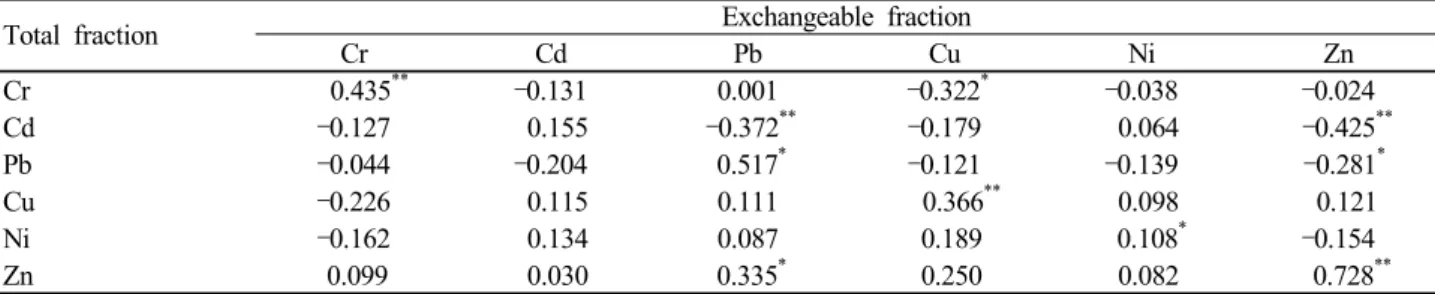
Table 3. The values of correlation coefficient (r)† between total and exchangeable contents of selected heavy metals in soils of R.
coreanus cultivation fields.
Total fraction Exchangeable fraction
Cr Cd Pb Cu Ni Zn
Cr 0.435** –0.131 0.001 –0.322* –0.038 –0.024
Cd –0.127 0.155 –0.372** –0.179 0.064 –0.425**
Pb –0.044 –0.204 0.517* –0.121 –0.139 –0.281*
Cu –0.226 0.115 0.111 0.366** 0.098 0.121
Ni –0.162 0.134 0.087 0.189 0.108* –0.154
Zn 0.099 0.030 0.335* 0.250 0.082 0.728**
†Correlation coefficient (r) was determined by Pearson correlation analysis to evaluate the relationship between parameters. Results were evaluated with 95% and 99% confidence intervals: *p<0.05 and **P<0.01 levels of significance.
Results and Discussion
Total, exchangeable, and plant available contents of selected heavy metals, chromium (Cr), cadmium (Cd), lead (Pb), copper (Cu), nickel (Ni), and zinc (Zn) in the cultivated soils of the Korean raspberry plant are shown in Table 1. The total contents of heavy metals in the soils ranged from 0.87 mg Cr kg-1 to 66.82 mg Zn kg-1, which were much less than the levels of Soil Contamination Warning Standard (SCWS) of Soil Environment Conser- vation Law (MOE, 2011); 5 mg Cr kg-1, 200 mg Pb kg-1, 4 mg Cd kg-1, 150 mg Cu kg-1,100 mg Ni kg-1, and 300 mg Zn kg-1, and even as compared to the SCWS levels before amending in 2009, 4 mg Cr kg-1, 100 mg Pb kg-1, 1.5 mg Cd kg-1, 50 mg Cu kg-1, 40 mg Ni kg-1, and 300 mg Zn kg-1, they were still lower than the SCWS levels. Exchangeable metal fractions known as a directly plant available form ranged from 0.02 to 0.67 mg kg-1 for the target metals.
DTPA-extractable metal fractions considered as an estimate of the pools of plant available forms were between 0.05 mg Cd kg-1and 7.07 mg Zn kg-1.
The concentrations of target metals (estimated on a dry-basis) in Korean raspberry plant as related to the metal
contents in the soil are shown in Table 2. The metal concentrations in the plant leaf ranged between 1.30 mg Cr kg-1 and 38.82 mg Zn kg-1, except Cd and Pb that were not detected. The raspberry fruit contained only between 0.05 mg Cd kg-1 and 0.75 mg Pb kg-1, and other metals were ranged between 0.30 mg Cr kg-1 and 21.51 mg Zn kg-1. In particular, the dry-basis concentrations of Cd and Pb in the raspberry fruit were about 5 times higher than those in wet- or fresh-basis (based on ca. 80% moisture contents), so that the concentrations of Cd and Pb in the fruit estimated on a wet-basis were approximately 0.01 and 0.15 mg kg-1, respectively. Thus, the concentrations of Cd and Pb in the fruit were about or lower than the maximum permissible limits, based on a wet-basis, of Cd (<0.05~0.2 mg kg-1) and Pb (<0.1~0.3 mg kg-1) for various food crops in Korea (KFDA, 2011); however, Korean government has not established any type of heavy metal permissible limits for the raspberry fruit or any part of the plant yet.
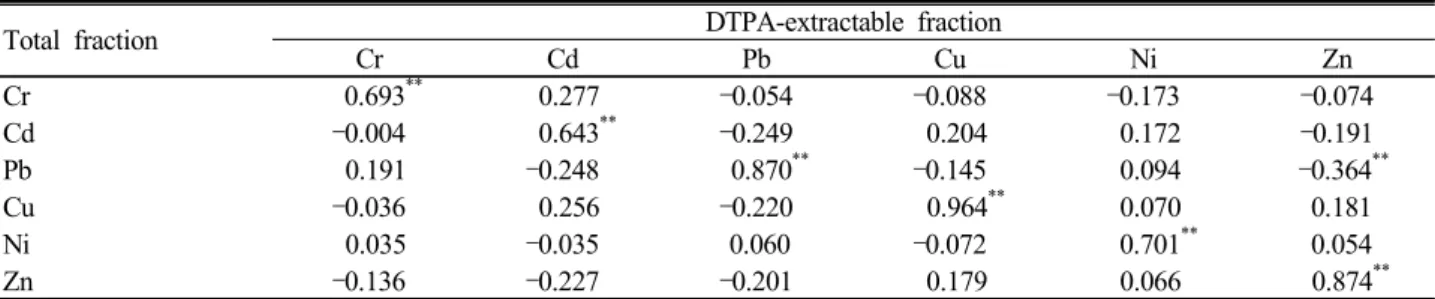
Relationship among total, plant available and exchangeable contents of target metals in the soils was presented in Table 3, 4, and 5. As compared between the same metals in the total and exchangeable metal fractions, the total
Table 4. The values of correlation coefficient (r)†between total and DTPA-extractable contents of selected heavy metals in soils of R.
coreanus cultivation fields.
Total fraction DTPA-extractable fraction
Cr Cd Pb Cu Ni Zn
Cr 0.693** 0.277 –0.054 –0.088 –0.173 –0.074
Cd –0.004 0.643** –0.249 0.204 0.172 –0.191
Pb 0.191 –0.248 0.870** –0.145 0.094 –0.364**
Cu –0.036 0.256 –0.220 0.964** 0.070 0.181
Ni 0.035 –0.035 0.060 –0.072 0.701** 0.054
Zn –0.136 –0.227 –0.201 0.179 0.066 0.874**
†Correlation coefficient (r) was determined by Pearson correlation analysis to evaluate the relationship between parameters. Results were evaluated with 95% and 99% confidence intervals: *p<0.05 and **P<0.01 levels of significance.
Table 5. The values of correlation coefficient (r)†between exchangeable and DTPA-extractable contents of selected heavy metals in soils of R. coreanus cultivation fields.
Exchangeable fraction DTPA-extractable fraction
Cr Cd Pb Cu Ni Zn
Cr 0.375** 0.050 0.007 –0.186 –0.211 0.026
Cd –0.097 0.137 –0.159 0.137 –0.028 0.049
Pb 0.153 –0.458** 0.668** –0.197 0.067 –0.282**
Cu –0.085 –0.491** –0.101 0.349* 0.227 0.279*
Ni –0.024 0.066 –0.177 0.118 0.206* 0.084
Zn –0.157 –0.327* –0.181 0.155 –0.019 0.722**
†Correlation coefficient (r) was determined by Pearson correlation analysis to evaluate the relationship between parameters. Results were evaluated with 95% and 99% confidence intervals: *p<0.05 and **P<0.01 levels of significance.
content of each metal ion, Cr, Pb, Cu, Ni, or Zn, was directly correlated with the exchangeable content of the same metal, except Cd content, at 0.05 or 0.01 level of significance. The values of correlation coefficient (r) ranged from 0.108 to 0.728. However, as compared between different metals in the two different fractions, many of metals between the two fractions were inversely correlated.
Total Cr content was negatively correlated with exchangeable Cu content at 0.05 level of significance, r = –0.322. Total Cd content was inversely correlated with exchangeable Pb and Zn contents at 0.01 level of significance, r = –0.372 and –0.425, respectively. Also, Inverse correlation (r = – 0.281; P<0.05) was occurred between total Pb content and exchangeable Zn content, but total Zn content was directly correlated with exchangeable Pb content at 0.05 level of significance, r = 0.335. When compared between the total and plant available (DTPA-extractable) metal contents, the total contents of each metal ion were also directly correlated with the DTPA-extractable contents of the same metals at 0.01 level of significance and the r values ranged between 0.643 and 0.964. However, there were no significant correlations between the total content of a specific metal ion and the DTPA-extractable contents of other metal ions, except between total Pb and DTPA-extractable Zn content
that was inversely correlated at 0.01 level of significance, r = –0.364. As in other comparison studies, the exchangeable content of each metal ion was directly and significantly correlated with the DTPA-extractable contents of the same metal at 0.05 or 0.01 level of significance. The r values ranged between 0.206 for Ni and 0.722 for Zn contents, but Cd contents between the two fractions were only not significantly correlated. On the other hand, exchangeable Pb content was negatively correlated with DTPA-extractable Cd and Zn contents at 0.01 level of significance (r = –0.458 and –0.282, respectively). Exchangeable Cu content was also inversely correlated with DTPA-extractable Cd and Zn contents (r = –0.496 for exch. Cu with DTPA-ext. Cd, P<0.01; r = –0.279 for exch. Cu with DTPA-ext. Zn, P<0.05). Also, exchangeable Zn content was negatively correlated only with DTPA-extractable Cd content at 0.05 level of significance, r = –0.327.
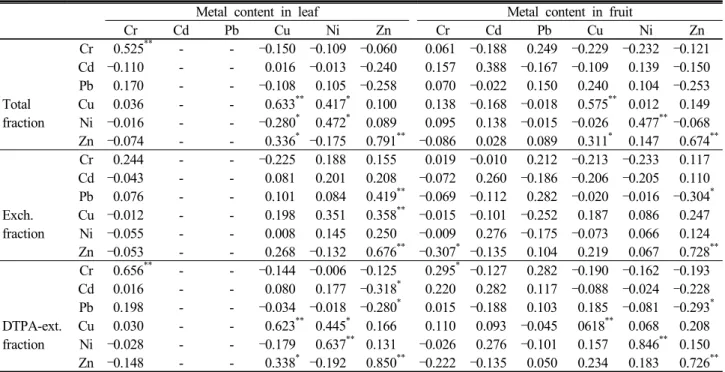
The multi-comparisons between the different metal fractions in soil and the metal concentrations in raspberry plant leaf and fruit are shown in Table 6. Total metal content of each metal ion, Cr, Cu, Ni, or Zn, in the soil was directly correlated with the same metal concentration of the plant leaf at 0.05 or 0.01 level of significance, r = 0.472~0.791, and the total metal content for Cu, Ni, or Zn was also
Table 6. The values of correlation coefficient (r)†between the contents of selected heavy metal fractions in soils and the metal contents in R. coreanus leaves and fruits.
Metal content in leaf Metal content in fruit
Cr Cd Pb Cu Ni Zn Cr Cd Pb Cu Ni Zn
Total fraction
Cr 0.525** - - –0.150 –0.109 –0.060 0.061 –0.188 0.249 –0.229 –0.232 –0.121 Cd –0.110 - - 0.016 –0.013 –0.240 0.157 0.388 –0.167 –0.109 0.139 –0.150 Pb 0.170 - - –0.108 0.105 –0.258 0.070 –0.022 0.150 0.240 0.104 –0.253 Cu 0.036 - - 0.633** 0.417* 0.100 0.138 –0.168 –0.018 0.575** 0.012 0.149 Ni –0.016 - - –0.280* 0.472* 0.089 0.095 0.138 –0.015 –0.026 0.477**–0.068 Zn –0.074 - - 0.336* –0.175 0.791** –0.086 0.028 0.089 0.311* 0.147 0.674**
Exch.
fraction
Cr 0.244 - - –0.225 0.188 0.155 0.019 –0.010 0.212 –0.213 –0.233 0.117 Cd –0.043 - - 0.081 0.201 0.208 –0.072 0.260 –0.186 –0.206 –0.205 0.110 Pb 0.076 - - 0.101 0.084 0.419** –0.069 –0.112 0.282 –0.020 –0.016 –0.304* Cu –0.012 - - 0.198 0.351 0.358** –0.015 –0.101 –0.252 0.187 0.086 0.247 Ni –0.055 - - 0.008 0.145 0.250 –0.009 0.276 –0.175 –0.073 0.066 0.124 Zn –0.053 - - 0.268 –0.132 0.676** –0.307* –0.135 0.104 0.219 0.067 0.728**
DTPA-ext.
fraction
Cr 0.656** - - –0.144 –0.006 –0.125 0.295* –0.127 0.282 –0.190 –0.162 –0.193 Cd 0.016 - - 0.080 0.177 –0.318* 0.220 0.282 0.117 –0.088 –0.024 –0.228 Pb 0.198 - - –0.034 –0.018 –0.280* 0.015 –0.188 0.103 0.185 –0.081 –0.293* Cu 0.030 - - 0.623** 0.445* 0.166 0.110 0.093 –0.045 0618** 0.068 0.208 Ni –0.028 - - –0.179 0.637** 0.131 –0.026 0.276 –0.101 0.157 0.846** 0.150 Zn –0.148 - - 0.338* –0.192 0.850** –0.222 –0.135 0.050 0.234 0.183 0.726**
†Correlation coefficient (r) was determined by Pearson correlation analysis to evaluate the relationship between parameters. Results were evaluated with 95% and 99% confidence intervals: *p<0.05 and **P<0.01 levels of significance.
significantly correlated with the same metal in the plant fruit at 0.01 level of significance, r = 0.477~0.674. As compared between the contents of different metal in the soil and in the plant parts, the total Zn content in the soil was directly and significantly correlated (P<0.05) with the Cu concentration in the plant leaf (r = 0.336) and fruit (r = 0.311). DTPA-extractable fraction of each metal ion, Cr, Cu, Ni, or Zn, in the soil was also directly and significantly correlated with the same metal concentration in the plant parts mostly at 0.01 level of significance, r = 0.295~0.850.
However, the negative correlations (P<0.05) were occurred between the DTPA-extractable Cd and the Zn in the plant leaf (r = –0.318) and between the DTPA-extractable Pb and the Zn in the leaf (r = –0.318) and in the fruit (r = – 0.293), while the direct correlations (P<0.05) were observed between the DTPA-extractable Cu and the Ni in the plant leaf (r = 0.445) and between the DTPA-extractable Zn and the Cu in the leaf (r = 0.338). Besides, the exchangeable metal fractions in the soil were relatively not correlated with the metal concentrations in the plant parts, not even between same metal ions, except Zn contents (r = 0.676 and 0.728; P<0.01). As compared between different metal contents, the exchangeable Cd and Pb in the soil were directly correlated with the Zn concentrations in the plant leaf (r = 0.419 and 0.358, respectively; P<0.01), whereas the exchangeable Pb and Zn in the soils were inversely
correlated with the Zn (r = –0.304) and Cr (r = –0.307) in the fruits at 0.05 level of significance.
Those results indicated that the same metals of the different fractions in the soil had proportionally close relationship each other, whereas among the different metals of the different fractions were mostly correlated inversely because of the adsorption and desorption competitions between the different metals in soil. However, the relationship between the different contents of selected metal fractions in soil and the metal concentrations in the plant leaf and fruit were somewhat different as comparing with the relationship among the soil metals only. Total and DTPA- extractable metal fractions were statistically correlated with the metal concentrations in the plant, but the exchangeable metal fraction was not closely related to the plant metal concentration. Many researchers also reported relationships between the DTPA-extractable metals and the metals in plants. Golia, et al. (2009) reported that there was a high correlation between Oriental tobacco heavy-metal content and DTPA-extracted heavy-metal level in soils, and also a positive and significant relationship was observed between Ni and Zn in the plant material and their amounts extracted by DTPA from the soil (Arnesen and Singh, 1998). However, Sadiq (1985) reported that Cd concentrations in corn were significantly correlated with DTA-extractable Cd in soil, while there was no significant correlation between the
concentrations of Ni and Pb in the corn and the DTPA- extractable levels of these metals in the soil; thus, he concluded that DTPA soil test may not predict plant available metals in soil. Nevertheless, in this study we found that total metal contents in soil were closely related to DTPA-extractable and exchangeable metal contents, and then the DTPA-extractable metal content give us an estimate value for plant available metal content. In addition, when the plant absorbed the different metal fractions, the plant might have selective synergistic or antagonistic effects on the different metal uptake.
Conclusions
In this study, we conducted to investigate the relationship between the contents of different metal, Cr, Cd, Pb, Cu, Ni, and Zn, fractions and the metals in Korean raspberry plant. The total metal contents ranged from 0.87 mg kg-1 to 66.82 mg kg-1, which were much lower than the levels of SCWS. Exchangeable and DTPA-extractable metal fractions in the soil ranged between 0.02 and 0.67 mg kg-1 and between 0.05 mg kg-1 and 7.07 mg kg-1, respectively.
The metal concentrations (determined on a dry-basis) in the leaf and fruit of Korean raspberry were between 1.30 mg kg-1 and 38.82 mg kg-1 including less than detection limit of Cd and Pb contents and between 0.05 mg kg-1 and 21.51 mg kg-1, respectively. Thus, the Cd and Pb concentrations in the fruit were about or lower than the maximum permissible limits for various food crops. As compared among the total, exchangeable, and DTPA- extractable contents of the same metal ions in soil, they were directly correlated. However, when compared between different metals in the different fractions, there were inverse correlations: total Cr – exch. Cu, total Cd – exch. Pb and Zn, total Pb – exch. Zn, total Pb – DTPA-ext. Zn, exch. Pb – DTPA-ext. Cd and Zn, exch. Cu – DTPA-ext. Cd and Zn, and exch. Zn – DTPA-ext. Cd, except total Zn – exch. Pb that was directly correlated. As compared between the soil metal fractions and the metals in the plant leaf and fruit, the total and DTPA-extractable Cr, Cu, Ni, or Zn in the soil were directly correlated with the same metal content in the plant leaf and fruit, except between total Cu in the soil and the Cu in the fruit. The exchangeable metal fractions in the soil were mostly not correlated with even the same metals in the plant parts. On the other hand, there were some statistical correlations between different metals in the different fractions and in the plant parts: the direct
correlations between total Zn in the soil and the Cu in the leaf and fruit, between the DTPA-ext. Cu and the Ni in the leaf, between the DTPA-ext. Zn and the Cu in the fruit, and between exch. Cd and Pb and the Zn in the leaf, and the inverse correlations between the DTPA-extractable Cd and the Zn in the leaf, between the DTPA-extractable Pb and the Zn in the fruit, and between exch. Pb and Zn and the Zn and Cr in the fruit, respectively. Therefore, the different metal fractions in the soil were closely related one another and released important information to predict plant available metal content. Also, the plant might have selective synergistic or antagonistic effects on the uptake of different metals in the different fractions.
References
Amacher, M.C. 1996. Nickel, cadmium, and lead. pp. 739-768. In Sparks, D.L. (eds.), Methods of Soil Analysis, Part 3-Chemical Methods. Number 5 in the SSSA of America Book Series, SSSA and ASA, Madison, WI, USA.
Arnesen, A.K.M. and B.R. Singh. 1998. Plant uptake and DTPA- extractability of Cd, Cu, Ni and Zn in a Norwegian alumshale soil as affected by previous addition of dairy and pig manures and peat. Can. J. Soil Sci. 78:531-539.
D’Amore, J.J., S.R. Al-Abed, K.G. Scheckel, and J.A. Ryan.
2005. Methods for speciation of metals in soils: a review. J.
Environ. Qual. 34:1707-1745.
Golia, E.E., A. Dimirkou, and I.K. Mitsios. 2009. Heavy-metal concentration in tobacco leaves in relation to their available soil fractions. Commun. Soil Sci. Plant Anal. 40:106-120.
Jeollabuk-do, 2010. Master plan of Korean raspberry cultivation works inJeollabuk-do, Korea. Jeollabuk-do, Jeonju, Korea.
Korea Food and Drug Administration (KFDA). 2011. Food code.
Korea Food and Drug Administration, Chungcheongbuk-do, Korea.
Lee, J.H. and B.K. Ahn. 2010. Comparisons of various chemical extracts as quantity factors to determine metal-buffering capacity of soils. Commun. Soil Sci. Plant Anal. 41:1463-1477.
Lindsay, W.L. and W.A. Norvell. 1978. Development of a DTPA soil test for zinc, iron, manganese, and copper. Soil Sci. Soc.
Am. J. 42:421-428.
Meers, E., S. Lamsai, P. Vervaeke, M. Hopgood, N. Lust, and F.M.G. Tack. 2005. Availability of heavy metals for uptake Salix viminalis on a moderately contaminated dredged sediment disposal site. Environ Poll. 137:354-364.
Ministry of Environment (MOE). 2003. Standard test methods for soil pollution. InEnforcement decree of the soil environment conservation act. Ministry of Environment, Korea.
Ministry of Environment (MOE). 2011. Enforcement decree of the soil environment conservation act No. 411, Soil Environment Conservation Law, Ministry of Environment, Korea.
Sadio, M. 1985. Uptake of cadmium, lead and nickel by corn grown in contaminated soils. Water Air Soil Poll. 26:185-190.
Wolt, J.D. 1994. Soil Solution Chemistry: Applications to Environmental Science. John Wiley and Sons, New York, NY. USA.