• 검색 결과가 없습니다.

Automatic Wood Species Identification of Korean Softwood Based on Convolutional Neural Networks

N/A
N/A
Protected

Academic year: 2021

Share "Automatic Wood Species Identification of Korean Softwood Based on Convolutional Neural Networks"

Copied!
12
0
0

로드 중.... (전체 텍스트 보기)

전체 글

(1)

Original Article

Automatic Wood Species Identification of

Korean Softwood Based on Convolutional Neural Networks 1

Ohkyung Kwon

2,†

⋅Hyung Gu Lee

2

⋅Mi-Rim Lee

2

⋅Sujin Jang

2

⋅ Sang-Yun Yang

3

⋅Se-Yeong Park

3

⋅In-Gyu Choi

3,4,5

⋅Hwanmyeong Yeo

3,4

ABSTRACT

Automatic wood species identification systems have enabled fast and accurate identification of wood species outside of specialized laboratories with well-trained experts on wood species identification. Conventional auto- matic wood species identification systems consist of two major parts: a feature extractor and a classifier. Feature extractors require hand-engineering to obtain optimal features to quantify the content of an image. A Convolutional Neural Network (CNN), which is one of the Deep Learning methods, trained for wood species can extract intrinsic feature representations and classify them correctly. It usually outperforms classifiers built on top of extracted features with a hand-tuning process.

We developed an automatic wood species identification system utilizing CNN models such as LeNet, MiniVGGNet, and their variants. A smartphone camera was used for obtaining macroscopic images of rough sawn surfaces from cross sections of woods. Five Korean softwood species (cedar, cypress, Korean pine, Korean red pine, and larch) were under classification by the CNN models. The highest and most stable CNN model was LeNet3 that is two additional layers added to the original LeNet architecture. The accuracy of species identi- fication by LeNet3 architecture for the five Korean softwood species was 99.3%. The result showed the auto- matic wood species identification system is sufficiently fast and accurate as well as small to be deployed to a mobile device such as a smartphone.

Keywords : automatic wood species identification, convolutional neural networks, CNN, LeNet, MiniVGGNet

1

Date Received October 5, 2017, Date Accepted October 30, 2017

2

National Instrumentation Center for Environmental Management (NICEM), Seoul National University, 1 Gwanak-ro, Gwanak-gu, Seoul 08826, Republic of Korea

3

Department of Forest Sciences, Seoul National University, 1 Gwanak-ro, Gwanak-gu, Seoul 08826, Republic of Korea

4

Research Institute of Agriculture and Life Sciences, Seoul National University, 1 Gwanak-ro, Gwanak-gu, Seoul 08826,

Republic of Korea

5

Institutes of Green Bio Science and Technology, Seoul National University, 1447 Pyeongchang-daero, Daehwa-myeon, Pyeongchang 25354, Republic of Korea

Corresponding author: Ohkyung Kwon (e-mail: [email protected], ORCID: 0000-0002-6307-0060)

(2)

1. INTRODUCTION

Automatic wood species identification sys- tems have enabled fast and accurate identi- fication of wood species outside of specialized laboratories with well-trained experts on wood species identification. Previously most of the automated wood species identification systems have used pipelines relying on hand-tuning seg- mentation, feature extraction and classification steps for each macroscopic images of the wood surface.

Feature extractors or image descriptors re- quire hand-engineering to obtain optimal fea- tures to quantify the content of an image. In general, image content quantification algorithms can be classified into several categories such as encoding color (color moments, color histo- grams, color correlograms), encoding shape (Hu moments and Zernike moments), encoding texture (Local Binary Pattern and Haralick texture), key point detectors (FAST, Harris, DoG, and so on), local invariant descriptors (SIFT, SURF, BRIEF, ORB, and so on), and Histogram of Oriented Gradients (HOG).

For the past years, many researchers have ex- plored various types of feature extractors for wood identification: hue, saturation, value, con- trast, angular second moment, sum of variances, long run emphasis, fractal dimension, and wave- let horizontal energy proportion (Yu et al., 2009), color-based features (Peng, 2013), tex- ture-based features such as Gabor filters, Gray Level Co-occurrence Matrices (GLCM), Local Binary Patterns (LBP), Completed Local Binary

Pattern (CLBP), Local Phase Quantization (LPQ), Basic Grey Level Aura Matrix (BGLAM), Improved Basic Grey Level Aura Matrix (I-BGLAM), Statistical Properties of Pores Distribution (SPPD), Mask Matching Image (MMI), Coiflet Discrete Wavelet Transform (DWT), the Markovian, spectral, and illumination invariant textural features, aniso- tropic diffusion and Local Directional Binary Patterns (LDBP) (Tou et al., 2009a; Tou et al., 2009b; Nasirzadeh et al., 2010; Yusof et al., 2010; Yusof and Rosli, 2013; Kobayashi et al., 2015; Kobayashi et al., 2017; Khalid et al., 2011; Khairuddin et al., 2011, Wang et al., 2013a; Wang et al., 2013b; Yadav et al., 2013;

Mohan et al., 2014; Yadav et al., 2014; Martins et al., 2015; Haindl and Vácha, 2015; Zamri et al., 2016; Hiremath and Bhusnurmath, 2017), key point detectors, and local invariant de- scriptors such as Speeded Up Robust Features (SURF) (Huang et al., 2009) and Scale-Invariant Feature Transform (SIFT) (Hu et al., 2015;

Martins et al., 2015). A Kernel-Genetic Algorithm (K-GA) technique was also used for feature selection (Yusof et al., 2013a).

From the extracted feature vectors, re-

searchers used different types of classifiers such

as k Nearest-Neighbor (kNN) classifier (Khalid

et al., 2011; Khairuddin et al., 2011; Kobayashi

et al., 2015; Hu et al., 2015; Hiremath and

Bhusnurmath, 2017), Support Vector Machine

(SVM) (Martins et al., 2013; Paula Filho et al.,

2014; Hu et al., 2015; Zamri et al., 2016),

Linear Discriminant Analysis (LDA) classifier

(Khalid et al., 2011), a multi-layer neural net-

(3)

work based on the popular back propagation (MLBP) algorithm (Yusof et al., 2010; Yusof and Rosli, 2013), Artificial Neural Networks (ANN) (Hu et al., 2015), Multilayer Perceptron Backpropagation Artificial Neural Network (MPB ANN) (Yadav et al., 2013), several WEKA classification algorithms (Yadav et al., 2014), and correlation (Mohan et al., 2014).

Sometimes, a pre-classifier such as Fuzzy log- ic-based pre-classifier (Yusof et al., 2013b) was used to increase classification accuracy. For the same purpose, several studies adapted combina- tory strategies such as image segmentation and multiple feature sets (Cavalin et al., 2013;

Kapp et al., 2014), a two-level divide-and-con- quer classification strategy (Paula Filho et al., 2014), the combination of all classifiers, and different dynamic selection of classifiers (DSC) methods (Martins et al., 2015). Also, an adap- tive multi-level approach for combining multi- ple classifications was applied to forest species recognition (Cavalin et al., 2016).

In these days, the hand-engineering process in the conventional automatic image recognition has been replaced by utilizing Convolutional Neural Networks (CNNs) such as LeNet (Lecun et al., 1998), AlexNet (Krizhevsky et al., 2012), GoogLeNet (Szegedy et al., 2014), VGGNet (Simonyan and Zisserman, 2014), ResNet (He et al., 2016), and so on. The CNNs trained for wood species can extract intrinsic feature representations and classify them correctly. It usually outperforms classifiers built on top of extracted features with a hand-tuning process. A CNN model was developed to rec-

ognize Brazilian forest species (macroscopic im- ages for 41 species and microscopic images for 112 species), and resulting accuracy was better than 97% for both datasets (Hafemann et al., 2014).

Utilization of a mobile device like a smart- phone is essential to speed up the wood identi- fication process on sites. A smartphone equips with a decent camera can be used as a camera for automatic wood species identification from macroscopic pictures of wood although it is not the best choice for the conventional process of feature extraction tasks. Also, illumination con- dition is often not appropriate for most of the traditional image recognition tasks. However, deep neural network techniques give a chance to overcome the limitations posed by the conven- tional feature extraction methods requiring high-quality images under controlled illumination.

In this study, we developed an automatic wood species identification system utilizing CNN models and macroscopic images that were obtained by a smartphone camera. Regarding the accuracy of the automatic wood species identification system, several pipelines based on different CNN models were evaluated for five Korean wood species (cedar, cypress, Korean pine, Korean red pine, and larch).

2. MATERIALS and METHODS 2.1. Sample Preparation

Five Korean softwood species [cedar

(Cryptomeria japonica), cypress (Chamaecyparis

(4)

obtusa), Korean pine (Pinus koraiensis), Korean red pine (Pinus densiflora), and larch (Larix kaempferi)] were under investigation by an auto- matic wood species identification utilizing CNN techniques. We purchased fifty lumbers of each species of 50 × 100 × 1200 mm

3

(thickness × with × length) from several mills participating the National Forestry Cooperative Federation in Korea. The lumbers in each species were from different regions of Korea. 10 ∼ 20 specimens of 40 × 50 × 100 mm

3

(R × T × L) were cut from each lumber (50 wood samples per spe- cies).

2.2. Image Acquisition and Dataset Preparation

We used a smartphone (iPhone 7) to obtain macroscopic pictures of the sawn surfaces of cross sections of the specimen. During image acquisition process, the smartphones placed on a simple frame as a stable support. The camera in an iPhone 7 model has f/1.8 lens and phase detection autofocus function and produces an image of 12 Megapixels. The camera produces a color picture of 3024 × 4032 pixels. The pix- el size of the image was 41.7 µm. Only center

part of the picture contains an image of wood.

The images were vertical shape, and thus only a part of the wood image (1200 × 2400 pixels around the center) was cropped. The total num- ber of the cropped images were 187.

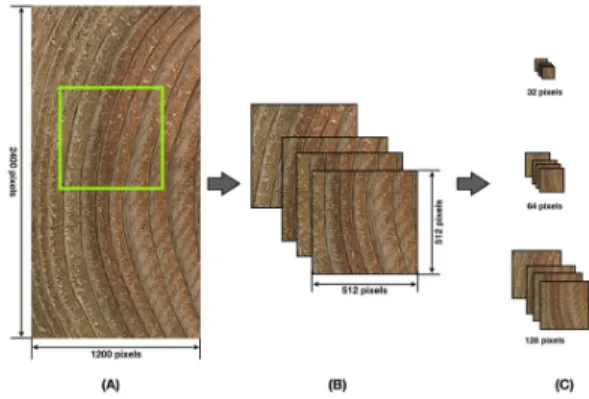
We prepared 16865 images of 512 × 512 pixels by utilizing a sliding window method;

12649 images of all (75%) were used for train- ing and the other 4216 images (25%) for validation. Table 1 listed the number of images for each species. Also, we separately prepared an “External Validation Set (EVS)” for determi- nation of the accuracy of the automated wood species identification. The images in the EVS were not overlapped those in the training and testing sets. The EVS included total 50 images (10 images from each species) of 1200 × 2400 pixels.

Species Train Test Total

cedar 2321 774 3095

cypress 2565 855 3420

Korean pine 2970 990 3960

Korean red pine 2295 765 3060

Larch 2498 832 3330

Total 12649 4216 16865

Table 1. A number of images (512 × 512 pixels) for training and testing purpose for each species

Fig. 1. Dataset preparation from five Korean soft-

wood species. (A) Cropped image from an original

image from a smartphone camera, (B) cropped im-

ages prepared from (A) by a sliding window meth-

od, and (C) resized images from (B). Images of (C)

step were input images for the CNN models used in

this study.

(5)

2.3. Model Architecture

The CNNs are the types of algorithms that can learn appropriate parameters of various im- age processing operations such as smoothing, sharpening, and edge detection for an input image. The CNNs also have capabilities to au- tomatically learn discriminating filters for de- tection of low-level structures such as edges and blob-like structures as well as of high-level objection such as faces, cats, dogs, cups, etc.

This utilization of the lower-level layers or features to learn high-level features is called the compositionality of CNNs, which is ach- ieved by stacking a specific set of layers purposefully. Building blocks of CNNs are con- volution (CONV) layer, activation (ACT) layer, pooling (POOL) layer, fully-connected (FC) layer, batch normalization (BN), and dropout (DROPOUT). Combinations of these building

blocks become a CNN architecture for a given task (Table 2 and 3).

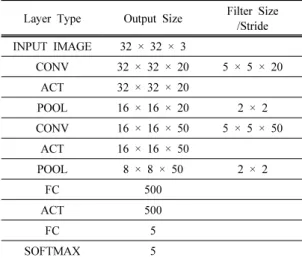
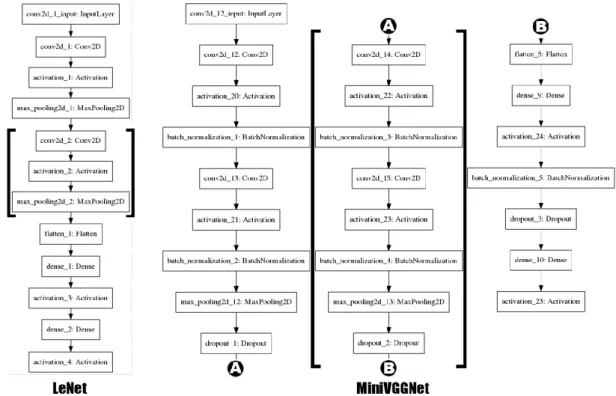
LeNet and VGGNet were the base of the models investigated in this study. LeNet archi- tecture is simple with only two convolution lay- ers (Fig. 2 and Table 2). VGGNet is a deep CNN (16 or 19 layers), but we stripped VGGNet down to only with two layers of two convolutional layers to build MiniVGGNet (Fig.

2 and Table 3). We added third and fourth ex-

Layer Type Output Size Filter Size /Stride INPUT IMAGE 32 × 32 × 3

CONV 32 × 32 × 20 5 × 5 × 20

ACT 32 × 32 × 20

POOL 16 × 16 × 20 2 × 2

CONV 16 × 16 × 50 5 × 5 × 50

ACT 16 × 16 × 50

POOL 8 × 8 × 50 2 × 2

FC 500

ACT 500

FC 5

SOFTMAX 5

Table 2. A table summary of the LeNet architecture for 32 × 32 × 3 input image. To build LeNet2 and LeNet3, one layer or two layers were added to the LeNet architecture, respectively

Layer Type Output Size Filter Size /Stride INPUT IMAGE 32 × 32 × 3

CONV 32 × 32 × 32 3 × 3 × 32

ACT 32 × 32 × 32

BN 32 × 32 × 32

CONV 32 × 32 × 32 3 × 3 × 32

ACT 32 × 32 × 32

BN 32 × 32 × 32

POOL 16 × 16 × 32 2 × 2

DROPOUT 16 × 16 × 32

CONV 16 × 16 × 64 3 × 3 × 64

ACT 16 × 16 × 64

BN 16 × 16 × 64

CONV 16 × 16 × 64 3 × 3 × 64

ACT 16 × 16 × 64

BN 16 × 16 × 64

POOL 8 × 8 × 64 2 × 2

DROPOUT 8 × 8 × 64

FC 512

ACT 512

BN 512

DROPOUT 512

FC 5

SOFTMAX 5

Table 3. A table summary of MiniVGGNet archi-

tectures for 32 × 32 × 3 input image. To build

MiniVGGNet2 and MiniVGGNet3, one layer or two

layers were added to the MiniVGGNet architecture,

respectively

(6)

tensive layers into the base models to build LeNet2, LeNet3, MiniVGGNet2, and MiniVGGNet3. For the LeNet-based model, (CONV ⟹ ACT ⟹ POOL) was the extensive layer unit, but for the MiniVGGNet model, (CONV ⟹ ACT ⟹ BN ⟹ CONV ⟹ ACT ⟹ BN ⟹ POOL ⟹ DROPOUT) was the one.

2.4. Model training and determination of accuracy

The Stochastic Gradient Descent (SGD) algo- rithm optimized the model parameters with the learning rate = 0.01. The loss function was bi- nary cross entropy. A number of epochs were 50 with a batch size of 64. Training process

used three levels (32, 64, and 128 pixels) of in- put images. Pixel values of the input images were normalized by 255. A workstation with XEON CPU (28 threads) with 64 GB of mem- ory as well as GPU with 24 GB (NVIDIA Quadro M6000). The operating system was Ubuntu 16.04 LTS with CUDA 8.0, Python 2.7, Tensorflow 1.2 and Keras 2.0.

We evaluate identification performance of the CNNs by utilizing the following equation.

Accuracy (%) =

Number of correctly identified patches

× 100 Total number of patches

used for identification

Fig. 2. The LeNet and MiniVGGNet architectures. The layers between brackets are the extensive unit layer for

each architecture during extension of the model.

(7)

From the EVS (images of 1200 × 2400 pix- els), we randomly cropped 100 patches with 512 × 512 pixels. We chose the size of the patch to include wood anatomical features such as growth rings. Each patch was fed into the model generated by utilizing the model archi- tecture described in section 2.3. For each pre- diction, we examined the classification result whether it is true or false, and then calculated an accuracy of wood species identification by the model.

To utilize macroscopic features of different wood species, we need to make the patch im- ages to include at least several growth rings.

We determined the patch size according to the

given condition for macroscopic features of all wood species. In the case of the smartphone camera without a zoom factor, the field of view in 512 × 512 pixels was turned out to be a proper size.

3. RESULTS and DISCUSSION 3.1. Accuracy of the CNN models

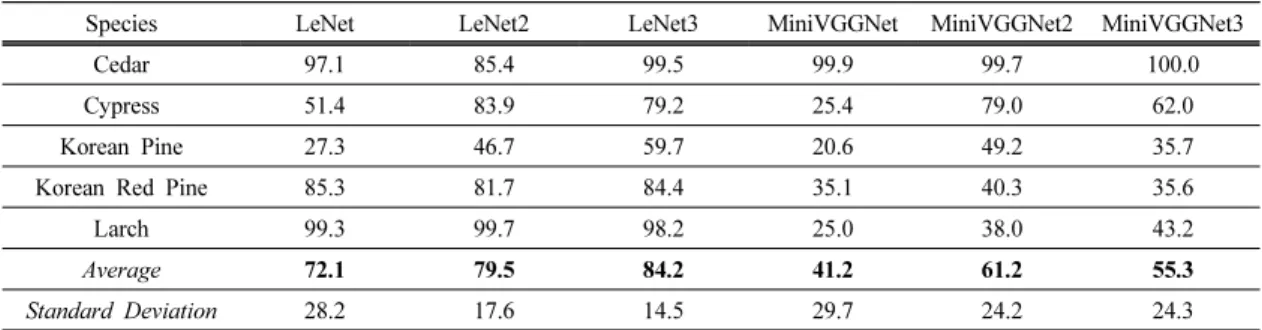
In general, the accuracy of the CNN models was improved by size increase of the input im- age (Table 4, 5, and 6; Fig. 3). With image size = 32, average accuracies of LeNet, LeNet2, LeNet3, MiniVGGNet, MiniVGGNet2, and

Species LeNet LeNet2 LeNet3 MiniVGGNet MiniVGGNet2 MiniVGGNet3

Cedar 97.1 85.4 99.5 99.9 99.7 100.0

Cypress 51.4 83.9 79.2 25.4 79.0 62.0

Korean Pine 27.3 46.7 59.7 20.6 49.2 35.7

Korean Red Pine 85.3 81.7 84.4 35.1 40.3 35.6

Larch 99.3 99.7 98.2 25.0 38.0 43.2

Average 72.1 79.5 84.2 41.2 61.2 55.3

Standard Deviation 28.2 17.6 14.5 29.7 24.2 24.3

Table 4. The accuracy (%) of the CNN models with image size = 32. The Accuracy Test Set was used for accuracy test for automatic identification of the five Korean softwoods

Species LeNet LeNet2 LeNet3 MiniVGGNet MiniVGGNet2 MiniVGGNet3

Cedar 99.1 99.6 100.0 100.0 100.0 94.6

Cypress 83.0 93.1 99.8 90.9 95.7 92.2

Korean Pine 90.9 93.5 63.7 99.8 98.6 99.3

Korean Red Pine 97.0 96.1 96.4 76.5 87.0 82.4

Larch 92.6 94.8 98.3 81.6 78.4 80.3

Average 92.5 95.4 91.6 89.8 91.9 89.8

Standard Deviation 5.6 2.3 14.0 9.5 8.1 7.3

Table 5. The accuracy (%) of the CNN models with image size = 64. The Accuracy Test Set was used for

accuracy test for automatic identification of the five Korean softwoods

(8)

MiniVGGNet3 were (72.1, 79.5, 84.2, 41.2, 61.2, and 55.3%), respectively. With patch size

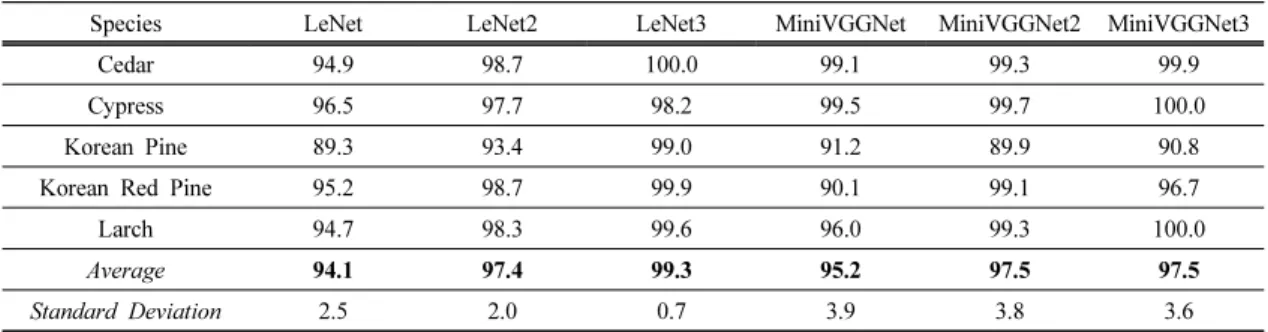
= 64 and 128, they increased to (92.5, 95.4, 91.6, 89.8, 91.9, and 89.8%), and (94.1, 97.4, 99.3, 95.2, 97.5, and 97.5%), respectively. The accuracy improvement by the increase of the input image is related to the disappearance of minute details of image content during the re- sizing process.

With the addition of layers to the original

LeNet and MiniVGGNet, accuracy improvement was not apparent with image size = 32 and 64 (Table 4 and 5). With image size = 128, im- provement of accuracy was evident for the LeNet-based model, but not consistent with the MiniVGGNet models (Table 6).

All MiniVGGNet-based models with patch size = 128 showed very high average accuracy, but the standard deviation was greater than 3%.

The highest accuracy (99.3 ± 0.7%) was ob- tained by LeNet3 model with image size = 128.

Thus, LeNet3 was considered to be the best CNN model for identification of the five Korean softwood species (Table 6).

There was no clear trend in accuracy im- provement related to wood species, but the LeNet-based and MiniVGGNet-based models gave the best identification accuracy for differ- ent species. With image size = 128, LeNet3 model showed 100% accuracy for cedar, but MiniVGGNet3 showed 100% accuracy for cy- press and Korean red pine (Table 6). While MiniVGGNet3 showed only 90.8% for Korean pine, LeNet3 produced greater than 98% for all other species. Thus, it is clear that LeNet3 was

Species LeNet LeNet2 LeNet3 MiniVGGNet MiniVGGNet2 MiniVGGNet3

Cedar 94.9 98.7 100.0 99.1 99.3 99.9

Cypress 96.5 97.7 98.2 99.5 99.7 100.0

Korean Pine 89.3 93.4 99.0 91.2 89.9 90.8

Korean Red Pine 95.2 98.7 99.9 90.1 99.1 96.7

Larch 94.7 98.3 99.6 96.0 99.3 100.0

Average 94.1 97.4 99.3 95.2 97.5 97.5

Standard Deviation 2.5 2.0 0.7 3.9 3.8 3.6

Table 6. The accuracy (%) of the CNN models with image size = 128. The Accuracy Test Set was used for accuracy test for automatic identification of the five Korean softwoods

Fig. 3. Performance of CNN models for identi- fication of five Korean softwood species. Utilizing bigger image size, higher accuracy is achieved.

MiniVGGNet architecture is more sensitive than

LeNet architecture to the changes of input image

size for CNN.

(9)

the best species identification CNN model for the five Korean softwoods.

3.2. Effect of Input Images

Improvement of identification accuracy ac- cording to the size of input images was appa- rent (Fig. 3). All models showed the lowest ac- curacy with the smallest image size (32 × 32 pixels). When the images of 512 × 512 pixels were resized into 32 × 32 pixels image, most of the details of the images considered to be disappeared. No distinctive features from the small images were not learned to differentiate the wood species. By the increase of the size of the input image, more features remained. As a result, the identification accuracy was improved.

With this fashion, bigger size of input images might improve accuracy more, but computa- tional cost increases. If we collect more images and expand the number of classes for identi- fication, input images might not be loaded into the computer memory. We need to consider computational cost, a number of classes, and a number of images in each class whether the im- age size needs to be increased further or not.

At the moment, the LeNet3 model produced >

98% accuracy for all five species; image size = 128 was considered to be sufficient for the use of this automatic wood species identification with a macroscopic image from a camera in an iPhone 7 smartphone.

Quality of a smartphone camera is a major factor to affect the accuracy of the automatic wood species identification. The image qualities

of different smartphone cameras were not inves- tigated in this study, but any smartphone with a decent camera module is expected to obtain im- ages with sufficient quality of macroscopic im- ages from a rough sawn surface of the wood.

The illumination condition used in this study was controlled to produce not much of shade, but the image acquisition setup utilized in this study was straightforward to make an auxiliary attachment for a smartphone. With a proper auxiliary attachment for a given smartphone, we can quickly reproduce the quality of macro- scopic images.

4. CONCLUSION

In this study, we investigated the use of deep learning techniques to automatically identify wood species of five Korean softwoods (cedar, cypress, Korean pine, Korean red pine, and larch). We built six CNN models (LeNet, LeNet2, LeNet3, MiniVGGNet, MiniVGGNet2, and MiniVGGNet3) and trained the models for the five species. A smartphone camera was used to obtain macroscopic images from rough sawn surfaces of the cross sections of the softwoods.

The experimental results showed that the best

accuracy (99.3%) was achieved by LeNet3

model trained with macroscopic images cap-

tured by iPhone 7 camera. The MiniVGGNet3

model produced 97.5% accuracy on the same

dataset of the softwoods, but the standard devi-

ation was much larger (3.6%) than that of

LeNet3 model (0.7%).

(10)

We demonstrated higher than 99% accuracy of wood species identification with a deep CNN model with four convolutional layers. The result in this study proved that a fast and accu- rate automatic wood species identification sys- tem could be developed by utilizing deep CNN models. The weights produced by the CNN models were small enough to be installed on a mobile device such as a smartphone. Deploying a mobile device with an automatic wood spe- cies identification capability can relieve the is- sues of slow process to obtain an accurate wood species identification due to lack of well-trained field agents, which causes the de- lay of logistics.

ACKNOWLEDGEMENTS

The Forest Science & Technology Projects (Project No. 2016009D10-1719-AB01) provided by the Korea Forest Service financially supported this study.

REFERENCES

Cavalin, P.R., Kapp, M.N., Oliveira, L.E.S. 2016. An adaptive multi-level framework for forest species recognition. Proc. of 2015 Brazillian Conference on Intelligent Systems (BRAICS 2015), pp. 92

∼97.

Cavalin, P.R., Martins, J., Kapp, M.N., Oliveira, L.E.S. 2013. A multiple feature vector frame- work for forest species recognition. New York, New York, USA, Proc. of the ACM Symposium on Applied Computing, pp. 16 ∼20.

Hafemann, L.G., Oliveira, L.S., Cavalin, P. 2014.

Forest Species Recognition Using Deep

Convolutional Neural Networks. 22nd International Conference on Pattern Recognition (ICPR), pp. 1103 ∼1107.

Haindl, M., Vácha, P. 2015. Wood Veneer Species Recognition Using Markovian Textural Features.

In: Computer Analysis of Images and Patterns, Lecture Notes in Computer Science. Springer International Publishing, Cham, pp. 300 ∼311.

He, K., Zhang, X., Ren, S., Sun, J. 2016. Deep Residual Learning for Image Recognition. 2016 IEEE Conference on Computer Vision and Pattern Recognition (CVPR), pp. 770 ∼778.

Hiremath, P.S., Bhusnurmath, R.A. 2017.

Multiresolution LDBP descriptors for texture classification using anisotropic diffusion with an application to wood texture analysis. Pattern Recognition Letters 89: 8 ∼17.

Hu, S., Li, K., Bao, X. 2015. Wood species recog- nition based on SIFT keypoint histogram. 8th International Congress on Image and Signal Processing (CISP), pp. 702 ∼706.

Huang, S., Cai, C., Zhao, F., He, D., Zhang, Y.

2009. An efficient wood image retrieval using SURF descriptor. 2009 International Conference on Test and Measurement (ICTM), pp. 55 ∼58.

Kapp, M.N., Bloot, R., Cavalin, P.R., Oliveira, L.E.S. 2014. Automatic forest species recog- nition based on multiple feature sets. Proc. of the International Joint Conference on Neural Networks, pp. 1296 ∼1303.

Kobayashi, K., Akada, M., Torigoe, T., Imazu, S., Sugiyama, J. 2015. Automated recognition of wood used in traditional Japanese sculptures by texture analysis of their low-resolution computed tomography data. Journal of Wood Science 61(6): 630 ∼640.

Kobayashi, K., Hwang, S.W., Lee, W.H., Sugiyama,

J. 2017. Texture Analysis of Stereograms of

Diffuse-Porous Hardwood: Identification of

(11)

Wood Species Used in Tripitaka Koreana.

Journal of Wood Science 63: 322 ∼330.

Khairuddin, A.S.M., Khalid, M., Yusof, R. 2011.

Using Two Stage Classification for Improved Tropical Wood Species Recognition System. In:

Intelligent Interactive Multimedia Systems and Services, Smart Innovation, Systems and Technologies. Springer Berlin Heidelberg, Berlin, Heidelberg, pp. 305 ∼314.

Khalid, M., Yusof, R., Khairuddin, A.S.M. 2011.

Tropical wood species recognition system based on multi-feature extractors and classifiers. Proc.

of 2011 2nd International Conference on Instrumentation Control and Automation (ICA), pp. 6 ∼11.

Krizhevsky, A., Sutskever, I., Hinton, G.E. 2012.

ImageNet classification with deep convolutional neural networks. Proc. of the 25th International Conference on Neural Information Proc.

Systems, pp. 1097 ∼1105.

Lecun, Y., Bottou, L., Bengio, Y., Haffner, P. 1998.

Gradient-based learning applied to document recognition. Proceeding of the IEEE 86(11):

2278 ∼2324.

Martins, J.G., Oliveira, L.S., Britto, A.S., Sabourin, R. 2015. Forest species recognition based on dy- namic classifier selection and dissimilarity fea- ture vector representation. Machine Vision and Applications 26(2-3): 279 ∼293.

Martins, J., Oliveira, L.S., Nisgoski, S., Sabourin, R.

2013. A database for automatic classification of forest species. Machine Vision and Applications 24(3): 567 ∼578.

Mohan, S., Venkatachalapathy, K., Sudhakar, P.

2014. An intelligent recognition system for iden- tification of wood species. Journal of Computer Science 10(7): 1231 ∼1237.

Nasirzadeh, M., Khazael, A.A., Bin Khalid, M. 2010.

Woods recognition system based on local binary

pattern. Proc. of 2nd International Conference on Computational Intelligence, Communication Systems and Networks (CICSyN 2010), pp. 308

∼313.

Paula Filho, P.L., Oliveira, L.S., Nisgoski, S., Britto, A.S.J. 2014. Forest species recognition using macroscopic images. Machine Vision and Applications 25(4): 1019 ∼1031.

Peng, Z. 2013. Robust wood species recognition us- ing variable color information. Optik - International Journal for Light and Electron Optics 124(17): 2833 ∼2836.

Simonyan, K., Zisserman, A. 2014. Very Deep Convolutional Networks for Large-Scale Image Recognition. arXiv.org. cs.CV.

Szegedy, C., Liu, W., Jia, Y., Sermanet, P., Reed, S., Anguelov, D., Erhan, D., Vanhoucke, V., Rabinovich, A. 2014. Going Deeper with Convolutions. arXiv:1409.4842.

Tou, J.Y., Tay, Y.H., Lau, P.Y. 2009a. A Comparative Study for Texture Classification Techniques on Wood Species Recognition Problem. Fifth International Conference on Natural Computation, pp. 8 ∼12.

Tou, J.Y., Tay, Y.H., Lau, P.Y. 2009b. Rotational invariant wood species recognition through wood species verification. 1st Asian Conference on Intelligent Information and Database Systems (ACIIDS 2009), pp. 115 ∼120.

Wang, H.J., Zhang, G.Q., Qi, H.N. 2013a. Wood Recognition Using Image Texture Features Wu, R. (ed.). PLoS ONE 8(10): e76101 ∼12.

Wang, H.-J., Qi, H.-N., Wang, X.-F. 2013b. A new Gabor based approach for wood recognition.

Neurocomputing 116: 192 ∼200.

Yadav, A.R., Anand, R.S., Dewal, M.L., Gupta, S.

2014. Analysis and classification of hardwood

species based on Coiflet DWT feature extraction

and WEKA workbench. 2014 International

(12)

Conference on Signal Proceeding and Integrated Netwroks (SPIN), pp. 9 ∼13.

Yadav, A.R., Dewal, M.L., Anand, R.S., Gupta, S.

2013. Classification of hardwood species using ANN classifier. Fourth National Conference on Computer Vision, Pattern Recognition, Image Processing and Graphics (NCVPRIPG), pp. 1 ∼5.

Yu, H., Cao, J., Luo, W., Liu, Y. 2009. Image retrieval of wood species by color, texture, and spatial information. 2009 International Conference on Information and Automation (ICIA), pp. 1116 ∼ 1119.

Yusof, R., Rosli, N.R. 2013. Tropical Wood Species Recognition System Based on Gabor Filter as Image Multiplier. 2013 International Conference on Signal-Image Technology & Internet-Based Systems (SITIS), pp. 737 ∼743.

Yusof, R., Khalid, M., Khairuddin, A.S.M. 2013a.

Application of kernel-genetic algorithm as non-

linear feature selection in tropical wood species recognition system. Computers and Electronics in Agriculture 93: 68 ∼77.

Yusof, R., Khalid, M., Mohd Khairuddin, A.S.

2013b. Fuzzy logic-based pre-classifier for trop- ical wood species recognition system. Machine Vision and Applications 24(8): 1589 ∼1604.

Yusof, R., Rosli, N.R., Khalid, M. 2010. Using Gabor Filters as Image Multiplier for Tropical Wood Species Recognition System. 12th International Conference on Computer Modelling and Simulation, pp. 289 ∼294.

Zamri, M.I.P., Khairuddin, A.S.M., Mokhtar, N., Yusof, R. 2016. Wood Species Recognition System based on Improved Basic Grey Level Aura Matrix as feature extractor. Journal of Robotics, Networking and Artificial Life 3(3):

140 ∼143.

수치

Table 1. A number of images (512 × 512 pixels) for training and testing purpose for each species
Table 2. A table summary of the LeNet architecture  for 32 × 32 × 3 input image. To build LeNet2 and  LeNet3, one layer or two layers were added to the  LeNet architecture, respectively
Fig. 2. The LeNet and MiniVGGNet architectures. The layers between brackets are the extensive unit layer for  each architecture during extension of the model
Table 4. The accuracy (%) of the CNN models with image size = 32. The Accuracy Test Set was used for accuracy test for automatic identification of the five Korean softwoods
+2

참조

관련 문서

In the present study, 10 study stations were established, and seasonal changes for various ecological aspects of the community such as species composition, number of

Furthermore, we evaluated the selective algaecidal effect of compound 34 on Microcystis aeruginosa and Selena strum, harmful and non-harmful algal

 Explain the key idea of ChebNet: Convolutional Neural Networks on Graphs with Fast Localized Spectral Filtering (Defferard et al. NIPS 2016).  Explain the key idea

A cross section of wood from a white-pocket area of decayed wood showing delignified wood cells. These cells have no middle lamella (this is the area between

Power penetration depth as a function of mc for different dry wood densities at room temperature at a frequency of 2.45 GHz.. (출처 : Doctoral thesis by

Any group of species are descended from a common ancestral species, which, over time, split into two species, with these descendents splitting again, and again,

The Dusky Lory ( Pseudeos fuscata ) is a monotypic species of parrot in the Psittaculidae family, and the only species of the genus Pseudeos... platyrhynchos

1 John Owen, Justification by Faith Alone, in The Works of John Owen, ed. John Bolt, trans. Scott Clark, "Do This and Live: Christ's Active Obedience as the