• 검색 결과가 없습니다.

Design of Shock Absorber Housing Using Aluminum Vacuum Die Casting Technology

N/A
N/A
Protected

Academic year: 2021

Share "Design of Shock Absorber Housing Using Aluminum Vacuum Die Casting Technology"

Copied!
8
0
0

로드 중.... (전체 텍스트 보기)

전체 글

(1)

Design of Shock Absorber Housing Using Aluminum Vacuum Die Casting Technology

Chul-Kyu Jin 1* , Chung-Gil Kang 2

<Abstract>

The purpose of this study is to develop a high-strength, high-toughness, thin-walled aluminum shock absorber housing product by applying a high vacuum die casting method to improve internal gas defect and formability. The analysis program dedicated for the casting was used because it was too costly and time-consuming to adopt the gating system design. The final casting plan was designed based on the flow pattern of the material filled into the mold and the result of air pressure and air pocket after the material was completely filled in the mold. Gaty shape was designed as a split type. The runner was designed to have the same shape as the initial inlet curve of the cavity, and the flow of the molten metal was prevented from turbulent flow. The most favorable results were obtained when the injection speed was V

2

= 4.0 m/s.

Defects on pores were reduced by applying high vacuum level inside the mold.

Keywords : Vacuum Die Casting, Mold Design, Casting Simulation, Thin-walled part

1* School of Mechanical Engineering, Kyungnam University

2 School of Mechanical Engineering, Pusan National University

(2)

1. Introduction

Die casting is a process in which the molten metal is charged into the mold by a plunger operating at a high speed in an extremely short time, and the molten metal is charged in a turbulent state [1,2]. The gating system design part (including the sleeve, the runner, etc.) which was charged, and air and gas which were present in the part and were curled to become bubbles, existed inside the product. Techniques to improve this gas drag have long been studied. The solutions are meant to slow the filling of the molten metal to prevent the turbulence of the molten metal when filling the molten metal by providing a large sprue, to carry out the laminar flow filling die casting and the squeeze casting. In addition, the development of semi-molten and semi-solidification processes, which changes the molten state, is also a way to produce products with good internal quality. However, such low-speed charging tends to make it difficult to form thin and long products, which is one of the advantages of die casting. One of the measures to prevent the gas from being caught inside the die casting product is to exhaust the inside of the cavity with the help of vacuum pump or the like to reduce the amount of entrapment gas. This is called vacuum die casting and is effective in removing defects caused by gas curling [3].

Various methods of vacuum die casting have been developed and put into practical

use. Such casting is divided into two types depending on the opening and closing methods of the vacuum valve. The gas free (GF) method is a method in which a valve is closed by inertial force of a molten metal, and the other is a method of closing a valve by a timer or position control, such as a shot-off pin method, which includes an MFT method and a vacuum method.

In the GF method, which uses the inertia

of the molten metal, the air in the mold is

opened to the atmosphere through the check

valve. In this state, the molten plunger

advances, and the vacuum valve is switched

by switching the electronic valve. In general,

the mold has a reduced pressure of 150 to

250 Torr in 0.2 to 0.3 seconds. At this point,

the molten metal is filled in the mold at

high-speed injection and the valve is driven

by the inertia force of the molten metal at a

velocity of 15 to 40 m/s, and closing and

filling are completed. This method has a

disadvantage in that the degree of vacuum is

higher than that of the product manufactured

by the general die casting method, but the

problem of valve clogging occurs [2-4]. The

purpose of this study is to develop a

high-strength and high-strength thin-walled

aluminum shock absorber housing product

which can be applied to the running car

body by increasing the internal gas defect

and formability upon applying the vacuum

die casting method described above.

(3)

2. Experimental

Figure 1 shows the housing shape for casting simulation. The shape of ingate is designed as a split type so that the shape of the ingate can match the shape of the cavity to make the flow of the molten metal smooth. In this part, ingate, which completely matches the initial cavity part, is designed to reduce the input area of the ingate so that the flow rate of the molten metal could be increased since a large input area of the ingate may cause decrease in the flow rate of the molten metal. In addition, when the ingate part was directly designed in the center part, too fast inflow at the center and the backward flow of the molten metal through the ingate of both sides were observed. Therefore, the ingate was designed to be symmetrical on both sides in the center part design. The runner part was designed to have the same shape as the initial inlet part of the cavity so that the flow of the molten metal can be prevented

and molten metal can flow smoothly.

Furthermore, an overflow was designed in the final gas outlet by investigating the flow pattern of the melt under the shape of ingate and runner.

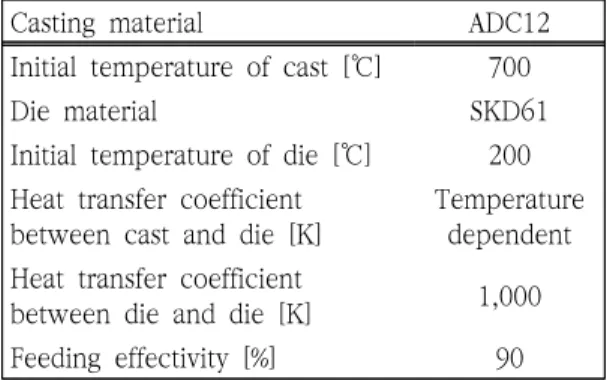
In order to investigate the filling pattern and solidification pattern during the die casting process of the shock absorber housing, ADC12 aluminum alloy, which is widely used as a die casting material, was used to simulate casting analysis using MAGMAsoft. Table 1 shows the material data during simulation.

Casting material ADC12

Initial temperature of cast [℃] 700

Die material SKD61

Initial temperature of die [℃] 200 Heat transfer coefficient

between cast and die [K]

Temperature dependent Heat transfer coefficient

between die and die [K] 1,000 Feeding effectivity [%] 90 Table 1. Material data

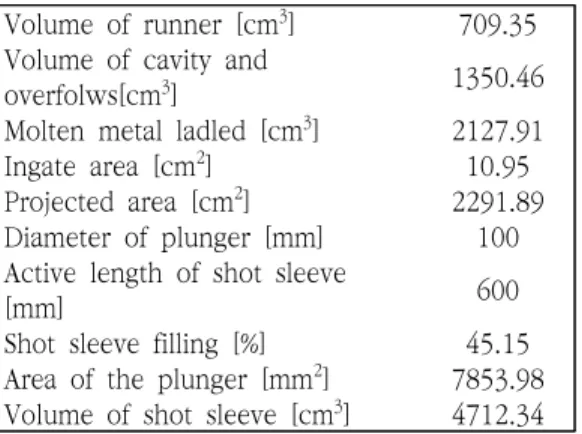
Table 2 shows the simulation conditions for casting analysis. The diameter of the plunger was set to 100 mm and the travel distance of the plunger was set to 600 mm.

Table 3 shows the injection speed conditions for casting analysis. The analytical work was performed by varying the V

2

, which has a direct effect on the molten metal velocity when passing through the ingate, from 2.5 to 4.0 m/s. The ingate feed rate of the molten metal is shown in Table 3.

Fig. 1 Design of gate system for Shock

Absorber Housing

(4)

Volume of runner [cm

3

] 709.35 Volume of cavity and

overfolws[cm

3

] 1350.46

Molten metal ladled [cm

3

] 2127.91

Ingate area [cm

2

] 10.95

Projected area [cm

2

] 2291.89 Diameter of plunger [mm] 100 Active length of shot sleeve

[mm] 600

Shot sleeve filling [%] 45.15 Area of the plunger [mm

2

] 7853.98 Volume of shot sleeve [cm

3

] 4712.34 Table 2. Simulation conditions

V

1

[m/s] V

2

[m/s] Velocity of Ingate[m/s]

Filling time [ms]

0.5 2.5 17.922 68.778

0.5 3.0 21.506 57.506

0.5 4.0 28.674 42.987

Table 3. Shot velocity conditions

3. Results

Figure 2 shows the comparison of the fill time at each injection speed condition. The fill time was reduced by 0.0320 seconds to 0.739 sec in condition 1-3 with an injection speed of 4.0 m/s compared with condition 1-1 with an injection speed of 2.5 m/s. Since the housing (the product of this analysis) has a thickness of less than 3 mm, it is advantageous to shorten the temperature deviation of the molten metal after filling and to shorten the fill time to improve the fluidity.

Figure 3 shows the comparison of the air pressure patterns at the time when the cavity filling of the molten metal is completed under each condition. In general, it is judged that the gas flows out through the air vent at the end of the overflow and a little gas remains in the overflow, which can be addressed by improving the shape of the air vent. It might be advantageous to reduce the filling time to make the flow of the molten metal smooth for a short time.

V

2

= 2.5 m/s V

2

= 3.0 m/s V

2

= 4.0 m/s Fig. 3 Air pressure in cavity by shot velocities

Figure 4 is a comparison of hot spots in each condition, and a hot spot indicates a region where porosity has possibly appeared due to shrinkage and the like. It is predicted that there will not be a big problem because the distribution time of the overall hot spot is short in the cavity area.

V

2

= 2.5 m/s V

2

= 3.0 m/s V

2

= 4.0 m/s

Fig. 2 Filling time in cavity by shot velocities

(5)

V

2

= 2.5 m/s V

2

= 3.0 m/s V

2

= 4.0 m/s Fig. 4 Hot spot in cavity by shot velocities

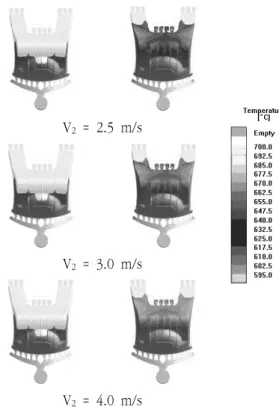
Figures 5 show the filling pattern of each condition. As the ingate shape changes and the fill rate changes according to the injection speed change, the filling is seen to be similar. However, since the number of the ingate shape was eight when the ingate is reduced on the side part of the ingate shape, the molten metal flows along the side surface and has many contact surfaces with the mold, the distance getting longer. It is expected that the temperature of the molten metal will be lowered, and the flow of the molten metal will be influenced in the future.

In addition, the temperature gradient between the initially introduced molten metal and the molten metal which is introduced later becomes large, which can lead to forming a contraction line, ultimately may cause shrinkage during the solidification. Since the thickness of the product of the product is as thin as 3 mm and there are many contact interactions of the molten metal, it is considered that a good product can be obtained by increasing the injection speed

and reducing the filling time for smooth filling. Based on the analysis results above, the temperature distribution and filling time of the molten metal were found to be the best in the filling aspect analysis with respect to the injection speed, while the hotspot, porosity, and the like were also good. In this respect, the injection speed is considered as the optimal condition V

2

= 4.0 m/s.

V

2

= 2.5 m/s

V

2

= 3.0 m/s

V

2

= 4.0 m/s

Fig. 5 Filling behavior in cavity by shot velocities

Figure 6 shows the mold temperature distribution from seven to ten cycles with the injection speed of V

2

= 4.0 m/s. After seven cycles, the overall balance became stabilized.

However, in the absence of a cooling line, it

(6)

is seen that the temperature at the interface with the cavity increases about 400 °C after ten cycles. If the temperature of the mold is too high, there is a possibility of problems such as mold sticking. Therefore, it is considered that the installation of the cooling line is required, and after the 7th cycle when the cooling line is implemented, the temperature is expected to be balanced at a temperature lower than the mold temperature.

After 7 cycle After 10 cycle Fig. 6 Temperature in die by V

2

= 4.0 m/s

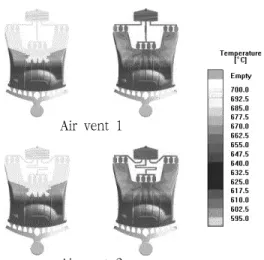
Figure 7 shows the filling pattern according to the change of the air vent shape. In order to examine the shape of the final gas exhaust, the air vent shape was set as a cavity and the analysis was performed. As a result, it became possible to more visually observe how the gas was discharged according to the change in shape of the air vent.

Figure 8 shows the air pressure pattern according to each air vent shape. The maximum air pressure was 2626 mbar in Vent 1 and 3766 mbar in Vent 2, but there was no overflow and air vent, and the product did not show high air pressure.

Air vent 1 Air vent 2 Fig. 8 Air pressure in cavity according to shape

of vent (V

2

= 4.0 m/s)

Figure 9 shows the hot spot pattern according to each air vent shape. Vent 1 and Vent 2 show a maximum hot spot duration of 22.31 second and 22.28 second, respectively. However, the hot spot duration was long in the runner region and the inlet region, while the maximum hot spot duration was in the cavity region with 2.14 seconds.

It is regarded that it will not be a problem in the production of products because the duration of hot spot of cavity is short,

Air vent 1

Air vent 2

Fig. 7 Filling behavior in cavity according to

shape of vent (V

2

= 4.0 m/s)

(7)

although it is desirable to install a cooling line based on porosity aspect considering product safety.

4. Conclusions

The results of the study on the design of the aluminum shock absorber housing mold of the vacuum die casting method using the casting dedicated software MAGMAsoft are as follows.

1. In order to manufacture a thin-walled housing by high vacuum die casting method, ingate shape was designed as a split type. The runner was designed to have the same shape as the initial inlet curve of the cavity, whereas the flow of the molten metal was prevented from turbulent flow.

The defects were controlled by investigating the flow pattern of the molten metal and designing overflow in the final gas discharge area.

2. The charging and solidification analysis was performed for the manufacture of shock

absorber housing by vacuum die casting process. The best results were obtained when the injection speed was V

2

= 4.0 m/s.

3. Although high vacuum was applied inside the mold to reduce defects in pores, it was found desirable to install a cooling line based on the porosity pattern for the safety of the product.

Acknowlegement

This work was supported by the National Research Foundation of Korea (NRF) Grant funded by the Korea Government (No.2017-017242).

References

[1] C. K. Jin and C. G. Kang. “Fabrication Process of Aluminum Bipolar Plate for Fuel Cell using Vacuum Die Casting,” Journal of the Korean Foundrymen’s Society, vol.31, no. 2, pp. 71-78, (2011).

[2] C. K. Jin, C. H. Jang, J. S. Kim, J. W. Choi and C. G. Kang. “Fabrication Process and Forming Analysis of Fuel Cell Bipolar Plate by Injection Condition of Vacuum Die Casting,”

Journal of the Korean Foundrymen’s Society, vol.31, no. 5, pp. 274-283, (2012).

[3] C. K. Jin, C. H. Jang and C. G. Kang.

“Vacuum Die Casting Mold Design of Fuel Cell Bipolar Plate using Die Filling Simulation and Experimental Verification,” Journal of the Korean Foundrymen’s Society, vol.32, no. 2, pp.

65-74, (2012).

Air vent 1 Air vent 2 Fig. 9 Hot spot in cavity according to shape of

vent (V

2

= 4.0 m/s)

(8)

[4] X. P. Niu, B. H. Hu, I. Pinwill and H. Li.

“Vacuum assisted high pressure die casting of aluminium alloys,” J. Mater. Proc. Technol, vol.105, pp. 119-127. (2000).

(Manuscript received November 24, 2017; revised

December 27, 2017; accepted January 8, 2018.)

수치

Figure  1  shows  the  housing  shape  for  casting  simulation.  The  shape  of  ingate  is  designed  as  a  split  type  so  that  the  shape  of  the  ingate  can  match  the  shape  of  the  cavity  to  make  the  flow  of  the  molten  metal  smooth
Figure  2  shows  the  comparison  of  the  fill  time  at  each  injection  speed  condition
Figure  6  shows  the  mold  temperature  distribution  from  seven  to  ten  cycles  with  the  injection  speed  of  V 2   =  4.0  m/s
Figure  7  shows  the  filling  pattern  according  to  the  change  of  the  air  vent  shape

참조

관련 문서

In order to investigate the effects of process parameters on qualities of the drilled hole quantitatively, laser drilling experiments were carried out using

ƒ Casting is a manufacturing process by which a molten material such as metal or plastic is introduced into a mold made of sand or metal, allowed to solidify within the mold,

The solidification process of metal alloy was expressed by the change of solid fraction, and the solid fraction was controlled by varying size and

In this study, the reliability of high efficiency air conditioning compressor applied with high vacuum local pressure die casting technique is to be analyzed through

The positive change pattern of CK-MB according to time on acute myocardiac infarction patient.. The positive change pattern of troponin-T according to time on

In terms of the mould design, the effects of runner system design and the mould temperature on filling characteristics, the weldline formation, the

 Casting is a manufacturing process by which a molten material such as metal or plastic is introduced into a mold made of sand or metal, allowed to solidify within the mold,

When melting aluminum, if the generated hydrogen exceeds the critical solubility in the melt, the gas pressure increases during solidification.. Then pores