근대 한식문헌 속 일제강점기 구황식품(救荒食品) 고찰
김 미 혜
호서대학교 생명보건과학대학 식품영양학과 및 기초과학연구소
Contemplation on the Emergency Foods in Korea under the Japanese Occupation
Mi-Hye Kim
Dept. of Food and Nutrition, The Research Institute for Basic Sciences, Hoseo University, Asan 31499, Korea
ABSTRACT
This research analyzed emergency foods in Korea during the Japanese occupation through the food literature of that era, and attempted to determine the cultural history of food through recorded contents of emergency foods literature. The examination was mainly conducted on the basis of the four excerpts within the emergency foods literature of the Japanese occupation:
Emergency plants of the Joseon, Wild Fruits and Plants of the Joseon, Guhwangginam, and Emergency Plants and How to Eat of the Joseon. After a thorough examination, each of the excerpts had unique data regarding amounts of ingredients, such as Namuls, trees, grain, and beans. Emergency Plants of the Joseon listed 142 Namuls, 54 trees,Wild Fruits and Plants of the Joseon listed 32 Namuls, 29 trees, Guhwangginam 4 grains, 205 Namuls, 84 trees, Emergency Plants and How to Eat of the Joseon listed five grain, three beans, 37 Namuls, and eight trees. Emergency foods literature demonstrated the utilization of various wild and edible plants as excellent ingredients for meals. Additionally, changes in traditional cooking methods using sugar, preservation through canning, and frying substantiate the subtle influence of foreign influence on Korean food. Perhaps the carefully structured components of the Korean food can be interpreted as a direct result of a scientific approach. It can be argued that creative application of methods ingredients, approach, of emergency foods is necessary to this modern age.
Key words: Japanese occupation, emergency foods, Emergency plants of the Joseon, Wild fruits and plants of the Joseon,
Guhwangginam, Emergency plants and their utilization of the Joseon
†Corresponding author : Mi-Hye Kim, Tel: +82-41-540-9663 Fax: +82 -41-548-0670 Email: [email protected]
서 론
최근 한식의 원형을 복원하고 세계화의 기반을 마련하고 자 아카이브 구축사업 및 사료의 발굴이 활발히 진행되고 있 다. 한식 원형 발굴은 대부분 조선시대에 집중되어 있고, 그 이전의 사료 발굴이나 일제강점기 이후 근대 한식문헌에 대 한 연구는 매우 미흡한 실정이다. 하지만 한식의 문화 수용 과 변용의 과정에서는 반드시 일제강점 시기의 연구가 필요 하다. 특히, 일제강점기는 식민지 현실 속에서도 근대적인 음식문화가 뿌리내리는 매우 중요한 시기이므로 체계적인 연구가 필요하다(Lee KJ & Cho MS 2008).
20세기 초 조선의 농업은 근대화 과정에서 일본 자본주의 발달에 필요한 식량, 원료 공급을 위해 오히려 그 지위가 강 화되었다(Lee SS 2008). 일제 식민정책에서 농업과 농촌문제 는 핵심적 사안이었으나, 그 목표가 조선 농업의 발달과 그
로 인한 조선 농민의 생활향상에 우선하지 않았다. 일본의 요구에 따라 미곡 증산과 이출량 증대를 중심으로 진행되었 고, 이것은 1920년대 말 30년대 초 공황기 조선농업과 농민 생존에 결정적 타격을 주었다(Han KM 2006). 흉작으로 인 한 기근은 조선시대에도 흔한 현상이었으나, 식민지 시기 일 제와 지주의 경제적 수탈로 인해 민중의 삶은 더욱 피폐해졌 고, 구황식품 개발의 요청은 필연적이었다.
구황은 자연재해나 인위적인 재해로 말미암은 흉년으로 굶주림에 빠진 빈민을 구제하는 일이다(Kim SW & Cha GH 2013). 구황식품은 흉년으로 곡식이 부족할 때 기근을 해결 하기 위해 주곡 대신 소비할 수 있는 식품을 말한다(Kim SM
& Lee SW 1992). 우리나라는 예로부터 전형적인 농업 국가 였으며, 한재(旱災)나 수재(水災) 등 예측할 수 없는 기후 변화 로 기근이 빈번하게 발생하여 생존을 위한 구황식품이 발달 하였다. 과거 식용과 약용으로 먹었던 구황식품은 최근 구황 식품이 가지고 있는 기능성 비 영양 화합물들의 생리활성 효 과들이 보고되면서 가치가 재평가되기 시작하였다(Lee SD et al 2000; Kim J et al 2005). 따라서 전통 구황식품을 대상
Table 1 Emergency foods literature during the period of Japanese occupation
Books Copyrighted in: Compiler Publisher Note
Emergency Plants of the Joseon
(朝鮮의 救荒植物) 1919 Agricultural Association of
the Joseon (朝鮮農會)
Agricultural Association of the Joseon (朝鮮農會)
Wild Fruits and Plants of the Joseon
(朝鮮の山果と山菜) 1935 Forestry Association of
Gyunggido (京畿道林業會)
Forestry Association of Gyunggido (京畿道林業會)
Guhwangginam
(救荒指南) 1943 -
Medical Herbs Nutrition Research Association (本草榮養硏究會)
Emergency Plants and Their Utilizations of the Joseon
(救荒植物と其の食用法-野生食用植物)
Unknownness Limsochi (林素治) Gyungdo-Books Corporlation (京都書籍株式會社) 으로 한 생체활성물질의 탐색과 이를 이용한 기능성 식품개
발은 각종 질병 치료제뿐만 아니라, 고부가가치 산업의 소재 로 개발하여 우리 농산물의 경쟁력을 확보하는 매우 중요한 일이다.
구황식품에 관한 연구는 Kim HS & Kim SH(1987)가 조선 후기 구황식품의 사회, 경제적 관점의 고찰을 하였으며, Kim SM & Lee SW(1992)가 조선시대 구황식품의 문헌적 연구를 하였고, RDA(2010)에서는 구황서를 한글로 번역, 발간하였 으며, Kim SW & Cha GH(2013)는 조선 후기 임원경제지 속 구황에 관한 부분을 고찰하였다. 이와 같이 구황식품에 관한 선행연구는 주로 조선시대에 국한되어 있고, 일제강점기 구 황식품에 대한 연구는 미흡한 실정이다.
따라서 본 연구에서는 음식문화사적 연구 불모지인 일제 강점기 한식문헌을 대상으로 하여 일제강점기 구황서 속 구 황식품을 분석하고, 대표 구황서 고찰을 통하여 일제강점기 음식문화사적 의의를 찾고자 한다. 또한, 일제강점기 구황서 의 체계적인 고찰을 통하여 전통 한식문화의 현대 한식문화 로의 변이 과정을 이해하며, 과거 구황식품의 고부가가치 기 능성 소재 개발 연구에 대한 기초자료를 제공하고자 한다.
연구대상 및 방법
1. 연구대상
일제강점기 구황서 중 조선의 구황식물, 조선의 산열매 와 산나물, 구황지남, 조선의 구황식물과 식용법 4권을 분석 대상으로 하였다(Table 1). 연구의 분석 텍스트는 농촌 진흥청에서 간행한 구황방 고문헌집성(救荒方古文獻集成)-일 제강점기의 구황방(발간등록번호 11-1390000-002751-01) 을 바탕으로 하였다. 또한 연구대상의 음식문화사적 고찰을 위 하여 일제강점기 관련 2차 연구 사료들을 분석하였다.
조선의 구황식물(朝鮮의 救荒植物)은 1919년 조선농회에
서 조선의 식물 100여 종을 서술하여 책으로 편찬하였다. 이 책은 편찬된 목적이 구황을 위해 식용이 가능한 식물을 알리 기 위한 것이므로, 모든 내용이 음식과 관련된 내용이라고 할 수 있으며, 특히 식물의 식용이 가능한 부위와 식용법, 영 양성분 등에 대해 나타나 있다.
조선의 산열매와 산나물(朝鮮の山果と山菜)은 산열매 29 가지, 산나물 32가지에 대한 설명으로 구성되어 있고, 이용이 비교적 용이한 산열매와 산나물에 대해 전체적으로 다루고 있다. 또한 산열매와 산나물을 이용하는 음식과 그에 이용할 수 있는 양념장 등이 나와 있다.
구황지남(救荒指南)은 곡식이 부족할 때 먹을 수 있는 구 황작물에 대해 설명하고 있으며, 구황작물이 평상시에 보조 식량으로 사용되어졌음을 말하고 있어 당시의 식량 사정에 대해 알 수 있다. 이 책의 분량은 1책 37페이지이고, 내용에 는 일반구황방, 선가복식방, 구황장, 해독방 등으로 구성되었 으며, 먹을 수 있는 재료들과 먹는 방법에 대해서 설명하고 있다.
조선의 구황식물과 식용법(救荒植物と其の食用法-野生食用 植物)은 흉년에 굶주림을 해결해 주는 야생식용식물들의 식 물명과 조선 안에서의 분포, 자라는 입지, 특징, 식용법, 유사 한 식용종 등에 대해 상세히 기술하였고, 실물 표본의 사진 을 첨부하였다. 이 책에서는 전체적으로 구황을 할 수 있는 식물들에 대해 기록하고 있어, 모두 식용이 가능한 식물에 대해 설명하고 있다. 특히 서언에서 채소 대용, 주식대용, 간 식대용품, 기타의 식품, 전해져 오는 구황법, 각론에서 각 식 용이 가능한 식물들에 대한 설명이 있고, 식품과 식용법에 관한 내용 등이 상세히 설명되어 있다.
2. 연구방법
연구방법은 내용분석(Contents Analysis)을 통하여 이루어 졌으며, 내용 분석의 절차는 분석의 목적을 확인하고, 구인
을 적절히 표상할 수 있는 특성들을 확인하며, 분석 유목과 지표를 개발하고, 사전 검사를 실시하여 수정, 보완의 과정 을 거친 후 내용 분석 타당성을 검증한 후 진행하였다(Park YJ & Woo YH 2012).
결과 및 고찰
1. 구황식품의 종류와 조리법
1) 구황식품 종류(種類)
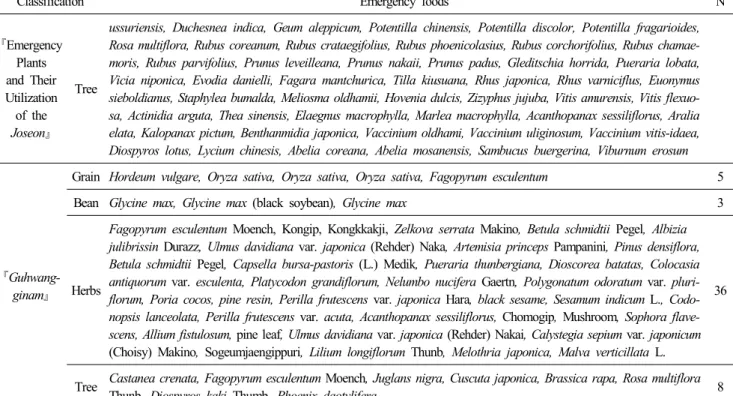
조선의 구황식물(朝鮮의 救荒植物)에는 나물류 140종, 나 무류 54종, 곡류 5종, 조선의 산열매와 산나물(朝鮮の山果と 山菜)에는 나물류 29종, 나무류 32종, 구황지남(救荒指南)
곡류 5종, 콩류 3종, 나물류 36종, 나무류 8종, 조선의 구황 식물과 식용법(救荒植物と其の食用法-野生食用植物) 곡류 4종, 나물류 206종, 나무류 95종이 나와 있다(Table 2).
구황식품의 종류는 산과 들에 있는 식물의 잎, 줄기, 뿌리, 꽃 그리고 나무의 열매나 껍질과 같은 식물성 식품이 주종을 이루고 있음을 알 수 있다. Kim HS & Kim SH(1987)의 연구 에도 조선시대 나물과 나무류가 구황식품의 대부분을 이루 고 있으며, 그 외에 곡물을 가공하고 남은 찌꺼기, 곤충, 개구 리, 해초 등 구황식품의 종류는 매우 다양하다고 보고하였다.
일제강점기 대표 구황서 4권에 등장하는 617개의 구황식 품 중 거의 대부분이 봄철에 어린잎이나 줄기를 먹는 것들이 다. 보통 식물의 잎이나 줄기는 대부분 봄에 어리고 연한 것 들을 따서 먹는 것이고, 뿌리 부분은 늦가을부터 초겨울까지 캐서 먹었다. 또한 나무껍질은 봄에 수액이 오르기 시작할 무렵에 주로 먹었다. 구황식물 중에 이처럼 봄철에 이용되는 것이 많은 것은 봄철의 부족했던 식량사정을 대변해 주고 있 으며, 이때에 맞춰 산과 들에 돋아나는 나물이나 나무의 새 싹을 식품으로 이용하였던 것으로 본다. 우리나라 자생식물 3,200여종 중 480종을 산채로 이용할 수 있으며, 실제로는 기호성이 좋고 식품적 가치가 놓은 식물 80여종 정도만이 최 근에는 산채로 이용하고 있다(Nam YK & Back JE 2005)고 한다.
가을에는 주로 열매를 먹었다. 열매가 과육인 경우는 날 것으로 먹었으나, 간혹 날것으로 먹기 어려운 것들은 말리거 나 물에 담갔다가 먹었다. 가을에 먹는 구황식품 중에서 가 장 중요한 것은 도토리다. 도토리는 우리나라 전역에서 생산 되는 열매로 과실은 식용으로 묵, 전분, 국수를 만드는데 이 용하며, 약 70%가 전분으로 이루어져 기근이 발생할 때마다 중요한 전분식량 대용으로 사용되어 왔으며, 다른 전분과 달 리 수렴작용이 있고, 6∼9% 탄닌을 함유하고 있어 떫고 쓴맛 이 나는 것이 특징이다(Kwon JH et al 2002).
겨울에는 식물의 뿌리 부분만이 먹을 수 있었다. 뿌리는 늦가을부터 이듬해 초봄까지 채취하여 굽거나 쪄서 먹는다.
또, 가루를 내어 곡식과 섞어 먹거나, 날것으로 먹기도 하였 다. 많은 식물의 뿌리 중에서도 가장 많이 이용하였던 것은 칡뿌리였다. 칡은 동남아 각지에서 자생하며, 뿌리의 약 16∼
19%가 전분으로 구성되어 있으며, 생리활성 물질인 아이소 플라본, 올리고당, 펩타이드, 피트산, 식이섬유, 페놀 성분, 사포닌 등을 함유하고 있어 영양학적으로나 한방학적으로 많이 이용되고 있다(Han GS et al 2013). 메밀은 줄기와 잎을 모두 먹을 수 있어서 다른 곡식보다 구황에 자주 이용되었 다. 메밀은 주로 국수, 냉면, 묵 등 전분을 이용한 음식형태 가 대부분이었으며, 소화도 잘 되고 맛이 있어 별미식에 활 용되고 있다. 탈피한 메밀에는 12∼15%의 단백질이 함유되 어 있고, 리신 함량도 5∼7%로 풍부하게 함유되어 있다. 또 한 메밀은 다른 식물에 비해 루틴이 풍부하며, 그 외 비타민 B1, E 등이 풍부하여 현대인의 건강식품으로 경쟁력이 우수 한 작물로 여겨진다(Kim JK & Kim SK 2004).
2) 구황식품 조리법
구황서에 나타난 구황식품의 식용법은 다양하다(Table 3).
구황식품을 가장 쉽게 먹는 방법은 날 것으로 먹는 것이다.
주로 단맛이 나는 열매들은 날 것으로 먹고, 솔잎이나 측백 나무 잎 그리고 소나무 껍질과 같이 쓴맛이 적고, 약간의 단 맛이 나는 잎이나 줄기도 날로 먹을 수 있는 구황식품이었 다. 생채는 맛이 청명하고 연하며 향미가 좋아, 일찍부터 일 상 상용음식으로 자리 잡아 왔으며, 굶주릴 때 식량으로도 중요한 역할을 하였다(Cho HJ 1998).
구황식품을 먹는 다른 방법은 솔잎이나 나무껍질, 열매 그 리고 곡식 등을 가루를 만들어서 먹는 것이다. 가루를 만들 때는 그냥 생으로 찧거나, 볶아서 찧기도 하였다. 이렇게 가 루를 만든 것을 물에 타서 먹거나 꿀로 개어서 환을 만들어 먹기도 하였다. 곡식을 가루로 만드는 경우는 그 양을 늘려 서 먹기 위해서였다. 곡식을 가루로 만들면 쌀 1되로는 가루 2되 5홉을 만들 수 있고, 보리는 껍질을 제거하고 볶아서 가 루로 만들면 2되를 만들 수 있었다. 구황서에는 채취한 구황 식품에 약간의 곡식가루를 더하여 양을 늘린 죽이나 떡의 형 태 음식이 가장 많음을 알 수 있다. 이렇게 구황식으로 죽이 널리 이용된 것은 중량도 되고 거친 섬유질의 소화에도 용이 하였기 때문으로 보고 있다(Chung HK 1999)
이와 같이 식량자원 부족은 야생 식물의 섭취를 증가시켰 고, 오랜 경험들은 야생식물 유독성분 식별능력을 향상시켰 다. 이러한 노력으로 식물의 식용부위를 가리게 되었고, 구황 서에는 식물의 식용부위별 식용법이 자세히 소개되고 있다.
따라서 식량부족과 약식동원 등의 음식철학은 오늘날 독특
Table 2. Emergency foods of the books written during the Japanese Occupation
Classification Emergency foods N
Emergency Plants of the Joseon
Grain Echinochloa crus-galli, Echinochloa oryzoides, Oryja sativa, Panicum germanicum, Eleocharis kuroguwai 5
Herbs
Pteridium aquilinum var. latiusculum, Osmunda japonica, Equisetum arvense, Potamogeton crispus L., Echinochloa crus-galli var. echinatum (Willd.) Honda, Echinochloa oryzoides, Oryza sativa, Setaria italica, Sagittaria pygmaea Miquel, Chrysosplenium ramosum Maxim, Meretrix lusoria, Lilium concolor var. partheneion, Lilium amabile Palib, Lilium dauricum, Erythronium japonicum, Scilla scilloides (Lindl.) Druce, Asparagus cochinchinensis Merr, Poly- gonatum odoratum var. pluriflorum, Dioscorea batatas, Spinacia oleracea, Rumex crispus, Chenopodium album var.
centrorubrum, Suaeda glauca (Bunge) Bunge, Amaranthus mangostanus, Portulaca oleracea L., Stellaria alsine var.
undulata (Thunb.) Ohwi, Cerastium holosteoides var. hallaisanense (Nakai) Mizush, Arenaria serpyllifolia L., Akebia quinata Decne, Thlaspi arvense L., Cardamine flexuosa With, Capsella bursa-pastoris (L.) Medik, Draba nemorosa L. for. nemorosa, Philadelphus schrenkii Rupr. var. schrenkii, Sanguisorba officinalis L., Viola verecunda A. Gray var. verecunda, Jeumbangnamul, Oenanthe javanica (Blume) DC, Vaccinium vitis-idaea L., Calystegia japonica, Prunella asiatica Nakai, Lycopus lucidus Turcz, Plantago asiatica L., Galium verum var. asiaticum Nakai, Omphalodes krameri, Patrinia scabiosaefolia, Platycodon grandiflorum, Adenophora triphylla var. japonica Hara, Adenophora remotiflora Mig, Codonopsis pilosula (Franch.) Nannf, Codonopsis pilosula, Codonopsis lanceolata (Siebold &
Zucc.) Trautv, Artemisia princeps Pampanini, Artemisia japonica Thunb, Aster scaber Thunb, Inula britannica var.
chinensis, Maetdarinamul, Surichigi, Synurus deltoides, Synurus excelsus (Mak.) Kitamura, Atractylodes japonica, Galium verum var. asiaticum Nakai, Syneilesis palmata (Thunb.) Maxim, Jangjakgaebinamul, Breea segeta (Bunge) Kitam, Rhapontia uniflora, Dokkaebinamul, Jichingge, Siegesbeckia glabrescens Makino, Xanthium strumarium, Ixeris dentata Nakai, Sseunnamul, Crepidiastrum sonchifolium (Bunge) Pak & Kawano, Hololeion maximowiczii Kitam, Sonchus brachyotus DC, Dictamnus dasycarpus Turcz, Hypericum erectum Thunb, Metdaechu, Vitis coignetiae Pulliat, Ajuga multiflora, Lamium amplexicaule L., Deulsae, Kkokdosan, Chenopodium album var. centrorubrum, Sseum- baegwibagwi, Crepidiastrum sonchifolium (Bunge) Pak & Kawano, Sansseumbakwinamul, Taraxacum platycarpum, Satbiul, Jichigoengi, Ssambae, Gireumgosari, Bumeul, Dalgiitsitgae, Jibo, Hemerocallis fulva, Allium thunbergii, Lilium brownii, Swiong, Polygonum aviculare L., Kkongadari, Kkwonguijangdari, Jijanggal, Eumnyanggak, Dokan- somaenjari, Sedum sarmentosum, Isi, Potentilla anemonifolia Lehm, Agrimonia pilosa Ledeb, Cucumis sativus, Jo- rinamul, Seokongneolgul, Trapa japonica, Aralia contientalis, Pimpinella brachycarpa, Angelica gigas Nakai, Angelica decursiva, Bamjeot, Seunggeolcho, Ledebouriella seseloides, Lysimachia barystachys, Gentiana squarrosa Ledeb, Cynanchum atratum, Saedam, Kkotdaju, Dabukssuk, Chobanginamul, Yeolgaji, Bidens frondosa L., Mattal, Suksepul, Samjinggeorijangdae, Sonamul, Sonchus oleraceus L., Gaesebadangnamul, Ligularia fischeri, Hemistepta lyrata (Bunge) Fisch. & C.A.Mey, Solidago virga-aurea var. asiatica, Artemisia keiskeana Mig, Gnaphalium japonicum Thunb
140
Tree
Ginkgo biloba L., Pinus densiflora, Pinus koraiensis, Clematis mandschurica, Juglans mandshurica, Corylus hete- rophylla, Quercus mongolica, Quercus serrata, Quercus, Quercus aliena, Quercus dentata, Castanea crenata, Ulmus japonica, Hemiptelea davidii, Crataegus pinnatifida, Pueraria lobata, Cedrela sinensis, Securinega subffruticosa, Actinidia arguta, Aralia elata, Kalopanax pictum, Jeolcheug, Diospyros lotus, Clerodendron tricuotomum, Vitis flexuosa, Smilax sieboldii, Morus alba, Kochia scoparia, Hwangsae namu, Aga namu, Dolbae namu, Rosa multiflora, Prunus serrulata, Vaccinium hirtum, Oyas namu, Hwal-yang namu, Menali gamnamu, Goehwa namu, Zanthoxylum schinifolium, Elaeagnus umbellata, Seongeob namu, Hugeria japonica, Vaccinium uliginosum, Rubus parvifolius, Rubus matsumuranus, Rubus oldhamii, Acanthopanax sessiliflorus, Rhus varniciflus, Heunlim namu, Huin namu, Vitis coignetiae, Clerodendrum trichotomum, Swaessari, Wisteria floribunda
54
Wild Fruits and Plants
of the Joseon
Herbs
Chenopodium album var. centrorubrum, Cirsium japonicum, Polygonum cuspidata Sieb. et Zucc, Aralia cordata Thunb, Plantago asiatica L., Ligularia fischeri, Atractylis koreana Nakai, Patrinia scabiosaefolia, Erythronium japonicum, Janamu, Equisetum arvense, Osmunda japonica, Aralia elata (Miq.) Seem, Taraxacum platycarpum, Adenophora triphylla var. japonica Hara, Capsella bursa-pastoris (L.) Medik, Allium tuberosum, Chrysosplenium ramosum Maxi, Gnaphalium affine, Rosa rugosa, Petasites japonicus, Cryptotaenia japonica, Amphicarpaea tri- sperma (Miq.) Baker, Dioscorea japonica Thu, Aster yomena, Artemisia princeps Pampanini, Pteridium aquilinum var. latiusculum, Hemerocallis fulva, Platycodon grandiflorum
29
Tree
Prunus armeniaca var. ansu M., Akebia quinata, Ginkgo biloba, Diospyros kaki, Rubus idaeus var. concolor Nakau, Castanea crenata var. dulcis, Elaeagnus umbellata, Neulchungnamu, Quercus acutissima, Crataegus pinnatifida B., Cornus officinalis, Actinidia arguta, Prunus salicina, Ribes mandshuricum (Maxim.) Kom, Ageubenamu, Lindera
32
Table 2. Continued
Classification Emergency foods N
Wild Fruits and Plants
of the Joseon
Tree
obtus, Juglans sinensis, Schizandra chinensis, Pinus koraiensis, Pyrus serotina var. culta (Rehder Nakai), Malus asiatica, Zizyphus jujuba var. inermis, Vaccinium hirtum var. koreanum (Nakai) Kitam, Corylus heterophylla var.
thunbergii, Prunus persica, Vitis amurensis Rupr, Morus, Sanbaenamu, Prunus tomentosa, Acanthopanax sessili- florus, Pueraria thunbergian, Lycium chinense
Emergency Plants and Their Utilization of the Joseon
Grain Oryza sativa, Hordeum vulgare, Avena sativa, Avena fatua 4
Herbs
Osmunda cimamomea, Hoechomichae, Variants Pteridium aquilinum, Pteridium aquilium, Osmunda japonica, Equi- setum arvense, Sangittaria trifolia, Eleocharis kuroguwai, Arisaema amurense, Symplocarpus renifolius, Sagina japonica, Streptolirion volubile, Allium monanthum, Allium japonica, Allium nipponicum, Allium microdictyon, Asparagus schoberioides, Chintonia udensis, Convallaria majalis, Mukdenia acanithifolia, Disporum smilacinum, Erythronium denscanis, Hemerocallis citrina, Hemerocallis aurantiana, Hosta clausa, Hosta longipes, Hosta longipes, Lilium tigrinum, Lilium miyuelianum Makino, Paris verticillata Sieb, Polygonum inflatum, Polygonum japonicum, Polygonatum falcatum, Scilla chinensis, Smilax china, Smilax nipponica, Smilax oldhami, Smilax nipponica, Dio- scorea japonica, Belamcanda chinensis, Liparis japonica, Amblygonum orientale, Persicaria perfoliata, Persicaria thunbergii, Aconogonum polymorphum, Polygonum aviculare, Rumex acetosa, Rumex japonicus, Chenopodium album, Suaeda japonica, Achyranthes japonica, Amaranthus blitum, Phytolacca esculenta, Portulaca silvestris, Arenaria juncea, Cerastium caespitosum, Pseudostellaria palibiniana, Myosoton aquaticum, Stellaria uliginosa, Brasenia schreberi, Aconitum ciliare, Caltha minor, Cimicfuga dahurica, Clematis apiifolia, Clematis fusca, Clematis mand- schurica, Viola verecunda, Peonia japonica, Ranunculus chinesis, Ranunculus japonicus, Thalictrum aqilegifolium, Dielytra spectabilis, Turritis glabra, Capsella bursa-pastoris, Cardamine flexuosa, Ssali deonggul, Cardamine leu- cantha, Draba nemorosa, Lepidium micranthum, Rorippa palustris, Rorippa sublyrata, Descurainia sophia, Sedum aizoon, Sedum sarmentosum, Agrimonia pilosa, Potentilla kleiniana, Sanguisorba officinalis, Prunus maackii, Prunus padus, Lathyrus davidii, Vicia amoena, Vicia cracca, Vicia unijuga, Galium nepalense, Oxalis fontana, Galarhoeus helioscopia, Securinega subffruticosa, Polygala japonica, Empetrum nigrum, Celastrus orbiculatus, Impatiens textori, Hypericum ascyron, Viola mandshurica, Viola acuminata, Aralia continentalis, Augelica dahurica, Porphyroscias decursica, Angelica gigas, Angelica koreana, Ostericum sieboldii, Angelica polymorpha, Bupleurum longeradiatum, Cryptotaenia japonica, Heracleum lenatum, Seseli libanotis, Oenanthe javanica, Peucedanum deltoideum, Cryptotaenia japonica, Pleurospermum kamtschaticum, Sanicula chinensis, Sium suave, Torilis japonica, Rhododendron mucro- natum, Vaccinium oldhami, Lysimachia clethroides, Metaplexis japonica, Calystegia japonica, Trigonotis radicans, Lithospermum arvense, Trigonotis peduncularis, Lamium amplexicaule, Lycopus coreanus, Meehania urticifolia, Mosla punctulata, Isodou inflexus, Amethystanthus japonica, Prunella vulgaris, Clinopodium chinense, Scutellaria baicalen- sis, Physalis franchetii, Solanum niqrum, Maqus stachydifolius, Pedicularis resupinata, Plantago asiatica, Galium aparine, Galium varum, Rubia akane, patrinia scabiosaefolia, Patrinia villosa, Valeriana fouriei, Trichosanthes ki- rilowii, Codonopsis lanceolata, Adenophora remotiflora, Codonopsis lanceolata, Codonopsis silvestris, Asyneuma japonica, Platycodon grandiflorum, Achillea mongolica, Adenocaulon adhaerescens, Ainsliaca acerifolia, Artemisia apiacea, Artemisia japonica, Artemisia keiskeana, Artemisia mongolica, Artemisia fukudo, Artemisia slengensis, Aster ageratoides, Aster ciliosus, Kalimeris yomena, Aster scaber, Aster tataricus, Atractylodes japonica, Bidens bioternata, Cacalia hastata subup, Cacalia pseudo-taimingasa, Cacalia krameri, Carduus crispus, Carpesium abrotanoides, Carpesium staquetii, Rhaponticum uniflorum, Cirium lineare, Cirium pendulum, Cynara scolymus, Lapsana apogo- noides, Gerbera arandria, Leontopodium coreanum, Gnaphalium hypoleucum, Hemistepta carthamoides, Hololeion maximowiczii, Hieracium umbellatum, Ixeris sonchifolia, Ixeris dentata, Lactuca indica, Ligularia fischeri, Picris hieracioides, Saussurea pseudogracilis, Saussurea grandifolia, Scorzonera albicaulis, Senecio campestris, Serratula coronata, Sonchus arvensis, Solidago virga-aurea, Synurus plamatopinnatifudus, Taraxacun platycarpum, Agastache rugosa, Solanum niqrum
206
Tree
Ginkgo biloba, Taxus cuspidata, Pinus densiflora, Pinus koraiensis, Phyllostachys nigro, Phyllostachys reticulata, Sasa borealis, Smilax sieboldii, Juglans mandshurica, Juglans regia, Corylus heterophylla, Castanea crenata, Castanea bungeana, Castanopsis cuspidata, Quercus acutissima, Quercus mongolica, Aphananthe aspera, Celtis koraiensis, Celtis sinensis, Hemiptelea davidii, Ulmus propinqua, Zelkowa serrata, Broussonetia kaqinoki, Cudrania tricuspi- data, Humulus japonicus, Morus alba, Duretia tricuspis, Ligustrum ciliatum, Kochia scoparia, Berberis koreana, Rosa davurica, Elaegnus macrophylla, Akebia quinata, Cocculus trilobus, Kudsura chinensis, Benjoin obtusilobum, Benjoin obtusilobum, Tilia amurensis, Corydalis pallida, Ribes fasciculatum, Ribes mandshuricum, Celastrus fra- gellaris, Sorbaria sorbifolia, Spiraea microgyna, Crataegus pinnatifida, Malus baccata, Micromeles alnifolia, Pyrus
95
Table 2. Continued
Classification Emergency foods N
Emergency Plants and Their Utilization of the Joseon
Tree
ussuriensis, Duchesnea indica, Geum aleppicum, Potentilla chinensis, Potentilla discolor, Potentilla fragarioides, Rosa multiflora, Rubus coreanum, Rubus crataegifolius, Rubus phoenicolasius, Rubus corchorifolius, Rubus chamae- moris, Rubus parvifolius, Prunus leveilleana, Prunus nakaii, Prunus padus, Gleditschia horrida, Pueraria lobata, Vicia niponica, Evodia danielli, Fagara mantchurica, Tilla kiusuana, Rhus japonica, Rhus varniciflus, Euonymus sieboldianus, Staphylea bumalda, Meliosma oldhamii, Hovenia dulcis, Zizyphus jujuba, Vitis amurensis, Vitis flexuo- sa, Actinidia arguta, Thea sinensis, Elaegnus macrophylla, Marlea macrophylla, Acanthopanax sessiliflorus, Aralia elata, Kalopanax pictum, Benthanmidia japonica, Vaccinium oldhami, Vaccinium uliginosum, Vaccinium vitis-idaea, Diospyros lotus, Lycium chinesis, Abelia coreana, Abelia mosanensis, Sambucus buergerina, Viburnum erosum
Guhwang- ginam
Grain Hordeum vulgare, Oryza sativa, Oryza sativa, Oryza sativa, Fagopyrum esculentum 5
Bean Glycine max, Glycine max (black soybean), Glycine max 3
Herbs
Fagopyrum esculentum Moench, Kongip, Kongkkakji, Zelkova serrata Makino, Betula schmidtii Pegel, Albizia julibrissin Durazz, Ulmus davidiana var. japonica (Rehder) Naka, Artemisia princeps Pampanini, Pinus densiflora, Betula schmidtii Pegel, Capsella bursa-pastoris (L.) Medik, Pueraria thunbergiana, Dioscorea batatas, Colocasia antiquorum var. esculenta, Platycodon grandiflorum, Nelumbo nucifera Gaertn, Polygonatum odoratum var. pluri- florum, Poria cocos, pine resin, Perilla frutescens var. japonica Hara, black sesame, Sesamum indicum L., Codo- nopsis lanceolata, Perilla frutescens var. acuta, Acanthopanax sessiliflorus, Chomogip, Mushroom, Sophora flave- scens, Allium fistulosum, pine leaf, Ulmus davidiana var. japonica (Rehder) Nakai, Calystegia sepium var. japonicum (Choisy) Makino, Sogeumjaengippuri, Lilium longiflorum Thunb, Melothria japonica, Malva verticillata L.
36
Tree Castanea crenata, Fagopyrum esculentum Moench, Juglans nigra, Cuscuta japonica, Brassica rapa, Rosa multiflora
Thunb, Diospyros kaki Thumb, Phoenix daotylifera 8
한 한식의 나물문화를 형성하게 된 배경이 되었다. 야생식물 들은 주로 물에 삶거나 데치는데, 이는 섬유소를 무르게 하 여 부드럽게 하거나, 쓴맛을 제거할 뿐만 아니라, 혹시 있을 지도 모르는 독성분을 제거하는 효과도 있다.
산채 나물은 신분의 고하를 가리지 않고 우리 민족의 중요 한 부식물로서 자리를 차지하며, 산채를 식용하는 동아시아 가운데서 가장 많은 종류의 산채를 다채롭게 요리할 수 있게 되었다(Lee SW 1999). 이렇게 낯선 야생식물이 새로운 먹을 거리로 신뢰할 수 있게 돕는 역할을 하는 것은 바로 고추장, 장, 마늘, 된장, 참기름, 식초와 같은 갖은 양념이었다. 이는 식품에 대한 이중성을 극복하려는 인간의 노력으로 부족한 먹을거리를 채우기 위해 전에는 먹지 않았던 새로운 식품을 먹어야 살 수 있는 상황에 처하게 되었을 때 익숙하지 않은 식품을 먹는 비법이 익숙한 맛의 양념과 함께 먹는 것이다 (Chung HK et al 2013). 즉, 익숙한 양념으로 조리된 음식은 식재료가 다르더라도 알고 있는 맛이 더해지면서 용이하게 먹을 수 있게 된다.
2. 구황식품의 활용(活用)
1) 주식(主食) 대용식
구황식품의 가장 주요 기능은 에너지원으로서의 탄수화물 공급이었다. 여러 가지 자연환경, 사회 경제적인 영향 등으
로 식량자원이 절대적으로 부족한 상황에서 생존을 위하여 한 끼를 해결할 수 있는 주식 대용식 개발은 매우 절실한 상 황이었다. 구황식품의 주식 대용식 개발은 크게 세 가지로 분 류할 수 있다(Table 4). 첫째는 잡곡으로서 곡류를 대신하는 경우가 있고, 둘째는 야생식물의 떫거나 쓴맛을 우려내고 다 른 곡분을 넣어 떡, 밥, 죽의 형태로 혼식하는 경우이다. 또 다른 경우는 야생식물에서 가루를 분리, 채취하여 전분으로 서 활용하는 것이다. 이 모든 것들은 탄수화물을 함유한 야 생식물일 경우 가능하였다. ‘사람은 곡(穀)으로 살아가는데 부족하면 채(菜)로써 배를 채우고 이것도 없으면 야생초과에 눈을 돌려야 한다’는 말이 있다(Lee SW 1985). 이처럼 구황 서를 통해 산과 들의 야생식물들을 다양하게 이용함으로써 부족한 식량사정에 적응해 가는 구한말, 일제강점기 생활상 을 살펴 볼 수 있다.
조선 후기 들어오면서 새로운 외래 작물들이 도입되었다.
18세기 중엽에 고구마가 도입되었고, 19세기 중엽에는 땅콩 과 감자도 도입되었다(Kim TW 2001). 중국이나 일본에서는 이렇게 도입된 새로운 작물이 부족한 식량을 대신하는 역할 을 하였다. 그러나 일제강점기 구황서를 분석한 결과 고구마, 땅콩, 호박 등의 언급은 잘 보이질 않았다. 당시 고구마가 식 량으로 이용되지 못하고, 단지 간식으로 여겨지고 있었으며, 이는 고구마 재배 기술, 종자 보관과 기후조건 등이 까다로 웠기 때문일 것으로 보인다(Chung HJ 2006) 달콤하고 맛있
Table 3. Emergency food's culinary methods during the Japanese occupation
Main material Side material Cooking (Food)
Emergency Plants of the Joseon
Stem․leaf
Starch, bean, wheat flour, acorn powder, adzuki bean powder, ordinarg rice, rice flourr, rice chaff, nanking rice, red pepper paste, sauce, garlic, vinegar, soybean paste etc.
Dry, boiled vegetables, vinegar dressing, stew, rice cake, mixed beans, raw material starch, gruel, danja,, papper paste of salted vegetables, damgeummul, jang- chea, pudding etc.
Fruit
Ordinarg rice, glutinous rice, soy sauce, oil, sesame seeds, pepper, spring onion, sugar, millet, bean pow- der etc.
Raw, dry, roast, steam, yeot, confect, rice cake, stir-fry, gruel, bun rice cake, pogwon, gomyeong, seasoning, oil, boiled, gyeongdan etc.
Root Soybean paste, mung bean powder, rice flour, grain, papper paste, garlic, meat, egg, oil, salt etc.
Starch, noodle, gruel, bowl of rice served with toppings, thin noodle, cooked rice, gruel, rice cake, papper paste season, jijimjeok, stew, steamed, namul etc.
Wild Fruits and Plants of the Joseon
Stem․leaf
Wheat flour, acorn powder, papper paste, meat, oil, red pepper powder, garlic, soy sauce, soybean paste, spring onion, egg, starch, Arrowroot starch, rice, honey, skipjack, soda, sesame oil, beef, fried tofu etc.
Juice, rice cake, namul, hwayangjeok, roast, c, starch, tea, namul bob, namul gruel, namul, soybean soup, stew, raw fish, jeongol, stew, pudding etc.
Fruit Salt, sugat, soju, tartaric acid, glutinous rice powder, honey, camellia oil, soy paste, nuts etc.
Jangajji, cookie, jam, jelly, sinseollo, dry, sweet jellty of red bean, soak in water, dumpling, danja,, tea, can, oil, fruit salad, yakgwa, kimchi, alcoholic drink etc.
Root Water Starch
Emergency Plants and their Utilization of the Joseon
Stem․leaf
Soybean paste, vinegar, salt, sugar, yam , bean pow- der, honey, sugar, glutinous rice, grain powder, soy sauce mixed with vinegar, soybean paste, oil, sesame seeds, red chili-pepper paste with vinegar etc.
Raw, blanch, boiled, season, vinegar dressing, juice, stir-fry, cooked rice, salted, stew, starch, rice cake, cookie, alcoholic drink, cookie, wine, namul-gruel, namulbab, gyeongdan, raw fish, flour, fried, kimchi, chilchojuk etc.
Fruit Taffy, glutinous rice powder., rice flour etc.
Raw, dry, roast, steamed, stir-fry, sinseollo, dumpling, tea, cookie, yeot, kimchi, juice, rice cake, flour, fruit liquor, jam, syrup, cooked rice etc.
Root
Mung bean powder, salt, spice products (sesame oil, sesame seeds, galic, spring onion, papper, ginger, vine- gar, papper paste), spring onion, dried gourd shavings (ogari), goriru, wheat flour, egg, sea tangle, sugar, rice etc.
Starch, steam, noddle powder, gyeongdan, gruel, coo- ked rice, tin noddle, roast, namul, season, noddle, salted, stew, raw, jeongol, kimchi,, Doenjangbagi, jijimtoek etc.
Guhwangginam
Grain
Graion, bean powder, sesame seeds, mippuri, baekbok- ryeong, zedoaria, ukssain, rice bran, mung bean pow- der etc.
Flour, rice cake, rice bran cake, gruel etc.
Stem․leaf
Grain powder, yellow bean, sesame seed, black bean, licorice, baekbok-ryeong, zedoariazedoaria, ukssain, rice bran etc.
Rice cake, steamed soybean flour, deadohwan, danja, etc.
Fruit Salt, bean powder etc. Roast, rice cake, dry, danja, dasik etc.
Root Mung bean powder, rice etc. Starch, cooked rice, gruel, noodle, steam, raw etc.
지만 식량이 될 수 없는 고구마보다는 산과 들에 피어난 풀 을 식량으로 먹는 것이 더 효과적이라 여겼기 때문일 것이다.
2) 간식(間食) 대용식
간식은 정해진 식사 시간 이외에 먹는 음식을 의미하는
것(Lee KJ et al 2000)으로 세끼 식사에서 충족하지 못한 영 양소를 보충하고, 끼니 사이에 공복 시간을 줄이는 역할을 한 다(Shim JE et al 2004).
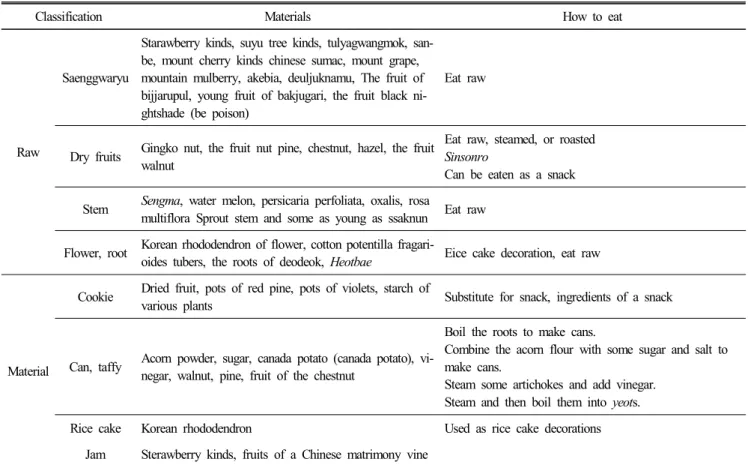
조선의 구황식물과 식용법 은 구황식품으로 간식 대용식 품 식용법이 잘 정리되어졌다(Table 5). 간식 대용식품은 크
Table 4. The utilizations of the substituted wild plants from the Emergency Plants and Their Utilization of the Joseon
Purpose Classification Main ingredient Food recipe
Grains
equality Vegetables Aeed (Setaria viridis Beauv, barnyard millet, Sasa
borealis Makino) Similar to the recipes of a millet
Mix
Tend to eat berries
Chestnut tree, walnut, hazel, the fruit of nut pine tree, oak, The fruit of aqueritron with Rice cake, rice, Po- rridge, jujube
Rice cake, cooked rice, gruel
Vegetables
Young leaves, plumule, young stems, bibichu type, saw- leaf zelkova, Japanese elm, foremost mugwort, osier, shepherd’s purse, Lamium amplexicaule, baembap, chick- weed, Lycium chinense mill, Allium victorialis
To rid the bitter and astringe taste of the vegetables, steep them.
After steeping, mix them with rice and barley to cook gruel or cooked rice.
Rice cake, cooked rice, starch type the mixed
Root
vegetables Balloon flower, Erythronium japonicum
Put the root vegetables into water to rid the astringe taste, and mix them with some rice to cook gruel or cooked rice.
Pulverize the root vegetables and mix them with diffe- rent grains to make rice or danja.
Etc Astringent skin of a pine tree, needle leaf
Make rice cakes with some glutinous rice and the other ingrediants listed on the left by mixing first and steaming later.
Mix them with rice flour to make danjas
Starch raw materials
Seed Gakttugwa: the kind of a queritron, oak (ganeundae) kind: Sasa borealis
Steam them with boiling water.
Rice, danja, porridge, Rice cake, noodle.
Distill the rice flour, and make danjas or noodles after washing it in water.
Coat of bark Makino, mountain mulberry, Morus bombysis koidz, Zanthoxylum piperitum, an elm,
Rootstock, a tuberous root
bracken, elezi, watermelon in the sky, lily, arrow-root, watermelon in the sky
게 자체를 생식하거나 조리과정을 거쳐 가공식품으로 만드 는 경우가 있다. ‘건과류는 날것으로 또는 찌거나 구워서 밥 상에 올라 먹을 수 있는 점 외에 신선로 또는 중국식 및 조선 식 각종 요리나 과자의 원료 등으로 쓰이고 있다. 과자의 경 우는 앞에 설명된 건과류 외에도 적송의 화분이나 제비꽃의 화분 및 각종 식물의 전분이 대부분이다. 이들은 부분적으로 과자 대용으로 되거나 혹은 과자의 원료로 쓰인다. 엿으로 쓰 이는 것들로 무릇의 뿌리를 삶아 통조림으로 만든 것, 탈삽 한 도토리 가루에 설탕을 넣고 소금으로 간을 맞추어 통조림 으로 만든 것들은 단맛이 있어서 엿 대용이 된다.’ Park JH (2010)의 연구에 의하면 무릇의 비늘줄기에는 과당, 서당, 전 분, 아밀로펙틴과 같은 다당류 및 이눌린과 같은 다당류가 들어 있으며, 항산화, 항암작용 등의 우수한 생리활성 기능 이 평가되었다.
‘뚱딴지(돼지감자)를 끓인 진약에 식초를 첨가하여 삶고 조림으로 만들면 진정한 엿이 얻어진다. 호도, 소나무, 밤나 무의 열매는 엿으로 쓰인다’. 엿은 이미 오래전부터 식용으 로 널리 이용되어온 우리나라 고유의 식품으로 1500년대 초
수운잡방 에 기록되어 있는 것으로 보아, 그 이전부터 만들 어져 온 것으로 추측된다(Chung HK et al 2015). 엿기름 내의 녹말 분해효소인 아밀라아제가 전분에 작용하여 전분을 포 도당, 맥아당, 호정 등으로 분해하여 단맛을 생성한다. 당화 된 전분용액을 가열, 농축시키면 엿이 형성되는데, 형성된 엿의 색은 고온에서 당류 또는 당류의 수용액을 가열할 때 일어나는 카라멜화에 의한 갈변화 반응으로 주로 당함량이 높은 식품들의 가열, 가공 중에 흔히 일어난다(Kim DH 2010).
3) 기호식(嗜好食) 대용식
조선의 구황식물과 식용법 에 구황식품으로 기타의 먹을 거리 식용법이 잘 정리되어졌다(Table 6). ‘식용기름의 경우, 호두종류, 개암나무, 으름, 수유나무, 산초나무 따위의 종자 를 짜서 식용유를 얻는다’. 호두, 개암, 으름열매씨, 수유나무 종자, 산초씨 등은 모두 지방함량이 풍부한 식품이다. 으름 (Akebia quinata)은 으름덩굴과의 낙엽덩굴식물로서 황해도 이남 지역에 널리 분포되어 있다(Park GH 2007). 으름덩굴 의 뿌리 및 줄기는 창달(暢達), 인후(咽喉), 진해(鎭咳), 해열
Table 5. Substituted snacks from the Emergency Plants and Their Utilization of the Joseon
Classification Materials How to eat
Raw
Saenggwaryu
Starawberry kinds, suyu tree kinds, tulyagwangmok, san- be, mount cherry kinds chinese sumac, mount grape, mountain mulberry, akebia, deuljuknamu, The fruit of bijjarupul, young fruit of bakjugari, the fruit black ni- ghtshade (be poison)
Eat raw
Dry fruits Gingko nut, the fruit nut pine, chestnut, hazel, the fruit walnut
Eat raw, steamed, or roasted Sinsonro
Can be eaten as a snack
Stem Sengma, water melon, persicaria perfoliata, oxalis, rosa
multiflora Sprout stem and some as young as ssaknun Eat raw
Flower, root Korean rhododendron of flower, cotton potentilla fragari-
oides tubers, the roots of deodeok, Heotbae Eice cake decoration, eat raw
Material
Cookie Dried fruit, pots of red pine, pots of violets, starch of
various plants Substitute for snack, ingredients of a snack
Can, taffy Acorn powder, sugar, canada potato (canada potato), vi- negar, walnut, pine, fruit of the chestnut
Boil the roots to make cans.
Combine the acorn flour with some sugar and salt to make cans.
Steam some artichokes and add vinegar.
Steam and then boil them into yeots.
Rice cake Korean rhododendron Used as rice cake decorations
Jam Sterawberry kinds, fruits of a Chinese matrimony vine
Table 6. Other foods from theEmergency Plants and Their Utilization of the Joseon
Foods Raw material Method
Edible oil Walnut types, hazel, akebia, feeding tree, peppertree prick-
lyash Extract oil from the seeds
Clcoholic drink Wild grape, petals of gamguk Wild grapes can be brewed to alcoholic drinks.
Petals of gamguk can be added on top of alcoholic drinks.
Juice Chumok type, mosae tree, blueberry tree, daengdaengyi namul Extract fruit juice from the fruits
Tea Indian jointvetch, senna Add crushed seaweeds to better the tea's taste Coffee Great plantain, japanese privet, privet, okra, wind oat, oat Use the water from boiling the seeds
Salt Japanese sumac
Gather the white creamish substances from a sumac's fruit skin to use them.
Can be used to make some tofus.
(解熱), 소염(消炎), 배농(排膿), 구충(驅蟲), 부종(浮腫) 등에 약 재로 사용되어 왔었고, 페놀성 물질과 사포닌 함유가 높은 물질로 알려져 있다(Hwang HN et al 2002). 산초씨에는 중 성지방이 많은 것으로 밝혀졌다(Kim DS & Kang SG 1990).
수유나무(Euodia daniellii Hemsley)도 우리나라 각지에 야생 하고 있으며, 그의 종자는 중성지방의 함량이 풍부하여(30∼
35%) 유지급원의 이용 및 개발에 유용하다(Chung BS & Ko
YS 1979)고 하겠다.
‘술의 경우, 산머루의 과육으로부터 술을 양조하며, 또는 감국의 꽃잎을 술에 띠워 마신다. 과즙은 주목 종류, 모새나 무, 들쭉나무, 댕댕이 나물의 과육으로부터 좋은 과즙이 얻 어진다’. 산머루는 포도과(Vitaceae)의 대형 낙엽덩굴식물로 산야에 자생하는 산과일이며, 가을에 익어 흑자색이 되면 신 맛과 향이 독특하고, 그 성분이 우수하여 예로부터 민간의 식
용 및 약용으로 애용되어 왔다(Kim MA et al 2012). 산머루 에는 칼슘, 인, 회분 등의 성분이 포도보다 10배 이상 높고, 특히 항산화작용을 하는 안토시아닌 성분이 다량 함유되어 있는 알칼리 식품이다. 또한 비타민, 유기산, 미네랄 등의 성 분은 심장을 강하게 하여 혈액순환을 원활하게 하므로 인제 노폐물을 배출시켜 주는 역할 한다(Kim SH 2008).
‘차 대용으로는 자귀풀, 차풀의 식물 전체를 모두 차대용 품으로 쓴다. 이런 것들의 차에는 해조를 잘게 부서 넣어 맛 을 좋게 한다’. 대용차는 차나무의 잎을 쓰지 않고, 다른 식물 의 재료(잎, 줄기, 열매, 뿌리, 꽃)로 만든 식용차와 약용차 등 으로 구분된다. 커피, 주스, 콜라, 사이다 등의 서양식 대용차 와 각종 한약재료, 과일, 곡류 등을 말리거나, 가루로 또는 얇게 저며 설탕에 재워 끓는 물에 타거나, 약초로 달여 마시 던 동양식 대용차가 있다(Lee JW 2002). 차란 기호성이 있거 나 몸에 좋은 재료를 뜨거운 물에 우린 것이고, 탕은 건강 지 향적인 생약재료를 몇 가지 섞어 끓여서 달인 액을 의미한다 (Kim SH et al 2014).
‘커피 대용으로는 질경이, 광나무, 쥐똥나무의 각 씨앗 따 위를 충분히 다려서 가루 내어 커피 대용으로 먹는다’. 질경 이는 우리나라 야산에서 자생하는 구황식물인데, 질경이 종 자는 차전자(車前子)라고 하고, 소염 및 이뇨작용 등에 효과 가 있어 민간요법으로 사용되어 왔다(Park SJ et al 2011). 광 나무(Japanese privet) 열매는 여정실(女貞實)이라 하여 강장약 으로 쓰이거나, 민간에서 잎을 삶아서 종기에 발랐다고 한다 (http://terms.naver.com/entry.nhn.). 쥐똥나무 열매는 수랍과 (水蠟果)라 부르는데, 잘 익은 열매를 채취하여 햇볕에 말렸 다가 물에 넣고 달인 후, 강장(强壯), 지혈(止血), 지한(止汗) 등의 치료 목적에 활용한다. 또한 민가에서는 쥐똥나무 열매 를 술과 함께 장기간 숙성시킨 후 복용하면 강장, 강정(强精) 및 피로 회복에 좋은 효과를 주는 것으로 알려져 있다(http://
terms.naver.com/entry.nhn).
‘소금 대용으로는 붉나무의 과피에 생기는 하얀 크림 상 태의 물질을 긁어모아서 소금대용으로 삼으며, 두부 제조 시 에 사용한다’. 붉나무(Rhus javanica L.; 오배자나무)는 우리 나라 각처의 산기슭 및 산골짜기에 나는 낙엽 소교목이며 (Oh YJ et al 2003), 가을의 단풍이 붉고 아름다워서 붉나무 라 했다. 붉나무 열매에는 흰가루가 붙어 있는데, 흰가루가 시고 짠맛이 있어 염부목(鹽부목)이라 했다. 바다에서 거리 가 먼 산간내륙지방에서 이 열매를 짓찧어서 물에 주물러 그 물로 두부를 만드는 간수로 썼다(Choi YJ 1997)고 한다.
4) 장류(醬類) 대용식
조선의 구황식물과 식용법 에는 흉년에 된장 만드는 방 법으로 겨된장, 비탄된장, 말장(末醬) 만드는 방법이 소개되
고 있으며, 더덕, 도라지, 콩깍지, 효모를 이용하여 간장 담는 방법도 소개되고 있다.
굶주린 사람들이 구황식품을 먹을 때 소금과 장은 중요한 필수품이었다. 장은 익숙하지 않은 맛없는 식품을 장이 가진 익숙한 맛과 풍미로 먹을 만한 것으로 바꾸어 주었고, 더불어 장 속의 식물성 단백질과 아미노산의 섭취할 수 있었다. 장 은 구황식품을 먹는데 중요하였기 때문에, 구황서에는 장에 대한 내용은 필수적으로 다루어져 왔다. 구황서에서 다루는 장 만드는 법은 일상적으로 먹는 장과는 다른 장이다. 대부 분 버려지는 재료들이었던 콩잎이나 콩깍지를 가지고 장을 만들거나 더덕이나 도라지 등 근채류를 가지고 장을 만드는 법이 실려 있다. 증보산림경제 에도 장이 필수적인 구황식 품으로 나타나고 있으며, 더덕과 도라지를 이용한 장 담그는 법과 아울러 곡식 없이 담그는 구황장법을 소개하고 있다 (Yoon SS 1985). 장이 필수적인 구황식품으로 이용된 이유 로는 익숙하지 않는 맛없는 식품들을 먹기 위한 수단으로 장 이 가진 익숙한 맛과 풍미를 가미한 것으로 본다. 또한, 짠 음식은 많이 먹을 수가 없으므로 식품을 절약하는 방법이 될 수 있었다. 음식의 간을 소금으로 할 때보다 장으로 할 때 짠 맛이 덜 느껴지는 효과를 들 수 있겠고, 장속의 식물성 단백 질과 아미노산의 섭취효과를 기대했던 것으로 본다. 식물성 식품은 대체로 K 함량이 높으므로 식물성 식품의 섭취가 많 아지면 체내에서 Na, K간의 균형유지를 위해서 Na의 요구량 이 생리적으로 증가하게 된다(Chung HK & Oh SY 2013).
이렇듯 구황서는 백성들이 구황에 대비하여 구황장을 만 들고, 곡물, 열매, 한약재, 나무를 이용하여 구황식과 벽온(辟 溫)에 필요한 약재와 열매로 환, 분말, 액 등을 만들어 상시 복용하는 등 다양한 구황민속과 벽온 민속을 태동시켰다. 구 황민속은 흉년 발생 시에 기근을 극복하는 지혜를, 벽온 민 속은 전염병을 예방하고 치유하는 지혜를 유포시켜 과학적, 의학적인 대응수단뿐만 아니라, 주술적인 대응민속도 유발 시켰다(Song HS 2010).
구황지남 에도 구황장법이 자세히 소개되어 있다(Table 7). 콩잎장, 더덕장, 도라지장, 콩깍지장, 묽은장, 급조장 등이 다. ‘콩잎장은 콩잎을 잘 씻어서 푹 삶고 고아 즙액이 농축되 기를 기다려 독에 가득 채우고, 소금으로 적당히 간을 맞추어 섞어 주면 맑은 장이 되어 콩장보다 좋다’. 콩잎은 우리나라 에서 장아찌나 쌈채소로 주로 사용되나, 구황서에서는 콩잎 을 고아 즙액을 농축시켜 콩잎장을 만들었다. 실제 콩잎에는 조단백 26∼32%, 탄수화물 52∼59%, 조지방 6.3∼6.9% 정도 들어 있어, 엽채류 중에서는 단백질 함량이 높은 채소이다 (Kim MK et al 2011). 또한 이소플라본 등 다양한 생리활성 물질이 포함되어 콩보다 다양한 기능성 물질이 함유하고 있 다고 보고되고 있다(Ho HM et al 2002).
Table 7. Types of emergency soy sauce in Gyuhwangginam
Division Sauce Main material Side material Cooking
Pulses
Watery sauce Wheat
Salt, soybean
sauce
Roste 7 hop of salt → add 8 hop flour and roste until the mixture becomes yellow
→ add 3 hop of concentrate soybean sauce → add 6 cups of water → boil the soy saurce to produce 4 cups of it
Bean pod
sauce Bean pod Salt, meju Braise bean pod → add a suitable amount of salt → putting the fermented soybean lumps in the meddle
Geupjjojang Soybean Wheat, salt
Braise 1 mal bean → roasting and grinding and mix 5 doe clean wheat → Korean floor heating system and spread over drying → becomes, the color is slightly yellow dried up dry sunshine in → here melt 6 doe of salt in the water and stir it → Put- ting in the sun → stirring often and ripen it about 7 days
Leaf Bean leaves
sauce Bean leaves Salt Wash well bean leaves → brais and boil it down boil and enrich juice → put in a jar and season with salt
Root
Deodeok source, bellflower
sauce
Deodeok
bellflower Salt, meju
Trim the balloon flower root of deodeok → washed and dried and ground up and reduce to powder → percolate powder through a sieve → out of poison not be sub- merged in water → juicy squeezing the squeeze by the hand → put in the jar and powder 10 mals and 1 to 2 mal of meju → curing it, putting adequate amount of salt water
‘더덕, 도라지장은 더덕과 도라지의 노두(싹이 돋았던 머 리 부위)를 잘라 내고 씻어 말려 빻아서 가루를 내고 체로 친 다. 이것을 물에 담가서 독(毒)을 우려내고, 물기를 손으로 꽉 쥐어 짜낸 다음, 독에 넣어 가루 양으로 10말에 메주를 1∼2 말 정도 되게 그 위로 넣는다. 적당량의 소금물을 넣어두면 모두 잘 익어 장이 된다’. 도라지와 더덕은 트리테르페노이 드계 사포닌인 플래티코딘 A, C 및 D 등이 알려졌으며, 이외 에 이눌린, 베툴린, 스티그마스테롤과 당질, 섬유질을 함유하 고 있어, 약용보다는 식용으로 더 많이 이용되어 왔다(Hwang CR et al 2011).
‘콩깍지장은 콩깍지를 푹 삶아 적당량의 소금을 끼얹고, 사이사이를 메주를 끼어 넣으면 장이 떠서 좋게 익는다. 만 일에라도 메주가 없어서 넣지 못하면 독(毒)이 있어서 매우 위험하다.’ 콩깍지의 조단백질 함량은 17.38%이며, 조단백질 함량이 비교적 높기 때문에, 이를 이용한 사료개발에 관한 연구가 있다(Cha YH et al 1987).
‘묽은장은 소금 7홉을 복아서 바짝 말리고 밀가루 8홉과 소금을 넣어 볶는다. 볶인 밀가루 색깔이 누런색을 띠게 되 면 진간장 3홉을 물 6그릇에 타서 4그릇으로 줄어들도록 달 이며, 이렇게 하면 묽은 장의 맛이 좋게 된다. 묽은장을 만드 는 요령이다. 급조장은 콩 1말을 푹 삶고, 여기에 밀 5되를 정갈한 것들로 가려 볶고, 빻아 섞은 다음 온돌 위에 펴 널어 말린다. 색깔이 누르스름하게 되면 햇살 아래에서 바짝 말린 다. 이렇게 된 데에다 소금 6되를 따뜻한 물에 풀어 섞어 안 친 다음, 햇살이 드는 양지에 두고 자주자주 휘저어 주기를 대략 7일 정도 하게 되면 장이 얻어진다’. 묽은장과 급조장
은 즙장(汁醬) 또는 집장이라고 하며, 찹쌀죽에 메주가루를 넣어 당발효시켜 새콤하면서 감칠맛이 나기 때문에 여름철 에 즐겨 먹었던 속성장이다. 즙장(汁醬)은 16세기말 주방문 에 나오는 것으로 미루어(Lee SW 1992) 먹기 시작한 지가 오 래 되었고, 널리 해먹던 장임을 알 수 있다. 찹쌀이 귀한 시 절 쌀 대신 밀가루를 넣어 급조장을 만들었다.
3. 구황식품이 근대 음식문화에 미친 영향 1) 다양한 식재료 수용과 활용
(1) 야생식물의 전분 원료 수용
조선의 구황식물 에는 야생식물의 줄기와 뿌리 등을 이 용하여 전분을 얻는 다양한 방법들이 기록되어 있다. ‘고사 리를 잘라 통에 넣은 후 물을 붓고 기다려 남은 액분을 포대 에 넣어 걸러서 전분을 가라앉힌다. 여러 차례에 걸쳐 침전 된 전분을 모아 건조시킨다. 이들 전분을 먹을 때에는 더운 물에 녹여 풀거나 또는 끓여 먹는다’. Jo JS 등(1981)의 연구 에서 고사리뿌리 전분의 이화학적 특성을 살펴보면, 감자전 분보다 강한 구조적 결합력을 가지고 있으며, 60∼70℃에서 95% 이상 호화되었으며, 전분 겔의 경도는 밀전분에 비해 높았으며, 저장 중 노화속도는 밀 전분보다 느린 특성이 있 다. ‘벼 줄기, 조 줄기 등을 잘게 빻아서 끓여 건조시킨 후 가 루 내어 풀을 섞어 죽을 끓여 먹는다. 또는 곡물을 석어서 떡 으로 만들면 한결 좋다고 한다’. 볏짚의 주성분은 리그닌, 셀 룰로오스 및 헤미셀룰로오스로 구성되어 반추가축의 열량원
으로서 이용되고 있으며, 조단백질 함량이 4.5% 정도로 낮을 뿐만 아니라, Ca 및 P 함량이 낮고, 수산칼륨 함량이 높아, 이 들이 무기질 흡수를 방해하고 소화율이 떨어진다(Park SJ &
Yoo SO 2002). ‘나리 뿌리를 삶아 먹거나 쌀에 섞어 밥으로 지어 먹으며, 말려서 가루를 내어 단자로 만들어 먹는다’. 백 합(Lilium davidi)은 예로부터 약용 및 식용으로 사용되어 왔 다. 백합 구근에는 코치신, 페룰산을 비롯한 다종의 알칼로 이드 성분이 함유되어 있고, 우수한 항산화 효능도 보고되어 졌다(Joung YM et al 2007).
조선의 산열매와 산나물 에도 ‘칡뿌리로 만든 녹말은 녹 말 중에서도 품질이 가장 좋은 것이라고 알려져 있다. 제조 법은 먼저 뿌리를 잘 씻어 절구에 넣고 찧어 부순 것을 통에 넣고 물로 헹구어 꺼낸 회백색의 즙액을 고운 소쿠리로 걸러, 그 액을 그대로 놓아두면 찌꺼기가 가라앉는다. 위에 뜬 액 을 취하여 걸러서 자루에 넣고, 이것을 짜서 다시 통에 넣어 물을 더하면 반나절 정도에 다시 가라앉게 된다. 그 위에 뜬 액을 버리고, 밑의 액과 가라앉은 것을 다른 통에 넣어 물을 더하고 저어 주며 다시 가라앉은 것을 버리고, 여기에 물을 넣는다. 이렇게 하기를 4∼5회 하여 최후의 침전물을 가지고 햇볕에 말려 건조시킨 것이 대강 만든 칡가루이다’. 칡은 주 로 겨울철에 채취하여 칡의 특수 성분을 이용한 칡즙, 칡차, 갈근탕으로 그리고 칡 전분을 사용한 국수, 냉면 등에 이용 되고 있다(Park JH et al 1998). 칡 전분의 호화온도는 60∼
73.5℃이며, 가열 또는 냉각에 의하여 안정한 점도를 보이며, 칡뿌리의 항산화 성분 등에 관한 보고가 있다(Lee SW et al 2009). 칡에서 뽑아낸 전분을 갈분이라 하며, 떡과 과자를 만 들어 먹기도 하였다. 칡뿌리의 일반성분을 보면 단백질 1.7%, 지방 0.2%, 탄수화물 27.5%, 섬유소 2.0%, 무기질 1.2% 정도 이다. 칡뿌리의 주성분은 전분이며, 10∼14%가 들어 있고, 당 분이 4∼5% 들어 있어 단맛이 있다(Food Science and Biote- chnology 2004).
이와 같이 야생식물의 줄기, 뿌리에 저장되어 있는 적은 양 의 전분이라도 식량으로 사용하기 위하여 즙액을 내어 침전 물을 가라앉힌 후 분말을 건조시켜 사용하였다. 이렇게 수확 된 전분들은 죽을 쑤거나 반죽하여 다양한 음식에 활용하였다.
(2) 야생 식물의 고미(苦味) 제거와 활용
식품의 맛은 각 사람의 식품에 대한 기호와 밀접한 관련 이 있고, 식품 고유한 품질을 결정하기 때문에 중요한 요인 이 된다. 구황서에는 채소 대용 야생식용식물의 식용법이 기 록되어 있으며, 야생식용식물의 고미(苦味) 제거와 활용법도 자세히 제시되었다.
조선의 구황식물과 식용법 ‘나물채는 살짝 데쳐서 그대 로 또는 물로 헹구어 널었다가 먹는 것들은 주로 명아주․밀
나물․질경이 따위와 같이 어느 정도 쓴맛을 지니는 식물은 데친 다음, 한동안 물에 담가서 재차 떫은맛이나 맵고, 독한 맛을 지니는 것들은 먹는 사람의 입맛에 맞추어 장시간까지 도 물에 담그고 물을 갈아 대었다가 흐르는 물에 씻어서 역 겨운 맛을 충분히 우려내어 없앤 다음에 조리하여 먹는다’.
질경이는 다년생 초본으로 도로와 건물주변에 많이 분포하 고 있는 인가식물(人家植物, rerural plant)로 구황식품으로 활 용되었음을 확인할 수 있는데, 최근 질경이가 나물 자원으로 우수하고(Heo BG et al 2005), 질경이 추출물에 항산화, 항균 활성 물질이 있으며, 위염 및 위궤양에 효과가 있음이 밝혀 졌다(Cho JY et al 2007).
조선의 산열매와 산나물 ‘도라지 뿌리를 햇볕에 말려 저 장하여 두고, 필요한 때에 꺼내어 더운 물에 담가 쓴 맛을 없 애고, 이것을 짜서 적당하게 잘라 기름과 고춧가루, 마늘 등 을 발라 구워서 먹는다. 작게 찢어 기름으로 한 번 튀겨 마늘 과 간장에 넣어 끓여 먹는다’. Cho EJ(2000)의 연구에 의하 면 우리나라에서 도라지는 두 번째로 많이 먹는 산채로 알려 져 있다. 도라지는 사포닌 성분으로 인한 독특한 쓴맛과 향 은 식품으로서 뿐만 아니라, 약리성도 뛰어난 것으로 밝혀졌 다(Jhee OH et al 2010).
조선의 구황식물 ‘고비는 고사리보다 쓴맛이 강하므로 데쳐서 말리거나 또는 소금 절임한 것을 먹는다고 하였다’.
실제 고사리는 데치는 과정을 통하여 쓴맛 성분인 티아민이 분해되었다(Yoon JY et al 1988).
쓴맛 성분은 구조적으로 매우 다양하지만, 독성물질에 대 한 일종의 지표물질로 작용하게 되어, 독성 물질의 섭취를 피 하려고 하는 본능적인 자기방어 기전에 기여하게 된다(Garcia J et al 1974). 따라서 쓴맛이 나는 야생식물은 위험 신호로 인지되어 선호도가 낮았으나, 구황식품으로 활용하기 위하 여는 데치거나 물에 우려내는 조리방법으로 쓴맛이나 떫은 맛을 제거하였다. 또한 야생식용식물을 활용하는 방법으로 우리에게 익숙한 고추장, 된장, 마늘 등의 양념을 활용하여 새로운 식재료에 대한 이질감과 맛을 적응시키는 방법이 사 용되었다.
2) 외래문화 유입과 전통 조리법 변용
(1) 설탕을 이용한 전통 조리법 변용
조선의 산열매와 산나물 ‘나무딸기로 잼을 만드는 일은 잘 익은 열매를 따서 물에 잘 씻어 꽃받침을 떼어 버리고 과 육 1,500 g에 대하여 흰 설탕 225 g의 비율로 섞어 냄비에 넣고, 약한 불로 원형이 손상되지 않도록 가볍게 지어가면서 오랫동안 끓이는 것이 좋다. 또한 산딸기 술을 만드는 일은 잘 익은 과실의 즙액을 만들어 하루 동안만 밀폐하여 둔 후,