• 검색 결과가 없습니다.

RAPD Analysis and Antimicrobial Susceptibility of Streptococcus equi subsp. zooepidemicus Isolated from Thoroughbred Horses

N/A
N/A
Protected

Academic year: 2021

Share "RAPD Analysis and Antimicrobial Susceptibility of Streptococcus equi subsp. zooepidemicus Isolated from Thoroughbred Horses"

Copied!
6
0
0

로드 중.... (전체 텍스트 보기)

전체 글

(1)

RAPD Analysis and Antimicrobial Susceptibility of Streptococcus equi subsp.

zooepidemicus Isolated from Thoroughbred Horses

Seong-kyoon Choi, Yong-soo Park

1

, Kwang-hyun Cho

1

and Gil-jae Cho*

College of Veterinary Medicine, Kyungpook National University, Daegu 702-701, Korea

1

Gyeongsangbukdo Livestock Research Institute, Yeongju 750-871, Korea Received February 4, 2010 /Accepted April 27, 2010

A total of 68 samples were collected including vaginal mucosa (n=66) from Jangsu stud farm, an equine aborted fetus (n=1), and uterine contents (n=1) from Jeju island. Seventeen Streptococcus equi subsp. zooepidemicus (S. zooepidemicus) strains isolated from horses in Korea were identified as S. zooepi- demicus by biochemical tests and sodA–seeI specific multiplex PCR. All isolated strains were divided into 4 clusters: group 1 (No. 2, 3, 5, 6, 7, 11, 12, 13, 14, 15), group 2 (No. 4, 9), group 3 (No. 10, 16, 17), and group 4 (No. 1, 8) by RAPD typing. In group 3, No. 10 isolate that was isolated from vaginal mucosa was indistinguishable from No. 16 and 17 isolates, which were isolated from the equine ute- rine contents and the equine aborted fetus, respectively. The results of this study suggest that a lim- ited epidemiological relationship exists between the strains from Jangsu (No. 10) and Jeju (No. 16 and No. 17). All isolates showed a high susceptibility to ampicillin, cefoxitin, ceftiofur, cephalothin, flor- ofenicol, gentamicin, nalidixic acid, oxacillin, penicillin, tiamulin, tylosin and vancomycin in anti- microbial susceptibility tests. These results may provide the basic information needed to establish strategies for the treatment and prevention of reproductive diseases in mares in Korea.

Key words : Antimicrobial susceptibility, equine, Streptococcus zooepidemicus

*Corresponding author

*Tel:+82-53-950-5978, Fax:+82-53-950-5955

*E-mail : [email protected]

Introduction

Streptococcus equi (S. equi) which belongs to the beta-hemo- lytic Lancefield group C, is a important pathogen in equine respiratory disease. Originally regarded as a single species, S. equi have recently been divided into two subspecies, S.

equi subsp. equi and S. equi subsp. zooepidemicus [2]. These two subspecies share 98% DNA homology but exhibit dis- tinctly different phenotypes. S. equi subsp. equi (S. equi) is a cause of the equine disease known as strangles and is con- sidered far more pathogenic than S. equi subsp. zooepidemicus (S. zooepidemicus) [28]. S. zooepidemicus is a normal commen- sal organism and an opportunistic pathogen in the equids.

Also S. zooepidemicus is commonly found in colonizing the mucous membranes of healthy equids. It is associated with respiratory tract infections in foals and with uterine in- fections in mares [28].

While S. equi is essentially confined to equids, S. zooepide- micus can cause disease both in animals and humans [17].

Human infections are rare and the clinical presentations in- clude pharyngitis, septicemia, meningitis, purulent arthritis,

and endocarditis [6,7]. The source of human infection was often traced back to contact with domestic animals, espe- cially horses, or ingestion of unpasteurized milk or milk products [10,21]. S. zooepidemicus is a bacterium the most fre- quently isolated from cases of equine pneumonia and pleu- ropneumonia [33] and has generally been regarded as the most important secondary pathogen of the respiratory tract of horses following primary viral infection [3] and it is asso- ciated in uterine infections in mares. Streptococcal infection of the uterus has long been recognized as a leading cause of infertility in horses [17]. Several species of bacteria have been incriminated as causative agents of equine abortion.

Of the these bacteria, S. zooepidemicus is one of the frequent causes of infectious abortion in mares [16,18].

There have been several typing techniques described for isolates of S. zooepidemicus using various technologies that have been available at different times [1,25,32]. The recently developed technique of random amplified polymorphic DNA (RAPD) analysis generates DNA fingerprints that can be used to compare strains within a species or from closely related species [9,31].

The objective of the study was to investigate the RAPD

analysis and antimicrobial susceptibility of S. zooepidemicus

isolates isolated from horses.

(2)

Materials and Methods Samples and Bacterial isolation

During the breeding season (March to June) from 2008 to 2009, 68 samples were collected from an equine fetus aborted in the fifth month and uterine contents of mare, and 66 vaginal mucosa of mares suspicious of the genital disease.

The isolates were identified on the basis of colonial and cel- lular morphology, Gram staining, and biochemical charac- teristics using standard bacteriological techniques [13], MicroLog (BIOLOG, USA) and molecular identification.

Molecular identification of S. zooepidemicus isolates was per- formed by using sodA–seeI specific multiplex PCR [2]. The SzP and the CNE encoding gene were then performed with the oligonucleotide primers described by Anzai et al. [4,5]

and Lannergard et al. [22], respectively. The sequences of the oligonucleotide primer is given in Table 1.

Random Amplification of Polymorphic DNA

The 17 strains (No. 1~15 isolates isolated from equine vaginal mucous, No. 16 uterine contents and No. 17 equine aborted fetus) were typed by using RAPD analysis. The se- quences of the oligonucleotide primer is given in Table 1.

PCR was carried out in a 50 ul reaction mixture containing 50 ng of template DNA, 25 ul of master mix, 50 pM of each primer, and 23 ul distilled water. PCR amplification was as follows: first step was performed by initial denaturation for 5 min at 94

o

C, followed by 35 cycles at 94

o

C for 1 min, 36

o

C for 1 min and 72

o

C for 3 min [9]. A negative control in- corporating all PCR components except genomic DNA was carried out for each RAPD-PCR conducted. The presence PCR products was determined by electrophoresis of 20 ul of the reaction product in an 1% agarose gel (SeaKem, USA)

Table 1. Oligonucleotide primers used in this study Primers Sequence (5’-3’)

Sod A F-CAGCATTCCTGCTGACATTCGTCAGG R-CTGACCAGCCTTATTCACAACCAGCC See I F-GAAGGTCCGCCATTTTCAGGTACTTTG

R-GCATACTCTCTCTGTCACCATGTCCTG

SzP F-ACAAAAGGGGAATAAAATGGC

R-TTTACCACTGGGGTATAAGGCTT

CNE F-GCAACTAATCTTAGTGACAACAT

R-AAAGCTGGTATAGCGACTGCCAT

RAPD F-AAGTAAGTGACTGGGGTGAGCG

R-TACATTCGAGGACCCCTAAGTG

with Tris-acetate electrophoresis buffer (Bioneer, Korea).

After electrophoresis, the gel was stained with ethidium bromide. RAPD patterns with the same number and size of DNA fragments were considered to belong to the same strain, regardless of band intensity.

Antimicrobial susceptibility test

All S. zooepidemicus tested were investigated for their anti- microbial susceptibility by an agar diffusion disk method using the following disks (Difco, USA) [8] : amikacin (30 μ g), ampicllin (10 μg), cefoxitin (30 μg), ceftiofur (30 μg), ce- foxitin (30 μg), cephalothin (30 μg), ciprofloxacin (5 μg), enro- floxacin (10 μg), florofenicol (10 μg), gentamicin (10 μg), ka- namycin (30 μg), nalidixic acid (30 μg), nitrofurantoin (30 μ g), oxacillin (30 μg), penicillin (30 μg), trimethoprim/sul- phamethoxazole (1.25/23.75 μg), tetracyclin (30 μg), tiamulin (30 μg), tylosin (150 μg), and vancomycin (19 μg). The results were evaluated according to the document M31-A2 of the clinical and laboratory standards institute.

Results and Discussion

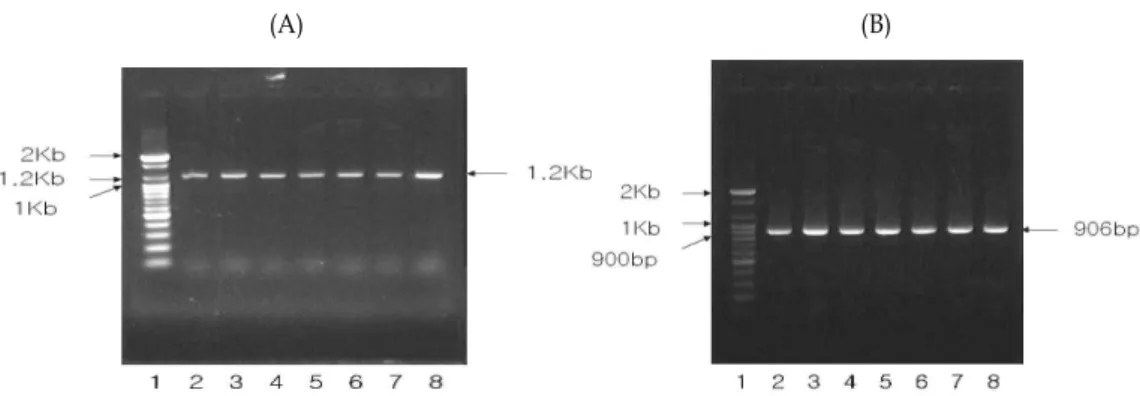
A total of 17 (25%) isolates were identified as S. zooepide- micus after negative aesculin and sodium hippurate hydrol- ysis reactions; fermentation of lactose, salicin, and sorbitol but not mannitol, raffinose and trehalose; negative CAMP reaction and other biochemical characteristics determined by using MicroLog (BIOLOG , USA) (Table 2). All isolates were confirmed by sodA-seeI PCR giving a positive sodA (235 bp) and a negative seeI reaction (Fig. 1), also positive for the SzP and the CNE encoding gene with amplicon sizes of approx- imately 1,200 bp and 906 bp, respectively (Fig. 2). Younan et al. [29] reported that the sodA and CNE encoding gene sizes of S. zooepidemicus isolated from camels and camel milk were 235 bp and 900 bp, respectively, and the SzP encoding gene sizes ranged from 1,075 bp to 1,225 bp. Alber et al.

[2] reported that the sizes of PCR product using sodA-

Table 2. Frequencies of S. equi subsp. zooepidemicus isolated from horse

Sources No. of

horse No.of S. equi subsp.

zooepidemicus (%) Fetus and uterine contents

Vaginal mucosa

2 66

2 (100.00) 15 ( 22.72)

Total 68 17 (25.00)

(3)

(A) (B)

Fig. 2. PCR products of 1200 bp (A) and 906 bp (B) fragments of SzP and CNE encoding gene of S. equi subsp . zooepidemicus , respectively. Lane 1: 100 bp ladder marker (Bioneer, Korea), Lane 2-7: vaginal mucosa, Lane 8: aborted equine fetus.

Fig. 3. Random amplified polymorphic DNA-PCR banding patterns of S. equi subsp . zooepidemicus isolates from horses. Lane M:

100 bp ladder marker (Elpisbiotech, Korea), Lane 1-15: vaginal mucosa, Lane 16: uterine contents, Lane 17: aborted equine fetus.

Fig. 1. Gel electrophoresis of PCR products of S. equi subsp . zooepidemicus with sizes of approximately 235 bp using sodA–seeI specific multiplex PCR. Lane 1: 100 bp ladder marker (Bioneer, Korea), Lane 2-7: vaginal mucosa, Lane 8: aborted equine fetus.

seeI oligonucleotide primers for identification of S. equi subsp. equi and S. zooepidemicus were approximately 230 bp and 520 bp, respectively. These results were almost consistent with results of this study. These molecular analysis are potentially useful in identifying and charac- terizing S. zooepidemicus strains, although an epidemio- logical relationship could not be confirmed with molec- ular methods.

RAPD has been used for typing a number of medically important bacteria, fungi and parasites [30]. It is a simple tool for the identification of closely related species and as-

sessment of their genetic relationships. In this study, all isolates were divided into 4 cluster by RAPD typing (Fig.

3). Group 1 (No. 2, 3, 5, 6, 7, 11, 12, 13, 14, 15), group 2 (No. 4, 9), group 3 (No. 10, 16, 17), and group 4 (No. 1, 8). In group 3, No. 16 and 17 isolates isolated from equine uterine contents and equine aborted fetus, respectively, were indistinguishable from No. 10, but an epidemiological relationship could not be confirmed with RAPD typing.

The results of this study suggest that a limited epidemio- logical relationship between the strains from Jangsu (No.

10) and Jeju (No. 16 and No. 17). Further studies are re- quired to determine the epidemiological relationships of S.

zooepidemicus infection and the opportunistic pathogenic character in horses.

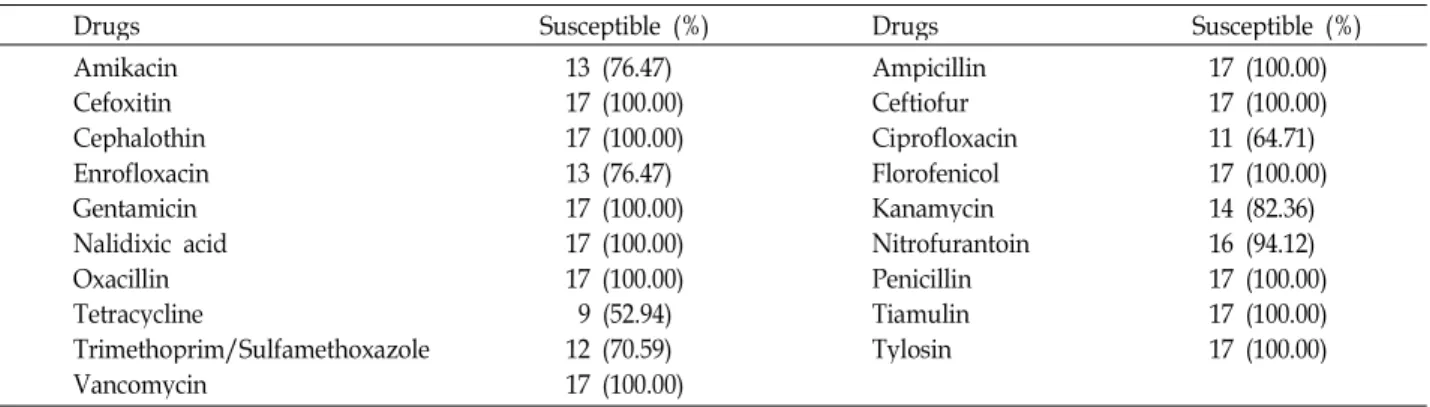
All isolates showed high susceptible to ampicillin, cefox- itin, ceftiofur, cephalothin, florofenicol, gentamicin, nalidixic acid, oxacillin, penicillin, tiamulin, tylosin and vancomycin in antimicrobial susceptibility tests (Table 3). These results show that β-lactams, enrofloxacin and gentamicin could be recommended as empiric antimicrobial therapy in cases of endometritis caused by S. zooepidemicus in horses [24]. The common infectious causes of equine abortions are EHV-1, S. zooepidemicus, Escherichia coli, and Leptospira spp. [16,18].

S. zooepidemicus is an important pathogen of the horse being

(4)

Table 3. Results of antimicrobial susceptibility tests of 17 S. equi subsp. zooepidemicus isolates

Drugs Susceptible (%) Drugs Susceptible (%)

Amikacin Cefoxitin Cephalothin Enrofloxacin Gentamicin Nalidixic acid Oxacillin Tetracycline

Trimethoprim/Sulfamethoxazole Vancomycin

13 (76.47) 17 (100.00) 17 (100.00) 13 (76.47) 17 (100.00) 17 (100.00) 17 (100.00) 9 (52.94) 12 (70.59) 17 (100.00)

Ampicillin Ceftiofur Ciprofloxacin Florofenicol Kanamycin Nitrofurantoin Penicillin Tiamulin Tylosin

17 (100.00) 17 (100.00) 11 (64.71) 17 (100.00) 14 (82.36) 16 (94.12) 17 (100.00) 17 (100.00) 17 (100.00)

associated with respiratory tract infections of foals and with uterine infections in mares. Also, this bacterium can be iso- lated from a wide variety of animals including pigs, sheep, cows, goats, dogs, foxs, birds, rabbits and guinea pigs [11,23,27]. S. zooepidemicus has been indicated as the most frequent bacterium isolated from the aborted equine fetus according to the several reviews [14,16,18-20,26]. Several spe- cies such as Escherichia coli, Staphylococcus aureus, and Pseudomonas aeruginosa were isolated from the genital tract in Thoroughbred mares [12]. Although it was reported to be isolated from genital organs of normal and subfertile mares [15], no investigation has reported isolation from an aborted equine fetus in Korea. These results may provide the basic information to establish strategies for the treatment and prevention of reproductive disease in mares in Korea, and further studies will be needed for much more profound understanding of the role of microbiologic agents associated with reproductive disease.

Acknowledgements

This study was supported by Technology Development Program for Agriculture and Forestry (108175-03-1-CG000), Ministry for Agriculture, Forestry and Fisheries, Republic of Korea.

References

1. Abdulmawjood, A. and C. H. Lammler. 2000. Determination of intraspecies variations of the V2 region of the 16S rRNA gene of Streptococcus equi subsp. zooepidemicus. Res. Vet. Sci . 68, 33-39.

2. Alber, J., A. EI-Sayed, C. Lammler, A. Hassan, R. Weiss, and M. Zschock. 2004. Multiplex polymerase chain reaction for identification and differentiation of Streptococcus equi subsp. zooepidemicus and Streptococcus equi subsp. equi. J. Vet.

Med . 51, 455-458.

3. Allpress, R. G. 1997. The treatment of lower airway disease in a group of young Thoroughbreds in training. Equine Vet.

Ed . 9, 68-71.

4. Anzai, T., T. A. Walker, M. B. Blair, T. M. Chambers, and J. F. Timoney. 2000. Comparison of the phenotypes of Streptococcus zooepidemicus isolated from tonsils of healthy horses and specimens obtained from foals and donkeys with pneumonia. Am. J. Vet. Res . 61, 162-166.

5. Anzai, T., J. F. Timoney, T. Kuwamoto, R. Wada, M.

Oikawa, and T. Higuchi. 2002. Polymerase chain reaction restriction fragment length polymorphism analysis of the SzP gene of Streptococcus zooepidemicus isolated from the res- piratory tract of horses . Am. J. Vet. Res. 63, 1298-1301.

6. Balter, S., A. Benin, S. W. Pinto, L. M. Teixeira, G. G. Alvim, D. Luna Jackson, L. Laclaire, J. Elliot, R. Facklam, and A.

Schuchat. 2000. Epidemic nephritis in Nova Serrana, Brazil.

Lancet. 355, 1776-1780.

7. Barnham, M., T. J. Thornton, K. Lange. 1983. Nephritis caused by Streptococcus zooepidemicus (Lancefield group C).

Lancet. 1, 945-948.

8. Bauer, A. W., W. M. M. Kirby, and J. C. Sherris. 1966.

Antibiotic susceptibility testing by a standardized single disk method. Am. J. Clin. Pathol. 45, 493-496.

9. Bert, F., B. Picard, C. Branger, and N. Lambert Zechovsky.

1996. Analysis of genetic relationships among strains of group A, C and G streptococci by random amplified poly- morphic DNA analysis. J. Med. Microbiol. 45, 278-284.

10. Bordes-Benitez, A., M. Sanchez-Onoro, P. Suarez-Bordon, A. J. Garcia-Rojas, J. A. Saez-Nieto, A. Gonzalez-Garcia, I.

Alamo-Antunez, A. Sanchez-Maroto, and M. Bolanos-Rivero.

2006. Outbreak of Streptococcus equi subsp. zooepidemicus in- fections on the island of Gran Canaria associated with the consumption of inadequately pasteurized cheese. Eur. J.

Clin. Microbiol. Infec. Dis. 25, 242-246.

11. Chalker, V. J., H. W. Brooks, and J. Brownlie. 2003. The association of Streptococcus equi subsp. zooepidemicus with ca- nine infections respiratory disease. Vet. Microbiol . 95, 149-156.

12. Choi, S. K., S. G. Lee, J. H. Yang, and G. J. Cho. 2007.

Distribution and antimicrobial susceptibility patterns of bac-

teria isolated from genital tract in Thoroughbred mares. J.

(5)

Vet. Clin . 24, 19-25.

13. Cowan, S. T. and K. J. Steel. 1993. Cowan and Steel’s Manual for the Identification of Medical Bacteria, third ed.

Cambridge University Press, Cambridge.

14. Dawlat, A., R. Orman, I. Essam, and M. Ahmed. 2002.

Abortion and stillbirth in Arabian mare: clinical, etiological and pathological studies in Arabian mare. Assiut. Vet. Med.

J. 47, 279-295.

15. Erdeger, J., M. Akan, A. Dakman, G. Altay, R. Vural, and M. Celebi. 1999. Kisraklarin genital organlarrindan izole ed- ilen β-hemolitik streptokok’larin identifikasyonu ve serogruplanirilmasi. Ankara. Univ. Vet. Fak. Derg. 46, 69-76.

16. Giles, R. C., J. M. Donahue, C. B. Hong, P. A. Tuttle, M.

B. Petrites-Murphy, K. B. Poonacha, A. W. Roberts, R. R.

Tramontin, B. Smith, and T. W. Swerczek. 1993. Causes of abortion, stillbirth, and perinatal death in horses: 3527 cases (1986-1991 ). J. Am. Vet. Med. Assoc. 203, 1170-1175.

17. Hashikawa, S., Y. Iinuma, M. Furushita, T. Ohkura, T.

Nada, K. Torii, T. Hasegawa, and M. Ohta. 2004.

Characterization of group C and G streptococcal strains that cause streptococcal toxic shock syndrome . J. Clin. Microbiol.

42, 186-192.

18. Hong, C. B., J. M. Donahue, R. C. J. Giles, M. B. Petrites- Murphy, K. B. Poonacha, A. W. Roberts, B. J. Smith, R. R.

Tramontin, P. A. Tuttle, and T. W. Swerczek. 1993. Equine abortion and stillbirth in central Kentucky during 1988 and 1989 foaling seasons . J. Vet. Diagn. Invest . 5, 560-566.

19. Julian, A. F. 1992.Equine abortions in New Zealand between 1974 and 1990. Surveill Wellington . 19, 24-25.

20. Kocabiyik, A. L., G. Sonmez, M. Ulgen, C. Ozakin, E.

Kocakaya, and A. Alasonyalilar. 2005. Abortion due to Streptococcus equi subsp. zooepidemicus in a mare. Turk. J. Vet.

Anim. Sci . 29, 937-940.

21. Kuusi, M., E. Lahti, A. Virolainen, M. Hatakka, R. Vuento, L. Rantala, J. Vuopio-Varkila, E. Seuna, M. Karppelin, M.

Hakkinen, J. Takkinen, V. Gindonis, K. Siponen, and K.

Huotari. 2006. An ourbreak of Streptococcus equi subsp. zooe- pidemicus associated with consumption of fresh goat cheese.

BMC. Infect. Dis . 6, 36-41.

22. Lannergard, J., L. Frykberg, and B. Guss. 2003. CNE, a colla- gen-binding protein of Streptococcus equi. FEMS. Microbiol.

Lett. 222, 69-74.

23. Las Heras, A., A. I. Vela, E. Fernandez, E. Legaz, L.

Dominguez, and J. F. Fernandez-Garayzabal. 2002. Unusual outbreak of clinical mastitis in dairy sheep caused by

Streptococcus equi subsp. zooepidemicus . J. Clin. Microbiol . 40, 1106-1108.

24. Luque, I., J. F. Fernandez-Garayzabal, V. Blume, A.

Maldonado, R. Astorga, and C. Tarradas. 2006. Molecular typing and anti-microbial susceptibility of clinical isolates of Streptococcus equi spp. zooepidemicus from equine bacterial endometritis. J. Vet. Med. B . 53, 451-454.

25. Pisoni, G., R. N. Zadoks, C. Vimercati, C. Locatelli, M. G.

Zanoni, and P. Moroni. 2009. Epidemiological investigation of Streptococcus equi subspecies zooepidemicus involved in clinical mastitis I dairy goats. J. Dairy. Sci . 92, 943-951.

26. Smith, K. C., A. S. Blunden, K. E. Whitwell, K. A. Dunn, and A. D. Wales. 2003. A survey of equine abortion, still- birth and neonatal death in the UK from 1988 to 1997 . Equine Vet. J. 35, 496-501.

27. Soedarmanto, I., F. H. Pasaribu, I. W. T. Wibawan, and C.

Lammler. 1996. Identification and molecular character- ization of serological group C streptococci isolated from dis- eased pigs and monkeys in Indonesia. J. Clin. Microbiol . 34, 2201-2204.

28. Timoney, J. F. 2004. The pathogenic equine streptococci. Vet.

Res . 35, 397-409.

29. Younan, M., A. T. S. Estoepangestie, M. Gengiz, J. Alber, A. El-Sayed, and C. Lammler. 2005. Identification and Molecular Characterization of Streptococcus equi subsp. zooe- pidemicus Isolated from Camels ( Camelus dromedaries ) and Camel Milk in Kenya and Somalia. J. Vet. Med. B . 52, 142-146.

30. Van Belkum, A. 1994. DNA fingerprinting of medically im- portant microorganisms by use of PCR. Clin. Microbiol. Rev.

7, 174-184.

31. Vogel, L., G. Jones, S. Triep, A. Koek, and L. Dijkshoorn.

1999. RAPD typing of Kelbsiella pneumoniae, Klebsiella oxy- toca, Serratia marcescens and Pseudomonas aeruginosa isolates using strandardized reagents. Clin. Microbiol. Infect . 5, 270- 32. Walker, J. A. and J. F. Timoney. 1997. Molecular basis of 276.

variation in protective SzP proteins of Streptococcus zooepidemicus . Ad. Exp. Med. Biol. 418, 611-613.

33. Yoshikawa, H., T. Yasu, H. Ueki, T. Oyamada, H. Oishi,

T. Anzai, M. Oikawa, and T. Yoshikawa. 2003. Pneumonia

in horses induced by intrapulmonary inoculation of

Streptococcus equi subsp. zooepidemicus . J. Vet. Med. Sci . 65,

787-792.

(6)

초록:더러브렛 말에서 분리한 Streptococcus equi subsp. zooepidemicus 의 RAPD 분석 및 약 제 감수성

최성균 · 박용수

1

· 조광현

1

· 조길재*

(경북대학교 수의과대학,

1

경상북도 축산기술연구소)

Streptococcus equi subsp. zooepidemicus 는 말의 생식기 질환을 유발하는 중요한 병원체 중 하나로서 국내 말의 생산성

향상을 도모할 목적으로 제주도에서 사육중인 더러브렛 암말의 유산태아 및 그 말의 자궁내용물과 장수목장에서 암말

의 교배전 생식기 질환이 의심되는 말의 질 내용물로부터 시료를 채취하여 Streptococcus equi subsp. zooepidemicus 을

분리하여 그 분리균의 특성 및 항균제 감수성 검사를 실시한 결과, RAPD typing에서는 크게 4개의 cluster로 구분되었

다. 특히 제주도에서 분리한 균주와 장수목장에서 분리한 하나의 균주가 동일한 pattern을 나타내었다. 항균제 감수성

검사에서는 대부분의 균주가 ampicillin 등의 약제에 감수성이 있음을 확인하였다. 본 연구의 결과는 국내에서 사육중

인 암말의 생식기 질병의 예방 및 치료에 유용할 것으로 생각된다.

수치

Table 1. Oligonucleotide primers used in this study Primers Sequence (5’-3’) Sod A F-CAGCATTCCTGCTGACATTCGTCAGG R-CTGACCAGCCTTATTCACAACCAGCC See I F-GAAGGTCCGCCATTTTCAGGTACTTTG R-GCATACTCTCTCTGTCACCATGTCCTG SzP F-ACAAAAGGGGAATAAAATGGC R-TTTACCACTGGGGTATAAG
Fig. 3. Random amplified polymorphic DNA-PCR banding patterns of S. equi subsp . zooepidemicus isolates from horses
Table 3. Results of antimicrobial susceptibility tests of 17 S. equi subsp. zooepidemicus isolates

참조

관련 문서

모든 사항 숙지 후, 동의하고 수강신청 진행... 연수지명번호 입력

전문기관에서 개발한 초등학교, 중학교, 고등학교 별 STEAM 프로그램 교사용 지도서 및 학생 활동지를

[r]

학술연구단체나 기술연구단체가 학술연구 또는 기술연구와 관련하여 공급하는 재화 또는 용역 (「산업교육진흥 및 산학연협력촉진에 관한 법률」에 따라

학교・유관기관・지역사회 협력

[r]

– 자신이 선택하는 직업 진로에 입문하기

융합인재교육의 개념을 이해하고 교육내용을 재구성하며, 나... 초․중․고등학생용 융합인재소양