Daehan Hwahak Hwoejee Volume 9, Number 3, 1965 Printed in Republic of Korea.
The Crystal Structure of Nicotine Dihydroiodide
by
Chung Hoe Koo and Hoon Sup Kim*
Department of Chemistry, College of Liberal Arts and Sciences, Seoul National University
(Received Aug. 7, 1965)
Nicotine Dihydroiodidc 의 結晶構造
서울大學校 文理科大學 化學科
具廷•會-金 勲 燮*
(1965. 8. 7 受理)
要 約
니코턴 二沃化水素酸鹽의 結晶은 直角非等軸結晶系, ( 斜方晶系) 에 屬하며 空間群은 P2021 이다. 單位格子
의 크기는 & = 7.61, 3 = 11.01 및 c = 17. 27 A 이며 單位格子안에 들어 있는 化學單位의 數는 4 이다.
이 結晶의 構造를 X-線廻折法에 依하여 解析하였으며 R 値 习 丨 丨 矽 一 丨电 丨 街 丨 가 FOki 와 如 에 關하여 各各 0. 16 및 0.14 의 값을 이룰 때까지 精密化하였다.
原子間 距離의 精密化를 試圖하지는 않었지만 피리딘 고리 안의 c —C 및 C—N의 平均距離는 各各 L40 및 1. 35 A 이며 피롤리딘 고리에 있어서는 各各 1. 56 및 1.48 A 의 값을 가진다
피리딘 고리 內의 各原子는 實驗誤差內에서 同一平面上에 있으며 피롤리딘 고리에서는 c 6j c 7 , c 8 및 n 2
原子는 大略 同一平面上에 있으나 C9 는 이 平面으로 부터 糸勺 0. 22 A 떨어저 있다.
피리 딘 고리의 平面과 C 6 , C 7, C 8 및 N2 가 이 루는 平面의 各 法線은 約 94° 의 角을 이 루고 있다. 니코틴 二 沃化水素酸鹽의 한 分子內의 두個의 요오드 原子中 한개 는 피리딘 고리의 窒素原子와 3.55 A 의 距離로 連結 되여 있으며 다른 한개는 피롤리딘 고리의 窒素原子와 3. 58 A의 距離로 連結되여 있다. 結晶內에서 各.分子 는 Van der Waals force 로 서 로 接觸되 여 있 다.
Abstract Cio
八、/k ..
Crystals of nicotine dihydroiodide, C2 C4 — — Cg • 2HI, are orthorhombic with space group F2i2i2i.
I II I I Ci C5 ---
The unit cell, of dimensions <z = 7. 61, 3 = 11.01, e = 17. 27 A, contains four formula units. The structure has been determined by X-ray diffraction method and has been refined to give the R-inclex, 2Z I I E, | — | 兀 | I 우 〜 £: 丨 I, of 0.16 and 0.14 for 瓦汨 and Fho i respectively.
Present Address: Science and Engineering Department, Naval Academy, Chinhae, Korea.
134
Vol. 9 (1965) 135 The mean lengths of C — C and C —N bonds in pyridine ring are 1. 40 and 1. 35 A and those in pyrr 이idine ring 1. 56 and 1. 48 A respectively, though accurate measurement of bond length has not been attempted.
The six atoms in the pyridine ring are coplanar and on the other hand C 6) C 7, Cg and N2 atoms in pyrr olidine ring form a plane within accuracy of the analysis, and C9 atom is distant 0. 22 A out of the plane consist of C、6, C 7 , C$, and N2 atoms. The normals to the two planes form an angle of 94° with each other.
Iodine atom is distant 3. 55 A from nitrogen atom in pyridine ring and the other iodine atom 3. 58 A from nitrogen atom in pyrrolidine ring, so that the nitrogen and iodine at이 ns are firmly linked.
It seems that the only forces binding nicotine dihydroiodide molecules together in the crystal are Van Her Waals forces.
Introduction
The nicotine, CH3
! II I I CH CH CH2— —CH 2
f/
is an alkaloid of considerably physiological importa
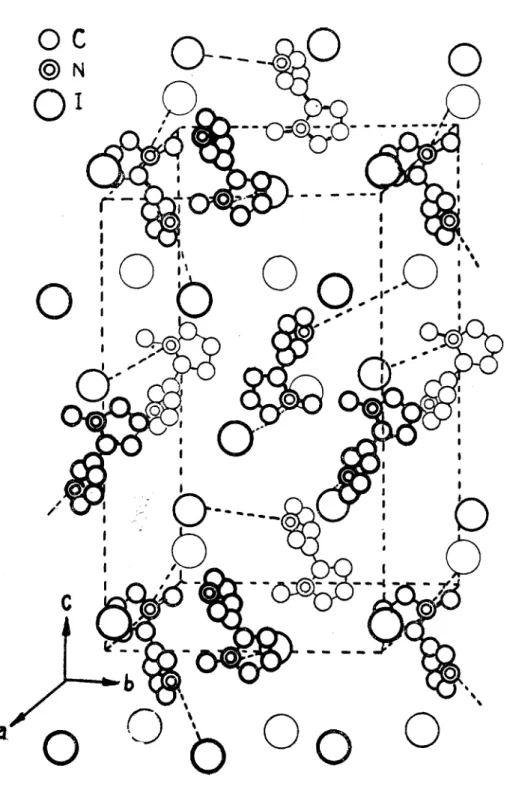
nce. Structure analysis of this compound was initiated in order to determine the shape of nicotine residue and the N…I contact in the crystal.
Experimental and Crystal Data
The nicotine dihydroiodide was prepared by reaction between nicotine in ethyl alcoholic solution and freshly prepared hydroiodic acid. And then crystals were grown by slow evaporation in a desiccator from the solution at room temperature. Its melting point was 195° C.
The crystals were thin flakes, rectangular or square in crosssection. The crystallographic axes, a and b 、 lie in the directions of plate edges. The samples used for the structure determination were reduced by slicing and dissolving to cylinder about 0.1mm. in diameter.
Rotation and Weissenberg photographs were taken around the a and b axes, using Cu一 Ka radiation.
Multiple films and visual estimation were used to obtain the intensities. The intensities were corrected for Lorentz and polarization effects, not for absorption or extinction.
The unit cell, determined by station and Weissen
berg photographs was found to be orthorhombic, with
= 61, ^ — 11.01, c = 17. 27 A. A higher degree of accuracy is not claimed because no allowance was made for film shrinkage. On the assumption of four molecules in the unit cell, the density was calculated as 1. 919 g. cm-3 .
The systematic absences determined from zero and first layer Weissenberg photographs led uniquely to 바 space group P2i2i2i.
Determination of the Structure
The structure has been determined by making use of the heavy atom method. 璀)From sharpened Patterson projections on (1 0 0) and (0 1 0) it was possible to locate the iodine atoms, h and I2 , at ^=0.50,'=
0. 60, 2=0.20 and —0. 86 0. 51, s — 0. 43 respec tively. Using the phases derived only from the positi
ons of the iodine atoms, the Fo Fourier projections on (1 0 0) and (0 1 0) were computed. At this stage of our research many difficulties were caused due to the heavy atoms in the molecule. Apart from errors in th 은 obse rved I F o I r S, owing to absorption, the diffraction effect of the iodine atoms could be enough to distort the shapes and heights of the electrondensity peaks of other atoms.
The presence of a number of peaks in Fourier maps which were not assigned to atom positions, therefore, suggested a cautious approach.
On the resulting Fourier maps projected on (1 0 0) and (0 1 0), the iodine atoms were well resolved, but the positions of the nicotine residue could not be una
mbiguously fixed. After laborious trials by spatial considerations and structure factor calculations, an approximate structure was obtained with the disagree
ment factors R=0. 18 for okl and K=0.16 for hoi
reflexions. However, it was not possible to distinguish
between the positions of the nitrogen atoms and that
of carbon atoms by the heights of electron contour in
136 具廷會•金 勲 燮 大韓化學會誌 the Fourier maps.
Second Fourier syntheses projected on (1 0 0) and (0 1 0) were calculated. The phases for the syntheses were determined by the structure factors which were calculated by using all the fourteen independent atoms in the molecule. The atomic scattering factor for carbon atom was used for 바 le all atoms in nicotine residue in the structure factor calculation because no distinction between nitrogen and carbon atoms were possible. A careful check of the second Fourier maps revealed that the peak hei 않 its of the postulated atoms increased or remained constant while the heights of the doubtful peaks decreased in general.
Yet, the distinction of the positions between nitro
gen and carbon atoms were still ambiguous. In the fifth stage of trials by structure factor calculation, the R-factor for the okl reflexion was reduced from 0.18 to 0.17 and for the hoi reflexion from 0.16 to 0.15.
In the stage of the crystal analysis interatomic dist ances between the atoms in nicotine residue and iodine
atoms were calculated. The shortest distances were 3.55 and 4. 47 A for the values between the- atoms in pyridine ring and Ii and 3. 58 and 4- 04A for the values between the atoms in pyrrolidine ring and I2.
On the other hand the shortest distance between atoms in pyridine ring and I2 was 4. 03 A and the shortest distance between atoms in pyrrolidine ring and Ii was 4. 34 A.
Considering the facts that nitrogen and carbon atoms have their own electronegativity trend and that the
Table 1 Final Parameters of the Atoms.
i
* 3 , F x y z
Ii 0.497 0.618 0. 213 c4 0. 413 0.567 0.612 I 2 0. 870 0. 525 0. 441 c5 0. 307 0. 644 0. 653
Nj 0. 355 0. 707 0.717 C6 0. 358 0. 505 0. 537 n 2 0. 40010. 528 0. 454 C7 0. 375 0. 367 0. 550 Cl 0. 523 0. 718 0. 740 C8 0. 408 0,318 0.467
c2 0. 642 0. 647 0. 69§ C9 0. 395 0, 420 0. 403
c3 0. 590 0. 576 0. 63 체 C IO 0. 353 0. 657 0. 439
Fig. 2 Electron density projection on (0 1 0).
The Contour lines are drawn an arbitrary scale.
Fig. 1 Electron density of projection on (1 0 0).
The Contour line are drawn an arbitrary
scale.
Vol. 9 (1965)
h 5 6
K 9 0
jt45G789 10ll 14 (516 ;7181 2 3 45G7 8 g 10 H 12 J?U151517
i 3 4 5 6 7 89 10 II12 13 i* i5ifi;T»!3 i 23*5 6 T J20111213 U 1516
eog
KO 0 0
J 1234567591011121314151 234 567SS10II121 23456
h o Q °
K 8 9 2
fif 181^34-567fl 9iuH i^iilSieiTl^345^7 89 19111213 14
#19® 0 0
K 9 "68 IE 2
1 0 j 2 3 4 56 789地in?洛■허 1 ? >4
K 10 U 3
£ 15[23456789 切nW I Z34 567하'JOil t 234567