Research trend of Chinese airport terminal using the Network Analysis
Siwei Liu1, Jiarong Chen2, Sung-Hoon Park1, Gi-Tae Yeo3*
1Doctoral Degree Student, Graduate school of Logistics, Incheon National University
2Master Degree Student, Graduate school of Logistics, Incheon National University
3Professor, Graduate school of Logistics, Incheon National University
네트워크 분석방법을 활용한 중국 공항터미널 연구 동향분석에 관한 연구
Siwei Liu1, Jiarong Chen2, 박성훈1, 여기태3*
1인천대학교 동북아 물류대학원 박사과정, 2인천대학교 동북아 물류대학원 석사과정
3인천대학교 동북아 물류대학원 교수
Abstract With the acceleration of economic globalization, the development of aviation logistics plays an increasingly significant role in the logistics industry. As the foundation of aviation logistics development, airport terminals are attracting increasing attention. In this respect, the aim of this research is to analyze 65 academic papers on Chinese airport terminals from 2003 to 2020 by utilizing analytic keywords of academic papers and suggest the research trend of Chinese airport terminals. The SNA was adopted as research methodology. Airport Terminal, Boned, and Chinese Mainland were the keywords for the first period (2003-2008), while the second period (2009-2014) included the keywords such as China, DEA, Airport, and Flight Delay. For the third period (2015-2020), Airport Competitiveness and Aviation Network were also highly connected keywords. This indicates that with the growth of the economy, the research trend of China’s airport terminals has been gradually expanding from infrastructure construction to network development. The results have implications on suggesting the research trend of Chinese airport terminals, and providing insights to the policy makers, academics, and practitioners in neighboring countries including Korea.
Key Words : China, Airports, Logistics, Network Analysis, Research Trend
요 약 글로벌 경제의 가속화와 더불어 물류산업에 있어서 항공물류는 점차 중요한 역할을 담당하고 있다. 항공물류산 업의 기초로서 공항터미널은 큰 주목의 대상이 되고 있다. 본 연구는 중국 공항터미널의 연구동향을 분석하는 것을 연구의 목적으로 하였으며, 2003년부터 2020년까지 65개 해외 논문의 키워드를 추출하고 SNA방법을 이용하여 분석 하였다. 첫 번째 기간 (2003-2008)은 "Airport Terminal", "Boned" 및 "Chinese Mainland"와 같은 키워드가 상위 키워드로 도출되었다. 두 번째 기간 (2009-2014)의 결과는 "China", "DEA", "Airport" 및 "Flight Delay"와 같은 키워드들이 도출되었고, 세 번째 기간(2015-2020)에는 "Airport Competitiveness"와 "Aviation Network"등의 키 워드가 상위로 나타났다. 본 연구의 결과는 경제의 성장에 따라 중국 공항터미널의 연구동향은 공항시설 건설에서 네트 워크 개발로 점차 확대되는 것을 확인할 수 있다. 본 연구는 중국 공항터미널의 연구동향을 분석하였으며, 향후 한국을 포함한 인근국가의 정책입안자, 학계, 실무자에게 시사점을 제공한다.
주제어 : 중국, 공항, 물류, 네트워크분석, 연구 동향
This work was supported by Incheon National University Research Grant in 2020.
*Corresponding Author : Gi-Tae Yeo([email protected])
Received August 21, 2020 Revised September 28, 2020 Accepted November 20, 2020 Published November 28, 2020
1. Introduction
With the continuous expansion of global integration, aviation logistics plays an indispensable role in the development of the logistics industry. After World War II, the established airline network provided the basic conditions for the development of aviation logistics. China’s aviation logistics highly expanded in the period of rapid economic growth after the Chinese economic reform in 1978 [1].
The central and local governments have continuously increased their investments in the construction of civil airports.
In the decades following the reform and joining the world markets, China has quickly become the world’s factory and supply chain, providing commodities and raw materials to many countries and regions around the world and becoming an important global trading partner. Simultaneous with the progress of aviation logistics, the construction and development of airports have become significant parts of aviation logistics[2].
China has a vast territory, and the development of airports is directly proportional to economic growth. The presence of a high-traffic airport has a positive effect on the local domestic economy.
Furthermore, the Chinese airport network has an important impact on the advancement of the world economy.
In the context of economic globalization, expanding the air transport network is a powerful measure to improve airport competitiveness, which directly affects economic development. For airports, to achieve competitiveness, expanding the air transport network is crucial. Furthermore, to increase the quality of the network, connecting the hub airports, which has a high centrality degree, is urgent. Simultaneously, promoting the exploitation of airports with a relatively low centrality degree is essential.
There is an abundance of academic studies on Chinese airports. Many scholars focused on the
efficiency (Zhang et al., 2012) [3], competitiveness (Cui et al., 2017) [4], connectivity (Huang & Wang, 2017) [5], and other aspects of the airports (Zhang et al., 2010) [6]; while some scholars have devoted research to the transportation network (Fung et al., 2008) [7] and spatial distribution (Chen et al., 2016) [8]; however, there is almost no research on the development trend of airports.
In this respect, the aim of this research is to analyze the research trend of Chinese airports.
First, keywords were collected from various academic papers related to Chinese airports, and then SNA (Social Network Analysis) was used to construct an aviation logistics web to analyze the degree centrality, betweenness centrality, and the closeness centrality of each keyword. Through the visual matrix diagram, some correlation points of the development trend of Chinese airports in different periods have been identified.
This is the first study that suggest the research trend of Chinese airports which focused on latest 17 years. It provides a comprehensive evaluation framework of multimodal shipping routes and offers references for decision-makers when dealing with similar problems. The results will provide insights to the policy makers, academics, and practitioners in neighboring countries including Korea.
2. Literature Review of China’s Logistics
China have grown economically since from 21st century with high income and demand of global market. Especially the aviation logistics are sharply going up[9]. With this phenomenon, many researchers have focused on Chinese airports.
Some researchers have focused on airport efficiency, and some have shown interest in airport infrastructure.
Below studies are approaching to chinese airport by measuring efficiency.
Wang and Song [10] evaluates chinese airport efficiency using Network DEA model and Grey model as a prediction method. They used tree parted variables. The variables are as follows. For initial inputs, runway, passenger terminal area are used, and for intermediate outputs/inputs, processed passengers, processed cargo and aircraft movements are inserted. finally. airport total revenues, airport net income are included in final output. the result shows that HKG will appears highest efficiency among whole DMUs of this research. Author classified airport by operationally efficient airports and financially efficient airports and suggest that chinese airport have weakness at financial efficiency compare operation efficiency.
Lu et al. [11] adopted the DEA method to analyze the efficiency of 27 Chinese airports during the period from 2014 to 2018. It was found that it is feasible and reliable to consider the weighted variables using the CFPR method.
Jiang et al. [12] utilized a three-stage method framework based on the DEA to reveal the existence and characteristics of technology spillovers between alliance airports and to determine whether the technology spillovers of alliance airports are more effective than the development of alliance airports. They found that the technology spillover of airport alliance has not been widely spread in all alliance airports, which is likely because China’s civil aviation industry is still in a rapid development stage.
Fan, Wu and Zhou [13] applied the directional distance function to evaluate the technical efficiency of 20 major airports in China from 2006 to 2009. It was shown that the overall average efficiency of Chinese airports increased with time.
Chang et al. [14] conducted DEA analysis for chinese airport. They considered business hour, runway as input variables, and movement, passengers and mail/cargo as outputs variables. In addition, this analysis included city level, the distance to CBD(Central Business District), flight
area, number of destinations, number of airlines served and number of international routes to compare each other. The result showed that the city of level 1 had the highest pure technical efficiency and the distance to CBD is not effect to efficiency. But, about freight area, 4F, 4E flight area grades are more efficient than other flight area. This study present considering divers method of approach utilizing modified DEA.
Liu et al. [15] conducted an annual passenger flow survey of an airport in China. Then they used a prediction model to accurately estimate the total occupant numbers in the departure process.
Huang and Wang [16] approached china airport as a hub port. They conducted compare analysis of indirect connection about china hub port during 2005 and 2015. They used weighted indirect connectivity (WIC). As the result, Beiging- Capital, Shanghai- Pudong, and Guangzhou- Baiyun are appeared as a high hub airport, and they show that they can be considered to provide indirect connectivity to passengers. The study can be extended to the whole region network analysis.
Zhang et al. [17] calculated the connectivity of 69 Chinese airports and identified the potential drivers of changes in airport connectivity over the period from 2005-2016. It was found that the existence of low-cost airlines is conducive to air connectivity, while a high-speed rail can reduce airport connectivity.
Cui et al. [18] discussed the dynamic formation mechanism of airport competitiveness in the case of China. The results showed that airport investment and urban R&D investment are two important factors affecting airport competitiveness, which can provide guidance for decision makers related to airport competitiveness cultivation.
2013 Chang, Yu, and Chen [19] assessed the influence of geographical characteristics and service strategy on airport performance in China.
The results showed that the airports in cities with a population of more than two million are more efficient than those in other cities.
In addition, SNA, a research method used in this study, is used in other studies as follows.
Behrouzi et al.[20] adopted SNA to grasp scientific research trends. Authors found out 106 papers of journal and 20 of conferences paper.
And nodes degree, local clustering coefficient, eigenvector centrality and community score are presented. According to this researchers, through SNA, future construction can be predicted, and can help to decide related issue.
Schodl et al[21] used SNA to mapping sustainability in pig farming. To collect keyword data, research paper, review paper, publications about livestock, and the title contains one of the following words pig, swine, livestock or farm animals contents or material etc. were used.
Degree centrality, betweenness centrality and clusters and topics concept. were analyzed. Author mentioned that keyword network able to map research areas and help researchers to obtain an overview on research idea or topic.
Li et al. [22] adopted SNA to study the structure of technology licensing. Author used ‘technology license“ by keyword to search, and found out 5,665 journal paper from 2005 to 2016. Degree centrality and k-mean concept was used, and finally
”cognitive radio“ was appeared to the highest keyword. through this study, the topics related to technology licensing were classified, also the trend of this filed was well appeared by using SNA.
As above, study adopting SNA have utilized and in domestic journal are also using SNA with activity.
Heo [23] used SNA for maritime policy research trend, Baek and Shin[24], Jung and Choi[25], Kim and Lim [26] utilized to education area.
SNA methodology is widely used to at diverse research field, and we adopted SNA to understand chinese airport terminal research field.
And about Chinese airport research, in general, some researchers have analyzed the development of Chinese airports using different methods and different views however, there is scant research focusing on analyzing the research trend of
Chinese airports. Hence, this study fills a research gap by using the SNA approach for analysis.
3. Research Methodology
To review Chinese airport research, the keyword network methodology was adopted to analyze the research trend of Chinese airports. A keyword network is a social network analysis method, and the core concept of the SNA method is to analyze the connections between various nodes. Keywords are regarded as nodes in the analysis process, and if there is a connection between two keywords, they can be defined as a link node. By analyzing the connection of each node, the centrality of each node can be found.
This study focused on three centralities: degree centrality, betweenness centrality, and closeness centrality (Freeman,1978)[27]. Through these centralities, the network of Chinese airports and the relationship between the research and the keywords can be discovered.
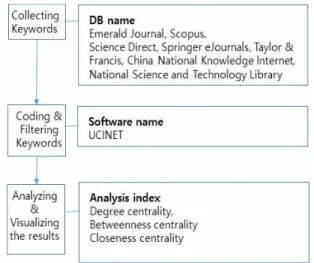
The schematic diagram of research flow is shown in Fig. 1. The first step is to gather the academic papers related in Chinese airport terminals, and next step is to extract the keywords of papers and code them. And thrid step is to analyze the coded data and visualize the network diagrams using the network analysis software, UCINET.
Fig. 1. Research flow
First, degree centrality is based on the relationship between each node. It calculates the number of links connected to other node. Nodes with more links are recoded with a high centrality.
On the other hand, nodes with fewer links are recorded with a low centrality. The following equation was used to calculate degree centrality in this study.
is the number of nodes existing in a network, and means that a specific node connected from a specific node or specific node is connected to specific node . If the specific node is not connected to specific node , it indicates
.
(1)
Second, betweenness centrality measures how the node functions as a broker role in the network. It calculates the connection when a node located between central network and other nodes.
When the node exists between other nodes, the node is recorded as having a high betweenness centrality.
The equation for betweenness centrality is expressed as follows:
(2)
is the number of the shortest paths when specific node is connected to specific node ; or specific node is connected to specific node .
is the number of times specific node is included in the link when specific node and are connected to each other.
Third, closeness centrality shows how nodes play a central role in the entire network. If a node has shorter links with other nodes, the node has a high closeness centrality.
Equation (3) was used to calculate the closeness centrality for this research.
(3)
is the number of nodes in the network, and
is the number of links needed for a connection when specific node is connected to specific node or specific node is connected to specific node .
4. Case Study
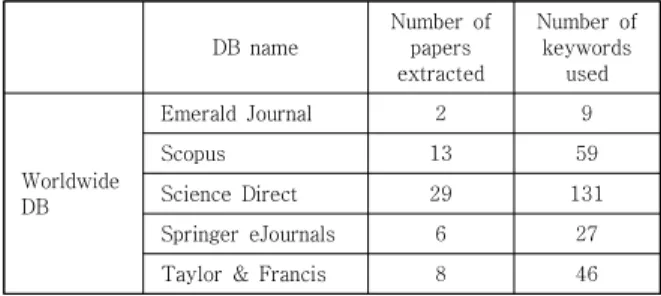
Before conducting the research and the analysis, the first step was to search for relevant papers on academic databases and to collect the required data from them. The data presented mainly originated from Science Direct, Scopus, Springer eJournals, Emerald Journal, and Taylor &
Francis, and some data were collected from the China National Knowledge Internet (CNKI) and the National Science and Technology Library (NSTL). After data collection, the data were evaluated, and the key words were identified for the data analysis. According to the search results, 63 papers were published from 2003 to 2020. The structure of the information of selected paper is shown in Table 1. In addition, the DBs of keywords extracted and the number of keywords used are indicated in Table 2. 295 keywords are used in the analysis.
DB Name
Paper
title Author(s) Journal Name
Keywords Used
Year Published
Table 1. Structure of information of selected papers
DB name
Number of papers extracted
Number of keywords
used
Worldwide DB
Emerald Journal 2 9
Scopus 13 59
Science Direct 29 131
Springer eJournals 6 27
Taylor & Francis 8 46
Table 2. Resources of keyworkds used
The outbreak of the subprime mortgage financial crisis in 2008 affected the global economy, and the demand of the international market decreased due to the impact of the financial crisis. Undoubtedly, China’ s foreign trade industry was also greatly affected. To reduce the impact of the financial crisis, the Chinese government introduced a series of policies to stimulate and to boost domestic demand.
Subsequently, the foundation of aviation logistics development was also affected. In 2014, to promote the development of the logistics industry, the State Council of China issued the medium-and long-term plans for the advancement of the logistics Industry.
As airports are the material basis of aviation logistics, the development trend of China’ s airports would surely be affected by this plan. To conduct more accurate research, this study was divided into three periods with 2008 and 2014 as the reference boundary points, i.e., from 2003 to 2008, from 2009 to 2014, and from 2015 to 2020.
4.1 Period from 2003 to 2008
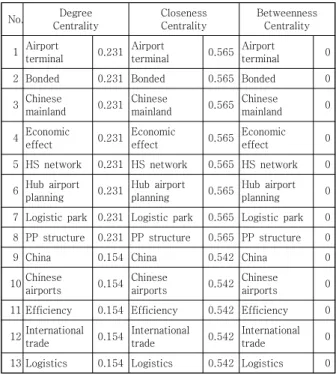
Fig. 2 is a visual representation of the period from 2003-2008. Table 3 shows the value of degree centrality, betweenness centrality, and closeness centrality, which are arranged from high to low. Because there were few studies on Chinese airports in the period from 2003-2008, the value of betweenness centrality is 0. The airport is a vital infrastructure for the air transport system.
Since the reform and opening up, especially after the beginning of the 21st century, both the scale and number of Chinese airports have achieved rapid growth. After China joined WTO in 2000, total foreign trade dramatically increased.
Following the increase in foreign trade, China’s aviation logistics industry also developed rapidly, which promoted the growth of China’s airports.
Focusing on the two numerical lists of degree centrality and closeness centrality, it can be observed that the top three keywords are the same. The three nodes, Airport Terminal, Boned, and Chinese Mainland are centrally located in the network. Next, there is Economic Effect, HS Network (Hub and Spoke Network), and Hub Airport Planning. This indicates that the infrastructure conditions of Chinese airports had a considerable influence on the development of airports in this period followed by the impact of economic growth.
Fig. 2. Result of visualizing in first period (2003-2008)
No. Degree
Centrality
Closeness Centrality
Betweenness Centrality
1 Airport
terminal 0.231 Airport
terminal 0.565 Airport
terminal 0
2 Bonded 0.231 Bonded 0.565 Bonded 0
3 Chinese
mainland 0.231 Chinese
mainland 0.565 Chinese
mainland 0
4 Economic
effect 0.231 Economic
effect 0.565 Economic
effect 0
5 HS network 0.231 HS network 0.565 HS network 0
6 Hub airport
planning 0.231 Hub airport
planning 0.565 Hub airport
planning 0
7 Logistic park 0.231 Logistic park 0.565 Logistic park 0 8 PP structure 0.231 PP structure 0.565 PP structure 0
9 China 0.154 China 0.542 China 0
10Chinese
airports 0.154 Chinese
airports 0.542 Chinese
airports 0
11 Efficiency 0.154 Efficiency 0.542 Efficiency 0
12International
trade 0.154 International
trade 0.542 International
trade 0
13 Logistics 0.154 Logistics 0.542 Logistics 0
Table 3. Keyword sequencing of the three centralities from 2003-2008
Chinese DB
China National
Knowledge Internet 2 9
National Science and
Technology Library 3 14
4.2 Period from 2009 to 2014
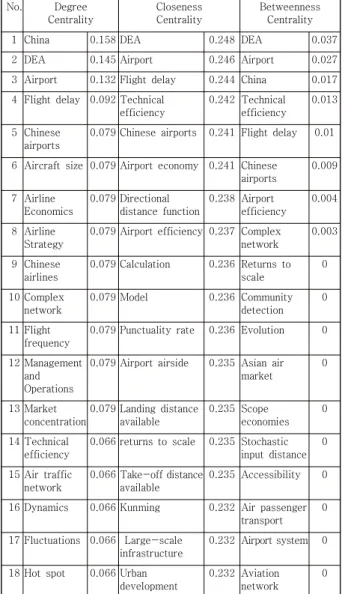
Fig. 3 presents the intuitive network analysis diagram from 2009 to 2014, and Table 4 provides the numerical list for this period. In the sequence of degree centrality, the top three nodes are China, DEA, and Airport. In the sequence of closeness centrality, the top three are DEA, Airport, and Flight. The top three for the betweenness centrality value list includes China, DEA, and Airport. From the numerical ordering of degree centrality, betweenness centrality, and closeness centrality, there are minor differences in the ordering of the three centralities; however, China, DEA, and Airport are all keywords with high connectivity and are the central nodes of the network. Subsequently, Flight Delay, Technical Efficiency, Chinese Airport, and Airport Economy are listed.
This indicates that during this period, apart from the development of airport infrastructure, the economy was a significant factor influencing the development of Chinese airports. The 2008 financial crisis greatly impacted the world economy, and China was no exception. Therefore, China’s economic growth even after the financial crisis is still under the influence of the financial crisis, and the development of Chinese airports during this period was more inclined to the exploitation of airport infrastructure, efficiency, and economy aspects.
Specially, the analysis of airport efficiency has become a common activity in aviation industry for this period. This is because the results of analyzing airport efficiencies provide insights to the policy makers, academics, and practitioners.
So that the government is able to provide maximized resources to support the airport constructions, and the airline companies make wise decision on selecting more efficient airports to fly with. For this period, the DEA method was
actively used to analyze the efficiency of the targeted industry.
Fig. 3. Results of visualizing the second period (2009-2014)
14Productivity
changes 0.154 Productivity
changes 0.542 Productivity
changes 0
No. Degree
Centrality
Closeness Centrality
Betweenness Centrality
1 China 0.158 DEA 0.248 DEA 0.037
2 DEA 0.145 Airport 0.246 Airport 0.027
3 Airport 0.132 Flight delay 0.244 China 0.017 4 Flight delay 0.092 Technical
efficiency
0.242 Technical efficiency
0.013
5 Chinese airports
0.079 Chinese airports 0.241 Flight delay 0.01
6 Aircraft size 0.079 Airport economy 0.241 Chinese airports
0.009
7 Airline Economics
0.079 Directional distance function
0.238 Airport efficiency
0.004
8 Airline Strategy
0.079 Airport efficiency 0.237 Complex network
0.003
9 Chinese airlines
0.079 Calculation 0.236 Returns to scale
0
10 Complex network
0.079 Model 0.236 Community detection
0
11 Flight frequency
0.079 Punctuality rate 0.236 Evolution 0
12 Management and Operations
0.079 Airport airside 0.235 Asian air market
0
13 Market concentration
0.079 Landing distance available
0.235 Scope economies
0
14 Technical efficiency
0.066 returns to scale 0.235 Stochastic input distance
0
15 Air traffic network
0.066 Take-off distance available
0.235 Accessibility 0
16 Dynamics 0.066 Kunming 0.232 Air passenger transport
0
17 Fluctuations 0.066 Large-scale infrastructure
0.232 Airport system 0
18 Hot spot 0.066 Urban development
0.232 Aviation network
0
Table 4. Keyword sequencing of the three centralities from 2009-2014
4.3 Period from 2015 to 2020
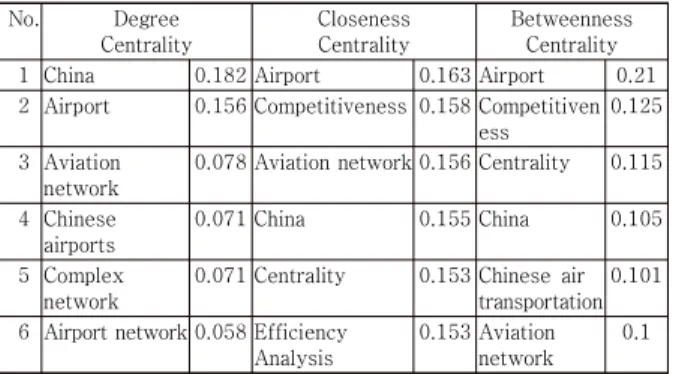
Fig. 4 shows the presentative network analysis diagram of the period from 2015 to 2020, and Table 5 contains the numerical list of this period.
As can be observed from the table, degree centrality ranks in the top three in China for Aviation Network and Chinese Airport followed by Complex Network, Airport Network, Air Transport Network, etc. The top three items in the order of closeness centrality are Airport, Competitiveness, and Aviation Network followed by Centrality, Efficiency Analysis, Spatial Stochastic Analysis, and Air Cargo. The top three in the betweenness centrality sequence are Airport, Competitiveness, and Centrality followed by China, Chinese Air Transport, Aviation Network, and Complex Network.
In general, China and Airport are located at the central node of the network at this stage.
Moreover, Competitiveness, Aviation Network, and Complex Network are also highly connected node keywords. This shows that the development trend of Chinese airports during this period was more comprehensive. Infrastructure development was still at the top of the list, but aviation networks are also conspicuous. For example, the aircraft movements were up to 11.888 million in 2018, an increase of 8.2% over the previous year. Among which, 10.156 million aircraft movements were completed by domestic routes, an increase of 8.3%
over the previous year (including 0.197 million flights from the mainland to Hong Kong, Macau and Taiwan Region, an increase of 2.3% over the previous year); the international routes completed 933,000 flights, the annual growth rate is 7.3%
compared to 2017.
In the medium- and long-term plans for the development of the logistics industry proposed by the State Council of China in 2014
(2014-2020)[28], the main task of this stage was to strengthen the informatization and standardization of logistics. Other tasks indicated by the research include developing green logistics, actively promoting the development of international logistics, and promoting the construction of the logistics infrastructure network. Aviation logistics has always been an important part of the logistics industry. The development of airports directly affects the process of the aviation logistics industry. During this period in particular, the world economy was highly globalized, The development of China’s airports was accelerated by the external and internal economic growth. In 2018, China had 235 civil aviation airports, which handled 1.674 billion passengers and 126,500 tons of cargo. With the support of China’s policy, the development of China’s airports was continuously expanded, and the aviation network advanced towards completion during this period.
Fig. 4. Results of visualizing the third period (2015-2020)
19 MARKET 0.066 China 0.229 Civilaviation 0 20 Scaling law 0.066 Airport
productivity
0.228 Node similarity
0
No. Degree
Centrality
Closeness Centrality
Betweenness Centrality
1 China 0.182 Airport 0.163 Airport 0.21
2 Airport 0.156 Competitiveness 0.158 Competitiven ess
0.125
3 Aviation network
0.078 Aviation network 0.156 Centrality 0.115
4 Chinese airports
0.071 China 0.155 China 0.105
5 Complex network
0.071 Centrality 0.153 Chinese air transportation
0.101
6 Airport network 0.058 Efficiency Analysis
0.153 Aviation network
0.1
Table 5. Keyword sequencing of the three centralities from 2015-2020)
5. Conclusion
The results presented in this paper clearly show that the research trend of Chinese airports is closely related to the development of China’ s economy. The SNA method was applied to analyze the research trend of Chinese airports, and the time span from 2003 to 2020 was divided into three stages for a specific analysis. In accordance with the sequence of keywords in the first stages, the keywords with high relevance are “Airport terminal,” “Boned,” “Chinese mainland,” and
“Economic effect.” Half of the relevant articles discuss airport terminal planning and Chinese airport planning[29-32]. This proves that the development of China’s airports in this period was still dominated by infrastructure construction.
In the next stage (2009-2014), “China,” “DEA,”
“Airport,” and “Flight delay” have a higher centrality value. As a method of the efficiency analysis, "DEA" ranks in the top three, and the keywords "Flight delay" and "Technical efficiency"
are also related to efficiency. As an undesirable variable, "Flight delay" is listed in first place,
indicating that the airport attaches great importance to efficiency. This illustrates that the research from this period focused on efficiency, which also reflects the influence of economic factors on the growth trend of airports. From the perspective of airport development, improving airport efficiency is a crucial measure to increase output and to reduce input.
In the final period (2015-2020), the concentration degree shifted to the keywords
“China,” “Aviation network,” and “Competitiveness.”
In this stage, in addition to China, "Airport,"
"Aviation Network," and "Competitiveness"
became the keywords with high connectivity, indicating that the development of Chinese airports during this period was more focused on competitiveness and the construction of the aviation network.
To summarize the results of research, the research trend of Chinese airport has been focused on the infrastructure construction on the first period (from year 2003 to 2008), followed by analyzing the efficiency of airports on the second period (from year 2009 to 2014), and finally establishing the airport networks on the third period (from year 2015 to 2020). The results of the paper have implication for academic side. For estimating the trend of future research, the results of betweenness centrality have been used. From the top tier of betweenness centrality from year 2009 to 2014, the analysis for a competitiveness, centrality and aviation networks will be popular in near the future.
There are some limitations of the research.
Notably, 63 academic papers were collected and analyzed from 2003-2020. Due to the lack of research related Chinese airports, the limited research outputs have been suggested. This leads to gather the limited keywords from them. If more relevant academic research had been collected, the research results would have a higher reliability and can explain the exact status of Chinese airports logically.
7 Air transport Network
0.052 Spatial Stochastic Analysis
0.153 Complex network
0.088
8 Airlines 0.052 Air cargo 0.152 Airport connectivity
0.059
9 Airport efficiency
0.052 Air transport Network
0.152 Air cargo 0.054
10 Airport connectivity
0.045 Air transportation 0.152 Chinese airports
0.053
11 Air cargo 0.039 Airline Alliance 0.152 Airport competition
0.04
12 Airline Alliance 0.039 Airlines 0.152 Airport network
0.036
13 Airport competition
0.039 Airport economic zone
0.152 Panel data model
0.028
14 Airport operations
0.039 International Logistics
0.152 Airport efficiency
0.026
15 Airport runway 0.039 Social Network Analysis
0.152 Air transport Network
0.015
16 Airside performance
0.039 The composite flow
0.152 Airlines 0.003
17 Aviation noise 0.039 United States 0.152 Africa 0 18 Cargo
warehouse
0.039 Africa 0.151 Agent-based analysis
0
19 Centrality 0.039 Air passenger transport
0.151 Air passenger transport
0
20 Chinese air transportation
0.039 Air routes 0.151 Air routes 0
In the future research, it is needed to analyse the strategies of increasing Chinese airports’
competitiveness. In addition, to keep the hub position for Chinese airports, the network connection analysis is also carried out.
REFERENCES
[1] X. Fu, A. Zhang & Z. Lei. (2012). Will China’s airline industry survive the entry of high-speed rail?. Research in Transportation Economics, 35(1), 13-25.
DOI.org/10.1016/j.retrec.2011.11.006
[2] C. Barnhart, P. Belobaba & A. R. Odoni. (2003).
Applications of operations research in the air transport industry. Transportation science, 37(4), 368-391.
Doi..org/10.1287/trsc.37.4.368.23276
[3] B. Zhang, J. Wang, C. Liu & Y. Zhao (2012). Evaluating the technical efficiency of Chinese airport airside activities. Journal of Air Transport Management, 20, 23-27.
DOI.org/10.1016/j.jairtraman.2011.10.007
[4] Q. Cui, Y. M. Wei, Y. Li, & W. X. Li. (2017). Exploring the differences in the airport competitiveness formation mechanism: evidence from 45 Chinese airports during 2010–2014. Transportmetrica B:
Transport Dynamics, 5(3), 325-341.
DOI.org/10.1080/21680566.2016.1216811
[5] J. Huang & J. Wang. (2017). A comparison of indirect connectivity in Chinese airport hubs: 2010 vs. 2015.
Journal of Air Transport Management, 65, 29-39.
DOI.org/10.1016/j.jairtraman.2017.07.002
[6] J. Zhang, X. B. Cao, W. B. Du & K. Q. Cai. (2010).
Evolution of Chinese airport network. Physica A:
Statistical Mechanics and its Applications, 389(18), 3922-3931.
DOI.org/10.1016/j.physa.2010.05.042
[7] M. K. Y. Fung, K. K .H. Wan, Y. V. Hui, J. S. Law. (2008).
Productivity changes in Chinese airports 1995–2004.
Transportation Research Part E: Logistics and Transportation Review, 44(3), 521-542.
DOI.org/10.1016/j.tre.2007.01.003
[8] Z. Chen, C. Barros, Y. Yu. (2017). Spatial distribution characteristic of Chinese airports: A spatial cost function approach. Journal of Air Transport Management, 59, 63-70.
DOI.org/10.1016/j.jairtraman.2016.11.011
[9] Y. Zhang, A. Zhang, Z. Zhu & Wang, K. (2017).
Connectivity at Chinese airports: The evolution and drivers. Transportation Research Part A: Policy and Practice, 103, 490-508.
[10] Z. Wang, & W. K. Song. (2020). Sustainable airport
development with performance evaluation forecasts: A case study of 12 Asian airports. Journal of Air Transport Management, 89, 101925.
[11] W. Lu, S. H. Park, T. Huang & G. T. Yeo. (2019). An analysis for Chinese airport efficiency using weighted variables and adopting CFPR. The Asian Journal of Shipping and Logistics, 35(4), 230-242.
DOI.org/10.1016/j.ajsl.2019.12.010
[12] Y. Jiang, F. Liao, Q. Xu & Z. Yang. (2019). Identification of technology spillover among airport alliance from the perspective of efficiency evaluation: The case of China.
Transport Policy, 80, 49-58.
DOI.org/10.1016/j.tranpol.2019.05.004
[13] L. W. Fan, F. Wu & P. Zhou. (2014). Efficiency measurement of Chinese airports with flight delays by directional distance function. Journal of Air Transport Management, 34, 140-145.
DOI.org/10.1016/j.jairtraman.2013.10.002
[14] Y. C. Chang, M. M. Yu & P. C. Chen. (2013). Evaluating the performance of Chinese airports. Journal of Air Transport Management, 31, 19-21.
[15] X. Liu, L. Li , X. Liu, T. Zhang, X. Rong , L. Yang, & D.
Xiong. (2018). Field investigation on characteristics of passenger flow in a Chinese hub airport terminal.
Building and Environment, 133, 51-61.
DOI.org/10.1016/j.buildenv.2018.02.009
[16] L. W. Fan, F. Wu & P. Zhou. (2014). Efficiency measurement of Chinese airports with flight delays by directional distance function. Journal of Air Transport Management, 34, 140-145.
[17] Y. Zhang, A. Zhang, Z. Zhu & K. Wang. (2017).
Connectivity at Chinese airports: The evolution and drivers. Transportation Research Part A: Policy and Practice, 103, 490-508.
DOI.org/10.1016/j.tra.2017.05.026
[18] Q. Cui, H. B. Kuang, C. Y. Wu & Y. Li. (2013). Dynamic formation mechanism of airport competitiveness: The case of China. Transportation Research Part A: Policy and Practice, 47, 10-18.
DOI.org/10.1016/j.tra.2012.10.021
[19] Y. C. Chang, M .M. Yu & P. C. Chen. (2013). Evaluating the performance of Chinese airports. Journal of Air Transport Management, 31,19-21.
DOI.org/10.1016/j.jairtraman.2012.11.002
[20] S. Behrouzi, Z. S. Sarmoor, K. Hajsadeghi & K. Kavousi.
(2020). Predicting scientific research trends based on link prediction in keyword networks. Journal of Informetrics, 14(4), 101079.
[21] K. Schodl, F. Klein & C. Winckler. (2017). Mapping sustainability in pig farming research using keyword network analysis. Livestock Science, 196, 28-35.
[22] Q. Li, H. Zhang & X. Hong. (2020). Knowledge structure of technology licensing based on co-keywords network:
A review and future directions. International Review of Economics & Finance, 66, 154-165.
[23] G. Heo. (2020). A Study on the Research Trends on the Marine Policy through Network Analysis in recent 11 years. Studies on Education of Fisheries and Marine Sciences, 32(2), 594-606.
[24] S. H. Baek & J. E. Shin. (2020). Trend analysis based on the keyword network analysis of papers written on physical education as a liberal education. Journal of Converging Sport and Exercise Sciences, 18(1), 45-57.
[25] D. H. Jung & Y. H. Choi. (2020). Research trends on invention education through keyword network analysis.
Journal of Research in Curriculum & Instruction, 24, 116-126.
[26] Y. J. Kim & K. R. Lim. (2020). Analysis of the Research Trend in Early Childhood Mathematics through Keyword Network Analysis. The Journal of Learner-Centered Curriculum and Instruction, 20, 231-261.
[27] L. C. Freeman. (1978). Centrality in social networks conceptual clarification. Social networks, 1(3), 215-239.
[28] (2014) The State Council Information Office of the People's Republic of China.
http://www.scio.gov.cn/32344/32345/37799/38021/xgz c38027/Document/1623955/1623955.htm
[29] X. Li. (2008, October). Analysis on the airport terminal bonded logistic park planning and industry economic effect. 2008 IEEE International Conference on Service Operations and Logistics, and Informatics. (pp.
1385-1389). Piscataway : Institute of Electrical and Electronics Engineers.
DOI.org/10.1109/SOLI.2008.4686617
[30] B. Zou, H. Lu, & Q. Liu. (2008). Towards a Hub-and-Spoke Network: A Study on the Chinese Mainland Hub Airport Planning. Plan, Build, and Manage Transportation Infrastructure. (pp. 134-146).
China : American Society of Civil Engineers.
DOI.org/10.1061/40952(317)14
[31] H. H. Kim, J. W. Jeon, & G. T. Yeou. (2018). Forecasting Model of Air Passenger Demand Using System Dynamics. Journal of Digital Convergence. 16(5), 137-143.
DOI : 10.14400/JDC.2018.16.5.137
[32] T. J. Shin, & T. W. Rho. (2019). Effects of Non-aeronautical Revenue on Airport Charges:
Moderation of Private Ownership. Journal of Digital Convergence. 17(9), 39-46.
DOI : 10.14400/JDC.2019.17.9.039
유 사 위(Siwei Liu) [정회원]
․ 2017년 2월 : Chungnam National University, Bachelor of Arts in English Language & Literature
․ 2019년 2월 : Incheon National University, Master of Logistics in Logistics management
․ 2019년 9월 ~ 현재 : Incheon National University, Graduate School of Logistics Doctoral Course
․ Research interested in : Port logistics, Shipping industry
․ E-Mail : [email protected]
진 가 영(Jiarong Chen) [학생회원]
․ 2017년 6월 : Zhengzhou University of Aeronautics, Air Logistics
․ 2019년 3월 ~ 현재 : Incheon University Graduate School of Logistics Interest : Port Logistics, shipping logistics
․ E-Mail : [email protected]
박 성 훈(Sung-Hoon Park) [정회원]
․ 2016년 2월 : 강릉원주대학교 국제통 상학과(국제통상학사)
․ 2017년 3월 ~ 현재 : 인천대학교 동북 아물류대학원 석사과정
․ 관심분야 : 해운물류 항만물류, Fuzzy methodology
․ E-Mail : [email protected]
여 기 태(Gi-Tae Yeo) [종신회원]
․ 2007년 2월 : University of Plymouth (경영학 석사, 경영학박사)
․ 2008년 9월 ~ 현재 : 인천대학교 교수
․ 관심분야 : 해운물류, 항만물류, System Dynamics, Fuzzy methodology
․ E-Mail : [email protected]