서 론
최근 경제가 발전하면서 소득이 증대되고 소비가 증가 하면서 상류 산간지역에 대한 인위적인 개발이 증가하고
있다
.
이 결과 산림이 벌채가 되고 이로 인해 상류1
차유 역에서 계류수질에 영향을 미치는 것을 나타나고 있다(Park, 2002).
산림벌채 이후 고랭지 채소를 경작하고 목축을 위한 초지를 조성하며 스키장 등의 위락시설들이 생
─
─ 21 ─ ─
동강 수계의 식물플랑크톤 군집 구조에 관한 연구
조 용 철∙신 윤 근*
(상지대학교 환경공학과)
A Study of Structure of Phytoplankton Community in the Upstream Watershed of East River, Korea. Cho, Yong-Chul and Yoon Keun Shin* (Department of Environmental Engineering, Sangji University, Wonju 220-702, Korea)
Survey on the phytoplankton community structure and distribution in the upstream watershed of the East River was carried out during the period from May, 2008 to April, 2009. A total composition of phytoplankton included 159 taxa, consisting of 7 orders, 56 genera, 139 species, and 40 unidenfied species. Among those, the diatoms and green algae were more frequently found during the investigation than the other taxa. Cocconeis placentula, Cymbella minuta, Diatoma vulgare, Melosira varians, Navicula cryptocephala, Scenedesmus acuminatus v. acuminatus, were among the most common. The standing crops of the phytoplankton ranged from 86 cells mL
-1to 1,467 cells mL
-1. The dominant species were Achnanthes minutissima, Asterionella formosa, Aulacoseira ambigua, Cocconeis placentula, Coelastrum microporum, Cyclo- tella sp., Cymbella affinis, C. minuta, C. tumida, Diatoma vulgare, Fragilaria capu- cina, F. construens, F. crotonensis, Gomphonema affine, G. clevei, Melosira varians, Merismopedia elegans, Navicula cryptocephala, N. pupula, Nitzschia tryblionella, Osci- llatoria anna, O. limosa, O. tenuis v. tenuis, Pediastrum duplex v. reticulatum, Phor- midium tenue, Scenedesmus acuminatus v. acuminatus, S. acutus v. acutus, S. ecornis v. ecornis, S. quadricauda v. quadricauda, Spirogyra sp., Stigeoclonium sp., Synedra acus, S. ulna, and Ulothrix sp. The most dominant species was Cymbella minuta. The diversity index, evenness index, and dominance index ranged from 1.58 to 3.10, 051 to 0.95, and 0.22 to 0.74, respectively. The phytoplankton community structure of up- stream stations of the survey area was influenced by the effluent of the Doam Lake.
Key words : phytoplankton, standing crops, dominant species, upstream, East River, Doam Lake
* Corresponding author: Tel: 033) 730-0441, Fax: 033) 730-0444, E-mail: [email protected]
ⓒ The Korean Society of Limnology. All rights reserved.
This is an open-access article distributed under the terms of the Creative Commons Attribution Non-Commercial License (http://creativecommons.org/licenses/by-nc/3.0/), which permits unrestricted non-commercial use, distribution, and reproduction in any medium, provide the original work is properly cited.
겨난 이후 계류의 수질이 악화되는 일들이 생겨나고 있 다
.
본 연구 대상지인 남한강 상류 유역은 강원도 강릉시,
정선군,
평창군,
영월군의 산림지대를 흐르는 계류성 하천 으로 하천 수변지형이 화려하고 주변의 산세가 험하며 하 천유역은 높은 절벽으로 이루어진 곳이 많아 유속이 비교 적 빠른 전형적인 상류 산간 수계의 모습을 나타내고 있 다.
하지만 연구대상의 상류 지역인 송천에 존재하고 있 는 도암호의 부영영화(Kim et al., 1995)
로 인해 몸살을 앓고 있다.
이로 인해 도암댐은 유역 변경식으로 가동되 다가 남대천의 오염이 심각해지자 발전을 멈추고 단순히 하류로 호수물을 방류하고 있다.
도암호에서 방류하는 물 에 미세한 입자들을 많이 포함하여 탁수 문제가 발생해2005
년 한수원에서 도암댐 문제 해결을 위한 연구를 수 행한 적이 있는데 도암호의 부영양화 원인은 상류에 존재 하고 있는 고랭지 농지,
목장 등과 스키장,
골프장,
콘도 등의 위락시설 등에서 나오는 오염물질들이 원인인 것으 로 판단된다(Lee et al., 2006).
하천에 존재하는 식물플랑크톤은 해발고도
,
하천의 경 사,
속도,
하상의 구조,
수량,
강우량 등의 물리적인 요인 에 의해 생태학적 서식 환경이 결정되므로 비교적 그 수 가 적고,
생활사의 일부 또는 전부를 정체성 수역에서 보 내거나 부착생활을 한다(Wetzel, 1983).
하천의 식물플랑 크톤은 진정 부유성인 경우와 본래 저서성이나 피부착물 로부터 탈리되어 일시적으로 부유하는 종류가 있는데 수 심이 얕고 유속이 빠른 하천의 경우 하천 바닥과 주변의 피부착물로부터 탈리되어 부상한 결과 진정 부유성보다 일시적으로 부상한 경우가 높은 출현율을 나타낸다(Lee
et al., 2002).
식물플랑크톤은 수계생태계의 중요한 구성원이자
1
차생산자로서 먹이연쇄의 기반을 형성하여 생태 계 내 에너지 순환에서 매우 중요하며,
이들은 주변환경 의 물리,
화학적 변화에 민감하게 반응하는 특성을 가지 고 있어 환경오염의 지표성이 뛰어나기 때문에 하천의 오염지표종으로 중요하게 다루어지고 있다(Watanabe, 1962; Palmer, 1977; Hellawell, 1986).
연구 대상지역의 선행 연구로는 도암호의 부영양화 실 태
(Kim et al., 1995),
송천 상류 수계의 수질 및 오염 부 하량 분포에 관한 연구(Huh et al., 1995),
도암호의 수질 과 어류군집 특성 연구(Lee et al., 2006),
도암댐 유역의 산림 파편화 분석(Heo et al., 2007)
이 있고 식물플랑크톤 의 연구는 동강의 수질과 식물플랑크톤군집을 연구한Lee (2004)
등이 있을 뿐이다.
본 연구 지역에서 같은 시기에 조사한 결과를 발표한 것으로는 동강지역의 제한 영양염을 규명한
Aditya et al.
(2010),
동강 수질과 부착조류에 대해 연구한Seo et al.
(2010),
집중 강우가 남한강 상류수계 수질에 미치는 영향을 연구한
Park and Shin (2011)
등이 있는데 본 연구는 식물플랑크톤 군집의 구조와 분포를 조사하여 상류 수계 의 하천생태계의 특성을 이해하고 아울러 도암호로부터 나오는 유출수가 남한강 상류수역의 생태계에 미치는 영 향을 분석함으로 도암호를 비롯한 남한강 수계에서의 향 후 수질관리에 유용한 기초자료를 제공하고자 하는 목적 으로 수행되었다.
재료 및 방법
1.
조사지점본 연구는 남한강의 상류지역에서 수행되었는데 조사 지점은 총
22
개 지점으로,
도암호가 위치한 송천의4
개 지점(I-1, M-1, M-2, M-3),
지류인 대기천(B1),
봉산천(B- 2),
골지천(B-3),
조양강의5
개 지점(M-5, M-6, M-7, M-8, M-9),
오대천(B-4),
어천(B-5),
동남천(B-7),
동강의6
개 지점(M-10, M-11, M-12, M-14, M-16, M-17),
지류인 석항 천(B-8)
이다. 2009
년4
월에는 도암호 내2
개의 정점(I-2, I-3)
을 추가하여24
개 지점에서 실시하였다(Fig. 1).
Fig. 1. Map showing the shape of upstream watershed of East River (Donggang) and sampling sites.
37.40
37.35
37.30
37.25
37.20
37.15
37.10
128.31 128.34 128.37 128.40 128.43 128.46
I1 I2
I3 M1
M2 M5
M6 M4
M8 M7
M9
M10 M12 M11
M13 M14 M16 M15
M17
M3 B1
B2
B8 B7
B5 B6
B4 B3 Dam Doam Lake
Song Stream
Golji Stream Uh Stream
Dongnam Stream
Seockhang Stream East River Bongsan Stream
Odae Stream
Pyeongchang
Pyeongchang River (West River)
Yeongwol
Youngtan Stream
Jeongseon
식물플랑크톤 군집 분석을 위한 조사는
2008
년5
월, 8
월, 10
월, 2009
년4
월 총4
회 실시하였으며,
이화학적 분 석도 수행하였으며 그 분석 결과는 동일 시기에 같은 장 소에서 연구를 수행한Seo et al. (2010)
과 같다.
식물플랑크톤 정성시료의 채집은
Plankton Net (
구경25 cm,
망목70 μm)
를 사용하였고 채집된 시료는HDPE
재질의250 mL bottle
에 담아Lugol’s solution 2 mL
를 넣어 고정하였다.
종의 동정은 고배율(1,000
배)
의 광학현미경
(Olympus BH-2)
하에서 검경하였다.
식물플랑크톤의정량분석을 위한 시료는 표층의 흐르는 물을
HDPE
재질 의500 mL bottle
에 취하여Lugol’s solution 4 mL
를 넣 어 고정한 후 햇빛을 차단하기 위해 알루미늄 호일로 감 쌌다.
고정된 시료를 일주일 이상 암실에서 정치한 후siphon
을 이용해 상등액은 따라 버린 후 침전 농축된 시 료를 분석에 이용하였다.
정량분석은Sedgewick-Rafter counting chamber
에 시료1 mL
를 취하여 저배율(100
배)
에서 단위 체적당 세포수(cells mL
-1)
로 계수하였으며,
시 료당3~4
회 계수를 실시하고 보정을 하여 시료마다 농 축한 정도를 근거로 계산한conversion factor
를 대입시켜 현존량을 산출하였다.
규조강
(
돌말류)
의 경우는Lee et al. (1995)
의 분류체계에 의거하여,
그 밖의 종류는Hirose and Yamagishi (1977)
체계에 의거하여 정리하였다.
검색참고문헌으로는Chung (1993), Mizuno (1977), Hirose and Yamagishi (1977), Ya- magishi and Akiyama (1984~1989), Patrick and Reimer (1964; 1975), Prescott (1962), Cleve-Euler (1951~1955), Simonsen (1979)
등을 이용하였다.
식물플랑크톤의 군집분석을 위하여 출현된 종수와 현존 량을 근거로 각 정점별
,
계절별로Shimpson
의 우점도지 수(Shimpson, 1949), Shannon and Wiener
의 다양성지수컴퓨터 프로그램을 이용하였다
.
식물플랑크톤 군집간의 유사성 분석을 위해 각 정점에서 출현한 종과 현존량을 근거로 유사도를 상관계수로 구하고 집괴분석을 하였으 며Dendrogram
을 이용하여 정점간의 유사성을 분석하였 으며 계산은SYSTAT
컴퓨터 프로그램을 이용하였다.
결과 및 고찰
1.
종조성동강수계에서 출현한 식물플랑크톤은 총
159
종으로서7
강58
속113
종21
변종25
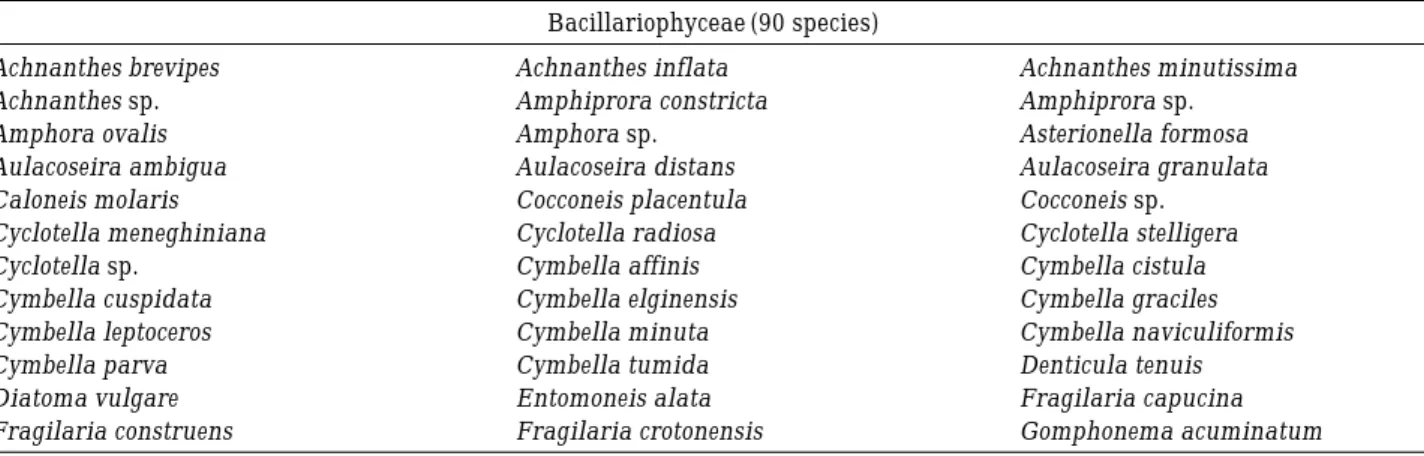
미동정종으로 구성되었다(Table 1).
같은 지역에서 같은 시기 부착조류를 연구한Seo et al. (2010)
의 결과85
종이 출현한 것과 비교하면 출현종이 많았다.
이 이유는 본 연구 수역 중 도암호 내2
개 정점과 방류수에 영향을 받는 하류에 출현한 부유성 식물플랑크톤,
그리고 상류 수계에 인접한 논이나 토양 등 수계 외부로부터 유입된 부착종이 포함되었기 때문으 로 여겨진다.
본 연구 결과는 한탄강의354
종(Kim, 2003)
에 비해서는 현저하게 낮고,
섬강의222
종(Shin, 1996),
임진강의193
종(Lee and Yoon, 2002)
에 비해서는 다소 낮았고,
변산반도 국립공원의 산간계류지역의143
종(Chung et al., 1991)
과 수어천의112
종(Lee and Yoon, 2002)
에 비해서는 높았다.
각 분류군의 점유율을 살펴보면 규조강이
90
종류로 전 체 중56.6%
로 가장 높은 점유율을 나타냈고,
그 다음으 로 녹조강이47
종류로29.6%
의 점유율을 나타냈다.
그 외 에 남조강이17
종류로10.7%,
유글레나강이2
종류로1.3
%,
황색편모조강,
갈색편모조강,
와편모강이 각각1
종으Table 1. Checklist of phytoplankton in upstream watershed of Southern Han River.
Bacillariophyceae (90 species)
Achnanthes brevipes Achnanthes inflata Achnanthes minutissima
Achnanthes sp. Amphiprora constricta Amphiprora sp.
Amphora ovalis Amphora sp. Asterionella formosa
Aulacoseira ambigua Aulacoseira distans Aulacoseira granulata
Caloneis molaris Cocconeis placentula Cocconeis sp.
Cyclotella meneghiniana Cyclotella radiosa Cyclotella stelligera
Cyclotella sp. Cymbella affinis Cymbella cistula
Cymbella cuspidata Cymbella elginensis Cymbella graciles
Cymbella leptoceros Cymbella minuta Cymbella naviculiformis
Cymbella parva Cymbella tumida Denticula tenuis
Diatoma vulgare Entomoneis alata Fragilaria capucina
Fragilaria construens Fragilaria crotonensis Gomphonema acuminatum
Gomphonema affine Gomphonema augur Gomphonema clevei
Gomphonema globiferum Gomphonema gracile Gomphonema olivaceum
Gomphonema parvulum Gomphonema pseudoaugur Gomphonema pseudosphaerophorum
Gomphonema pumilum Gomphonema truncatum Gomphonema sp.
Gyrosigma sp. Hantzschia amphioxys Melosira varians
Meridion circulare Navicula bacillum Navicula cryptocephala
Navicula cryptotenella Navicula cuspidata Navicula decussis
Navicula elginensis Navicula gregaria Navicula pupula
Navicula tripunctata Navicula trivialis Neidium affine
Nitzschia acicularis Nitzschia acuminata Nitzschia commutata
Nitzschia frustulum Nitzschia linearis Nitzschia longissima
Nitzschia palea Nitzschia romana Nitzschia sigma
Nitzschia tryblionella Nitzschia sp. Pinnularia appendiculata
Pinnularia viridis Pleurosigma rigidum Pleurosigma sp.
Rhoicosphenia abbreviata Rhopalodia gibba Stauroneis anceps
Stauroneis linearis Stauroneis phoenicentron Surirella lata
Surirella linearis Surirella robusta Synedra acus
Synedra delicatissima Synedra inaequalis Synedra ulna
Chlorophyceae (47 species)
Actinastrum hantzschii v. hantzschii Chlorella saccharophila v. ellipsoidea Closterium acerosum v. acerosum Closterium dianae v. dianae Closterium libellura v. libellura Closterium moniliferum
Closterium tumidulum Closterium venus v. venus Closterium sp.
Coelastrum microporum Coelastrum reticulatum Coelastrum sphaericum
Cosmarium circulare v. circulare Cosmarium connatum Cosmarium curtum
Cosmarium formosulum v. formosulum Cosmarium punctulatum v. punctulatum Cosmarium sublatere-undulatum
Cosmarium viridis Cosmarium sp. Crucigenia quadrata
Crucigenia rectangularis Desmidium aptogonum Euastrum dubium v. dubium
Eudorina elegans Monoraphidium contortum Oedogonium sp.
Pandorina morum Pediastrum boryanum Pediastrum duplex v. reticulatum
Pediastrum tetras Pleurotaenium sp. Rhaphidonema nivale
Scenedesmus acuminatus v. acuminatus Scenedesmus acutus v. acutus Scenedesmus armatus v. armatus Scenedesmus bernardii Scenedesmus ecornis v. ecornis Scenedesmus incrassatulus Scenedesmus quadricauda v. quadricauda Spirogyra sp. Staurastrum gracile
Staurastrum punctulatum Staurastrum sp. Stigeoclonium sp.
Ulothrix zonata Ulothrix sp.
Cyanophyceae (17 species)
Chroococcus minutus v. minutus Chroococcus turgidus v. turgidus Chroococcus sp.
Lyngbya putealis v. putealis Lyngbya sp. Merismopedia elegans
Merismopedia glaucum Merismopedia sp. Oscillatoria anna
Oscillatoria constricta Oscillatoria formosa Oscillatoria limosa
Oscillatoria princeps v. princeps Oscillatoria tenuis v. tenuis Oscillatoria sp.
Phormidium tenue Phormidium sp.
Chrysophyceae (1 species) Dinobryon serturalia
Cryptophyceae (1 species) Cryptomonas sp.
Dinophyceae (1 species) Peridinium sp.
Euglenophyceae (2 species)
Euglena sp. Phacus sp.
Bacillariophyceae (90 species)
May 2008 Navicula cryptocephala (29.6%) Cymbella minuta (22.0%) I-1 Aug. 2008 Melosira varians (19.4%) Cymbella affinis (12.1%)
Nov. 2008 Oscillatoria limosa (17.6%) Melosira varians (15.4%) Apr. 2009 Navicula cryptocephala (22.3%) Fragilaria capucina (12.7%) I-2 Apr. 2009 Asterionella formosa (57.2%) Aulacoseira ambigua (16.3%) I-3 Apr. 2009 Asterionella formosa (57.2%) Aulacoseira ambigua (15.6%)
May 2008 Melosira varians (24.1%) Stigeoclonium sp.(16.1%)
M-1 Aug. 2008 Synedra acus (13.3%) Melosira varians (12.9%)
Nov. 2008 Scenedesmus acuminatus v. acuminatus (16.0%)
Apr. 2009 Asterionella formosa (31.1%) Cymbella minuta (21.3%) May 2008 Cymbella minuta (25.8%) Ulothrix sp. (18.0%) B-1 Aug. 2008 Melosira varians (20.0%) Phormidium tenue (18.7%)
Nov. 2008 Cymbella minuta (29.2%) Melosira varians (14.6%) Apr. 2009 Diatoma vulgare (21.3%) Melosira varians (17.0%) May 2008 Melosira varians (22.5%) Cymbella minuta (21.6%) M-2 Aug. 2008 Melosira varians (17.0%) Oscillatoria tenuis (11.1%)
Nov. 2008 Cymbella minuta (14.3%) Scenedesmus ecornis v. ecornis (10.7%) Apr. 2009 Asterionella formosa (24.0%) Cymbella minuta (17.2%)
May 2008 Cymbella minuta (26.4%) Scenedesmus acutus v. acutus (14.2%) M-3 Aug. 2008 Melosira varians (26.8%) Navicula cryptocephala (10.3%)
Nov. 2008 Cymbella minuta (16.8%) Scenedesmus ecornis v. ecornis (15.6%) Apr. 2009 Cymbella minuta (23.8%) Melosira varians (17.2%)
May 2008 Cymbella minuta (55.2%) Navicula cryptocephala (22.0%) B-2 Aug. 2008 Cymbella minuta (34.6%) Cocconeis placentula (12.1%)
Nov. 2008 Navicula cryptocephala (20.0%) Cymbella minuta (15.4%) Apr. 2009 Cymbella minuta (24.0%) Navicula pupula (12.7%) May 2008 Scenedesmus acuminatus v. acuminatus (23.5%) Cymbella minuta (21.8%) B-3 Aug. 2008 Cymbella minuta (19.4%) Stigeoclonium sp. (14.9%) Nov. 2008 Cocconeis placentula (22.5%) Cymbella minuta (12.3%) Apr. 2009 Cymbella minuta (19.9%) Fragilaria capucina (10.8%) May 2008 Cymbella minuta (33.3%)
M-5 Aug. 2008 Cymbella affinis (14.1%) Cymbella tumida (12.0%) Nov. 2008 Scenedesmus acutus v. acutus (13.5%) Melosira varians (10.1%) Apr. 2009 Cymbella minuta (24.8%) Navicula pupula (10.3%) May 2008 Cymbella minuta (23.2%) Cocconeis placentula (13.5%) M-6 Aug. 2008 Cymbella affinis (14.7%) Scenedesmus ecornis v. ecornis (8.3%)
Nov. 2008 Fragilaria capucina (14.8%) Scenedesmus ecornis v. ecornis (13.6%) Apr. 2009 Cymbella minuta (31.5%) Navicula pupula (14.7%)
May 2008 Cymbella minuta (39.8%) Navicula cryptocephala (15.4%) B-4 Aug. 2008 Melosira varians (28.0%)
Nov. 2008 Cocconeis placentula (16.6%) Scenedesmus acutus v. acutus (12.2%) Apr. 2009 Cymbella minuta (42.3%) Navicula pupula (15.4%)
May 2008 Cocconeis placentula (21.1%) Cymbella minuta (18.7%) M-7 Aug. 2008 Cymbella affinis (14.0%)
Nov. 2008 Ulothrix sp. (14.4%) Apr. 2009 Cymbella minuta (22.1%)
May 2008 Gomphonema affine (22.7%) Scenedesmus acuminatus v. acuminatus (14.2%) B-5 Aug. 2008 Cymbella minuta (17.5%) Oscillatoria limosa (13.4%)
Nov. 2008 Cymbella minuta (25.6%) Achnanthes minutissima (16.3%)
Apr. 2009 Achnanthes minutissima (38.0%) Navicula pupula (11.7%)
로 각각
0.6%
의 점유율을 나타내 규조강이 가장 높은 비 율을 차지하였다(Table 2). Seo et al. (2010)
의 연구 결과규조강이
54.1%
의 높은 점유율을 보이고 녹조강이32.9%,
남조강이11.8%,
유글레나류가1.2%
등이어서 식 물플랑크톤 각 분류군의 점유율과 거의 유사하였다.
섬 강(Shin, 1996)
의 경우도 규조강이 가장 점유율이 높고 녹조강,
남조강 순으로 나타나 비숫한 경향을 보였다.
2008
년5
월에는 규조강54
종,
녹조강21
종,
남조강8
종,
갈색편모조강
1
종으로 총84
종이 출현하였으며 정점별로 는10
종(
정점B-2)
에서32
종(
정점M-17)
의 범위로 나타 났다.
이 시기 조사지역22
개 중20
개 정점 이상에서 출 현한 종은Cocconeis placentula, Cymbella affinis, Cym- bella minuta, Diatoma vulgare, Melosira varians, Navi- cula cryptocephala, Navicula pupula, Nitzschia acicularis, Scenedesmus acuminatus v. acuminatus, Scenedesmus ecornis, Synedra ulna
등이었다. 2008
년8
월에는 규조강May 2008 Cymbella minuta (16.5%) Cocconeis placentula (15.8%)
M-8 Aug. 2008 Cymbella minuta (13.0%)
Nov. 2008 Fragilaria construens (18.1%) Scenedesmus acutus v. acutus (13.6%) Apr. 2009 Cymbella minuta (21.3%) Navicula pupula (10.0%)
May 2008 Cymbella minuta (14.5%) Oscillatoria anna (13.7%) M-9 Aug. 2008 Cymbella minuta (18.5%) Navicula cryptocephala (14.6%)
Nov. 2008 Scenedesmus acuminatus v. acuminatus (13.9%) Pediastrum duplex v. reticulatum (13.0%) Apr. 2009 Cymbella minuta (38.4%)
May 2008 Cocconeis placentula (22.9%) Scenedesmus acuminatus v. acuminatus (18.5%)
B-7 Aug. 2008 Synedra ulna (26.9%) Melosira varians (16.1%)
Nov. 2008 Melosira varians (24.9%) Cyclotella sp. (15.0%) Apr. 2009 Cocconeis placentula (21.3%) Oscillatoria tenuis (11.4%) May 2008 Scenedesmus acutus v. acutus (14.2%) Cocconeis placentula (13.2%) M-10 Aug. 2008 Cymbella minuta (15.6%) Synedra ulna (12.6%)
Nov. 2008 Cocconeis placentula (34.6%) Scenedesmus quadricauda v. quadricauda (12.1%) Apr. 2009 Cymbella minuta (20.4%) Oscillatoria limosa (11.7%)
May 2008 Cymbella minuta (15.8%) Stigeoclonium sp. (12.3%) M-11 Aug. 2008 Cymbella minuta (17.8%) Cymbella affinis (11.8%)
Nov. 2008 Cocconeis placentula (16.2%) Coelastrum microporum (13.2%) Apr. 2009 Cymbella minuta (23.9%) Oscillatoria limosa (10.6%) May 2008 Cymbella minuta (21.3%)
M-12 Aug. 2008 Cymbella affinis (17.4%) Cymbella minuta (14.3%) Nov. 2008 Cocconeis placentula (14.2%) Stigeoclonium sp. (11.4%) Apr. 2009 Fragilaria construens (16.8%) Cymbella minuta (14.8%)
May 2008 Cymbella minuta (20.0%) Scenedesmus quadricauda v. quadricauda (12.0%) M-14 Aug. 2008 Melosira varians (12.1%) Cymbella minuta (11.0%)
Nov. 2008 Spirogyra sp. (21.5%) Fragilaria construens (13.4%) Apr. 2009 Spirogyra sp. (20.6%) Cymbella minuta (16.2%) May 2008 Oscillatoria anna (27.2%) Cymbella minuta (13.3%) B-8 Aug. 2008 Cymbella minuta (22.8%) Nitzschia tryblionella (15.2%)
Nov. 2008 Spirogyra sp. (17.0%) Cymbella minuta (11.1%) Apr. 2009 Ulothrix sp. (19.3%) Gomphonema clevei (16.8%)
May 2008 Cymbella minuta (16.5%) Scenedesmus acuminatus v. acuminatus (11.5%) M-16 Aug. 2008 Cymbella affinis (12.9%) Scenedesmus acutus v. acutus (11.8%)
Nov. 2008 Oscillatoria limosa (18.5%) Merismopedia elegans (14.8%) Apr. 2009 Cymbella minuta (22.0%) Fragilaria construens (12.8%) May 2008 Fragilaria crotonensis (13.0%) Cymbella minuta (11.6%) M-17 Aug. 2008 Cymbella affinis (13.0%) Synedra ulna (10.4%)
Nov. 2008 Phormidium tenue (15.5%) Scenedesmus ecornis v. ecornis (12.4%) Apr. 2009 Cymbella minuta (25.3%) Oscillatoria tenuis (14.5%)
Station Time Dominant species Subdominant species
11
종(
정점B-2)
에서29
종(
정점M-6)
의 범위로 나타났다.
이 시기 보편종은Cocconeis placentula, Cyclotella radi- osa, Cymbella affinis, Cymbella minuta, Cymbella tumi- da, Diatoma vulgare, Gomphonema affine, Melosira vari- ans, Navicula cryptocephala, Navicula pupula, Nitzschia palea, Scenedesmus acuminatus v. acuminatus, Synedra ulna
등이었다. 2008
년11
월에는 규조강50
종,
녹조강28
종,
남조강8
종,
갈색편모조강1
종으로 총87
종이 출현하 였으며 정점별로는13
종(
정점B-5)
에서28
종(
정점M-7)
의 범위로 나타났다.
출현 빈도가 높은 보편종은Achnan- thes minutissima, Cocconeis placentula, Cyclotella radi- osa, Cymbella affinis, Cymbella minuta, Diatoma vulgare, Gomphonema affine, Melosira varians, Navicula crypto- cephala, Scenedesmus acuminatus v. acuminatus, Scene- desmus acutus v. acutus, Synedra ulna
등이었다. 2009
년4
월에는 규조강70
종,
녹조강30
종,
남조강10
종,
유글 레나조강2
종,
갈색편모조강1
종,
와편모조강1
종으로 총111
종이 출현하였으며 정점별로는16
종(
정점B-2)
에서34
종(
정점M-8)
의 범위로 나타났다. 2009
년4
월 조사에 서 다른 시기에 비해 종 수가 증가한 것은 도암호로부터 방류수가 내려오면서 도암호의 부유성 플랑크톤이 추가 된 것과 관련이 있는 것으로 보인다.
도암호내2
개 정점 에서는 규조강18
종,
녹조강5
종,
유글레나조강2
종,
갈색 편모조강1
종,
와편모조강1
종으로 총27
종이 출현하였는 데 이것을 감안할 때 이전에85
종 내외의 출현종에 도암 호 종수가 더해지면 출현종수가 유사한 것이 이를 뒷받침 한다.
이시기 보편종은Achnanthes minutissima, Asteri- onella formosa, Cocconeis placentula, Cyclotella radiosa, Cymbella minuta, Diatoma vulgare, Fragilaria constru- ens, Gomphonema affine, Melosira varians, Navicula cryptocephala, Navicula pupula, Nitzschia palea, Scene- desmus acuminatus v. acuminatus, Synedra ulna
등이었 다.
네 시기 모두에서 보편종으로 나타난 종은Cocconeis placentula, Cymbella minuta, Diatoma vulgare, Melosira varians, Navicula cryptocephala, Scenedesmus acumina- tus v. acuminatus
등6
종이었다.
계류에서 부착조류의 군집 동태와 대사를 연구한
Sa- bater et al. (1998)
의 연구결과를 보면 규조류가 가장 중 요한 종군이고Achnanthes lanceolata, A. minutissima, Ceratoneis arcus, Cymbella minuta
가 가장 보편종으로 보고하고 있는데 본 연구에서 나타난 결과에서 규조류가 가장 중요한 종군이고Cymbella minuta
와Achnanthes
2.
현존량과 우점종식물플랑크톤의 현존량은
104 cells mL
-1(2008
년8
월 정점B-2)
에서1,467 cells mL
-1(2008
년5
월 정점M-17)
의 범위로 계절적 및 각 정점간의 현존량의 차이가 아주 크게 나타났다. 2008
년5
월 현존량은330 cells mL
-1(
정점B-2)
에서1,467 cells mL
-1(
정점M-17)
의 범위로 평균값 은907 cells mL
-1이고, 2008
년8
월 현존량(cells mL
-1)
은104 cells mL
-1(
정점B-2)
에서377 cells mL
-1(
정점M-2)
의 범위로 평균값은220 cells mL
-1, 2008
년11
월 현존량 은86 cells mL
-1(
정점B-5)
에서346 cells mL
-1(
정점B-7)
의 범위로 평균값은186 cells mL
-1, 2009
년4
월 현존량은292 cells mL
-1(
정점B-2)
에서1,265 cells mL
-1(
정점M- 8)
의 범위로 평균값은642 cells mL
-1이었다(Fig. 2).
계절 적으로 가장 봄철에 높고 여름철에 낮아져서 늦가을에 가장 낮은 현존량을 보이는데 여름철에 상당히 감소하는 경향은 집중 강우가 내릴 때 무기질의 부유물질이 포함되 어 있기 때문에 식물플랑크톤과 부착조류가 씻겨 내려간 것과 관련이 있을 것으로 보인다. Park and Shin (2011)
은 여름철 몬순에 의해 연구수역에서 총부유물질 농도를 증 가시키는 것으로 보고하고 있어 총부유물질의 증가로 인 하여 특히 부착조류가 직접적인 영향을 받아 하류로 씻겨 내려간 것으로 판단된다(Biggs and Close, 1989; Horner et al., 1990; Lohmann et al., 1992; Luce et al., 2010).
이 런 경향은 섬강(Shin, 1996),
임진강(Lee and Yoon, 2002)
과 한탄강(Kim, 2003)
의 결과에서도 찾아볼 수 있다.
공 간적으로는 정점B-2
의212 cells mL
-1에서 정점M-8
의Fig. 2. Spartial variation of phytoplankton standing crops (cells mL
-1) in upstream watershed of East River.
Standing crops (cells mL
-1) 2000
1500
1000
500
0
I-1 I-2 I-3 M-1 B-1 M-2 M-3 B-2 B-3 M-5 M-6 B-4 M-7 B-5 M-8 M-9 B-7 M-10 M-11 M-12 M-14 B-8 M-16 M-17
Station
May 2008 Aug. 2008 Nov. 2008 Apr. 2009
711 cells mL
의 범위로 나타났는데 전반적으로 지천에 서 낮은 현존량을 나타내고 본류에서는 높은 경향을 보 였다(Fig. 2). 2009
년5
월1
회 조사를 한 도암호I-2, I-3
정점을 포함하면 도암호 내 정점에서 최대치를 보였다.
식물플랑크톤 군집의 현존량의
10%
이상을 차지하는 우점종은Achnanthes minutissima, Asterionella formosa, Aulacoseira ambigua, Cocconeis placentula, Coelastrum microporum, Cyclotella sp., Cymbella affinis, C. minuta, C. tumida, Diatoma vulgare, Fragilaria capucina, F. con- struens, F. crotonensis, Gomphonema affine, G. clevei, Melosira varians, Merismopedia elegans, Navicula crypto- cephala N. pupula, Nitzschia tryblionella, Oscillatoria anna, O. limosa O. tenuis v. tenuis, Pediastrum duplex v.
reticulatum, Phormidium tenue, Scenedesmus acumina- tus v. acuminatus, S. acutus v. acutus, S. ecornis v. ecor- nis, S. quadricauda v. quadricauda, Spirogyra sp., Sti- geoclonium sp., Synedra acus, S. ulna, Ulothrix sp.
등34
종이었다(Table 2).
시료90
개 중52
개에서Cymbella
minuta
가 우점종 및 아우점종으로 나타나 조사지역에서정량적으로 가장 중요한 종이었다
.
이 종의 출현환경은 호수,
연못,
하천,
샘 등 담수생태계 내에서 널리 분포하며,
빈영양염종으로 흐르는 물을 좋아하고 빈부수성에서 베 타중부성 종(Kasaki, 1995)
인 것을 고려할 때 연구수역 의 특성과 잘 일치하는 것으로 보인다. Cymbella minuta
외에Melosira varians
가16
개 시료에서, Cocconeis pla-
centula
은12
개 시료에서 우점종이나 아우점종으로 비교적 조사수역에서 정량적으로 중요한 종들이었다
. Asterio- nella formosa, Aulacoseira ambigua
의 경우는 도암호와 도암호 하류 정점에서 우점종으로 나타났다. Asterionella
formosa
는 부-
중영양성을 가진 부유성 식물플랑크톤으로봄과 가을에 대발생하여 수도의 여과지를 망가뜨리는 종 으로 유명한데
(Kasaki, 1995), 2009
년4
월의 경우 도암댐 하류M-1, M-2
에서 우점종으로 나타나고(Table 2),
본류M-12
까지 출현하여 상당히 하류지역까지 도암호의 방류 수가 영향을 주는 것으로 나타났다. Aulacoseira ambigua
도 부영양성 종으로(Kasaki, 1995),
두 종이 우점종으로 나타나는 것은 도암호가 부영양화되어 있음을 시사하고 있고 도암호의 부영양화 실태를 조사한Kim et al. (1995)
의 연구 결과 도암호가 이미 부영양 상태에 있다는 결론 과 일치한다.
3.
종다양성지수,
균등도지수,
우점도지수식물플랑크톤군집의 안정성을 평가하는 종다양성지수
,
균등도지수
,
우점도지수의 분석값은Table 3
에 제시하였다.
종다양지수는2008
년5
월1.58 (
정점B-2)
에서2.98 (
정 점M-17), 8
월에1.88 (
정점B-2)
에서3.08 (
정점M-6), 11
월에2.27 (
정점B-5)
에서3.10 (
정점M-7), 2009
년4
월에 는1.58 (
정점I-3)
에서2.97 (
정점M-8)
의 범위이었다.
균 등도지수는5
월에0.69 (
정점B-2)
에서0.90 (
정점M-10), 8
월에0.79 (
정점B-2)
에서0.94 (
정점M-17), 11
월에0.80 (
정점M-10)
에서0.95 (
정점M-2), 2009
년4
월에0.51 (
정 점I-2)
에서0.86 (
정점I-1)
의 범위로 나타났다.
우점도지 수는5
월0.25 (
정점M-17)
에서0.67 (
정점B-2), 8
월0.23 (
정점M-8)
에서0.57 (
정점B-2), 11
월0.22 (
정점M-7)
에서0.47 (
정점M-10), 2009
년4
월0.31 (
정점B-3)
에서0.74 (
정점I-2)
의 범위로 나타났다. 2008
년5
월 정점B-2
에서 종다양성지수가 가장 낮게 나타나고 우점도지수가 가장 높게 나타났는데 이는 다른 정점에 비해 상대적으로 출현 종이 적은데다 현존량도 낮은 상황에서Cymbella minuta
종이55.2%
의 높은 우점도를 나타냈기 때문이다(Table 2).
2008
년8
월 정점B-2
에서 종다양성지수가2
이하로 낮게 조사가 되었는데 이는 현존량이 낮은데다 다른 정점보다 출현한 종이 상대적으로 적었기 때문이며, Cymbella mi-
nuta
종의 우점도가2008
년5
월의 조사보다는 다소 낮지 만34.6%
로 높은 수준을 나타냈기 때문이다(Table 2).
정 점B-2
이외에는2.30
이상으로 다양성지수가 높게 나타 났다. 2008
년11
월은 조사기간 중 종다양성지수와 균등 도지수가 가장 높게 나타났고 이에 따라 우점도지수는 가 장 낮게 조사되었으며 정점M-7
에서 종다양성지수가3.10
으로 조사기간 중 최고값을 기록하였으며 우점도지 수는0.22
로 조사기간 중 최저값을 기록하였다.
이는 점차 수온이 낮아지고 일조량이 줄어드는 등 식물플랑크톤의 성장에 불리해진 것 관련이 있는 것으로 보인다. 2009
년4
월에는 다른 조사시기와는 달리 도암호 내 정점인I-2
와I-3
가 추가 되었는데 호내 정점인I-2
와I-3
에서 종다양 성지수는1.60
이하로 낮게 나타나고 우점도지수는0.70
이상으로 높게 나타났는데 이는 정점I-2
와I-3
에서Aste-
rionella formosa
종이 각각57.22%, 57.18%
의 높은 우점 도를 나타냈기 때문이다.
생물군집의 구조와 기능을 분석 함에 있어서 생물군집 구성종의 종다양성지수가 일반적 으로 많이 이용되는데 본 연구에서는1.58~3.10
의 범위 로 상당히 높은 범위로 나타났으며, 2008
년5
월과8
월 정 점B-2
와2009
년4
월 도암호 내의 정점I-2
와I-3
을 제외 하면 종다양성지수는2.00
이상으로 높은 값을 나타내고 있어 본 연구수역의 수계생태계 내 식물플랑크톤 군집은 비교적 안정되었다고 판단된다.
4.
집괴 분석과 지역간 유사성각 정점에서 출현한 종과 현존량을 기반으로 상관계수 를 구해 군집분석을 실시한 결과는
Fig. 3
에 제시하였다.
2008
년5
월의 경우 정점M-5~M-9
의 유사성이 높은 것으로 조사되었고 정점B-5, B-8, M-10
등은 다소 경향 성이 적은 것으로 나타났으며 크게 혼재된 모습을 보이지 는 않았다. 2008
년8
월에는 정점M-7~M-14
의 유사성이 높은 것으로 조사되었고 정점M-1, M-2, M-17, B-3, B-5, B-7
등은 다소 경향성이 적은 것으로 나타났으며 크게 혼 재된 모습을 보이지는 않았다. 2008
년11
월에는 조사지 역의 상류구간인 정점M-1~M-3
구간과 중류 및 하류구 간인 정점M-8~M-12
구간의 유사성이 다소 높았고 그 외의 정점들은 다소 혼재되어 있는 것으로 나타났으며 이 외에는2008
년8
월의 조사보다는 다소 혼재되어 있는 경 향을 보이고 있다. 2009
년4
월에는 도암호 내의 정점인I- 2, I-3
와 도암호의 영향을 받는 정점M-1, M-2
가 유사성 이 매우 높은 것으로 조사되었고 그 외에 상류와 중류구간인
M-3~M-11
정점이 유사성이 높은 것으로 나타났으며 다른 조사시기보다 다소 혼재되어 있는 모습을 보이 고 있다
.
본 조사수역은 도암호 내 정점 두 곳을 제외하곤 변화 양상이 빠르게 변화하는 유수환경이기 때문에 조사시기 에 따라 지역간의 유사성이 다소 바뀌는 것으로 판단된 다
.
종조성과 현존량이 변함에 따라 정점간의 유사성이 변화하는데 불구하고 상당히 높은 안정성을 나타내고 있 는 것은 저서조류들이 이주에 따라 빠르게 회복되는 특성(Stevenson and Peterson, 1991)
과 관련이 있는 것으로 보 인다.
도암호의 방류수가 하류의 식물플랑크톤 상에 상당 한 영향을 주는 것으로 보인다.
특히2009
년4
월의 경우Asterionella formosa
가 도암댐 하류M-1, M-2
에서 우점 종으로 나타나고(Table 2),
본류M-12
까지 출현하여 상 당히 하류지역까지 도암호의 방류수가 영향을 주는 것으 로 나타났다.
도암호의 방류수의 양이나 시기에 따라 영 향을 받을 수 있는 지점은 늘어날 수 있는 것으로 판단된 다.
근래 국내 여러 지역에서 토양침식의 증가로 인해 탁 수가 발생하고 댐에 저류되어 장기화함으로써 호수의 수 질과 생태계 피해 및 방류 이후 하류 하천의 피해 사례가ST May Aug. Nov. Apr. May Aug. Nov. Apr. May Aug. Nov. Apr.
I-1 2.33 2.53 2.54 2.71 0.78 0.91 0.90 0.86 0.52 0.32 0.33 0.35
I-2 - - - 1.59 - - - 0.51 - - - 0.74
I-3 - - - 1.58 - - - 0.52 - - - 0.73
M-1 2.28 2.77 2.77 2.33 0.82 0.91 0.91 0.73 0.40 0.26 0.26 0.52
B-1 2.31 2.47 2.39 2.57 0.80 0.84 0.84 0.86 0.44 0.39 0.44 0.38
M-2 2.23 2.72 2.79 2.57 0.76 0.91 0.95 0.78 0.44 0.28 0.25 0.41
M-3 2.39 2.62 2.67 2.59 0.81 0.86 0.88 0.80 0.41 0.37 0.32 0.41
B-2 1.58 1.88 2.59 2.44 0.69 0.79 0.90 0.86 0.67 0.57 0.34 0.39
B-3 2.37 2.85 2.60 2.83 0.77 0.87 0.90 0.83 0.45 0.34 0.35 0.31
M-5 2.39 2.81 2.89 2.75 0.78 0.92 0.92 0.83 0.43 0.26 0.24 0.35
M-6 2.49 3.08 2.77 2.42 0.82 0.90 0.88 0.77 0.37 0.23 0.28 0.46
B-4 2.06 2.69 2.80 2.16 0.74 0.85 0.90 0.66 0.55 0.36 0.29 0.58
M-7 2.59 2.95 3.10 2.82 0.82 0.93 0.93 0.82 0.40 0.23 0.22 0.31
B-5 2.46 2.59 2.27 2.26 0.85 0.93 0.89 0.72 0.37 0.31 0.42 0.50
M-8 2.51 2.94 2.88 2.97 0.83 0.92 0.89 0.84 0.32 0.23 0.32 0.31
M-9 2.75 2.66 2.87 2.51 0.85 0.87 0.87 0.75 0.28 0.33 0.27 0.45
B-7 2.35 2.36 2.62 2.72 0.83 0.85 0.85 0.83 0.41 0.43 0.40 0.33
M-10 2.81 0.75 2.40 2.73 0.90 0.92 0.80 0.81 0.27 0.28 0.47 0.32
M-11 2.91 2.82 2.73 2.74 0.87 0.89 0.91 0.83 0.28 0.30 0.29 0.35
M-12 2.91 2.67 2.92 2.85 0.86 0.89 0.93 0.82 0.30 0.32 0.26 0.32
M-14 2.69 2.85 2.72 2.73 0.84 0.94 0.87 0.79 0.32 0.23 0.35 0.37
B-8 2.40 2.59 2.83 2.58 0.83 0.88 0.92 0.85 0.41 0.38 0.28 0.36
M-16 2.82 2.88 2.62 2.78 0.84 0.92 0.88 0.79 0.28 0.25 0.33 0.35
M-17 2.98 2.96 2.68 2.65 0.86 0.94 0.91 0.82 0.25 0.23 0.28 0.40
Min. 1.58 1.58 2.27 1.58 0.69 0.79 0.80 0.51 0.25 0.23 0.22 0.31
Max. 2.98 2.98 3.10 2.97 0.90 0.94 0.95 0.86 0.67 0.57 0.47 0.74
증가하고 있고
,
몬순강우에 의한 탁수 관련 연구들도 많 은 수계에서 다양하게 보고되고 있다(An and Shin, 2005;
Park et al., 2005; Shin et al., 2006; Kim et al., 2007).
도 암호에서 방류하는 물에 미세한 입자들을 많이 포함하여 탁수문제가 발생해2005
년 한수원에서 도암댐 문제 해결 을 위한 연구를 수행한 적이 있을 정도로 도암호의 탁수 문제와 도암호의 부영양화 문제는 심각한 상태에 있다.
도암호의 탁수와 부영양화 문제의 원인은 상류에 존재하 고 있는 고랭지 농지,
목장 등과 스키장,
골프장,
콘도 등의 위락시설 등에서 나오는 오염물질들인 것으로 판단된 다
(Lee et al., 2006).
우리나라 강우 특성상 여름철에 집중 강우가 내리고 있으며(Park and Shin, 2011),
집중강우는 도암호 상류에 있는 비점오염원으로부터 총인 및 총부유 물 농도를 증가시키는 것으로 판단되며 상류지역에 위치 한 고랭지 밭 및 축산농가 등에서 배출되는 수질 오염물 질이 도암호에 수질을 악화시키고 있는 것으로 보인다(Kim et al., 1995; Lee et al., 2006).
인 등의 영양염과 탁 수를 포함한 도암호의 방류수가 하류로 배출될 때 방류Fig. 3. Dendrogram of cluster analysis of phytoplankton community in upstream watershed of East River.
B5 B8 M10 M17 M14 B7 B3 M16 M12 B2 B4 I1 M2 M5 M6 M7 M8 M9 M3 B1 M11 M1
M17 M7 B8 M14 M9 M6 B2 B5 B1 M2 M3 M1 M8 M12 M11 B3 M10 B4 M5 B7 I1 M16
M1 M2 B1 B4 M3 I1 M5 M6 M7 M12 M11 B2 M9 M8 M10 B8 M14 M16 M17 B7 B5 B3
I3 I2 M1 M2 B1 I1 B5 M14 M3 M8 B2 B3 B4 M9 M5 M6 M7 M11 M10 M16 M12 M17 B8 B7
0.0 0.1 0.2 0.3 0.4 0.5 0.6 0.0 0.1 0.2 0.3 0.4 0.5 0.6
Distances Distances
0.0 0.1 0.2 0.3 0.4 0.5 0.6 0.7 0.0 0.1 0.2 0.3 0.4 0.5 0.6 0.7
Distances Distances
(c) Nov. 2008 (d) Apr. 2009
1981; Biggs and Close, 1989; Horner et al., 1990; Loh- mann et al., 1992; Luce et al., 2010),
일차생산자의 감소 는 하천생태계 전반에 영향을 줄 것으로 판단된다(Poff et al., 1997; Osmundson et al., 2002).
동강유역의 하천생태 계를 건강하게 유지하기 위해서는 도암호 상류지역에 위 치한 고랭지 밭 및 축산농가 등에서 배출되는 수질 오염 물질과 동강 유역에 위치한 도심지역의 오염부하 등에 의 한 하천으로의 유입을 최소화하고 오염부하 저감을 통한 효율적인 수질관리가 요구된다.
적 요
동강 수계의 식물플랑크톤 군집 구조를 알아보기 위하 여
2008
년5
월부터2009
년4
월까지22
개 지점에서 총4
회 조사를 실시하였다.
동강수계에서 출현한 식물플랑크 톤은 총159
종으로서7
강58
속113
종21
변종25
미동정 종으로 구성되어 있으며,
규조강이90
종류로 전체 중56.6
%
로 가장 높은 점유율을 나타냈고,
그 다음으로 녹조강이47
종류로29.6%
의 점유율을 나타냈으며 남조강이17
종 으로10.7%,
유글레나강이2
종으로1.3%,
황색편모조강,
갈색편모조강,
와편모조강이 각각1
종0.6%
순으로 나타 났다.
조사기간 모든 시기20
정점 이상에서 출현한 보편 종은Cocconeis placentula, Cymbella minuta, Diatoma vulgare, Melosira varians, Navicula cryptocephala, Sce- nedesmus acuminatus v. acuminatus
등6
종이었다.
현존 량은86 cells mL
-1~1,467 cells mL
-1의 범위로 나타났고,
점유율이10%
이상인 우점종은Achnanthes minutissima, Asterionella formosa, Aulacoseira ambigua, Cocconeis placentula, Coelastrum microporum, Cyclotella sp., Cym- bella affinis, C. minuta, C. tumida, Diatoma vulgare, Fragilaria capucina, F. construens, F. crotonensis, Gom- phonema affine, G. clevei, Melosira varians, Merismope- dia elegans, Navicula cryptocephala N. pupula, Nitzschia tryblionella, Oscillatoria anna, O. limosa O. tenuis v.
tenuis, Pediastrum duplex v. reticulatum, Phormidium tenue, Scenedesmus acuminatus v. acuminatus, S. acutus v. acutus, S. ecornis v. ecornis, S. quadricauda v. quadri- cauda, Spirogyra sp., Stigeoclonium sp., Synedra acus, S. ulna, Ulothrix sp.
등34
종이었는데,
가장 중요한 종은90
개 시료 중52
개에서 우점종으로 나타난Cymbella minuta
이었다 종다양성지수는1.58~3.10,
균등도지수는정점의 식물플랑크톤 군집구조는 도암호에서 나오는 방 류수에 의해 영향을 받는 것으로 사료된다
.
사 사
본 연구는
2008
년도 상지대학교 교내연구비와 연구년 지원을 받아 수행되었습니다.
현장조사를 도와준 김태훈 박사,
박성민,
김도현, Aditya
군에게 감사를 드립니다.
아울 러 본 논문의 부족한 부분들을 지적하여 수정하도록 도와 주신 두 분 심사위원님들에게 진심으로 감사를 드립니다.
인 용 문 헌