• 검색 결과가 없습니다.

Effect of combined sodium hyaluronate and carboxymethyl cellulose on ocular surface in rat dry eye model

N/A
N/A
Protected

Academic year: 2021

Share "Effect of combined sodium hyaluronate and carboxymethyl cellulose on ocular surface in rat dry eye model"

Copied!
6
0
0

로드 중.... (전체 텍스트 보기)

전체 글

(1)

Korean J Vet Res(2016) 56(3) : 155~160 http://dx.doi.org/10.14405/kjvr.2016.56.3.155

155

<Original Article>

Effect of combined sodium hyaluronate and carboxymethyl cellulose on ocular surface in rat dry eye model

Jong-Gab Moon

1

, Sae-Kwang Ku

2

, Young-Sam Kwon

1,

*

1

Department of Veterinary surgery, College of Veterinary Medicine, Kyungpook National University, Daegu 41566, Korea

2

Department of Anatomy and Histology, College of Oriental Medicine, Daegu Haany University, Daegu 42158, Korea (Received: January 28, 2016; Revised: June 30, 2016; Accepted: July 1, 2016)

Abstract: This study was conducted to evaluate three different mixed formulations of sodium hyaluronate (SH) and carboxymethyl cellulose (CMC) using a low-humidity air flow-induced rat dry eye model and determine the most suitable mixture. The total thickness of the cornea, corneal epithelial thickness, corneal stroma thickness, damaged corneal epithelium percentage region, thickness of the bulbar conjunctiva epithelium, number of goblet cells, goblet cell occupation percentage region, and damaged bulbar conjunctiva epithelium percentage region were measured by histomorphological evaluation. After 5 h exposure to drying airflow, the thickness of the cornea and conjunctiva was decreased with desquamation of the corneal and conjunctiva epithelium. However, these dry eye symptoms were markedly inhibited by treatment with the reference and test formulations. More favorable effects on decreased thickness were detected in response to the CMC than the SH. However, SH had a greater protective effect against corneal and conjunctiva epithelial damage. The application of a mixture of 0.1% SH and 0.2% CMC showed more favorable effects on the corneal and conjunctival damage and the stabilization of the ocular surface than SH or CMC alone.

Keywords: carboxymethyl cellulose, dry eye, rat, sodium hyaluronate

Introduction

Dry eye or keratoconjunctivitis sicca (KCS) is a multifac- torial ocular disease and the associated tear film instability can cause potential damage to the ocular surface [6]. Various etiologies lead to the development of dry eye conditions and, therefore, different methods have been used to induce exper- imental dry eye conditions or abnormalities in tear dynamic such as evaporation [4], pharmacologic blockade of cholin- ergic muscarinic receptors [7, 12], surgical excision of the lac- rimal glands [13, 19], or mechanical prevention of blinking [13]. However, because these techniques cannot exclude the complex influence of surgery, hormone, and pharmacologi- cal agents, the low-humidity air flow-induced dry eye ani- mal model was chosen for the present study [20].

Sodium hyaluronate (SH) is a naturally occurring sub- stance found in connective tissue matrices of vertebrae such as synovial fluid. It is a linear polymer composed of long chains of repeating disaccharide units. SH is synthesized from corneal epithelial cells and, therefore, is a major com- ponent of tears [16]. Topical applications of SH have been proven to both subjectively and objectively improve the symptoms and non-invasive break-up time in patients with

dry eye syndrome or KCS [10, 17, 24].

Carboxymethyl cellulose (CMC) is an essential high-molecu- lar polysaccharide that prolongs the residual time of artificial tears on the ocular surface. Owing to its viscous and mucoad- hesive properties, the use of CMC has been effective in the treatment of qualitative dry eye conditions and ocular sur- face staining [7]. CMC-based artificial tears have also been widely used after laser in situ keratomileusis to accelerate postoperative ocular surface recovery and minimize dry eye symptoms [18].

Although the mechanism underlying the profound protec- tive role of CMC and SH on dry eye conditions is unknown, it is hypothesized that a combination CMC and SH formula- tion may have a beneficial effect on the ocular surface in dry eye. Therefore, the aim of this study was to determine the most suitable and efficacious formulation among three types of combination CMC and SH formulations, by using a rat dry eye model.

Materials and Methods

Animals and husbandry

Male Sprague-Dawley rats (6-week-old on receipt; SLC,

*Corresponding author

Tel: +82-53-950-5969, Fax: +82-53-950-7488

E-mail: [email protected]

(2)

Japan) were used after acclimatization for 7 days. The ani- mals were housed at five rats per polycarbonate cage in a temperature (20–25

o

C) and humidity (40–45%) controlled room with a 12-h light:dark cycle. The animal feed (Samyang, Korea) and water were supplied ad libitum. The experimental proce- dures were approved by the Institutional Animal Care and Use Committee of Kyungpook National University (2016- 0016). After acclimatization, 10 rats per group (total 70 rats) were selected based on body weights and eyeball states (all animals with any defects in the eyeballs were excluded).

Experimental groups

The animals were divided into seven groups, which were treated as follows: groups 1 and 2, distilled water applied to the eye of normal and dry eye-induced rats (intact and dry eye [DE] control, respectively); groups 3 to 7, 0.5% CMC (Dial Clear; DHP Korea, Korea), 0.1% SH (Tearin Fresh;

DHP Korea), 0.1% SH and 0.2% CMC mixture, 0.1% SH and 0.3% CMC mixture, and 0.1% SH and 0.5% CMC mix- ture applied to dry eye-induced rats (CMC, SH, 0.1% SH + 0.2% CMC, 0.1% SH + 0.3% CMC, and 0.1% SH + 0.5%

CMC groups, respectively).

Preparations and administration of test articles Three different formulations, 0.1% SH + 0.2% CMC, 0.1%

SH + 0.3% CMC, and 0.1% SH + 0.5% CMC mixtures were used in this study. Samples (5- µL) of the test materials were instilled onto the rat eyeballs 30 min before exposure to air- flow, and then every 30 min after initiation of exposure (total of 11 times, Table 1).

Induction of dry eye

The rats were anesthetized by the administration of 25 mg/

kg intraperitoneal injections of zolazepam/tiletamine (Zoletile 50; Virbac, France). After deep anesthesia had been achieved, the central region of the corneal epithelium (0.4 mm

2

) was

scraped mechanically with an ophthalmic surgical blade. Then, the rats were placed in a desiccation room at a temperature of 28

o

C, relative humidity of 25 to 30%, and constant air flow (2.4 m/sec), and maintained for 5 h. The intact control rats were continuously exposed to the same conditions for accli- matization after the scraping procedure.

Histology and histomorphometry

The rats were killed with an overdose of zolazepam/tile- tamine and the eyeballs with the bulbar conjunctiva were removed and fixed in Davidson’s solution (37.5% ethanol, 12.5% acetic acid, and 25% formaldehyde [37% solution]).

The corneal specimens were embedded in paraffin, cross-sec- tioned, and stained with hematoxylin and eosin (H&E) to examine the cornea and with periodic acid-Shiff (PAS) to detect mucus-producing goblet cells in the conjunctiva.

The total thickness of the cornea, corneal epithelial thick- ness, corneal stromal thickness, damaged corneal epithelium percentage region (%/5 mm of corneal epithelial lining), thick- ness of the bulbar conjunctiva epithelium at 1 mm from the limbus, number of goblet cells (numbers PAS-positive cells/

µm of epithelial lining), goblet cell occupation percentage region (%/mm of epithelial lining), and damaged bulbar con- junctiva epithelium percentage region (%/mm of epithelial lining) were measured using a digital image analyzer (DMI- 300; DMI, Korea). The histopathologist who performed the analysis was blinded to the group distributions.

Statistical analyses

Multiple comparison tests for different dose groups were conducted. The variance homogeneity was examined using the Levene test. If the Levene test indicated no significant deviations from the variance homogeneity, the data were ana- lyzed using a one-way analysis of variance (ANOVA) fol- lowed by a least-significant difference multicomparison test to determine the pairs of group comparison that were signifi- Table 1. Histomorphometrical changes detected in rat cornea after 5 h exposure to dry-air flow with or without test formulation

instillation (5 µL/eye at 30-min intervals)

Groups Thickness (µm) Epithelial damage regions

(% of 5-mm of cornea)

Total Epithelium Stroma

Controls

Intact 355.164 ± 34.956 76.301 ± 7.624 277.628 ± 29.843 56.326 ± 4.113

Dry eye 268.501 ± 20.018

a

53.335 ± 7.982

a

237.409 ± 22.209

a

30.505 ± 11.692

a

Single formulas

0.5% CMC 310.419 ± 43.824

ac

64.147 ± 8.889

ac

241.675 ± 32.466

b

25.000 ± 7.468

a

0.1% SH 295.914 ± 25.671

a

56.282 ± 6.194

a

253.626 ± 36.117 16.875 ± 6.256

ac

Combination formulas

0.1% SH + 0.2% CMC 323.418 ± 30.349

bc

71.297 ± 13.719

c

256.282 ± 29.995 12.640 ± 2.997

ac

0.1% SH + 0.3% CMC 307.592 ± 30.961

ac

73.097 ± 7.593

c

254.456 ± 27.549 11.422 ± 3.996

bc

0.1% SH + 0.5% CMC 288.356 ± 34.869

a

61.491 ± 9.095

ad

237.988 ± 46.541

a

10.788 ± 5.035

c

Values are mean ± SD of 10 rats. CMC, carboxymethyl cellulose sodium; SH, sodium hyaluronate;

a

p < 0.01 and

b

p < 0.05 compared with

intact control.

c

p < 0.01 and

d

p < 0.05 compared with dry eye control.

(3)

cantly different. In the case of significant deviations from the variance homogeneity in Levene test, a non-parametric com- parison test, Kruskal-Wallis H test was conducted. When a significant difference was observed in the Kruskal-Wallis H test, the Mann-Whitney U test was conducted to determine the specific pairs of group comparison that were significantly different. The statistical analyses were conducted using the statistical package for the social sciences (SPSS) for Win- dows release 6.1.3. (SPSS, USA). In addition, the percentage changes compared to that of the DE control were calculated to facilitate the understanding of the efficacy of test materials and the percent changes between intact and DE control were also calculated to observe the induction status as follows:

Equation 1. Percentage changes compared with intact con- trol (%) = [({Data of DE control − Data of intact control} / Data of intact control) × 100]

Equation 2. Percentage changes compared with DE control (%) = [({Data of eye dropped groups − Data of DE control}) / Data of DE control) × 100]

Results

Changes in cornea

A focal desquamation of the corneal epithelial lining was detected in the DE control with significant (p < 0.01) decreases in the thickness of the cornea, corneal epithelium, and stroma, and significant (p < 0.01) increases in the damaged epithelial regions compared with the intact control. However, these his- topathological changes to the cornea were decreased com- pared with the DE control in all three different mixed formulas-0.1% SH + 0.2% CMC mixture, 0.1% SH + 0.3%

CMC mixture, and 0.1% SH + 0.5% CMC mixture and two single formulas-CMC and SH treated groups, respectively.

The exception was the stroma thicknesses, in which no meaningful changes were detected after treatment with all five formulas tested in the present study. Compared with the DE control, the thickness of the cornea increased in the fol- lowing ascending order to, 0.1% SH + 0.2% CMC, CMC, 0.1% SH + 0.3% CMC, SH, and 0.1% SH + 0.5% CMC. The thicknesses of the corneal epithelium were increased in this ascending order, 0.1% SH + 0.3% CMC, 0.1% SH + 0.2%

CMC, CMC, 0.1% SH + 0.5% CMC, SH; and the damage to the epithelial regions decreased in this ascending order, 0.1%

SH + 0.5% CMC, 0.1% SH + 0.3% CMC, 0.1% SH + 0.2%

CMC, SH, and CMC (Fig. 1; Table 1).

The thicknesses of cornea were changed by −24.40% in the DE control compared with the intact control, but they were changed by 15.61, 10.21, 20.45, 14.56, and 7.39% in the CMC, SH, 0.1% SH + 0.2% CMC, 0.1% SH + 0.3% CMC, and 0.1% SH + 0.5% CMC groups compared with the DE control, respectively.

The thickness of the corneal epithelium was changed by

−30.10% in the DE control compared with the intact control, but was changed by 20.27, 5.53, 33.68, 37.05, and 15.29% in the CMC, SH, 0.1% SH + 0.2% CMC, 0.1% SH + 0.3%

CMC, and 0.1% SH + 0.5% CMC groups compared with the DE control, respectively.

The thicknesses of corneal stroma were changed by −14.49%

in the DE control compared with the intact control, but was changed by 1.80, 6.83, 7.59, 7.18, and 0.24% in the CMC, SH, 0.1% SH + 0.2% CMC, 0.1% SH + 0.3% CMC, and 0.1% SH + 0.5% CMC groups compared with the DE con- trol, respectively.

The damaged epithelial regions were changed by 382.19%

in the DE control compared with the intact control, but were changed by −18.05, −44.68, −58.56, −62.56, and −64.64% in the CMC, SH, 0.1% SH + 0.2% CMC, 0.1% SH + 0.3%

CMC, and 0.1% SH + 0.5% CMC groups compared with the DE control, respectively.

Changes on the conjunctiva

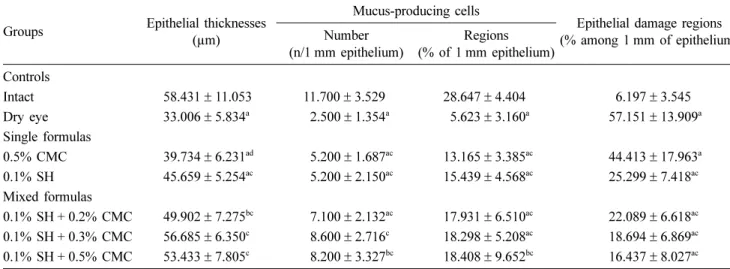
Compared with the intact control, focal desquamation of the bulbar conjunctiva epithelial lining was detected in the DE control with significant (p < 0.01) decreases in the con- junctiva epithelial thicknesses, number and percent of mucus- producing cells, and significant (p < 0.01) increases of the Fig. 1. Histopathological observations of cornea in intact con- trol (A and B), dry eye control (C and D), CMC (E and F), SH (G and H), 0.1% SH + 0.2% CMC (I and J), 0.1% SH + 0.3%

CMC (K and L), and 0.1% SH + 0.5% CMC (M and N) treat-

ment groups. Arrows indicate thickness of total cornea (ThT),

epithelium (ThE), and stroma (ThS). Arrowheads indicate region

of cornea scraped mechanically. H&E stain. Scale bars = 80 µm.

(4)

damaged epithelial regions. However, these histopathologi- cal changes to the conjunctiva were decreased compared with

those to the DE control treated with all five formulas in the present study, respectively. Compared with the DE control, the conjunctiva thickness was increased in ascending order in the 0.1% SH + 0.3% CMC, 0.1% SH + 0.5% CMC, 0.1%

SH + 0.2% CMC, SH, and CMC; mucus-producing cell numbers were increased by 0.1% SH + 0.3% CMC, 0.1%

SH + 0.5% CMC, 0.1% SH + 0.2% CMC, SH, and CMC;

mucus-producing cell percentage was increased by 0.1%

SH + 0.5% CMC, 0.1% SH + 0.3% CMC, 0.1% SH + 0.2%

CMC, SH, and CMC; and damaged epithelial regions were decreased by 0.1% SH + 0.5% CMC, 0.1% SH + 0.3% CMC, 0.1% SH + 0.2% CMC, SH, and CMC (Fig. 2; Table 2).

The thicknesses of conjunctiva epithelium were changed by −43.51% in the DE control compared with the intact con- trol, but were changed by 20.39, 38.34, 51.19, 71.75, and 61.89% in the CMC, SH, 0.1% SH + 0.2% CMC, 0.1%

SH + 0.3% CMC, and 0.1% SH + 0.5% CMC groups as compared with the DE control, respectively.

The numbers of mucus-producing cell were changed by

−78.63% in the DE control compared with the intact control, but were changed by 108.00, 108.00, 184.00, 244.00, and 228.00% in the CMC, SH, 0.1% SH + 0.2% CMC, 0.1%

SH + 0.3% CMC, and 0.1% SH + 0.5% CMC groups com- pared with the DE control, respectively.

The regions of the mucus-producing cells were changed by

−80.37% in the DE control compared with the intact control, but were changed by 134.13, 174.57, 218.89, 225.41, and 227.37% in the CMC, SH, 0.1% SH + 0.2% CMC, 0.1%

SH + 0.3% CMC, and 0.1% SH + 0.5% groups compared with DE control, respectively.

The regions of damaged epithelium were changed by 822.24% in the DE control compared with the intact control, but were changed by −22.29, −55.73, −61.35, −67.29, and

−71.24% in the CMC, SH, 0.1% SH + 0.2% CMC, 0.1%

SH + 0.3% CMC, and 0.1% SH + 0.5% CMC groups com- pared with the DE control, respectively.

Fig. 2. Histopathological observations of conjunctiva in intact control (A and B), dry eye control (C and D), CMC (E and F), SH (G and H), 0.1% SH + 0.2% CMC (I and J), 0.1% SH + 0.3% CMC (K and L), and 0.1% SH + 0.5% CMC (M and N) treatment groups. Arrows indicate thickness of epithelium (ThE).

Periodic acid-Shiff stain. Scale bars = 80 µm.

Table 2. Histomorphometrical changes detected in rat conjunctiva after 5 h exposure to dry-air flow with or without test formulation instillation (5 µL/eye at 30 min-intervals)

Groups Epithelial thicknesses (µm)

Mucus-producing cells

Epithelial damage regions (% among 1 mm of epithelium) Number

(n/1 mm epithelium)

Regions (% of 1 mm epithelium) Controls

Intact 58.431 ± 11.053 11.700 ± 3.529 28.647 ± 4.404 56.197 ± 3.545

Dry eye 33.006 ± 5.834

a

52.500 ± 1.354

a

55.623 ± 3.160

a

57.151 ± 13.909

a

Single formulas

0.5% CMC 39.734 ± 6.231

ad

55.200 ± 1.687

ac

13.165 ± 3.385

ac

44.413 ± 17.963

a

0.1% SH 45.659 ± 5.254

ac

55.200 ± 2.150

ac

15.439 ± 4.568

ac

25.299 ± 7.418

ac

Mixed formulas

0.1% SH + 0.2% CMC 49.902 ± 7.275

bc

57.100 ± 2.132

ac

17.931 ± 6.510

ac

22.089 ± 6.618

ac

0.1% SH + 0.3% CMC 56.685 ± 6.350

c

58.600 ± 2.716

c

18.298 ± 5.208

ac

18.694 ± 6.869

ac

0.1% SH + 0.5% CMC 53.433 ± 7.805

c

58.200 ± 3.327

bc

18.408 ± 9.652

bc

16.437 ± 8.027

ac

Values are mean ± SD of 10 rats.

a

p < 0.01 and

b

p < 0.05 compared with intact control.

c

p < 0.01 and

d

p < 0.05 compared with dry eye control.

(5)

Discussion

Both SH and CMC have been used to alleviate the symp- toms of dry eye and prevent intraperitoneal adhesion after abdominal or gynecologic surgery [10, 14, 17, 21, 23, 25].

The mixed formulations of SH and CMC also exhibited an anti-adhesive effect and prevented the intra-abdominal adhe- sion formation [3, 5, 8, 9]. However, the effect of the mixed formulation of SH and CMC on dry eye has not yet been reported. Therefore, to determine the suitable formulation of the three different combination formulations of CMC and SH, their protective effects were evaluated in a low-humid- ity air flow-induced rat dry eye model in the present study.

The common histopathological feature of keratoconjunc- tivitis sicca is corneoconjunctival epithelial damage, which is desquamation of the surface epithelial linings with apoptosis [15, 20]. By 5-h exposure to dry airflow, desquamation of corneal and conjunctival epithelium was induced in the present study. The thickness of the cornea and conjunctiva markedly decreased, and the number of mucus-producing goblet cells was also reduced in a proportion of the regions with dam- aged corneal and bulbar conjunctiva epithelium when the dry eye was induced. However, these dry eye symptoms were inhibited by treatment with all three combination formula- tions, 0.1% SH + 0.2% CMC, 0.1% SH + 0.3% CMC and 0.1% SH + 0.5% CMC, and the two single formulas, CMC and SH.

These results were consistent with the findings of previous studies, showing that CMC had a beneficial effect on aque- ous tear-deficient dry eye symptoms and ocular surface stain- ing [11, 14]. In addition, our results agreed with previous reports that CMC reduced the incidence of epithelial defects during laser-assited in situ keratomileusis [1, 2], and that SH protected the corneal epithelium and reduced the histological changes in the corneal and conjunctival surface in dry eye [22, 26].

In summary, the 0.1% SH + 0.2% CMC combination exhib- ited more favorable effects on the total thickness of the cor- nea and the conjunctival damages than the SH and CMC did alone. Although the 0.1% SH + 0.5% CMC combination also showed a greater inhibition of the epithelial damages, its effects on the thicknesses were relatively lower. This obser- vation suggests that an appropriate combination formulation of CMC and SH would exhibit favorable synergic effects in treating dry eye conditions.

Therefore, we suggest that the combination formulation containing 0.1% SH + 0.2% CMC has a favorable effect on dry eye conditions. Future studies involving the application of this formulation on ocular surfaces may further clarify its effects in the animal dry eye model.

References

1. Ahee JA, Kaufman SC, Samuel MA, Bogorad D, Wee C.

Decreased incidence of epithelial defects during laser in situ

keratomileusis using intraoperative nonpreserved carboxy- methylcellulose sodium 0.5% solution. J Cataract Refract Surg 2002, 28, 1651-1654.

2. Albietz JM, Lenton LM, McLennan SG, Earl ML. A comparison of the effect of refresh plus and bion tears on dry eye symptoms and ocular surface health in myopic LASIK patients. CLAO J 2002, 28, 96-100.

3. Arslan E, Talih T, Oz B, Halaclar B, Caglayan K, Sipahi M. Comparison of lovastatin and hyaluronic acid/carboxy- methyl cellulose on experimental created peritoneal adhesion model in rats. Int J Surg 2014, 12, 120-124.

4. Barabino S, Dana MR. Animal models of dry eye: a critical assessment of opportunities and limitations. Invest Ophthalmol Vis Sci 2004, 45, 1641-1646.

5. Bashir S, Ananth CV, Lewin SN, Burke WM, Lu YS, Neugut AI, Herzog TJ, Hershman DL, Wright JD.

Utilization and safety of sodium hyaluronate-carboxymethyl- cellulose adhesion barrier. Dis Colon Rectum 2013, 56, 1174- 1184.

6. Brewitt H, Sistani F. Dry eye disease: the scale of the problem. Surv Ophthalmol 2001, 45 (Suppl 2), S199-202.

7. Burgalassi S, Panichi L, Chetoni P, Saettone MF, Boldrini E. Development of a simple dry eye model in the albino rabbit and evaluation of some tear substitutes. Ophthalmic Res 1999, 31, 229-235.

8. Caglayan EK, Caglayan K, Erdogan N, Cinar H, Güngör B. Preventing intraperitoneal adhesions with ethyl pyruvate and hyaluronic acid/carboxymethylcellulose: a comparative study in an experimental model. Eur J Obstet Gynecol Reprod Biol 2014, 181, 1-5.

9. Caglayan K, Gungor B, Cinar H, Erdogan NY, Koca B.

Preventing intraperitoneal adhesions with linezolid and hyaluronic acid/carboxymethylcellulose: a comparative study in cecal abrasion model. Am J Surg 2014, 208, 106-111.

10. DeLuise VP, Peterson WS. The use of topical Healon tears in the management of refractory dry-eye syndrome. Ann Ophthalmol 1984, 16, 823-824.

11. Donshik PC, Nelson JD, Abelson M, McCulley JP, Beasley C, Laibovitz RA. Effectiveness of BION tears, Cellufresh, Aquasite, and Refresh Plus for moderate to severe dry eye. Adv Exp Med Biol 1998, 438, 753-760.

12. Dursun D, Wang M, Monroy D, Li DQ, Lokeshwar BL, Stern ME, Pflugfelder SC. A mouse model of kerato- conjunctivitis sicca. Invest Ophthalmol Vis Sci 2002, 43, 632-638.

13. Fujihara T, Nagano T, Nakamura M, Shirasawa E.

Establishment of a rabbit short-term dry eye model. J Ocul Pharmacol Ther 1995, 11, 503-508.

14. Grene RB, Lankston P, Mordaunt J, Harrold M, Gwon A, Jones R. Unpreserved carboxymethylcellulose artificial tears evaluated in patients with keratoconjunctivitis sicca.

Cornea 1992, 11, 294-301.

15. Higuchi A, Ueno R, Shimmura S, Suematsu M, Dogru M, Tsubota K. Albumin rescues ocular epithelial cells from cell death in dry eye. Curr Eye Res 2007, 32, 83-88.

16. Inoue M, Katakami C. The effect of hyaluronic acid on corneal epithelial cell proliferation. Invest Ophthalmol Vis Sci 1993, 34, 2313-2315.

17. Johnson ME, Murphy PJ, Boulton M. Effectiveness of

sodium hyaluronate eyedrops in the treatment of dry eye.

(6)

Graefes Arch Clin Exp Ophthalmol 2006, 244, 109-112.

18. Lenton LM, Albietz JM. Effect of carmellose-based artificial tears on the ocular surface in eyes after laser in situ keratomileusis. J Refract Surg 1999, 15 (2 Suppl), S227-231.

19. Maitchouk DY, Beuerman RW, Ohta T, Stern M, Varnell RJ. Tear production after unilateral removal of the main lacrimal gland in squirrel monkeys. Arch Ophthalmol 2000, 118, 246-252.

20. Nakamura S, Shibuya M, Saito Y, Nakashima H, Saito F, Higuchi A, Tsubota K. Protective effect of

D

-β-hydroxy- butyrate on corneal epithelia in dry eye conditions through suppression of apoptosis. Invest Ophthalmol Vis Sci 2003, 44, 4682-4688.

21. Nehéz L, Vödrös D, Axelsson J, Tingstedt B, Lindman B, Andersson R. Prevention of postoperative peritoneal adhesions:

effects of lysozyme, polylysine and polyglutamate versus hyaluronic acid. Scand J Gastroenterol 2005, 40, 1118-1123.

22. Nelson JD, Farris RL. Sodium hyaluronate and polyvinyl

alcohol artificial tear preparations. A comparison in patients with keratoconjunctivitis sicca. Arch Ophthalmol 1988, 106, 484-487.

23. Ryan CK, Sax HC. Evaluation of a carboxymethylcellulose sponge for prevention of postoperative adhesions. Am J Surg 1995, 169, 154-159.

24. Stuart JC, Linn JG. Dilute sodium hyaluronate (Healon) in the treatment of ocular surface disorders. Ann Ophthalmol 1985, 17, 190-192.

25. Wurster SH, Bonet V, Mayberry A, Hoddinott M, Williams T, Chaudry IH. Intraperitoneal sodium carboxy- methylcellulose administration prevents reformation of peritoneal adhesions following surgical lysis. J Surg Res 1995, 59, 97- 102.

26. Wysenbeek YS, Loya N, Ben Sira I, Ophir I, Ben Shaul

Y. The effect of sodium hyaluronate on the corneal

epithelium. An ultrastructural study. Invest Ophthalmol Vis

Sci 1988, 29, 194-199.

수치

Table 2. Histomorphometrical changes detected in rat conjunctiva after 5 h exposure to dry-air flow with or without test formulation instillation (5 µL/eye at 30 min-intervals)

참조

관련 문서

The effect of Combined Exercise program on Body composition, Physical fitness and thickness of subcutaneous fat in. Obese

This study has the purpose to investigate the applicability of different thickness aluminium alloys by friction stir welding to vehicle body and to

The purpose of this study is to compare the degrees of conversion of light curing resin cement specimens cured by the light transmitted different thickness of zirconia

Figure 6.23 Comparison of the average absorption coefficient between the honeycomb panel and HMPP for a 25-mm core thickness.. 174 Figure 6.24 Comparison of STL between

The average position of the posterior superior alveolar artery, the wall thickness of the lateral wall, and the average volume of the maxillary sinus will

~ a model in which the entire resistance to diffusion from the liquid surface to the main gas stream is assumed to occur in a stagnant or laminar film of constant thickness

▪ This equation provides a handy rule of thumb for estimating the thickness of a diffusion layer (e.g., how far product molecules have moved, on the average, from an electrode

Effect of plate thickness on normal overall spectral transmittance of soda-lime glass (includes surface reflection) at 298 K. Transmittance