韓國水資源學會論文集 第48卷 第11號 2015年 11月 pp. 945~955
The SWG Component Technology Classification Scheme Researchthrough the Technology Trend Analysis
Son, Hong Min* / Hu, Jong Wan**
...
Abstract
The technology of the SWG (Smart Water Grid) as one of most important national projects results in significant assignment that is closely associated with systematic management and effective operation. The individual component technics are required to establish directory and classification for the purpose of effectively managing their information related to research and development (R&D). The national science technology (S&T) standard classification tree which results in the representative example has been established with an intention to manage R&D information, human resource, and budget. It has been also revised every five years and then used in the various fields related to the evaluation, administration, and prediction of the national R&D projects. In addition, the standard classification system for R&D projects has been widely used in the UNESCO (United Nations Educational, Scientific and Cultural Organization) and EU (European Union) since the Frascati Manual was established in the Organization for Economic Cooperation and Development (OECD). Therefore, it is necessary for SWG techniques to develop the standard S&T classification tree for research management and evaluation. For this, it is essential to draw the core techniques for the SWG, which are incorporated with IT (Information Technology), NT (Nano Technology), and BT (Biology Technology).
Keywords : Smart Water Grid (SWG), technology classification system, standardization, component technology ...
* PH. D, Department of Civil and Environmental Engineering, Incheon National University, 12-1 Songdo-dong, Yeonsu-gu, Incheon 406-840, Korea (e-mail: [email protected])
**Corresponding Author, Assistant Professor, Department of Civil and Environmental Engineering, Incheon National University, 12-1 Songdo- J. Korea Water Resour. Assoc.
Vol. 48, No. 11:945-955, November 2015 http://dx.doi.org/10.3741/JKWRA.2015.48.11.945 pISSN 1226-6280 • eISSN 2287-6138
1. Introduction
According to the UN (United Nations) Report in July, 2008, it is expected that about 3 billion people will suffer from water shortage by 2025 due to environ- mental pollution and climate changes. As the demands for water continue to grow, many studies are currently being conducted to take advantage of alternative water resources such as sea water desalination, reuse of sewage/waste water, to overcome the problem of water shortage, and to enhance the usability of alternative water resources. In the U.S., for instance, it is expected that the application of the National Smart Water Grid
TM suggested by the Lawrence Livermore National Lab to rivers around Colorado and water channels in the western area will produce net profit as much as 33 billion dollars with the effects of flood and drought prevention. The water resource management service of IBM is also applied to some areas including Hudson River, New York. In Australia, SEQ Water Grid project is in progress. In China, the South-to-North water transfer project is in progress to transfer water from Yangtze River to the northern area where the problem of water shortage is serious.
Water resource management system is drawing keen attention around the globe with regard to the issue of
water shortage, increasing number of mega cities, water management in combination of water and energy, and fostering of new-growth green industry. This well represents that water industry will be rapidly growing in the near future. Currently, water industry is regarded as "Blue Gold Industry," being expected to grow as fast as 6.5% per year and become 865 billion dollars (1,038 trillion won) by the year of 2025 (GWI). In particular, Smart Water Grid (SWG) technology is in the limelight.
SWG technology adopts cutting-edge ICT (Information and Communication Technologies) to enhance the effici- ency of water resource and water/sewage management.
In line with this next-generation water management system for informatization and intelligence in all areas of water resource management, water production and transportation, sewage treatment and reuse, etc., 'The watergrid intelligence research group' was formed as a national R&D project and presented specific strategies for technical development and application with 3S (Security, Safety, Solution) as the three basic objectives for securing water resources, abolishing differentials, securing stability of water quality and water supply grids, and maintaining intelligent low-energy high- efficiency programs.
SWG technology is one of the major national projects around the globe, and especially the way of manage- ment and efficient operation is regarded as important.
For efficient management and distribution of technical information as well as human resources, classifying component technologies into directories is essential.
Currently in Korea, for instance, the National Science and Technology Standard Classification System are specified ever three years to efficiently manage infor- mation, human resource, and R&D projects. This is utilized in various areas such as national R&D project evaluation, management, etc. In addition, OECD specified the Frascati Manual as a standard classification system for R&D in various agencies in various regions in- cluding UNESCO, EU, etc (Kim, 2003).
SWG technology currently in spotlight, home and abroad, requires its dedicated classification system to manage and evaluate researches effectively. To this end, the development of SWG component technology is
essential as one of the convergence technologies in- cluding IT, NT, and BT.
This study suggests SWG classification system with the aim to investigate and analyze the classification system for efficient management and distribution of SWG technology information, technology directories for human resource management, and national science technology standards.
2. National Science Technology Classification System
2.1 National Science and Technology Standard Classification System
The National Science and Technology Standard Classification System It was initially established in 2002 in accord with the Basic Law for Science and Techno- logy stipulated to form the basis for science technology development and strengthen the national competiti- veness (Ministry of Science & Technology, Notice No.
2002-22, ’02. 12). The Standard Classification System consists of three steps with 19 categories, 160 divisions, and 1,023 sections on the basis of Art. 27 of the Basic Law for Science and Technology and Art. 41 of the Enforcement Ordinance (Jung, 2002).
As for technology classification, the decimal system and cross reference were used for the divisions and sections. The number of sections was limited to 10, and the codes of other related sections were specified between parentheses right next to the section.
According to the Basic Law for Science and Techno- logy, Science and Technology Standard Classification System is to be revised every 5 years, and the first revision was conducted in 2005 (Ministry of Science &
Technology, Notice No. 2005-2, ’05. 9). The revision in the year of 2005 aimed mainly to complement the con- tents on the basis of the mainframe of 2002 Standard Classification System as the National Science and Tech- nology Standard Classification System was in the initial stage when it comes to R&D planning and evaluation.
Accordingly, the decimal system, cross reference, and categorization remained. In addition, emerging techno- logies and convergence technologies were actively
•national science technology standard classifi- cation system call rates low
- Standard classification system and the mini- stries, agencies and the technology used classification system that there is a difference in depth
- Classification system, each department its own standard classification system at one-to-one mapping is not possible to average ratio 51.1%
- Standard classification system for each depart- ments in the classification system itself is not possible at 1:1 mapping ratio 44.2%
•Only with cross-references to reflect the latest developments in technology that limits
•Interdisciplinary research in science and techno- logy through the fusion and complex principles, techniques and bonding difficulties in the appli- cation of science and technology
- Increasing convergence of research in the field of research is one that does not belong to one categorized cases increase
•Flat classification system, the study of technology and information, the purpose of classification and there are limits to identify linkages
Table 2. National Science Technology Standard Classification System Need for Reform
applied. As certain divisions and sections were speci- alized and more specifically classified, the general number of them increased. The number of divisions increased to 178, 18 more than in 2002 while the number of sections to 1,235, 212 more than in the year (Lee, 2005).
According to Art. 2 of the Basic Law for Science and Technology, national science technology should seek the balanced and linked mutual development of natural science and liberal arts science. The Standard Classi- fication System, however, does not include the areas of liberal arts science, which has been an issue since its establishment. As the weak points of Classification System were highlighted in 2005, the necessity of modi- fication came to the fore. The major issues are pre- sented in Table 2 below.
Due to the problems above, it became necessary to establish Technology Classification System that could be linked to the socio-economic classification and standard industrial classification of OECD, and thus the general modification was conducted for the revised version of Standard Classification System in 2008 (Ministry of Science & Technology, Notice No. 2008- 159, ’08.12), and the category of liberal arts science was newly added. Thus, the scope of Standard Classification System was no longer limited to the area of science technology but covered the general research areas. In addition, the existing decimal system and cross reference were abolished and the classification systems of various departments were reflected, which increased the number of categories significantly('Area,' a greater classification unit than a category, was defined and thus the structure of four steps was newly formed). The general classification included 5 areas, 34 categories (▲
19), 347 divisions (▲ 169), and 2,773 sections (▲ 1,538).
The division multiple selection and weight system was also introduced, which made it easy to describe convergence technologies. To make clear the research objectives and connections with industrial sectors, the application areas indicating the socio-economic goals of research activities were introduced to the two-dimen- sional classification system (Area of Research+Area of Application). To avoid excessive complexity and pro- mote smooth establishment in the early stage, the application areas of Standard Classification System had the categories only (public: 12, industrial: 20). In the case of public areas, SEO (classification for socio-economic objectives) specified in OECD Frascati guideline, which was referred to for research, analysis, and R&D of national R&D projects, was introduced to the categories of application areas. In the case of industrial sectors, the categories of KSIC were reflected (Park, 2007).
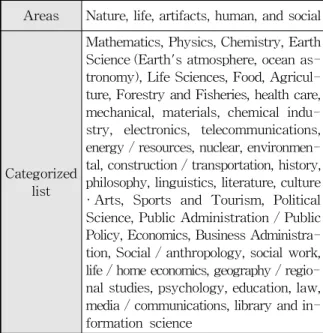
To enhance the area of liberal arts in the Standard Classification System after the revision in 2008, some details of Standard Classification System were revised Mathematics / Physics / Chemistry / Life Science
/ Earth Sciences / Mechanics / Materials / Chemical Process / Electrical and Electronics / Information / Communication / Agriculture, Forestry and Fisheries / health / environmental / energy / nuclear / con- struction and transportation / aerospace astronomy / Marine Science and Technology Policy Innovation Table 1. National Science Technology Standard Clas- sification System 19 Categorized Lists
Areas Nature, life, artifacts, human, and social
Categorized list
Mathematics, Physics, Chemistry, Earth Science (Earth's atmosphere, ocean as- tronomy), Life Sciences, Food, Agricul- ture, Forestry and Fisheries, health care, mechanical, materials, chemical indu- stry, electronics, telecommunications, energy / resources, nuclear, environmen- tal, construction / transportation, history, philosophy, linguistics, literature, culture
· Arts, Sports and Tourism, Political Science, Public Administration / Public Policy, Economics, Business Administra- tion, Social / anthropology, social work, life / home economics, geography / regio- nal studies, psychology, education, law, media / communications, library and in- formation science
Table 3. National Science Technology Standard Classification System Categorized Lists in 2008
Fig. 1. Technology Classification of Science and Technology, and Humanities and Social Sciences
Category Code Comparison
in 2009 (Ministry of Science & Technology, Notice No.
2009-34, ’09. 9), and similar research areas of liberal arts were integrated and the number of categories was adjusted accordingly (18 categories →17). To reflect the convergence area in linkage between liberal arts and science technology, the area of 'human science and technology' was newly added. As a result, the Standard Classification System in 2008 included 6 areas, 33 categories, 371 divisions, and 2,902 sections.
The most recent modification of Standard Classifi- cation System in 2012 was to solve problems found in the operation of the Classification System after the revision in 2009. First of all, the inconsistency of 2009 Classification System lowered the usability and effec- tiveness. More specifically, the different code systems between the areas of science technology and liberal arts caused confusion in practical affairs among different divisions and agencies. Such inconsistency of code systems limited the automation of information manage- ment, and thus additional elements into the process were unavoidable. As the 5 code digits (science techno- logy) and 6 code digits (liberal arts science) were different, it was difficult to unify the classification code management methods. The category code was defined as the classification order in the area of science tech-
nology and as the contents in the area of liberal arts, which lowered the efficiency of classification code utilization (Han and Yu, 2009).
Second, unlike the area of research, that of applica- tion involved the problem of a limited scope of utiliza- tion as the multiple selection and weight system was not applied. Even though the areas of public and indu- strial sectors were counted in a single system, the same classification system was applied, which made it diffi- cult to grasp and connect public and industrial objec- tives.
Third, the discrepancy with international standards made application difficult. As NABS2007 Classification System, the recommended latest OECD international classification system, was not reflected, it was difficult to use the Standard Classification System in interna- tional statistical comparative researches and data sets.
Fourth, without a methodology for consistent ex- ploration and objective evaluation of appropriateness in response to the demands for standard classification revision, there was a limitation to securing the suit- ability for Classification System revision. Since previous revisions focused on the procedural methodology based on the comprehensive opinions of related divisions and expert groups, the objectivity and quantitative basis of revision methodologies were uncertain. Besides, there was no system to explore the demands for revision and to evaluate its appropriateness, which put limitations on optimization of Classification System. For example, while the scale of investments into 'human resources
and infrastructures' drastically increased recently, it was unable to grasp the related demands in a timely manner. As a result, it failed to analyze the trends in investment accurately. It is also not certain how to solve the problem of uncertainty in understanding of the future consistency of demands for revisions and their influence on other areas.
Lastly, frequent revisions impeded the continuity.
The short term of revision at intervals of 3 years meant that the utilization of the recently revised items would last only for 3 years, and the frequent preparation of compatability tables made it difficult to secure statis- tical stability of Classification System. In addition, the utilization of revisions was inefficient.
Accordingly, the revised version of science technology classification system in 2012 reflected the necessity of solving these problems. First of all, the codes of liberal arts and science technology were unified to enhance the uniformity of Classification System. New area codes were added and category order codes were modified to secure consistency in codes in harmony with the area of liberal arts. As the category codes were modified, the codes of related divisions and sections were changed accordingly.
2.2 Current Utilization of National Science and Technology Standard Classification System National Science and Technology Standard Classifi- cation System are utilized in various areas such as national science technology research, planning, evalua- tion, management, and connection with industrial sectors. Since there has been few actual cases where the 2013 revision was used, the 2009 revision of National Science and Technology Standard Classifi- cation System was investigated in terms of applica- tions. Basically, Standard Classification System has been utilized in such various areas as R&D report, national R&D project report, current condition of invest- ment in different socio-economic areas, national R&D project planning, execution and management, budgeting for national R&D, distribution and management of science technology information, national science techno- logy planning, and so forth (Hwang, 2010).
3. Definition and Scope of SWG Technology Smart Water Grid is a high-efficiency next genera- tion water management infra system in utilization of ICT (Information Communication Technology) to over- come the limitation of existing water resource manage- ment systems. As for existing water resource and water/
sewage facilities, it is unable to manage the water demands real time, and the imbalance of demand and supply deteriorates the operation efficiency of facilities.
The frequent leak causes great loss of water resources.
In addition to such a large amount of energy put into water production and transportation, environmental pollution and excessive processing of water resources regardless of usage due to the central management system causes a tremendous amount of loss. To solve such problems of existing water management systems, advanced countries including the U.S., Australia, and Europe suggested Smart Water Grid technology in 2009.
Smart Water Grid technology was designed for infor- mation-based and intelligent water resource manage- ment in such ways as managing water demand and supply real time accurately, solving the problem of regional and time imbalance in use of water resources, management and reuse of water resources in the pro- cess of production, and transportation. Owing to such advantages, Smart Water Grid technology has been a global issue, and various researches and discussions are in progress.
Smart Water Grid technology is applicable to various areas such as water supply, distribution, demand, design, etc. It covers such ranges as water resource, intelligent management, utilization network, and test range. Table 1 and Fig. 1 show the details of Smart Water Grid technology.
Smart Water Grid touches such various areas as water production, treatment efficiency, cost and energy saving through systematic and preventive system management, solving the problem of regional imbalance, etc.
Hence, it covers comprehensive aspects from family unit to national water resource management. It also is in close relation with other related industry sectors and
Water
Cycle Range
Division Contents
Supply Water
Range
Water (Nature Type:
natural), replace the water (active: manufacturing)
Distribution /
Administration Range of intelligence
Regional imbalance of water resources, and time to address the imbalance
of water information management technology
and operations for real-time network optimization techniques Demand Range of
network utilization
New towns, such as lack of water consumers personalized service area
Design Test
Bed
Testbed for the proposed design standards and
operational Table 4. A range of technical details of classifica- tion techniques
technologies. Technologies related to Smart Water Grid is divided into three parts: IT, water resource manage- ment technology, infrastructure technology.
IT is applied for monitoring and analyzing water resource supply and transportation, knowledge-based system for effective management and utilization of water information, efficient operation of a complicated system, etc. Water resource management technology involves utilization of various water sources, alternative water resource development, response to quantitative and qualitative changes in demands for water, sustai- nability of water resource supply, etc. Infrastructure technology involves optimization of existing water resource management infrastructures including ground water and underground water, advanced technology of mega-city water/sewage infrastructures that is in in- creasing demand worldwide, establishment and operation of water management infrastructure in consideration of the connection between water and energy, etc. Besides, researches on various types of convergence technologies are being conducted in relation to the core technology of Smart Water Grid.
As Smart Water Grid technology is related to various areas and industry sectors, the potential in markets is
quite positive. For instance, Lux Research, an agency that analyzes the prospects of new technologies, estimated the scale of smart water grid market in 2009 to about 0.53 billion dollars and that in 2020 up to 16.3 billion dollars. Cisco, an industrial consulting group, expected that Smart Water Grid would bring the effects, direct and indirect, as large as 100 billion dollars to the market.
Such Smart Water Grid technology handles various and distributed resources and features the cutting-edge measuring units, interactive real time distribution system, and service paradigm.
This study aims mainly at efficient management of SWG technology information, formation of technology directories for distribution and human resource manage- ment, and the establishment of Technology Classi- fication System.
4. SWG technical trend
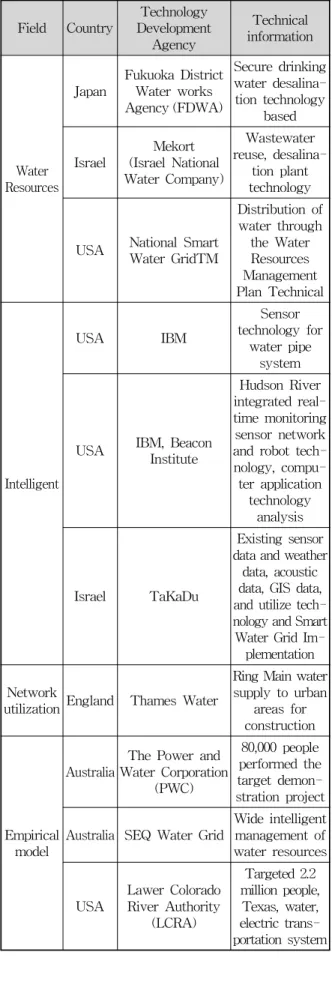
Smart Water Grid technology has been developed in advanced countries particularly in such areas as water resource, intelligence, utilization network, and verification of empirical models. The technical development trends in each area are presented in Table 5.
4.1 Water Resource Area
In advanced countries, the governments provide various types of supports in the area of water resources. In the U.S., for instance, USGS (U.S. Geological Survey) pro- vides GIS-based water resource information including water, disaster, and water quality real time from funda- mental data to virtual data for researches. In addition, USBR (U.S. Bureau of Reclamation) provides numerical information on dams and related resources including reservoirs for each project unit. The office of environment, U.K., provides various types of information on atmo- sphere, soil, and water quality, as well as maps of risks of flooding. In addition to the real time flood-related information, other water resource data sets are provided in a form of reports. Such government supports are backed up by various services and technologies related to water resources from other agencies.
IBM, the U.S., has provided water resource manage-
Field Country Technology Development
Agency
Technical information
Water Resources
Japan Fukuoka District Water works Agency (FDWA)
Secure drinking water desalina- tion technology
based Israel Mekort
(Israel National Water Company)
Wastewater reuse, desalina-
tion plant technology
USA National Smart Water GridTM
Distribution of water through
the Water Resources Management Plan Technical
Intelligent
USA IBM
Sensor technology for
water pipe system
USA IBM, Beacon Institute
Hudson River integrated real- time monitoring sensor network and robot tech- nology, compu- ter application
technology analysis
Israel TaKaDu
Existing sensor data and weather
data, acoustic data, GIS data, and utilize tech- nology and Smart Water Grid Im-
plementation Network
utilization England Thames Water
Ring Main water supply to urban
areas for construction
Empirical model
Australia The Power and Water Corporation
(PWC)
80,000 people performed the target demon- stration project Australia SEQ Water Grid Wide intelligent management of water resources USA Lawer Colorado
River Authority (LCRA)
Targeted 2.2 million people, Texas, water, electric trans- portation system
Table 5. SWG Technology Development Practices ment services in utilization of IT. Some of the examples are the Water Infrastructure, which is a sensing system for water resource measurement, Water Metering Service that enhances water resource management with the real time information on the utilization, Natural Water Resources that integrates, analyzes, and visualizes water resource management information, Water Utilities, which is a decision-making service in response to water pol- lution through the efficient approach to business logic and operation, and Green Sigma for Water, which is a business consulting service related to water resources.
National Smart Water Grid TM, the U.S, presented a way to manage water resources from the stream in the middle to Colorado River and to the western region and established the governmental plan to transport water through the channels.
In Israel, Mekort (Israel National Water Company) and other organizations in the water-related academic and industrial circles established Waterfronts for the cooperative work, which is developing water-related technologies. Some of the technologies include the farming technology in utilization of drip irrigation applicable mainly to deserts, sewage reuse technology, and world largest desalination facility technology. In Japan, Fukuoka District Waterworks Agency (FDWA) is carrying out the plan to turn water produced from fresh water plants to be drinkable in application of IBM software. In particular, Hitachi suggested Intelligent Water System as a business solution in water industry that is centered on existing equipment industry. This integrates physical water cycling system and water information system for a higher level of operation efficiency. Besides, Information Technology for the ad- vanced water treatment, sea water desalination facility, and efficient system integration were selected as the core technologies.
4.2 Intelligence Area
One of the major technical development companies in the area of intelligence is IBM, the U.S., which pre- sented the intelligence framework recently. It stated that the infrastructure of Smart Water Grid was ad- vancing from the level of analyzing and securing spatial
Fig. 2. SWG Classification System Configuration data to that of efficient and decentralized decision-
making system.
In addition, natural science modeling capacities such as hydrology were added to IT, and the integrated operation and management model for water resource and water quality was developed to create synergy effects between information technology and natural science. This model goes beyond the level of monitoring pollutants and leakage real time and exchange informa- tion regarding water utilization, water gate, water quality, and environmental influence, controls the operation automatically according to the programmed decision- making system, and optimizes the system accordingly.
This technology provides the utility company with the water piping management system sensor to prevent water resource from being wasted and polluted and electricity companies and water resource management companies with software to check pipeline damage and water resource quality respectively. In cooperation with Beacon Institute, IBM applied to Hudson River, New York, the integrated sensor network for real time monitoring, robot technology, and computer interpreta- tion technology. It also established the River and Estuary Observatory Network (REON) system, an integrated sensor network, for the 315 mile long river. In Israel, TaKaDu developed the technology of Smart Water Grid in utilization of existing sensor data, atmospheric data, sound data, and GIS data.
4.3 Utilization Network Area
One of the major examples of adapting Smart Water Grid technology is Thames Water, U.K. Thames Water is now constructing and operating the 'Ring Main' to supply large cities such as London with water. The water supply in London accounts for 50% of the entire supply. The underground water system for the large oval region is about 80 km long. The main pipe of the tunnel is 2.1~2.9 m in diameter.
4.4 Empirical Model Area
Empirical models of Smart Water Grid technology include The Power and Water Corporation and SEQ Water Grid, Australia. The Power and Water Corpora-
tion paid 14.5 million dollars to IBM and established the system to manage water and electricity supply more efficiently in addition to sewage treatment. It focused on the asset management technology used to secure integrity of devices such as pump and valve. SEQ Water Grid focused on taking preventive measures for drought, securing water resources on a long-term basis, distributing risks by integrating regional facilities, and utilizing various water sources efficiently. In the U.S., Lower Colorado River Authority (LCRA) is operating the water and electricity transportation system in utilization of IBM tool over the 58 regions of the Texas State.
5. Plan to Establish SWG Technology Classification System
5.1 Basic Direction for SWG Technology Clas- sification System
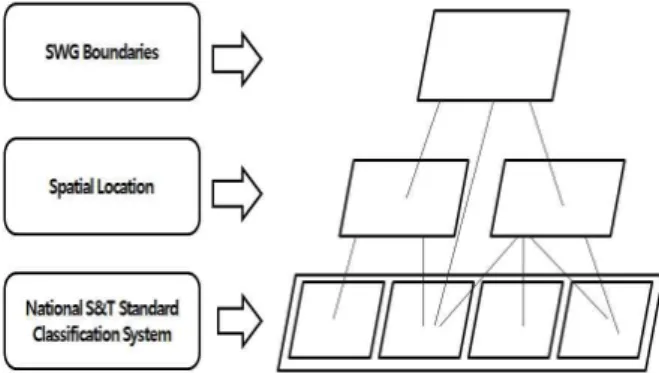
SWG Classification System divides the steps into water resourc (supply), intelligence (division/ management), utilization network (demand), and empirical model (design) according to the water cycle with SWG R&D at the top level of classification (category).
The area of water resources includes active water resources such as reuse of water, desalination as well as existing natural water resources. The area of intel- ligence is defined as real time information management technology and operation network optimization techno- logy to solve the problem of regional and time imbalance of ICT-based water resource supply.
The area of utilization networking is a customized
Fig. 3. SWG Division System Composition Draft service for such areas as new town and zone of water
shortage. This is a technology to supply water resources to the area in need safely and stably. The area of empirical models include the design standardization and operation of test-beds for the practical use of SWG technology and other aspects to verify SWG technology.
Divisions, the lower level of classification, involve the spatial location in connection with SWG Component Technology. A dictionary defines space as “an empty place with nothing” but in Classification System, space is viewed as a theoretically bordered area or volume for the spatial use and physical elements. In general, space for facilities is mostly for human activities. More speci- fically, it is divided to space for human activities and space for storage, transportation, and isolation of resources for such activities. Some functions may be simple, but some are quite complex. For the same Technology Classification System, two different con- cepts of space are adopted. Space is to apply SWG technology depending on the supply, distribution, manage- ment, and demand of water resources. Software, etc.
that can be applied to all space related to the flow of water resources is classified as 'no spatial location.' Spatial location is divided to 7 items: water source, water collection facility, water conveyance facility, purifying facility, sewage facility, supply facility, and 'no spatial location.'
As for the lower level of categorizing, the divisions of National Science Technology Classification System established by KISTEP (Korea Institute of Science &
Technology Evaluation and Planning) defines aspects applicable to SWG technology in such areas as techno- logy management, evaluation, planning, etc. The clas- sified division units of National Science Technology Classification System include the 12 items: atmospheric science, climatology, natural disaster analysis/prediction, energy/environment machinery system, software, RFID/
USN, water management, facility design/interpretation technology, water supply system technology, construc- tion environment facility technology, control technology, control technology, etc. Other technologies are classified as 'etc.' for future expansion of Technology Classifi- cation System.
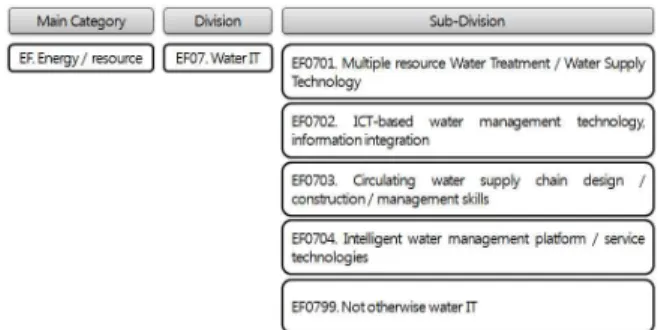
5.2 SWG Technology Classification System As the R&D area of SWG is expanded and invest- ment into its R&D continues to increase, the necessity and demands for systematic management in application of Classification System increase accordingly. Hence, the national science technology standard classification system added more water IT related divisions under the category of EF. energy/resource and sections related to IT-based water resource management technologies.
Categories that include divisions related to SWG technology are EH. environment and EI. construction/
traffic, but the water IT area to be newly added is intelligent water management system that overcomes the limitation of existing water resource management systems in utilization of cutting-edge information tech- nology. As it is ever more difficult to secure water resources due to climate changes, water resources are diversified and ICT-based measuring technologies are advancing. Accordingly, technologies are developing in direction different from that of existing Classification System, and thus the new water IT Classification System is designed as in Fig. 3.
6. Conclusion
In fact, some adjustment is required in utilization of SWG technology standard classification system, but there has yet to be sufficient empirical data to verify it.
It is unreasonable, therefore, to conduct a large scale revision only based on insufficient data. Although a survey was conducted to collect opinions of experts on the standard and scope of Standard Classification System,
it is necessary to accumulate data at least for 3 years and analyze changes in investment.
The official webpage of SWG Technology Standard Classification System was opened to share information and establish the constant monitoring system for Standard Classification System. It also became neces- sary to provide users with the information on Standard Classification System through the website. Accordingly, information on newest trends and new technologies related to Classification System, home and abroad, are available for reference. The opened notice board is to accept various opinions from various circles regarding Standard Classification System, which should be ex- amined in future revisions. In addition, it will be able to broaden the scope of research if an online expert Delphi investigation system is established and thus embraces experts' opinions.
It is necessary to reorganize the system so that Standard Classification System can be operated and managed on the level of categories and divisions.
Governmental notices on SWG Technology Standard Classification System may be released at intervals of 5 to 6 years on the level of categories and divisions, and sections may be operated and managed by agencies at intervals of 1 to 2 years. Besides, to facilitate informa- tion availability and promotion of SWG Technology Standard Classification System, the official website should be utilized in association with NTIS and other ways to provide various types of information more effectively in a timely manner should be sought as well.
It is also necessary to improve the classification stan- dards including publication at NTIS and agency web- sites, preparation/distribution of manuals, recommenda- tion of a list of compatible items, and establish a constant feedback and monitoring system in cooperation with experts and research centers for better usability, col- lection of technical trend information, examination of difficulties and proposals, etc. Standard Classification System research meetings may be conducted among hands-on workers at research centers for efficient information collection and better ways of classification system operation. For efficient revisions, it is also vital to establish a system to collect basic data systema-
tically such as opinions on classification standards for each level, newest trends in a discipline (technology), feedback regarding problems in utilization, etc.
Acknowledgments
This research was supported by Basic Science Research Program through the National Research Foun- dation of Korea (NRF) funded by the Ministry of Science, ICT, and Future Planning (Grant No. 2013R1A2A2A01 068174).
This research was supported by a grant (14CTAP- C078944-01) from Infrastructure and Transportation Technology Promotion Research Program funded by Ministry of Land, Infrastructure and Transport of Korean government.
References
Han, S.K. (2009). National Science and Technology stan- dard classification system(’08 Reorganization), KISTEP.
Hwang, B.Y. (2010). Utilization of science and techno- logy to raise the standard classification system for the pan-utilized building departments, KISTEP.
Jung, K.H. (2002). Standard classification system to establish the National Science and Technology Studies, KISTEP.
Kim, B.M. (2003). Systems of the major industrialized countries Comparative Study of Science and Tech- nology Indicators, KISTEP.
Lee, S.Y. (2005). National Science and Technology standard classification system ('05 adjustment), KISTEP.
Ministry of Education, Science and Technology (2009).
National Research and Development Survey Analysis Report in 2009.
Ministry of Education, Science and Technology (2009).
Report on R & D activities in 2009.
Ministry of Education, Science and Technology (2010).
National Research and Development Survey Analysis Report in 2010.
Ministry of Education, Science and Technology (2010).
Report on research and development activities in 2010.
Ministry of Environment·Korea Environment & Resources Corporation. (2009). Report on Environmental Industry in 2007.
Park, B.Y. (2007). In 2008, the National Science and Technology Planning and Research for modifying the standard classification system, KISTEP.
Park, B.Y. (2008). In 2008, the National Science and Technology Research Direction revise standard clas- sification system, KISTEP.
Rural Development Administration (2010). Information
technology architecture, technology-based information service items standard code home food ingredients.
Yu, S.H. (2009). Technology sector classification system for the establishment of R & D Trends Survey, KISTI.
paper number : 15-064 Received : 19 August 2015 Revised : 23 September 2015 Accepted : 23 September 2015