• 검색 결과가 없습니다.

Life Cycle Cost Breakdown Structure Development of Buildings through Delphi Analysis

N/A
N/A
Protected

Academic year: 2021

Share "Life Cycle Cost Breakdown Structure Development of Buildings through Delphi Analysis"

Copied!
11
0
0

로드 중.... (전체 텍스트 보기)

전체 글

(1)

pISSN 1598-2033 eISSN 2233-5706 Journal of the Korea Institute of Building Construction, Vol. 12, No. 5

http://dx.doi.org/10.5345/JKIBC.2012.12.5.528 www.jkibc.org

Life Cycle Cost Breakdown Structure Development of Buildings through Delphi Analysis

Jeong, Jae-Hyuk

1

Shin, Han-Woo

1

Ryu, Han-Guk

2

Kim, Gwang-Hee

3

Kim, Tae-Hui

1*1)

Department of Architectural Engineering, Mokpo National University, Muan-gun, jeonnam, 534-729 Korea

1

Department of Architectural Engineering, Changwon National University, Changwon, Gyeongnam, 641-773 Korea

2

Department of Architectural Engineering, Kyonggi University, Suwon-si, Kyonggi, 443-760, Korea

3

Abstract

With domestic construction projects becoming bigger, more specialized and more advanced, the construction industry is striving to improve quality and quantity, and is diversifying functions and shapes. Nevertheless, the process of a construction project causes problems when we estimate construction price, because the cost breakdown structures are different in each step. The primary aim of this study was to estimate building life cycle cost using the Delphi method.

The cost breakdown structure for life cycle cost was classified into planning, design, construction, maintenance and waste disposal, and each detailed classification was determined by estimating life cycle cost. Moreover, the developed cost breakdown structure is verified by consulting with experts to secure objectivity and validity.

Keywords : cost breakdown structure, building, life cycle cost, delphi method

1. Introduction

1.1 Research objective

As in recent years construction projects have become larger, more specialized and more advanced. the construction industry is making efforts to diversify functions and types while pursuing quantitative and qualitative growth. A construction project consists of a series of processes with diverse characteristics, from planning to design, construction, maintenance and waste disposal[1]. The processes have different cost breakdown structures(CBS) by phase, which poses a problem in calculating construction work cost in a reasonable manner. For this reason, designers and engineers spend a lot of time and expense estimating

Received : March 26, 2012 Revision received : July 2, 2012 Accepted : August 6, 2012

* Corresponding author : Kim, Tae-Hui

[Tel: 82-61-450-2459, E-mail: [email protected]]

ⓒ2012 The Korea Institute of Building Construction, All rights reserved.

and calculating building construction cost of a construction project by phase [2].

To make a reasonable calculation of construction cost, both initial construction cost and Life Cycle Cost (LCC) should be considered. However, the CBS used in bills of quantities for construction work for LCC estimation is classified by work type, while for maintenance cost estimation the elemental cost breakdown structure is employed. which means that an error may occur in the course of integrating the two CBS. In addition, a different replacement cycle for each element should be applied to estimate maintenance cost, but the construction cost items have not yet been standardized, and it is difficult to accurately reflect costs at an early phase of a construction project[3]. To address this problem, a CBS should be established for easy LCC estimation by phase of a construction project.

Hence, this study aims to develop CBS for LCC

estimation of a structure using the Delphi analysis. If

a CBS is developed. the construction work cost can be

(2)

estimated in a more economical manner, lessening the relative cost for time.

1.2 Research scope and method

There are many cost items by phase in a construction project. and the items can vary depending on who participates in a construction project. To estimate cost in a more systematic manner that considers LCC from planning to design, construction, maintenance and waste disposal, the CBSs that have a direct influence on LCC estimation of a structure or can make it possible to adjust it should be studied. To establish a CBS appropriate for LCC estimation, the scope of this research is limited to cost items appropriate for LCC estimation.

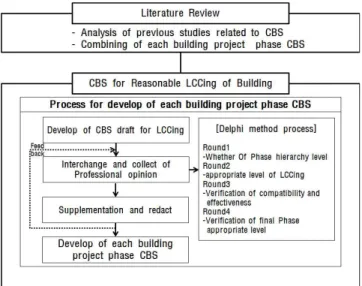
Figure 1. Research Process

The research process is divided into four main steps. First. previous studies related to CBS conducted in Korea and abroad were reviewed to draw cost items by phase of a construction project. Second, the common items of CBS by phase were extracted, and a linking plan was made to develop a CBS draft for LCC estimation by phase based on the linking plan. Third, to secure the objectivity and validity of the CBS draft developed. the Delphi analysis

technique was applied. Fourth, opinions and advice from experts were gathered to develop a CBS for LCC estimation of a structure. Figure 1 illustrates the research process.

2. Theoretical review

2.1 Literature review

The previous studies related to CBS conducted in Korea are as follows. As indicated in Table 1, studies were conducted largely on the classification system of construction cost and on the life cycle cost breakdown structure(LCCBS). Studies on the development of a CBS were performed mostly on reduction in construction cost, LCC and system building.

researcher contents

breakdown cost structure

Kang et al.[5]

A Study on the Estimation of Elemental Costs for an Apartment Building. Journal of

Construction Management Hyun et

al.[7]

Development of the Space Cost Breakdown Structure for Multi-Family Housing Projects

C L C B S

Maintenance countermeas

ure

Jung[8]

A Study on the Cost Analysis Breakdown System for Decision makerin Life Cycle

Cost Analysis Lee et

al.[9]

A Study on the Establishment of Maintenance Standards of

Educational Facilities Kang et

al.[10]

A Study on the Long-Term Maintenance Costs and Elemental Maintenance Costs

for Apartment Buildings

Public Facilities

Lee et al.[11]

A Study on Development of Life Cycle Cost Analysis

System for Build-Transfer-Lease Projects Kim and

Kang[12]

Variation Range for Maintenance Costs of Education Facilities Based on

LCC Analysis. Journal of Construction Management Table 1. Literature review

Kang et al.[5] studied the construction cost estimation

by elemental cost format of an apartment. Hyun et

al.[7] developed the CBS by spatial cost format in an

apartment building construction. The studies were on

construction cost estimation by elemental cost format

(3)

and by spatial cost format focusing on the construction phase, and it is very difficult to analyze CBS from the beginning of a construction project, such as the planning and design stage.

The studies related to LCC usually dealt with countermeasures for the maintenance phase. Kang et al.[10] performed an analysis of replacement cycle costs and long-term maintenance costs by part of an apartment, and Lee et al.[9] conducted a study on the establishment of maintenance and replacement cycle criteria for educational facilities. Jung[8] studied cost analysis breakdown structure for a decision-maker that helped to create a life cycle cost analysis. LCC has been utilized as important factors to determine the winner in bid dings due to the increased scale of investments by the private sector and the introduction of technical proposal bids, for which LCC estimation of a public building has actively been studied. Lee et al.[11] studied the development of an LCC analysis system for private sector-funded projects, and Kim and Kang[12] helped to establish a CBS appropriate for the maintenance and waste disposal phase through an analysis of variation range of maintenance cost for educational facilities using an LCC technique.

However, for systematic maintenance a construction project should be maintained from the initial phase of a project, but this LCCBS is only used as a tool for maintenance, and is insufficient to be linked by phase of a construction project, which prevents LCC from being applied from the beginning.

2.2 Domestic and overseas CBS analysis

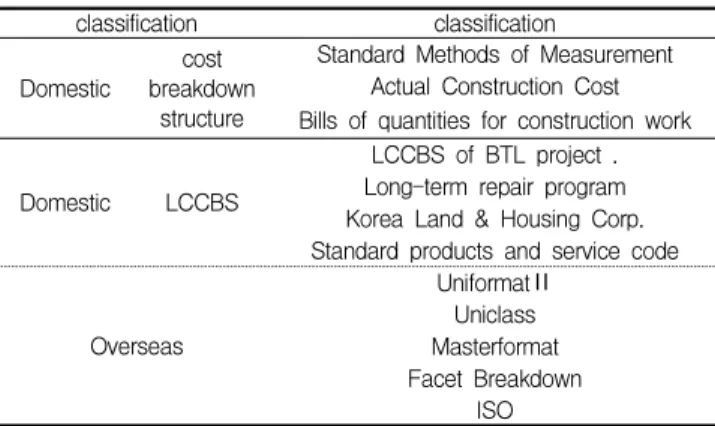
Domestic and overseas CBS types applied to construction cost and LCC estimation were reviewed to establish a CBS for the LCC estimation.

As the domestic construction cost breakdown structure, the standard breakdown structure for quantity take-off set by Ministry of Land, Transportation and Marine Affairs, and standard breakdown structure for historical

cost were analyzed, and as breakdown structure of construction cost, bills of actual construction cost from 2008 to 2011 were analyzed.

To analyze breakdown structure for LCC estimation, the application method and content of the private sector-funded construction projects of educational facilities, RFP·maintenance cost breakdown structure, the long-term maintenance plan stipulated in Enforcement Decree of the Housing Act, construction cost breakdown structure by Korea Land and Housing Corporation and Public Procurement Service Nomenclature were reviewed and analyzed.

To analyze the overseas CBS, the U.S. UniformatII, Masterformat of North America, SfB type of Uniclass in Europe, Facet Breakdown Structure of the U.K. and ISO breakdown structure of construction information were analyzed.

Table 2 indicates the domestic and overseas CBS types.

Table 2. Domestic and Overseas CBS classification classification Domestic cost

breakdown structure

Standard Methods of Measurement Actual Construction Cost Bills of quantities for construction work Domestic LCCBS

LCCBS of BTL project . Long-term repair program Korea Land & Housing Corp.

Standard products and service code Overseas

UniformatⅡ Uniclass Masterformat Facet Breakdown

ISO

Delphi analysis is a series of processes in which

experts give their opinions and advice on an issue in

order to gather professional opinions and elicit a

collective judgment. Delphi analysis was developed

and used for the first time in the 1950s by the Rand

Corporation to eliminate the restrictions people often

encounter in a face-to-face deliberation. and enable

experts to arrive at a conclusion regarding an urgent

military issue.

(4)

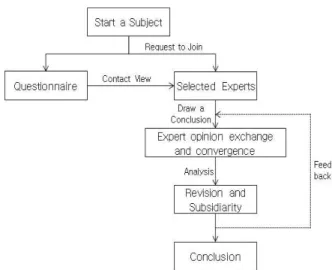
Figure 2. Process of Delphi Method

Most importantly, questionnaires were sent to a certain number of experts to collect their opinions.

Then. a format representing the experts’ opinions was made based on the collected opinions ­ e.g. the average when collected in number, or distribution of frequency when collected in multiple choice ­ was presented to the same experts to take more specific opinions. When using this method. to prevent the represented opinion from being distorted by a specific perspective, the experts made comments on each other’s opinions until they reached a general agreement[4].

Through the series of this process. the opinions of the expert group can be statistically collected and kept consistent (See Figure 2).

3. Development of CBS for LCC estimation

3.1 Current state of CBS-related data analysis Previous studies were reviewed to develop a CBS for LCC estimation by phase of a construction project.

To make an economic LCC estimation. maintenance should be considered from the early phase of a construction project. However, it is realistically difficult to take maintenance into account at an early phase of a construction project, since different CBSs are now being applied to different phases. In other

words, it is hard to link the CBSs to each other, since different breakdown structures are used for different phases, e.g. element breakdown structure for planning and design phase, work breakdown structure for construction phase. elemental cost breakdown structure for maintenance phase.

The CBS for the planning and design phase follows an element breakdown structure because it is easy to present costs in a rapid and accurate manner for such categories as structural items, basic items. and resource items. Main cost items at the planning and design phase were analyzed to include elemental costs: construction planning, construction contract, construction management, field research, land acquisition, environment management, and construction design. The elemental costs analyzed among CBSs were mostly similar, but there are some differences in the details.

The CBS for construction phase employs a work breakdown structure due to the classification appropriate for building construction by work type.

Work breakdown structure is an easy way to accurately estimate cost when placing an order to each company specialized in each work type, and for this reason it is used at construction phase. The cost items at construction phase include direct cost, indirect cost and general management cost, and profit. Construction cost is classified by work type into construction work. temporary work, and earth work.

The CBS for maintenance phase employs the elemental cost breakdown structure that classifies cost items based on the location. When using the elemental cost breakdown structure, cost is aggregated from the upper level, which is conducive to managing construction cost at construction phase.

As main cost items. roof, external and internal wall,

floor or slab are included. The work breakdown

structure is applied to a facility-related cost item.

(5)

and it is possible to link it to construction phase.

At waste disposal phase, an element breakdown structure is employed, as it as at the planning and design phase. The cost breakdown for the waste disposal phase is divided into dismantling. disposal, environmental measure, and residual value, each of which also has sub-items.

3.2 Development of a CBS

Through the analysis of domestic and overseas CBS and previous studies, it was found that individual CBS is similar in terms of cost elements. but is different in terms of the criteria for cost breakdown, which presents an obstacle to developing a composite CBS. In addition. it is hard to link between phases of a construction project, which makes it inappropriate to estimate LCC at an early phase of a project in consideration of maintenance cost.

Thus, concomitant features were analyzed based on the data analyzed by phase of a construction project to establish a CBS for a more accurate LCC estimation of a construction project, and a linking plan was established accordingly. A CBS draft by phase of a construction project was made based on the construction cost breakdown structure of an apartment building for planning. design, construction, and disposal phases, while on maintenance cost breakdown structure presented in educational facility BTL projects and RFP·maintenance cost breakdown structure for maintenance phase.

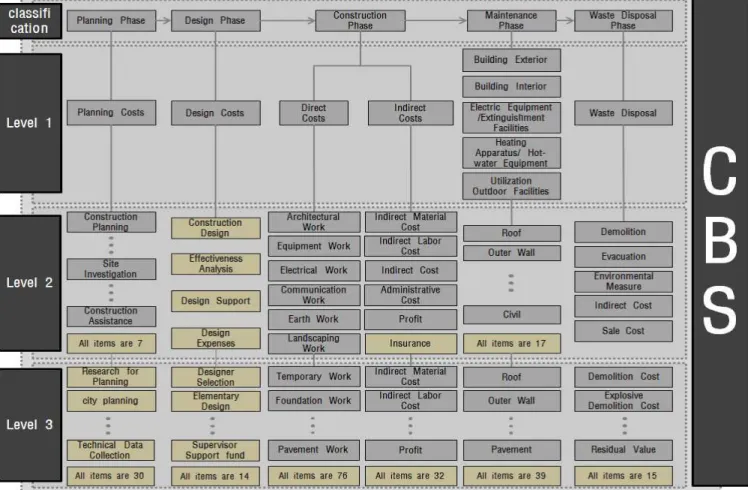
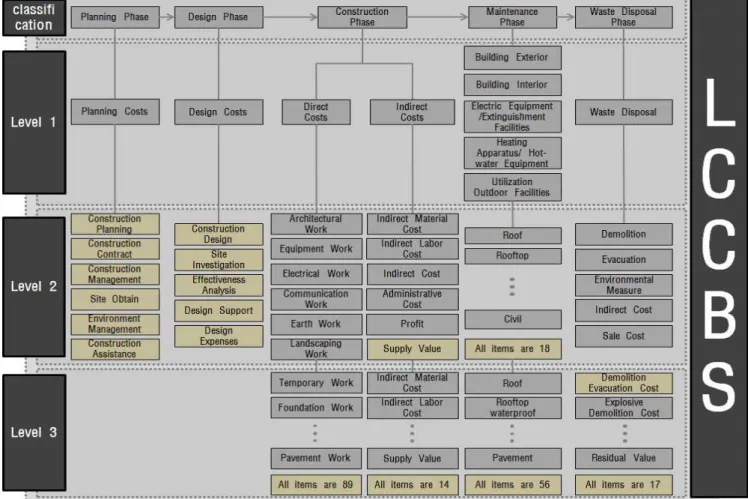
As illustrated in Figure 3, the draft of the cost breakdown structure of a construction project is divided into planning and design, construction, maintenance and waste disposal phases, each of which was also classified into category, division and section. The category of planning and design included planning cost and design cost; the division consisted of detailed items for the category items; and the section included sub-items by item in the division.

For a systematic classification of the construction phase, bills of quantities for construction work, standard of estimation, specification and others were analyzed and classified. Costs were divided into direct cost and indirect cost; the division was divided by work type in the category; and sub-work types by division were included in the section.

The maintenance phase is the most important cost item for LCC estimation of a construction project, and to build a reasonable LCCBS, the RFP·maintenance cost breakdown structure used for the educational facilities BTL project was adopted. Categories were divided into external and internal maintenance, electricity and fire fighting facility, heating and hot water facility, and outside ancillary facility; the division included items by main process; and the section was composed of sub-items by item in the division.

The category of the waste disposal phase was set as waste disposal, and the division was set as dismantling, disposal, environmental measure, indirect cost, and cost of sale. The section consisted of sub-items by item in the division.

4. Development of CBS for LCC estimation

4.1 Development process of CBS

The CBS draft for LCC estimation was established based on the development direction described earlier.

To secure the validity and objectivity of the CBS draft developed, Delphi technique was applied, Through the Delphi technique, experts’ opinions were collected, and a CBS was developed for LCC estimation after modification and addition.

The information of the experts that participated in

the Delphi analysis is indicated in Table 3, The

experts selected have at least 18 years of experience

in the field, which means they are professional and

ave sufficient experience in their career.

(6)

Figure 3. Draft of Cost Breakdown Structure for Life Cycle Costing

Table 3. Present Condition of Construction Experts for Delphi Method Participation

Experts Affiliation position caree

r

A K University Associate

professor 23

B M University Associate

professor 12

C K Education office

in-local Action officer 20

F D Construction firm CEO 18

As shown in Figure 1, four Rounds of Delphi analysis were conducted based on the CBS draft. In Round 1, the hierarchy level of the CBS draft was evaluated to determine whether or not it was appropriately drawn up. In Round 2, modifications and additions were made to the CBS by phase, and each hierarchy was analyzed appropriate for LCC

estimation. In Round 3, modification and addition were made for the analysis results conducted in Round 2 to verify objectivity and validity, and an analysis was done of the items modified. In Round 4, modification and addition were made for the items modified in Round 3, and the hierarchy level by phase was finally verified.

4.2 Results of Delphi analysis technique

4.2.1 Delphi analysis results of planning and design phase

Four rounds of Delphi analysis of planning and

design phase were implemented. The main findings

are presented in Table 4. In Round 1, the items in the

division of planning cost, the field research item, was

(7)

reclassified into design cost, and the sub-items in the section were additionally classified and reclassified. In Round 2, all the items in the section were eliminated since it was determined to be appropriate to determine and utilize the classification level according to LCC estimation when verifying the hierarchy level appropriate for LCC estimation. In Round 3, objectivity and validity was verified, but the added items were not analyzed. In Round 4, final verification was made for the hierarchy level by phase.

Round Experts Main Analysis

1

A On the spot examination is reclassified.

B No modifications

C Elimination of supervisor support cost Add of item to test and analysis Add of item to a geological survey D

Add of item to VE and LCC Change of item name in construction

contract

E Subdivision of calculating method designers

F No modifications

2

A No modifications

B Reclassification of item to VE and LCC

C Glossary is needed.

D Add of item to basic design E Add of cost to BF authentication F Eliminate of small scale classification

3

A No modifications

B No modifications

C Change of item name

Subdivision of design cost D

Add of item to BIM design Add of item to cost of design and

supervision

E Add of item to judgment of every kind

F No modifications

4

A Verification of Hierarchy level B Verification of Hierarchy level C Verification of Hierarchy level D Verification of Hierarchy level E Verification of Hierarchy level F Verification of Hierarchy level Table 4. Results of Delphi Method Analysis on Planning and

Design Phase

4.2.2 Delphi analysis results for construction phase Four rounds of Delphi analysis were conducted for construction phase, using the experts’opinions and advice based on the CBS draft for LCC estimation.

As shown in Table 5, in Round 1 the hierarchy level by phase was reclassified to be appropriate, and an additional classification was made through modification and adjustment. In Round 2, the indirect cost was incorporated based on the contract cost for work not in the implementation budget for the classification appropriate for LCC estimation. In Round 3, objectivity and validity were verified, and specifications for the doorway work were modified.

In Round 4, final verification was made for the hierarchy level by phase.

Round Experts Main Analysis

1

A No modifications

B

Reclassification to share of the expenses Reclassification of item to wastewater work

and rainwater work Add of item to city wall Work C

Add of item to elevator work Reclassification of item to wastewater work

and rainwater work

Add of item to waste water treatment work Add of item to front gate work D

Add of item to quality management cost Reclassification of item to wastewater work

and rainwater work Add of item to city temporary work E Add of labor costs item to green building

F No modifications

2

A

Subdivision of appurtenant work Add of item to city temporary work Waterproof work and vaporproofing work is

not required to item B Subdivision of doorway work C Add of item to city gas work D Add of item to city dismantling work E Add of cost to BF authentication F Combination of cost to overhead

3

A Doorway work does not require a subdivision

B No modifications

C No modifications

D Add of item to plastering and waterproof work

E No modifications

F No modifications

4

A Verification of Hierarchy level B Verification of Hierarchy level C Verification of Hierarchy level D Verification of Hierarchy level E Verification of Hierarchy level F Verification of Hierarchy level Table 5. Results of Delphi Method Analysis on Construction

Phase

(8)

4.2.3 Delphi analysis results for maintenance phase Four rounds of Delphi analysis were conducted for maintenance phase, and the findings are shown in Table 6. In Round 1, it was proven that the hierarchy level by phase was appropriately drawn, but it was found that additional classification was needed. In Round 2, hierarchy level was also analyzed to be appropriate for LCC estimation, but additional classification was needed for door lock in the category of window and door. In Round 3, objectivity and validity were verified. and it was found that no modification was needed. In Round 4, Final verification was made for the hierarchy level by phase.

Table 6. Results of Delphi Method Analysis on Maintenance Phase

Round Experts Main Analysis

1

A No modifications

B No modifications

C

Add of item to outdoor units Subdivision of floor Subdivision of outer wall Add of item to door-lock and strong glass

Subdivision of house wiring Add of item to play equipments

D Subdivision of pump type

E Add of item to new regeneration Add of item to waterproof Add of item to air conditioning facilities

F No modifications

2

A No modifications

B Partition wall is not required to item Change of item name to strong glass

doorlock

C No modifications

D No modifications

E Add of item to green building certification

F No modifications

3

A Add of item to door lock

No modifications B

C Partition wall is necessary to item

D No modifications

E No modifications

F Green building certification is not required to item

4

A Verification of Hierarchy level B Verification of Hierarchy level C Verification of Hierarchy level D Verification of Hierarchy level E Verification of Hierarchy level Verification of Hierarchy level F

4.2.4 Delphi analysis results for waste disposal phase Four rounds of Delphi analysis were performed on the waste disposal phase through the advice of experts based on the CBS draft for LCC estimation.

Table 7 describes the main findings by round. In Round 1, hierarchy level by phase was found to have been appropriately classified; however, the nomenclature should be modified appropriately in the detailed classification. In Round 2, hierarchy level was evaluated as appropriate for LCC estimation, and additional modification for the nomenclature was made in the detailed classification. In Round 3, objectivity and validity were verified, but additional modification was not analyzed. Final verification was made for the hierarchy level by phase.

Table 7. Results of Delphi Method Analysis on Waste Disposal Phase

Round Experts Main Analysis

1

A No modifications

B No modifications

C No modifications

D Subdivision of small scale classification

E No modifications

F No modifications

2

A No modifications

B No modifications

C No modifications

D Add of item to asbestos research expenditure

E No modifications

F Unnecessary of small scale classification

3

A No modifications

B No modifications

C Required of small scale classification

D No modifications

E No modifications

F No modifications

4

A Verification of Hierarchy level B Verification of Hierarchy level C Verification of Hierarchy level D Verification of Hierarchy level E Verification of Hierarchy level F Verification of Hierarchy level

4.3 CBS for reasonable LCC estimation of a building structure

The CBS developed after Delphi analysis is shown

(9)

Figure 4. Model of Cost Breakdown Structure for Life Cycle Costing

in Figure 4, and is divided into four phases:

planning and design, construction, maintenance, and waste disposal. The breakdown structure for each phase was classified appropriately for LCC estimation. The CBS for planning and design phase was divided into category and division levels. The category was classified into planning cost and design cost, and the division consisted of detailed items according to the classifications in the category.

Construction phase was classified into category, division and section. Direct and indirect cost was included in the category; the division was classified by work type such as construction work, machine work, electricity work, communication work, and public work. Since indirect cost is usually calculated

based on the contract cost for work in LCC estimation, indirect cost was quantified based on the contract cost for work. In addition, the section was divided into sub-items by item in the division.

The breakdown structure of the maintenance phase was similar overall to the CBS draft, but some additional items were included for reasonable LCC estimation. The breakdown structure of waste disposal phase was also similar overall to the CBS draft, and was largely divided into category, division and section. Waste disposal was set as the category;

dismantling, disposal, environmental measure,

indirect cost, and cost of sale were set as the item

in the division; and the sub-items by item in the

division were set for the section.

(10)

As indicated in Figures 3 and 4, the differences between the CBS draft by phase of a construction project and the LCCBS developed based on the Delphi analysis were the addition and elimination of the items to make the LCC estimation more accurate.

In the modification for planning and design phase, the items classified in the section that did not affect LCC estimation and additions of the items to the division were eliminated. In the modification for construction phase, since detailed classification of the indirect cost items was not necessary, the direct cost was classified more specifically, while the indirect cost was eliminated for quantification. In the modification for maintenance phase, there were no big differences overall. The items were classified more specifically, and nomenclature was modified in the waste disposal phase.

5. Conclusion

The construction industry involves a series of processes from planning, to design, construction, maintenance and to waste disposal, each of which has different and unique characteristics. The CBS used at each phase is different, which presents an obstacle to estimating construction cost. To address the problem, a CBS should be established to perform systematic LCC estimation by phase of a construction project.

For this reason, a Delphi analysis technique was utilized in this research to develop a CBS for more accurate LCC estimation of a building structure. The CBS developed in this research was finally drawn through four rounds of collecting experts’opinions and advice. The hierarchy level of the breakdown structure was verified through the final verification step.

The CBS developed was divided into four phases:

planning and design, construction, maintenance and

waste disposal. The cost breakdown items were limited to classification for LCC estimation. The breakdown structure of planning and design was divided into category and division. In the category planning, cost and design cost were included; and in the division, detailed sub-items for each category were included. The breakdown structure of construction was divided into category, division and section. In the category, direct cost and indirect cost were included. The direct cost was classified by work type, and the indirect cost was quantified based on the contract cost for work. The breakdown structures of maintenance and waste disposal phases were not different from the overall frames of the CBS draft, but more detailed sub-items were reclassified to conduct LCC estimation in a more rational manner.

If the compatible standard for CBS by phase of a building construction is specified more clearly in the future, the CBS developed in this study can be applied continuously, which could relatively reduce time cost in the course of LCC estimation and enable construction work cost to be calculated more economically and effectively.

Acknowledgement

This research was supported by Basic Science Research Program through the National Research Foundation of Korea(NRF) funded by the Ministry of Education, Science and Technology(2011-0015148)

References

1. Choi OY, Kim TH, Kim GH. A Study on Selection of Roof Waterproofing Method by analyzing Life Cycle Costing.

Journal of the Korea Institute of Building Construction. 2008 Oct;8(5):127-35.

2. Park KJ. The Cost Saving Method on Each Building Phase by

Analyzing the Cost Structure. Journal of the Korea Institute

of Building Construction. 2005 May;5(1):97-105.

(11)

3. Kwon OB, Son JH, Lee SH. Study on the Application of 3D-based BIM for School Facilities to Increase Cost Management Efficiency. Journal of the Korea Institute of Building Construction. 2010 Dec;10(6):49-61.

4. Lee JS. Study Method 21 Delphi Method. Paju-si (Korea):

Kyoyookbook; 2001. 138 p.

5. Kang HW, Yoo JH, Kim YS. A Study on the Estimation of Elemental Costs for an Apartment Building. Journal of Construction Management. 2007 Apr;8(2):173-82.

6. Hyun CT, Hong TH, Son MJ, Lee HC, Ha SH. Development of the Cost Breakdown Structure Organization Tool for the Planning Phase of Mixed Used Development Projects. Journal of Architectural Institute of Korea. 2009 Aug;25(8):185-95.

7. Hyun CT, Hong TH, Koo KJ, Yeon HJ, Moon HS, Cho KM.

Development of the Space Cost Breakdown Structure(CBS) for Multi-Family Housing Projects. Journal of Construction Management. 2007 Dec;8(6):178-88.

8. Jung SS. A Study on the Cost Analysis Breakdown System for Decision makerin Life Cycle Cost Analysis. Journal of Architectural Institude of Korea. 2004 Mar;20(3):201-11.

9. Lee MH, Jung YH, Park TK. A Study on the Establishment of Maintenance Standards(Repair Periods and Rates) of Educational Facilities. Journal of Architectural Institude of Korea. 2009 Sep;25(9):145-52.

10. Kang HW, Won YM, Kim YS. A Study on the Long-Term Maintenance Costs and Elemental Maintenance Costs for Apartment Buildings. Journal of Architectural Institute of Korea. 2010 Nov;26(11):111-9.

11. Lee CK, Lee MH, Cho BH, Choi JH, Park TK. A Study on Development of Life Cycle Cost Analysis System for Build-Transfer-Lease Projects. Journal of Architectural Institute of Korea. 2008 Apr;24(4):53-62.

12. Kim YS, Kang HW. Variation Range for Maintenance Costs of Education Facilities Based on LCC Analysis. Journal of Construction Management. 2010 May;11(3):72-80.

13. Korea Advanced Institute of Science and Technology.

Standard of Estimate for Architectural Work. Gccity-si (Korea): Ministry of Construction Transportation; 2010. p.

757-1036

14. Charette RP, Marshall HE. UniformatⅡ Element Classification for Building Specifications, cost estimation and cost analysis.

West Conshohocken (PA): ASTM; 1999. p. 12-26

15. Chua D, Godinot M. Use of a WBS Matrix to Improve Interface Management in Projects. Journal of Construction Engineering and Management. 2006 Jan;132(1):67-79.

16. Jung YS, Woo S. Flexible Work Breakdown Structure for

Integrated Cost and Schedule Control. Journal of Construction

Engineering and Management. 2004 Oct;130(5):616-25.

수치

Figure 1. Research Process
Table  2  indicates  the  domestic  and  overseas  CBS  types.
Figure 2. Process of Delphi Method
Figure 3. Draft of Cost Breakdown Structure for Life Cycle Costing
+3

참조

관련 문서

Considering these aspects, this paper aimed to develop a customized Korean life cycle cost analysis model estimating various effects on road users and socio-environmental costs

A CBR-based hybrid for predicting construction duration and cost based on project characteristics in multi-family housing projects, MSc Thesis, The University of Seoul (in

In this study, various artificial intelligence models were used to accurately predict the construction cost in the planning and design phase with limited variables and lack

Annual loads were calculated and applied to the alternative for the purpose of calculating annual energy cost.. Second, several types of data were collected

Figure 10.. According to the design, the temporary structure is not required all over the project site. Temporary structure regions are divided into three regions

Life Cycle Cost Analysis at Design Stage of Cable Stayed Bridges based on the Performance

Considering these aspects, this paper aimed to develop a customized Korean life cycle cost analysis model estimating various effects on road users and socio-environmental

The proposed method can establish the lifetime optimum maintenance strategy of the deteriorating bridges considering the life-cycle performance as well as the life-cycle