92 Choi : Preparation of Cobalt Complex Compound of Chlorophyllin Vol. 7
Preparation of Cobalt Complex Compound of Chlorophyllin
By
Chong-Ihn Choi*
(Received March 30, 1963)
S S C * Chlorophyllin cobalt Complex 슘®의 에 IB한
Magnesium Chlorophyllin 으로부터 *렇 ^에 하여 활한한 Chlorin-e 에 7J<^t토 Cobalt 텔을 시 켜 Chlorophyllin 에 Cobalt Complex 출원을 헬 하 였 다 ■ C hlorinl보^에 있어 서 alcohol첸S혹를 햇평해 온 은 Chlorin 이 alcohol에 t l 한 ^ 월 S 가 혈히 적 은
로 SKJtl을 불 한 iBC분후로 얻지 못할 뿐만 아니 라 이에 따르는 종 도 복잡 불 편하였으나 헬 를 급};텔빨으로 ft팔하므로써 좋은 및볶률 얻을 수가 있었다.
It has been well known that chlorophyll derivative has a particular action pharmacologically espe
cially for granulation tumor.
Various metallic derivatives of chlorophyll has been used in proprietary products for removing objectionable odors/* According to Moss et aP an ointment containing water soluble chlorophyll has excellent deodorant power for suppurating wounds and ulcers.
The Compounds has also been recommended for control of body and breath odors,®*신* a usage which may provide a large market for chlorophyll derivatives.
Within the last few years interest in cobaltous chlorophyllin has marketly increased. It has been known that the chlorophyllin derivatives which has cobalt in the center of chlorophyllin molecule instead of magnesium has worth action pharmaceutically.
L.S. Hiraoka®* reported that cobalt chlorophyllin derivative was obtained from silkworm feces which is the by-product in the silk industry, but the method can not be considered as the practical method, since the yield is too low (0.02%—0.025% of the starting material, 2% of chlorophyllin), and the procedure is complicated. Therefore it can be thought that no method of preparing cobaltous chlorophyllin which can be used practically is reported in detail, although several attempts have been made/궁*®* for the purpose of preparation of metallic especially, cobalt chlorophyllin derivatives.
In this experiment relatively good result in preparation of cobaltous chlorophyllin was obtained.
Author believes that the compound obtained in this experiment can be used as a starting material of other cobalt chlorophyllin derivatives and it is enough to use this cobalt chlorophyllin externally for the therapeutical purpose, although the compound obtained does not have so high purity. (70——80%)
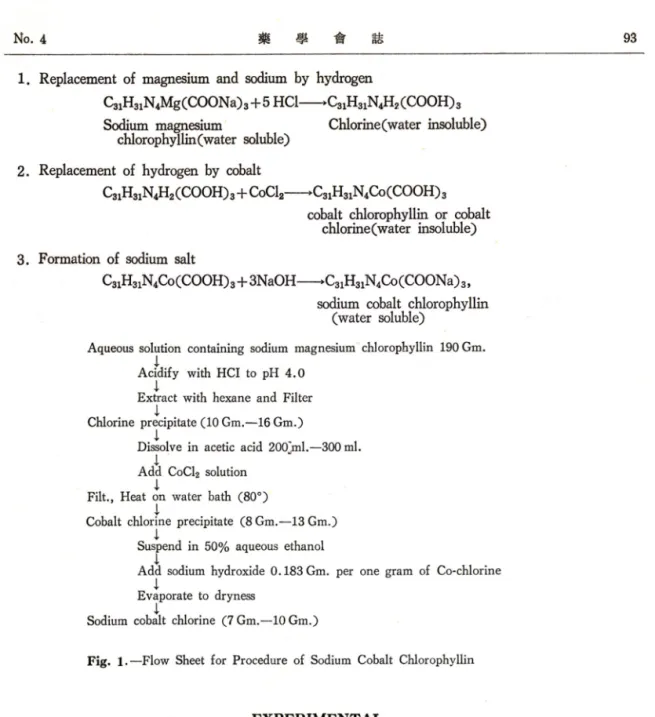
The process to be described involves the preparation of cobaltous chlorophyllin from water soluble magnesium chlorophyllin which can be obtained cheeply.
The three following reactions are involved in the conversion of water soluble magnesium chloro
phyllin which is produced by well known process from plants.
♦College of pharmacy, Sung Kyun Kwan University, Seoul, Korea
1. Replacement of magnesium and sodium by hydrogen C3iH3iN4Mg(COONa)3+5 H C l~
Sodium magnesium Chlorine (water insoluble) chlorophyllin (water soluble)
2. Replacement of hydrogen by cobalt C3iH3iN4H2(COOH)3 + CoCV
No. 4 m m t ^ 93
3. Formation of sodium salt
C3iH3iN4Co(COOH)3+3NaOH-
-C3iH3iN4Co(COOH)3 cobalt chlorophyllin or cobalt
chlorine (water insoluble)
-C3iH3iN4Co(COONa)3.
sodium cobalt chlorophyllin (water soluble)
Aqueous solution containing sodium magnesium chlorophyllin 190 Gm.
Acidify with H Cl to pH 4.0
•i ^
Extract with hexane and Filter Chlorine precipitate (10 Gm.— 16 Gm.)
Dissolve in acetic acid 200jnl.—300 ml.i
Add C0CI2 solution Filt., Heat on water bath (80°)i
Cobalt chlorine precipitate i (8 Gm.— 13 Gm.)
i .
Suspend in 50% aqueous ethanol
Add sodium hydroxide 0.183 Gm. per one gram of Co-chlorine Evaporate to dryness
Sodium cobalt chlorine (7 Gm.—10 Gm.)
Fig. 1 .Flow Sheet for Procedure of Sodium Cobalt Chlorophyllin
EXPERIMENTAL
Preparation, of chlorin-e.—The well known method which is commercialy used was used in this experiment. Water soluble magnesium chlorophyllin grade 4 which is made by Charles Browman
& Company was used as starting material.
The aqueous water soluble magnesium chlorophyllin (pH 4,0) was slightly acidified by adding hydrochloric acid stirring vigorously.
The precipitated chlorin-e was filtered on Buchner funnel, and washed with slightly acidified water to prevent the chlorin-e from forming a colloidal suspension which was virtually unfilterable. It was recommended to wash the precipitate with toluene in order to obtain purer chlorin-e.
The chlorin-e was finally dried by suction, and stored in closed containers. 흐오*
Praparation of cobaltous chlorophyllin.—The chlorine 10Gm., was dissolved in 200—300mis of glacial acetic acid. To this solution, 300 mis of 10% aqueous solution of cobaltous chloride was
slowly added stirring vigorously. The mixture was heated at 80° for one hour. After cool, the precipitated cobalt chlorophyllin was filtered and washed thoroughly with, hot, slightly acidified water, and dried by suction. On the purpose of purifying cobalt chlorophyllin thus obtained, the impure compound was suspended in ethanol(10 ml™20 mis. per one gram of derivative, moisture free basis).
It was refluxed for one half hour with an equal volume of ethanol containing the theoretical quantity of sodium hydroxide required for reaction with the cobalt chlorophyllin. For every gram of 100 per cent cobalt chlorophyllin, moisture free basis, 0.183 gram of sodium hydroxide is required.
Since excess alkali may decompose the cobalt complex compound, the purity of the cobalt chloro
phyllin should be carefully determined and appropriate adjustments of the quantity of alkali made if necessary. For example, if the cobalt derivative is 50 per cent pure, then 0.183x0.50=0.0915 grams sodium hydroxide would be required for every gram of derivative. The resultant solution was filtered, any insoluble material was washed with 50 percent aqueous ethanol, and the filtrate was neutralized by hydrochloric acid to pH 7.2 and filtered.
The filtrate was slightly acidified by hydrochloric acid (pH 4.0—4.5). Then relatively purer cobalt chlorophyllin was precipitated.
The precipitate was washed with water, alcohol and ether and dried.
Although alcohol was often used as a solvent in preparation of metallic chlorophyllin compound, glacial acetic acid was used as the solvent in this experiment. The advantage of this method is as follows:
1 . smaller amount of solvent is needed in comparison with other method.
2 . the yield is very high.
3. the procedure is relatively simple.
Preparation of Sodium Cobalt Chlorophyllin.~The solution obtained by the same process as the purification process was concentrated to dryness on a steambath.
The yields based on cobalt chlorophyllin are almost quantitative. The purity of the product based on cobalt analysis ranges from 70% to 80%.
Determination of Cobalt.—The cobalt content is one of the criteria of the purity of cobaltous chlorophyllin and sodium cobaltous chlorophyllin.
Theoretically, the former compound contains 9.035 per cent cobalt and the latter 8.17 per cent.
A sample of approximately 0.1 gram (moisture-free basis) is digested with 3 mis—10 mis of con
centrated sulfuric acid in Kjeldahl tube. When all frothing and foaming ceases and the color of the solution turns black to brown or light brown (this process takes 2 to 4 hours), the solution is cooled.
Ten to fifteen drops of 35% perchloric acid is added, and the solution is boiled until it turns coloress or light red (10 to 20 minutes). This solution is cooled, and diluted to 50 mis, and an alliquot is taken for analysis. A colorimetric method involving formation of a blue cobaltous thiocyanate ion was used.®*
Since the chlorine and cobalt chlorophyllin preparations can not be heat dried, they will have variable water and organic solvent content. The conversion of chlorine to cobaltous chlorophyllin and sodium cobalt chlorophyllin is based on weights calculated to a moisture-free basis. Hence every new batch of these compounds must have an analytical moisture determination. This is simply done
94 Choi : Preparation of Cobalt Complex Compound of Chlorophyllin Vol. 7
N o. 4 m m ^ m 95
by weighing accurately 1.0 to 2.0 grams of chlorophyllin derivatives and drying to constant weight in vacuum oven at 60°—70°C.
ACKNOWLEDGMENT
The author wishes to express the appreciation of the advice and encouragement given by Dr.
Head, W.F., Jr., Dean Coker, Samuel T., Dr. Hargreaves, George Walter and Dr. Redman, Glenden D. during this experiment.
REFERENCES
1. Westcott. H.F., N. Y. State J. Med., 50, 698(1950) 2. Paschal G.S., U.S. Patent, 2, 326, 672(1943) 3. Moo et a/., Biochem. Z.y 324, 536(1953) 4. Serhing, M.E, Vet. Med., 45, 291(1950)
5. A.D. Powell, J. Soc. Chem. Chem, Ind., 36, 273(1917) E.S. Tomula, Z, Anal. Chem., 83, 6(1931)
H.M. Putsche, Anal. Chem., 19, 236(1947) 6. Westcott. H.F., N .Y. State J. Med., 50, 648(1950)
Moo et al., Biochem. Z., 323, 439(1953) 7. Hiraoka, J. P., 4945 . 28.
8. —9. Stomura J.P ., 33 945 Feb. 15(1958); J.P , 32, 5729.
Etdr. Ber. Nat. Konred L. Zirm.
Lannach (Steiermark) osterreichisches Patentant, 178162.
10. Monroe E. Wall, U.S.D.A.t 1951 (March), AIC 299.