pISSN 2288-3886 / eISSN 2288-3959
필수지방산 결핍이 유도된 기니피그에서 보라지유와 홍화유 섭취의 표피 과증식 억제 및 세라마이드 대사에 미치는 효과 비교*
이세령
·
조윤희†경희대학교동서의학대학원의학영양학과
Comparative effect of dietary borage oil and safflower oil on anti-proliferation and ceramide metabolism in the epidermis of essential fatty acid deficient guinea pigs *
Lee, Se Ryung · Cho, Yunhi
†Department of Medical Nutrition, Graduate School of East-West Medical Science, Kyung Hee University, Gyeonggi 446-701, Korea
서 론
피부의 가장 외층인 표피는 외부 환경으로부터 인체를 보호하는 역할을 하며, 특히, 표피의 최외각층인 각질층에 서 형성되는 표피장벽은 스핑고지질, 콜레스테롤, 유리지 방산 등의 지질혼합체로 층상구조를 이루어 세균, 곰팡이, 바이러스 등의 피부 침투를 억제할 뿐 아니라 수분 유지 및
과증식을 억제한다.1-3 표피장벽의 주요 지질인 스핑고지 질은 세라마이드 (ceramide: Cer) 및 Cer의 전구지질인 글 루코실세라마이드 (glucosylceramide: GlcCer) 및 스핑고 마이엘린 (sphingomyelin: SM)을 총칭하며이들 스핑고지 질은 표피 장벽의 정상적인 층상구조 유지를 위해 여러 불 포화 지방산을 함유하고 있다.4-7
Linoleic acid (LA, 18 : 2n-6)와 γ-linolenic acid (GLA,
ABSTRACT
Purpose: Borage oil (BO) and safflower oil (SO) are efficacious in reversing epidermal hyperproliferation, which is caused by the disruption of epidermal barrier. In this study, we compared the antiproliferative effect of dietary BO and SO. Altered metabolism of ceramide (Cer), the major lipid of epidermal barrier, was further determined by measurement of epidermal levels of individual Cer, glucosylceramide (GlcCer), and sphingomyelin (SM) species, and protein expression of Cer metabolizing enzymes. Methods: Epidermal hyperproliferation was induced in guinea pigs by a hydrogenated coconut diet (HCO) for 8 weeks. Subsequently, animals were fed diets of either BO (group HCO + BO) or SO (group HCO + SO) for 2 weeks. As controls, animals were fed BO (group BO) or HCO (group HCO) diets for 10 weeks. Results: Epidermal hyperproliferation was reversed in groups HCO + BO (67.6% of group HCO) and HCO + SO (84.5% of group HCO).
Epidermal levels of Cer1/2, GlcCer-A/B, and β-glucocerebrosidase (GCase), an enzyme of GlcCer hydrolysis for Cer generation, were higher in group HCO + BO than in group HCO, and increased to levels similar to those of group BO. In addition, epidermal levels of SM1, serine palmitoyltransferase (SPT), and acidic sphingomyelinase (aSMase), enzymes of de novo Cer synthesis and SM hydrolysis for Cer generation, but not of Cer3-7, were higher in group HCO + BO than in group HCO. Despite an increase of SPT and aSMase in group HCO + SO to levels higher than in group HCO, epidermal levels of Cer1-7, GlcCer-A/B, and GCase were similar in these two groups. Notably, acidic ceramidase, an enzyme of Cer degradation, was highly expressed in group HCO + SO. Epidermal levels of GlcCer-C/D and SM-2/3 did not differ among groups. Conclusion: Dietary BO was more prominent for reversing epidermal hyperproliferation by enhancing Cer metabolism with increased levels of Cer1/2, GlcCer-A/B, and SM1 species, and of GCase proteins.
KEY WORDS: borage oil, safflower oil, epidermal hyperproliferation, ceramide metabolism
Received: June 10, 2015 / Revised: July 7, 2015 / Accepted: July 24, 2015
*This work was supported by a grant of the Korean Health Technology R&D Project, Ministry of Health & Welfare, Republic of Korea (Grant No. HN13C0076).
†
To whom correspondence should be addressed.
tel: +82-31-201-3817, e-mail: [email protected]
© 2015 The Korean Nutrition Society
This is an Open Access article distributed under the terms of the Creative Commons Attribution Non-Commercial License (http://creative-
commons.org/licenses/by-nc/3.0/) which permits unrestricted non-commercial use, distribution, and reproduction in any medium, provided
the original work is properly cited.
18 : 3n-6)는 표피의 주요 불포화 지방산으로 이중 LA는 표 피 전체 지방산의 38%를 차지하는 가장 대표적인 불포화 지방산이다.6-8 LA 및 GLA를 비롯한 불포화지방산 결핍 식이를 장기간 섭취하는 경우 각질층의 층상 구조가 손상 되고 이차적으로는 표피의 수분 손실 증가 및 과증식이 초 래됨이 보고되어,8,9이들 불포화 지방산은 표피의 정상적 인 층상구조 유지를 위해 식이로 섭취해야 되는 필수지방 산으로 알려져 있다. LA가 전체 지방산의 70% 이상을 차 지하는 홍화유가 LA의 주요 급원 유지로 알려져 있는 한 편, 보라지유 (20~25% GLA 함유) 및 달맞이꽃기름 (8~10% GLA 함유)등에 함유되어 있는 GLA는 홍화유의 LA 함유량에 비해서는 소량이나 인체 내에서 GLA 대사 체들은 LA를 능가하는 표피 과증식 억제 및 항염 활성을 나타낸다.10,11또한 홍화유 및 GLA 함량이 가장 높은 보라 지유의 식이 공급이 표피 장벽의 층상구조를 복구시키고, 표피 과증식 억제 및 Cer 함량을 증가시킴이 보고되어12,13 이 두 유지의 피부건강을 위한 건강기능식품 소재로의 상 용화에 대한 과학적 근거를 제시하고 있다. 그러나 이들 사 전 연구는 홍화유 또는 보라지유의 개별적인 피부 효능을 보고하거나 Cer의 전체 함량 증가에 한하여 관련 기전이 보고되어 있을 뿐,10,13 이 두 유지의 표피 과증식 억제 효능 을 비교하거나 관련 기전을 개별 Cer, GlcCer, SM species 의 함량 및 Cer 생성, 대사, 분해 관련 효소들의 발현을 포 함하는 전체적인 Cer 대사 차원에서 비교한 연구는 미흡 한 수준이다. 따라서 본 연구에서는 기니피그에 필수지방 산 결핍 식이를 통해 표피 과증식을 유도한 후 보라지유 및 홍화유를 식이 공급하고, 이들 두 유지의 섭취가 표피 과증 식 억제와 Cer, GlcCer, SM의 표피 함량 및 관련 효소들의 단백질 발현에 미치는 영향을 비교·분석하였다.
연구방법 실험동물 및 식이구성
생후 5일된 수컷 기니피그 ((주)샘타코, Korea)를 구입하 여 1주간 고형배합 사료로 적응시켰다. 표피 과증식 유도 를 위해 8주간 불포화 지방산이 결핍된 코코넛 유지 (hydrogenated coconut oil: HCO)를 식이 공급하였다. 8주 후 유도된 표피 과증식의 억제를 위해서 난괴법으로 군을 나누어 보라지유 (borage oil: BO) (HCO + BO군) 또는 홍 화유 (safflower oil: SO) (HCO + SO군)를 식이에 첨가하 여 2주간 추가적으로 식이 공급하였다. 홍화유 및 기니피 그의 제한적 확보에 의해 보라지유를 10주간 식이 공급한 정상대조군 (BO군)을 두었으며, 10주간 HCO 식이를 공급 한 필수지방산 결핍군 (HCO군)을 음성대조군으로 두었다.
10주간 (HCO군) 및 8주간의 코코넛 유지의 식이 급여에 의 한 불포화 지방산 결핍 유도는 사전 연구와 동일한 gas chromatography 분석을 이용하여14불포화지방산 결핍시 oleic acid (18 : 1n-9)에서 비정상적으로 생성되는 mead acid (eicosatrienoic acid) (20 : 3n-9)의15표피 내 축적으로 확인하였다 (data not shown). 이어서 2주간의 보라지유 및 홍화유의 추가적인 식이 공급이 이루어진 HCO + BO군 및 HCO + SO군의 불포화지방상 결핍의 회복 또한 mead acid의 표피 내 감소에 의해 사전에 확인하였다 (data not shown).
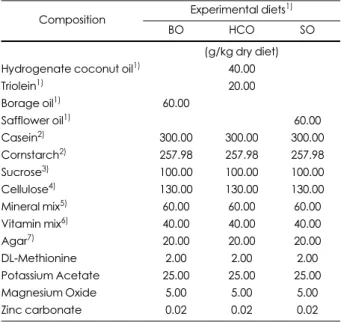
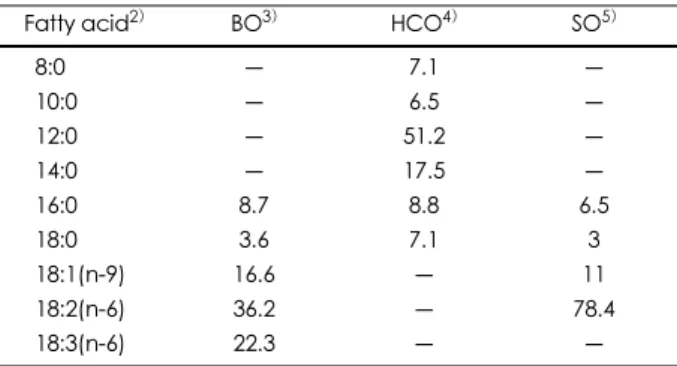
각 실험군의 식이 조성은 Table 1과 같으며 기니피그 기 본 식이 기준에 준하여 각 유지의 함유량은 전체 식이 무게 의 6%로 고정하였다.14 각 식이의 지방산 조성의 분석 결 과 (Table 2), 코코넛 유지에는 C8~C18의 포화 지방산만 이 함유되어있고, 보라지유에는 LA (36.2%)와 GLA (22.3%)가 주요 지방산인 반면 홍화유에는 LA (78.4%)가
Table 1. Compositions of experimental diets
Composition Experimental diets1)
BO HCO SO
(g/kg dry diet)
Hydrogenate coconut oil1) 40.00
Triolein1) 20.00
Borage oil1) 60.00
Safflower oil1) 60.00
Casein2) 300.00 300.00 300.00
Cornstarch2) 257.98 257.98 257.98
Sucrose3) 100.00 100.00 100.00
Cellulose4) 130.00 130.00 130.00
Mineral mix5) 60.00 60.00 60.00
Vitamin mix6) 40.00 40.00 40.00
Agar7) 20.00 20.00 20.00
DL-Methionine 2.00 2.00 2.00
Potassium Acetate 25.00 25.00 25.00
Magnesium Oxide 5.00 5.00 5.00
Zinc carbonate 0.02 0.02 0.02
1) Group BO: borage oil (BO) diet for 10 wks, Group HCO: hydro- genated coconut oil (HCO) diet for 10 wks, Group HCO + BO and HCO + SO: HCO diet for 8 wks followed by feeding BO diet (group HCO + BO) or safflower oil (SO) diet (group HCO + SO) for 2 wks 2) Kyungdong (Sungbookgu, Seoul, Korea) 3) Cheiljedang (Seoul, Korea) 4) Sigma, St. Louis, MO 5)Briggs chick salt mix- ture A, contained in (g/kg) mix: CaCO3, 250; Ca3(PO4)2· 5H2O, 233; CuSO4· H2O, 0.3; ferric citrate· 5H2O, 6.7; MgSO4· 7H2O, 83.3;
MnSO4· 4H2O, 7.0; KI, 0.7; K2HPO4, 150; NaCl, 146.7; Na2HPO4, 121.7; ZnCO3, 0.3; ICN Biomedicals, Aurora, OH 6) Vitamin mix provided the following (mg/kg) of the complete diet: D-a- tocopherol, 134; L-ascorbic acid, 1,800; choline chloride, 30,000;
D-calcium panththenate, 120; inositol, 200; menadione, 90; nia- cin, 180; p-amino-benzoic acid, 200; pyridoxine HCL, 40; ribofla- vin, 40; thiamin HCL, 40; retinyl acetate, 10.8; biotin, 0.8; folic acid, 3.6; cyanocobalamin, 0.054; ICN Biomedicals, Aurora, OH 7) BD Biosciences (Sparks, MD)
주요 지방산으로 파악되었다. 총 10주의 사육 기간 동안 0.05%의 vitamin C를 함유한 물을 자유롭게 섭취하도록 하였고, 식이는 2일 마다 40 g으로 일정량 공급하였다. 온 도 22 ± 1oC, 습도 60 ± 5%로 유지하였고 12시간 간격으로 명암을 조절하였다. 본 연구는 경희대학교 동물실험윤리 위원회의 승인을 받아 수행하였다 (KHUASP-13-05).
기니피그 희생 및 표피 분리
각 실험식이를 10주간 공급 후 희생된 기니피그의 피부 조직을 등 부위에서 취하였다. 피부 조직을 Hank solution (Hank's Balanced Salt Solution)과 Dispase II (2.4 unit/
mL, Roche, Germany)의 1 : 1 혼합용액에 진피를 아래 방 향으로 위치하여 4oC에서 16시간 동안 처리 후 표피를 분 리하였다.16
표피 증식의 조직학적 평가
표피의 증식 정도를 가시적으로 측정하기 위해 등 부위 에서 얻은 2 mm2의 피부 조직을 neutral buffered formalin 에 고정하고 8 µm 두께로 절단한 후 hematoxylin과 eosin (H&E)으로 염색하였다.17 100× 배율로 현미경을 이용하 여 표피층 두께를 측정하고 표피의 증식 정도를 수치화하 였다.
표피 지질 추출
표피를 PBS와 함께 polytron으로 분쇄하고 원심분리 후 (3,000 rpm, 5분) (GYROGEN 416G, Korea) 얻어진 상층 액은 bovine serum albumin (BSA)을 표준 물질로 한 Bio- rad protein assay를 이용하여 단백질을 정량하였다.18 단백 질 정량 후 남은 용액에 Folch 용액 (CHCl3 : MeOH = 2 : 1, v/v)을 첨가하고 원심 분리한 후 얻어진 상층액에 CHCl3 : H2O (1 : 1, v/v)을 첨가하여 3,000 × g, 10분 동안 다시 원
심분리 하였다. 상층액에 saturated H2O : CHCl3 : MeOH (0.8 : 1 : 1, v/v/v)을 첨가하고 3000 × g, 10분 간 원심 분리 한 후 얻어진 하층을 N2 gas를 이용하여 건조시키고 CHCl3 : MeOH (1 : 1, v/v)에 최종적으로 녹였다.17 스핑고지질 분석
표피에서 추출된 지질은 다음과 같은 전개 조건에서 high performance thin layer chromatography (HPTLC)를 이용하여 분석하였다.4,19 Cer 및 GlcCer species는 전개액 CHCl3 : MeOH : H2O (20 : 5 : 0.5, v/v/v)으로 3 cm 전개 (1차)와 6 cm 전개 (2차), 전개액 CHCl3 : MeOH : acetic acid (23.5 : 1 : 0.25, v/v/v)으로 9.5 cm 전개 (3차), n- hexane : diethyl ether : acetic acid (15 : 7.5 : 0.25, v/v/v) 으로 9.5 cm 전개 (4차)를 순차적으로 시행하여 분리하였 다. SM species는 CHCl3 : MeOH : concentrated NH4OH (16 : 6 : 1.2, v/v/v)으로 8.5 cm 전개하여 분리하였다. 모든 샘플은 automatic multiple development (AMD) apparatus (Linomat5, CAMAG, Muttenz, Switzerland)를 이용하여 분석하였고, 분획된 각 지질의 함량은 cupric acetate- phosphoric acid 처리 후 160oC, 15분 가열에 의해 발색하 여 해당 표준물질과 함께 TLC III scanner (DigiStore2, CAMAG, Muttenz, Switzerland)를 이용하여 정량하였다.
분석된 모든 스핑고지질은 시료의 단백질 정량과 함께 ng lipid/µg protein 으로 표시하였다.
세라마이드 대사 관련 효소의 단백질 발현 측정 표피를 lysis buffer (20 mM Tris-HCl, 150 mM NaCl, 10 mM NaPO4, 10% Glycerol, 100 µM Ammonium moly- bdate, 1% NP-40, 0.1% SDS)와 함께 polytron을 이용하여 분쇄하였다. 분쇄한 조직을 15분간 원심분리 후 (15,000 rpm, 4oC) 얻어진 상층액을 Bio-rad protein assay를 이용 하여 단백질 정량을 하였다.18준비된 시료를 (15 μg/each) 8% PAGE/SDS gel에서 전기 영동 시킨 후 nitrocellulose membrane에 흡착시켰다. Membrane은 PBST 용액을 이용 하여 1/1000 농도로 희석한 각 1차 항체 [serine palmitoyl- transferase (SPT): Cat No. sc-27500, β-glucocerebro- sidase (GCase): Cat No. sc-32883, acid sphingomyelinase (aSMase): Cat No. sc-9817, acid ceramidase (aCDase) Cat No. 28486] (Santa Cruz Biotechnology Inc. USA)와 함께 4oC에서 16시간 동안 반응시키고 PBST 용액으로 3 회 세척하였다. 연속적으로 PBST 용액을 이용하여 1/4000 농도로 희석한 2차 항체, anti-rabbit IgG-HRP (Bethyl Laboratories Inc. USA, A120-101P) 또는 anti-Goat IgG- HRP (Bethyl Laboratories Inc. USA, A50-101P)와 함께
Table 2. Fatty acid composition of dietary oils1)
Fatty acid2) BO3) HCO4) SO5)
8:0 ― 7.1 ―
10:0 ― 6.5 ―
12:0 ― 51.2 ―
14:0 ― 17.5 ―
16:0 8.7 8.8 6.5
18:0 3.6 7.1 3
18:1(n-9) 16.6 ― 11
18:2(n-6) 36.2 ― 78.4
18:3(n-6) 22.3 ― ―
1) Data are measured in mg/100mg total fatty acids. 2) Only the major fatty acids are listed. 3) BO: borage oil 4) HCO:
hydrogenated coconut oil 5) SO: safflower oil
실온에서 2시간 동안 반응시켰다. PBST 용액으로 3회 세 척 후 ECL hyperfilm으로 발색하고, imaging densitometer (Lab work version 4.6 UVP, CA)를 사용하여 정량하였다.
각 band의 intensity는 loading control인 actin의 발현을 기 준으로 표준화하고, 다시 %control로 나타내었다.
통계분석
실험 결과는 SPSS, ver 21.0 program (statistical package for social science, IBM SPSS, Anmonk, NY, USA)을 이용 하여 통계 처리하였다. 결과는 mean ± SEM (n = 4)으로 나 타냈으며, 각 군 간의 비교는 one-way ANOVA 로 분석한 후 Tukey's honestly significant difference (HSD) post hoc test로 p < 0.05 수준에서 검증하였다. 또한 HCO군과 BO군 간 및 HCO군과 HCO + SO군간의 GCase 효소와 HCO군과 BO군간의 aSMase 효소의 단백질 발현 변화를 unpaired Student's t-test로 분석하여 p < 0.01(**) 수준에서 유의성 을 나타내었다 (Fig. 2).
결 과
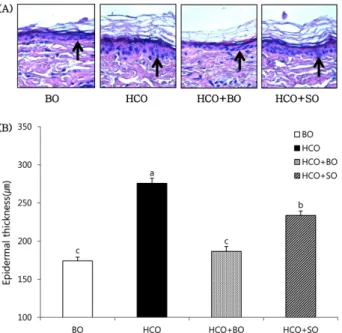
보라지유 및 홍화유 섭취에 의한 표피 증식 변화 H&E 염색법을 이용한 표피의 조직학적 평가 결과 코코 넛 유지를 공급한 HCO군이 BO군에 비해 표피 두께가 증 가되었다 (Fig. 1). 이는 HCO군에서 필수지방산 결핍 증상 인 표피의 과증식이 유도되었음을 의미한다.8,9 HCO + BO군의 표피 두께는 HCO군에 비해 유의적으로 감소하였 고 (HCO군의 67.6%) 그 감소 정도는 BO군과 유사하였다.
이는 필수지방산 결핍에 의해 유도된 표피 과증식이 GLA 주요 공급 유지인 보라지유의 식이 공급에 의해 억제되었 음을 의미한다. 홍화유 식이를 공급한 HCO + SO군에서도 HCO군에 비해 유의적으로 표피 두께가 감소하여 표피 과 증식이 억제되었으나 (HCO군의 84.5%) 그 감소 정도는 HCO + BO군에 미치지 못하였다.
보라지유 및 홍화유 섭취에 의한 표피 스핑고지질 함 량 변화
Sphingoid base를 기본 구조로 지방산이 amide-linkage 로 연결되어 있는 Cer는 sphingoid base 및 지방산의 종류 에 따라 다양한 극성을 나타내는 여러 species로 세분화되 는데, 기니피그 표피에서는 Cer1-7 species가 확인되었다 (polarity, Cer1 < 2 < 3 < 4 < 5 < 6 < 7).20 Cer에 당이 결합 한 GlcCer와 Cer에 콜린이 phosphodiester 결합한 SM 또 한 sphingoid base에 결합된 지방산의 종류에 따라 GlcCer- A/B/C/D (polarity, GlcCer-A < B < C < D)와 SM1/2/3
(polarity, SM1 < 2 < 3) species로 세분화된다.4,5각 실험군 의 표피에서 지질 추출 후 HPTLC를 이용하여 Cer 함량 변 화를 분석한 결과 (Table 3), HCO 군의 Cer의 총 함량은 정 상대조군인 BO 군에 비해 유의적으로 감소하였다. 개별 Cer의 함량 분석 결과 HCO군의 Cer1/2와 Cer5/6/7의 함량 이 BO군에 비해 유의적으로 감소하였다. 이는 코코넛 유 지 식이 공급에 의해 유도된 표피의 과증식이 Cer1/2/5/6/
7을 포함하는 Cer 총 함량 감소와 병행되었음을 의미한다.
HCO + BO군에서는 HCO군에서 감소한 Cer 총 함량 및 Cer1/2 함량이 BO군과 비슷한 수준으로 증가하였다. 그러 나 HCO + BO군의 Cer3-7의 함량은 HCO군과 유사하였 다. 반면 HCO + SO군의 Cer 총 함량 및 모든 Cer의 개별 species의 (Cer1-7) 함량은 HCO군과 유사하였다.
Cer 생성의 전구지질인 GlcCer과 SM의 함량을 분석한 결과4,5,21 HCO군의 GlcCer 총 함량 및 GlcCer-A/B의 함량 이 BO군에 비해 유의적으로 감소하였다. HCO + BO군의 GlcCer 총 함량 및 GlcCer-A/B의 함량은 HCO군에 비해 유의적으로 증가하였고, 그 증가 정도는 정상대조군과 유 사하거나 다소 높았다. 반면 HCO + SO군의 GlcCer 총 함
Fig. 1. Effect of dietary oils on epidermal proliferation in guinea pigs. (A) Histological appearance of epidermal proliferation in control guinea pigs fed the borage oil (BO) diet for 10 wks (group BO), and essential fatty acid (EFA) deficient guinea pigs fed the hydrogenated coconut oil (HCO) diet for 10 wks or 8 wks followed by feeding BO diet (group HCO + BO) or safflower oil (SO) diet (group HCO + SO) for 2 wks. Arrows indicate that the bottom layer of epidermis and epidermal proliferation is correlated with epider- mal thickness from the arrow to the top. (B) Epidermal proliferation of guinea pigs fed different diets as indicated in A. Values are mean ± SEM (n = 4). Means with different letters indicate significant differences at p < 0.05 levels by one-way ANOVA and Tukey's hon- estly significant difference (HSD) post hoc test.
량 및 GlcCer-A/B의 함량은 HCO군과 비슷한 수준이었다.
GlcCer-C/D의 함량은 군간의 유의적인 차이가 없었다.
SM의 총 함량 및 SM2/3의 함량은 군간 변화가 없었으나 BO군, HCO군 및 HCO + SO군에서 유사한 SM1 함량은 HCO + BO군에서 현저히 증가하였다.
보라지유 및 홍화유 섭취에 의한 표피 세라마이드 대 사 관련 효소의 단백질 발현 변화
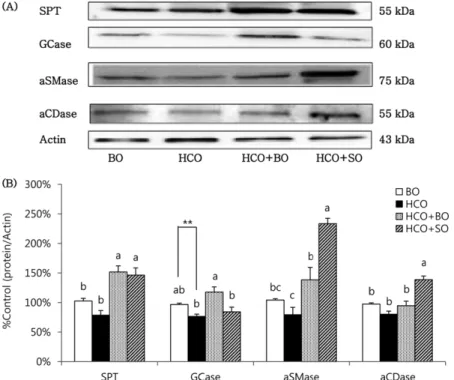
Cer는 SPT 효소에 의해 serine과 palmitoyl-CoA가 결합 하여 de novo 합성되고1이는 가역적으로 aCDase 효소에 의해 sphingosine과 fatty acid로 다시 분해된다.22한편, 생 성된 Cer는 glycosylation 및 choline 등의 결합에 의해 GlcCer 및 SM으로 대사될 수 있는데, 이들은 Cer 생성을 위한 전구지질로서 이중 주요 전구지질인 GlcCer은 GCase 효소에 의해 Cer1-7을 생성하는 반면4 SM은 aSMase 효소에 의해 분해되어 Cer2 및 Cer5를 선택적으 로 생성한다.5 HCO군의 SPT 효소의 단백질 발현은 정상 대조군인 BO군과 유사하였으며 HCO + BO군과 HCO + SO군에서는 BO군 및 HCO군에 비해 유의적으로 증가하 였다 (Fig. 2). 이는 2주간의 보라지유와 홍화유 식이 공급 이 SPT 효소의 단백질 발현 증가를 통해 모두 Cer의 de novo 생성을 증가시켰음을 의미한다. HCO군에서 GlcCer 을 Cer로 분해하는 GCase 효소의 단백질 발현은4 BO군에 비해 감소하였고 [다중 비교 검증시 BO군과 HCO군이 유 의성이 없었으나, BO군과 HCO군간의 t-test 검증시 유의
적 (p < 0.01)으로 감소하였음], HCO + BO군은 HCO군에 비해 유의적으로 증가하였는데 그 증가 정도는 BO군보다 다소 높은 수준이었다 (다중 비교 및 t-test 검증시 HCO군 과 HCO + SO군간의 유의성이 모두 없었음). 반면 HCO + SO군의 GCase 단백질 발현은 HCO군과 비슷한 수준이었 다. SM으로부터 Cer를 생성시키는 aSMase 효소의 단백질 발현은5 BO군과 HCO군에서 유사하였으나 (t-test 검증에 서도 유의성 없었음), HCO + BO군에서는 HCO군에 비해 유의적으로 높았고, HCO + SO군에서 더욱 현저히 증가하 였다. BO, HCO 및 HCO + BO군에서 Cer 분해효소인 aCDase의 단백질 발현은23유사한 반면 HCO + SO군에서 는 유의적으로 증가하였다.
고 찰
지속된 필수 지방산 결핍 식이는 표피 Cer 감소 및 Cer 대사 이상과 함께 표피장벽의 파괴를 유발하고, 2차적으로 피부 건조화, 표피 과증식 등의 여러 증상이 초래됨이 보고 되었다.24이에 본 연구는 필수 지방산 결핍 식이에 의해 표 피 과증식이 유도된1 기니피그에서 GLA 급원 유지인 보 라지유 및 LA 급원 유지인 홍화유 식이 공급이 표피 과증 식 억제 및 Cer 대사에 미치는 효과를 비교하였다.14,25
HCO군에서 대표적인 불포화 지방산 결핍증상인 표피 의 과증식이8,9유도되었음이 확인되었고, 또한 표피의 Cer 와 Cer 생성의 주요 전구물질인4 GlcCer의 함량이 감소하
Table 3. Levels of ceramide, glucosylceramide and sphingomyelin species
Lipid classes2) Dietary groups1)
BO HCO HCO + BO HCO + SO
Ceramide (Cer) ng lipid / µg protein
Total Cer 53.4 ± 1.75a3 27.6 ± 4.33b 52.3 ± 0.32a 24.7 ± 1.13b
Cer 1/2 35.6 ± 2.96a 15.9 ± 2.17b 33.1 ± 4.01a 19.4 ± 1.02b
Cer 3/4 11.9± 0.47ab 9.7 ± 2.97ab 16.9 ± 3.34a 4.4± 0.66b
Cer 5/6/7 5.9 ± 1.38a 2.0 ± 0.46b 2.3 ± 0.58b 0.8 ± 0.41b
Glucosylceramide (GlcCer)
Total GlcCer 24.1 ± 1.07ab 18.1 ± 1.97b 29.6 ± 2.77a 16.6 ± 1.61b
GlcCer–A/B 5.2 ± 0.20a 1.8 ± 0.90b 5.1 ± 0.69a 0.7± 0.23b
GlcCer–C/D 18.9 ± 1.11a 16.3 ± 2.18a 24.5 ± 2.98a 15.9 ± 1.58a
Sphingomyelin (SM)
Total SM 20.8 ± 1.71a 16.4 ± 2.02a 24.5 ± 0.54a 23.6± 4.12a
SM 1 6.8 ± 0.76ab 4.6 ± 1.66b 9.6 ± 1.22a 8.1 ± 0.56ab
SM 2/3 14.0 ± 0.95a 11.7 ± 0.38a 14.9 ± 1.42a 15.6 ± 3.80a
1)Control guinea pigs fed the borage oil (BO) diet for 10 wks (group BO), and essential fatty acid (EFA) deficient guinea pigs fed the hydrogenated coconut oil (HCO) diet for 10 wks or 8 wks followed by feeding BO diet (group HCO + BO) or safflower oil (SO) diet (group HCO + SO) for 2 wks. 2)Individual species of Cer1-7, GlcCer-A/B/C/D or SM1-3 were fractionated by high-performance thin layer chro- matography (HPTLC). 3) Values are mean ± SEM (n = 4).
a,b Means with different letters in the same row indicate significant differences (p < 0.05) using one way ANOVA and Tukey's honestly sig- nificant difference (HSD) post hoc test.
였다. HCO + BO군에서는 표피 과증식이 현저히 억제된 반면, HCO + SO군의 표피 과증식의 억제 정도는 HCO + BO군에 비해 미비하였다. 표피의 스핑고지질 분석 결과 HCO군의 Cer 총 함량 및 주요 세라마이드 species인 Cer1/
2는 BO군의 ~50% 수준으로 감소하였고 이는 표피장벽의 손상과 함께 과증식을 나타내는 표피에서 Cer 함량이 현 저히 감소되었다는 사전 연구 결과와 일치하였다.13,26 HCO + SO군의 Cer 총 함량 및 Cer1/2 함량은 HCO군과 유사한 수준인 반면 HCO + BO군의 Cer 총 함량 및 Cer1/2 함량 은 정상대조군인 BO군의 수준으로 증가하였다. 이는 표피 과증식 억제는 표피 Cer 총 함량 및 Cer1/2 함량 증가와 역 의 상관성이 있음을 의미한다.
Cer는 SPT 효소에 의한 de novo 합성 과정과 주요 전구 물질인 GlcCer과 SM의 GCase와 aSMase 효소에 의한 가 수분해를 통해 생성되며, 생성된 Cer는 최종적으로 aCDase 효소에 의해 sphingosine과 fatty acid로 분해된다.4,5,21이 에 따라 Cer대사 과정에서 Cer 함량의 변화는 SPT효소에 의한 Cer 합성 과정과 Cer의 주요 전구물질인 GlcCer과
SM의 함량 및 관련 효소의 발현 등과 상관성이 크다.18,27 Cer 대사 과정에 관련한 효소의 단백질 발현을 측정한 결 과 필수지방산 결핍 식이 공급은 GCase의 발현 및 표피 Cer 함량의 감소를 초래하였다. 반면 HCO + BO군은 표피 에서 Cer1-7 생성의 주요 전구지질인 GlcCer4 함량 및 GCase 효소 단백질 발현 증가와 더불어 표피 Cer의 함량 이 증가되어 표피 과증식이 효과적으로 억제된 것으로 여 겨진다. 이와 같은 HCO + BO군의 효과가 10주간 동일 유 지를 식이 공급한 BO군과 유사한 것은 BO 유지의 식이 공 급 기간보다는 LA를 70% 이상 함유한 홍화유와 구분되는 보라지유의 주요지방산인 GLA에 의한 효능으로 해석될 수 있다. 섭취된 GLA는 desaturase의 부재와 elonagse의 강 한 활성에 의해 설명되는 표피의 독특한 지방산 대사에 의 해,10 arachidonic acid (20 : 4n-6)로 전환되지 않는다. GLA 와 LA을 포함하는 지방산들은 표피의 과증식 억제 및 정상 적인 표피 장벽 형성에 관여하는 peroxisome proliferator- actovated receptor-γ (PPARγ)의 주요 리간드로 알려져 있 다.28,29한편 GLA는 표피에서 dihommo-γ-linolenic acid
Fig. 2. Altered expression of ceramide metabolic enzymes in control guinea pigs fed the borage oil (BO) diet for 10 wks (group BO), and essential fatty acid (EFA) deficient guinea pigs fed the hydrogenated coconut oil (HCO) diet for 10 wks or 8 wks followed by feeding BO diet (group HCO + BO) or safflower oil (SO) diet (group HCO + SO) for 2 wks. (A) Representative expressions of serine palmitoyltransferase (SPT), β-glucocerebrosidase (GCase), acid sphingomyelinase (aSMase) and acid ceramidase (aCDase) in epidermis of guinea pigs.
Protein extracts (15 μg each) from groups BO, HCO, HCO + BO and HCO + SO were subjected to 8% sodium dodecylsulfate-polyacryl- amide gel electrophoresis and immunoblotted with polyclonal antiserum against SPT (55 kDa), GCase (60 kDa), aSMase (75 kDa) or aCDase (55 kDa) and with actin (Santa Cruz, CA). (B) The signal intensities from multiple experiments of (A) were quantified, and the integrated areas were normalized, first to the corresponding value of actin and then to the signal observed in the normal control group (group BO). Values are mean ± SEM (n = 4). Means with different letters indicate significant differences at p < 0.05 levels by one-way ANOVA and Tukey's honestly significant difference (HSD) post hoc test. p < 0.01(**) between groups by unpaired Student’s t-test.
(DGLA, 20 : 3n-6)로 신속히 전환된 후, cyclooxygenase (COX)에 의해 prostaglandin E1 (PGE1) 및 15-lipoxygeanse (15-LOX) 기질로써 15-hydroxytrienoic acid (15-HETrE) 로 대사되는데, 이들 GLA 대사체들은 LA의 15-LOX 대사 체인 13-hydroxyoctadecadienoic acid (13-HODE)에 비해 표피 과증식 억제 및 항염 효능이 20배 이상 높을 뿐 아니
라,10,11 PPARγ의 리간드로서 GLA, LA 등의 지방산들과
유사한 수준의 결합력을 나타낸다.28,29 HCO + BO군 표피 에서 표피장벽의 주요 지질인 Cer와2 Cer의 주요 전구지질 인4 GlcCer함량 증가, GCase 효소 단백질 발현 증가와 표 피 과증식 억제가 GLA에 의한 직접적인 효과인지. 또는 PGE1 및 15-HETrE 등의 대사체에 의한 간접적인 PPARγ 신호 전달 체계의 변화에 의한 것인지는 추후 연구에 의해 파악할 필요성이 있다.
HCO + SO군에서는 홍화유 식이 공급이 SM1의 함량을 다소 증가시키고 특히 aSMase 효소의 단백질 발현을 현저 히 증가시켰으나, SM는 Cer2 및 Cer7생성의 제한적인 전 구 지질로5 Cer 총 함량 및 Cer1/2 함량 증가에 크게 영향 을 미치지 못한 것으로 사료된다. 또한 HCO + SO군에서 는 aCDase 효소의 발현 증가와 더불어 Cer 분해가 현저히 증가됨에 따라 Cer 함량이 증가되지 못하였고,25 이로 인 해 표피 과증식 억제 효과가 미비한 것으로 확인되며 이에 대한 더욱 명확한 기전의 파악을 위해 이들 효소들의 활성 변화에 대한 연구가 추후 필요한 것으로 생각되어진다.
HCO + SO군의 Cer 및 GlcCer의 함량이 HCO군과 유사하 고, aCDase의 발현이 크게 증가하였음에도 불구하고 표피 과증식의 지표인 epidermal thickness가 HCO군에 비해 다 소 감소함은 Cer 이외에 과증식 억제에 관여하는 filaggrin 등의 타 요소들이30 긍정적으로 개선되었을 가능성을 제 안하나 이 또한 추후 연구에 의해 검증될 필요가 있다. 결 론적으로 보라지유 식이 공급은 홍화유 식이 공급에 비해 표피의 GlcCer A/B를 포함한 총 함량, SM1 함량 및 GCase 의 발현 증가와 더불어 Cer 총 함량, 특히 Cer1/2 함량을 증 가시켜 궁극적으로 표피 과증식을 더욱 현저히 억제하였 다. 이는 임상적으로 보라지유가 표피의 세라마이드 대사 이상이나 과증식을 수반하는 아토피 피부염, 피부건조증 (xerosis) 등의 여러 피부 질환 개선을 위해 홍화유를 능가 하는 식이 소재로 활용될 수 있음을 제안한다.
요 약
본 연구에서는 기니피그에 8주간 필수지방산 결핍 식이 공급에 의해 표피 과증식을 유도한 후 계속된 2주간의 보 라지유 또는 홍화유 식이 공급에 의한 과증식 억제 및 Cer,
GlcCer, SM의 표피 함량 및 세라마이드 대사 관련 효소들 의 단백질 발현 변화를 정상대조군인 BO군 및 필수지방산 결핍 군인 HCO군과 비교하였으며 그 결과는 다음과 같다.
1. 8주간의 필수지방산 결핍 식이 공급 후 계속된 2주간 의 보라지유 식이 공급 (HCO + BO군)은 2주간의 홍화유 식이 공급에 (HCO + SO군) 비해 더욱 현저히 표피 과증식 을 억제하였다.
2. 10주간 필수지방산 결핍식이를 공급한 HCO군은 정 상대조군인 BO군에 비해 Cer의 총 함량 및 Cer1/2/5/6/7, GlcCer-A/B의 함량이 유의적으로 감소되었다. HCO + BO 군의 Cer과 GlcCer의 총 함량 및 Cer1/2, GlcCer-A/B, SM1의 함량은 HCO군에 비해 유의적으로 증가한 반면 HCO + SO군의 이들 함량은 HCO군과 유사하였다.
GlcCer-C/D, SM의 총 함량 및 SM 2/3의 함량은 군간 변화 가 없었다.
3. HCO군에서는 GCase 발현이 감소한 반면 HCO + BO 군에서는 현저히 증가하였다. HCO + SO군의 aSMase의 단백질 발현이 HCO군에 비해 유의적으로 증가하였으나 aCDase의 발현 또한 다른 군에 비해 현저히 증가하였다.
HCO + BO군과 HCO + SO군 모두 SPT의 단백질 발현이 HCO군에 비해 유의적으로 증가하였다.
결론적으로 표피 과증식이 유도된 기니피그에 보라지유 식이 공급은 GlcCer-A/B을 포함하는 GlcCer 총 함량, SM1 및 GCase의 발현 증가와 더불어 Cer1/2를 포함하는 Cer 총 함량을 증가시켜 궁극적으로 표피 과증식을 현저 히 억제하였다.
References