| Abstract |
Purpose: This study examined the effects of upper- and lower-limb coordinated exercise with proprioceptive neuromuscular facilitation (PNF) on stroke patients’ recovery of their balancing and walking abilities.
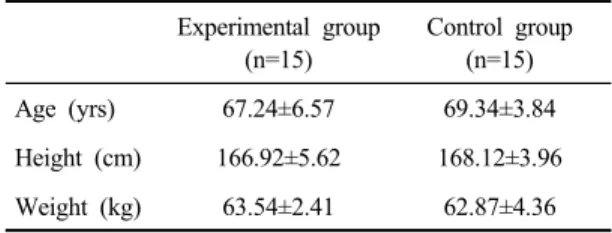
Methods: This study was conducted with 30 patients aged at least 60 years and diagnosed with stroke. The patients were randomly assigned to either a PNF upper- and lower-limb coordinated exercise group of 15 patients or an aero-step balance exercise group of 15 patients. To test the subjects’ balancing and walking abilities, balancing ability tests and 10-m walking speed tests were conducted before and after the interventions. The patients performed their respective exercises for 30 minutes per session, three times per week for four weeks. The PNF exercise group performed six stages of exercise consisting of a combination of PNF patterns such as sprinting, skating, and striking. The six stages (right striking, right skating, right sprinting, left striking, left skating, and left sprinting) were performed continuously with a rest period of 1 min. after training for 4 min. The exercises for the aero-step balance group consisted of balancing in a two-leg standing position, weight shifting in a two-leg standing position, one-leg standing, squat exercises, marching in place, and squatting on an aero step.
Results: The PNF exercise group showed significant improvements in their balancing ability evaluations compared to the aero-step balance group and also showed significant improvements in their 10-m walking speed tests.
Conclusion: Based on the results of this study, PNF upper- and lower-limb coordinated exercise resulted in clinical improvements of stroke patients’ balancing and walking abilities. Therefore, this type of exercise is recommended as a clinical
†Corresponding Author : Hyun-Gyu Cha ([email protected])
Original Article Open Access
고유수용성신경근촉진법을 적용한 상하지 협응 운동이 뇌졸중 환자의 균형 및 보행능력에 미치는 효과