• 검색 결과가 없습니다.

The Effect of Elector Spine Muscle Tone Using Irradiation According to the Angular Motion of a Proprioceptive Neuromuscular Facilitation (PNF) Arm Pattern

N/A
N/A
Protected

Academic year: 2021

Share "The Effect of Elector Spine Muscle Tone Using Irradiation According to the Angular Motion of a Proprioceptive Neuromuscular Facilitation (PNF) Arm Pattern"

Copied!
10
0
0

로드 중.... (전체 텍스트 보기)

전체 글

(1)

| Abstract |

Purpose: This study aimed to compare the elector spine muscle tone using the irradiation of the proprioceptive neuromuscular facilitation (PNF) arm pattern according to angular motion.

Methods: Thirty subjects participated in this study. Elector spine muscle tone was measured using a Myotonpro device while in the sitting position according to the angular motion (70°, 100°, 130°) of the PNF arm pattern using a D1 flexion pattern. Each angular motion of the PNF arm pattern was performed with a continuous passive motion (CPM). The change in elector spine muscle tone was statistically evaluated using a repeated one-way ANOVA test. Post-hoc analysis was performed using the Bonferroni method.

Results: The results revealed a significant change in elector spine muscle tone when performing the PNF arm pattern using D1 flexion pattern. Specifically, the elector spine muscle tone had significantly increased at 100° and 130° motion in the PNF arm pattern when compared to the initial muscle tone (p < 0.05). No significant muscle tone changes were noted for any of the angular motions of the PNF upper arm pattern (p > 0.05).

Conclusion: The results of this study indicate a positive increase in elector spine muscle tone with irradiation of the PNF upper arm pattern exercise with 100° or 130° angular motion. The minimum angle at which the effect of the irradiation of the PNF arm pattern could be seen was 100°.

Key Words: Irradiation, Elector spine, Muscle tone

†Corresponding Author : Jung-Hoon Lee ([email protected])

Original Article Open Access

PNF 팔 패턴의 각도 변화가

척추세움근의 근 긴장도 변화와 방산의 효과에 미치는 영향
양재만⋅이상무⋅이정훈 1†

1)

영도병원 물리치료실, 1 동의대학교 물리치료학과

The Effect of Elector Spine Muscle Tone Using Irradiation According to the Angular Motion of a Proprioceptive Neuromuscular Facilitation (PNF) Arm Pattern

Jae-Man Yang, P.T., M.S.⋅Sang-Moo Lee, P.T., B.S.⋅Jung-Hoon Lee, P.T., Ph.D. 1†

Department of Physical Therapy, Young-Do General Hospital

1 Department of Physical Therapy, Dong-Eui University Received: September 15, 2020 / Revised: October 19, 2020 / Accepted: November 20, 2020

ⓒ 2020 Journal of Korea Proprioceptive Neuromuscular Facilitation Association

This is an Open Access article distributed under the terms of the Creative Commons Attribution Non-Commercial License

(http://creativecommons.org/licenses/by-nc/3.0) which permits unrestricted non-commercial use, distribution, and reproduction

in any medium, provided the original work is properly cited.

(2)

Ⅰ. 서 론

손상된 근육의 근력 강화나 근 재교육을 위한 대표 적인 치료방법 중 고유 수용성 신경근 촉진법 (proprioceptive neuromuscular facilitation, PNF)은 신장 과 등척성 수축(isometric contraction)을 대각선 방향으 로 적용하여 근육과 관절 수용기를 자극하는 치료방 법이다(Sato et al., 2009). PNF 치료방법들 중 임상에서 많이 사용되는 간접적 치료방법인 방산(irradiation)은 신체 한 부분에 적용된 강한 근력 강화 자극이 연결된 근육을 따라 다른 부위로 확산, 전달되는 현상으로, 반대편 근육의 간접적인 근력 강화, 근 재교육을 위해 적용하는 치료 기법이다(Adler et al., 2014; Caroll et al., 2006). 따라서 PNF 팔 패턴을 수행하는 동안 적용 된 적절한 저항의 힘은 방산의 효과를 통해 팔의 움직 임과 협력 관계인 몸통 근육에도 근 긴장과 힘의 전달 이 이루어진다(Adler et al., 2014; Caroll et al., 2006;

Keiner et al., 2014; Lee & Caroll, 2007; Markovic &

Pavle, 2010). 이러한 현상들은 한쪽 근육에서 수축하 는 동안 받은 자극들이 올림 운동 신경(upper motor neuron)을 따라 대뇌 또는 대뇌 아래 영역, 척수 등에 전달 되고, 이렇게 전달된 자극에 대한 되먹임 (feedback) 정보들은 방산의 형태로 반대쪽 내림 운동 신경 경로(lower motor neuron)를 따라 양쪽 팔과 다리 로 배분되어 전달 되는 것이다(Roe et al., 2000; Zhou et al., 2002).

방산에 대한 이론은 Enoka (1988)와 Scripture (1894) 에 의해 처음 보고 된 현상으로 교차 훈련(cross training), 교차 운동(cross exercise), 교차 전이(cross transfer)등을 포함하는 교차 교육(cross education)과 관련성이 있으 며, 인체의 다양한 근육에서 구심성, 원심성, 등척성 등 모든 수축 방법을 통해 힘의 전달이 일어난다 (Carroll et al., 2006; Zhou et al., 2002)라고 정의하였으 며, Munn 등(2004)은 한쪽 팔과 다리에서의 근력 강화 운동이 다른 쪽 팔과 다리에서도 근력을 강화 하는지 에 대하여 보고한 많은 연구논문 결과들에 대한 메타- 분석한 연구결과에서는 한쪽 근육에서의 근력 강화

운동은 반대쪽 근육에서도 근력이 강화가 된다고 하 였으며, 이러한 근력의 증가는 교차 교육 또는 교차 훈련의 결과라고 하였다. 또한 Zhou (2000)는 이러한 교차 교육을 통해 패턴이 적용 된 근육 쪽과 비교하여 패턴이 적용되지 않은 쪽에도 60 % 정도 근력의 전달 이 이루어 진다고 하였으며, Panzer 등(2011)의 연구에 서는 한쪽 근육에서의 근력 강화 운동 실행 후 반대쪽 같은 근육에서도 근력 강화가 향상되는 것은 교차 교 육의 효과이며 방산 현상의 기본적인 메커니즘 (mechanism) 중의 하나라고 하였다.

팔의 움직임과 협력관계인 몸통 근육은 팔이 움직 일 때 가동성(mobility)과 안정성(stability)을 제공하는 가장 중요한 부위로서 외부 자극 및 자세 변화 등에 대하여 균형과 중심을 유지하는데 가장 중요한 역할 을 한다(Akuthota & Nadler, 2004; Marshall & Murphy, 2005). 몸통 근육들 중 외부 자극 및 변화에 올바른 균형을 유지하기 위하여 뭇갈래근(multifidus)과 배가 로근(transversus abdominis)이 다른 몸통 근육들 보다 가장 먼저 수축하기 때문에 뭇갈래근과 배 근육 (abdominal muscle)을 강화시키는 몸통 안정화 운동은 올바른 자세 균형 유지 및 중심 조절 능력을 향상시키 는데 효과적이다(Hodges & Grandevia, 2000; McGill, 2001). 현재 임상에서는 환자 치료 시 몸통의 안정성을 증가시키기 위해 curl up, 윗몸 일으키기 등의 배 근육 중심화 운동(abdominal core exercise)들이 해당 근육의 직접적인 근력 증진 운동 방법으로 많이 사용되고 있 다(Escamilla et al., 2006; Haynes, 2004). 그러나 본 연구 와 같이 한쪽 팔에서의 저항 운동이 반대편 몸통 근육 으로 힘의 전달과 방산의 효과를 이용한 간접적인 근 력 강화 운동 및 치료 방법은 많이 사용되지 않고 있다.

현재 많은 연구들에서는 교차 훈련을 통한 방산

현상의 이론을 적용하여 반대편 근육에서 근력 증가

와 근 활성도 증가에 대한 선행 연구들이 발표되고

있으나, 한쪽 팔에서 저항 운동을 통한 힘의 전달 및

방산의 효과를 통해 반대편 몸통 근육에서 근 긴장도

변화가 나타나는지에 대한 연구는 미흡하였다. 따라

서 본 연구의 목적은 우세 팔의 PNF 팔 패턴 운동

(3)

시 반대편 척추세움근(elector spine muscle)의 근 긴장 도 변화를 비교하여 반대편 같은 근육으로 힘이 전달 되는 방산의 효과를 확인하고자 하였고, 팔 패턴의 각도에 따라 척추세움근의 근 긴장도 변화를 비교하 여 방산의 효과가 나타나는 최소한의 PNF 팔 패턴 시작 각도를 확인하고자 하였다.

Ⅱ. 연구 방법 1. 연구 대상

본 연구의 모든 대상자들에게 실험에 앞서 연구의 목적을 충분히 설명하고 연구 참여를 동의한 자를 대 상으로 하였으며, 부산지역 Y병원에 근무하는 팔과 몸통 부분에 정형외과적 및 신경학적인 통증 및 기능 장애 등 문제가 없는 건강한 성인 남, 녀 30명을 대상으 로 본 연구를 실시하였다.

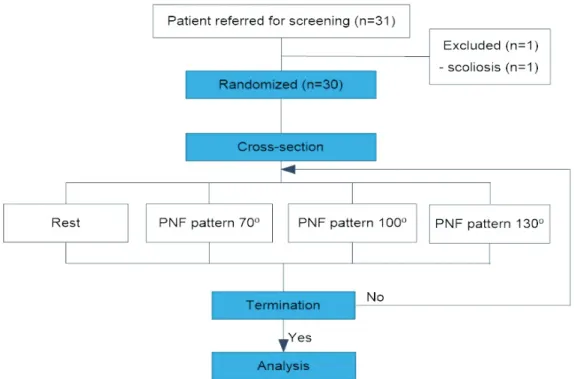
연구 대상자 수 선정 기준은 G*Power 3.1(G*Power, universität of düsseldorf, Germany)을 이용하여 one-way ANOVA, 유의수준 0.05, 검정역 0.8, 효과 크기 0.8로 설정한 결과 연구 대상자 수는 21명이 산출되었으나, 탈락률을 고려하여 총 31명을 모집하였다. 그러나 모 집인원 중 1명이(척추 측만증) 스크리닝 과정에서 제 외되어 최종 30명이 본 실험에 참여하였다. 연구 대상 자 한 명당 총 3가지 중재 방법의 실험을 무작위 순서 로, 단일 눈가림 cross-section 연구를 위하여 대상자에 게 불투명의 봉투 안에서 무작위 순서 번호가 적혀 있는 메모를 선택하게 하였다(Fig. 1).

2. 측정방법 및 도구 1) 근 긴장도 측정 및 방법

연구대상자들에게 척추세움근의 근 긴장도를 측정 하기 위한 측정 장비는 마이오톤프로(Myotonpro,

Fig. 1. Study flow diagram.

(4)

Myoton AS, Estonia)를 사용하였으며, 해당 장비는 근 육의 긴장도(muscle tone), 탄성도(elasticity), 경도 (stiffness)를 측정할 수 있는 장비로 많이 사용되어지 고 있다(Viir et al., 2006). 마이오톤프로는 탐침(probe) 을 사용하여 순간적으로 0.4N의 압력으로 피부에 기 계적 진동 자극을 유발하고, 변형된 피부 조직에서 처음 형태로 돌아오는 회복 정도를 측정하게 된다 (Wang, 2015). 선행 연구에서 마이오톤프로에 대한 평 가자 내 신뢰도 상관계수는 0.94∼0.99이다(Agyapong- Badu et al., 2013). 본 실험에서는 앉은 자세에서 PNF 팔 패턴 수행 시 반대편 척추세움근의 근 긴장도 측정 을 위하여 마이오톤프로를 이용하였으며, PNF 팔 패 턴 수행 각도 순서는(70°, 100°, 130°) 대상자가 밀봉된 봉투 속에서 무작위 순서가 적혀있는 종이를 선택하 게 하여 패턴 수행 각도의 순서를 결정하였다. 척추세 움근의 근 긴장도 측정은 선행 연구의 실험방법에 따 라 2번째 허리뼈 가시돌기(spinous process)에서 외측 으로 2㎝ 지점에서 측정하였다(Kim et al., 2015).

2) PNF 팔 패턴 수행 및 각도

연구 대상자들의 우세(dominant) 팔은 평소에 본인 이 필기를 하는 팔을 우세 팔로 선정하였으며, PNF 팔 패턴 4가지 중 어깨관절 굽힘(flexion)-모음

(adduction)-가쪽돌림(external rotation)으로 끝나는 Diagonal 1 굽힘 패턴(D 1 flexion pattern)으로 실험하였 다. 실험 전 모든 대상자들에게 PNF 팔 패턴을 스스로 수행할 수 있도록 시작과 끝 방향을 2분간 교육하였다.

대상자들은 PNF Diagonal 1 굽힘 패턴을 수행하는 동안 보조 전문가는 실험에 해당하는 패턴의 각도(70°, 100°, 130°)까지 적용하도록 하였고, 마지막 끝 범위에 서 5초간 유지하도록 한 상태에서 반대편 척추세움근 의 근 긴장도를 각각 측정하였다. 또한 각각의 실험 후 근 피로도 회복을 위하여 실험 측정 후에는 1분간 휴식을 취하도록 하였다.

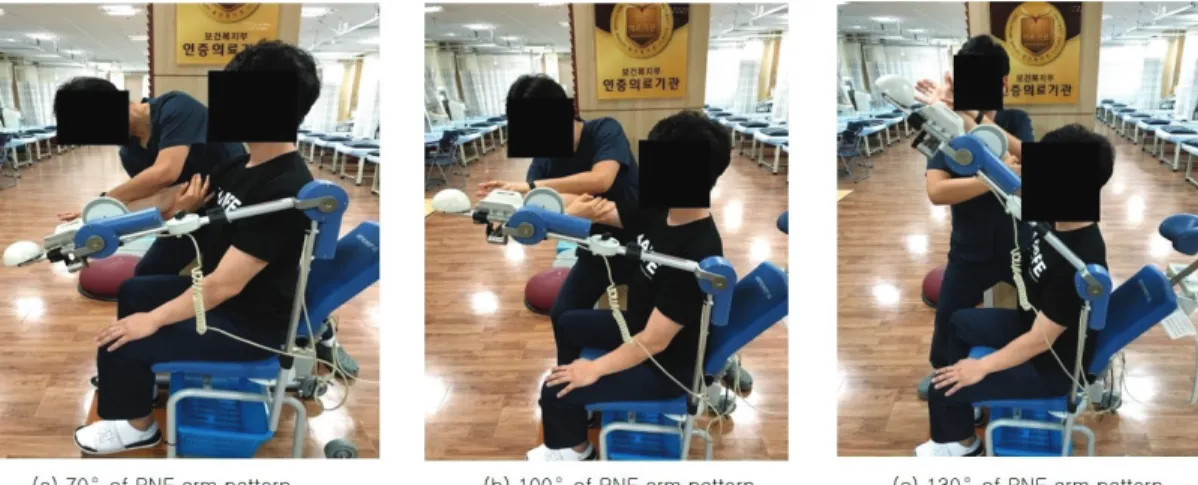
본 연구에서 실시한 70°, 100°, 130°의 PNF 팔 패턴 수행의 각도 통제는 대상자의 반대편에서 해당 각도 가 설정된 어깨 수동관절운동기(continuous passive motion, CPM)를 이용하여 측정 각도를 유지하도록 하 였다(Fig. 2).

3. 자료분석

본 연구에서의 자료 분석 프로그램은 SPSS 21.0 for Windows 프로그램을 이용하였다. 실험 전과 각 패턴 의 수행 시 3가지 각도 변화에 따른 근 긴장도 변화 결과는 repeated one-way ANOVA 통계 분석 방법으로 분석하였으며, Bonferoni 검정으로 사후 검정하였다.

Fig. 2. Angular motion of PNF arm pattern.

(5)

통계학적 유의 수준은 0.05로 하였다.

Ⅲ. 연구 결과 1. 대상자의 일반적 특성

모든 대상자는 오른쪽 팔이 우세 팔이었고 남자 19명, 여자 11명으로 총 30명이었다. 대상자들의 일반

적 특성은 다음과 같다(Table 1).

2. 우세 팔 PNF 패턴 적용 시 비 우세 팔 척추세움 근의 근 긴장도 변화

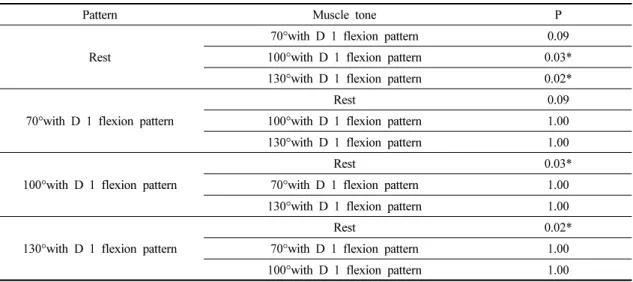
본 연구의 결과 앉은 자세에서 우세 팔에 PNF 팔 패턴을 적용 시 반대편 비 우세(non-dominant)팔 척추 세움근의 근 긴장도 변화 값은 유의하게 증가하였다 (p<0.05)(Table 2). 그러나 PNF 팔 패턴을 70°로 적용 시 비 우세 팔 척추세움근의 근 긴장도는 초기 값과 비교하여 유의하게 증가하지 않았고(p˃0.05), 100°와 130°로 적용 시에만 유의하게 증가하였다(p<0.05) (Table 3). 또한 각 패턴 간의 근 긴장도 변화 차이는 유의하지 않았다(p˃0.05)(Table 3)(Fig. 3).

Characteristics Mean±SD

Age (years) 32.66±6.58

Height (㎝) 170.56±6.31

Weight (㎏) 69.86±14.34

Table 1. General characteristics of subjects (n=30)

Non dominant elector

spine muscle Rest 70°with

D 1 flexion pattern

100°with D 1 flexion

pattern

130°with D 1 flexion

pattern df p

Muscle tone 335.53±110.17 420.50±137.45 432.66±137.52 435.13±147.18 3 0.01*

Note. The values are Mean±SD, * Statistically significant with p<0.05.

Table 2. Comparison of muscle tone with angle of PNF arm pattern (unit: N/m)

Pattern Muscle tone P

Rest

70°with D 1 flexion pattern 0.09 100°with D 1 flexion pattern 0.03*

130°with D 1 flexion pattern 0.02*

70°with D 1 flexion pattern

Rest 0.09

100°with D 1 flexion pattern 1.00 130°with D 1 flexion pattern 1.00 100°with D 1 flexion pattern

Rest 0.03*

70°with D 1 flexion pattern 1.00 130°with D 1 flexion pattern 1.00 130°with D 1 flexion pattern

Rest 0.02*

70°with D 1 flexion pattern 1.00 100°with D 1 flexion pattern 1.00 Note. The values are Mean±SD, * Statistically significant with p<0.05.

Table 3 . Comparison angular motion of arm pattern with post hoc test (unit: N/m)

(6)

Ⅳ. 고 찰

본 연구의 실험 결과 우세 팔 PNF 패턴을 수행하는 동안 반대쪽 척추세움근에서 근 긴장도가 증가하였 다. 또한 PNF 팔 패턴 각도 증가에 따른 척추세움근의 근 긴장도를 측정한 결과 100°와 130°에서 유의하게 증가하였다.

PNF 패턴 수행과 방산의 효과에 대한 최근의 연구 들 중 Manca 등(2017)의 연구결과에서는 다발성경화 증 환자에게서 발등 굽힘근에 직접 근력 강화를 적용 한 그룹과 반대편에서 근력 강화를 적용한 그룹 모두 에서 유의하게 발등 굽힘근의 근력이 증가하였으며, 특히 반대편의 근력 증가의 결과는 방산 효과로 근력 이 증가되었다고 하였다. Abreu 등(2015)의 연구결과 에서는 우세 팔에서 대각선 방향으로 운동을 하는 동 안 반대편 비 우세 팔 어깨부위 근육에서 근 활성도가 유의하게 증가하였으며, 그 결과는 방산의 효과를 통 해 증가한다고 하였다. 또한 Yoo 등(2013)의 연구결과 에서는 한쪽 다리에서 PNF 다리 패턴의 수행은 방산 효과를 통해 반대쪽 다리에서도 근 활성도가 증가된 다고 하였다. Park과 Han (2012)의 연구에서도 방산의

이론을 기초로 한 교차 훈련을 통해 PNF 패턴 운동을 적용하지 않은 반대편 근육에서도 근 활성도가 유의 하게 증가한다고 하였다. Choi 등(2019)도 방산 효과로 인해 비 절단 부위 근육의 PNF 패턴 움직임이 절단 부위 근육의 근 활성도 증가에 영향을 미친다고 보고 하였다.

이러한 방산 효과에 대한 많은 연구 결과들에 대하 여 Myers (2014)는 인체는 머리에서 발끝까지 모든 부분이 하나의 근막(fascia)으로 근육 사슬(muscle chain)처럼 연결이 되어 있어, 한쪽 팔과 다리에서 적용 된 힘이 근막으로 연결 된 다른 쪽 팔과 다리로 힘이 전달되는데 영향을 미친다고 하였다. 따라서 본 연구 결과에서 나타난 우세 팔에서의 PNF 팔 패턴 적용 시 반대편 척추세움근의 근 긴장도 증가는 우세 팔에 적용된 힘이 근막으로 연결 된 반대편 척추세움근으 로 힘의 전달이 이루어진 방산 이론의 결과라고 할 수 있을 것이다.

많은 연구들에서 PNF 팔 패턴 수행 시 각도 변화에

따라 팔과 연결된 등 근육들의 근 활성도 변화를 연구

한 결과들이 보고 되고 있다. Ekstrom 등(2005)의 팔

각도 변화에 따른 등세모근의 근 활성도 변화에 대한

Fig. 3. Comparison of muscle tone for different angle of PNF arm pattern.

(7)

연구 결과에서는 팔 90° 벌림 각도에서 가장 높은 근 활성도 결과를 보고하였으며, 벌림의 각도 증가에 따 라 근 활성도가 함께 증가한다고 하였다. Ekstrom 등 (2003)이 보고한 어깨관절의 운동 종류와 각도 변화에 따른 등세모근과 앞톱니근의 근 활성도 변화에 관한 연구결과에는 어깨관절에서 90° 이상의 벌림과 외회 전을 시행할 때 등세모근에서 근 활성도가 가장 높았 으며, 어깨관절의 120° 이상의 각도로 팔의 굽힘과 대각선 운동을 동반하였을 때 앞톱니근에서 근 활성 도가 가장 높다고 하였다. Gülcan 등(2017)의 견갑골 모으기(scapular retraction) 운동 시 팔의 각도 변화에 따른 어깨 근육들의 활성도 변화 비교에 대한 연구결 과에서는 90° 이상에서 가장 큰 근 활성도 변화를 나타 내기 때문에 어깨에 문제가 있는 환자들에서는 90°

미만에서 견갑골 수축 운동을 실시 할 것을 제안 한다 고 하였으며, Faria 등(2009)의 연구결과에서는 팔의 각도가 150°∼180° 에서 등세모근의 근 활성도가 가장 높다고 하였다. 또한 Park 등(2018)의 연구결과에서는 팔의 각도가 120° 일 때 윗쪽 등세모근에서 가장 큰 근 활성도 증가가 나타난다고 하였다.

비록 본 연구와 같이 팔에서의 PNF 패턴 운동의 연구결과는 아니지만 Kim 등(2011)의 연구에서는 PNF D2 다리 패턴(굽힘(flexion)-벌림(abduction)-안쪽 돌림(internal-rotation)-무릎 굽힘(knee flexion))을 90°

각도로 적용 시 척추세움근에서 근 활성도가 유의하 게 증가하였다고 하였으며, Ki 등(2011)의 연구에서는 PNF D1 다리 패턴(굽힘(flexion)-모음(adduction)-바깥 쪽 돌림(external-rotation)-무릎 굽힘(knee flexion))을 90° 각도로 적용 시 척추세움근에서 근 활성도가 유의 하게 증가하였다고 하였다. 각 연구자들의 연구결과 들마다 약간의 차이는 있지만 대부분의 연구결과들에 서 어깨나 다리에서 벌림과 굽힘의 각도가 90° 이상의 각도일 때 주변 근육들의 근 활성도가 유의하게 증가 하였다. 이러한 연구결과들은 본 연구결과에서 나타 난 100° 이상의 각도로 팔 굽힘 패턴을 적용했을 때에 만 반대편 척추세움근에서 근 긴장도가 증가하였다는 본 연구 결과를 설명할 수 있다.

이렇게 팔의 굽힘 각도가 증가함에 따라 척추세움 근의 근 긴장도가 증가하는 이유는 지레팔의 증가에 따른 결과로서 설명할 수 있다. 견갑골의 움직임을 살펴볼 때 팔의 각도가 90° 이상으로 굽힘 운동을 할 때 아래 등세모근을 비롯한 아래 척추기립근 등의 근 육들의 길이 또한 같이 증가하기 때문이다(Johnson &

Pandyan, 2005). 또한 팔의 굽힘 각도가 90° 이상에서 어깨뼈의 상방 회전과 후방 경사 등의 운동성이 증가 할 때, 아래 등세모근의 근 활성도가 함께 증가하기 때문이다(Borstad & Ludewig, 2002; Lee et al., 2011).

따라서 팔의 굽힘 각도가 90° 이상에서 견갑골의 상방 회전과 후방 경사 등의 운동성이 증가할 때 본 연구 결과에서 나타난 척추기립근의 근 긴장도 증가의 결 과는 PNF 팔 패턴을 수행할 때 나타난 견갑골 움직임 에 따른 지레팔 증가로 인하여 아래 등세모근을 비롯 한 척추기립근들에서 안정성을 유지하기 위한 현상으 로 생각된다.

현재 많은 연구결과들에서 PNF 패턴 움직임에 대 한 방산의 효과를 측정하기 위해 표면 근전도를 이용 한 근 활성도 분석법을 주로 사용 되어지고 있다. 주로 사용되는 표면 근전도 신호 값들 중 RMS (root mean squre)값은 근육 긴장과 수축의 정도를 측정하는 값으 로 쓰이며, 통상적으로 RMS 값이 높아질 수록 근육 수축과 근 긴장도가 높아짐을 의미한다(Soderberg &

Knutson, 2000). 그러므로 본 연구결과에서 나타난 PNF 팔 패턴을 100° 와 130° 를 적용 시 척추세움근에 서 근 긴장도 증가가 유의하게 나타난 결과는 선행연 구들의 결과와 같이 특정 각도 이상으로 PNF 패턴 수행이 반대쪽 근육들의 근 활성도 증가와 근 수축 및 근 긴장도의 증가를 일으킨다는 결과를 뒷받침 할 수 있을 것이다. 따라서 본 연구 결과를 통해 우세 쪽 팔 근력 강화 운동을 통해 반대쪽 근육에서 충분한 방산의 효과를 얻기 위해서는 PNF 팔 패턴 적용 시 100° 이상으로 적용이 필요하다고 생각된다.

그러나 본 연구의 제한점은 첫째, 건강한 일반인을

연구 대상자로 하였기 때문에 모든 환자들에게 일반

화할 수가 없다. 둘째, PNF의 많은 팔 패턴 중 D1 굽힘

(8)

패턴 만을 적용하였으며, 몸통 근육들 중 척추세움근 의 근 긴장도만 측정하였다. 셋째, 팔 패턴 적용 시 모든 대상자에게 똑같은 양의 저항을 적용하지 못하 였으며, 70°, 100°, 130°외에 90°를 포함한 다양한 각도 에서 실험을 하지 못하였다. 넷째, 이전의 연구결과들 처럼 근 활성도를 측정하지 않았고 근 긴장도 만을 측정하였다. 따라서 향후 뇌졸중 환자들을 비롯한 중 추신경계 손상 환자들에 대해서도 본 연구의 제한 점 을 보완한 지속적인 연구가 필요할 것이다.

Ⅴ. 결 론

본 연구의 결과를 바탕으로 임상에서 환자 치료 시 몸통의 안정성 증가를 위한 치료를 목적으로 앉은 자세에서 PNF 팔 패턴을 적용할 때 방산의 효과가 나타날 수 있도록 척추세움근의 근 긴장도가 증가하 는 100° 이상을 적용할 것을 제시하고자 합니다.

References

Abreu R, Lopes AA, Sousa AS, et al. Force irradiation effects during upper limb diagonal exercises on contralateral muscle activation. Journal of Electromyography and Kinesiology. 2015;25(2):292-297.

Adler SS, Beckers D, Buck M. PNF in practice: an illustrated guid, 4th ed. Berlin. Springer-Verlag. 2014.

Agyapong-Badu S, Aird L, Bailey L, et al. Interrater reliability of muscle tone, stiffness and elasticity measurements of rectus femoris and biceps brachii in healthy young and older males. Work Papers Health Science.

2013;1(4):1-11.

Akuthota V, Nadler SF. Core strengthening. Archives of physical medicine and rehabilitation. 2004;85(3 suppl 1):

86-92.

Borstad JD, Ludewig PM. Comparison of scapular kinematics

between elevation and lowering of the arm in the scapular plane. Clinical Biomechanics. 2002;17 (9-10): 650-659.

Carroll TJ, Herbert RD, Munn J, et al. Contralateral effects of unilateral strength training: evidence and possible mechanisms. Journal of Applied Physiology. 2006;

101(5):1514-1522.

Choi SH, Rhee MH, Ha KJ, et al. Effects of irradiation on the muscle activity around an amputation site during proprioceptive neuromuscular facilitation pattern exercise for upper extremity and scapular exercise on the non-amputated part a case study. PNF and Movement, 2019;17(1):11-18.

Ekstrom RA, Donatelli RA, Soderberg GL. Surface electromyographic analysis of exercises for the trapezius and serratus anterior muscles. Journal of Orthopaedic & Sports Physical Therapy. 2003;33(5):

247-258.

Ekstrom RA, Soderberg GL, Donatelli RA. Normalization procedures using maximum voluntary isometric contractions for the serratus anterior and trapezius muscles during surface EMG analysis. Journal of Electromyography and Kinesiology. 2005;15(4):

418-428.

Enoka RM. Muscle strength and its development. Sports Medicine. 1988;6(3):146-168.

Escamilla RF, Babb E, DeWitt R, et al. Electromyographic analysis of traditional and nontraditional abdominal exercises: implications for rehabilitation and training.

Physical Therapy. 2006;86(5):656-671.

Faria CD, Teixeira-Salmela LF, Gomes PF. Applicability of the coactivation method in assessing synergies of the scapular stabilizing muscles. Journal of Shoulder and Elbow Surgery. 2009;18(5):764-772.

Gülcan HARPUT, Hande GÜNEY DENİZ, İrem DÜZGÜN.

Upper to middle trapezius muscle activation ratio

during scapular retraction exercise at different

(9)

shoulder abduction angles. Türk Fizyoterapi ve Rehabilitasyon Dergisi. 2017;28(3):111-117.

Hodges PW, Grandevia SC. Activation of the human diaphragm during a repetitive postural task. The Journal of Physiology. 2000;522(1):165-175.

Johnson GR, Pandyan AD. The activity in the three regions of the trapezius under controlled loading conditions- an experimental and modelling study. Clinical Biomechanics. 2005;20(2):155-161.

Keiner M, Sander A, Wirth K, et al. Long-term strength training effects on change-of-direction sprint performance.

Journal of Strength and Conditioning. 2014;28(1):

223-231.

Ki KI, Cho HS, Shim SM, et al. The effects of PNF leg flexion patterns according to the hip joint angle on EMG activity of the trunk. PNF and Movement.

2011;9(3):11-17.

Kim KH, Ki KI, Youn HJ. The effects of PNF leg flexion patterns on EMG activity of the trunk. PNF and Movement. 2011;9(3):19-24.

Kim KH, Youn HJ, Park SH, et al. The effect of trunk muscle activity on applied normal timing according to angular motion in PNF patterns. PNF and Movement.

2015;13(2):81-88.

Kofotolis ND, Kellis E. Cross-training effects of a proprioceptive neuromuscular facilitation exercise programme on knee musculature. Physical Therapy in Sport. 2007;

8(3):109-116.

Lee M, Caroll TJ. Cross education: possible mechanisms for the contra lateral effects of unilateral resistance training. Sports Medicine. 2007;37(1):1-14.

Lee WH, Ha SM, Park KN, et al. A comparison of EMG activity for middle and lower trapezius muscle according to shoulder abduction angles. Physical Therapy Korea. 2011;18(1):47-56.

Manca A, Cabboi MP, Dragone D, et al. Resistance training for muscle weakness in multiple sclerosis: direct versus

contralateral approach in individuals with ankle dorsiflexors’ disparity in strength. Archives of Physical Medicine and Rehabilitation. 2017;98(7):1348-1356.

Markovic G, Pavle M. Neuro-musculoskeletal and performance adaptations to lower-extremity plyometric training.

Sports Medicine. 2010;40(10):859-895.

Marshall PW, Murphy BA. Core stability exercises on and off a swiss ball. Archives Physical Medicine and Rehabilitation. 2005;86(2):242-249.

McGill SM. Low back stability: From formal description to issues for performance and rehabilitation. Exercise and Sport Sciences Review. 2001;29(1):26-31.

Munn J, Herbert RD, Gandevia SC. Contralateral effects of unilateral resistance training: a meta-analysis. Journal of applied physiology. 2004;96(5):1861-1866.

Myers T. Anatomy trains, 3rd ed. London. Churchill Livingstone. 2014.

Panzer S, Schinowski D, Kohle D. Cross-Education and contralateral irradiation. Journal of Human Kinetics.

2011;27(1):66-79.

Park IS, Han DW. The effects of self-induced and therapist-assisted lower-limb PNF pattern training on the activation of contralateral muscles. Journal of Physical Therapy Science. 2012;24(11):1123-1126.

Roe C, Brox JI, Saugen E, et al. Muscle activation in the contralateral passive shoulder during isometric shoulder abduction in patients with unilateral shoulder pain. Journal of Electromyography and Kinesiology.

2000;10(2):69-77.

Sato H, Maruyama H. The effects of indirect treatment of proprioceptive neurosmuscular facilitation. Journal of Physical Therapy Science. 2009;21(2):189-193.

Soderberg GL, Knutson LM. A guide for use and Interpretation of kinesiologic electromyographic data. Physical Therapy. 2000;80(5):485-498.

Viir R, Laiho K, Kramarenko J, et al. Repeatability of trapezius

muscle tone assessment by a myometric method.

(10)

Journal of Mechanics in Medicine and Biology.

2006;6(2):215-228.

Wang CJ. The effects of relaxation exercise using EMG biofeedback training for upper trapezius on shoulder pain for the patient with spinal cord injury. Yong-In University. Dissertation of Master’s Degree. 2015.

Zhou S, Oakman A, Davie AJ. Effects of unilateral voluntary and electromyostimulation training on muscular strength on the contralateral limb. Hong Kong Journal of sports medicine and sports science. 2002;

14(1):1-11.

수치

Fig.  1.  Study  flow  diagram.
Fig.  2.  Angular  motion  of  PNF  arm  pattern.
Table  3 .  Comparison  angular  motion  of  arm  pattern  with  post  hoc  test                                                          (unit:  N/m)

참조

관련 문서

This study was performed to confirm the effect of the stress distribution on short implant supporting bone according to horizontal bone loss using a three-dimensional

The purpose of this study is to clarify the effect of identification affirmation according to K-Pop star image on the desire of middle school students to participate

Therefore, the aim of this study was to investigate the morphologic characteristics of the interalveolar foramen and to analyze according to sex and age using cone

The purpose of this study is to compare the degrees of conversion of light curing resin cement specimens cured by the light transmitted different thickness of zirconia

The purpose of this study was to analyze the cultural contents of English textbooks (Grade 7) according to the 2009 revised middle school curriculum and

The purpose of this study was to investigate the impact of social capital and positive psychology capital on the will of start-up according to experience

The purpose of this study is to establish and design the characteristics of summer resorts according to the design manual, develop cultural products using

Purpose: This study was aimed to compare the functional outcomes of the continuous and discontinuous fractures, retrospectively, in multiple thoracolumbar