• 검색 결과가 없습니다.

Comparison of Changes in Dynamic Balance and Leg Muscle Activity in Adults in Their 20s With or Without Shoes

N/A
N/A
Protected

Academic year: 2021

Share "Comparison of Changes in Dynamic Balance and Leg Muscle Activity in Adults in Their 20s With or Without Shoes"

Copied!
10
0
0

로드 중.... (전체 텍스트 보기)

전체 글

(1)

1)

| Abstract |

Purpose: The purpose of this study was to investigate the difference in the dynamic balance and leg muscle activity of adults in their 20s with or without shoes.

Methods: In this study, seven male and 11 female university students in their 20s were randomized to determine the order of being with or without shoes, and the dominant foot was supported on the central platform of dynamic balance according to the order procedure. Using the opposite foot, the distance of leg stretching in the anterior, posterior medial, and posterior lateral directions and the muscle activity of the supporting leg were measured. Muscle activity measurement sites were attached to the dominant vastus medialis oblique muscle, vastus lateral oblique muscle, tibialis anterior muscle, peroneus longus muscle, and lateral gastrocnemius muscle.

Results: As a result of this study, the distance of leg stretching was significantly increased in the anterior, posterior medial, and posterior lateral directions when barefoot rather than when wearing shoes (p < 0.05). The muscle activity of the vastus medial and lateral oblique muscles was significantly increased in all three directions when barefoot rather than when wearing shoes (p

< 0.05). The muscle activity of the tibialis anterior was significantly increased in the anterior direction when barefoot (p < 0.05), the peroneus longus muscle was significantly increased when it was barefoot in the posterior medial direction (p < 0.05), and the

†Corresponding Author : Su -Kyong Lee ([email protected])

Original Article Open Access

신발 착용 유무에 따른 20대 성인의 동적 균형 및 다리의 근활성도 변화 비교
안수홍⋅이수경 1† ⋅양주희⋅조재성 2 ⋅박진성 3 동의대학교 보건의과학대학원, 1 동의대학교 물리치료학과,

2 부산워크재활병원 물리치료실, 3 주식회사 다온웰니스

Comparison of Changes in Dynamic Balance and Leg Muscle Activity in Adults in Their 20s With or Without Shoes

Su-Hong Ahn, P.T., Ph.D.⋅Su-Kyong Lee, P.T., Ph.D. 1† ⋅Ju-Hui Yang, P.T., M.S.⋅

Jae-Sung Jo, P.T., B.S. 2 ⋅Jin-Sung Park, P.T., Ph.D. 3

Department of Biomedical Health Science, Graduate School, Dong-Eui University

1 Department of Physical Therapy, College of Nersing and Healthcare Sciences, Dong-Eui University

2 Department of Physical Therapy, Walk Rehabilitation Hospital

3 Daonwellness Corp.

Received: March 18, 2021 / Revised: April 20, 2021 / Accepted: April 27, 2021

ⓒ 2021 Journal of Korea Proprioceptive Neuromuscular Facilitation Association

This is an Open Access article distributed under the terms of the Creative Commons Attribution Non-Commercial License

(http://creativecommons.org/licenses/by-nc/3.0) which permits unrestricted non-commercial use, distribution, and reproduction

in any medium, provided the original work is properly cited.

(2)

lateral gastrocnemius muscle activity significantly increased when barefoot in the posterior direction (p < 0.05).

Conclusion: The movement of the legs is freed when barefoot as compared to when wearing shoes, and being barefoot can effectively activate muscle activity and improve balance ability.

Key Words: Dynamic balance test, Muscle activity, Shoes, Foot reach length

Ⅰ. 서 론

균형이란 다양한 움직임과 자세 변화 시 무게 중심 (center of mass)을 중력에 대항하여 지지면(base of support) 내에 위치하도록 조절함으로써 신체를 바른 자세로 유지하는 기전이다(Radomski & Latham, 2008).

이러한 균형은 감각 기관을 통해 신체의 움직임 패턴 을 파악하여 중추신경계로 입력시켜 감각을 통합한 후에 근육뼈대계로 다시 신호를 전달하여 그에 따른 자세조절 반응을 수행하는 복잡한 과정을 거쳐 달성 된다(Nagano et al., 2011).

균형은 정적균형과 동적균형으로 나눌 수 있으며 정적균형은 안정된 지지면에서 최소한의 신체 움직임 만으로 서 있을 수 있는 능력을 의미하고(Hrysomallis, 2011) 동적 균형은 불안한 환경에서 움직이는 동안 신경근 동원 순서를 유동적으로 바꾸어 자세를 조절 하는 능력이다(Fullam et al., 2014; Gribble et al., 2004).

균형을 잘 유지하기 위해서는 움직임을 수행하는 동 안 자세의 안정성을 확보할 수 있도록 충분한 근력, 근지구력, 근긴장도, 관절의 유연성 등 다양한 기능적 요인이 뒷받침되어야 한다(Vuillerme et al., 2002). 특 히, 발이 균형을 유지하는데 필수적인 역할을 하게 되는데 이는 발이 지면과 직접적으로 맞닿게 되면서 자세유지를 위한 안정성과 지면에 대한 감각 정보를 제공하여 지면으로부터 받게 되는 충격을 흡수하여 균형을 유지하는데 중요한 역할을 하기 때문이다 (Hillstrom et al., 2013). 따라서 발목관절 근육들의 안정 성이 확보되지 않는다면 자세동요가 나타날 때 자세 균형을 유지하는 능력이 감소하게 될 것이다(Clifford

& Holder-Powell, 2010). 이렇듯 균형을 잘 유지하기

위해서는 발이 제 기능을 할 수 있도록 보호하는 것이 중요한데 신발이 외부환경으로부터 발을 보호하고 기 능 향상 및 발의 움직임 조절을 통해 보행의 효율을 증진시켜 부상을 예방할 수 있다(Barton et al., 2009).

하지만 몇몇 연구자들은 신발을 착용하는 것이 맨발 에 비해 발에 대한 위치감각 및 운동감각을 감소시키 고 고유수용성 감각정보들을 정확하게 수용하지 못해 발 주위 근육들의 민감도를 떨어뜨려 오히려 균형능 력이 감소되어 보행패턴에 악영향을 미쳐 낙상이 증 가할 수 있다고 하였다(McKeon et al., 2014; Petersen et al., 2020; Robbins et al., 1995). 또한 대부분의 신발들 은 이동이 주목적이기 때문에 뒤굽이 앞굽보다 높기 때문에 신체의 중심이 앞쪽으로 쏠려 발의 변형을 유 발하여 균형에 부정적인 영향을 미칠 수 있다고 하였 다(An et al., 2007; Kim et al., 2015; Lee, 2010). 이처럼 신발과 맨발에 따른 균형능력의 논란은 현재까지 계 속 진행중에 있으며 대부분의 선행연구들은 주로 정 적인 상황에서 맨발과 신발 착용 시 균형능력을 비교 하였다(Alghadir et al., 2018; Andresa et al., 2012; Carl

& Barrett, 2008; D’AoÛt et al.; 2009). 그러나 균형능력

은 정적인 자세보다 변화하는 환경에 대해 균형을 유

지하는 동적균형능력이 자세를 조절하는데 있어 더

필수적인 요소이며, 또한 균형 유지 시에는 다리의

근활성도 패턴 변화양상도 매우 중요하다(Shimada et

al., 2003). 따라서 본 연구에서는 정상 성인을 대상으

로 맨발과 신발을 착용한 상태에서 동적균형능력 평

가 및 다리의 근활성도 변화양상을 분석하여 장차 발

의 기능을 최대한 이끌어낼 수 있는 신발 개발에 기초

가 되는 자료를 제공하고자 한다.

(3)

Ⅱ. 연구 방법

1. 연구 대상

건강한 20대 성인 남자 7명과 여성 11명이 본 연구 에 자원하였으며, 연구대상자의 선정 기준은 다음과 같다. (1) 몸통과 다리에 근육뼈대계 질환이 없는 자, (2) 다리에 선천적인 기형이 없는 자, (3) 외과적 혹은 신경학적 질환의 경험이 없는 자로 선정하였다(Ahn, 2018; Ahn, 2021). 연구대상자의 제외 기준은 (1) 몸통 과 다리에 영향을 미치는 염증성 질환의 이력이 있는 자, (2) 몸통과 다리에 무리한 운동이나 특별한 운동을 하고 있는 자, (3) 최근 1년 이내에 골절이나 다른 근골 격계 질환으로 수술이나 치료를 받은 자로 설정하였다.

연구대상자 표본 선정 기준은 G-Power 3.1(University of Dusseldorf, Germany)을 이용하여 Paired t-test, 유의 수준 0.05, 검정역 0.8, 효과크기 0.5로 설정한 결과 연구대상자수는 15명이 산출되었는데 탈락 인원을 고 려하여 18명을 선정하였다. 본 연구는 동의대학교 생 명윤리위원회의 승인을 받았으며, 모든 환자는 헬싱 키 선언의 윤리 기준에 따라 사전 동의 양식을 읽고 서명하였다.

2. 측정 도구 및 방법

1) 동적 균형 검사(dynamic balance test)

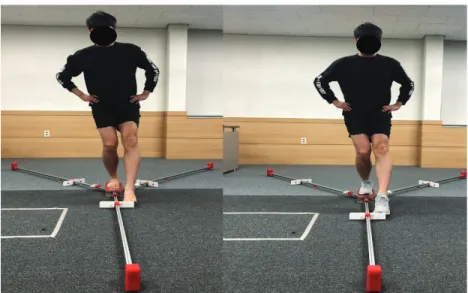
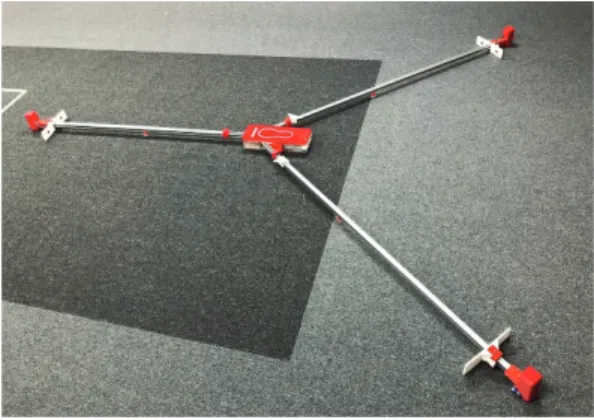
본 연구의 동적균형은 다이나믹 밸런스 장비를 이 용하여 측정하였다. 다이나믹 밸런스 검사(Dynamic balance test, O2lab Inc., Korea)는 동적 균형 능력을 측정하는 장비로써 한 발로 선 자세에서 중앙 발판을 중심으로 앞쪽(anterior, AT), 뒤안쪽(posterior medial, PM), 뒤가쪽(posterior lateral, PL)으로 균형을 유지하면 서 최대한 발을 뻗고 돌아올 수 있는 지점까지의 거리 를 측정하는 Y-balance test와 동일한 플랫폼의 형태로 구성되어 있다(Lee & Ahn, 2018)(Fig. 1). 측정방법과 평가기준 또한 똑같은 방식을 취하고 있으며 디지털

센서 기술(데이터 무선전송 시스템, 데이터 기록 및 관리 자동화 시스템, 대상자 1명으로 균형능력 측정이 가능한 기능)이 탑재되어 있기 때문에 자동화 시스템 을 사용하여 실험이 가능하다(Lee & Ahn, 2018). 본 연구에서 측정은 신발유무에 따라서 우세발을 중앙플 랫폼에 지지하고 반대쪽 발을 앞쪽, 뒤안쪽, 뒤바깥쪽 의 세 방향으로 균형을 유지하면서 평면 형태의 슬라 이드 판을 밀고 돌아올 수 있을 만큼의 거리를 측정하 였고, 근피로를 방지하기 위해 각 방향별로 3회 측정 후 30초간의 휴식을 제공하였다. 뻗은 지점까지의 거 리는 소수점 2자리까지 cm단위로 측정을 하였고 학습 효과의 방지를 위해 각 방향별로 6번의 모의 연습 후 본 실험을 진행하였으며(Plisky et al., 2009) 총 3회 측정 하여 평균값을 본 연구의 데이터로 사용하였다. 측정 도중 지지하고 있는 발이 중앙플랫폼에서 떨어지거나 슬라이드 판을 밀고 시작자세로 다시 돌아오지 못할 경우에는 실패로 간주하고 다시 측정하였다(Plisky et al., 2009)(Fig. 2). 다이나믹 밸런스의 경우 기존에 있던 Y-밸런스 장비와의 타당도를 비교한 결과 각방향별 타당도 계수 r 값은 앞쪽방향에서 0.87, 뒤안쪽 방향에 서 0.96, 뒤바깥쪽 방향에서 0.94로써 각 방향별 타당도 는 아주 높은 타당도를 보인다고 할 수 있다. 장비에 대한 신뢰도의 경우에는 앞쪽 방향에서 0.92, 뒤안쪽 방향에서 0.97, 뒤가쪽방향에서 0.98의 높은 신뢰도를 나타내었다(Park, 2020).

Fig. 1. Dynamic balance test.

(4)

2) 표면 근전도

본 연구에서 신발 유무에 따른 동적균형능력을 측 정하는 동안 다리의 근활성도를 알아보기 위해 표면 근전도 Noraxon telemyo 2400 system (Myosystem TM DTS, Noraxon Inc., USA)를 사용하였다(Fig. 3). 전극을 근육에 부착하기 전 피부 저항의 마찰은 줄이고 청결 함을 유지시키기 위해 소독용 알콜솜으로 부착부위를 깨끗이 닦아낸 후 근섬유의 방향과 나란하게 부착하 였으며, 전극 사이 간 거리는 2cm로 설정하였다 (Hermens et al., 2000). 전극은 우세측 안쪽넓은근, 가쪽 넓은근, 앞정강근, 긴종아리근, 가쪽장딴지근에 부착 하였으며, 부착방법은 다음과 같다. 안쪽넓은근은 위

앞엉덩뼈가시에서 무릎뼈 안쪽을 이은 선 80% 사이의 거리에 위치, 가쪽넓은근은 위앞엉덩뼈가시에서 무릎 뼈 바깥쪽을 이은선 2/3 사이의 거리에 위치, 앞정강근 은 종아리뼈 상단과 안쪽복사뼈 사이 위쪽 1/3 선상의 위치, 긴종아리근은 종아리뼈 머리의 먼쪽 3cm 지점 의 위치, 가쪽장딴지근은 종아리뼈 머리와 발뒤꿈치 사이 위쪽 1/3 선상 위치에 부착하였다(Hermens et al., 2000)(Fig. 4). 각 근육에서 측정된 표면근전도의 신호 는 평균제곱근법(root mean square, RMS)의 값을 사용 하여 신호 파형(raw date)을 제곱한 뒤 적분하여 정량 화를 분석하였고 표본추츌률(sampling rate)은 2,000㎐

Fig. 2. Comparison of dynamic balance tests with or without shoes.

Fig. 3. Noraxon telemyo 2400 system. Fig. 4. EMG attachment site.

(5)

로 설정하였으며, 주파수 대역폭은 20∼450Hz로 설정 하여 노이즈 제거하였다. 기타 신호 처리는 정류 (rectification)와 평활화(smoothing)를 사용하여 처리하 였고, 근전도 신호의 일반화는 최대 수의적 등척성 수축의 동작을 기준 값으로 사용하는 %MVIC (maximum voluntary isomeric contraction) 값을 사용하 였다(Cram et al., 1998). 측정은 총 3회 실시하였고 측정 된 값을 평균화하여 사용하였다. 표면근전도의 장비 에 대한 신뢰도는 0.77∼0.98 사이로 높은 신뢰도를 나타내었다(Kim, 2011).

3. 실험 절차

본 연구는 신발 유무에 따른 동적균형능력과 근활 성도의 변화를 알아보기 위해 무작위 배정(randomized controlled trial)비교를 통해 신발 유무에 따른 순서를 정하였고 그 순서절차에 따라 다이나믹 밸런스의 중 앙플랫폼에 우세발을 지지하고 반대측 발을 이용하여 앞쪽, 뒤안쪽, 뒤가쪽 방향으로 다리를 뻗는 동안 뻗은 거리와 지지하고 있는 다리의 근활성도를 측정하였 다. 학습효과를 방지하기 위해 각 방향별 6번의 사전연 습 후 본 실험을 진행하였으며, 총 3회 반복측정한 값을 평균화하여 사용하였다. 신발 유무에 따라서 각 방향별로 3회 측정 후 근피로 방지를 위해 1분간 휴식 을 취하였다.

4. 자료 분석

본 연구에서 수집된 자료는 SPSS 25.0 for Windows 프로그램을 이용하여 통계를 분석하였으며, 통계적 검증을 위한 유의수준은 0.05로 설정하였다. 연구대상 자의 일반적 특성은 기술통계로 산출하였고 샤피로윌 크 검정을 통해 모집단의 정규분포가 충족하여 모수 적 분석방법을 사용하였다. 신발 유무에 따른 다이나 믹 밸런서 검사 수행 시 뻗은 거리와 다리의 근활성도 의 차이를 비교하기 위해 독립 표본t-test (independent t test)을 사용하여 분석하였다.

Ⅲ. 연구 결과

1. 연구 대상자의 일반적인 특성

본 연구는 자발적으로 실험참가의 의사를 밝힌 정 상 성인 남녀 18명을 대상으로 연구를 진행하였으며, 평균나이는 23.58±3.51세, 평균 키 171.35±8.13cm, 평 균 몸무게는 67.38±8.47kg이었다(Table 1).

Characteristics

Sex (geneder) Male (7)/Female (11) Age (yerars) 23.58±3.51 Height (cm) 171.35±8.13 Weight (kg) 67.38±8.47 Table 1. General characteristics of subjects (n=18)

2. 신발 유무에 따른 다이나믹 밸런스 측정 시 발 뻗은 거리 비교

신발 유무에 따른 다이나믹 밸런스 측정 시 앞쪽, 뒤안쪽, 뒤가쪽으로 발 뻗은 거리는 신발을 신었을 때 보다 맨발일 때 3방향 모두에서 발 뻗은 거리는 유의하게 증가하였다(p<0.05)(Table 2).

Direction Bare foot Shoes t p AT 40.26±5.46 34.12±4.60 3.64 0.00*

PM 68.75±9.22 60.23±8.12 2.93 0.01*

PL 66.91±9.56 57.96±7.23 3.16 0.00*

*p<0.05, Mean±SD

AT: anterior, PM: posterior medial, PL: posterior lateral Table 2. Comparison of muscle activity of the neck and

shoulder muscle among the various postures of chin-in exercise (n=18, unit: %MVIC)

3. 신발 유무에 따른 다이나믹 밸런스 측정 시 다리 의 근활성도 비교

신발 유무에 따른 다이나믹 밸런스 측정 시 앞쪽,

(6)

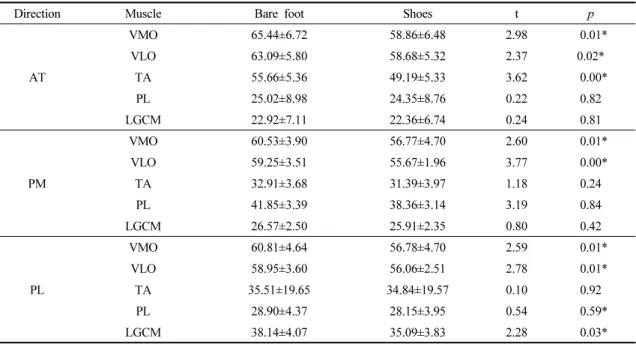
뒤안쪽, 뒤가쪽으로 발 뻗는 동안 지지하고 있는 다리 의 안쪽넓은근과 가쪽넓은근의 근활성도는 신발을 신 었을 때 보다 맨발일 때 3방향 모두에서 유의하게 증가 하였다(p<0.05)(Table 3). 앞정강근의 근활성도는 앞쪽 방향에서 신발을 신었을 때 보다 맨발일 때 유의하게 증가하였고(p<0.05)(Table 3) 긴종아리근의 근활성도 는 뒤안쪽 방향에서 신발을 신었을 때 보다 맨발일 때 유의하게 증가하였으며(p<0.05)(Table 3) 가쪽장딴 지근의 근활성도는 뒤가쪽 방향에서 신발을 신었을 때 보다 맨발일 때 유의하게 증가하였다(p<0.05)(Table 3).

Ⅳ. 고 찰

본 연구에서는 신발유무에 따라서 다이나믹 밸런 서 측정 시 앞쪽, 뒤안쪽, 뒤가쪽 3방향에 따른 발 뻗은 거리와 지지하고 있는 측 다리의 근활성도 차이를 알

아보았다. 본 연구의 결과 발을 3방향으로 뻗는 동안 신발을 신었을 때 보다 맨발일 때 발을 뻗는 거리가 유의하게 증가하였다.

Perry (1992)는 맨발이 신발을 신었을 때 보다 발을 뻗는 동작에서 균형을 잘 유지할 수 있다고 하였고 Rose 등(2011)은 맨발이 신발에 비해 직접적으로 지면 과 접촉을 하여 다양한 감각 자극들을 받아들이기 때 문에 고유수용성 자극을 증가시킴으로써 균형 및 근 육능력을 증진시킨다고 하였다(Al-Abdulwahab &

AL-Dosry, 2000; Franklin et al., 2015, Sacco et al., 2010).

또한 Wolf 등(2008)은 신발이 맨발에 비해 체중이 앞쪽 으로 이동하여 균형능력이 감소한다고 하였는데 이는 신발의 경우 보행 시 추진력을 얻기 위해 뒷굽이 앞굽 보다 높게 제작되기 때문에 신체중심이 앞쪽으로 이 동하게 되어 발가락에 체중부하가 많이 발생하여 균 형유지에 중요한 역할을 하는 발가락이 제 기능을 하 지 못하기 때문이다(Endo et al., 2002; Lee, 2010). 따라

Direction Muscle Bare foot Shoes t p

AT

VMO 65.44±6.72 58.86±6.48 2.98 0.01*

VLO 63.09±5.80 58.68±5.32 2.37 0.02*

TA 55.66±5.36 49.19±5.33 3.62 0.00*

PL 25.02±8.98 24.35±8.76 0.22 0.82

LGCM 22.92±7.11 22.36±6.74 0.24 0.81

VMO 60.53±3.90 56.77±4.70 2.60 0.01*

VLO 59.25±3.51 55.67±1.96 3.77 0.00*

PM TA 32.91±3.6831.39±3.97 1.18 0.24

PL 41.85±3.39 38.36±3.14 3.19 0.84

LGCM 26.57±2.50 25.91±2.35 0.80 0.42

VMO 60.81±4.64 56.78±4.70 2.59 0.01*

VLO 58.95±3.60 56.06±2.51 2.78 0.01*

PL TA 35.51±19.65 34.84±19.57 0.10 0.92

PL 28.90±4.37 28.15±3.95 0.54 0.59*

LGCM 38.14±4.07 35.09±3.83 2.28 0.03*

*p<0.05, Mean±SD

AT: anterior, PM: posterior medial, PL: posterior lateral

VMO: vastus medialis oblique, VLO: vastus lateralis oblique, TA: tibialis anterior, PL: peroneus longus, LGCM: lateral gastrocnemius

Table 3. Repeated measures ANOVA on neck and shoulder muscle activity

(7)

서 본 연구에서도 맨발이 신발에 비해 지면과 직접 접촉하여 발의 압력이 고르게 분배됨에 따라 고유수 용성 감각들이 많이 활성화되어 자세 안정성이 향상 되었고 신체중심 또한 어느 한 방향으로 치우쳐지지 않기 때문에 균형 유지에 중요한 발가락이 제 기능을 할 수 있게 되어 3방향으로 뻗은 길이가 증가하였고 판단된다.

지지하고 있는 다리의 근활성도는 맨발일 때 앞쪽, 뒤안쪽, 뒤가쪽 3방향 모두에서 안쪽넓은근과 가쪽넓 은근의 근활성도가 유의하게 증가하였다.

안쪽넓은근과 가쪽넓은근은 다이나믹 밸런서와 동 일한 방향으로 측정이 되는 Y-balance test를 이용한 측정에서 3방향 모두 높은 근활성도를 보이게 되는데 (Earl & Hertel, 2001) 이는 측정자세가 한 발로 선 상태 에서 스쿼트 동작을 하면서 발을 뻗는 자세이기 때문 에 무릎 주변 근육들이 활성화되어 안쪽넓은근과 가 쪽넓은근의 근활성도를 증가시킨다고 하였다(Plisky et al., 2006; Tang et al., 2001). 특히, 맨발이 신발을 신고 동작을 수행했을 때 보다 더 큰 근활성도가 나타 났는데 이러한 이유는 스쿼트 동작의 경우 발이 직접 적으로 지면에 닿아 있기 때문에 발목전략을 사용하 여 무릎 관절을 굽혔다가 펴는 동작을 하는 동안 흔들 리는 신체의 무게중심을 유지하게 된다(Kim &

Phuong, 2010; Yang, 2011). 즉 신체의 흔들림이 적어져 자세의 안정성이 증가함에 따라 정확한 스쿼트 동작 을 수행할 수 있게 되어 안쪽넓은근과 가쪽넓은근의 근수축이 보다 효율적으로 사용되어 근활성도가 증가 하기 때문이다(McGill & Cholewicki, 2001). 반면에 신 발의 경우 신발 자체가 발목의 안정성을 잡아주기 위 해 오히려 발목관절의 움직임을 제한시켜(Lee, 2015) 효과적인 발목전략을 사용할 수 없게 된다. 따라서 스쿼트 동작을 하면서 발을 뻗게 되는 동작 시에 올바 른 스쿼트 동작을 하지 못하게 되어 무릎보다는 허리 를 과도하게 사용하는 보상작용이 나타날 수 있다 (Ahn, 2018).

또한, 앞정강근의 근활성도는 맨발일 때 앞쪽방향 에서 유의하게 증가하였고 긴종아리근은 뒤안쪽 방향

에서 가쪽장딴지근은 뒤가쪽 방향에서 유의하게 증가 하였다.

Plisky 등(2009)은 Y-balance test 시 앞쪽으로 다리를

뻗는 동작은 앞정강근의 활성화와 관련이 깊다고 하

였고 Hoch와 McKeon (2011)은 앞정강근의 활성화는

발등굽힘의 가동범위를 증가시켜 Y-balance test 수행

에 있어 중요한 역할을 한다고 하였다. 그 이유는 앞으

로 다리를 뻗는 동작은 시상면(sagittal plane)에서의

움직임으로써 동작을 수행하는 동안 몸의 무게중심

조절을 발등굽힘을 통해 앞정강근이 자세를 유지하기

때문이다(Egol et al., 1998; Schieppati et al., 1996). 또한

뒤안쪽과 뒤가쪽으로 뻗는 동작을 살펴보면 먼저 뒤

안쪽으로 뻗는 경우에는 동작 수행 시 체중이 바깥쪽

으로 이동하기 때문에 발목의 가쪽번짐의 작용을 하

는 긴종아리근이 활성화되어 체중을 안쪽으로 이동시

켜 자세의 안정성을 증가시키고 뒤가쪽으로 뻗는 경

우에는 체중이 안쪽으로 이동하기 때문에 발목의 안

쪽번짐을 통해 체중을 바깥쪽으로 이동시켜 자세의

안정성을 증가시키게 된다(Cote et al., 2005; Gefen,

2002). 이때 안쪽번짐의 경우 해부학적 구조로 인해

발바닥굽힘과 동반되어 작용하기 때문에 발바닥굽힘

의 작용을 하는 가쪽장딴지근이 활성화된다고 할 수

있다(Neumann, 2010). 이처럼 앞쪽, 뒤안쪽, 뒤가쪽 3

방향으로 발을 뻗는 경우에는 다리의 근활성도의 활

성화가 중요한데 맨발의 경우에는 신발에 비해 공간

의 제약을 받지 않기 때문에(Franklin et al., 2015) 원하

는 발목의 움직임을 통해 체중을 이동할 수 있으며

또한 지면과 발이 닿는 표면적이 커짐에 따라 발 전체

에 압력을 고르게 분배하여 기저면이 증가함에 따라

동적 안정성에 기여하는 다리 근육들이 효율적으로

활성화되어 자세 안정성이 향상된다고 하였다

(Franklin et al., 2015; Rose et al., 2011). 따라서 본 연구

에서도 맨발이 신발보다 다이나믹 밸런서에서 움직임

수행 시 공간이 제약을 받지 않기 때문에 안정성에

기여하는 다리의 근육들이 더 많이 활성화되었다고

판단된다. 본 연구의 제한점은 다음과 같다. 첫째, 연구

대상자의 수가 충분히 많지 않았고 신발과 맨발의 균

(8)

형 및 근활성도 비교를 다양한 측정방법을 통해 비교 를 하지 못했다. 둘째, 특정 신발하고 맨발의 균형능력 과 근활성도를 비교하였기 때문에 측정 값을 일반화 시키기에는 어려움이 있다. 셋째, 균형능력 측정 시 다리의 일부 근육만을 실험하였기 때문에 신체의 전 반적인 움직임에 대한 운동학적 분석을 일반화시키기 에는 다소 어려움이 있다. 따라서 향후 연구에서는 본 연구의 제한점을 보완하여 신발과 맨발에서 나타 날 수 있는 여러 가지 변수에 대한 다양한 연구가 이루 어져야 할 것이다.

Ⅴ. 결 론

본 연구는 정상 성인 남자 7명, 여자 11명을 대상으 로 신발 유무에 따라서 다이나믹 밸런스 검사 시 앞쪽, 뒤안쪽, 뒤가쪽 3방향으로 다리를 뻗는 동안 뻗은 거리 와 지지하고 있는 다리의 근활성도를 비교하였다. 본 연구결과 맨발이 신발에 비해 상대적으로 움직임 수 행 시 공간의 제약을 받지 않기 때문에 안정성에 기여 하는 다리의 움직임이 자유로워져 효율적으로 근활성 도를 활성화시켜 균형능력을 증진시킬 수 있다. 따라 서 본 연구는 발의 기능을 최대한 이끌어낼 수 있는 맨발과 유사한 신발을 개발하여 외부환경으로부터 발 을 보호하고 균형의 증진을 통해 낙상을 예방할 수 있는 신발을 개발하는데 기초가 되는 자료가 될 것이 라고 사료된다.

References

Ahn SH. Effects of various handle grip directions on muscle activity of trunk and upper limb of wheelchair attendant and ground reaction force during ramp climbing.

Dongeui University. Dissertation of Master’s Degree.

2018.

Ahn SH. The effect of strengthening the gluteus medius and

muscles around the ankle on the balance and muscle activity during functional movements in chronic ankle instability. Dongeui University. Dissertation of Doctorate Degree. 2021.

Ahn HJ. Effect of the squat exercise methods on thickness of leg muscles and muscle activity, balance ability.

Nambu University. Dissertation of Master’s Degree.

2018.

An SY, Kim SB, Lee KK. A comparative study of characters of muscle activity in lower limb and gait pattern on type of heel rockers. Korean Journal of Sports Biomechanics. 2007;17(1):111-119.

Al-Abdulwahab S, Al-Dosry RD. Hallux valgus and preferred shoe types among young healthy saudi arabian females. Annals of Saudi Medicine. 2000;20(3-4):

319-321.

Alghadir AH, Zafar H, Anwer S. Effect of footwear on standing balance in healthy young adult males. Journal of Musculoskeletal and Neuronal Interactions. 2018;

18(1):71-75.

Andresa MCG, Gunther S, Thomas LM. Balance control and muscle activity in various unstable shoes compared to barefoot during one-leg standing. Footwear Science.

2012;4(2):145-151.

Barton CJ, Bonanno D, Menz HB. Development and evaluation of a tool for the assessment of footwear characteristics.

Journal of foot and ankle research. 2009;23(2):

1142-1146.

Carl TJ, Barrett SL. Computerized analysis of plantar pressure variation in flip-flops, athletic shoes, and bare feet.

Journal of the American Podiatric Medical Association.

2008;98(5):374-378.

Clifford AM, Holder-Powell H. Postural control in healthy individuals. Clinical Biomechanics. 2010;25(6):

546-551.

Cote KP, Brunet ME, Gansneder BM, et al. Effects of pronated

and supinated foot postures on static and dynamic

(9)

postural stability. Journal of Athletic Training.

2005;40(1):41-46.

Cram JR, Kasman GS, Holtz J. Introduction to surface electromyography. Gaithersburg. Aspen. 1998.

D’AoÛt K, Pataky TC, De Clercq D, et al. The effects of habitual footwear use: foot shape and function in native barefoot walkers. Footwear Science.

2009;1(2):81-94.

Earl JE, Hertel J. Lower-extremity muscle activation during the star excursion balance tests. Journal of Sport Rehabilitation. 2001;10(2):93-104.

Egol KA, Koval KJ, Kummer F, et al. Stress fractures of the femoral neck. Clinical Orthopaedics and Related Research. 1998;34(8):72-78.

Endo M, Ashton-Miller JA, Alexander NB. Effects of age and gender on toe flexor muscle strength. The Journals of Gerontology: Series A. 2002;57(6):392-397.

Franklin S, Grey MJ, Heneghan N, et al. Barefoot vs common footwear: a systematic review of the kinematic, kinetic and muscle activity differences during walking. Gait

& Posture. 2015;42(3):230-239.

Fullam K, Caulfield B, Coughlan GF, et al. Kinematic analysis of selected reach directions of the star excursion balance test compared with the Y-balance test. Journal of Sport Rehabilitation. 2014;23(1):27-35.

Gefen A. Biomechanical analysis of fatigue-related foot injury mechanisms in athletes and recruits during intensive marching. Medical and Biological Engineering and Computing. 2002;40(3):302-310.

Gribble PA, Hertel J, Denegat CR, et al. The effects of fatique and chronic ankle instability on dynamic postural control.

Journal of Athletic Training. 2004;39(4):321-329.

Hermens HJ, Freriks B, Disselhorst-Klug C, et al. Development of recommendations for SEMG sensors and sensor placement procedures. Journal of Electromyography and Kinesiology. 2000;10(5):361-374.

Hillstrom HJ, Song J, Kraszewski AP, et al. Foot type

biomechanics part 1: structure and function of the asymptomatic foot. Gait & Posture. 2013;37(3):

445-451.

Hoch M, McKeon PO. Joint mobilization improves spatiotemporal postural control and range of motion in those with chronic ankle instability. Journal of Orthopaedic Research. 2011;29(3):326-332.

Hrysomallis C. Balance ability and athletic performance. Sports medicine. 2011;41(3):221-232.

Kim CY, Choi JD, Kim SY, et al. Reliability and validity of ultrasound Imaging and sEMG measu rement to external abdominal oblique and lumbar multifidus muscles. Physical Therapy Korea. 2011;18(1):37-46.

Kim EJ, Jeon SB, Jeong KY. Influences of short-term high-heeled walking on the activities of ankle-stabilizing muscles in healthy young females.

The Journal of Korean Academy of Orthopedic Manual Therapy. 2015;21(2):39-46.

Kim YH, Phuong BTT. Analysis of muscle forces and joint moments during squat exercise. Journal of the Korean Society for Precision Engineering. 2010;2010(5):

987-988.

Lee JH. Effect of treadmill walking by type of shoes to muscular activity and balance ability of lower extremity.

Namseoul University. Dissertation of Master’s Degree. 2014.

Lee KY. The effect of shoe type on plantar pressure distributions.

Journal of Korean Physical Education Association for Girls and Woman. 2010;24(4):1-12.

Lee SK, Ahn SH. Effects of balance evalutation comparison of dynamic balance and Y Balance. Journal of Exercise Rehabilitation. 2018;14(6):939-943.

McGill SM, Cholewicki J. Biomechanical basis for stability:

an explanation to enhance clinical utility. Journal of Orthopaedic & Sports Physical Therapy. 2001;

31(2):96-100.

McKeon PO, Hertel J, Bramble D, et al. The foot core system:

(10)

a new paradigm for understanding intrinsic foot muscle function. British Journal of Sports Medicine.

2014;49(5):290-298.

Nagano Y, Ida H, Akai M, et al. Effects of jump and balance training on knee kinematics and electromyography of female basketball athletes during a single limb drop landing: pre-post intervention study. Sports Medicine, Arthroscopy, Rehabilitation, Therapy &

Technology. 2011;3(1): 14.

Neumann DA. Kinesiology of the musculoskeletal system foundations for rehabilitation, 2nd ed. St. Louis.

Elsevier Mosby. 2010.

Park JS. Development of the dynamic balance measurement equipment and correlation between the muscular activity of the legs and the distance of reach out a foot according to the direction of measurement.

Dongeui University. Dissertation of Doctorate Degree.

2021.

Perry J. Gait analysis. Normal and pathological function. New Jersey. SLAK. 1992.

Petersen E, Zech A, Hamacher D. Walking barefoot vs. with minimalist footwear – influence on gait in younger and older adults. BMC Geriatrics. 2020;20(1):88.

Plisky PJ, Gorman PP, Butler RJ, et al. The reliability of an instrumented device for measuring components of the star excursion balance test. North American Journal of Sports Physical Therapy. 2009;4(2):92–99.

Plisky PJ, Rauh MJ, Kaminski TW, et al. Star ex-cursion balance test as a predictor of lower ex-tremity injury in high school basketball players. Journal of Orthopaedic & Sports Physical Therapy. 2006;36(12):

911-919.

Radomski MV, Latham CAT. Occupational therapy for physical dysfunction. Baltimore. Lippincott Williams &

Wilkins. 2008.

Robbins S. Waked E, McClaran J. Proprioception and stability:

foot position awareness as a function of age and

footwear. Age and Ageing. 1995;24(1):67-72.

Rose W, Bowser B, McGrath R, et al. Effect of footwear on balance. American Society of Biomechanics Annual Meeting. 2011;3(7):65-66.

Sacco IC, Akashi P, Hennig E. A comparison of lower limb EMG and ground reaction forces between barefoot and shod gait in participants with diabetic neuropathic and healthy controls. BMC Musculoskeletal Disorders. 2010;11(1):1-9.

Schieppati M, Nardone A, Siliotto R, et al. Early and late stretch responses of human foot muscles induced by perturbation of stance. Experimental Brain Research.

1996;105(3):411-422.

Shimada H, Obuchi S, Kamide N, et al. Relationship with dynamic balance function during standing and walking. American journal of physical medicine &

rehabilitation. 2003;82(7):511-516.

Tang SF, Chen CK, Hsu R, et al. Vastus medialis obliquus and vastus lateralis activity in open and closed kinetic chain exercises in patients with patellofemoral pain syndrome: an electromyographic study. Archives of Physical Medicine and Rehabilitation. 2001;82(1):

1441-1445.

Vuillerme N, Forestier N, Nougier V. Attentional demands and postural sway: the effect of the calf muscles fatigue. Medicine and Science in Sports and Exercise.

2002;34(12):1907-1912.

Wolf S, Simon J, Patikas D, et al. Foot motion in children shoes-a comparison of barefoot walking with shod walking in conventional and flexible shoes. Gait &

Posture. 2008;27(1):51-59.

Yang CH. The effect of muscle contraction type on iEMG

responses of vastus medialis, vastus lateralis, biceps

femoris and gastrocnemius in university student`s

squat. Journal of Korean Society for the Study of

Physical Education. 2011;16(3):207-218.

수치

Fig.  1.  Dynamic  balance  test.
Fig.  2.  Comparison  of  dynamic  balance  tests  with  or  without  shoes.
Table  3.  Repeated  measures  ANOVA  on  neck  and  shoulder  muscle  activity

참조

관련 문서

Effects of Nitroglycerin(Ni) on Spontaneous Activity(S.A) and Oxytocin (OT) Induced Contractions in the Uterine Smooth Muscle. Data are expressed as mean

In the change of physical strength, The exercise group showed statistically significant differences in muscle strength(right), muscle strength(left),

3) When investigating effects of sports club activity on university life satisfaction and self-efficacy, social satisfaction of club activity affected influences positively

Changes in the level of physical fitness of obese women who performed complex exercise were significantly different in muscle endurance,

Sixth, there was no significant correlation between lower extremity muscle thickness, static stability, and dynamic stability of excellent athletes in college

This study was to do a comparative analysis on kinematic differences and differences in muscle activity between the skilled and the unskilled in windsurfing

Greco-Roman wrestlers of high school, college, and the professionals players showed significant differences depending on their performance when measuring the maximum muscle

The third was combination of levator palpebrae, superior rectus, inferior oblique muscle weakness(n=5) and the fourth was the third group plus medial rectus