Print ISSN: 2288-4637 / Online ISSN 2288-4645 doi:10.13106/jafeb.2021.vol8.no7.0245
Corporate Governance Strength and Leverage:
Empirical Evidence from Jordan
Mohammad Yousef ALGHADI
1, Ayed Ahmad Khalifah AlZYADAT
2Received: February 20, 2021 Revised: April 20, 2021 Accepted: June 01, 2021
Abstract
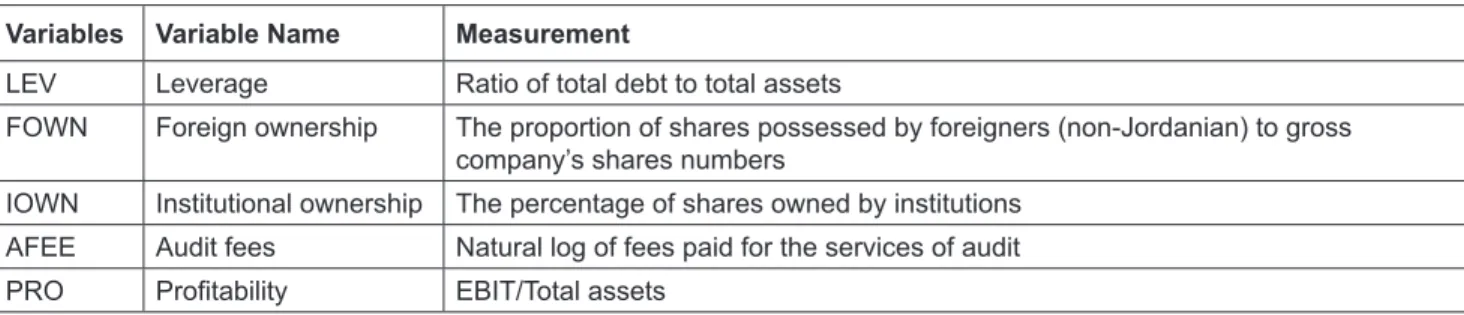
This paper examines the impact of corporate governance strength on capital structure in an emerging country, namely, Jordan, by constructing a corporate governance score that captures both internal monitoring mechanisms (foreign ownership and institutional ownership) and external monitoring mechanism (audit fees). In addition, this study uses profitability as control variable. This paper uses data of non-financial companies (industrial and services) of 87 listed firms on Amman Stock Exchange (ASE) from 2011 to 2019.
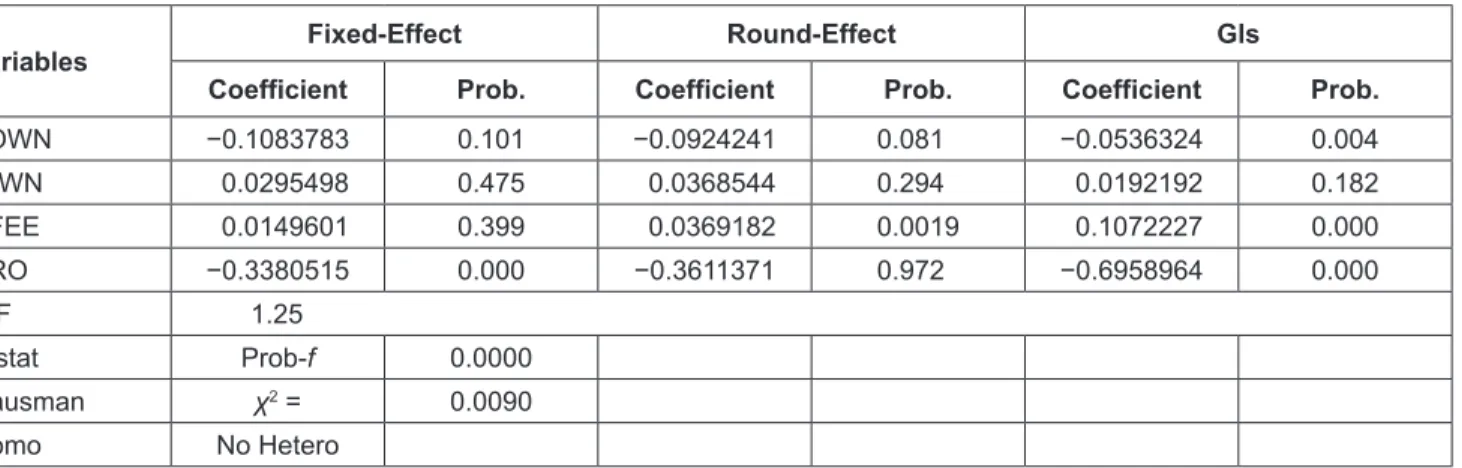
Using the random-effects generalized least square (GLS) regression model, the findings reveal that foreign ownership significantly and negatively influences the level leverage, while institutional ownership has a positive and insignificant association with level leverage.
Further, audit fees have a positive and strong significant association with level leverage in Jordan. In addition, profitability has a positive and significant association with leverage. These outcomes suggest that foreign ownership should be encouraged in listed companies as it can replace the weakness of other corporate governance mechanisms in Jordan. The outcomes of the current study should be of great interest to regulators and policy-makers. The results, which are robust to a range of alternative proxies and to additional tests, provide new insights into the determinants of level leverage.
Keywords: Ownership Structure, Audit Fees, Leverage JEL Classification Code: G3, G32, G11
strong corporate governance. However, Jantadej and Wattanatorn (2020) argue that corporate governance plays a crucial role in protecting shareholder wealth and reduces asymmetric information between corporate and external investor including debt holder leading to a decreasing in cost of debt financing.
Corporate governance has been defined as the control systems and practices through which investors or lenders get assurance of receiving returns on the money they invested (Shleifer & Vishny, 1997). A solid and well established corporate governance system is important for the rapid advancement of an economy. The countries with strong corporate governance systems have been able to rapidly expand their corporate sector by bringing more capital into their economies at lower costs, thereby increasing the value of the firm and maximizing the wealth of the shareholders (Ahmed Sheikh & Wang, 2012). Integration of China’s economy into the global economy along with the speedy development of capital markets enabling higher investment from different countries have caught the attention of researchers to investigate the governance structure of the firms in China (Huang & Wang, 2015; Liu & Fong, 2010;
Wei, 2007; Xu & Wang, 1997).
1
First Author and Corresponding Author. Department of Finance &
Banking Science, University Irbid National, Jordan [Postal Address:
Irbid, Jordan] Email: [email protected]
2
Department of Finance & Banking Science, University Irbid National, Jordan. Email: [email protected]
© Copyright: The Author(s)
This is an Open Access article distributed under the terms of the Creative Commons Attribution Non-Commercial License (https://creativecommons.org/licenses/by-nc/4.0/) which permits unrestricted non-commercial use, distribution, and reproduction in any medium, provided the original work is properly cited.