Print ISSN: 2288-4637 / Online ISSN 2288-4645 doi:10.13106/jafeb.2021.vol8.no1.851
The Impact of Government Ownership and Corporate Governance on the Corporate Social Responsibility: Evidence from UAE
Ayda FARHAN
1, Abdel Razaq Farah FREIHAT
2Received: October 01, 2020 Revised: December 06, 2020 Accepted: December 14, 2020
Abstract
The main objective of this study is to examine the government ownership effect on the United Arab Emirates (UAE) firm’s corporate social responsibility (CSR). Government ownership is assumed to affect the CSR either directly or indirectly. That is by moderating the association between corporate governance and CSR. Publicly listed companies on the UAE capital markets (Abu Dhabi and Dubai) from 2010-2013 constituted the study sample. Panel data regression analyses and random effect model is used to examine the effects of board size, board independence, and audit committee characteristics on CSR. Government ownership is used as a moderator variable. The result showed that the existence of government ownership has a moderator effect on the association between corporate governance mechanisms and the CSR. Precisely, the research revealed that the audit committee characteristics become more effective in improving the firm’s CSR when the government owns shares in the organization. The main contribution of this study is to examine how firm ownership structure influences good corporate governance and CSR in the UAE. The study contributes to the CSR literature by merging between the existence of governmental ownership and the power to enforce the implementation of corporate governance in an emerging country.
Keywords: Government Ownership, Corporate Social Responsibility (CSR), Corporate Governance, Moderating Effect, UAE JEL Classification Code: M41, M48, M14
1
First Author and Corresponding Author. Assistant Professor, Accounting Department, Higher Colleges of Technology, United Arab Emirates [Postal Address: 17258, Al Ain, United Arab Emirates]
Email: [email protected]
2
[1] Visiting Associate Professor, Business Administration Program, Arab Open University, Kuwait Branch. Email: [email protected] [2] Associate Professor, Accounting Department, Business School, Al-Balq’a Applied University, Jordan. Email: [email protected]
© Copyright: The Author(s)
This is an Open Access article distributed under the terms of the Creative Commons Attribution Non-Commercial License (https://creativecommons.org/licenses/by-nc/4.0/) which permits unrestricted non-commercial use, distribution, and reproduction in any medium, provided the original work is properly cited.
1. Introduction
In the current literature, it is one of the concerns to find the reason behind the tendency of firms to participate in social activities and act responsibly towards society (Amran & Devi, 2008). An explanation of this behavior was put forward by Li et al. (2013), who found that corporate social responsibility (CSR) enhances a firm’s performance.
Other studies assumed that serving the community ensures a firm’s long-term existence (Carroll & Shabana, 2010), and
minimizes social problems. Further, Maher and Andersson (2000) concluded that the best firms are not the ones that achieve excess profits; rather, the best are the ones that invest in serving all the stakeholders as compared to only the shareholders.
The foremost concern in most of the CSR research studies is to determine the factors that affect the firm’s CSR. Most researchers are concerned about the effect of the firm’s leverage, size, performance, or industry among other factors (McGuire et al., 1988; Dam & Scholtens, 2012; Li et al., 2013). While some like Jo and Harjoto (2012), studied corporate governance as a major determinant of firms’
engagement in social activities. Further, Dam and Scholtens (2012) viewed state ownership among other ownership structures as one of the factors responsible for a firm’s’
social activities.
The positive effect of government ownership on firms’
CSR has been identified by many researchers such as Amran
and Devi (2008) and Zhou (2019). O’Connor et al. (2014)
examined the combined effect of two factors; namely, the
legal rules and its enforcement by the government, and
discovered that these two factors can influence a firm’s
corporate governance. Chalevas (2011) also studied the state
role where he found that mandating corporate governance by the state would expand the positive effect of the corporate governance for all the parties involved along with the stockholders.
Further, across the literature, stakeholder theory and institutional theory are found to be the most frequently employed concept in the theoretical framework (Fernando
& Lawrence, 2014; Amran & Devi, 2008). Based on the stakeholder theory, a firms’ long-term existence and success are not purely a result of its profit numbers, rather it is a product of its stakeholders’ interaction in a way that will achieve the firm’s objectives (Mitchell et al., 1997; Farhan &
Annuar 2018). According to Htay et al. (2013), the board must work to align the objectives of all the stakeholders in such a way that maximizes the firm’s performance. On the other hand, the stakeholder theory suggests that a business must seek to maximize value for its stakeholders. It emphasizes the interconnections between business and all those who have a stake in it, namely customers, employees, suppliers, investors, and the community.
Donaldson and Preston (1995) stated that the stakeholder who has the managerial power will always prioritize his/her objectives. For instance, one of the objectives of the powerful stakeholders could be that firms should practice more CSR, especially if that stakeholder is the government. Here, the stakeholder perspective can be integrated with the institutional theory perspective. Particularly, due to the intervention of external factors, the coercive isomorphism will be adopted.
The government objectives are consistent and it holds the power to direct the firms to adopt these objectives by being one of the owners in that firm. Similarly, by owning shares in different firms, the government leads those firms to share the same objectives (Scott, 1987; Fernando & Lawrence, 2014); consequently, different organizations adopt similar management practices and seem to have uniformity.
This study is based on an assumption that government ownership plays a significant role in a firm’s management practices. The study observes the government ownership effect since the beginning of corporate governance implementation in the UAE. Moreover, the objective is to determine if government ownership affects a firm’s services towards the community in the UAE by imposing the implementation of the corporate governance mechanisms.
Government ownership is assumed to affect the CSR - either directly or indirectly - by measuring the moderator effect of government ownership on the association between corporate governance and CSR.
Previous studies have explicitly examined the direct effect of government ownership on firms’ CSR. However, this study fills in the gap of finding the indirect role that could be played by the government in enhancing the implementation of corporate governance to satisfy the community. Further, the organizations that constitute the sample for this study
differentiate it from the previous studies; as most of them were concerned with the emerging markets and none of those studies has discussed the Gulf countries. Therefore, this study specifically looks into the vital role of the governments of one of the Gulf countries in driving the country’s economy towards socially responsible growth.
2. Literature Review and Hypothesis Development
The benefits of government ownership in the firms are many; however, this study is concerned about its effect on enhancing and assuring the implementation of the regulations by the firms. Research conducted by O’Connor et al. (2014) supported this idea. It is emphasized that the legal rules and their enforcement by the government are a substitute for the firm’s corporate governance. In essence, mandating corporate governance by the state expands the positive effect for all the parties involved, not only the stockholders (Chalevas, 2011). Firms adopt CSR that is preferred by the government as per Voinea et al. (2019). When the government owns substantial shares in a firm, it will encourage the firm to adhere strictly to corporate governance, not only in books but also through real-time and active implementation. Supportive results were reported by Xu et al. (2012) who examined the influence of ownership structure on earnings quality of firms listed on the Chinese Stock Exchange. They found that the governmental ownership within the sample firm enhanced the firm’s performance pertaining to the actual enforcement of the corporate governance codes. The UAE Ministry of Economy issued its corporate governance code at the end of 2009 and simultaneously mandated its application by all the companies listed in the financial markets not later than May 2010 (Minister of Economy, No. (518) Article 16, 2009).
After the imposition of corporate governance codes, all the corporations are forced to act in a socially responsible manner and must disclose their contribution within their governance reports (Minister of Economy, No. (518), 2009).
2.1. The Impact of Government Ownership on CSR
Jo and Harjoto (2012) showed that compared with the private enterprises, the internal control in the state-owned enterprises has a more significant partial mediating effect in the process of corporate social responsibility affecting enterprise value. The behavior of CSR also contributes to the improvement of enterprise internal control. Corporate governance and ownership structures are among the factors that are usually studied to highlight the effects of government ownership on CSR (McGuire et al., 1988).
Corporate governance mechanisms are adopted by
organizations not only to serve the shareholder’s objectives
(higher dividends) but also to ensure that the firms are concerned about social welfare (Goodpaster, 1991; Freeman, 1994; Beltratti, 2005). Besides, the lack of monitoring is one of the shortcomings of the voluntary adoption of CSR principles. The system of promoting CSR through self- regulation or introducing prescriptive regulation without sustainable stakeholder engagement is ineffective and inefficient. (Ihugba, 2014). The ownership structure had been researched as one of the determinants of the firm’s engagement in CSR according to Dam and Scholtens (2012).
They investigated the effect of different ownership structures on the firm’s CSR, where state ownership structure was the prominent one. However, research studies that investigated the direct effect of government ownership on CSR are not many.
Alshbili et al. (2019) examined the extent to which corporate governance structures and ownership types are associated with the level of CSR disclosures in a developing country.
Results showed that pressures exerted by the government and external stakeholders have a considerable influence in promoting firm-level CSR disclosure activities in Libya oil firms. Further, Zhou (2019) found that state ownership as one of the governance mechanisms encouraged the public listed firms to adopt CSR disclosure in China. He found that state ownership, institutional ownership, managerial ownership, and board size are positively and significantly associated with the decision to voluntarily disclose CSR reports. Saraswati et al. (2020) found that companies owned by the government engage in more CSR activities than other companies. Since that, the importance of the existence of government as an owner can be derived from other related research studies.
This study assumes the following as the second hypothesis:
H
2: Government ownership has a positive impact on CSR 2.2. The Association between Corporate
Governance and CSR and the Role of Government Ownership
Dam and Scholtens (2012) showed the neutral effect of the government ownership on the firm’s engagement in CSR activities and recommended to include the state power in imposing regulations that enhance the firm’s CSR activities in further research. The existence of public regulations was the concern raised by Campbell (2007) in an attempt to determine why firms differ in their CSR engagements.
Another research conducted by Esa and Anum (2012) supported the need for regulations, as they found that the CSR disclosure of the GLC (Government Linked Corporations) in Malaysia had increased after the adoption of the Silver Book (Guidelines for the Government Linked Corporations to act socially). The government can force companies to adopt a corporate governance mechanism, that is if applied would motivate companies to provide more services to the
community as found by Huynh (2020). Tang et al. (2020) found concentrated ownership structure, strong government intervention, and media pressure are core conditions in the effectiveness of corporate governance patterns. Therefore, it is evident that the government plays a significant role in enhancing the social responsibility of the firms by influencing the association between corporate governance and CSR. This literature analysis leads to hypothesizing that government ownership could moderate the relationship between corporate governance and CSR.
H
3: Government ownership positively affects the association between corporate governance and CSR.
3. Data and Methods 3.1. Data and Sample
For each firm in the sample, the annual financial reports for four years (2010 to 2013) were obtained. The time selected was based on the first implementation of Corporate Governance Codes (CGC). The data about total assets, net earnings, and total debt were extracted from the financial reports. Further, the corporate governance data was obtained from the governance reports that enclosed all the CGC required information including the board size, the information related to the board composition, information related to the audit committee, and government ownership.
This study focuses on publicly listed firms in the UAE, which include the corporations listed on the Abu Dhabi Securities Market and the Dubai Financial Market. There is a total of 127 companies listed on the financial markets of the UAE, which are distributed between 12 industrial sectors, namely: Real Estate, Banks, Investment and Financial Services, Energy, Telecommunication, Insurance, Industrial, Consumer Stables, Services, Debt Instrument, Electronically Traded Fund, and Transportation. Banks and Investment and Financial Services had been exempted because they were excluded from the scope of the CGC application.
However, both sectors apply the central bank requirements, which require the UAE’s all financial corporations to supply information related to capital adequacy, capital management, and regulatory framework management (Hassan, 2011).
Only 92 companies listed in the financial markets fell
under the prescribed criteria and therefore were selected as
the sample. During data collection, it was found that few of
the selected firms were listed after 2011 that does not serve
the study purposes; therefore, these companies were also
excluded. The exemption also included few companies which
were owned by other Gulf countries but listed on the UAE
capital markets. Finally, the study sample ended up with 72
companies altogether and 288 annual reports. More details
about the sample are given in Table 1.
3.2. Study Variables
This study measures the effect of government ownership on CSR; i.e. CSR is the dependent variable. Government ownership is the independent variable. Moreover, the corporate governance mechanisms mandated by the government are included as the independent variables, namely: board size, board composition, and audit committee characteristics. Many control variables are expected to affect the CSR such as the risk and the firm size. More details about the variables are explained in the following sections.
3.2.1. The Dependent Variables
Most of the studies that measure the effect of corporate governance on CSR, incorporate CSR as a dependent variable (Huang, 2010; Arora & Dharwadkar, 2011). Consistent with Prado‐Lorenzo et al. (2009) and the study by Michelon et al.
(2015), this study measures the frequency of social services provided during the year to one of the following: workers, customers, suppliers, community, environment, and society as being reported in the governance report. Frequency means the number of separate sentences that mention the social activity that is related to one of the six stakeholders mentioned above.
CSR in this study is not a measurement of the CSR disclosure, as the disclosure of CSR in the UAE has begun after 2010 and is therefore very limited. Details are given in the governance report about the CSR activities of the firm and to whom it is provided; in rare cases, the amount of the contribution is mentioned. This study explicitly includes CSR as the number of times a firm provided services to the other stakeholders rather than its shareholders; regardless of to whom the services are provided. In special cases where the firms list a meaningless contribution towards the community, such cases are excluded. For instance, if a firm reports that it is keen to minimize the paper use, the case was excluded as there is no meaningful action taken to minimize the paper use.
3.2.2. The Independent Variables
The independent variables are determined based on the mechanisms required in the UAE’s CGC, which include: board size, board independence, and internal audit committee structure.
i. Board Size: the total number of directors on the board (Adams & Mehran, 2012; Hussainey & Aljifri, 2012).
ii. Board Independence: measured as the percent of the independent directors in the board (O’Connell &
Cramer, 2010; Adams & Mehran, 2012; Guo & Kga, 2012).
iii. Audit Committee (AC) Structure: measured by including four characteristics of the audit committee, which are expected to affect the firm’s performance.
These characteristics are:
1. The independence of the audit committee (AC) members: measured by dividing the independent members by the total number of members on the audit committee as done by Saibaba and Ansari (2013), and Sharma and Kuang, (2014).
2. Financial experts: measured as the proportion of the members within the committee with financial experience, qualifications, or worked previously as an auditor (Carcello et al., 2011; Chan et al., 2011; Rickling, 2014).
3. The number of audit committee meetings held during the year (Carcello et al., 2011; Chan et al., 2011; Rickling, 2014; Sharma & Kuang, 2014).
4. The audit committee (AC) compensation: the log of the average fees per member that have been received by the audit committee members during the year (Chan et al., 2011, 2013).
3.2.3. The Moderator Variable
Government ownership is expected to alter the relationship between corporate governance and CSR because government ownership could serve the other minor shareholders by facilitating the firm’s profit maximization objective. Wu (2011) explained that the government can play a monitoring role over management. Government ownership for this study is calculated as the percentage of shares owned by the UAE government in the public listed firms (Wu, 2011; Tran et al., 2014).
3.2.4. The Control Variables
The variables which have been found to affect the firm’s CSR in the previous studies and included in this study are:
Table 1: Sample Selection
Financial Market Total Number of Companies
Listed
Companies excluded
Companies Included Foreign
companies New
Companies Banks Investing &
finance Co.
Abu Dhabi 68 5 3 13 3 44
Dubai 59 7 5 11 8 28
Total 127 12 8 24 11 72
The Firm Size:
Smaller firms are less encouraged to contribute to the community in a socially responsible way according to Dam and Scholtens (2012). Furthermore, the positive effect of the firm size on the CSR has been found by many studies including Anas et al. (2015) and Li and Zhang (2010). Also, according to Dalton et al. (1998), firm size could be an important factor in affecting firms’ performance since large firms are generally followed by more analysts who motivate these firms to perform well towards their stakeholders (Haniffa & Hudaib, 2006). In affirmation to most previous studies, this study uses the natural logarithm of the total assets as a proxy for the firm size (Bhagat & Black, 2002; Hussainey & Aljifri, 2012; Chan et al., 2013; Anas et al., 2015; Freihat et al., 2019)
The Risk Variable (Leverage):
The risk measured by the debt ratio is included as a control variable because firms with debt have to meet the interest expenses and the possibilities of loan default, which could negatively affect the firm’s performance (Chahine & Filatotchev, 2011). Most of the CSR studies have been controlled for risk (leverage) (Dam & Scholtens, 2012; Esa & Anum 2012; Jizi et al., 2014). For this study, the risk is calculated based on accounting measures, which is the ratio of the total debt to the total assets, as used by Haniffa and Hudaib (2006) and Freihat et al. (2019). The variables, their symbols, and the methods to measure each variable are shown in Table 2.
4. Results
4.1. Descriptive Statistics and Correlation Coefficients
Table 3 reports the descriptive statistics (means and standard deviations) of the study variables over the period of 2010 to 2013. The number of observations for each variable is 231. The CGC does not specify a specific number of the board members; however, on average, the firms have about eight members on their board. Here, the majority of them are independent as concluded from the average of the board independence ratio, which is equal to 70.4%. The CGC stated that the Audit Committee (AC) should include at least three members, where one of them at least should have financial experience or qualifications. From Table 3 the mean of the financial experts’ ratio in the AC is 36.0%, which is slightly higher than the required number (three).
This shows that the firms strictly complied with the CGC regarding the financial expert ratio. Further, the AC should meet once each three months as per the CGC so that the average of the AC meetings is 4.35, and in some cases, there are busy committees with more meetings. Although the average of the incentives paid for the AC member per meeting is AED 3775, but some companies pay much more incentives, as reflected in the standard deviation.
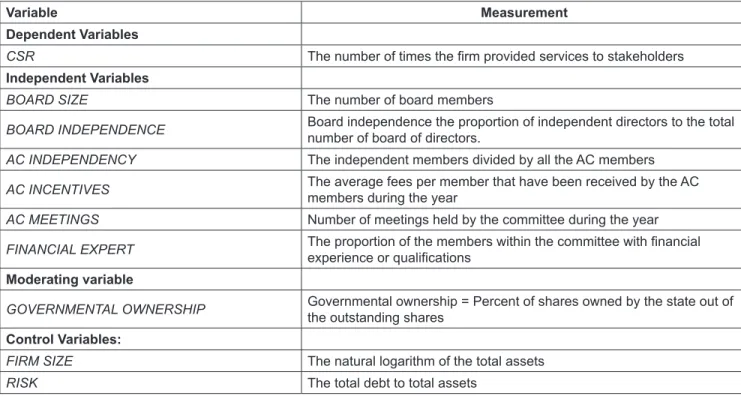
Table 2: Research Variables and Their Measurements
Variable Measurement
Dependent Variables
CSR The number of times the firm provided services to stakeholders
Independent Variables
BOARD SIZE The number of board members
BOARD INDEPENDENCE Board independence the proportion of independent directors to the total number of board of directors.
AC INDEPENDENCY The independent members divided by all the AC members
AC INCENTIVES The average fees per member that have been received by the AC
members during the year
AC MEETINGS Number of meetings held by the committee during the year
FINANCIAL EXPERT The proportion of the members within the committee with financial experience or qualifications
Moderating variable
GOVERNMENTAL OWNERSHIP Governmental ownership = Percent of shares owned by the state out of the outstanding shares
Control Variables:
FIRM SIZE The natural logarithm of the total assets
RISK The total debt to total assets
Correlation evaluation was carried out to take a look at the relationship amongst all the variables over the 2010–2013 period. The results are shown in Table 4. As can be seen in Table 4, the correlation coefficients are weak and do not violate the assumption of independence between the variables. It is worthy to note that there is a significant positive association between the government ownership and the CSR 0.1439 at p 0.0295; also there is a significant positive association between firm size and CSR 0.3234 at p 0.0000.
4.2. Panel Data Regression Fixed Effects vs.
Random Effects
The panel data regression model is used to test hypotheses 1 and 2. To use the panel data model, we had to run the Hausman test to determine which model to use to determine the fixed effect or random effect. The decision base is that; the fixed effect model is the appropriate model if the p-value is small, [less than 0.05]. Table 5 presents the results of the Hausman test. The results of the Hausman test suggest that the chi2 for model 1 is (10) and for model 2 is (11.34), and the significance is (0.264) for model 1 and is (0.6595) for model 2 which is greater than 0.05. Therefore, the test results imply that the random effect model was the appropriate model for the study.
Table 4: Correlation Matrix CSR Board
Size Board
Independence AC
Independence AC
Incentives AC Meetings
Financial AC Expert
Government Ownership Firm
Size
CSR 1.0000
Board Size 0.1668*
0.0104 1.0000 Board
Independence 0.0006
0.9928 0.1627*
0.0125 1.0000 AC Independence -0.0658
0.3165 0.0679
0.3011 0.5196*
0.0000 1.0000
AC Incentives 0.3582* 0.0000 0.3332*
0.0000 -0.0887
0.1780 -0.1473*
0.0249 1.0000
AC Meetings 0.2202* 0.0000 0.2945*
0.0000 0.0674
0.3075 0.0552
0.4037 0.1465*
0.0249 1.0000 AC Financial
Expert 0.0319
0.6273 0.0631
0.3368 -0.0911
0.1650 0.0284
0.6655 0.0390
0.5549 -0.0521
0.4303 1.0000 Government
Ownership 0.1439*
0.0295 0.0365
0.5832 0.1708*
0.0096 -0.0086
0.8973 0.1630*
0.0142 0.1785*
0.0073 -0.0213
0.7485 1.0000 Firm Size 0.3234*
0.0000 0.3963*
0.0000 0.0470
0.4732 0.0598
0.3626 0.2728*
0.0000 0.3637*
0.0000 0.0671
0.3065 0.2403*
0.0002 1.0000 Debt Ratio -0.0568
0.3864 0.0086
0.8961 0.0783
0.2320 0.0637
0.3318 -0.0890
0.1769 0.1440*
0.0287 -0.0200
0.7604 0.0601
0.3650 0.1983*
0.0023 Table 3: Descriptive Statistics
Mean Std. Deviation
CSR 3.5520 4.15304
Board Size 7.7186 2.03738
Board Independence 70.4249 19.04611
AC Independence 84.969 16.905
AC Incentives 3775.3261 7664.31690
AC Meetings 4.358 2.0712
AC Financial Expert 36.161 22.690
Governmental Ownership 12.1624 19.52076
Firm Size 6.2151 .65906
Debt ratio 44.373 19.557
The mean of the AC independence is high with 84.9%
that could be due to a clear statement in the CGC that the majority of the members should be independent.
Nonetheless, the average debt of the firms in the UAE is
44% which is relatively high.
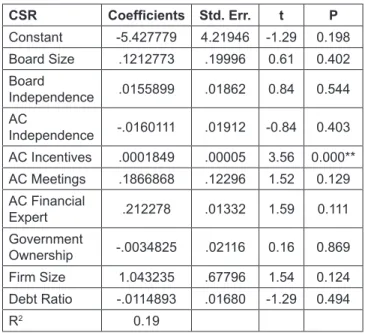
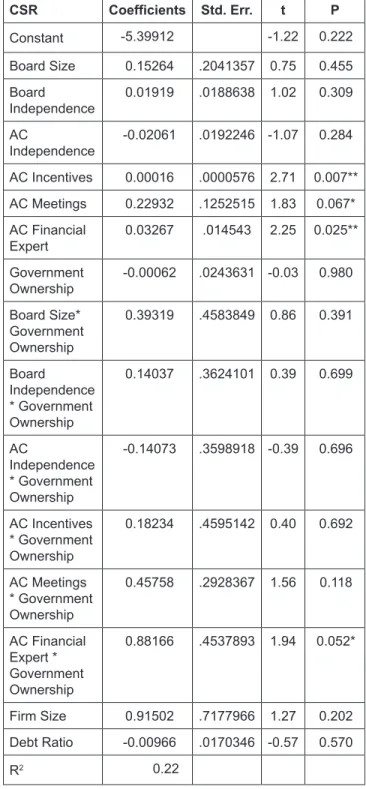
The panel random effect regression has been used through two steps: Firstly, Model 1 is applied to measure the effect of the corporate governance and government ownership effect on the CSR; then Model 2 is applied to find the moderator effect of the government ownership on the association between the corporate governance and the CSR.
The two models are explained as follows:
Model 1:
0 1 2
3 4
5 6
7 8
9
it it
it it
it it
it it
it it
CSR Board Size Board Independence AC Independence AC Incentives AC Meetings AC Financial Expert Governmental Ownership Firm Size Debt Ratio
β β β
β β
β β
β β
β ε
= + +
+ +
+ +
+ +
+ +
Model 2:
0 1 2
3 4
5 6
7 8
9
*
it it
it it
it it
it it
CSR Board Size Board Independence AC Independence AC Incentives AC Meetings AC Financial Expert Governmental Ownership Board Size GovernmentalOwnership Board Indep
β β β
β β
β β
β β
β
= + +
+ +
+ +
+ +
+
10 11 12 13
*
*
*
*
*
it it
it it it
endence GovernmentalOwnership AC Independence GovernmentalOwnership AC Independence GovernmentalOwnership AC Meetings GovernmentalOwnership AC Financial Expert GovernmentalOwners
β β β β + + + +
14 15
it it
it it