• 검색 결과가 없습니다.

The Influence of Corporate Governance on Dividend Decisions of Listed Firms: Evidence from Sri Lanka

N/A
N/A
Protected

Academic year: 2021

Share "The Influence of Corporate Governance on Dividend Decisions of Listed Firms: Evidence from Sri Lanka"

Copied!
7
0
0

로드 중.... (전체 텍스트 보기)

전체 글

(1)

Print ISSN: 2288-4637 / Online ISSN 2288-4645 doi:10.13106/jafeb.2021.vol8.no2.0289

The Influence of Corporate Governance on Dividend Decisions of Listed Firms: Evidence from Sri Lanka

Mohamed Cassim Abdul NAZAR

1

Received: November 05, 2020 Revised: December 30, 2020 Accepted: January 08, 2021

Abstract

This study investigates the role of corporate governance in the dividend decision of 198 non-financial companies listed on the Colombo Stock Exchange of Sri Lanka, over the period from 2009 to 2016. Four corporate governance indicators are used in this study; managerial ownership, the board size, board independence, and CEO duality. Furthermore, this study considers three control variables such as profitability, firm size, and corporate tax. This study employed the Generalized Method of Moments (GMM) model to estimate the regression models on panel data study. The major contribution of this study is exploring the insight into the effect of corporate governance factors on dividend decisions. The results of the study revealed that managerial ownership showed a significant positive impact on the dividend payout ratio. Board size showed a significant positive influence on the dividend payout ratio. Board independence negatively but significantly influenced the dividend payout ratio. CEO duality showed an insignificant negative impact on the dividend payout ratio. In the framework of these CG indicators, Sri Lankan listed firms are recommended to have dispersed ownerships, large Board size and maintain a balance of power and authority by separating the individual who is assuming the position of the CEO from the Chairperson of the Board and maintain at least two independent directors.

Keywords: Financing, Corporate Governance, GMM, Sri Lanka JEL Classification Code: M41, P34, P43, Q28, R51

community. Corporate governance, in strategic management, refers to the set of internal rules and policies that determine how a company is directed. Corporate governance decides, for example, which strategic decisions can be decided by managers and which decisions must be decided by the board of directors or shareholders. Hence, good corporate governance influences the strategic decision-making of a firm, for example, financing, dividend, and investment.

Therefore, corporate governance variables like board size, board independence, and CEO duality may have a direct impact on financial decisions. Corporate governance holds a key mechanism to protect outside investors through the legal system. Responsible firms extend the corporate governance practices that impact positively on the environment and society at large while enhancing shareholders’ value in long term.

It is important to keep in mind that a dividend policy of a firm is not independent of its other financing and investment decisions. For example, for a firm that has at least some debt, paying a dividend decreases the firm’s equity and therefore raises its debt ratio. A firm that decides to distribute cash to shareholders via dividend or share repurchase may

1

First Author and Corresponding Author. Senior Lecturer, Department of Accountancy and Finance, Faculty of Management and Commerce, South Eastern University of Sri Lanka [Postal Address: University Park, Oluvil, 32360, Sri Lanka] Email: [email protected]

© Copyright: The Author(s)

This is an Open Access article distributed under the terms of the Creative Commons Attribution Non-Commercial License (https://creativecommons.org/licenses/by-nc/4.0/) which permits unrestricted non-commercial use, distribution, and reproduction in any medium, provided the original work is properly cited.

1. Introduction

Corporate governance refers to how a corporate board

makes an authentic decision for the organization with

the guidelines, and approval of the board that is usually

necessary for making investments, issuing shares, and

declaring dividends. Corporate governance is the system of

rules, practices, and processes by which a firm is directed

and controlled. Corporate governance essentially involves

balancing the interests of a company’s many stakeholders,

such as shareholders, senior management executives,

customers, suppliers, financiers, the government, and the

(2)

increase the likelihood of raising external financing in the future. In fact, it is not unusual for the same firm to pay a dividend, repurchase shares, borrow money, and issue new common stock all in the same year. Dividends may affect capital structure; retaining earnings increases common equity relative to debt. It is an important concept in the dividend policy. A firm may decide to distribute almost its entire earnings. Another firm may decide to distribute only a portion of its earnings

Dividend decision arises at the time when a company earns extra profits. This decision is linked with the distribution or retention of corporate profits to improve the share value of the firm. The pivotal objective of the finance manager is to confirm that every corporate decision must lead the company to achieve its target of shareholders’ wealth maximization.

Therefore, the finance manager should consider the future investment needs and also take into account the possible impact of the decision on company share value, when deciding on the distribution of profits as dividend and retention of profit. The distribution of more than the optimal dividend payout may enhance the image of the company, at the same time, this will decrease the retention of profit. The unusually high-profit distribution rate is very difficult to maintain in the long run and also has a negative impact on company reserves, as a result, the value of the share goes down. In contrast, a low-profit distribution rate exhibits the firm’s weak financial position and mismanagement of financial matters.

Few researchers are not much confident about how will dividends create an effect on the value of a firm’s shares. In their pioneer study, Miller and Modigliani (1961) revealed a well-designed analysis of the relationship between dividend policy, growth, and share valuation. Based on well-defined but a simplified set of perfect capital market assumptions (e.g., no taxes, transaction, and agency costs, and information freely available to everyone), Miller and Modigliani (1961) expressed a dividend irrelevance theorem. According to this concept, investors do not pay any importance to the dividend history of a company and thus, dividends are irrelevant in calculating the valuation of a company. A dividend is typically a cash payment made from a company’s profits to its shareholders as a reward for investing in the company. The dividend irrelevance theory goes on to state that dividends can hurt a company’s ability to be competitive in the long term since the money would be better off reinvested in the company to generate earnings. Early studies by Black and Scholes (1974) and Miller and Scholes (1978) supported the dividend irrelevance argument.

More recent works have suggested that dividend disbursements could be considerably influenced by corporate governance, such as the size of the board, separation role of the Chairman and Chief Executive Officer. For instance, La Porta et al. (2000) suggested two

models that considered the association between corporate governance and dividend disbursement of firms. They are Outcomes Model and Substitution Model. According to the outcome model dividends are paid because minority shareholders pressure corporate insiders to empty cash.

According to the substitute model, insiders interested in issuing equity in the future, pay dividends to establish a reputation for decent treatment of minority shareholders.

Chae et al. (2009), who empirically tested whether strong corporate governance would lead to higher payout to minimize agency problems or to lower payout to avoid costly external financing. They found that firms with higher (lower) external financing constraints tend to decrease (increase) payout ratio with an improvement in their corporate governance. Thus, the relation between payout and corporate governance is reversed depending on the relative sizes of agency and external financing costs.

The remainder of this paper is organized in the following manner. The next section of the paper reviews prior research and discusses the related theoretical underpinning to develop the hypotheses. This is followed by a section that explains the data, variable measurement, model specification, and the GMM estimation method. The results and discussion are presented in Section 4 while the conclusion is laid out in the final section.

2. Literature Review and Hypotheses Development

A negative relationship is found between managerial ownership and dividend payout (Jensen et al., 1992). Jensen et al. (1992) stated that levels of insider ownership differ systematically across firms. Further, high insider ownership firms choose lower levels of both debt and dividends. Further, agency problems can be resolved along with managerial ownership and dividends. Chen and Steiner (1999) supported the argument that managerial ownership helps to resolve the agency conflicts between external stockholders and managers but at the expense of exacerbating the agency conflict between stockholders and bondholders. They further observed evidence of substitution-monitoring effects between managerial ownership and debt policy, between managerial ownership and dividend policy, and between managerial ownership and institutional ownership. Mullah (2001) investigated the behavior of the pay-out policy of Dhaka Stock Exchange (DSE) listed firms preceding and following the financial crisis to see whether dividend policy appears as a significant measure to protect the general shareholders’ interest following the crisis in 1997-1998.

They found that managerial ownership is the determining

factor of the dividend payout policy of listed companies.

(3)

Board Size is also identified as one of the influencing factors on the dividend decision in the existing literature. A small board size may not be ready to deliver the governance roles that are expected. At the same time, boards with more members may not perform well and may not support to mitigate the conflicts of agency between managers and shareholders. Bigger board size may lead to paying more dividend payouts if members of the board are attempting to satisfy various clients. Bokpin (2011) emphasized that there is a positive and significant relationship between board size and dividend payout ratio. Moreover, Abor and Fiador (2013) found that bigger board size is related to low dividend payout in listed firms in Nigeria. Dividend payout positively affects board composition, suggesting that firms with high-payout tend to adopt good corporate governance structures to ensure the protection of shareholder interest.

A bigger board may bring about an impression on keeping hold of returns enabling financing better investment opportunities.

The existence of independent directors at the board will affect dividend policy (Feng et al., 2007; Rahman, & Saima, 2018). This has been supported strongly by Chen et al.

(2011). Furthermore, Brokhoric et al. (2005) concluded that board independence significantly and negatively influences dividend policy. Conversely, Setia-Atmaja et al. (2009) suggested that there is a significant positive relationship between board independence and dividend payout of firms during the period of 2000 – 2005 in Australia. Moreover, this result is supported by another Australian study done by Yarram and Dollery (2015) and further study in Pakistan by Tahir and Mushtaq (2016). Consequently, the more number of independent directors at the board will tend to pay a dividend to shareholders.

The results of the effect of CEO duality on dividend policy decisions are inconsistent. Bokpin (2011) revealed that there is a favorable association between CEO duality and dividend payout ratio. Furthermore, Yarram and Dollery (2015) concluded that CEO duality and dividend policy have a significant positive association. In contrast, Abor and Fiador (2013) concluded that CEO duality is said to have a negative impact on dividend payout in firms in Nigeria.

This means that dividend payout positively affects board composition, suggesting that Ghanaian firms with high- payout ten adopt good corporate governance structures to ensure the protection of shareholder interest. Moreover, Chen et al. (2011) found that there is an inverse relationship between the payout of dividend and duality of the CEO.

Therefore, with the discussion and analysis given above, researcher hypothesizes are formulated as follows:

H1: There is a significant relationship between Corporate Governance factors and the Dividend Decision of a firm.

H1a: There is a significant relationship between Managerial Ownership and Dividend Decision of a firm.

H1b: There is a significant relationship between Board Size and Dividend Decision of a firm.

H1c: There is a significant relationship between Board Independence and the Dividend Decision of a firm.

H1d: There is a significant relationship between CEO Duality and the Dividend Decision of a firm.

3. Research Methods and Methodology 3.1. Sample and Data Collection

There are 287 companies listed in the Colombo Stock Exchange (CSE) as of 2016. The sample data for this study consists of 198 firms listed on the Colombo Stock Exchange after excluding the financial sector of 75 companies listed from 2009 to 2016. The reason for the exclusion of financial firms is they have to conform to strict legal requirements pertaining to their financing. The data and other related information for this study are collected from the published annual reports, (CSE) Colombo Stock Exchange websites, magazines, and CSE publication.

3.2. Model Specification

Dividend Managerial ownership + Board size + Boar

= b + b

b b

0
1

2 3 d d independent

+ CEO duality + Profitability + Firm s

b b

b

4 5

6 iize + b 7 Corporate tax + e

4. Results and Discussion 4.1. Descriptive Analysis

Table 2 presents descriptive statistics of the variables which have been used in the study. With a view to explain the general characteristics of the sample drawn for the study, this table reports the minimum, maximum, mean, and standard deviations.

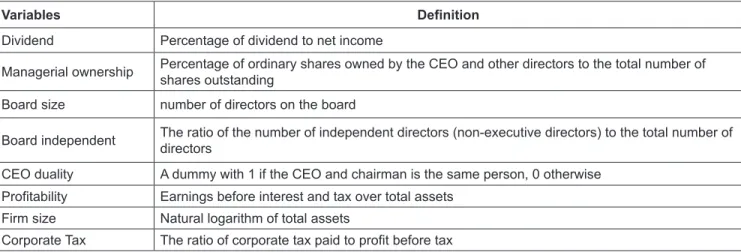
Dividend payout is calculated by dividing dividend paid by net income. Managerial ownership is the number of ordinary shares owned by the board of directors to the total number of shares. Board size is the number of directors on the board.

Board independence is the ratio of non-executive directors to

the total number of directors. CEO duality is a dummy variable

if the CEO and chairman are the same people. Profitability

is the EBIT to total assets. Firm size is the natural logarithm

of total assets. Corporate tax is income taxes divided by total

assets.

(4)

Table 1: Definition of the variables

Variables Definition

Dividend Percentage of dividend to net income

Managerial ownership Percentage of ordinary shares owned by the CEO and other directors to the total number of shares outstanding

Board size number of directors on the board

Board independent The ratio of the number of independent directors (non-executive directors) to the total number of directors CEO duality A dummy with 1 if the CEO and chairman is the same person, 0 otherwise

Profitability Earnings before interest and tax over total assets Firm size Natural logarithm of total assets

Corporate Tax The ratio of corporate tax paid to profit before tax

Table 2: Descriptive Statistics of the Variables

Variable Observations Mean Std. Dev Min Max

Dividend payout 1584 0.118 0.136 0.000 0.460

Managerial ownership 1584 0.108 0.166 0.000 0.710

Board size 1584 7.818 1.994 3.000 15.000

Board independent 1584 0.390 0.124 0.000 0.900

CEO duality 1584 0.422 0.494 0.000 1.000

Profitability 1584 0.075 0.111 -0.390 0.520

Firm size 1584 9.329 0.692 6.870 11.820

Corporate tax 1584 0.021 0.009 0.010 0.140

The dividend payout ratio is considered for measuring the dividend decision. The mean value of the dividend payout was 0.118. An average of 11.8% of the earnings was paid as dividend to shareholders. The minimum and maximum values were 0 and 0.460 respectively with an overall standard deviation of 0.136.

This study considered four corporate governance factors, one of which is managerial ownership. The mean value of managerial ownership is 0.108. The minimum and maximum values of managerial ownership are 0 and 0.710 respectively and the overall standard deviation is 0.166. The second variable, Board size recorded a mean value of 7.818. The smallest board size is 3 while the largest is 15 and the standard deviation is 1.994. The board independence which is the third variable of corporate governance recorded a mean value of 0.390. It means that 39 percent of directors are non-executive or independent directors of the board. The minimum and

maximum values are 0 and 0.9 respectively with a standard deviation of 0.124. The fourth variable, CEO duality recorded a mean value of 0.422. The range of CEO duality was between 0 and 1 with a standard deviation of 0.494.

4.2. Correlation Analysis

The bivariate correlations are used to investigate the

explanatory variables and to identify independent variables

with higher correlation coefficients enabling to test variables

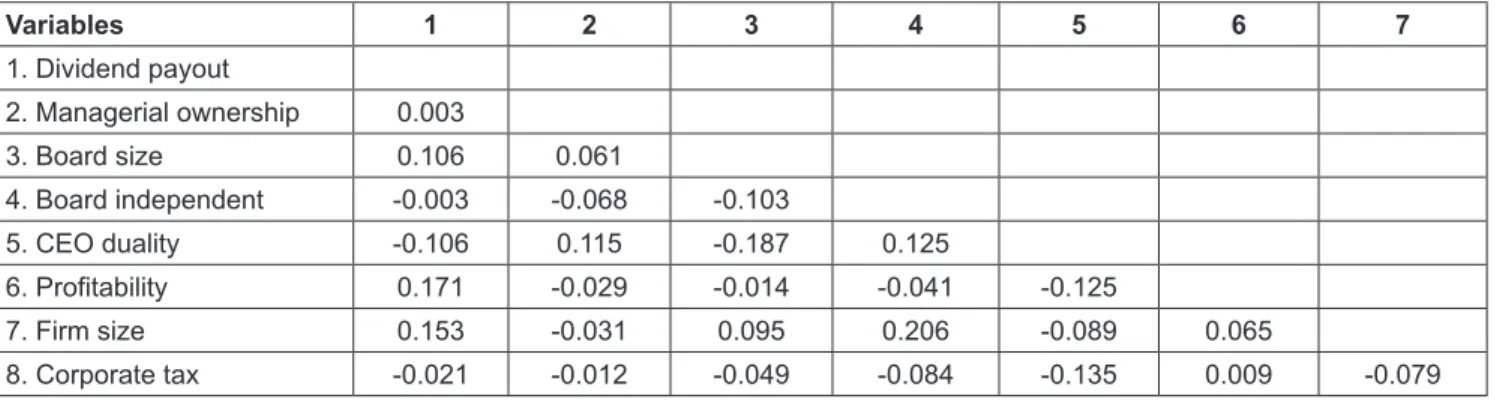
with a multicollinearity problem. Table 3 provides the matrix

of Pearson correlation measuring the degree of association

between the variables under the study. As per the Table,

correlation coefficients are not greater than 0.8. According to

Gujarati (2003), a value greater than 0.8 could be considered

as having a multicollinearity problem.

(5)

4.3. Regression Analysis

In connection with variables related to corporate governance, the results exhibit that managerial ownership has a significantly positive impact on dividend payout ratio according to the regression Table 4 Therefore, hypothesis H1a showed that there is a significant relationship between managerial ownership and dividend decision of a firm and hence, H1a is supported. However, this result contradicted the findings of Kulathunga and Azeez (2016) who expressed a significantly negative relationship between managerial ownership and dividend payout ratio. Furthermore, another

Sri Lankan study conducted by Senaratne and Gunaratne (2006) concluded a negative association between managerial ownership and dividend payout ratio. However, the regression result of the impact of managerial ownership on dividend payout is consistent with Obaidat (2018) and Al Qahtani and Ajina (2017) in the context of Jordan and Saudi Arabian stock markets respectively.

Board size has a significantly positive influence on dividend decisions. It indicates that the greater the number of board members, the more dividend payout by the firms.

Therefore, hypothesis H1b showed that there is a significant relationship between board size and dividend decision of a firm, and hence, H1b is supported. This is consistent with the studies of Pahi and Yadav (2018), Mansourinia et al. (2013), and Chen et al. (2011). However, this result contradicted the findings of Kulathunga et al. (2017) who found a negative relationship between board size and dividend payout ratio in the context of Sri Lanka.

The association between board independence and dividend decision was significantly negative. The results specify that when the number of independent directors increases, the dividend payment to the shareholders goes down. This may happen when the independent directors tend to safeguard the minority shareholders’ interests that mitigate the agency problem. That is why firms are not using dividend payment as a tool to minimize the agency problem.

Therefore, hypothesis H1c showed that there is a significant relationship between board independence and dividend decision of a firm and hence, H1c is supported. This result is consistent with the results of Pahi and Yadav (2018) and Al-Homaidi et al. (2020)

CEO duality was insignificantly negative with the dividend payout ratio. This result was consistent with Ajanthan (2013) who showed a negative relationship between CEO duality and dividend payout. Therefore, hypothesis H1d showed that there is an insignificant relationship between Table 3: Correlation Analysis

Variables 1 2 3 4 5 6 7

1. Dividend payout

2. Managerial ownership 0.003

3. Board size 0.106 0.061

4. Board independent -0.003 -0.068 -0.103

5. CEO duality -0.106 0.115 -0.187 0.125

6. Profitability 0.171 -0.029 -0.014 -0.041 -0.125

7. Firm size 0.153 -0.031 0.095 0.206 -0.089 0.065

8. Corporate tax -0.021 -0.012 -0.049 -0.084 -0.135 0.009 -0.079

Table 4: System GMM Estimation of Regression Results for Dividend Decisions

Variables Coefficient value

DP 0.607***

MO 0.149***

BS 0.007***

BI -0.074***

CEOD -0.014

PRO 0.026

Log FS -0.007

CT 1.257**

Constant 0.072

No of groups 198

No of instruments 148

AR(2) 0.996

Hansen test 0.264

Note: *** Significant at 1% level, ** Significant at 5% level,

* Significant at 10% level.

(6)

CEO duality and dividend decision of a firm and hence, H1d is not supported.

Regression results of Table 4 also exhibited that profitability as a control variable was positively influenced by dividend decisions. This finding infers that the permanent earnings to a greater extent empower firms to pay dividends to shareholders. Firm size has an insignificant negative effect on dividend decisions. The results of the study indicate that bigger sized firms are able to pay more dividends compared to the smaller sized firms because the bigger firms have a relatively easy admittance to capital markets. Corporate tax has a significant positive relationship with dividend decisions.

5. Conclusion

This study experiments the role of corporate governance through four indicators (Managerial ownership, Board size, Board independence, and CEO duality) in influencing dividend decision of 198 non-financial listed companies in Sri Lanka for the 2009-2016 period. In the framework of these indicators, Sri Lankan listed firms are strongly recommended to have dispersed ownerships, large board size and maintain a balance of power and authority by separating the individual who is assuming the position of the CEO from the Chairperson of the board and maintain at least two independent directors. Last, corporate governance indicators such as managerial ownership, the board size, board independence are significant on dividend payout ratio, however, CEO duality is not significant.

References

Abor, J., & Fiador, V. (2013). Does corporate governance explain dividend policy in Sub-Saharan Africa? International Journal of Law and Management, 55(3), 201-225. https: doi.

org/10.1108/17542431311327637

Ajanthan, A. (2013). Corporate governance and dividend policy:

A study of listed hotels & restaurant companies in Sri Lanka.

International Journal of Management, IT, and Engineering, 3(12), 98-114. https://ssrn.com/abstract=2380762

Al-Homaidi, E. A., Tabash, M. I., Al-Ahdal, W. M., Farhan, N. H. S.,

& Khan, S. H. (2020). The liquidity of Indian firms: Empirical evidence of 2154 firms. Journal of Asian Finance, Economics, and Business, 7(1), 19-27. https://doi.org/10.13106/jafeb.2020.

vol7.no1.19

Al-Qahtani, T. H., & Ajina, A. (2017). The impact of ownership structure on dividend policy the evidence from Saudi Arabia.

Journal of Emerging Issues in Economics, Finance, and Banking, 6(1), 2187-2202.

Black, F., & Scholes, M. (1974). The effects of dividend yield and dividend policy on common stock prices and return. Journal of

Financial Economics, 1(1), 1–22. https://doi.org/10.1016/0304- 405X(74)90006-3

Bokpin, G. A. (2011). Ownership structure, corporate governance, and dividend performance on the Ghana stock exchange.

Journal of Applied Accounting Research, 12(1), 61-73. https://

doi.org/10.1108/09675421111130612

Borokhovich, K., Brunarski, K., Harman, Y., & Kehr, J. (2005).

Dividends, corporate monitors, and agency costs. The Financial Review, 40(1), 37-65. https://doi.org/10.1111/j.0732- 8516.2005.00092.x

Chae, J., Kim, S., & Lee, E. J. (2009). How corporate governance affects payout policy under agency problems and external financing constraints. Journal of Banking & Finance, 33(11), 2093-2101. https://doi.org/10.1016/j.jbankfin.2009.05.003 Chen, C. R., & Steiner, T. L. (1999). Managerial ownership and

agency conflicts: A nonlinear simultaneous equation analysis of managerial ownership, risk-taking, debt policy and dividend policy, Financial Review, 34(1), 119-136.

Chen, L., Lin, C., & Yong-cheol, K. (2011). Financial characteristics, corporate governance, and the propensity to pay cash dividends of Chinese listed companies. International Business and Management, 3(1), 176-188. http://dx.doi.org/10.3968/j.

ibm.1923842820110301.1Z0653

Feng, Z., Ghosh, C., & Sirman, C. F. (2007). CEO involvement in director selection: Implication for REIT dividend policy.

Journal of Real Estate Finance and Economics, 35(4), 385- 410. https://doi.org/10.1007/s11146-007-9065-3

Gujarati, D. N. (2003). Basic econometrics (4th ed.). New Delhi, India: McGraw-Hill

Jensen, G. R., Solberg, D. P., & Zorn, T. S. (1992). Simultaneous determination of insider ownership, debt, and dividend policies.

Journal of Financial and Quantitative Analysis, 27(2), 247- 263. https://doi.org/10.2307/2331370

Kulathunga, N., Weerasinghe, W. D. J. D., & Jayarathne, J. A. B.

(2017). Corporate governance and dividend policy: A study of listed manufacturing companies in Sri Lanka. International Journal of Scientific Research and Innovative Technology, 4(2), 64-81. http://www.ijsrit.com/uploaded_all_files/2167709373_

u7.pdf

Kulathunga, N., & Azeez, A. A. (2016). The impact of ownership structure on dividend policy: Evidence from listed companies in Sri Lanka. In: Global Science and Technology Forum (GSTF)’s 6

th

Annual International Conference on Qualitative and Quantitative Economics Research (QQE), 30-31 May 2016 in Singapore. https://doi.org/10.5176/2251-2012_QQE16.43 La Porta, R., Lopez-de-Silanes, F., Shleifer, A., & Vishny, R. (2000).

Agency problems and dividend policies around the world.

Journal of Finance, 55(1), 1-33. https://doi.org/10.1111/0022- 1082.00199

Mansourinia, E., Emamgholipour, M., Rekabdarkolaei, E.

A., & Hozoori, M. (2013). The effect of board size,

board independence, and CEO duality on dividend policy

(7)

of companies: Evidence from Tehran stock exchange.

International Journal of Economy, Management and Social Sciences, 2(6), 237–241.

Miller, M. H., & Modigliani, F. (1961). Dividend policy, growth, and the valuation of shares. The Journal of Business, 34(4), 411-433. https://doi.org/10.1086/294442

Miller, M., & Scholes, M. (1978). Dividends and taxes.

Journal of Financial Economics, 6(4), 333-364. https://doi.

org/10.1016/0304-405X(78)90009-0

Mullah, S. (2011). Do emerging market firms follow different dividend policies? An empirical investigation on the pre-and post-reform dividend policy and behavior of Dhaka Stock Exchange-listed firms. Emerald Studies in Economics and Finance, 28(2), 118-135. https://doi.org/10.2139/ssrn.1462099 Obaidat, A. N. (2018). Ownership structure and dividend policy:

Emerging market evidence. International Business Research, 11(6), 65-71. https://doi.org/10.5539/ibr.v11n6p65

Pahi, D., & Yadav, I. S. (2018). Role of corporate governance in determining dividend policy: Panel evidence from India, International Journal of Trade, Economics and Finance, 9(3), 111-115. https://doi.org/10.18178/ijtef.2018.9.3.598

Rahman, M. M., & Saima, F. N. (2018). The efficiency of board composition on firm performance: Empirical evidence from listed manufacturing firms of Bangladesh. The Journal of Asian Finance, Economics, and Business, 5(2), 53-61. https://doi.

org/10.13106/jafeb.2018.vol5.no2.53

Senaratne, S., & Gunaratne, P. S. M. (2006). The role of corporate governance in economic development. Colombo Business Journal, 1(1), 1-12.

Setia-Atmaja, L., Tanewski, G. A., & Skully, M. (2009). The role of dividends, debt, and board structure in the governance of family-controlled firms. Journal of Business Finance &

Accounting, 36(7-8), 863-898. https://doi.org/10.1111/j.1468- 5957.2009.02151.x

Tahir, M., & Mushtaq, M. (2016). Determinants of dividend payout:

Evidence from listed oil and gas companies of Pakistan. The Journal of Asian Finance, Economics, and Business, 3(4), 25- 37. https://doi.org/10.13106/jafeb.2016.vol3.no4.25

Yarram, S. R., & Dollery, B. (2015). Corporate governance and

financial policies: Influence of board characteristics on the

dividend policy of Australian firms. Managerial Finance,

41(3), 267-285. https://doi.org/10.1108/MF-03-2014-0086

수치

Table 1: Definition of the variables
Table 4: System GMM Estimation of Regression Results for  Dividend Decisions

참조

관련 문서

The study on the impact of corporate governance mechanisms on the cost of equity is important as it makes three crucial contributions: first, most of the previous studies