1)1. 서 론
저서성 대형무척추동물은 호수나 하천에서 생활사의 전부 또는 일부분을 저서생활을 하고 수생태계의 먹이그 물을 통한 에너지 이동에서 매우 중요한 역할을 맡고 있 다(Rosenberg and Resh, 1993). 또한 담수생태계의 종 풍부성과 종다양성을 판단할 뿐만 아니라 유수생태계와
정수생태계의 다양한 서식처에 적응하고 있으며 생활사 가 비교적 짧고 정량채집이 용이하기 때문에 많은 생태 학적 연구에 이용되고 있다. 이들을 이용한 생물학적 수 질환경 평가는 이화학적으로 알 수 없는 오염물질이나 이에 따른 복합적 효과까지 반영하기 때문에 수질을 평 가하는데 유용하다(Won et al., 2006). 이와 관련한 연구 가 지속적으로 수행되고 있으며, 우리나라의 수생태계에
Received 4 July, 2018; Revised 27 July, 2018;
Accepted 17 August, 2018
*Corresponding author: Jung-Lark Kim, Department of Health Management, Uiduk University, Gyeongju 38004, Korea Phone: +82-54-760-1603
E-mail: [email protected]
ⓒ The Korean Environmental Sciences Society. All rights reserved.
This is an Open-Access article distributed under the terms of the Creative Commons Attribution Non-Commercial License (http://
creativecommons.org/licenses/by-nc/3.0) which permits unrestricted non-commercial use, distribution, and reproduction in any medium, provided the original work is properly cited.
ORIGINAL ARTICLE
기계천의 저서성대형무척추동물 군집동태와 생물학적 수질평가
김중락*
위덕대학교 보건관리학과
Community Dynamics of Benthic Macroinvertebrates and Biological Evaluation of Water Quality from Gigyecheon
Jung-Lark Kim*
Department of Health Management, Uiduk University, Gyeongju 38004, Korea
Abstract
Community dynamics of benthic macroinvertebrates and biological evaluation of water quality were investigated at Gigyecheon of Pohang and Gyeongju, Korea. The survey was carried out at 8 sites from May to October, 2017. As a result, total of 104 species under 54 families, 15 orders, 8 classes in 4 phyla with 5,052 individuals were revealed. The number of species was the most abundantly identified in aquatic insects, 76 species under 34 families, 6 orders. Among them, the order Odonata was the most abundant taxon as 21 species(20.2%). The most abundant individuals were collected in the phylum Mollusca as 1,453 individuals(28.8%). Various species appeared dominantly at each site by season, and the most dominant species was Caridina denticulata denticulata belonging to the class Malacostraca with 0.08 of dominance index. According to the results of community structure analyses, the diversity and richness indices were the highest at site Ⅱ, the evenness index was the highest at site Ⅰ, and the dominance index was the highest at site
Ⅳ. The number of species and individuals of gathering collectors were the highest among functional feeding groups. Those of sprawlers were the highest among habitat orientation groups. The ESB showed a tendency to change according to season and site, and it was the highest in May at most surveyed sites. The KSI was also somewhat fluctuated according to season and site. From these indices, average biological water quality was evaluated as class Ⅱ.
Key words : Benthic macroinvertebrates, Community analysis, Biological evaluation, Water quality, Gigyecheon
1008
김중락적용이 가능한 생물학적 평가방법도 제안되어(Yoon et al., 1992a, b; Kong, 1997; Won et al., 2006), 이를 적 용한 연구들이 다양한 지역에서 수행되고 있다(Lee et al., 2010; Park et al., 2013; Bang et al., 2016; Moon et al., 2018).
기계천은 경북 포항시 기북면에서 발원하여 형산강에 합류하는 주요 지류 중 하나로 하천연장 16.50 km, 유로 연장 32.00 km, 유역면적 197.65 km2에 달하는 지방 2 급 하천이다(Kim, 2008). 이 하천은 포항시민들에게 식 수를 공급하는 유강정수장 상부에서 형산강에 합류하여 형산강과 영일만의 수질에도 큰 영향을 끼치고 있으나 기계천의 수생태계에 대한 연구는 Kim(2008)의 조사가 최초이며 그 후로 전반적인 조사가 이루어진 바는 없다.
이 연구에서는 하천생태계의 환경 또는 수질을 평가 하는 지표로서 매우 효과적이라고 평가받고 있는 저서성 대형무척추동물상의 조사(Resh and Rosenberg, 1984;
Ward, 1991)를 통하여 기계천의 수생태계 현황과 군집 구조 분석 및 생물학적 수질평가를 수행하였다. 이를 통 하여 기계천의 생태계와 수질을 지속적으로 관리하는 방
안 도출을 위한 연구와 지역의 하천들에 대한 연구의 기 초자료로 활용되기를 기대하고 있다.
2. 재료 및 방법
2.1. 조사지점 및 조사 시기
조사지점은 접근이 용이하고 하천의 제반 특성상 중 요하다고 생각되는 기계천의 본류와 화대천 및 내단천 2 개의 지류에서 8곳을 선정하여 조사하였다(Fig. 1). 지점 들의 하상은 뻘과 모래로 된 지점 (형산강 합류부)과 저 수지(용전지)인 지점 을 제외하고는 자갈과 호박돌이 혼재하고 있었으며, 유속은 다소 빠른 지점 와 저수지 인 지점 외에는 그다지 빠르지 않았다.
조사는 계절별로 모두 3차(춘계: 2017년 5월 20~21 일, 하계: 2017년 8월 25~26일, 추계: 2017년 10월 21~22일)에 걸쳐 실시되었다.
2.2. 조사방법
현지조사에서 정성적 조사는 수서무척추동물용 채집 망과 뜰채, 핀셋 등을 이용하였고 정량적 조사는 Surber Fig. 1. Investigation sites(SI-S ) at Gigyecheon(2017).
net(30×30, 1 mesh size)을 이용하였다. 채집된 시료 는 현장에서 에탄올 95%에 액침표본하여 실험실로 가져 와 관찰, 동정하였다.
저서성 대형무척추동물들의 동정은 Yoon(1995), Kwon et al.(2001), Won et al.(2005), Bae(2010), Jung(2011), Kwon et al.(2015) 등을 이용하여 수행하 였다.
2.3. 군집구조 및 기능군 분석
각 조사지역별로 이들의 실제 서식상황을 파악하기 위하여 다양도지수(Diversity index, H′)(Shannon and Weaver, 1949), 균등도지수(Evenness index, J′)(Pielou, 1975), 우점도지수(Dominance index, DI)(McNaughton, 1967) 및 풍부도지수(Richness index, RI)(Margalef, 1958)를 통하여 군집구조 분석을 시행하였다.
저서성 대형무척추동물의 기능군은 Ro and Chun (2004), Kwon et al.(2015)에 따라 섭식기능군(Functional Feeding Groups)과 서식기능군(Habitat Orientation Groups)으로 나누어 분석하였다
2.4. 생물학적 수질평가
조사지점의 저서성 대형무척추동물의 분포를 기반으로 한 생물학적 수질평가는 저서성대형무척추동물생태점수 (ESB, Ecological Score of Benthic macroinvertebrate community)(Kong, 1997)와 한국오수생물지수(KSI, Korean Saprobic Index)(Won et al., 2006)를 이용하였 다.
3. 결과 및 고찰
3.1. 저서성 대형무척추동물의 서식 현황
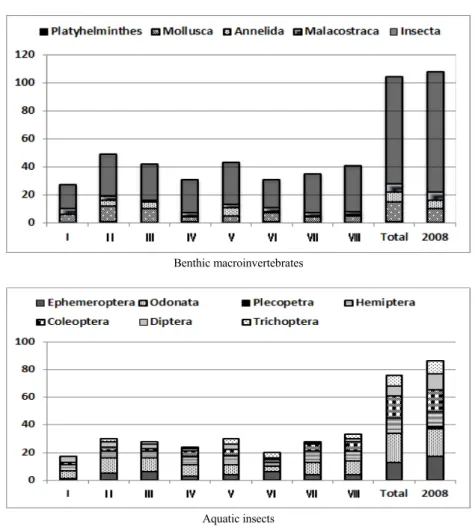
현지조사 결과, 동정된 저서성 대형무척추동물은 모 두 4문 8강 15목 54과 104종이었고 이 가운데 수서곤충 류가 6목 34과 76종으로 73.1%를 차지하였다(Table 1, Fig. 2). 이전의 조사(Kim, 2008)에서는 3문 5강 15목 49과 108종이었으며 수서곤충류는 86종(79.6%)이었다.
이번 조사와 비교하면 전체 종수와 종류는 비슷하였으나 곤충류와 연체동물에서 다소 종의 차이를 보였다.
지점별로는 낮은 보가 설치되어 있고 하폭이 넓은 지 점 에서 가장 많은 49종의 저서성대형무척추동물이 확 인되었는데 출현종의 47.1%에 이른다(Table 1, Fig. 3).
다음이 지점 , , 로 각각 44종, 43종, 41종이 출현 하였다. 형산강 합류부이며 수심이 깊은 지점 에서 가 장 적은 27종이 조사되었다. 그 밖의 지점들에서는 31종 (지점 와 )과 35(지점 )종을 기록하였다.
계절별로는 봄철인 5월 조사에서 대부분 지점들에서 가장 많은 종들이 출현하였고, 그 이후 조사들에서 종수 가 감소하는 경향을 보였다. 이러한 결과는 곤충류들의 우화 등 계절적인 영향도 있겠으나, 2017년 포항 지역의 8월과 10월은 5월보다 강수량이 상당히 많았던 것도 종 감소 원인 중의 하나로 생각할 수도 있을 것이다(Fig.
4)(Korea Meteorological Administration, 2018). 강수 량 증가에 의한 씻김효과는 하천생태계에 영향을 미치는 주요 교란요인으로 다른 지역의 조사에서도 보고되고 있 지만(Park et al., 2013; Lee et al., 2014), 생물종 구성 에 따라 결과가 달라질 가능성도 있으므로 수환경의 변 화와 군집변동의 상관관계에 대해서는 추후 면밀한 조사 가 필요할 것이다.
종수에서는 잠자리목(Odonata)이 21종으로 20.2%
를 차지하여 가장 많은 종이 출현한 분류군이었고(Table 2, Fig. 5), 딱정벌레목(Coleoptera) 16종(15.4%), 연체 동물문(Mollusca) 14종(13.5%)의 순으로 종수가 많았 으며 연갑강(Malacostraca)이 가장 적은 6종(5.8%)으로 조사되었다. 조사기간 모두 5,052개체가 채집되었는데, 곤충류가 2,756개체(54.6%), 비곤충류가 2,296개체 (45.4%)였다. 연체동물문에서 1,453개체(28.8%)가 확 인되어 가장 많이 출현하였다. 분류군별로는 곤충강의 잠자리목(1,059개체, 21.0%), 하루살이목(Ephemeroptera) (690개체, 13.7%)과 연갑강(675개체, 13.4%)의 순으로 많이 나타났다. 출현종수가 연체동물문과 비슷하였던 딱 정벌레목(16종, 15.4%)은 126개체(2.5%)로 1종이 조사 되었던 편형동물문(Platyhelminthes)(35개체, 0.7%)을 제외하고 가장 적게 출현하였다.
조사지점 및 계절별 우점종을 Table 3에 나타내었는 데, 지점과 계절별로 다양한 우점종이 나타나고 있었 다. 최종 결과에서 지점별로는 수심이 깊고 유속이 완 만한 지점 에서 논우렁이(Cipangopaludina chinensis malleata)가 우점종으로 조사되었으며, 물살이 빠르고 비교적 수질이 좋은 지점 와 에서는 작은갈고리하루 살이(Procloeon maritimum)가, 수초가 풍부한 지점 와 지점 및 지점 에서는 새뱅이(Cardina denticulata
10 10
김중락 Table 1. The number of species of benthic macroinvertebrates at Gigyecheon in the present study(2017) and Kim(2008) SiteIⅡⅢⅣⅤⅥⅦⅧTotalKim (2008)SeasonMAOTMAOTMAOTMAOTMAOTMAOTMAOTMAOTMAOT Platyhelminthes0000101100001001000010110000000010110 Mollusca45568691177510132335254556422433251214111410 Annelida0000203422350111412600111001010154576 Malacostraca4334132311111212222232232202222265466 Insecta1210817191493019111128111311241414133016672014101428141914335542367686 Total2018162731232449292120441419153123221943241316312114163519251841796557104108 Insecta Ephemeroptera0111511542261113123451362124221412551317 Odonata443667511935103568426741144249655101510122120 Plecoptera0000000000000000000000000000000000002 Hemiptera43443325152553464447121355584457101091110 Coleoptera1102211311121204130410121225072771161616 Diptera31042204201311020304100110110102542712 Trichoptera0000100220020101400442141001201362289 Total 1210817191493019111128111311241414133016672014101428141914335542367686 M: May, A: August, O: October, T: TotalBenthic macroinvertebrates
Aquatic insects
Fig. 2. Comparison of number of species of benthic macroinvertebrates at Gigyecheon in the present study(2017) and 2008.
Fig. 3. Comparison of number of species of benthic macroinvertebrates according to the season at Gigyecheon(2017).
1012
김중락Fig. 4. Monthly fluctuation of precipitation of Pohang city in 2017(Korea Meteorological Administration, 2018).
Fig. 5. Comparison of species and individuals composition(%) of benthic macroinvertebrates at Gigyecheon(2017).
Taxa Species Individuals
No. % No. %
Platyhelminthes 1 1.0 35 0.7
Mollusca 14 13.5 1,453 28.8
Annelida 7 6.7 133 2.6
Malacostraca 6 5.8 675 13.4
Ephemeroptera 13 12.5 690 13.7
Odonata 21 20.2 1,059 21.0
Hemiptera 11 10.6 553 10.9
Coleoptera 16 15.4 126 2.5
Diptera 7 6.7 138 2.7
Trichoptera 8 7.7 190 3.8
Total 104 100 5,052 100
Table 2. The number and composition(%) of species and individuals of benthic macroinvertebrates at Gigyecheon(2017)
denticulata)가 각각 우점하고 있었다. 보가 있는 지점 에서는 왕우렁이(Pomacea canaliculata)가 계절에 관계없이 우점종으로 나타났으며, 저수지(용전지)인 지점
에서는 왕잠자리(Anax parthenope julius)와 대칭이 (Anodonta arcaeformis)가 우점적으로 출현하고 있었
다. 계절별로는 전 지역에서 골고루 많이 채집된 물달팽 이(Lymnaea auricularia)가 봄철에 가장 많이 나타났고 (우점도지수 0.06), 여름철인 8월에는 Procloeon maritimum가(우점도지수 0.12), 가을철과 총 조사된 종 들 가운데서는 Cardina denticulata denticulata(우점도
Site Month Dominant species DI
Ⅰ
May Physa acuta 0.16
August Cipangopaludina chinensis malleata 0.14
October Cipangopaludina chinensis malleata 0.21
T Cipangopaludina chinensis malleata 0.14
Ⅱ
May Semisulcospira forticosta 0.11
August Crocothemis servilia 0.16
October Procloeon maritimum 0.15
T Procloeon maritimum 0.10
Ⅲ
May Procloeon maritimum 0.09
August Procloeon maritimum 0.23
October Caridina denticulata denticulata 0.14
T Procloeon maritimum 0.10
Ⅳ
May Caridina denticulata denticulata 0.16
August Procloeon maritimum 0.19
October Caridina denticulata denticulata 0.26
T Caridina denticulata denticulata 0.21
Ⅴ
May Asellus hilgendorfii 0.14
August Caridina denticulata denticulata 0.19
October Caridina denticulata denticulata 0.14
T Caridina denticulata denticulata 0.13
Ⅵ
May Pomacea canaliculata 0.14
August Pomacea canaliculata 0.22
October Pomacea canaliculata 0.23
T Pomacea canaliculata 0.18
Ⅶ
May Anodonta arcaeformis 0.15
August Anax parthenope julius 0.22
October Anodonta arcaeformis 0.24
T Anax parthenope julius 0.11
Ⅷ
May Caridina denticulata denticulata 0.16
August Pantala flavescens 0.19
October Asellus hilgendorfii 0.16
T Caridina denticulata denticulata 0.11
Total
May Lymnaea auricularia 0.06
August Procloeon maritimum 0.12
October Caridina denticulata denticulata 0.09
T Caridina denticulata denticulata 0.08
Table 3. Dominant species and dominance index(DI) at Gigyecheon(2017)
1014
김중락지수 0.08)가 우점종으로 나타났으나 이들의 우점도지수 가 낮아 지점 별로 다양한 우점종들이 출현하고 있음을 보여주었다.
3.2. 군집분석
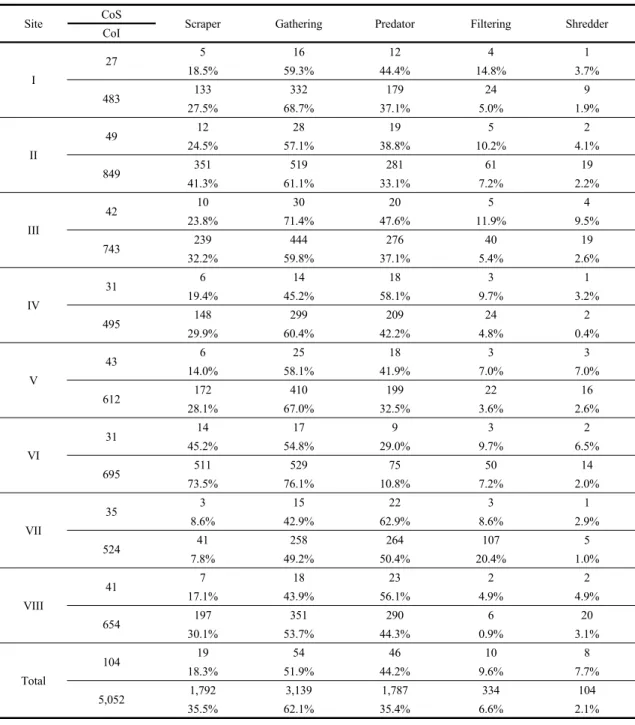
군집분석의 결과를 Table 4에 정리하였다. 종다양도 지수(H′)는 대체로 출현종수와 연관되어 나타났는데 출 현종수가 가장 많았던 지점 에서 가장 높은 4.974로, 두 번째로 적었던 지점 에서 가장 낮은 4.079로 출현종 수가 가장 적었던 지점 에서 그 다음으로 높은 4.330을 기록하였다. 계절별로도 출현종수가 많았던 봄철인 5월 에 그 지수가 다른 계절에 비하여 대체로 높게 나타났다. 균등도지수(J′)도 계절별로는 지점별로는 다양하게 나타 났지만 이와 유사한 경향을 보였는데 출현종수가 가장 적었던 지점 에서 가장 높게, 두 번째로 적었던 지점 에서 가장 낮게 나타났다. 종풍부도지수(RI)는 지점별 및 계절별 분석 결과에서 출현종수가 많은 계절과 지점 에서 대체로 높게 나타나서 종수가 가장 많았던 지점 에서 가장 높게, 가장 적었던 지점 에서 가장 낮게 기록 되었다. 우점도지수(DI)는 비교적 낮게 나타났는데, 지
점 별 분석에서는 지점 에서 0.321로 가장 높게 나타났 으며, 가장 많은 종수와 개체수를 보인 지점 에서 가장 낮은 0.172로 나타났다. 계절별로는 여름철인 8월 또는 가을철인 10월에 가장 높게, 봄철인 5월에 가장 낮게 나 타나는 경향을 보였다. 우점도지수는 종다양도가 낮을수 록 높게 나타는 것으로 알려져 있는데(Bae and Park, 1992; Park et al., 2001), 이번 조사에서도 같은 결과로 나타났다. 상술한 각 지수들의 결과는 이전의 조사(KIm, 2008)와 비슷한 패턴을 보여 대체로 건강한 다양성을 유 지하고 있는 것으로 보인다.
3.3. 기능군 분석
이번 조사에서 섭식기능군은 긁어먹는 무리(Scraper), 주워먹는 무리(Gathering collector), 잡아먹는 무리 (Predator), 걸러먹는 무리(Filtering collector), 썰어먹 는 무리(Shredder)의 5개 무리가 확인되었다(Table 5, Fig. 6). 전체적으로 종수에서는 주워먹는 무리가 가장 높게 나타났고 잡아먹는 무리가 그 다음이었으며, 긁어 먹는 무리, 걸러먹는 무리, 썰어먹는 무리의 순이었다. 개 체수로는 역시 주워먹는 무리가 가장 높은 비율로 나타
Index Season Site
I Ⅱ Ⅲ Ⅳ Ⅴ Ⅵ Ⅶ Ⅷ T
H′
May 4.098 4.624 4.558 3.545 4.193 4.175 3.990 3.751 5.547
August 3.950 3.983 3.744 3.666 3.934 3.325 3.200 3.813 4.991
October 3.707 4.141 3.840 3.330 4.003 3.468 3.427 3.826 5.676
Total 4.330 4.974 4.835 4.079 4.616 4.248 4.334 4.564 5.536
J′
May 0.948 0.933 0.938 0.931 0.927 0.910 0.908 0.883 0.891
August 0.947 0.880 0.852 0.863 0.882 0.899 0.840 0.821 0.829
October 0.927 0.903 0.888 0.852 0.911 0.867 0.857 0.901 0.973
Total 0.911 0.886 0.897 0.823 0.851 0.857 0.852 0.852 0.828
RI
May 3.675 5.168 4.841 2.829 3.946 3.782 3.730 3.209 9.738
August 3.416 4.164 3.831 3.366 4.169 2.299 2.730 4.668 8.867
October 2.967 4.025 3.486 2.679 3.793 2.908 2.853 3.382 7.563
Total 4.207 7.117 6.202 4.835 6.545 4.584 5.274 6.170 11.968
DI
May 0.239 0.178 0.169 0.303 0.258 0.193 0.221 0.315 0.123
August 0.262 0.289 0.378 0.371 0.318 0.384 0.444 0.357 0.207
October 0.318 0.294 0.322 0.430 0.236 0.391 0.349 0.278 0.177
Total 0.240 0.172 0.225 0.303 0.219 0.321 0.284 0.185 0.149
Table 4. Biotic indices of macroinvertebrates at Gigyecheon(2017)
났으며 긁어먹는 무리와 잡아먹는 무리가 비슷하게 출현 하였고 썰어먹는 무리는 가장 낮게 조사되었다. 하천생 태계에 서식하는 저서성 대형무척추동물의 섭식기능군
과 서식기능군의 분포 경향은 주어진 먹이자원과 서식처 의 환경요인을 반영하고 있다(Kil et al., 2010). 주워먹 는 무리는 일반적으로 담수생태계에서 출현종수와 개체
Site CoS
Scraper Gathering Predator Filtering Shredder
CoI
I
27 5 16 12 4 1
18.5% 59.3% 44.4% 14.8% 3.7%
483 133 332 179 24 9
27.5% 68.7% 37.1% 5.0% 1.9%
II
49 12 28 19 5 2
24.5% 57.1% 38.8% 10.2% 4.1%
849 351 519 281 61 19
41.3% 61.1% 33.1% 7.2% 2.2%
III
42 10 30 20 5 4
23.8% 71.4% 47.6% 11.9% 9.5%
743 239 444 276 40 19
32.2% 59.8% 37.1% 5.4% 2.6%
IV
31 6 14 18 3 1
19.4% 45.2% 58.1% 9.7% 3.2%
495 148 299 209 24 2
29.9% 60.4% 42.2% 4.8% 0.4%
V
43 6 25 18 3 3
14.0% 58.1% 41.9% 7.0% 7.0%
612 172 410 199 22 16
28.1% 67.0% 32.5% 3.6% 2.6%
VI
31 14 17 9 3 2
45.2% 54.8% 29.0% 9.7% 6.5%
695 511 529 75 50 14
73.5% 76.1% 10.8% 7.2% 2.0%
VII
35 3 15 22 3 1
8.6% 42.9% 62.9% 8.6% 2.9%
524 41 258 264 107 5
7.8% 49.2% 50.4% 20.4% 1.0%
VIII
41 7 18 23 2 2
17.1% 43.9% 56.1% 4.9% 4.9%
654 197 351 290 6 20
30.1% 53.7% 44.3% 0.9% 3.1%
Total
104 19 54 46 10 8
18.3% 51.9% 44.2% 9.6% 7.7%
5,052 1,792 3,139 1,787 334 104
35.5% 62.1% 35.4% 6.6% 2.1%
Table 5. The number and composition(%) of species(CoS) and individuals(CoI) of the functional feeding groups at Gigyecheon(2017)
1016
김중락밀도가 높으며, 특히 평지하천과 강에서 구성비가 높은 것으로 알려져 있어(Kwon, et al., 2015) 이번의 결과는 이러한 특성을 잘 표출한다고 할 수 있을 것이다. 잡아먹 는 무리는 잠자리와 노린재, 딱정벌레류와 관련이 있고 긁어먹는 무리는 주로 연체동물과 하루살이류와 관련이 있어 위의 결과는 이들 분류군의 분포상태를 대변한다고 볼 수 있다.
각 지점별 출현 비율은 대체로 유사한 순서로 나타났 으나 지점 , 및 에서는 잡아먹는 종의 비율이 동 일한 패턴을 보이는 개체수의 비율과 달리 가장 높게 나 타났다. 즉, 잡아먹는 무리인 잠자리류의 개체수가 많았 던 결과이며 이러한 경향성은 여타 지점에서도 보이고 있다. 지점 에서는 걸러먹는 무리의 비율이 다른 지점 에 비해 매우 높게 나타났는데, 이는 대칭이(Anodonta arcaeformis)의 높은 개체수에 의한 것으로 볼 수 있다.
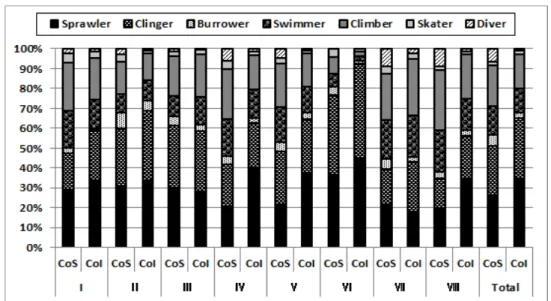
서식기능군은 기는 무리(Sprawler), 붙는 무리 (Clinger), 굴파는 무리(Burrower), 헤엄치는 무리 (Swimmer), 기어오르는 무리(Climber), 지치는 무리 (Skater), 잠수하는 무리(Diver)의 7개 무리가 확인되었 다(Table 6, Fig. 7). 전체적으로 기는 무리의 비율이 종 수와 개체수에서 모두 가장 높게 나타났으며, 붙는 무리, 기어오르는 무리, 헤엄치는 무리의 순으로 나타났고 종 수에서는 5번째로 높았던 잠수하는 무리는 개체수에서
는 가장 낮게 나타났다. 각 지점별 출현 비율은 대체로 유 사한 순서로 나타났으나 유속이 비교적 빠른 지점 에서 는 붙는 무리가 종수와 개체수에서 가장 높은 비율이었 고 근소한 차이로 기는 무리가 그 다음으로 출현하였는 데, 하루살이류의 비율이 높은 것이 그 이유로 생각된다.
지점 에서는 종수에서 붙는 무리의 비율이 가장 높았고 개체수에서는 기는 무리가 가장 높았던 반면, 지점 에 서는 이와 반대의 결과가 나타나서 지점 별 특성에 따른 다소간의 차이를 보였다. 지점 과 지점 에서는 기어오 르는 무리가 가장 높게 나타났으며 이들 지점에서는 특 히 잠수하는 무리의 종 비율이 여타 지점들보다 높았는 데, 이는 딱정벌레류의 종수가 많음에 따른 것으로 보인 다. Yoon et al.(1992b)에 의하면 유속이 빠르고 하상이 호박돌 이상의 입도를 보이게 되면 붙는 무리가, 유속이 느리면 바닥이나 수초 표면을 기어 다니는 기는 무리와 기어오르는 무리가 증가하게 된다고 하였는데, 위의 결 과는 기계천의 이러한 하상 상태를 잘 반영하고 있다 하 겠다.
3.4. 생물학적 수질평가
생태점수(ESB)의 결과를 살펴보면(Table 7), 대체로 봄철인 5월의 점수가 다른 계절에 비하여 높게 나타났고 지점별로는 계절에 따라 다소 변동을 보였다. 오수생물 Fig. 6. Composition of species(CoS) and individuals(CoI) of the functional feeding groups at Gigyecheon(2017).
계열(Saprobity)에서 5월에 지점 , , 및 의 4개 지점들에서 빈부수성(oligosaprobic)을 나머지에서는 β -중부수성(β-saprobic)을 나타낸 반면, 여름철인 8월과
가을철인 10월 조사에서는 빈부수성을 보인 8월의 지점 을 제외한 전 지점에서 β-중부수성을 나타내었다. 전 체 평균적으로는 빈부수성을 나타내었다. 환경상태
Site CoS
Sprawler Clinger Burrower Swimmer Climber Skater Diver
CoI
I
27 12 8 1 8 10 2 1
44.4% 29.6% 3.7% 29.6% 37.0% 7.4% 3.7%
483 253 194 8 109 161 24 10
52.4% 40.2% 1.7% 22.6% 33.3% 5.0% 2.1%
II
49 23 22 6 7 12 3 2
46.9% 44.9% 12.2% 14.3% 24.5% 6.1% 4.1%
849 449 462 68 139 181 16 12
52.9% 54.4% 8.0% 16.4% 21.3% 1.9% 1.4%
III
42 24 25 4 8 16 2 1
57.1% 59.5% 9.5% 19.0% 38.1% 4.8% 2.4%
743 327 365 37 164 254 26 6
44.0% 49.1% 5.0% 22.1% 34.2% 3.5% 0.8%
IV ,
31 10 10 2 9 12 2 3
32.3% 32.3% 6.5% 29.0% 38.7% 6.5% 9.7%
495 289 164 18 104 125 15 9
58.4% 33.1% 3.6% 21.0% 25.3% 3.0% 1.8%
V
43 15 18 3 12 15 2 3
34.9% 41.9% 7.0% 27.9% 34.9% 4.7% 7.0%
612 331 248 27 116 152 11 8
54.1% 40.5% 4.4% 19.0% 24.8% 1.8% 1.3%
VI
31 17 19 2 3 4 2 0
54.8% 61.3% 6.5% 9.7% 12.9% 6.5% 0.0%
695 543 567 17 31 28 15 0
78.1% 81.6% 2.4% 4.5% 4.0% 2.2% 0.0%
VII
35 12 10 3 11 13 2 5
34.3% 28.6% 8.6% 31.4% 37.1% 5.7% 14.3%
524 137 197 18 160 216 22 19
26.1% 37.6% 3.4% 30.5% 41.2% 4.2% 3.6%
VIII
41 13 10 2 14 20 1 6
31.7% 24.4% 4.9% 34.1% 48.8% 2.4% 14.6%
654 331 213 25 152 215 13 16
50.6% 32.6% 3.8% 23.2% 32.9% 2.0% 2.4%
Total
104 43 41 9 24 33 3 11
41.3% 39.4% 8.7% 23.1% 31.7% 2.9% 10.6%
5,052 2,674 2,412 218 972 1,337 134 77
52.9% 47.7% 4.3% 19.2% 26.5% 2.7% 1.5%
Table 6. The number and composition(%) of species(CoS) and individuals(CoI) of the habitat orientation groups at Gigyecheon(2017)
1018
김중락(Environmental condition)와 지역구분(Area determination) 은 지점 및 계절에 따라 다소 변동을 보였으며, 여름철인 8월 조사에서 상태가 다소 저하되는 경향을 나타내었다.
전체 평균적으로는 봄철에 각각 다소 양호(some defectiveness)와 보호수역(protection waters)으로, 여 름과 가을철에 다소 불량(some defectiveness)과 개선수 역(improvement waters)으로 나타났는데 출현종수의
감소와 관련이 있어 보인다. 수질(WQ)은 5월에만 지점 , 및 에서 등급이었으며, 나머지 결과들에서는 모두 등급을 나타내었고 평균적으로 2급수의 수질을 유지하고 있었다.
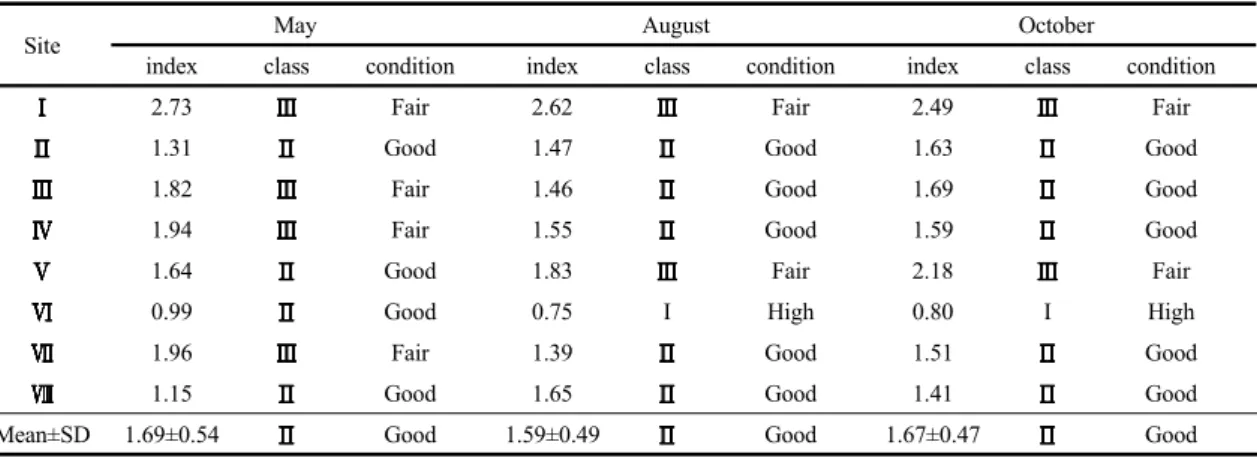
한국오수생물지수(KSI) 산정의 결과는 Table 8에 정 리하였는데, 계절별 및 지점별로 다소 변동이 있었으나 수질은 역시 평균 2급수의 하천의 상태를 나타내었다.
Site
May August October
Index Saprobity Environ -mental condition
Area determin
-ation WQ Index Saprobity Environ -mental condition
Area determin
-ation WQ Index Saprobity Environ -mental condition
Area determin
-ation WQ
Ⅰ 42 β-mss ssat pw Ⅱ 34 β-mess sdef iw Ⅱ 32 β-mess sdef iw Ⅱ
Ⅱ 72 olig sat ppw I 46 β-mess ssat pw Ⅱ 50 β-mess ssat pw Ⅱ
Ⅲ 62 olig sat ppw I 41 β-mess ssat pw Ⅱ 37 β-mess sdef iw Ⅱ
Ⅳ 27 β-mss sdef iw Ⅱ 34 β-mess sdef iw Ⅱ 28 β-mess sdef iw Ⅱ
Ⅴ 51 olig ssat pw Ⅱ 40 β-mess sdef iw Ⅱ 41 β-mess ssat pw Ⅱ
Ⅵ 64 olig sat ppw I 32 β-mess sdef iw Ⅱ 45 β-mess ssat pw Ⅱ
Ⅶ 39 β-mss sdef iw Ⅱ 32 β-mess sdef iw Ⅱ 33 β-mess sdef iw Ⅱ
Ⅷ 46 β-mss ssat pw Ⅱ 52 olig ssat pw Ⅱ 40 β-mess sdef iw Ⅱ
Mean±SD 50.38
±13.94 olig ssat pw Ⅱ 38.88±6.81 β-mess sdef iw Ⅱ 38.25±6.78 β-mess sdef iw Ⅱ olig; oligosaprobic, β-mess: β-mesosaprobic, sat: satisfactory, ssat; some satisfactory, sdef; some defectiveness, ppw; priority protection waters, pw; protection waters, iw; improvement waters, WQ: Water Quality
Table 7. Saprobic quality and environmental quality according to ESB at Gigyecheon(2017)
Fig. 7. Composition of species(CoS) and individuals(CoI) of the habitat orientation groups at Gigyecheon(2017).
4. 결 론
현지 조사 결과, 기계천에서 채집되어 동정된 저서성 대형무척추동물은 모두 4문 8강 15목 54과 104종이었 으며 이 가운데 수서 곤충류가 6목 34과 76종이었다. 분 류군별 종수에서는 잠자리목이 21종(20.2%)으로 가장 많았고 총 개체수에서는 연체동물문이 1,453개체 (28.8%)로 가장 많이 확인된 분류군이었다. 지점별로는 지점 에서 가장 많은 49종이, 지점 에서 가장 적은 27 종이 조사되었다. 계절별로는 봄철인 5월 조사에서 대부 분 지점들에서 가장 많은 종들이 출현하였다. 지점별 특 성에 따라 다양한 우점종이 출현하였으며 전체적으로는 새뱅이가 우점종으로 나타났다. 계절별로는 전 지역에서 골고루 채집이 된 물달팽이가 5월에 가장 많이 조사되었 으며, 8월에는 작은갈고리하루살이가, 10월과 총 조사된 종들 가운데서는 새뱅이가 우점종으로 나타났다. 각 조 사지점별 군집구조에서 종다양도지수(H )는 출현종수 가 가장 높았던 지점 에서 가장 높게 나타났고 계절별 로는 출현종수가 많았던 5월에 대체로 높게 나타났다. 균 등도지수(J )도 계절별로는 대체로 유사한 경향을 보였 지만 지점별로는 지점 에서 가장 높게, 두 번째로 적었 던 지점 에서 가장 낮게 나타났다. 종풍부도지수(RI)는 지점별 및 계절별 분석 결과에서 출현종수가 많은 계절 과 지점에서 대체로 높게 나타나서 종수가 가장 많았던 지점 에서 가장 높게, 가장 적었던 지점 에서 가장 낮 게 기록되었다. 우점도지수(DI)는 비교적 낮게 나타났으 며 지점 별 분석에서는 지점 에서 가장 높게 나타났고
계절별로는 여름철인 8월 또는 가을철인 10월에 가장 높 게, 봄철인 5월에 가장 낮게 나타나는 경향을 보였다. 기 능군은 지점과 계절에 따라 다소 차이가 있었는데, 섭식 기능군은 전체적인 결과에서 종수와 개체수에서 주워먹 는 무리가 가장 높게 나타났으며 서식기능군은 전체적으 로 기는 무리의 비율이 종수와 개체수에서 모두 가장 높 게 나타났다. 생태점수(ESB)는 대체로 5월의 점수가 다 른 계절에 비하여 높게 나타났고 지점별로는 계절에 따 라 다소 변동을 보였으나 평균적으로 2급수의 수질을 유 지하고 있음을 보여주었다. 한국오수생물지수(KSI)도 계절별 및 지점별로 다소 변동이 있었으나 수질은 역시 평균 2급수로 나타났다.
이번 연구에서 저서성 대형무척추동물을 대상으로 기 계천의 수생태계 현황과 군집구조의 분석 및 생물학적 수질평가를 수행하였는데 결과는 추후 지역의 다양한 하 천들에 대한 연구와 기계천의 생태계와 수질을 지속적으 로 관리하는 방안 도출을 위한 연구의 기초자료로 활용 될 수 있을 것으로 기대한다.
감사의 글
이 연구결과물은 2017학년도 위덕대학교 학술진흥연 구비 지원에 의하여 이루어졌음.
REFERENCES
Bae, K. S., Park, S. S., 1992, Benthic invertebrate community and relation with environmental factors at
Site May August October
index class condition index class condition index class condition
2.73 Fair 2.62 Fair 2.49 Fair
1.31 Good 1.47 Good 1.63 Good
1.82 Fair 1.46 Good 1.69 Good
1.94 Fair 1.55 Good 1.59 Good
1.64 Good 1.83 Fair 2.18 Fair
0.99 Good 0.75 I High 0.80 I High
1.96 Fair 1.39 Good 1.51 Good
1.15 Good 1.65 Good 1.41 Good
Mean±SD 1.69±0.54 Good 1.59±0.49 Good 1.67±0.47 Good
Table 8. Saprobic water quality using KSI(5 classes) at Gigyecheon(2017)
1020
김중락the ecosystem of tributary streams in Han River, Korean J. Limnol., 25(1), 41-57.
Bae, Y. J., 2010, Insect Fauna of Korea. 6(1), Arthropoda:
Insecta: Ephemeroptera, NIBR, pp. 141.
Bang, G. J., Kim, H. G., Yoon, C. S., Cheong, S. W., 2016.
Distribution characteristics of functional feeding groups of benthic macroinvertebrates and biological evaluation of water quality in Jirisan National Park, J.
Environ. Sci., 25(5), 655-671.
Jung, K. S., 2011, Odonata larvae of Korea, Nature &
Ecology, Korea, 399.
Kil, H. K., Kim, D. G., Jung, S. W., Jin, Y. H., Hwang, J.
M., Bae, K. S., Bae, Y. J., 2010, Impacts of impoundments by low-head and large dams on benthic macroinvertebrate communities in Korean streams and rivers, Korean J. Limnol., 43(2), 190-198.
Kim, J. L., 2008, Community structure of benthic macroinvertebrates from Gigye stream, J. Environ.
Sci., 17(8), 879-889.
Korea Meteorological Administration, 2018, https://data.
kma.go.kr/climate/RankState/selectRankStatisticsDiv isionList.do?pgmNo=179.
Kong, D. S., 1997, Benthic macroinvertebrates in Hongseong and Yesan county, Ministry of Environment, Natural Environment in Yesan, Seosan and Hongseong, 155-204.
Kwon, O. K., Min, D. K., Lee, J. R., Lee, J. S., Je, J. G., Choe, B. L., 2001, Korean Mollusks with Color Illustration, Shell House, Hangeul, Busan, 332.
Kwon, S. J., Jun, Y. C., Park, J. H., 2015, Benthic Macroinvertebrates, Nature & Ecology, Korea. 791.
Lee, J. W., Choi, J. k., Oh, S. H., Choi, G. W., 2010, A Study on the benthic macroinvertebrates and biological water quality evaluation in nature sabbatical area of Unmunsan, Korean J. Environ. Eco., 24(1), 1-13.
Lee, J. Y., Lee, K., Y., Han, S. J., Lee, S. J., Jung, Y. K., Cheon, J. Y., Choi, J. S., Kim, J. C., 2014, Spatial and temporal variation of macroinvertebrates according to physical factors in Gongji stream area, Korean J.
Environ. Eco., 28(1), 24-32.
Margalef, R., 1958, Information theory in ecology, General Systems, 3, 36-71.
McNaughton, S. J., 1967, Relationship among functional properties of California grassland, Nature, 216,
168-169.
Moon, T. Y., An, M. S., Kim, H. G., Yoon, C. S., Cheong, S. W., 2018, Distribution of functional feeding and habitat trait groups of benthic macroinvertebrates and biological evaluation of water quality in Gayasan National Park, J. Environ. Sci., 27(6), 383-399.
Park, J. W., Hwang, M. K., Aw, S. J., Choi, S. S., Chung, P.
R., 2001, Biological evaluation of water quality and community structure of benthic macroinvertebrates in the Pyungchang River water system, Gangwon-do, Korea. Korean J. Environ. Biol., 19(2), 119-128.
Park, Y. J., Jeon, Y. L., Kim, K. D., Yoon, H. N., Nam, S.
H., 2013, Community analysis and biological water quality evaluation of benthic macroinvertebrate in Wangpi-cheon watershed. Korean J. Environ. Eco., 27(3), 327-343.
Pielou, E. C., 1975, Ecological diversity, Wiley, New York, 165.
Resh, V. H., Rosenberg, D. M., 1984, The ecology of aquatic insects, Holt Saunders Ltd., Praeger Publishers, New York, 508-557.
Ro, T. H., Chun, D. J., 2004, Functional feeding group categorization of Korean immature aquatic insects and community stability analysis, Korean J. Limnol, 37(2), 137-148.
Rosenberg, D. D., Resh, V. H., 1993, Freshwater biomonitoring and benthic macroinvertebrates, Chapman and Hall, New York, 488.
Shannon, C. E., Weaver, W., 1949, The mathematical theory of communication, University of Illinois Press, Urbana, 117.
Ward, J. V., 1991, Aquatic Insect Ecology, Part. 1, Biology and Habitat, John Wiley & Sons, New York, 456.
Won, D. H., Jun, Y. C., Kwon, S. J., Hwang, S. J., Ahn, K.
G., Lee, J. K., 2006, Development of Korean saprobic index using benthic macroinvertebrates and its application to biological stream environment assessment, J. Korean Soc. Water Qual., 22(5), 768-783.
Won, D. H., Kwon, S. J., Jun, Y. C., 2005, Aquatic Insects of Korea, Korea Ecosystem Service Press, Seoul, 415.
Yoon, I. B., 1995, Aquatic Insects of Korea, Junghaengsa, Korea, 262.
Yoon, I. B., Kong, D. S., Ryu, J, K., 1992a, Studies on the
biological evaluation of water quality by benthic macroinvertebrates( )-Saprobic valency and indicative value, Korean J. Environ. Biol., 10(1), 24-39.
Yoon, I. B., Kong, D. S., Ryu, J, K., 1992b, Studies on the
biological evaluation of water quality by benthic macroinvertebrates( )-Effect of environmental factors to community, Korean J. Environ. Biol., 10(1), 40-55.