• 검색 결과가 없습니다.

The Effect of Intellectual Capital and Financial Services Knowledge on Financial Inclusion

N/A
N/A
Protected

Academic year: 2021

Share "The Effect of Intellectual Capital and Financial Services Knowledge on Financial Inclusion"

Copied!
9
0
0

로드 중.... (전체 텍스트 보기)

전체 글

(1)

Print ISSN: 2288-4637 / Online ISSN 2288-4645 doi:10.13106/jafeb.2021.vol8.no1.247

The Effect of Intellectual Capital and Financial Services Knowledge on Financial Inclusion

Mar’a Elthaf ILAHIYAH

1

, Noorlailie SOEWARNO

2

, I Made Laut Mertha JAYA

3

Received: September 30, 2020 Revised: November 22, 2020 Accepted: December 05, 2020

Abstract

The study aims to determine the influence of intellectual capital and education on public financial services in increasing financial inclusion.

This study applied a survey technique by selecting respondents according to the purposive sampling method. The number of respondents in this study was 500 people and came from various regions in Indonesia. Data analysis was performed using Structural Equation Modeling (SEM) techniques. The results indicate that intellectual capital has a positive effect on financial inclusion. Conversely, education about public financial services has no influence in increasing financial inclusion. The results of this study indicate that the success of financial inclusion programs in Indonesia is caused more by the role of public intellectual capital. Studies show that the public does not have the courage to be involved in banking institutions because the image of this institution tends to be inflexible in its operations. The results of this study are expected to make a real contribution, especially for the government and banks, that in order to achieve the success of the financial inclusion program in Indonesia; the related parties should educate the public directly to citizens who have not been reached by banking services continuously and with a more down to earth approach.

Keywords: Intellectual Capital, Public Financial Service Education, Financial Succession, Unbanked Citizens, Indonesia JEL Classification Code: G28, I22, I25, P46

world, one of which is in Indonesia (Jaya, 2019). Unbanked people are citizens who do not have bank accounts, so they do not have access to any financial services. Previous studies have proven that the financial inclusion program has a significant impact on economic growth, poverty alleviation, income inequality, and financial stability (Cavoli, Gopalan, & Rajan, 2020; Omar & Inaba, 2020; Pham & Doan, 2020; Ratnawati, 2020). Even though research proves the importance of financial inclusion for the economic progress of a country, the facts show that many small business actors experience difficulties in gaining access to formal and non-formal financial services (Bongomin et al., 2017; Brixiová et al., 2020). In Indonesia, the role of the small- and medium-sized enterprise sector has been proven to influence the country’s economy. However, data from Bank Indonesia shows that the share of the credit market for small businesses related to finance access is still low, at less than 20%. This is because many small business actors are classified as unbanked.

Data from the World Bank in 2017 shows that only around 36% or around 90 million Indonesian adults have bank accounts. This percentage is still relatively small when compared to neighboring countries, such as Malaysia with 81%, China 79%, India 53%. This low percentage is due to the presence of asymmetric information which causes financial

1

First Author. [1] PhD Student, Department of Accounting, Faculty of Economics and Business, Universitas Airlangga, Indonesia. Email:

[email protected] [2] Lecturer, Department of Accounting, Sekolah Tinggi Ilmu Ekonomi Indonesia, Indonesia.

Email: [email protected]

2

Corresponding Author. Lecturer, Department of Accounting, Faculty of Economics and Business, Universitas Airlangga, Indonesia [Postal Address: Jalan Airlangga, Surabaya, East Java, 60286, Indonesia] Email: [email protected]

3

[1] PhD Student, Department of Accounting, Faculty of Economics and Business, University Airlangga, Indonesia. Email: i.made.laut.

[email protected] [2] Lecturer, Department of Accounting, Majoring Accounting, Sekolah Tinggi Ilmu Ekonomi Bisnis dan Perbankan, Yogyakarta, Indonesia. Email: [email protected]

© Copyright: The Author(s)

This is an Open Access article distributed under the terms of the Creative Commons Attribution Non-Commercial License (https://creativecommons.org/licenses/by-nc/4.0/) which permits unrestricted non-commercial use, distribution, and reproduction in any medium, provided the original work is properly cited.
1. Introduction

The financial inclusion movement began to be activated

around the world since the onset of the economic crisis in the

early 2000s until today. The aim of this financial inclusion

movement is to reduce the number of people who are not

reached by banking services, known as unbanked, around the

(2)

institutions to be too selective in choosing customers.

Take an example, the perception of banking institutions towards low-income housewives so that they do not have access to financial services. In practice, it is precisely this housewife who is creative in helping her household finances by doing small business activities. In addition, bureaucratic administration processes are too complicated, high formality and complex problems, as well as the view that grassroots communities are not considered profitable.

The aim of this research is to determine the effect of intellectual capital and the socialization of public financial services education in increasing financial inclusion. The role of banking has been recognized in helping stabilize a country’s economy (Banna, Ahmad, & Koh, 2017; Nair &

Anand, 2020; Uzoma, Adetiloye, Esther, Eke, & Osuma, 2020). The fact that financial inclusion plays an important role in increasing the progress of the country’s economy, but not accompanied by community involvement in this program motivates this study to look at the condition of intellectual capital and education about banking services in Indonesian society, specifically the unbanked.

One of the main reasons for the existence of unbanked people is the low level of education. This affects their knowledge (knowledge modal) regarding to the role of banking institutions. The level of education is very important to be able to reduce the percentage rate of the number of unbanked people.

Previous studies found that the role of financial education is very significant in the success of financial management practices (Bakar & Bakar, 2020; Despard, Friedline, & Martin- West, 2020). People who are educated and have financial knowledge are proven to be able to succeed financial inclusion programs (Jaya, 2019). Therefore, it is proved that knowledge or education as part of intellectual capital is very important for the success of financial inclusion programs in Indonesia.

Intellectual capital is considered as knowledge that has potential value if that knowledge is of benefit to anyone.

Therefore, intellectual capital can be said as knowledge, but only certain knowledge (Stewart, 1998). Knowledge can be created based on individual initiative or interactions that occur in an organizational group which will later crystallize through a process of dialogue, discussion, sharing of experiences, and observation in detail (Pham & Doan, 2020). Experience is one of the elements of the emergence of intellectual capital. However, experience is more personal, so it is very difficult to formulate and communicate. This is why the experience element is included in the category of tacit knowledge in the concept of intellectual capital.

Education on financial services to the public has proven to need support from other parties, for example through financial literacy (Bakar & Bakar, 2020; Jaya, 2019; Morgan

& Long, 2020; V. T. Nguyen & Doan, 2020; Panos & Wilson, 2020). The government must reactivate cooperation in terms of financial literacy education for people who are classified as unbanked in Indonesia. This education is a conception of public financial services education that is created and

specifically for people classified as unbanked in Indonesia.

The expectation of this activity is for the public to know the various benefits, risks and costs arising from financial services and the means of payment they use. Education on public financial services is a strategy to be able to increase a person’s intellectual capabilities regarding financial management so that the financial inclusion program can be implemented successfully. In the 2018 National Strategy for Financial Inclusion by Bank Indonesia, it is stated that this educational activity can be started by increasing public knowledge and awareness regarding financial products and services. This includes knowledge of various types of financial products and services; knowledge of the risks associated with financial products; knowledge of protection for customers; and skills to be able to manage household finances. Therefore, the role of intellectual capital in simplifying modified financial knowledge through a clear transformation will be of value and benefit to many parties (the public) and be able to overcome current financial inclusion problems.

Some previous literature proves that the variable public financial service education has an effect on financial inclusion (Bakar & Bakar, 2020; Jaya, 2019; Morgan & Long, 2020;

V. T. Nguyen & Doan, 2020; Panos & Wilson, 2020). The more governments and higher education institutions provide financial education guidance for unbanked people, the higher the resulting increase in financial inclusion. The educational factor is also closely related to someone’s knowledge or intellectuality. Therefore, it is necessary to conduct research to prove the intellectual capital aspects which are thought to be more related to the succession of financial inclusion.

The current research was conducted using a questionnaire survey method adapted from previous research (Jaya, 2019).

The respondents targeted are rural communities and urban migrants in various regions in Indonesia. The analysis technique used is structural equation modeling (SEM).

The results of this study indicate that intellectual capital has proven to have a positive and significant impact in increasing financial inclusion programs in Indonesia. On the other hand, public financial service education has proved to have no significant impact on the success of financial inclusion in Indonesia. The results of this study provide a new conception that intellectual capital is not only related to the performance of a company or entity. This study also shows that intellectual capital is very important in helping the success of government programs, especially financial inclusion. This study points out that the concept of intellectual capital is not only limited to the scope of financial accounting, but also relates to economic studies in general, such as financial inclusion.

2. Literature Review 2.1. Intellectual Concepts

In general, intellectual or intelligence is a person’s mental

ability that is related to the rational thinking process. This

(3)

makes it very difficult for intellectuals or intelligences to be observed directly, so it requires various concrete actions from a manifestation of this rational thinking process.

Intellectual capital is a knowledge, intellectual property, and experiential learning that is very useful and beneficial for the future (García-Meca, Parra, Larrán, & Martínez, 2005). The intellectual concept based on the Resource Based View (RBV) states that knowledge consists of several crucial forms and comes from a resource (Ramon-Jeronimo, Florez-Lopez, & Araujo-Pinzon, 2019). Meanwhile, from the perspective of Knowledge Based View, it is assumed that knowledge is a very significant strategic resource for a particular organization (Curado & Bontis, 2006).

However, philosophically, intellectual is an ability possessed by individuals from birth, so that the intellectual will experience development based on his environment and move by itself to all changes in his situation and condition.

This person’s ability can be seen when he is doing some activities. The actions or activities carried out can show that the individual is good at a certain field and is not, so that the intellectual development of this individual will adjust to the situation and conditions that exist in his enviro

nment. For the ability to understand a certain concept, an individual needs a process such as learning or training for a certain period of time. This proves that an individual can receive learning when they practice and evaluate in an organized manner. Thus, this intellectual concept with financial inclusion assumes that when the government or educational institutions collaborate to conduct training or coaching for part of the community who are classified as unbanked, they will begin to understand financial services until finally they are separated from the unbanked group. Of course, these results can have an impact on the succession of government financial inclusion programs for a better future.

2.2. Educational Theory

Education is a universal aspect that always exists in every human life. Development and culture develop because of education. In addition, life will also become static without progress; it may even decline and become extinct. Therefore, it is an indisputable fact that education is something that is necessary in every human life. Education is the formation of a civilization, and without civilization humans will become extinct. In general, education has been around since humans were on this earth. Education will also experience changes and a continuous process, not stopping even until the human dies. With the development of human civilization, the development of education is more complex.

Community-based education is a model of education in which everything related to it involves the role of the community. This is known as educational democracy (Suharto, 2005). The community has great authority and responsibility in providing education. The community-based education model is an offer to the state-based education mainstream.

The practice of community-based education has been around for a long time since Indonesian independence even before independence. Although conceptually the community-based education model was not formulated in a standard way at that time. Community-based education is basically developed and implemented from the community, by the community and for the benefit of the community. Through community-based educational institutions, the community strives to improve their lives continuously through empowerment by means of education and training. From here then develop models or forms of community-based education. Based on the concept of public education, we assume that to facilitate the succession of financial inclusion programs, the government and higher education institutions can continuously provide guidance and monitoring for the unbanked group. The goal is, of course, to provide simple financial education to them, and to develop it completely from the unbanked group. Thus, community-based education is a mechanism that provides opportunities for everyone in society to enrich science and technology through learning (Zubaedi, 2017). Community- based education is also a form of democratization of education through the expansion of education services for the benefit.

2.3. Inclusive Financial Concept

The concept of financial inclusion means efforts to involve people who do not have access to formal financial services in order to have access to these services (Adil & Jalil, 2020).

Financial Inclusion is a situation where the majority of individuals can take advantage of available financial services and minimize the presence of groups of individuals who are not yet aware of the benefits of financial access through available access at affordable costs. Financial inclusion is an important factor in promoting sustainable economic growth. The low level of financial inclusion indicates that public participation in formal financial services is still low. An increase in the level of financial inclusion is expected to increase financial efficiency through improvements in formal financial services, which in turn will have an impact on the increasing of economic growth. Financial inclusion has become a topic of interest in global development, and is widely regarded as a policy tool that promotes economic growth and stability while reducing poverty (Adil & Jalil, 2020; Li, 2018; Thomas & Subhashree, 2020). People who have knowledge through indicators of intellectual capital and are educated through indicators of the concept of education or education will have a very good impact on the succession of financial inclusion. Of course, the assumptions used have been based on several logical and theoretical understandings applied in this study.

2.4. Intellectual Capital, Education Enables Public

Financial Education and Financial Inclusion

Many studies related to intellectual capital have

been conducted on the scope of financial institutions,

(4)

especially in certain entities (Caplan, Sherraden, & Bae, 2018; Nguyen & Doan, 2020; Ousama, Hammami, &

Abdulkarim, 2019; Pirogova, Voronova, Khnykina, &

Plotnikov, 2020; Soewarno & Tjahjadi, 2020). However, not many have done it to start new assumptions about intellectual towards financial inclusion. Many researchers still do not have the courage to make an assumption based on philosophical logic that intellectual capital actually plays a role in handling other economic events such as financial inclusion. Therefore, this concept then turns into a knowledge-based economic era. In general, there are many assumptions that intellectual capital appears in financial statements only, but we assume philosophically that intellectual capital is more general. Therefore, intellectual capital is the most important capital recently (Chen & Zhu, 2004).

The main targets of financial inclusion programs in Indonesia are mobile workers and people who live in remote areas. The financial inclusion strategy in Indonesia consists of 6 (six) pillars, namely financial education;

public financial facility; guarantee of public welfare;

mapping on financial information; supporting regulation and policy; intermediary and distribution facility; and customer protection. The low level of financial inclusion in Indonesia is also caused by other obstacles. These obstacles are caused by a lack of knowledge about financial literacy from the public and the function of financial institutions and the mismatch of products offered by financial institutions with the needs of low-income people. This is also supported by a survey conducted by the Indonesian financial services authority in 2013 which states that the level of financial literacy of the Indonesian population is divided into 4 (four) parts, namely well literate (21.84%), sufficient literate (75.69%), less literate (2.06%), and not literate (0.41%).

The results of previous studies have found that the level of a person’s financial knowledge affects their accessibility to formal financial services (Grohmann, Klühs, & Menkhoff, 2018; Hussain, Salia, & Karim, 2018; Nitani, Riding, &

Orser, 2020; Pomeroy, Arango, Lomboy, & Box, 2020;

Thoene & Turriago-Hoyos, 2017; Xu, Shi, Rong, & Yuan, 2020). A person’s knowledge of financial literacy is very important and continues throughout the stages of human life and includes not only the individual, but also the family level (Hauff, Carlander, Gärling, & Nicolini, 2020; Kim, Gutter,

& Spangler, 2017). Based on literature review and previous research, the hypotheses used in the current research are as follows.

H1: Intellectual capital has a positive effect on the success of financial inclusion

H2: Public financial services education has a positive effect on the success of financial inclusion

3. Research Methods and Materials

The independent variables in this study are intellectual capital and education on public financial services. The dependent variable in this study is financial inclusion. This study was conducted using a questionnaire adapted from previous research (Jaya, 2019).

The answers to the statements given to the respondents were compiled by forming a 5-point Likert scale, namely, answers strongly agree, agree, neutral, disagree and strongly disagree.

The question indicator of the intellectual capital variable consists of eight statements, including 1) curiosity and motivation, 2) experience, 3) innovation and creativity, and 4) ability/

competence. Indicators of public financial services education consist of eight statements, including 1) knowledge of financial planning, 2) knowledge of financial management, 3) basic knowledge of investing, and 4) knowledge of money and assets.

For the dependent variable, financial inclusion, using indicators 1) financial knowledge, 2) financial behavior, 3) financial attitudes, and 4) future planning; with a total of five items.

The stages of data analysis used in this study include testing the validity, reliability, descriptive statistical tests, and SEM (Structural Equation Modeling) analysis tests. The analytical tool applied in this study used a data processing program, namely, Lisrel 8.0, while the reliability test was carried out using the SPSS analysis tool. The research model employed in this study is as follows.

FI = α + β

1

IC + β

1

PF + ε (1) Notes:

FI: Financial Inclusion IC: Intellectual Capital

PF: Public Financial Service Education

The number of respondents in this study was 500 people, and was determined by certain criteria (purposive sampling).

These criteria include residents who live in rural areas or migrants in cities, do not have bank accounts, maximum high school education, minimum age 18 years and married.

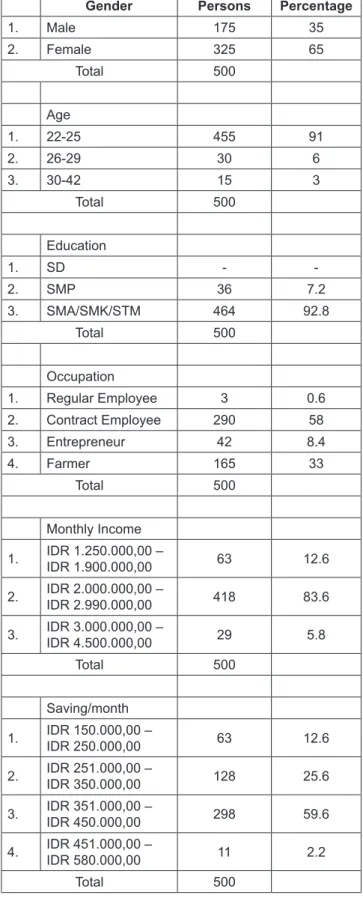
The characteristics of the respondents involved in this study are shown in Table 1 below. Based on Table 1, it can be seen that the number of male respondents is 175 people, less than the number of female respondents, which is 325 people. Respondents were also divided into three age groups ranging in age from 22 years to 42 years. The background of the respondents who were recorded was divided into two categories, namely, SMP and SMA / SMK / STM graduates.

Respondents’ occupations also varied, ranging from farmers, entrepreneurs, contract employees, and permanent employees.

Respondents’ monthly income varied from IDR1,250,000 -

IDR4,500,000. Respondents’ consumption power is high as a

result of high food prices, so the ability of respondents to save

for a month is IDR150,000 - IDR580,000.

(5)

Table 1: The Characteristic of the Respondents

Gender Persons Percentage

1. Male 175 35

2. Female 325 65

Total 500

Age

1. 22-25 455 91

2. 26-29 30 6

3. 30-42 15 3

Total 500

Education

1. SD - -

2. SMP 36 7.2

3. SMA/SMK/STM 464 92.8

Total 500

Occupation

1. Regular Employee 3 0.6

2. Contract Employee 290 58

3. Entrepreneur 42 8.4

4. Farmer 165 33

Total 500

Monthly Income 1. IDR 1.250.000,00 –

IDR 1.900.000,00 63 12.6

2. IDR 2.000.000,00 –

IDR 2.990.000,00 418 83.6

3. IDR 3.000.000,00 –

IDR 4.500.000,00 29 5.8

Total 500

Saving/month 1. IDR 150.000,00 –

IDR 250.000,00 63 12.6

2. IDR 251.000,00 –

IDR 350.000,00 128 25.6

3. IDR 351.000,00 –

IDR 450.000,00 298 59.6

4. IDR 451.000,00 –

IDR 580.000,00 11 2.2

Total 500

Table 2: Results of Descriptive Statistical Analysis

Variable N Minimum Maximum Mean

Intellectual

Capital (X1) 500 1.00 5.00 3.64

Public Financial Service

Education X2) 500 1.00 5.00 3.48

Financial

Inclusion (Y) 500 1.00 5.00 3.41

4. Results and Discussion 4.1. Descriptive Statistics

The results of descriptive statistics from respondents’

answers to the three variables in this study are shown in Table 2.

This table shows that all variables in this study have a minimum value of 1 and a maximum value of 5. The variable intellectual capital has an average of 3.64; public financial service education (PF) of 3.48; and financial inclusion variable of 3.41.

4.2. Validity and Reliability Test Results

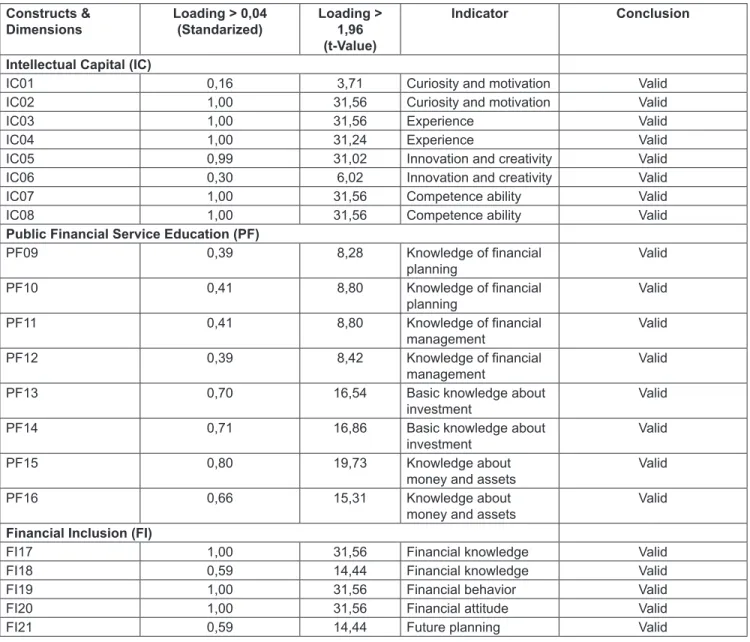
Table 3 below shows the results of testing the validity of each construct. Based on the table, it is known that all constructs in each indicator variable illustrate valid results so that they can be used in further analysis. The results of the validity test show that the standardized values of the intellectual capital variable (items IC01 to IC08), public financial services education variables (items PF09 to PF16) and financial inclusion (items FI 17 to FI21) have a t-value greater than 1.96 as a whole with a standardized value greater than 0.04. These results indicate that all statement indicators for the three variables are valid.

Furthermore, for the reliability test results it is known that the Cronbach’s Alpha value is 0.928. This value is compared with the r table with N = 500 which are sought using a significance of 5% (0.05), and the r table value are 0.087. These results indicate that the Cronbach’s Alpha value> from r table or 0.928> 0.087. Therefore, all statement items used in this study have been reliable or can be trusted as data collection tools (Jaya, 2019).

4.3. SEM (Structural Equation Modeling) Analysis Test Results

The analysis test carried out is to test the independent

variable (Intellectual Capital (X

1

) and Public Financial

Services Education (X

2

) on the dependent variable (Financial

Inclusion). This equation test is done by using SEM analysis

test to find out how much influence the compiled indicators

have of this research variable. Table 5 below illustrates a

summary of the relationship results between the independent

variable and the dependent variable in this study.

(6)

Table 3: Validity Test Result Based on Fit Model’s Loading Factor Constructs &

Dimensions Loading > 0,04

(Standarized) Loading >

(t-Value) 1,96

Indicator Conclusion

Intellectual Capital (IC)

IC01 0,16 3,71 Curiosity and motivation Valid

IC02 1,00 31,56 Curiosity and motivation Valid

IC03 1,00 31,56 Experience Valid

IC04 1,00 31,24 Experience Valid

IC05 0,99 31,02 Innovation and creativity Valid

IC06 0,30 6,02 Innovation and creativity Valid

IC07 1,00 31,56 Competence ability Valid

IC08 1,00 31,56 Competence ability Valid

Public Financial Service Education (PF)

PF09 0,39 8,28 Knowledge of financial

planning Valid

PF10 0,41 8,80 Knowledge of financial

planning Valid

PF11 0,41 8,80 Knowledge of financial

management Valid

PF12 0,39 8,42 Knowledge of financial

management Valid

PF13 0,70 16,54 Basic knowledge about

investment Valid

PF14 0,71 16,86 Basic knowledge about

investment Valid

PF15 0,80 19,73 Knowledge about

money and assets Valid

PF16 0,66 15,31 Knowledge about

money and assets Valid

Financial Inclusion (FI)

FI17 1,00 31,56 Financial knowledge Valid

FI18 0,59 14,44 Financial knowledge Valid

FI19 1,00 31,56 Financial behavior Valid

FI20 1,00 31,56 Financial attitude Valid

FI21 0,59 14,44 Future planning Valid

Table 4: Reliability Test Results

N Cronbach’ Alpha N of Items r-table Conclusion

500 0.928 21 0.087 Reliable

Table 5: Test Results of SEM Analysis

Relation t-Value

(>1,96) Decision Adjusted R

2

The influence of intellectual capital (X

1

) towards Financial

Inclusion 2,21 Significant 0.299

The influence of public financial education (X

2

) to Financial

Inclusion (Y) -2,05 Insignificant -

(7)

The test results in Table 5 show that the intellectual capital variable has a t-value of 2.21 or > 1.96. These results indicate that the variable intellectual capital has a significant positive impact on the success of financial inclusion in Indonesia.

Based on the results of the determination coefficient test, it can be seen that the influence of the intellectual capital variable on the succession of financial inclusion is 0.299 or 29.9%. This proves that in addition to detect financial performance (Nguyen & Doan, 2020; Ousama et al., 2019; Pirogova et al., 2020; Soewarno & Tjahjadi, 2020), intellectual capital can also help you succeed in financial inclusion. So, our current research has a broader orientation in which intellectual capital can also be used to support the economy, one of which is financial inclusion succession. The results of this study prove that the role of intellectual capital towards the succession of financial inclusion in Indonesia is quite large. This result should be able to provide advice to the government and policy makers (regulators) to start to intensify cooperation with any educational institution to assist by providing knowledge (finance) properly and correctly to unbanked people so that they immediately can access to financial institutions and independently manage their finances. .

Unlike the variable intellectual capital, the results in Table 5 show the opposite result. The variable public financial service education has a t-value of -2.05 lower than the t value of 1.96 (Sujarweni, 2018). These results indicate that the variable public financial service education has no impact on the succession of financial inclusion in Indonesia.

This result is in line with research by Jaya (2019), which states that the public financial service education that has been carried out by the government and banking financial institutions has not been able to succeed in the financial inclusion program in Indonesia. This condition is due to the fact that some people who are classified as unbanked tend not to dare to go to financial institutions to obtain financial knowledge. Therefore, the government, the private sector and academics need to educate public financial services by coming directly to unbanked places in the community and providing continuous guidance.

5. Conclusions

The purpose of this study was to determine the effect of intellectual capital and the socialization of public financial services education in increasing financial inclusion.

Financial inclusion plays an important role in increasing the progress of the country’s economy. However, the facts show that community involvement in Indonesia, especially in this program, is still low. This can be seen from the high number of people who are classified as unbanked. The results of this study found that intellectual capital has a significant positive effect on the success of financial inclusion. On the other hand, public financial service education is not proven

to have an impact on financial inclusion. Even though intellectual capital is often identified with efforts to improve the company’s financial performance, this study actually provides a new conception that intellectual capital can be developed in an effort to succeed government programs, especially financial inclusion.

The limitation of this study is to explore deeper the reasons behind people’s reluctance to have bank accounts, both savings and loans. Therefore, further researchers should use a more intensive research approach by conducting a mixed method research model. Using a questionnaire survey technique combined with open-ended questions and in-depth interviews is likely to make research related to financial inclusion more meaningful for the public and the government as the regulator.

References

Adil, F., & Jalil, A. (2020). Determining the financial inclusion output of banking sector of pakistan—supply-side analysis. Economies, 8(2), 1–20. https://doi.org/10.3390/

ECONOMIES8020042

Bakar, M. Z. A., & Bakar, S. A. (2020). Prudent financial management practices among Malaysian youth: The moderating roles of financial education. Journal of Asian Finance, Economics and Business, 7(6), 525–535. https://doi.org/10.13106/Jafeb.2020.

vol7.no6.525

Banna, H., Ahmad, R., & Koh, E. H. Y. Y. (2017). Determinants of Commercial Banks’ Efficiency in Bangladesh: Does Crisis Matter? Journal of Asian Finance, Economics and Business, 4(3), 19–26. https://doi.org/10.13106/jafeb.2017.vol4.no3.19 Bongomin, G. O. C., Munene, J. C., Ntayi, J. M., & Malinga, C.

A. (2017). Financial literacy in emerging economies: Do all components matter for financial inclusion of poor households in rural Uganda? Managerial Finance, 43(12), 1310–1331.

https://doi.org/10.1108/MF-04-2017-0117

Brixiová, Z., Kangoye, T., & Yogo, T. U. (2020). Access to finance among small and medium-sized enterprises and job creation in Africa. Structural Change and Economic Dynamics, 55, 177–

189. https://doi.org/10.1016/j.strueco.2020.08.008

Caplan, M., Sherraden, M., & Bae, J. (2018). Financial Capability as Social Investment. The Journal of Sociology & Social Welfare, 45(4). https://scholarworks.wmich.edu/jssw/vol45/iss4/9 Cavoli, T., Gopalan, S., & Rajan, R. S. (2020). Does Financial

Inclusion Amplify Output Volatility in Emerging and Developing Economies? Open Economies Review, 31(4), 901–

930. https://doi.org/10.1007/s11079-019-09568-0

Chen, J., & Zhu, Z. (2004). Measuring intellectual capital: A new model and empirical study. Journal of Intellectual Capital, 5(1), 195–212. https://doi.org/10.1108/14691930410513003 Curado, C., & Bontis, N. (2006). The knowledge-based view of

the firm and its theoretical precursor. International Journal of Learning and Intellectual Capital, 3(4), 367–381. https://doi.

org/10.1504/IJLIC.2006.011747

(8)

Despard, M. R., Friedline, T., & Martin-West, S. (2020). Why Do Households Lack Emergency Savings? The Role of Financial Capability. Journal of Family and Economic Issues, 41(3), 542–557. https://doi.org/10.1007/s10834-020-09679-8 García-meca, E., Parra, I., Larrán, M., & Martínez, I. (2005). The

explanatory factors of intellectual capital disclosure to financial analysts. European Accounting Review, 14(1), 63–94. https://

doi.org/10.1080/0963818042000279713

Grohmann, A., Klühs, T., & Menkhoff, L. (2018). Does financial literacy improve financial inclusion? Cross country evidence.

World Development, 111, 84–96. https://doi.org/10.1016/j.

worlddev.2018.06.020

Hauff, J. C., Carlander, A., Gärling, T., & Nicolini, G. (2020).

Retirement Financial Behaviour: How Important Is Being Financially Literate? Journal of Consumer Policy, 43(3), 543–

564. https://doi.org/10.1007/s10603-019-09444-x

Hussain, J., Salia, S., & Karim, A. (2018). Is knowledge that powerful? Financial literacy and access to finance: An analysis of enterprises in the UK. Journal of Small Business and Enterprise Development, 25(6), 985–1003. https://doi.

org/10.1108/JSBED-01-2018-0021

Jaya, I. M. L. M. (2019). The Impact of Financial Inclusion on Public Financial Services Education through Financial Technology in Sleman Regency, Indonesia. Esensi: Jurnal Bisnis Dan Manajemen, 9(2), 155–174. https://doi.org/10.15408/ess.

v9i2.13576

Kim, J., Gutter, M. S., & Spangler, T. (2017). Review of family financial decision making: Suggestions for future research and implications for financial education. Journal of Financial Counseling and Planning, 28(2), 253–267. https://doi.

org/10.1891/1052-3073.28.2.253

Li, L. (2018). Financial inclusion and poverty: The role of relative income. China Economic Review, 52, 165–191. https://doi.

org/10.1016/j.chieco.2018.07.006

Morgan, P. J., & Long, T. Q. (2020). Financial literacy, financial inclusion, and savings behavior in Laos. Journal of Asian Economics, 68, 101197. https://doi.org/10.1016/j.

asieco.2020.101197

Nair, A. R., & Anand, B. (2020). Monetary policy and financial stability: Should central bank lean against the wind? Central Bank Review, 20(3), 133–142. https://doi.org/10.1016/j.

cbrev.2020.03.006

Nguyen, A. H., & Doan, D. T. (2020). The impact of intellectual capital on firm value: Empirical evidence from Vietnam.

International Journal of Financial Research, 11(4), 74–85.

https://doi.org/10.5430/ijfr.v11n4p74

Nguyen, V. T., & Doan, M. D. (2020). The Correlation between Financial Literacy and Personal Saving Behavior in Vietnam.

Asian Economic and Financial Review, 10(6), 590–603. https://

doi.org/10.18488/journal.aefr.2020.106.590.603

Nitani, M., Riding, A., & Orser, B. (2020). Self-employment, gender, financial knowledge, and high-cost borrowing. Journal

of Small Business Management, 58(4), 669–706. https://doi.org /10.1080/00472778.2019.1659685

Omar, M. A., & Inaba, K. (2020). Does financial inclusion reduce poverty and income inequality in developing countries? A panel data analysis. Journal of Economic Structures, 9(1). https://doi.

org/10.1186/s40008-020-00214-4

Ousama, A. A., Hammami, H., & Abdulkarim, M. (2019).

The association between intellectual capital and financial performance in the Islamic banking industry: An analysis of the GCC banks. International Journal of Islamic and Middle Eastern Finance and Management, 13(1), 75–93. https://doi.

org/10.1108/IMEFM-05-2016-0073

Panos, G. A., & Wilson, J. O. S. (2020). Financial literacy and responsible finance in the FinTech era: capabilities and challenges. European Journal of Finance, 26(4–5), 297–301.

https://doi.org/10.1080/1351847X.2020.1717569

Pham, M. H., & Doan, T. P. L. (2020). The impact of financial inclusion on financial stability in Asian countries. Journal of Asian Finance, Economics and Business, 7(6), 47–59. https://

doi.org/10.13106/jafeb.2020.vol7.no6.047

Pirogova, O., Voronova, O., Khnykina, T., & Plotnikov, V. (2020).

Intellectual capital of a trading company: Comprehensive analysis based on reporting. Sustainability (Switzerland), 12(17), 1–21. https://doi.org/10.3390/su12177095

Pomeroy, R., Arango, C., Lomboy, C. G., & Box, S. (2020).

Financial inclusion to build economic resilience in small-scale fisheries. Marine Policy, 118, 103982. https://doi.org/10.1016/j.

marpol.2020.103982

Ramon-Jeronimo, J. M., Florez-Lopez, R., & Araujo-Pinzon, P. (2019). Resource-based view and SMEs performance exporting through foreign intermediaries: The mediating effect of management controls. Sustainability, 11(12). https://doi.

org/10.3390/SU11123241

Ratnawati, K. (2020). The impact of financial inclusion on financial stability in Asian countries. Journal of Asian Finance, Economics and Business, 7(10), 73–85. https://doi.

org/10.13106/jafeb.2020.vol7.no10.073

Soewarno, N., & Tjahjadi, B. (2020). Measures that matter: an empirical investigation of intellectual capital and financial performance of banking firms in Indonesia. Journal of Intellectual Capital, 21(6), 1085–1106. https://doi.org/10.1108/

JIC-09-2019-0225

Stewart, T. A. (1998). Intellectual Capital: The New Wealth of Organizations (2nd ed.). London, UK: Nicholas Brealey Publishing.

Suharto, T. (2005). The basic concept of community based education. Cakrawala Pendidikan, 24(3), 323–346.

Thoene, U., & Turriago-Hoyos, Á. (2017). Financial inclusion in Colombia: A scoping literature review. Intangible Capital, 13(3), 582–614. https://doi.org/10.3926/ic.946

Thomas, B., & Subhashree, P. (2020). A review on the recent trends

in financial inclusion: The research journey so far. Humanities

(9)

and Social Sciences Reviews, 8(4), 192–200. https://doi.

org/10.18510/hssr.2020.8420

Uzoma, A. B., Adetiloye, K. A., Esther, A. O., Eke, P. O., & Osuma, G. O. (2020). Social integration and financial inclusion of forcibly displaced persons in sub-Saharan African countries.

Problems and Perspectives in Management, 18(3), 170–181.

https://doi.org/10.21511/ppm.18(3).2020.15

Xu, N., Shi, J., Rong, Z., & Yuan, Y. (2020). Financial literacy and formal credit accessibility: Evidence from informal businesses in China. Finance Research Letters, 36, 101327. https://doi.

org/10.1016/j.frl.2019.101327

Zubaedi, Z. (2017). Community Based Education. In: Resensi.

IAIN Bengkulu.

수치

Table 2: Results of Descriptive Statistical Analysis
Table 3: Validity Test Result Based on Fit Model’s Loading Factor Constructs &  Dimensions Loading > 0,04 (Standarized) Loading >  (t-Value)1,96 Indicator Conclusion

참조

관련 문서

“Exit Strategy” are the researches on the cause and effect of the global financial crisis, the trend of the financial stability of capital market in G20 countries, the

‘The Capital Market and Financial Investment Services Act’, in effect from February 4th, 2009, made it possible for the financial investment service companies to

The main purpose of this study is to determining how different the debt ratio of the company’s financial condition before and after the financial crisis

Since the market competition and investment are the strategical decisions of firms, in order to scrutinize the effect of financial structure on the CEO's decision, I research

Jung Bum Wee This paper studies the effect of the government economic policy and the optimizing behaviors of financial institution and business firm on

As stated in its contribution to the preparation of Europe 2020 2 , reinforcing the Open Method of Coordination in the field of social protection and social inclusion and

The “Asset Allocation” portfolio assumes the following weights: 25% in the S&P 500, 10% in the Russell 2000, 15% in the MSCI EAFE, 5% in the MSCI EME, 25% in the

1 John Owen, Justification by Faith Alone, in The Works of John Owen, ed. John Bolt, trans. Scott Clark, "Do This and Live: Christ's Active Obedience as the