21(11); 1321~1331; November 2012 http://dx.doi.org/10.5322/JES.2012.21.11.1321 ORIGINAL ARTICLE
Purification of BTEX at Indoor Air Levels Using Carbon and Nitrogen Co-Doped Titania under Different Conditions
Wan-Kuen Jo
*, Hyun-Jung Kang
Department of Environmental Engineering, Kyungpook National University, Daegu 702-701, Korea
Abstract
To date, carbon and nitrogen co-doped photocatalysts (CN-TiO
2) for environmental application focused mainly on the aqueous phase to investigate the decomposition of water pollutants. Accordingly, the present study explored the photocatalytic performance of CN-TiO
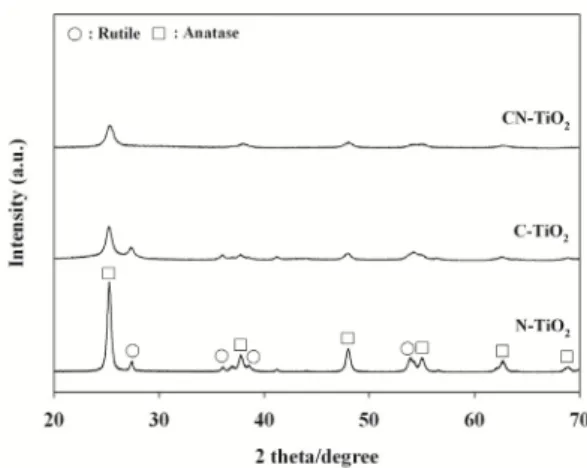
2photocatalysts for the purification of indoor-level gas-phase aromatic species under different operational conditions. The characteristics of prepared photocatalysts were investigated using X-ray diffraction, scanning emission microscope, diffuse reflectance UV-VIS-NIR analysis, and Fourier transform infrared (FTIR) analysis. In most cases, the decomposition efficiency for the target compounds exhibited a decreasing trend as input concentration (IC) increased.
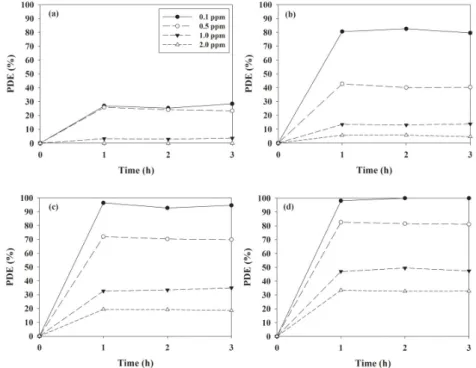
Specifically, the average decomposition efficiencies for benzene, toluene, ethyl benzene, and xylene (BTEX) over a 3-h process decreased from 29% to close to zero, 80 to 5%, 95 to 19%, and 99 to 32%, respectively, as the IC increased from 0.1 to 2.0 ppm. The decomposition efficiencies obtained from the CN-TiO
2photocatalytic system were higher than those of the TiO
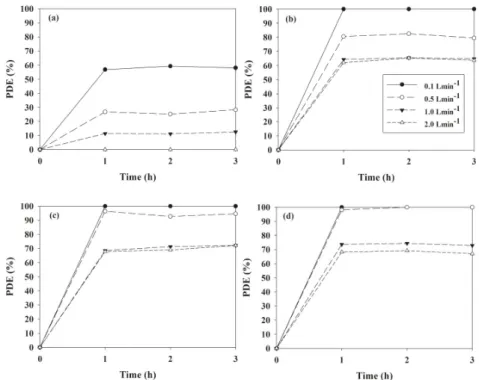
2system. As relative humidity (RH) increased from 20 to 95%, the decomposition efficiencies for BTEX decreased from 39 to 5%, 97 to 59%, 100 to 87%, and 100 to 92%, respectively. In addition, as the stream flow rates (SFRs) decreased from 3.0 to 1.0 L min
-1,the average efficiencies for BTEX increased from 0 to 58%, 63 to 100%, 69 to 100%, and 68 to 100%, respectively. Taken together, these findings suggest that three (IC, RH, and SFR) should be considered for better BTEX decomposition efficiencies when applying CN-TiO
2photocatalytic technology to purification of indoor air BTEX.
Key Words : Decomposition efficiency, Aromatic species, Input concentration, Relative humidity, Stream flow rate
1. Introduction
1)In recent, heterogeneous photocatalysis using titanium dioxide (TiO
2) has been considered a promising technique in cleaning of environmental pollutants (Keshmiri et al., 2006; De Witte et al., 2008). This technique is known as an advanced oxidation process, which converts light energy into chemical reaction energy. However, although TiO
2has outstanding photocatalytic activity and stability toward photocorrosion, its application requires light irradiation above the band gap energy of 3.2eV
(anatase) to produce electron-hole pairs that can generate superoxide anion radicals and hydroxyl radicals (Fujishima et al., 2008). This energy corresponds to UV light irradiation of wavelength
<387 nm; therefore, a variety of strategies for modifications to enhance its light absorption and photocatalytic activities under visible light irradiation have been investigated. These strategies have generally involved dye sensitization (Ding et al., 2005), transition metal doping (Zhu et al., 2006; Rauf et al., 2011), and nonmetallic element doping (Ohno
received 24 August, 2012; revised 24 September, 2012;
accepted 12 November, 2012
*