Korean J. Environ. Biol. 37(3) : 362-366(2019)
et al. 2015). Recently, many entities that had been included in Ulva were transferred to Monostroma based on molec- ular analyses (Brodie et al. 2007; Sfriso 2010; Alongi et al.
2014; Guiry and Guiry 2019). Therefore, about 30 species are currently accepted in this genus worldwide (Guiry and Guiry 2019).
A total of nine species are currently recorded in Korea (Lee and Kang 1986, 2002; Lee 2008; Bae 2010; Kim et al.
2013). During a survey of marine algal flora, one
monostro- maticspecies (Chlorophyta) was collected from the eastern coast of Korea. This Korean entity was first recorded based on morphological and molecular analyses in the present study.
MATERIALS AND METHODS
Samples for the present study were collected from Sa-
https://doi.org/10.11626/KJEB.2019.37.3.362
INTRODUCTION
Monostroma Thuret (
Monostromataceae), which is dis- tributed in all aquatic habitats from freshwater to seawater environments (Loughnane et al. 2008), is a green alga with
monostromaticleafy blades of 2-30 cm (or more) in size.
This genus was lectotypfied with Monostroma bullosum (Roth) Thuret (Pfeiffer 1874), and is delimited by some vegetative and reproductive features (Guiry and Guiry 2019).
Species belonging to the genus Monostroma are classi- cally defined on the basis of morphological characteris- tics such as size and shape of cells and thickness of thalli (Wittrock 1866; Bast et al. 2015). However, this makes it difficult to identify Monostroma species, because of the sim- ple thallus structure (Heesch et al. 2009). Culture studies have been conducted in some of the taxa, and have resulted in taxonomical revisions (Gayral 1964; Bliding 1968; Bast
Original article
Monostroma alittorale, a marine green algal species newly recorded in Korea
Jae Woo An, Pil Joon Kang and Ki Wan Nam*
Department of Marine Biology, Pukyong National University, Busan 48513, Republic of Korea
Korean J. Environ. Biol.
37(3) : 362-366(2019) ISSN 1226-9999(print) ISSN 2287-7851(online)
Korean Journal of Environmental Biology
* Corresponding author Ki Wan Nam
Tel. 051-629-5922
E-mail. [email protected]
Received: 17 August 2019 Revised: 4 September 2019
Revision accepted: 4 September 2019
Abstract: A marine green algal species(Chlorophyta) was collected from the eastern coast of Korea. It is morphologically characterized by monostromatic thallus, usually undulate and entire margins, cap-like chloroplast and several pyrenoids per cell. In a phylogenetic tree based on molecular data, the Korean alga nests in the same clade as Monostroma alittorale originally described from Japan, as a sister clade of M. grevillei from France. The genetic distance for ITS(Internal Transcribed Spacer) sequences among Monostroma species ranges from 2.3% to 38.2%. The value between the Korean entity and M. alittorale was calculated as 0.01%, considered to be intraspecific divergence.
This Korean entity is identified as Monostroma alittorale based on morphological and molecular analyses. This is the first record of M. alittorale in Korea.
Keywords: Chlorophyta, molecular analyses, morphology, first record, Monostroma alittorale
jin-ri, Yeongdeok located on the eastern coast of Korea.
All specimens were preserved in 5-10% formalin seawater solution, and pressed on herbarium sheets. A portion of the material was dried and preserved in silica gel for molec- ular analysis. Sections of the thallus were mounted in 20%
corn syrup for permanent preparation.
Total genomic DNA was extracted from silica-gel-pre- served sample using the DNeasy Plant Mini Kit (Qiagen, Hilden, Germany) according to the manufacturer’s pro- tocol. Extracted DNA was used for amplification of ITS regions using following primers (Ent18SA: 5ʹ GAGGCA ATAACAGGTCTGTGATGC 3ʹ, ITS2: 5ʹ GCTGCGTT
Fig. 1. Monostroma alittorale T. Tanaka & K. Nozawa. A. Herbarium specimen(MGARB012873). B. Habit of the vegetative plant. C.
Monostromatic thallus with cap-like chloroplast in the transverse section. D. Undulate and entire margin of the thallus. E. Surface view of the rectangular-to-polygonal cells with round corner near the upper portion. F. Several pyrenoids in the surface view.
a b
c d
e f
CTTCATCGATGC 3ʹ, ITS4: 5ʹ TCCTCCGCTTATTGA- TATGC 3ʹ) (White et al. 1990; Blomster et al. 1998). PCR amplifications were performed in a TaKaRa PCR Thermal Cycler Dice with an initial denaturation step at 94°C for 5 min followed by 35 cycles at 94°C for 1 min, 56°C for 1 min, and 72°C for 2 min and a final extension at 72°C for 7 min. The reaction volume was 20 μL, consisting of 20 ng of genomic DNA, 2 μL of 10
×PCR buffer, 2 μL of 200 μM dNTP, 1 μL each of forward and reverse primer, and 0.5 units of Taq polymerase (Takara Korea, Korea). The PCR products were moved to Macrogen Sequencing Service for sequencing (Macrogen, Seoul, Korea). The PCR primers were also used for sequencing.
Sequences for the ITS region were aligned using BioEdit (Hall 1999). Phylogenetic analysis was performed using the maximum-likelihood (ML) methods. Bootstrap values were calculated with 1,000 replications. Cladophora albida (Nees) Kutzing was used as an outgroup.
RESULTS AND DISCUSSION
Monostroma alittorale T. Tanaka & K. Nozawa in Tanaka 1963: 75
Korean name: Dong-hae-hot-pa-rae nom. nov.
(
신칭:
동해홑파래)
Specimens examined: MGARB012873-MGARB012 874 (Sajin-ri, Yeongdeok, 17 Feb. 2016), MGARB012 875-012877 (Sajin-ri, Yeongdeok, 25 Sep. 2019).
Habitat: Epilithic near the lower intertidal.
Type locality: Mage Island, Tanegashima, Japan
Morphology: Thalli 5-12 cm high (Fig. 1A, B), erect, membranous,
monostromatic(Fig. 1C), usually unbranched or little branched conical to ligulate shape, light to dark green in color, soft in texture, attached by a small cuneate holdfast (
<5 mm) on rocks near the lower intertidal, with usually undulate and entire margin (Fig. 1D), 40-60 μm thick in the upper portion, 80-120 μm thick in the basal portion; cells usually arranged in pairs, rectangular to po- lygonal near the middle to upper portion, oval to rectangu- lar with round corners near the basal portion in the surface view (Fig. 1E, F), transformed into rhizoidal cells near the base, 15-25 μm
×10-15 μm, with a length to width ratio of 1.6-1.8 in the transverse section; chloroplasts cap-like, parietal, with several pyrenoids (3-4 μm) (Fig. 1C, F).
Monostroma alittorale was originally described from Ja- pan (Tanaka 1963). Since then, the occurrence of this spe- cies has only been recorded in Japan (Yoshida et al. 1990;
Yoshida 1998; Guiry and Guiry 2019). According to Tana- ka (1963), this species seems to be characterized by having undulate or entire margin without microscopic teeth, short cuneate stipe and somewhat costate thalli in the basal por-
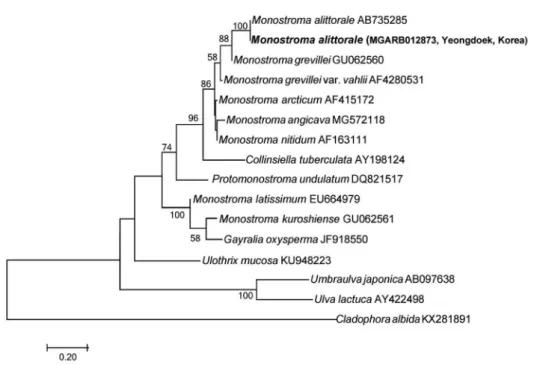
Fig. 2. Phylogenetic tree of Monostroma species obtained from ML(Maximum-likelihood) analysis based on ITS(Internal Transcribed Spac- er) sequences. Bootstrap percentages(1,000 replicates samples) are shown above the branches. Scale bar=0.20 substitutions/site.
tion, chromatophore in most of the cells not filling the in- terior, and several pyrenoids per cell.
Most of these features including gross morphology are also found in our Korean specimens with the exceptions of a lack of basal costate thallus and cap-like parietal position of chloroplast. However, the basal features of thallus and chloroplast position appear to be variable with habitat.
Several studies have used the ITS region to analyze the phylogenetic relationships among Monostroma species (Hayden et al. 2003; Hayden and Waaland 2004; Bast et al.
2014; Bast 2015). Monostroma appears to not be mono- phyletic based on the ITS sequence (Fig. 2). M. latissimum Wittrock and M. kuroshiense F. Bast form the same clade as Gayralia K.L. Vinogradova. Phylogenetic consideration of these species needs further investigation. In a phylogenetic tree based on the ITS sequence (Fig. 2), the Korean alga nests in the same clade as M. alittorale from Japan, as a sister clade of M. grevillei (Thuret) Wittrock from France sharing a polygonal cell shape and several pyrenoids per cell.
According to Bast et al. (2014, table 3), the genetic dis- tance for ITS sequences among Monostroma species ranges from 0.48% to 6.55%. The values were calculated as 2.3%- 38.2% (the present study). The genetic distance of 0.01%
between sequences from the Korean specimens and M.
alittorale from Japan suggests that our specimens are re- ferred to M. alittorale. Based on these morphological and molecular data, the Korean alga is identified as M. alittorale, which is first recorded in the Korean marine algal flora.
ACKNOWLEDGMENTS
This work was supported by the Marine Biotechnolo- gy Program of the Korea Institute of Marine Science and Technology Promotion (KIMST) funded by the Ministry of Oceans and Fisheries (MOF) (No. 20170431), and by a grant from the National Institute of Biological Resources (NIBR) funded by the Ministry of Environment (MOE) of the Republic of Korea (NIBR 201501204).
REFERENCES
Alongi G, M Cormaci and G Furnari. 2014. A nomenclatural re- assessment of some of Bliding’s Ulvaceae. Webbia: J. Plant Taxon. Geogr. 69:89-96.
Bae EH. 2010. Ulotrichales, Ulvales. pp. 7-52. In Algal Flora of Korea. Volume 1, Number 1. Chlorophyta: Ulvophyceae:
Ulotrichales, Ulvales, Cladophorales, Bryopsidales. Marine Green Algae(Bae EH, HS Kim, CJ Kwon, IK Hwang, GH Kim and TA Klochkova eds.). National Institute of Biological Re- sources, Incheon.
Bast F, S Kubota and K Okuda. 2014. Phylogeographic assess- ment of panmictic Monostroma species from Kuroshio Coast, Japan reveals sympatric speciation. J. Appl. Phycol.
27:1725-1735.
Bast F. 2015. Taxonomic reappraisal of Monostromataceae(Ulvo- phyceae: Chlorophyta) based on multi-locus phylogeny. Web- bia: J. Plant Taxon. Geogr. 70:43-57.
Bliding C. 1968. A critical survey of European taxa in Ulvales. II.
Ulva, Ulvaria, Monostroma Kornmannia. Bot. Not. 121:535- 629.
Blomster J, CA Maggs and MJ Stanhope. 1998. Molecular and morphological analysis of Enteromorpha intestinalis and E.
compressa(Chlorophyta) in the British Isles. J. Phycol. 34:
319-340.
Brodie J, CA Maggs and DM John. 2007. Green Seaweeds of Britain and Ireland. British Phycological Society, London.
Gayral P. 1964. Sur le démembrement de l’actual genre Mono
stroma Thuret(Chlorophycées, Ulotrichales s.l.). C. R. Acad.
Sci. Paris 258:2149-2152.
Guiry MD and GM Guiry. 2019. AlgaeBase. World-wide electron- ic publication, National University of Ireland, Galway. Available from http://www.algaebase.org. Accessed: 05 July 2019.
Hall TA. 1999. BioEdit: a user-friendly biological sequence align- ment editor and analysis program for Windows 95/98/NT.
Nucleic Acids Symp. Ser. 41:95-98.
Hayden HS, J Blomster, CA Maggs, PC Silva, MJ Stanhope and JR Waaland. 2003. Linnaeus was right all along: Ulva and En
teromorpha are not distinct genera. Eur. J. Phycol. 38:277- 294.
Hayden HS and JR Waaland. 2004. A molecular systematic study of Ulva (Ulvaceae, Ulvales) from the northeast Pacific. Phyco- logia 43:364-382.
Heesch S, JES Broom, KF Neill, TJ Farr, JL Dalen and WA Nelson.
2009. Ulva, Umbraulva and Gemina: genetic survey of New Zealand taxa reveals diversity and introduced species. Eur. J.
Phycol. 44:143-154.
Kim HS, SM Boo, IK Lee and CH Sohn. 2013. National List of Species of Korea, Marine Algae. Jeonghaengsa, Seoul.
Lee IK and JW Kang. 1986. A check list of marine algae in Korea.
Kor. J. Phycol. 1:311-325.
Lee YP. 2008. Marine Algae of Jeju. Academy Publishing Co., Seoul.
Lee YP and SY Kang. 2002. A Catalogue of the Seaweeds in Ko- rea. Jeju National University Press, Jeju.
Loughnane CJ, LM McIvor, F Rindi, DB Stengel and MD Guiry.
2008. Morphology, rbcL phylogeny and distribution of distro- matic Ulva(Ulvophyceae, Chlorophyta) in Ireland and south- ern Britain. Phycologia 47:416-429.
Pfeiffer L. 1874. Nomenclator Botanicus: Nominum ad Finem anni 1858 Publici Juris Factorum, Classes, Ordines, Tribus, Familias, Divisiones, Genera, Subgenera vel Sectiones Des- ignatium Enumeratio Alphabetica(Vol. 2). Cassellis: sumpti- bus Theodori Fischeri.
Sfriso A. 2010. Coexistence of Ulva rigida and Ulva laetevirens (Ulvales, Chlorophyta) in Venice Lagoon and other Italian tran- sitional and marine environments. Bot. Mar. 53:9-18.
Tanaka T. 1963. Studies on some marine algae from southern
Japan, V. Mem. Fac. Fish. Kagoshima Univ. 12:75-91.
Wittrock V. 1866. Forsok till en monographi ofver algslagtet Monostroma. Uppsala University, Sweden.
White TJ, T Bruns, S Lee and J Taylor. 1990. Amplification and direct sequencing of fungal ribosomal RNA genes for phylo- genetics. pp. 315-322. In PCR Protocols: A Guide to Meth- ods and Applications(Innis M, J Gelfand, J Sninsky, T White, eds.). Academic, Orlando.
Yoshida T, Y Nakajima and Y Nakata. 1990. Check-list of marine algae of Japan(revised in 1990). Jpn. J. Phycol. 38:269-320.
Yoshida T. 1998. Marine Algae of Japan. Uchida Rokakuho, Tokyo.