Pil Joon Kang, Jae Woo An and Ki Wan Nam
308Korean J. Environ. Biol. 36(3) : 308~313(2018) https://doi.org/10.11626/KJEB.2018.36.3.308
INTRODUCTION
Cryptonemia J. Agardh (1842), which involves 45 species, belongs to Halymeniaceae Bory, and is widely distributed from warm temperate to tropical waters (Guiry and Guiry 2018). This genus was established based on C. lactuca J.
Agardh, which is currently regarded as a synonym of C. lo
mation (Bertoloni) J. Agardh. Cryptonemia shows morpho- logical features of foliose or linear and cartilaginous erect thalli usually with small discoid holdfast, dichotomously branched or palmately lobed blade often with an evanescent midrib at the base, perennial stalk, multiaxial structure, en- twined filamentous medulla with refractive stellate cells, bushy ampulla with conical outline and tetrasporangia usu-
ally restricted to proliferations (Chiang 1970; Irvine 1983;
Womersley 1994; Nam and Kang 2013; D’Archino et al.
2014; Guiry and Guiry 2018). It is distinguished from other Korean genera, Polyopes (J. Agardh, Kintokiocolax T. Tana- ka et Y. Nozawa, Halymenia C. Agardh and Grateloupia C.
Agardh, within the Halymeniaceae, by a combination of the feature of thalli with or without midrib, presence of refrac- tive cells in medulla and tetrasporangia usually produced in proliferations (Nam and Kang 2013). In particular, it is tradi- tionally distinguished from the similar genus Halymenia by the feature of medullary filaments (D’Archino et al. 2014), but an exception was also reported (Womersley and Lewis 1994). The development type of auxiliary ampulla filament was also adopted for a distinction between both genera (Chi- ang 1970). However, this characteristic also appears not to be significant based on some other reports (Gargiulo et al. 1986;
Guimarães and Fujii 1998; Kawaguchi et al. 2002, 2004).
* Corresponding author: Ki Wan Nam, Tel. 051-629-5922, Fax. 051-629-5922, E-mail. [email protected]
ⓒ2018. Korean Society of Environmental Biology.
Note on a Marine Algal Species,
Cryptonemia lomation (Halymeniaceae) in Korea
Pil Joon Kang, Jae Woo An and Ki Wan Nam*
Department of Marine Biology, Pukyong National University, Busan 48513, Republic of Korea
Abstract - During a survey of marine algal flora, a red algal species was collected from Giseong, Uljin located on the eastern coast of Korea. This species has the generic features of Cryptonemia belonging to Halymeniaceae, and is characterized by the presence of erect foliose thalli arising from a discoid holdfast, somewhat fan-shaped blade with an evanescent midrib at the base, narrow main axes with blade-like wings of slightly undulate margin, a perennial stalk, and entwined filamentous medulla with refractive stellate cells. In a phylogenetic tree based on rbcL sequence, the Korean alga nests in the same clade with C. lomation from France and C. seminervis from Spain. Genetic divergence among the sequences within the clade was not recognized thus suggesting that both the species are conspecific. The name C. lomation considered to be valid nomenclaturally is accepted for the entity. Based on the morphological and molecular analyses, the Korean alga is identified as
C. lomation, originally described from Italy. This confirms the occurrence of C. lomation in Korea.The species appears to be distributed in the temperate region influenced more or less by the North Korea Cold Current.
Keywords : Cryptonemia lomation, red alga, Halymeniaceae, temperate region, Korea
<Original article>
described C. asiatica M.Y. Yang et M.S. Kim, based on a molecular analysis of specimens collected from the same locality (Yang and Kim 2014). Accordingly, two Cryptone
mia species, C. tuniformis and C. asiatica, have been recog- nized in Korea.
During a survey of marine algal flora, a red algal species was collected from Korea. It was identified based on mor- phological and molecular analyses, and a taxonomic note was included. This study confirms the occurrence of the spe- cies in Korea.
MATERIALS AND METHODS
Specimens for this study were collected from Giseong, Uljin on the east coast of Korea. Taxonomic data were ob- tained from fresh, liquid-preserved and herbarium specimens.
Liquid-preserved material was stored in a 10% solution of formalin/seawater. Blades dissected from the cleared mate- rials were hand-sectioned, transferred to a slide with distill- ed water, and mounted in pure glycerin. Measurements are given as width and length. For permanent slides, the glycer- in was exchanged with 10-20% corn syrup.
Total genomic DNA was extracted from a silica-gel-pre- served sample using the DNeasy Plant Mini Kit (Qiagen, Hil- den, Germany) according to the manufacturer’s protocol.
Before extraction, dried material was crushed with liquid nitrogen using a mortar and pestle. Extracted DNA was used for the amplification of ribulose-1, 5-bisphosphate carboxy- lase large subunit (rbcL) regions. For rbcL, the gene was amplified in three overlapping parts with the primer pairs FrbcL start (5ʹ-TGTGTTGTCGACATGTCTAACTCTGTA GAAG-3ʹ) - R753 (5ʹ-GCTCTTTCATACATATCTTCC-3ʹ), F492 (5ʹ-CGTATGGATAAATTTGGTCG-3ʹ) - R1150 (5ʹ-
Seoul, Korea). Sequences for the rbcL region were aligned using BioEdit (Hall 1999). Phylogenetic analyses were per- formed using neighbor joining and maximum-likelihood methods. Bootstrap values were calculated with 1,000 repli- cations. RbcL sequences of other species were obtained from GenBank. Gracilaria bursapastoris (S.G. Gmelin) P.C. Silva was used as an outgroup.
RESULTS AND DISCUSSION
Cryptonemia lomation(Bertoloni) J. Agardh 1851 Korean name: Sang-chu-ba-da-seon-in-jang (
상추바다선 인장).
Type locality: La Spezia, Italy.
Specimens examined: NIBR0000051245 (Giseong, Uljin, Korea: 05.vi.2015), MGARBb000753-MGARBb000755 (Giseong, Uljin, Korea: 05.vi.2015).
Habitat: Epilithic or epiphytic on other algae near upper to lower intertidal.
Morphology: Thalli 3-5 cm high, erect, foliose, somewhat fan-shaped blade with evanescent midrib at the base, red to dark brown in color, cartilaginous in texture, attached to sub- stratum by small discoid holdfast (Fig. 1A and B); main axes narrow, 2-3 mm wide, with blade-like wings of slightly un- dulate margin, 300-600 μm thick; cortex 6-10 cell layers, with 2-4 cell layers in the outer cortex; inner cortical cells ovoid to polygonal shape (Fig. 1C and D); medullary fila- ments loosely entwined, with refractive stellate cells (Fig. 1E and F). Tetrasporangial and sexual plants were not observed during the present study.
The Korean alga shares the generic features of Crypto
nemia. Cryptonemia lomation is the generic type and was
originally described from Italy as Fucus lomation Bertoloni (1818). According to Dixon (1961), C. lactuca (currently accepted as C. lomation) and C. seminervis which were col- lected from Herm, Channel Isles are inseparable from each
other. It was also suggested that C. lactuca is conspecific with C. seminervis (Irvine 1983). Athanasiadis (1987) noted that the type species appears to be closely related to the At- lantic C. seminervis (C. Ag.) J. Agardh, and that the two algae
Fig. 1. Cryptonemia lomation. A. The habit of vegetative plant. B. Blade with evanescent midrib at the base. C. Cortex with 6-10 cell layers in the branch. D. Inner cortical cells with ovoid to polygonal shape. E. Entwined medullary filaments in transverse section of branch. F.Refractive stellate cells(arrow) in the medulla.
A B
C D
E F
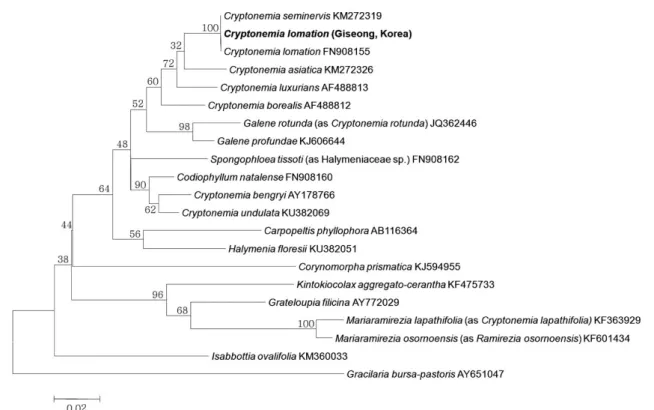
should be regarded as being conspecific based on a floristic account in the British Isles by the previous authors (Ardré 1970; Irvine and Farnham 1983). Guiry and Guiry (2018) also commented on the conspecificity of both species, even though they have treated them as two separate entities, like Silva et al. (1996). This is supported by molecular analysis in the present study (Fig. 2). The two entities nest in the same clade, and genetic distance between both sequences within the clade is not recognized. Therefore, C. lomation, which is considered to have nomenclatural priority (Guiry’s personal communication, see Guiry and Guiry 2018), is accepted tax- onomically. Cryptonemia luxurians (C. Agardh) J. Agardh originally described from Brazil has been reduced to a syn- onym of C. seminervis (Guiry and Guiry 2018). However, this species appears to be genetically distinct from C. semin
ervis (Yang and Kim 2014; the present study).
C. lomation is characterized by the following features:
erect foliose thalli arising from a discoid holdfast, fan-shaped or somewhat palmately lobed blade with an evanescent mid- rib at the base, a perennial stalk, and entwined filamentous medulla with refractive stellate cells (Irvine 1983, as C. semi
nervis; Athanasiadis 1987). In particular, it appears to be dis- tinguished from other species with a similar habit by the eva- nescent midrib at the basal blade and the stellate cells in medulla (Irvine 1983, as C. seminervis). These features are found in Korean specimens (Fig. 1B and F).
In a phylogenetic tree based on rbcL sequences, the Korean alga nests in the same clade with C. lomation (Fig. 2). In general, interspecific divergence in the Halymeniaceae is 2.6-11.6% (Sheng et al. 2012). In the present study, the val- ue in Cryptonemia was calculated as 2.3-5.4%. The genetic distance between both sequences within the clade was 0.0%.
Based on these morphological and molecular analyses, the alga that was collected from Giseong, Uljin on the east coast of Korea is identified as C. lomation, originally describ ed from Italy. Yang and Kim (2014) reported that C. lomation from Udo, Jeju Island, is assignable to C. asiatica. C. loma
tion appear does not to be distributed in subtropical waters based on their report. This study confirms the occurrence of C. lomation in a temperate region influenced more or less by the North Korea Cold Current.
Fig. 2. Phylogenetic tree of Cryptonemia species obtained from a maximum-likelihood method based on rbcL sequences. Bootstrap propor- tion values(1,000 replicates samples) are shown above the branches. Scale bar=0.02 substitutions/site.
ACKNOWLEDGEMENTS
This work was supported by a grant from the National In- stitute of Biological Resources (NIBR) funded by the Minis- try of Environment (MOE) of the Republic of Korea (NIBR 201801205), and by the Marine Biotechnology Program of the Korea Institute of Marine Science and Technology Pro- motion (KIMST) funded by the Ministry of Oceans and Fish- eries (MOF) (No. 20170431).
REFERENCES
Agardh JG. 1842. Algae maris Mediterranei et Adriatici, obser- vationes in diagnosin specierum et dispositionem generum.
Apud Fortin, Masson et Cie, Paris.
Agardh JG. 1851. Species genera et ordines algarum, seu de- scriptiones succinctae specierum, generum et ordinum, qui- bus algarum regnum constituitur. Volumen secundum: algas florideas complectens. Part 1. C.W.K. Gleerup, Lund.
Ardré F. 1970. Contribution à l’étude des algues marines du Por- tugal. I. La flore. Port. Acta Biol. B 10:137-555.
Athanasiadis A. 1987. A survey of the seaweeds of the Aegean Sea with taxonomic studies on species of the tribe Antitham- nieae(Rhodophyta). University of Gothenburg, Gothenburg.
Bertoloni A. 1818. Lettera del dottore Antonio Bertoloni Profes- sore di Botanica nell’Università di Bologna al signor Lam- ouroux Professore di Storia naturale nell’Accademia di Caen.
Opuscoli Scientifici(Bologna) 2:286-292.
Chiang YM. 1970. Morphological studies of red algae of the family Cryptonemiaceae. Univ. Calif. Publ. Bot. 58:1-95.
D’Archino R, WA Nelson and GC Zuccarello. 2014. Amalthea and Galene, two new genera of Halymeniaceae(Rhodophy- ta) from New Zealand. Bot. Mar. 57:185-201.
Dixon PS. 1961. List of marine algae collected in the Channel Islands during the joint meeting of the British Phycological Society and the Société Phycologique de France September 1960. Br. Phycol. Bull. 2:71-80.
Freshwater DW and J Rueness. 1994. Phylogenetic relationships of some European Gelidium(Gelidiales, Rhodophyta) spe- cies based upon rbcL nucleotide sequence analysis. Phyco- logia 33:187-194.
Gargiulo GM, F De Masi and G Tripodi. 1986. Structure and reproduction of Halymenia asymmetrica sp. nov.(Rhodo- phyta) from the Mediterranean Sea. Phycologia 25:144-151.
Guimarães SMPB and MT Fujii. 1998. Two species of foliose Halymenia(Halymeniaceae, Rhodophyta) from Brazil. Bot.
Mar. 41:495-504.
Guiry MD and GM Guiry. 2018. AlgaeBase. World-wide elec- tronic publication, National University of Ireland, Galway.
http://www.algaebase.org. Accessed 15 May 2018.
Hall TA. 1999. BioEdit: a user-friendly biological sequence alignment editor and analysis program for Windows 95/98/
NT. Nucl. Acids Symp. Ser. 41:95-98.
Irvine LM. 1983. Seaweeds of the British Isles. Volume 1. Rho- dophyta. Part 2A. Cryptonemiales(sensu stricto), Palmari- ales, Rhodymeniales. British Museum(Natural History), London.
Irvine LM and WF Farnham. 1983. Halymeniaceae. pp. 17-29.
In Seaweeds of the British Isles. Volume 1. Rhodophyta, Part 2A Cryptonemiales(sensu stricto), Palmariales, Rho- dymeniales. Vol. 1(2A)(Irvine LM ed.). British Museum (Natural History), London.
Kang JW. 1966. On the geographic distribution of marine algae in Korea. Bull. Pusan Fish. Coll. 7:1-123.
Kawaguchi S, K Lewmanomont and KJ McDermid. 2002. Mor- phology of Halymenia maculata J. Agardh from Vietnam.
pp. 259-266. In Vol. 8(Abbott IA and KJ McDermid eds.).
California Sea Grant College, La Jolla.
Kawaguchi S, S Shimada, HW Wang and M Masuda. 2004. The new genus Yonagunia Kawaguchi & Masuda(Halymenia- ceae, Rhodophyta), based on Y. tenuifolia Kawaguchi &
Masuda sp. nov. from southern Japan and including Y. for
mosana(Okamura) Kawaguchi & Masuda comb. nov. from southheast Asia. J. Phycol. 40:180-192.
Kim HS, SM Boo, IK Lee and CH Sohn. 2013. National List of Species of Korea Marine Algae. Jeonghaengsa, Seoul.
Kim SY, TH Seo, JK Park, GH Boo, KM Kim and SM Boo.
2012. Cryptonemia rotunda(Halymeniales) and Schizyme
nia apoda(Nemastomatales), two new records of red algae from Korea. Algae 27:1-8.
Lee YP, BS Kim and MR Kim. 2005. New record of marine algae from Jeju Island, Korea. Fish. Aquat. Sci. 8:97-108.
Nam KW and PJ Kang. 2013. Algal flora of Korea. Volume 4, Number 9. Rhodophyta: Florideophyceae: Halymeniales:
Halymeniaceae, Tsengiaceae. Marine Red Algae. National Institute of Biological Resources, Incheon.
Sheng YW, W Zhang, D Zhao and HW Wang. 2012. A morpho- logical and molecular assessment of the genus Sinotubimor
pha(Halymeniaceae, Rhodophyta). J. Syst. Evol. 50:146- 152.
Silva PC, PW Basson and RL Moe. 1996. Catalogue of the ben- thic marine algae of the Indian Ocean. Univ. Calif. Publ.
Bot. 79:1-1259.
Womersley HBS. 1994. The Marine Benthic Flora of Southern Australia-Part IIIA-Bangiophyceae and Florideophyceae (Acrochaetiales, Nemaliales, Gelidiales, Hildenbrandiales