Comparison of Quality Traits of Breast Meat from Commercial Broilers and Spent Hens in Sri Lanka
Pubudu Lakshani
1, Dinesh D. Jayasena
1†and Cheorun Jo
21Dept. of Animal Science, Uva Wellassa University, Badulla 90000, Sri Lanka
2Dept. of Agricultural Biotechnology, Center for Food and Bioconvergence, and Research Institute of Agriculture and Life Sciences, Seoul National University, Seoul 08826, Republic of Korea
ABSTRACT With the aim of investigating the differences in the quality traits of breast meat between spent hen and broiler chicken, the physicochemical characteristics, fatty acid profile and sensory attributes of breast meat from the two chicken types were assessed. A higher protein content and a lower moisture content were found in breast of spent hen compared to that of commercial broilers (P<0.05). No significant differences in crude fat and ash contents were detected between commercial broilers and the older spent hens (P>0.05). Spent hens showed a significantly lower pH value than did commercial broilers.
Spent hen meat had a higher L* value than broiler chicken meat did (P<0.05). However, a* and b* values of breast meat were similar between spent hens and commercial broilers. Water holding capacity values measured in the breast meat were comparable between the two types of chicken used in this study (P>0.05). However, spent hen meat showed a higher cooking loss value than did broiler meat (P<0.05). Total polyunsaturated fatty acid content was significantly higher in spent hen meat compared to broiler meat, in particular eicosapentaenoic acid and docosahexaenoic acid. Nevertheless, sensory characteristics of breast meat were comparable between spent hen and broiler chicken. This information can help consumers to understand better the nutritive value and important quality traits of breast meat from commercial broilers and spent hens.
(Key words: Spent hen, broilers, fatty acid profile, cooking loss, omega-3 fatty acids)
†To whom correspondence should be addressed : [email protected]
INTRODUCTION
Chicken meat has higher demand globally because of its low fat and cholesterol contents and cheap price (Farrell, 2013). In addition, there are no cultural or religious constraints for consumption of poultry meat (Barbut, 2001). Commercial chicken can be primarily divided into two groups; meat chicken (broilers) which are specially bred for meat production and layer chickens which lay eggs for human consumption (Probst, 2008). With the increasing demand for chicken meat, farm households tend to produce more broilers, especially on a large scale, because they can be sent to the market within 5 to 6 week, providing more economical benefits (Choe et al., 2009; Jayasena et al., 2013). Their meat has a high nutritive value, good taste and aroma, and soft texture and is relatively cheaper in price (Suriani et al., 2014).
Spent hens are female birds that finish their egg laying cycle and their meat has a similar nutritive value as that of commercial broilers, and is a good source of protein (Lee et
al., 2003). In particular, breast meat of spent hen is enriched with omega-3 fatty acids and low cholesterol content which already proved its beneficial effect on consumers’ health (Suriani et al., 2014). However, demand for spent hen meat is low due to broiler meat industry, lack of availability of spent hen meat in market and poor consumer knowledge re- garding this type of meat. Hence, layer farms have problems in selling these birds at a considerable price. Due to that reason, they are used for different types of processing. In Denmark, all spent hens are processed on the farm to be used as mink feed. The pulp derived from the process can also be used for the production of bio-energy, as well as meat and bone meal in a feed ration.
The quality of chicken meat vary with breed, age, gender, and diet (Probst, 2008). No scientific analysis has been con- ducted on quality characteristic of spent hens and broiler chickens in Sri Lankan context and little is known about the meat characteristics of two chicken types. Therefore, the prin- ciple objective of this study is to investigate the quality traits
of breast meat from spent hens and commercial broilers in terms of physicochemical characteristics, fatty acid profile and sensory attributes.
MATERIALS AND METHIDS
1. Breast Fillet Preparation
Ten carcasses from each types of chicken (spent hens and commercial broilers) were purchased from Seven Hills farm in Maskeliya and super market in Badulla, respectively and stored in a freezer at —80℃ until further use. Breast fillets from each bird were dissected separately after chilling at 4℃
for 24 h and they were trimmed of visible skin, fat, and connective tissues. Dissected left breast of each bird was then minced separately for further analyses. The remaining breasts were used for determination of water holding capacity (WHC) and for sensory analyses.
2. Proximate Composition
The proximate compositions of breast meat from each bird was determined by the methods of AOAC (1995). Briefly, moisture content was measured by drying the samples (2 g) at 102℃ for 15 h. Crude protein content was measured by the Kjeldahl method (KDN-103 F, China). The amount of nitrogen obtained was multiplied by 6.25 to calculate the crude protein content. Crude fat content was measured by the Soxhlet extraction system (DZKW-4, China). Crude ash content was measured by heating the samples (2 g) in a furnace set at 550℃ for 4 h.
3. pH Value
pH of breast meat from each bird was determined using a pH meter (PH700, Eutech instrument, Singapore) after calib- ration using buffers (pH 4.01, 7.00 and 10.01) at room tem- perature according to the method described by Jung et al.
(2011). The mean value of three repeated measurements from each sample was used.
4. WHC
WHC was determined based on the technique described by Hamm (1960), as described in Wilhelm et al. (2010). Samples were analyzed in duplicate. First, samples were cut into cubes
of 2.0±0.10 g. They were then carefully placed between two pieces of filter papers (No. 4; Whatman International Ltd, Maidstone, England) on acrylic plates and left under a 10-kg weight for 5 min separately. After recording the final weight of each sample, WHC was calculated using the following equation, where Wi and Wf are the initial and final weights of sample, respectively.
WHC =
×
5. Color Values
The color values were determined on the surface of minced breast meat samples from each bird using a colorimeter (CR- 410, Konica Minolta, NIC., Japan) which was calibrated aga- inst a white reference tile. The values of lightness (CIE L*), redness (CIE a*) and yellowness (CIE b*) were obtained using the average value of three repeated measurements taken from different locations on the meat surface.
6. Cooking Loss
Approximately 40 g of breast meat from each bird was packed in low density polyethylene bags and properly sealed.
Samples were then cooked in a water bath (LWB-IIID, Daihan Labtech Co. Ltd., Korea) at 85℃ for 30 minutes. Meat samples were then cooled to room temperature and final weights were taken after removing excess moisture on the meat surface.
The cooking loss was calculated based on the weight loss took place during cooking as a percentage of the initial weight (Piao et al., 2015).
7. Fatty Acids Composition
Analysis of fatty acid profiles were conducted at Analytical Chemistry Laboratory in National Aquatic Resources Research and Development Agency (NARA), Colombo, Sri Lanka. Li- pids were extracted from breast meat samples following the method described by Bligh and Dyer (1959). The fatty acid methyl esters (FAME) were generated and then analyzed by capillary gas chromatography. The capillary gas chromatograph (GC-2014, Shimadzu, Kyoto, Japan) was equipped with a fused silica DB wax capillary column (30 m × 0.32 m, film 0.25 µm) and a flame ionization detector. The initial temperature
of the column was set at 160℃ and finally increased to 240
℃ at a rate of 3℃ min—1. The detect or temperature was set at 270℃, while the temperature at the injection port was maintained at 240℃. Helium was used as the carrier gas at 14 psi. Relative quantities were expressed as weight percent of total fatty acids identified via comparison of retention times to known FAME standards (17 fatty acid methyl esters mix, Sigma-Aldrich).
8. Sensory Evaluation
Breast meat samples from commercial broilers and spent hens were heated in a pot of water (1.5 times the weight of chicken meat) separately for 30 minutes until an internal tem- perature of 72℃ reached. Meat samples (2.0 × 3.0 × 1.5 cm) were then placed on coded white dishes and served with drinking water. Thirty panelists, mainly students and staff members of Uva Wellassa University of Sri Lanka, recorded their preferences using a 7-point hedonic scale (7=like very much, 6=like, 5=moderately like, 4=neither like nor dislike, 3=moderately dislike, 2=dislike, 1=dislike very much). The sensory parameters tested were color, odor, taste, texture, jui- ciness, and overall acceptance. All samples were labeled with random 3-digit numbers and presented to panelists in random order.
9. Statistical Analysis
Analysis of variance was conducted by the procedure of General Linear Model using SAS program version 9.1 (SAS, 2002, SAS Institute, Cary, NC, USA). Comparisons of means were analyzed by Duncan’s multiple range tests at P<0.05.
Mean values and standard error of the means (SEM) were reported.
RESULTS AND DISCUSSION
1. Proximate Composition
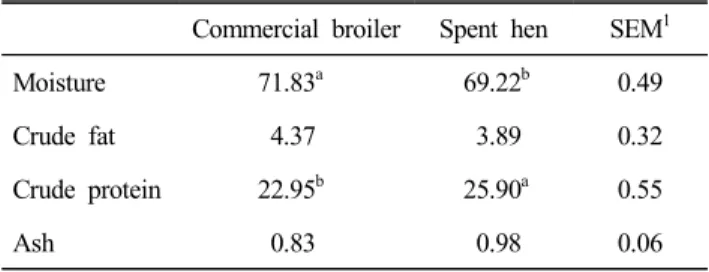
The proximate composition of breast meat from commercial broilers and spent hens is shown in Table 1. It was observed that moisture and protein contents of breast meat were signi- ficantly different (P<0.05) between spent hens and commercial broilers. A higher protein content and a lower moisture content were found in breast of spent hen compared to that of commer-
Table 1. Proximate composition (%) of breast meat from co- mmercial broilers and spent hen
Commercial broiler Spent hen SEM1
Moisture 71.83a 69.22b 0.49
Crude fat 4.37 3.89 0.32
Crude protein 22.95b 25.90a 0.55
Ash 0.83 0.98 0.06
1 Standard error of the means (n=20).
a,b Mean values in the same row with different superscripts di ffer significantly (P<0.05).
cial broilers (P<0.05). These findings are in well agreement with those of Okarini et al. (2013). Similarly, Suriani et al.
(2014) described that a mixture of breast and thigh fillets from spent hen and broiler chicken comprised of 73.45% and 75.48% of moisture (P<0.05) and 23.99% and 21.81% of protein (P<0.05), respectively. In addition, Chuaynukool et al.
(2007) observed a higher moisture content in commercial broiler breast meat as opposed to spent hen breast meat.
However, no significant differences in crude fat and ash con- tents of breast meat were detected between commercial broilers and spent hens (P>0.05) in the present study. Similarly, Chuay- nukool et al., (2007) detected comparable fat contents in breast meat between spent hens and commercial broilers (P>
0.05). In contrast, spent hen meat had a significantly higher fat content (Suriani et al., 2014) and commercial broiler meat contained a higher ash content (Chuaynukool et al., 2007;
Okarini et al., 2013) compared to their counterparts (P<0.05).
In addition, Ji et al. (2007) revealed that older birds had more fat in their meat than the younger birds. However, the results of the present study may confirm that the genotypic effect on fat deposition could go beyond age influence in some cases (Tang et al., 2009). The chemical composition of chicken meat can be affected by breed, sex, age, type of muscle, rearing system and nutrition (Wattanachant et al., 2004; Okarini et al., 2013; Suriani et al., 2014).
2. pH
Muscle pH is a critically important factor that affects all quality attributes because both the rate and extent of pH decline greatly affect meat properties (Dadgar et al., 2011).
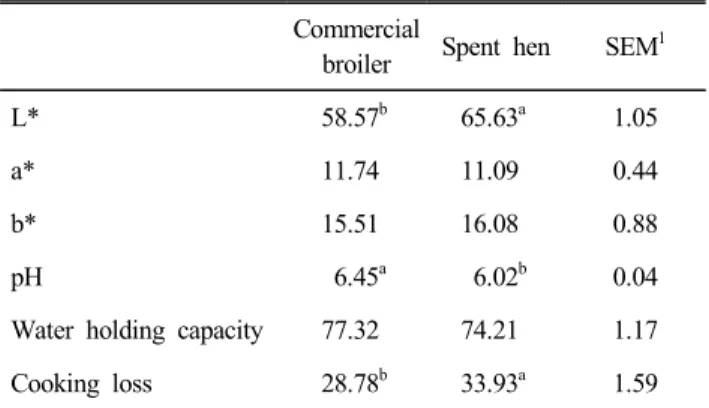
In terms of the pH of breast meat, spent hens showed a significantly lower value than did commercial broilers (Table 2). Similar to the results of the present study, Chuaynukool et al. (2007) reported that breast meat of commercial broiler chicken showed a higher pH value than that of spent hen (P<
0.05). Differences in pH values among the types of chicken investigated may be attributed to the pre-slaughter stress, which changes muscle glycogen content and eventually has an effect on the rate and extent of pH decline (Berri et al., 2007). Because ultimate pH is considered to be the main factor that affects all quality attributes (Dadgar et al., 2011), observed changes in pH values may affect the quality attributes including color, WHC, and cooking loss.
3. Surface Meat Color
Color is an important factor that influences consumer pre- ference for meat (Jayasena et al., 2013). According to Fletcher (1999), various factors, including heme pigments, genetics, and feeding can affect the color of meat. With regards to color values, the L* value of breast meat was different (P<0.05) between the types of chicken used (Table 2). Spent hen meat had a higher L* value than broiler chicken meat did (P<
0.05). However, a* and b* values of breast meat were similar between spent hens and commercial broilers. Similarly, Chuay- nukool et al. (2007) observed higher L* values in breast meat of spent hen compared to that of commercial broilers (P<
Table 2. Surface meat color, pH, water holding capacity (%) and cooking loss (%) of breast meat from commercial broilers and spent hen
Commercial
broiler Spent hen SEM1
L* 58.57b 65.63a 1.05
a* 11.74 11.09 0.44
b* 15.51 16.08 0.88
pH 6.45a 6.02b 0.04
Water holding capacity 77.32 74.21 1.17
Cooking loss 28.78b 33.93a 1.59
1 Standard error of the means (n=20).
a,b Mean values in the same row with different superscripts di- ffer significantly (P<0.05).
0.05). According to Swatland (2008), low-pH chicken breasts had the highest reflectance, whereas high-pH chicken breasts had the greatest transmittance into their tissues and across individual muscle fibers which is associated with darker meat (Fletcher, 1999). In addition, Petracci et al. (2004) reported that pH was negatively correlated with lightness in turkey and chicken breast meat. Thus, the brighter color of spent hen breast meat can be attributed to relatively low pH value of its meat (P<0.05; Table 2). In addition, variations between myoglobin content between the chicken types might be another reason for the observed color variation in the present study.
4. WHC
Huff-Lonergan and Lonergan (2005) explained that early postmortem events, including the rate and extent of pH de- cline; proteolysis; and even protein oxidation, affect the ability of meat to retain moisture. In addition, Tang et al. (2009) revealed that WHC was lowest for fast-growing broilers (Avian and Lingnanhuang), intermediate for layers (Hy-Line Brown), and highest for local breeds (Wenchang and Xianju). However, as shown in Table 2, the WHC values measured in the breast meat were not significantly different (P>0.05) between the two types of chicken used in this study.
5. Cooking Loss
Cooking loss of breast meat was significantly different bet- ween the two types of chicken used in the present study (P<
0.05; Table 2). Spent hen meat showed a higher cooking loss value than did broiler meat (P<0.05). Similarly, Chuaynukool et al. (2007) detected a higher cooking loss value in breast meat of spent hens compared with commercial broiler chickens.
Dawson et al. (1991) reported a moisture loss of 0.8 to 2.9%
for broiler meat and 2.9 to 7.4% for hen meat during aseptic processing at high temperature (120 to 145℃) and short time (10 s). Lower pH is associated with lower WHC, which results in increased cooking loss and drip loss (Barbut, 2001). Hence, the higher cooking loss value of spent hen breast meat as compared with broiler breast meat can be attributed to signi- ficantly lower pH value of spent hen breast meat (P<0.05;
Table 2).
6. Fatty Acids Composition
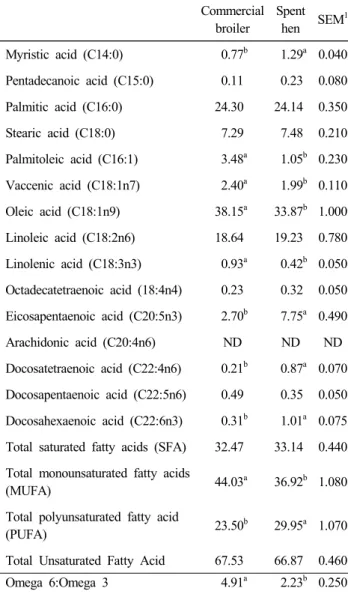
Fatty acids profiles of breast meat from spent hens and com- mercial broilers are presented in Table 3. The main fatty acid found was oleic acid followed by palmitic acid, linoleic acid, and stearic acid. These findings are in well agreement with those of Suriani et al. (2014). Myristic acid (C14:0) content of breast meat was significantly higher in spent hen than in com- mercial broilers (P<0.05). Total SFA contents of breast meat reported in the present study were not significantly different between broiler meat and spent hen meat (P>0.05) and were
Table 3. Fatty acid composition (%) of breast meat from co- mmercial broilers and spent hen
Commercial broiler
Spent hen SEM1 Myristic acid (C14:0) 0.77b 1.29a 0.040 Pentadecanoic acid (C15:0) 0.11 0.23 0.080
Palmitic acid (C16:0) 24.30 24.14 0.350
Stearic acid (C18:0) 7.29 7.48 0.210
Palmitoleic acid (C16:1) 3.48a 1.05b 0.230 Vaccenic acid (C18:1n7) 2.40a 1.99b 0.110 Oleic acid (C18:1n9) 38.15a 33.87b 1.000 Linoleic acid (C18:2n6) 18.64 19.23 0.780 Linolenic acid (C18:3n3) 0.93a 0.42b 0.050 Octadecatetraenoic acid (18:4n4) 0.23 0.32 0.050 Eicosapentaenoic acid (C20:5n3) 2.70b 7.75a 0.490
Arachidonic acid (C20:4n6) ND ND ND
Docosatetraenoic acid (C22:4n6) 0.21b 0.87a 0.070 Docosapentaenoic acid (C22:5n6) 0.49 0.35 0.050 Docosahexaenoic acid (C22:6n3) 0.31b 1.01a 0.075 Total saturated fatty acids (SFA) 32.47 33.14 0.440 Total monounsaturated fatty acids
(MUFA) 44.03a 36.92b 1.080
Total polyunsaturated fatty acid
(PUFA) 23.50b 29.95a 1.070
Total Unsaturated Fatty Acid 67.53 66.87 0.460
Omega 6:Omega 3 4.91a 2.23b 0.250
1 Standard error of the means (n=20).
a,b Mean values in the same row with different superscripts di- ffer significantly (P<0.05).
slightly higher than those reported by Suriani et al. (2014).
Palmitoleic acid (C16:1), oleic acid (C18:1n9) and vaccenic acid (C18:1n7) were found as the main MUFA in breast meat (Table 3) and their contents were significantly higher in com- mercial broilers compared to spent hens (P<0.05). As a result, total MUFA content of broiler breast meat was also signifi- cantly greater compared with that of spent hen meat (P<0.05;
Table 3). Similar results have been reported by Suriani et al.
(2014) regarding MUFA content between spent hen and com- mercial broilers.
Linoleic acid (C18: 2n6), linolenic acid (C18:3n3), eicosa- pentaenoic acid (EPA; C20:5n3), docosatetraenoic acid (C22:
4n6), docosapentaenoic acid (C22:5n6) and docosahexaenoic acid (DHA; C22:6n3) were found as the main PUFA in breast meat (Table 3). However, linoleic acid content of breast meat was comparable between the two chicken types (P>0.05). In contrast, spent hen breast meat had significantly higher con- tents of EPA, docosatetraenoic acid and DHA than did broiler breast meat. Nevertheless, linolenic acid content of breast meat was higher in commercial broilers as opposed to spent hens and Suriani et al. (2014) observed similar findings on linolenic acid content. Total PUFA content of spent hen meat (29.95
%) was significantly higher compared to that of broiler meat (23.50%).
The beneficial effect of PUFA depends on the ratio of the omega-6 (n-6) and omega-3 (n-3) fatty acids. In general the ideal ratio is 4:1 (Suriani et al., 2014). In this study, n-6: n-3 ratio was higher in breast meat of broiler chicken than that of spent hen chicken (Table 3). Fatty acid composition in chicken meat can be affected by many factors such as species, rearing environment, and feeding system (Suriani et al., 2014).
7. Sensory Evaluation
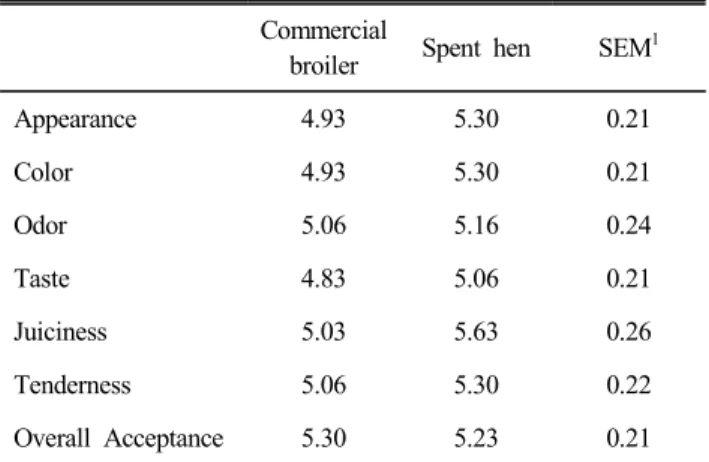
Table 4 shows the results of the sensory characteristics of breast meat from the two types of chicken studied. According to Table 4, sensory evaluation data showed no difference bet- ween spent hen and broiler breast meat for appearance, color, odor, taste, juiciness, tenderness, and overall acceptance (P>
0.05).
CONCLUSION
Table 4. Sensory evaluation of breast meat from commercial broilers and spent hen
Commercial
broiler Spent hen SEM1
Appearance 4.93 5.30 0.21
Color 4.93 5.30 0.21
Odor 5.06 5.16 0.24
Taste 4.83 5.06 0.21
Juiciness 5.03 5.63 0.26
Tenderness 5.06 5.30 0.22
Overall Acceptance 5.30 5.23 0.21
1 Standard error of the means (n=60).
In general, breast fillet of spent hen had a higher crude protein content, lower pH, higher L* value and higher cook- ing loss compared to that of broiler chicken. In addition, spent hen breast meat is a good source of PUFA compared with commercial broiler breast meat, in particular EPA and DHA.
However, sensory characteristics of breast meat were com- parable between spent hen and broiler chicken.
REFERENCES
AOAC 1995 Official Methods of Analysis. 16th edn. Association of Official Analytical Chemists, Washington, DC, USA.
Bligh EG, Dyer WJ 1959 A rapid method for total lipid ex- traction and purification. Can J Biochem Physiol 37:911- 917.
Barbut S 2001 Poultry products processing: An industry guide, Taylor and Francis Group, Boca Raton.
Berri C, Bihan-Duval L, Debut M, Santé-Lhoutellier V, Baéza E, Gigaud V, Jégo Y, Duclos M 2007 Consequence of muscle hypertrophy on characteristics of Pectoralis major muscle and breast meat quality of broiler chickens. J Anim Sci 85:2005-2011.
Choe JH, Lee JC, Jo, C 2009 Relationship between the eco- nomical defects of broiler meat carcass and quality grade A by a meat grader. Korean J Food Sci An 29:494-499.
Chuaynukool K, Wattanachant S, Siripongvutikorn S, Yai H 2007 Chemical and physical properties of raw and cooked
spent hen, broiler and Thai indigenous chicken muscles in mixed herbs acidified soup (Tom Yum). J Food Technol 5:180-186.
Chueachuaychoo A, Wattanachant S, Benjakul S 2011 Quality characteristics of raw and cooked spent hen Pectoralis major muscles during chilled storage: Effect of salt and pho- sphate. Int Food Res J 18:601-613.
Dadgar S, Lee E, Leer T, Crowe T, Classen H, Shand P 2011 Effect of acute cold exposure, age, sex, and lairage on broiler breast meat quality. Poultry Sci 90:444-457.
Dawson P, Sheldon B, Miles J 1991 Effect of aseptic proce- ssing on the texture of chicken meat. Poultry Sci 70:2359- 2367.
Farrell D 2013 The role of poultry in human nutrition.
Available at http://www.fao.org/docrep/013/al709e/al709e00.
Fletcher D 1999 Broiler breast meat color variation, pH, and texture. Poultry Sci 78:1323-1327.
Hamm R 1960 Biochemistry of meat hydration. Adv Food Res 10:335-362.
Huff-Lonergan E, Lonergan SM 2005 Mechanisms of water- holding capacity of meat: The role of postmortem bioche- mical and structural changes. Meat Sci 71:194-204.
Jayasena DD, Jung S, Kim HJ, Bae YS, Yong HI, Lee JH, Kim JG, Jo C 2013 Comparison of quality traits of meat from Korean native chickens and broilers used in two di- fferent traditional Korean cuisines. Asian Australas J Anim Sci 26:1038-1046.
Ji CL, Zhang DX, Zhang XQ 2007 Effect of slaughter age on breast muscle quality in dwarf yellow chicken. China Poult 29:12-14.
Jung YK, Jeon HJ, Jung S, Choe JH, Lee JH, Heo KN, Kang BS, Jo C 2011 Comparison of quality traits of thigh meat from Korean native chickens and broilers. Korean J Food Sci An 31:684-692.
Lee S, Min J, Kim I, Lee M 2003 Physical evaluation of po- pped cereal snacks with spent hen meat. Meat Sci 64:383- 390.
Okarini IA, Purnomo H, Radiati LE 2013 Proximate, total phe- nolic, antioxidant activity and amino acids profile of Bali indigenous chicken, spent laying hen and broiler breast fillet. Int J Poult Sci 12(7):415-420.
Petracci M, Betti M, Bianchi M, Cavani C 2004 Color va- riation and characterization of broiler breast meat during processing in Italy. Poultry Sci 83:2086-2092.
Piao MY, Jo C, Kim HJ, Lee HJ, Kim HJ, Ko J, Baik M 2015 Comparison of carcass and sensory traits and free amino acid contents among quality grades in loin and rump of Korean cattle steer. Asian Australas J Anim Sci 28:1629- 1640.
Probst Y 2008 Nutrient composition of chicken meat. Rural Industries Research and Development Corporation, King- ston. Available at file:///C:/Users/user/Downloads/08-210.
SAS 2002 SAS/STAT software for PC. Release 9.1, SAS Inst.
Inc., Cary, NC, USA
Suriani NW, Purnomo H, Estiasih T, Suwetja IK 2014 Physi- cochemical properties, fatty acids profile and cholesterol content of indigenous Manado chicken, broiler and spent
hen meat. Int J ChemTech Res 6(7):3896-3902.
Swatland H 2008 How pH causes paleness or darkness in chicken breast meat. Meat Sci 80:396-400.
Tang H, Gong Y, Wu C, Jiang J, Wang Y, Li K 2009 Variation of meat quality traits among five genotypes of chicken.
Poultry Sci 88:2212-2218.
Wattanachant S, Benjakul S, Ledward D 2004 Composition, color, and texture of Thai indigenous and broiler chicken muscles. Poultry Sci 83:123-128.
Wilhelm AE, Maganhini MB, Hernandez-Blazquez FJ, Ida EI, Shimokomaki M 2010 Protease activity and the ultra- structure of broiler chicken PSE (pale, soft, exudative) meat.
Food Chem 119:1201-1204.
Received Mar. 11, 2016, Revised Apr. 27, 2016, Accepted Apr. 27, 2016