Thyroglossal duct cyst (TGDC) is the most common type of midline neck masses in children. Though usual- ly benign, 1% of cysts may undergo neoplastic change.
The most common histological subtype is papillary car- cinoma (80%) followed in order of frequency by mixed follicular-papillary, squamous, follicular, anaplastic, and hurthle-cell carcinoma (1).
The synchronous occurrence of thyroglossal duct car- cinoma and thyroid carcinoma in the thyroid gland is extremely rare. Debate exists as to where the original sites of primary process are located as well as whether thyroglossal duct carcinoma and thyroid carcinoma tru-
ly are synchronous. We report a case of coexistence of papillary carcinomas in the thyroglossal duct cyst and thyroid gland.
Case Report
A 67-year-old male patient presented with an anterior midline neck mass. A 10-year history was highlighted by the slowly enlarging mass in the preceding months, however no dyspnea, dysphasia, or hoarseness was not- ed. A physical examination revealed a 3-cm midline mass below the hyoid bone that was painless, not ten- der, and well-demarcated. The thyroid gland was of nor- mal size with no palpable nodules. Further, no cervical lymph nodes were palpated. A thyroid function test re- vealed normal triiodothyronine, thyroxine, thyroid stim- ulating hormone (TSH), and thyroglobulin levels. Lastly, other laboratory investigations revealed no abnormali- ties.
J Korean Soc Radiol 2011;64:445-448
─ 445 ─
Concurrent Papillary Carcinoma Arising in Thyroglossal Duct Cyst and Thyroid Gland: A Case Report1
Kyoung Tae Kim, M.D., Yeo Ju Kim, M.D., Sei Joong Kim, M.D.
2, Young Up Cho, M.D.
2, Yong Sun Jeon, M.D., Youn Jeong Kim, M.D.
Departments of 1Radiology and 2General Surgery, Inha University School of Medicine, Incheon, Korea
This work was supported by Inha University Hospital Research Grant.
Received December 14, 2010 ; Accepted March 12, 2011
Address reprint requests to : Youn Jeong Kim, M.D., Department of Radiology, Inha University School of Medicine, 3-Ga, Sinheung-dong, Jung-gu, Incheon 400-711, Korea.
Tel. 82-32-890-2769 Fax. 82-32-890-2743 E-mail: [email protected]
The occurrence and diagnosis of thyroglossal duct carcinoma is very rare. The syn- chronous occurrence of papillary carcinomas arising in a thyroglossal duct cyst (TGDC) and thyroid gland is extremely rare. Sistrunk’s surgical technique must always be the initial treatment for a TGDC. However, if there is an intra-thyroidal carcinoma or local invasion, thyroidectomy has to be considered. Accurate pre-operative radiolog- ical evaluation should be performed in order to plan a surgical strategy. The aim of this report was to review our experience in the management of papillary thyroid carcino- ma associated with TGDC. Our patient was a 67-year-old man who had a mural, mi- cro-calcified nodule within a palpable, thick-walled cyst at the level of the hyoid and synchronously, a small macro-calcified mass in the isthmus of the thyroid gland.
Index words : Thyroglossal cyst
Thyroid Neoplasms
Carcinoma, Papillary
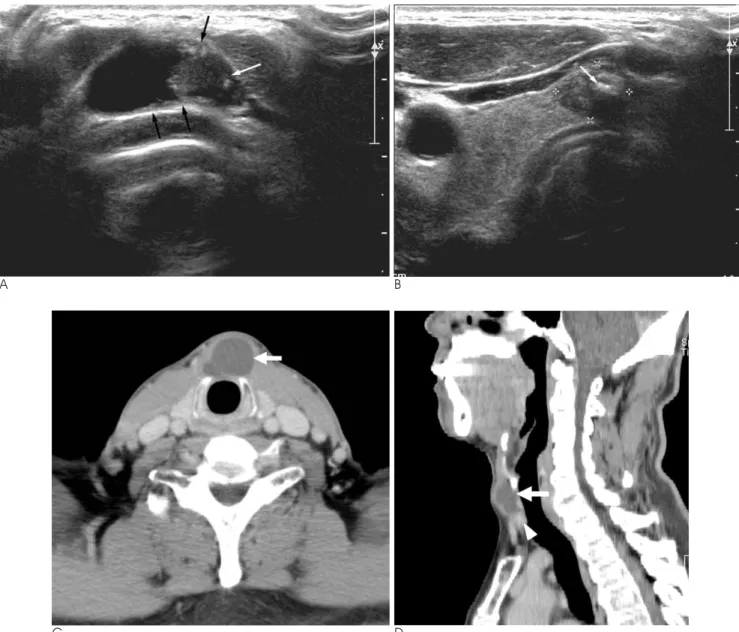
Ultrasound (US) demonstrated a 0.8-cm mural, micro- calcified nodule within a 2.6 × 2.3 cm, partially thick- walled cyst at the level of the hyoid (Fig. 1A). In addi- tion, there was a 1.8 × 0.8 cm, oval shaped, macro-cal- cified mass in the isthmus of the thyroid gland that is suggestive of a malignant nodule (Fig. 1B). A computed tomography (CT) scan demonstrated a cystic mass con- taining an enhancing mural nodule below the level of the hypoid bone (Figs. 1C, D). Additionally, a small dense calcified mass in the isthmus was identified adja-
cent to the cystic mass. On the basis of the clinical and imaging findings, our diagnosis was the coexistence of carcinomas arising in a TGDC and thyroid carcinoma.
The patient underwent a Sistrunk operation and total thyroidectomy under general anesthesia. Gross exami- nation of the cystic mass showed a 3 cm, cystic mass filled with yellow serous fluid, and a 1.0 × 0.9 × 0.6 cm mural nodule protruded from the inner surface of the wall. The nonneoplastic cystic spaces were partially lined by flattened epithelial cells. Histopathological ex-
Kyoung Tae Kim, et al: Concurrent Papillary Carcinoma Arising in Thyroglossal Duct Cyst and Thyroid Gland
─ 446 ─
A B
C D
Fig. 1. Concurrent papillary carcinomas arising in the thyroglossal duct cyst and thyroid gland in a 67-year-old man.
A. Axial sonogram shows a 1-cm, intramural, micro-calcified nodule (white arrow) within an irregular thick walled cystic mass (black arrows). The cystic mass was located below the level of the hypoid bone.
B. Axial sonogram shows a 1.8 × 0.8 cm heterogeneous hypoechoic nodule with calcifications (white arrow) in the isthmus of the thyroid.
C. Axial contrast-enhanced CT scan shows a 2.6 × 2.0 cm cystic mass with septation at the level of the thyroid (white arrow), rep- resenting the thyroglossal duct cyst.
D. Sagittal contrast-enhanced CT scan shows an enhancing mural nodule (white arrowhead) in a cystic mass (white arrow).
amination disclosed papillary carcinoma that was con- fined to the cyst and isthmic papillary carcinoma.
After the procedure, the patient was discharged with- out further significant complications. Three months af- ter the operation, the thyroglobulin level in the blood following TSH stimulation was normal (< 1 ng/mL), and anti-thyroglobulin antibody was 1.42 U/mL (0-55 U/mL). The patient was treated with radioiodine abla- tion. Over the course of a 2-year follow-up from time of the procedure, ultrasound of the neck displayed no re- currence in the thyroid gland or cervical lymph nodes.
Discussion
The median age for development of carcinoma in a thyroglossal duct cyst is 40 years, and few cases present before 14 years (2). Papillary carcinoma is the most com- mon histologic subtype, with a higher female to male ra- tio (female: male =3:2) (3). Papillary carcinoma within thyroglossal duct cyst usually presents as an asympto- matic mass. Uncommonly, dysphasia, voice change, and draining cutaneous sinuses may be developed.
The clinical features of a thyroglossal duct cyst do not usually distinguish it from a benign TGDC.
Thyroglossal duct carcinoma may present with a rapidly enlarging neck mass, but the same history can be elicit- ed in patients with recent infection in a benign cyst.
Thus, in most cases a diagnosis of malignancy is not made until after surgery. Nevertheless, carcinoma should be suspected in any TGDC that is hard, fixed, ir- regular, or associated with lymphadenopathy (4).
The differential diagnosis of central cervical cystic le- sions involves many diseases including a dermoid cyst, mucocele, thyroid diseases (benign colloid nodule, ade- noma, papillary carcinoma, and cystic Hashimoto’s thy- roiditis in the pyramidal lobe), a delphian lymph node with cystic thyroid papillary carcinoma, a cystic parathyroid tumor or abscess, or a branchial cleft cyst located in the midline, and a complicated TGDC (5).
Some authors recommend the use of a US-guided FNAB (fine needle aspiration biopsy) in all these tumors be- cause due to the variability.
The origin of thyroid cancer in a thyroglossal duct cyst is debated. Some believe that its occurrence is de novo from islands of normal thyroid tissue found in thyroglos- sal duct remnants. This theory is supported by the fact that ectopic thyroid nests have been identified histologi- cally in as many as 62% of the surgical specimens of thy- roglossal duct cysts, and that carcinoma in a thyroglossal
duct cyst is found without evidence of thyroid malig- nancy (6). Additionally, the synchronous occurrence of papillary carcinomas in a thyroglossal duct cyst and the thyroid gland can be explained as a representative of multifocal tumors. Others suggest that they are proba- bly metastases from a thyroid carcinoma through a patent thyroglossal duct (7).
The thyroid carcinoma, concomitant with TGDC car- cinoma is rare and is frequently not palpable or de- tectable by preoperative imaging techniques (8). A radio- logic imaging study can alter the surgical plan. The US findings of TGDC may be variable, but the presence of a solid component should alert physicians to the possibili- ty of the carcinoma. The CT findings of TGDC carcino- ma are a solid nodule in the cyst, as observed our case, calcification, and an irregular margin.
The reported rate of nodal metastasis in patients with TGDC carcinoma is low. A prior study has reported that the lymphatic drainage route may differ from thyroid carcinoma (9). It is supposed that the drainage runs pri- marily along the superior thyroid vessels, directly to the lateral neck and without direct drainage to the central neck, because of the anatomic location of TGDC.
The standard surgical procedure for the management of thyroglossal duct anomalies is the Sistrunk proce- dure, which consists of excising the entire tract of the thyroglossal duct, midportion of the hyoid bone, and a portion of the base of the tongue. Thyroidectomy and regional neck dissection is indicated only if there is an intra-thyroidal carcinoma or local invasion of TGDC carcinoma.
Surgeons should be aware of concurrent TGDC and thyroid carcinomas. Moreover, a pre-operative radiolog- ical evaluation should be performed in order to accu- rately plan the most effective surgical strategy. We re- port a rare case of the coexistence of papillary carcino- mas in the TGDC and thyroid gland.
References
1. Van Vuuren PA, Balm AJ, Gregor RT, Hilgers FJ, Loftus BM, Delprat CC, et al. Carcinoma arising in thyroglossal remnants. Clin Otolaryngol Allied Sci 1994;19:509-515
2. Dedivitis RA, Guimarães AV. Papillary thyroid carcinoma. In thy- roglossal duct cyst. Int Surg 2000;85:198-201
3. Weiss SD, Orlich CC. Primary papillary carcinoma of a thyroglos- sal duct cyst: report of a case and literature review. Br J Surg 1991;78:87-89
4. Prasad MC, Rrangaswamy M, Kumar N, Shukla NK. Papillary car- cinoma of a thyroglossal duct remnant with Hashimoto’s thyroidi- tis. Ear Nose Throat J 1990;69:358-360
J Korean Soc Radiol 2011;64:445-448
─ 447 ─
5. Massol N, Nizam S & Mazzaferri E. Cystic thyroid nodules: diag- nostic and therapeutic dilemmas. Endocrinologist 2002;12:185-198 6. Miccoli P, Minuto MN, Galleri D, Puccini M, Berti P. Extent of
surgery in thyroglossal duct carcinoma: reflections of a series of eighteen cases. Thyroid 2004;14:121-123
7. Pacheco-Ojeda L, Micheau C, Stafford N, Marandas P, Luboinski B, Martinez AL. Papillary carcinoma in thyroglossal duct rem- nants. Eur Arch Otorhinolaryngol 1991;248:268-270
8. Park MH, Yoon JH, Jegal YJ, Lee JS. Papillary thyroglossal duct cyst carcinoma with synchronous occult papillary thyroid micro- carcinoma. Yonsei Med J 2010;51:609-611
9. Hartl DM, Al Ghuzlan A, Chami L, Leboulleux S, Schlumberger M, Travagli JP. High rate of multifocality and occult lymph node metastases in papillary thyroid carcinoma arising in thyroglossal duct cysts. Ann Surg Oncol 2009;16:2595-2601
Kyoung Tae Kim, et al: Concurrent Papillary Carcinoma Arising in Thyroglossal Duct Cyst and Thyroid Gland
─ 448 ─
대한영상의학회지 2011;64:445-448
갑상설관낭과 갑상선내에 동시에 발생한 암종:
증례 보고11
인하대병원 영상의학과
2