https://doi.org/10.20307/nps.2017.23.3.183
183
Luteolin 5- O-glucoside from Korean Milk Thistle, Cirsium maackii, Exhibits Anti-Inflammatory Activity via Activation of the Nrf2/HO-1 Pathway
Hyun Ah Jung
1,†, Anupom Roy
2,†, Qudeer Ahmed Abdul
2, Hyeung Rak Kim
2,Hee Juhn Park
3, and Jae Sue Choi
2,*
1
Department of Food Science and Human Nutrition, Chonbuk National University, Jeonju 54896, Republic of Korea
2
Department of Food and Life Science, Pukyong National University, Busan 48513, Republic of Korea
3
Department of Pharmaceutical Engineering, Sangji University, Wonju 220-702, Republic of Korea
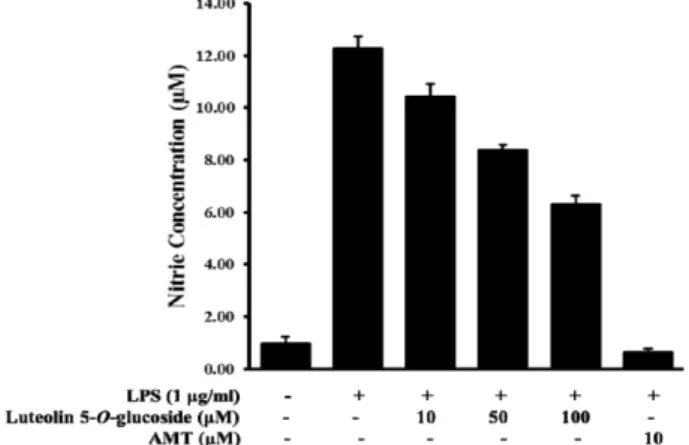
Abstract – Luteolin 5-O-glucoside is the major flavonoid from Korean thistle, Cirsium maackii. We previously reported the anti-inflammatory activities of luteolin 5-O-glucoside in lipopolysaccharide (LPS)-stimulated RAW 264.7 cells. In this study, we determined the anti-inflammatory mechanisms of luteolin 5-O-glucoside through the inhibition of nitric oxide (NO) production in vitro and in vivo. Results revealed that luteolin 5-O-glucoside dose- dependently inhibited NO production and expression of iNOS and COX-2 in LPS-induced RAW 264.7 cells.
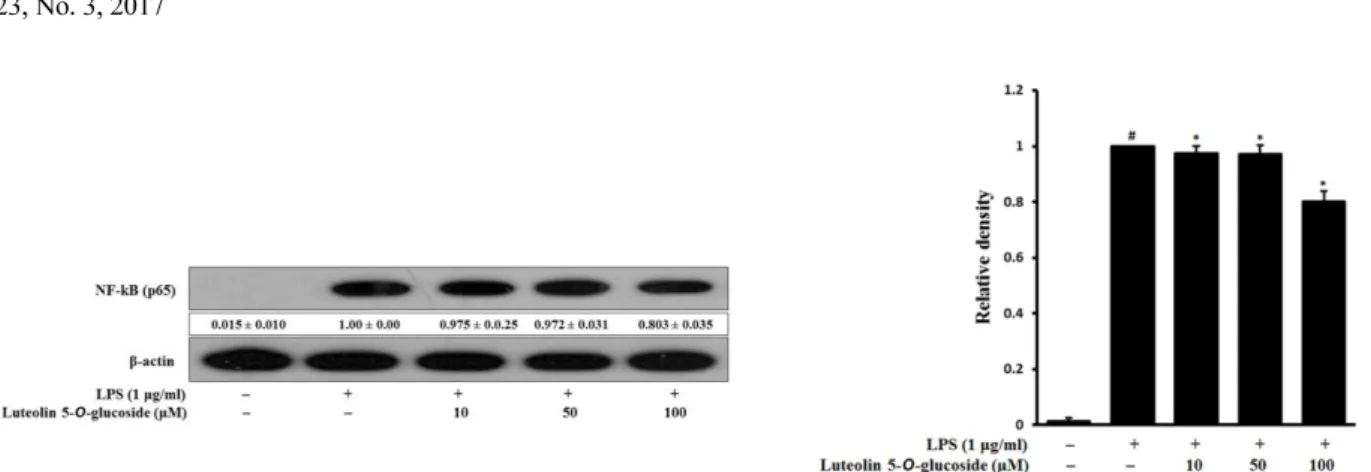
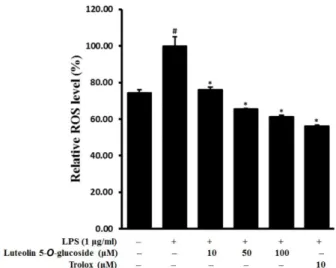
Luteolin 5-O-glucoside also significantly inhibited the translocation of NF- κB, the activation of MAPKs, and ROS generation in LPS-induced RAW 264.7 cells. In addition, protein expressions of Nrf-2 and HO-1 were also upregulated by luteolin 5-O-glucoside treatment. Moreover, luteolin 5-O-glucoside inhibited λ-carrageenan- induced mouse paw edema by 65.34% and 48.31% at doses of 50 and 100 mg/kg body weight, respectively.
These findings indicate potential anti-inflammatory effect of luteolin 5-O-glucoside particularly by downregulating NF- κB and upregulating HO-1/Nrf-2 pathway.
Keywords – Luteolin 5-O-glucoside, Cirsium maackii, Anti-inflammation, HO-1/Nrf-2, NF-κB, λ-carrageenan
Introduction
Inflammation is an essential biological response of the body to many stimuli and leads to the release of proinflammatory cytokines and mediators. Various factors such as microbial infections, chemicals, and immunological reactions are associated with inflammation. Although inflammation is a beneficial host response to tissue injury, it may result in chronic conditions such as cancer, cardiovascular disease, diabetes, pulmonary disorders, neurological disease, and arthritis.
1The suppression of inflammatory mediators or signaling pathways including nitric oxide (NO), inducible nitric oxide synthase (iNOS), cyclooxygenase (COX-2), prostaglandin E
2(PGE
2), nuclear factor kappa B (NF- κB), mitogen-activated protein kinase (MAPK), reactive oxygen species (ROS), and proinflam- matory cytokines (tumor necrosis factor [TNF]- α, interleukin [IL]-6, and IL-1 β) are the treatment focus points of inflammatory diseases.
2The transcription factor NF- κB
plays a vital role in inflammatory and acute response.
3In general, NF- κB subunits are inactive and bound to IκB inside the cytoplasm. Phosphorylation of I κB releases NF- κB, allowing it to enter the nucleus and activate gene expression.
4NF- κB is a central regulator of proinflammatory gene expression and mediates the synthesis of cytokines such as TNF- α, IL-1β, IL-6, and IL-8.
5It also controls the transcription of other inflammatory mediators such as COX-2 and iNOS.
5Activation of NF- κB is also controlled by cellular kinases such as MAPKs and phosphatidylinositol 3-kinase (PI3K)/protein kinase B (Akt) signaling pathways.
MAPKs, extracellular signal-regulated kinase (ERK), c- Jun N-terminal kinase (JNK), and p38 MAPK have been associated with the transcriptional regulation of inflam- matory genes via NF- κB activation.
6Heme oxygenase-1 (HO-1), an inducible and essential enzyme in heme catabolism, degrades heme and produces biliverdin, ferrous iron, and carbon monoxide. These products contribute to the anti-inflammatory effects of HO-1.
7Recent studies showed that HO-1 inhibits the excessive production of proinflammatory cytokines as well as ROS in LPS- stimulated RAW264.7 cells.
8HO-1 induction is regulated at the transcriptional level by a transcription factor called nuclear transcription factor-E2-related factor 2 (Nrf-2).
*Author for correspondence
Jae Sue Choi, Department of Food and Life Science, Pukyong National University, Busan 48513, Republic of Korea.
Tel: +82-51-629-5845; E-mail: [email protected]
†