Circumferential Resection Margin Involvement in Stage III Rectal Cancer Patients Treated with Curative Resection Followed by Chemoradiotherapy: A Surrogate Marker for Local Recurrence?
Jeonghyun Kang,
1Hyunki Kim,
2Hyuk Hur,
1Byung Soh Min,
1Seung Hyuk Baik,
1Kang Young Lee,
1Seung Kook Sohn,
1and Nam Kyu Kim
1Departments of 1Surgery and 2Pathology, Yonsei University College of Medicine, Seoul, Korea.
Received: February 7, 2012 Revised: March 19, 2012 Accepted: March 21, 2012
Corresponding author: Dr. Nam Kyu Kim, Department of Surgery,
Yonsei University College of Medicine, 50 Yonsei-ro, Seodaemun-gu, Seoul 120-752, Korea.
Tel: 82-2-2228-2117, Fax: 82-2-313-8289 E-mail: [email protected]
∙ The authors have no financial conflicts of interest.
© Copyright:
Yonsei University College of Medicine 2013 This is an Open Access article distributed under the terms of the Creative Commons Attribution Non- Commercial License (http://creativecommons.org/
licenses/by-nc/3.0) which permits unrestricted non- commercial use, distribution, and reproduction in any medium, provided the original work is properly cited.
Purpose: Circumferential resection margin (CRM) involvement is a well-known predictor for poor prognosis in rectal cancer. However, the significance is contro- versial in some studies. Accordingly, this study attempted to examine the prognos- tic impact of CRM involvement in stage III rectal cancer. Materials and Meth- ods: Between January 1990 and December 2007, a total of 449 patients who underwent curative resection followed by complete adjuvant chemoradiotherapy for stage III rectal cancer located within 12 cm from the anal verge were selected.
Patients were divided into a CRM-positive group (n=79, 17.6%) and a CRM-neg- ative group (n=370, 82.4%). Results: With a median follow-up of 56.6 months, re- current disease was seen in 53.2 and 43.5% of the CRM-positive and CRM-nega- tive group, respectively. CRM involvement was an independent prognostic factor for 5-year systemic recurrence-free survival (HR: 1.5, CI: 1.0-2.2, p=0.017). How- ever, no significant difference was observed for local recurrence rate between the two groups (13.0 and 13.5%, respectively, p=0.677). Conclusion: In this study, lo- cal recurrence rate did not differ according to CRM involvement status in stage III rectal cancer patients, although CRM involvement was shown to be an indepen- dent poor prognostic factor. Accordingly, validation of the results of this study by further large prospective randomized trials is warranted.
Key Words: Rectal neoplasm, circumferential resection margin, local recurrence, systemic metastasis, prognosis
INTRODUCTION
After radical resection of rectal carcinoma, local recurrence (LR) remains a major problem, ranging in occurrence between 7.6 and 11.3%.1,2 With the introduction of novel treatment modalities such as total mesorectal excision and neoadjuvant chemoradiotherapy, the rate of local recurrence in rectal cancer has decreased sig- nificantly.3-5
Circumferential resection margin (CRM) in rectal cancer has been defined as the non-peritonealized surface of a resection specimen created by dissection of the
from the aorta at its root. During surgery, care was taken to preserve the hypogastric nerve. The inferior mesenteric vein was ligated at the lower border of the pancreas. A sharp pelvic dissection was performed from the entrance to the pelvic cavity down to the pelvic floor, or the anal hiatus within the levator ani muscles along the visceral mesorectal fascia.15 Tumor-specific mesorectal excisions were per- formed according to the tumor distance from the anal verge.
For cases of upper rectal cancer, the mesorectum was ex- cised 4 cm from the lower edge of the tumor. Total mesorec- tal excision was performed for cases of mid and low rectal cancer at the level of the levator ani muscle.16 A potentially curative procedure was defined as one in which the surgeon believed that the entire tumor had been removed at the time of surgery. All of the patients registered in the prospectively collected colorectal database in our hospital made postoper- ative follow-up visits every 2-3 months for 3 years. After 3 years, follow-up visits were reduced to every 6 months un- til 5 years, and annually thereafter. A physical examination, serum carcinoembryonic antigen (CEA) level measure- ment, and chest radiography were performed at each fol- low-up visit. Abdominopelvic CT scans and bone scintigra- phies were performed annually. Chest CT, pelvic MRI, or 18-FDG PET scan was performed as indicated according to the clinician’s decision. Patient follow-up lasted until the cutoff date (October 31, 2010), or when the patient died.
The median follow-up period for all the patients was 56.6 months (range, 4.9-230.9 months).
Pathologic examination
Lymph nodes were retrieved after gross examination and manual palpation. All dissected and retrieved lymph nodes were stained with hematoxylin and eosin (H&E), and ex- amined by light microscopy for the presence of tumor me- tastasis. After confirming their proper orientation, surgical specimens were thoroughly inspected during gross exami- nation. CRM was then identified as described by Quirke, et al.9 In some cases, the CRMs of the freshly received speci- mens were stained using the Davidson Marking System (Bradley Product, Inc., Bloomington, MN, USA) and sub- sequently fixed for 48 h. Dissection consisted of slicing 5 mm serial sections of the whole tumor and the surrounding mesorectum in the transverse plane. Using a pathology slide (H&E stain), the shortest distance was measured from the microscopically lateral portion of the tumor to the stained CRM.11 CRM involvement was defined as a distance from the circumference margin of ≤1 mm.9 Patients were divided subperitoneal aspect at surgery.6 CRM involvement occurs
at a rate ranging from 7.3 to 25%.6-8 Many studies have demonstrated that CRM involvement is able to predict local recurrence and poor prognosis in patients with rectal can- cer.7-11 For this reason, CRM positivity had been regarded as an important short-term end-point in well-designed clini- cal trial for rectal cancer.12 In contrast, some previous inves- tigators reported that CRM involvement showed no corre- lation with local recurrence or long-term prognosis.13,14 These results were based upon curatively operated patients with rectal cancer of several stages treated with or without neoadjuvant chemoradiotherapy. However, studies focusing on the prognostic impact of CRM involvement, especially in stage III rectal cancer patients treated with curative re- section followed by adjuvant chemoradiotherapy, are rarely reported.
The aim of this study was to evaluate whether CRM in- volvement could be a clinical parameter for predicting local recurrence or long-term prognosis in stage III rectal cancer patients.
MATERIALS AND METHODS
Patient eligibility
Between January 1, 1990 and December 31, 2007, a total of 811 patients diagnosed with stage III adenocarcinoma of the rectum within 12 cm from the anal verge after undergoing curative resection followed by selective adjuvant chemora- diotherapy were extracted from our prospectively collected database. Of the 811 patients, due to patient refusal, poor performance status, or other reasons, only 525 patients com- pleted the scheduled adjuvant chemoradiotherapy. Among the 525 patients, 76 in whom CRM was not measured were also excluded. The remaining 449 patients were eligible for this study.
Surgery and follow-up
Patients were staged via either a combination of appropriate imaging studies such as chest radiography, transrectal ultra- sonography, pelvic magnetic resonance imaging (MRI), ab- dominopelvic computed tomography (CT), or 18-FDG pos- itron emission tomography (PET) before the operation.
Patients received mechanical bowel preparation with poly- ethylene glycol solution the day before surgery. Prophylac- tic antibiotics were administered at the induction of anes- thesia. The inferior mesenteric artery was doubly ligated
Statistical analysis
All statistical analyses were performed using SPSS soft- ware, version 18.0 (SPSS, Chicago, IL, USA). Categorical variables were analyzed using the chi-square test or Fish- er’s exact test, and continuous variables were analyzed us- ing Student’s t-test. Local recurrence-free survival was de- fined from the date of surgery to the date of detection of local recurrence. Systemic recurrence-free survival was de- fined as the date of surgery to the date of detection of sys- temic recurrence. Differences in survival and recurrences between the groups were compared using the Kaplan-Mei- er method and tested with the log-rank test. Factors associ- ated with local-recurrence free survival and systemic-recur- rence free survival were analyzed by a Cox proportional hazards model done by a backward stepwise selection of variables. p-values <0.05 were considered statistically sig- nificant.
RESULTS
Patient characteristics
Of the 449 patients, 79 (17.6%) were classified as CRM- positive group and 370 patients (82.4%) as CRM-negative group. The clinicopathological characteristics of the pa- tients are summarized in Table 1. There were significant differences in CRM status according to the degree of lym- phovascular invasion, tumor size, pathologic T stage, and pathologic N stage.
Local recurrence (LR) and systemic recurrence (SR) Overall, 203 patients (45.2%) exhibited recurrence during the study period. Of these patients, 42 patients (20.7%) into two groups: ‘‘CRM-positive group’’ (CRM ≤1 mm) and
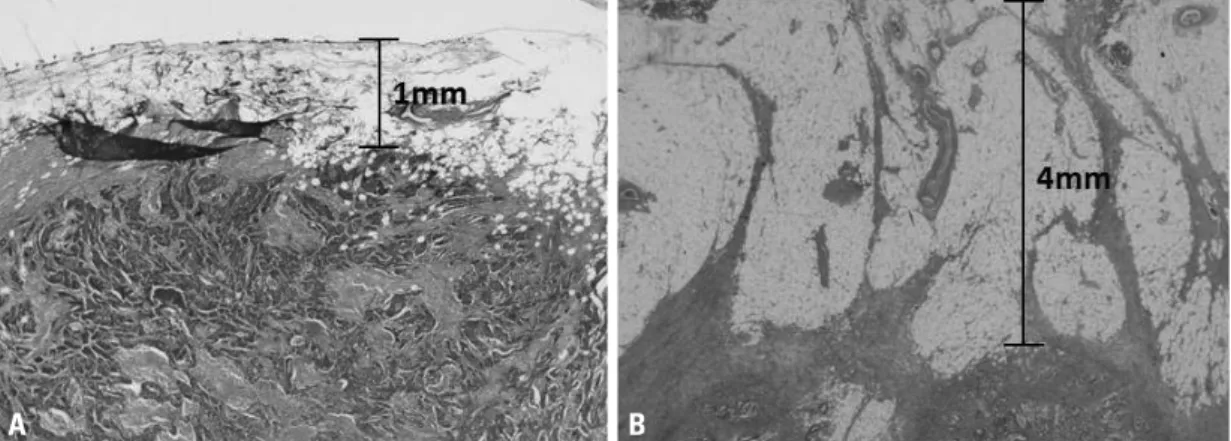
‘‘CRM-negative group’’ (CRM >1 mm) according to the shortest distance between the CRM and the tumor (Fig. 1).
Adjuvant chemoradiotherapy
In this study, 5-FU (450 mg/m2 for 5 days) and leucovorin (20 mg/m2 for 5 days) was given intravenously each month with six cycles. A total dose of 5040 cGY of external beam radiation therapy was delivered after the second round of chemotherapy (as supplied by a 6 MV/10 MV dual photon linear accelerator, CLINAC 2100 C, Varian, Palo Alto, CA, USA) in 30 fractions of 180 cGY each, five times weekly to the pelvic cavity with individually shaped portals and us- ing a four-field box technique.17
Definition of recurrence
LR was defined as any recurrent tumor growth within the pelvic cavity or perineal area confirmed by clinical, radio- logical or pathological evidence. For histological confirma- tion, an imaging-guided biopsy was performed, when pos- sible. Overall local recurrence rates were calculated as the sum of isolated LR and LR with concomitant systemic me- tastases.8 Systemic recurrence was defined as recurrence outside the pelvis.
Lymph node ratio evaluation
Lymph node ratio (LNR) was defined as the ratio of meta- static lymph nodes to total retrieved lymph nodes. Patients were categorized into three groups based on their LNR:
Group 1=0<LNR≤0.099 (LNRG1); Group 2=0.01≤LNR
≤0.249 (LNRG2); or Group 3=0.25≤LNR≤1.0 (LNRG3).
This cut-off value was chosen based on the tertile number of LNR in this study group.
Fig. 1. Pathologic findings of the CRM-positive and CRM-negative groups. The distance between the tumor and the circumferential resec- tion margin was 1 mm (H&E staining, ×12) in the CRM-positive group (A), and 4 mm (H&E staining, ×12) in the CRM-negative group (B).
CRM, circumferential resection margin.
A B
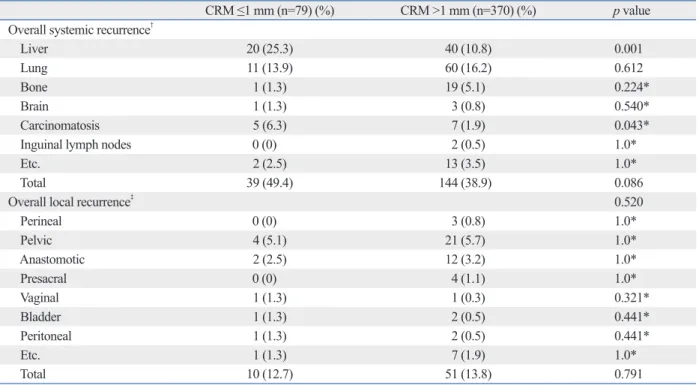
nomatosis were significantly higher in the CRM-positive group than in the CRM-negative group (25.3% vs. 10.8%;
p=0.001, and 6.3% vs. 1.9%; p=0.043, respectively) (Table 3).
Survival analysis
The 5-year overall survival rate was 54.2% in the CRM- were CRM positive and the remaining 161 patients (79.3%)
were CRM negative. Isolated SR rate was higher in the CRM-positive group than that of the CRM-negative group, although the p-value thereof was only marginally signifi- cant (40.5% vs. 29.7%, p=0.062) (Table 2).
Among various patterns of SR, liver metastasis and carci-
Table 1. Clinicopathological Characteristics of Stage III Rectal Cancer Patients According to CRM Involvement Status
Variables CRM ≤1 mm (n=79)
n (%) CRM >1 mm (n=370)
n (%) p value
Gender Male 46 (58.2) 232 (62.7) 0.457
Female 33 (41.2) 138 (37.3)
Age (yrs) <60 50 (63.3) 233 (63.0) 0.958
≥60 29 (36.7) 137 (37.0)
BMI (kg/m2) <25 54 (68.4) 257 (69.5) 0.619
≥25 16 (20.3) 83 (22.4)
No data 9 (11.4) 30 (8.1)
Histologic grade* G1 and G2 63 (79.7) 320 (86.5) 0.125
G3 and Etc. 16 (20.3) 50 (13.5)
LVI Negative 38 (48.1) 258 (69.7) <0.001
Positive 41 (51.9) 112 (30.3)
CEA (ng/mL) <5 49 (62.0) 232 (62.7) 0.910
≥5 30 (38.0) 138 (37.3)
Tumor size (cm) <5 39 (49.4) 242 (65.4) 0.007
≥5 40 (50.6) 128 (34.6)
Tumor location 7-12 cm 46 (58.2) 195 (52.7) 0.371
1-6 cm 33 (41.8) 175 (47.3)
pT T1 and T2 1 (1.3) 52 (14.1) 0.001
T3 and T4 78 (98.7) 318 (85.9)
pN N1 34 (43.0) 219 (59.2) 0.009
N2 45 (57.0) 151 (40.8)
LNR group LNRG1 (0-0.099) 22 (27.8) 132 (35.7) 0.270
LNRG2 (0.1-0.249) 25 (31.6) 120 (32.4)
LNRG3 (0.25-1.0) 32 (40.5) 118 (31.9)
Operation method APR 18 (22.8) 106 (28.6) 0.362†
Hartmann 4 (5.1) 11 (3.0)
SPP 57 (72.2) 253 (68.4)
Operation type Open surgery 75 (94.9) 350 (94.6) 1.0†
Lapa or robot surgery 4 (5.1) 20 (5.4)
BMI, Body Mass Index; LVI, lymphovascular invasion; CEA, carcinoembryonic antigen; CRM, circumferential resection margin; LNR, lymph node ratio; APR, abdominoperineal resection; SPP, sphincter preserving procedure.
*Histologic grade; G1, well differentiated; G2, moderately differentiated; G3, poorly differentiated; Etc., mucinous carcinoma and signet ring cell.
†Fisher’s exact test.
Table 2. Rate and Patterns of Recurrence According to CRM Involvement Status
CRM ≤1 mm (n=79) (%) CRM >1 mm (n=370) (%) p value
Local recurrence only 3 (3.8) 17 (4.6) 1.0*
Systemic recurrence only 32 (40.5) 110 (29.7) 0.062
Combined recurrence 7 (8.9) 34 (9.2) 0.927
Overall recurrence 42 (53.2) 161 (43.5) 0.118
CRM, circumferential resection margin.
Combined recurrence: local recurrence plus systemic recurrence.
*Fisher’s exact test.
adjuvant chemoradiotherapy, CRM involvement proved to be an independent adverse prognostic factor. However, local recurrence rate did not differ between CRM-positive and CRM-negative patients.
The clinical relevance of CRM involvement in rectal can- cer for oncological outcomes has been well documented since Quirke, et al.9 first reported the importance of CRM on prognosis. It was reported that CRM involvement increased the risks of both local recurrence and distant metastases.7-10 In contrast, Hall, et al.13 reported that although circumferential margin positive was associated with poor prognosis in terms of distant metastasis and survival in rectal cancer, CRM in- volvement did not greatly increase the local recurrence rate due to the early development of distant disease rather than lo- cal failure. Khani, et al.14 reported that there were no signifi- cant differences in local recurrence and survival between CRM positive and negative tumors after preoperative radio- therapy and postoperative chemotherapy. These previous studies included all stages of rectal cancer patients with or without preoperative chemoradiotherapy. In contrast, this study included a relatively large number of stage III rectal cancer patients in whom no preoperative chemoradiothera- py had been applied. Therein, a strong positive association was observed for CRM involvement with distant recur- positive group and 66.1% in the CRM-negative group. On
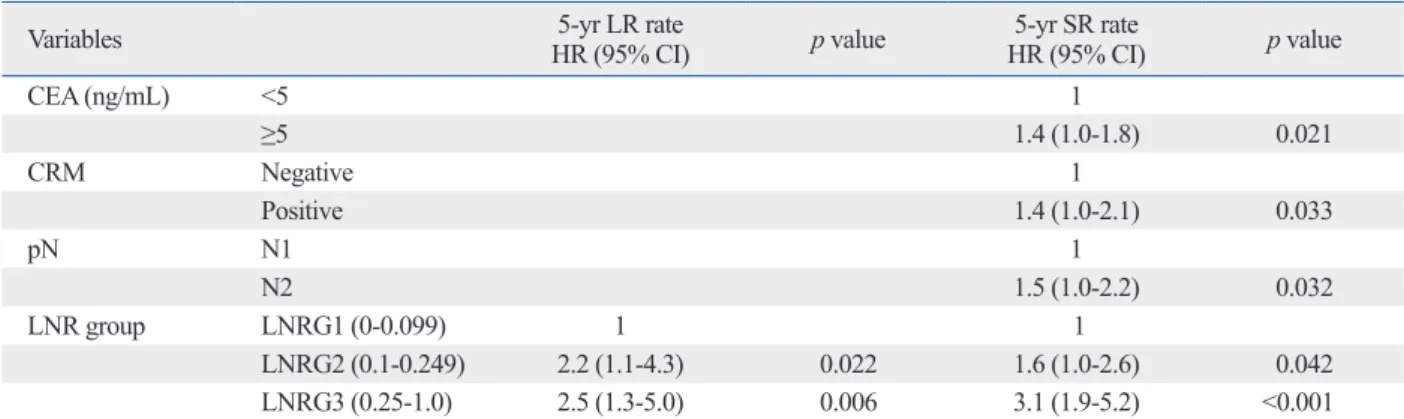
univariate analysis, LNR group and pathologic N stage were shown to be significant predictors of LR, while lymphovas- cular invasion, circumferential resection margin involve- ment, LNR group, pathologic T stage, and pathologic N stage were shown to be significant predictors of SR (Table 4). Cox proportional hazards analysis showed that LNR group was an independently predictor of LR. Additionally, preoperative CEA level, CRM involvement, pathologic N stage, and LNR group were shown to be independent pre- dictors of SR on multivariate analysis (Table 5).
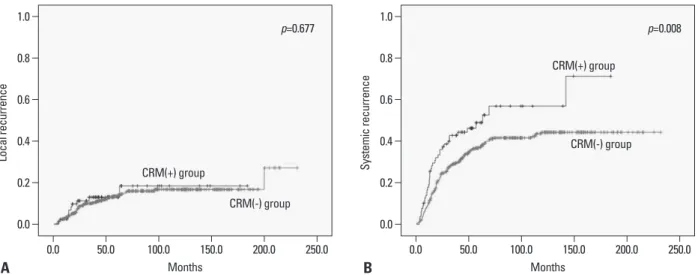
The cumulative incidences of LR and SR according to CRM status are shown in Fig. 2. The overall local recur- rence rate (the sum of isolated LR and LR with concomi- tant distant metastases) was not different regardless of whether the patient was CRM positive or not (5-year LR rate in the CRM-positive group 13.0% vs. CRM-negative group 13.5%; p=0.677).
DISCUSSION
In this study focusing on stage III rectal cancer patients who were treated with curative resection followed by complete
Table 3. Site of Local and Systemic Recurrence according to CRM Involvement Status
CRM ≤1 mm (n=79) (%) CRM >1 mm (n=370) (%) p value
Overall systemic recurrence†
Liver 20 (25.3) 40 (10.8) 0.001
Lung 11 (13.9) 60 (16.2) 0.612
Bone 1 (1.3) 19 (5.1) 0.224*
Brain 1 (1.3) 3 (0.8) 0.540*
Carcinomatosis 5 (6.3) 7 (1.9) 0.043*
Inguinal lymph nodes 0 (0) 2 (0.5) 1.0*
Etc. 2 (2.5) 13 (3.5) 1.0*
Total 39 (49.4) 144 (38.9) 0.086
Overall local recurrence‡ 0.520
Perineal 0 (0) 3 (0.8) 1.0*
Pelvic 4 (5.1) 21 (5.7) 1.0*
Anastomotic 2 (2.5) 12 (3.2) 1.0*
Presacral 0 (0) 4 (1.1) 1.0*
Vaginal 1 (1.3) 1 (0.3) 0.321*
Bladder 1 (1.3) 2 (0.5) 0.441*
Peritoneal 1 (1.3) 2 (0.5) 0.441*
Etc. 1 (1.3) 7 (1.9) 1.0*
Total 10 (12.7) 51 (13.8) 0.791
CRM, circumferential resection margin.
*Fisher’s exact test.
†Overall systemic recurrence (SR) is given as the sum of isolated SR and SR with concomitant local recurrence.
‡Overall local recurrence (LR) is given as the sum of isolated LR and LR with concomitant systemic recurrence.
ther evidence to the report of Hall, et al.13 In our study, the median time to diagnosis of systemic recurrence from the rence. However, local recurrence rate was not correlated
with CRM involvement status. This result might give fur-
Table 4. Univariate Analysis of Factors Associated with 5-Year Local Recurrence and 5-Year Systemic Recurrence
Variables 5-yr LR rate (%) p value 5-yr SR rate (%) p value
Gender Male 14.4 0.543 38.5 0.546
Female 12.1 40.2
Age (yrs) <60 14.4 0.220 35.5 0.059
≥60 11.9 45.4
BMI (kg/m2) <25 13.9 0.729 37.0 0.238
≥25 10.7 41.0
Unknown 17.9 50.6
Histologic grade* G1 and G2 13.3 0.791 36.9 0.104
G3 and Etc. 14.7 49.9
LVI Negative 12.4 0.549 34.1 0.001
Positive 16.2 49.0
CEA (ng/mL) <5 11.5 0.120 34.0 0.120
≥5 16.9 47.6
Tumor size (cm) <5 12.2 0.159 39.3 0.843
≥5 15.8 38.6
Tumor location 7-12 cm 11.5 0.236 36.2 0.230
1-6 cm 15.8 42.2
CRM Negative 13.5 0.677 37.1 0.008
Positive 13.0 48.9
LNR group LNRG1 (0-0.099) 6.2 0.014 17.9 <0.001
LNRG2 (0.1-0.249) 15.3 37.5
LNRG3 (0.25-1.0) 21.1 63.4
pT T1 and T2 8.6 0.265 22.0 0.009
T3 and T4 14.2 41.4
pN N1 8.7 0.004 25.1 <0.001
N2 20.6 57.6
Operation method APR or Hartmann procedure 17.1 0.166 45.8 0.168
SPP 11.9 36.4
LR, local recurrence; SR, systemic recurrence; BMI, body mass index; LVI, lymphovascular invasion; CEA, carcinoembryonic antigen; CRM, circumferential resection margin; LNR, lymph node ratio; APR, abdominoperineal resection; SPP, sphincter preserving procedure.
*Histologic grade; G1, well differentiated; G2, moderately differentiated; G3, poorly differentiated; Etc., mucinous carcinoma and signet ring cell.
Table 5. Multivariate Analysis of Factors Associated with 5-Year Local Recurrence and 5-Year Systemic Recurrence
Variables 5-yr LR rate
HR (95% CI) p value 5-yr SR rate
HR (95% CI) p value
CEA (ng/mL) <5 1
≥5 1.4 (1.0-1.8) 0.021
CRM Negative 1
Positive 1.4 (1.0-2.1) 0.033
pN N1 1
N2 1.5 (1.0-2.2) 0.032
LNR group LNRG1 (0-0.099) 1 1
LNRG2 (0.1-0.249) 2.2 (1.1-4.3) 0.022 1.6 (1.0-2.6) 0.042
LNRG3 (0.25-1.0) 2.5 (1.3-5.0) 0.006 3.1 (1.9-5.2) <0.001
LR, local recurrence; SR, systemic recurrence; CEA, carcinoembryonic antigen; CRM, circumferential resection margin; LNR, lymph node ratio; HR, hazard ratio; CI, confidence interval.
Factors with a p-value of less than 0.20 on univariate analysis were entered into the multivariate analysis.
recurrence-free and systemic recurrence-free survival.
Neoadjuvant chemoradiotherapy (NCRT) could further lower the local recurrence rates compared with adjuvant chemoradiotherapy in rectal cancer.5 Clinical stages of T3 or T4 and/or node positivity was regarded as a good candi- date for NCRT. Due to enhancing diagnostic accuracy, es- pecially in pelvic MRI, preoperative threatened or involved CRM was also regarded as an essential indication for NCRT to reduce CRM positive rates.19,20 According to our obser- vations of a positive relationship between systemic recur- rence and CRM involvement, threatened or involved CRM groups defined by preoperative MRI should be regarded as an immediate candidate for more urgent and intensified neoadjuvant chemotherapy in clinical trials. Accordingly, further prospective studies are warranted.
In conclusion, in patients with stage III rectal cancer treat- ed with curative resection followed by adjuvant chemora- diotherapy, although CRM involvement was an important adverse prognostic factor, local recurrence rate was not cor- related with CRM involvement status. For this reason, CRM involvement should be considered as an indicator of more advanced disease. Additionally, these features should be considered in establishing end-points in further randomized controlled trials for rectal cancer.
ACKNOWLEDGEMENTS
This study was supported by a grant from the Korea Health 21 R&D Project, Ministry of Health and Welfare, Republic of Korea (0405-BC01-0604-0002).
primary resection in the CRM-positive group was shorter than that of the CRM-negative group (13.3 vs. 19.7 months; p=0.052) (data not shown). This result might have originated from the more aggressive tumor biology in the CRM-positive group than in the CRM-negative group. For this reason, the rate of local recurrence could have appeared lower than it really was in the CRM-positive group.
It is known that low rectal cancers entails a higher posi- tive CRM rate than upper rectal cancer.8 In the present study, the CRM positive rate in upper rectal cancer was higher than that of low rectal cancer, although this differ- ence was not statistically significant. The reason for this phenomenon is difficult to explain. During the early periods of this study, abdominoperineal resection (APR) was fre- quently performed for low rectal cancer. In this data set, the CRM positivity rate was 14.5% for patients who underwent APR and 18.4% for patients who underwent a sphincter- preserving procedure (p=0.335, data not shown). From these data, we deduced that APR had been with excellently performed in our center, which could have lowered the CRM involvement rate in low rectal cancer.
With regard to local recurrence-free survival, LNR re- tained its significance in the multivariate analysis. With re- gard to systemic recurrence-free survival, preoperative CEA level, LNR, pathologic N stage, and CRM retained their statistical significance in the multivariate analysis. These results are on par with published data. Recently, LNR was reported as an effective parameter for predicting patient prognosis in node positive colorectal cancer, though debate still exist as to the ideal cut-off value.18 In our analysis, LNR also proved to be an independent prognostic factor of local
Fig. 2. Five-year cumulative recurrence rate according to CRM status. (A) Five-year local recurrence rate in the CRM(-) group (13.5%) and CRM(+) group (13.0%) (p=0.677). (B) Five-year systemic recurrence rate in the CRM(-) group (37.1%) and CRM(+) group (48.9%) (p=0.008). CRM, circumferential resection margin.
A B
0.0 0.0
0.2 0.2
0.4 0.4
0.6 0.6
0.8 0.8
1.0 1.0
Local recurrence Systemic recurrence
0.0 50.0 100.0 150.0 200.0 250.0 0.0 50.0 100.0 150.0 200.0 250.0
Months Months
CRM(+) group
CRM(+) group
p=0.677 p=0.008
CRM(-) group
CRM(-) group
lowing total mesorectal excision and adjuvant chemoradiotherapy in patients with rectal cancer. Ann Surg Oncol 2007;14:462-9.
12. Guillou PJ, Quirke P, Thorpe H, Walker J, Jayne DG, Smith AM, et al. Short-term endpoints of conventional versus laparoscopic- assisted surgery in patients with colorectal cancer (MRC CLAS- ICC trial): multicentre, randomised controlled trial. Lancet 2005;365:1718-26.
13. Hall NR, Finan PJ, al-Jaberi T, Tsang CS, Brown SR, Dixon MF, et al. Circumferential margin involvement after mesorectal exci- sion of rectal cancer with curative intent. Predictor of survival but not local recurrence? Dis Colon Rectum 1998;41:979-83.
14. Khani M, Smedh K, Kraaz W. Is the circumferential resection margin a predictor of local recurrence after preoperative radiother- apy and optimal surgery for rectal carcinoma? Colorectal Dis 2007;9:706-12.
15. Kim NK. Anatomic basis of sharp pelvic dissection for curative resection of rectal cancer. Yonsei Med J 2005;46:737-49.
16. Kim NK, Kim YW, Min BS, Lee KY, Sohn SK, Cho CH. Opera- tive safety and oncologic outcomes of anal sphincter-preserving surgery with mesorectal excision for rectal cancer: 931 consecu- tive patients treated at a single institution. Ann Surg Oncol 2009;16:900-9.
17. Kim YW, Kim NK, Min BS, Lee KY, Sohn SK, Cho CH. The in- fluence of the number of retrieved lymph nodes on staging and survival in patients with stage II and III rectal cancer undergoing tumor-specific mesorectal excision. Ann Surg 2009;249:965-72.
18. Ceelen W, Van Nieuwenhove Y, Pattyn P. Prognostic value of the lymph node ratio in stage III colorectal cancer: a systematic re- view. Ann Surg Oncol 2010;17:2847-55.
19. Brown G, Radcliffe AG, Newcombe RG, Dallimore NS, Bourne MW, Williams GT. Preoperative assessment of prognostic factors in rectal cancer using high-resolution magnetic resonance imag- ing. Br J Surg 2003;90:355-64.
20. Brown G, Richards CJ, Bourne MW, Newcombe RG, Radcliffe AG, Dallimore NS, et al. Morphologic predictors of lymph node status in rectal cancer with use of high-spatial-resolution MR imag- ing with histopathologic comparison. Radiology 2003;227:371-7.
REFERENCES
1. Killingback M, Barron P, Dent OF. Local recurrence after curative resection of cancer of the rectum without total mesorectal exci- sion. Dis Colon Rectum 2001;44:473-83.
2. Yun HR, Lee LJ, Park JH, Cho YK, Cho YB, Lee WY, et al. Local recurrence after curative resection in patients with colon and rectal cancers. Int J Colorectal Dis 2008;23:1081-7.
3. Enker WE, Thaler HT, Cranor ML, Polyak T. Total mesorectal ex- cision in the operative treatment of carcinoma of the rectum. J Am Coll Surg 1995;181:335-46.
4. Cecil TD, Sexton R, Moran BJ, Heald RJ. Total mesorectal exci- sion results in low local recurrence rates in lymph node-positive rectal cancer. Dis Colon Rectum 2004;47:1145-9.
5. Sauer R, Becker H, Hohenberger W, Rodel C, Wittekind C, Fiet- kau R, et al. Preoperative versus postoperative chemoradiotherapy for rectal cancer. N Engl J Med 2004;351:1731-40.
6. Hermanek P, Junginger T. The circumferential resection margin in rectal carcinoma surgery. Tech Coloproctol 2005;9:193-9.
7. Adam IJ, Mohamdee MO, Martin IG, Scott N, Finan PJ, Johnston D, et al. Role of circumferential margin involvement in the local recurrence of rectal cancer. Lancet 1994;344:707-11.
8. Wibe A, Syse A, Andersen E, Tretli S, Myrvold HE, Søreide O;
Norwegian Rectal Cancer Group. Oncological outcomes after to- tal mesorectal excision for cure for cancer of the lower rectum:
anterior vs. abdominoperineal resection. Dis Colon Rectum 2004;47:48-58.
9. Quirke P, Durdey P, Dixon MF, Williams NS. Local recurrence of rectal adenocarcinoma due to inadequate surgical resection. Histo- pathological study of lateral tumour spread and surgical excision.
Lancet 1986;2:996-9.
10. de Haas-Kock DF, Baeten CG, Jager JJ, Langendijk JA, Schouten LJ, Volovics A, et al. Prognostic significance of radial margins of clearance in rectal cancer. Br J Surg 1996;83:781-5.
11. Baik SH, Kim NK, Lee YC, Kim H, Lee KY, Sohn SK, et al.
Prognostic significance of circumferential resection margin fol-