Vol. 19, No. 6, pp. 47-53, December 2015
대기온도에 따른 휘발유 자동차의 배출가스 특성에 관한 연구 A Study on the exhaust gas characteristics of the vehicle
gasoline according to the ambient temperature
임재혁*†․김기호*․김성우*․이민호*․오상기**
Jae-Hyuk Lim*†, Ki-Ho Kim*, Sung-Woo Kim*, Min-Ho Lee* and Sang-Gi Oh**
(Received 10 August 2015, Revision received 29 October 2015, Accepted 02 November 2015)
Abstract: Korea is the geographic location during the summer, the temperature rising to 35 ℃ and winter temperature is -15 ℃ to reduce the air temperature changes, such as relatively large compared to other countries. This increase or decrease of the harmful exhaust gas discharged from automobile substantially inconvenience a significant impact on the active side of the car engine temperature and exhaust gas reducing device receives a large impact on the atmospheric temperature is regulation to be different. However, domestic vehicle emissions test temperature of 20 ~ 30 ℃ is it does not reflect this situation the actual test temperature to accurately measure the exhaust gas volume of the vehicle is difficult. In this study, domestic automobile exhaust gas test conditions of a test temperature 20~30 ℃ various temperatures, including (35, 25, 0, -7, -15, -25 ℃) under the two vehicles (2.0L MPI, 2.4 L GDI) as was discussed with respect to the exhaust gas characteristics of the vehicle according to the ambient temperature gas. As a result, domestic emissions test temperature of 25 ℃ than average conditions were temperature decreases greenhouse gas emissions and increase overall increased by up to 15 times higher. Air temperature and the engine exhaust gas inconvenience a direct effect on the activation temperature required in the reduction unit is determined to be an increase of emissions and greenhouse gases, and also an increase in the variety of lubricants based lubricating and viscosity reduction, such as the engine oil due to the low temperature of these result It is considered that shows the.
Key Words:Ambient temperature, Emission, Greenhouse gas
*†임재혁(교신저자) : 한국석유관리원 석유기술연구소 E-mail : [email protected], Tel : 043-240-7957
*김기호, 김성우, 이민호 : 한국석유관리원 석유기술연구소
**오상기 : 경기과학기술대학교 자동차과
*†Jae-Hyuk Lim(corresponding author) : R&D center, Korea Petroleum Quality & Distribution Authority, 33, Yangcheong 3-gil, Ochang-eup, Cheongwon-gu, Cheongju-si, Chungcheongbuk -do, 363-883, Korea.
E-mail : [email protected], Tel : 043-240-7957
*Ki-Ho Kim, Sung-Woo Kim, Min-Ho Lee : R&D center, Korea Petroleum Quality & Distribution Authority
**Sang-Gi Oh : Automotive Engineering, Gyeonggi College of Science & Technology.
1. 서 론
전 세계적으로 자동차 산업계는 대기 질 개선 및 지구 온난화 방지, 그리고 화석에너지의 고갈 이라는 문제점을 해결하기 위한 강구책으로 자동 차 배출가스 허용기준을 대폭 강화하고 있는 추 세이다. 이에 자동차 및 저감장치 제작사에서는 자동차 배출가스 양을 줄이기 위해 다양한 분야 에서 노력을 기울이고 있는 실정이다.
경유 자동차에서는 배출가스를 저감하기 위해 EGR, SCR 및 DPF를 사용하고 있으며, 휘발유 자동차의 경우 탄화수소 및 일산화탄소를 저감하 기 위해 엔진 후단에 삼원촉매를 장착하여 배출 가스 양이 저감되고 있다. 삼원촉매의 경우 일정 온도 이상에서 장치가 활성화 되어 유해 배기가 스를 저감시키는 역할을 하는 데 대기온도가 낮 으면 장치의 활성화 시간이 길어져 저감 효율 저 하 현상이 나타날 수 있다. 또한 엔진오일의 윤 활성 감소와 점성의 증가를 야기시켜 기계적 손 실과 연비저하를 일으키고, 동시에 배출가스 증 가에 직접적인 영향을 준다.
1)우리나라는 지리적 위치상 여름철에는 35 ℃ 까지 온도가 상승하고 겨울철은 –15 ℃까지 온도가 감소하는 등 대기온도변화가 다른 국가 에 비해 상대적으로 큰 편이다. 이는 대기온도 에 많은 영향을 받는 자동차 엔진 및 배출가스 저감 장치의 온도 활성화 측면에 큰 영향을 끼 쳐 실질적으로 자동차에서 배출되는 유해 배기 가스의 증감이 달라질 것으로 판단된다. 하지 만 국내 자동차 배출가스 시험법 온도 조건인 20~30 ℃는 이러한 실질적인 시험온도 조건을 반영하지 못하고 있어 자동차에서 배출되는 유 해 배기가스양을 정확히 측정하기는 어려운 실 정이다.
2)본 연구에서는 국내 자동차 배출가스 시험법 시험온도 조건인 20~30 ℃를 포함하여 다양한 온도조건 (35, 25, 0, -7, -15, -25 ℃)하에서 2대의 차량(2.0L MPI, 2.4L GDI)으로 대기온도에 따른 휘발유 자동차의 배출가스 특성에 관하여 논하 였다.
2. 시험장치 및 시험방법
2.1 시험장치
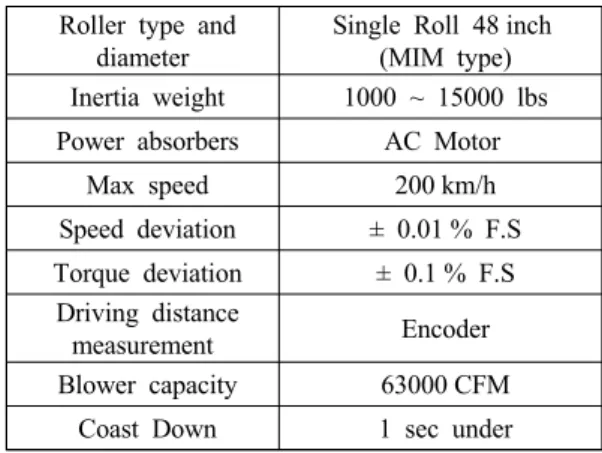
본 시험에 사용된 차대동력계는 자동차를 실 도로 조건과 동일하게 부하를 제어하는 장비로서, 국내 차량 총중량 3.5ton 미만의 소형, 승용 및 화 물자동차에 대하여 연비 및 배출가스를 측정 할 수 있도록 형식 승인된 장비이다. 동력계의 개략 도 및 제원을 Fig. 1과 Table 1에 나타내었다.
Fig. 1 The schematic diagram of chassis- dynamometer system
Table 1 Specifications of chassis-dynamometer Roller type and
diameter
Single Roll 48 inch (MIM type) Inertia weight 1000 ~ 15000 lbs Power absorbers AC Motor
Max speed 200 km/h Speed deviation ± 0.01 % F.S Torque deviation ± 0.1 % F.S
Driving distance
measurement Encoder Blower capacity 63000 CFM
Coast Down 1 sec under
차대동력계는 자동차가 실제도로를 주행할 때
정지→가속→정속→감속 등을 반복하는 과정을
대표화한 실측 주행모드를 사용하여 주행할 수
있도록 자동차에 부하를 가해주는 장치로서 시험
에 사용한 차대동력계는 AC동력계(AVL 저온시험
용 차대동력계)로 관성중량(Inertia weight), 동력흡
수계(Power absorption unit), 제어기(Controller)로 구성되어 있다.
배출가스 측정장치(HORIBA Co. MEXA series) 는 자동차의 배출가스 중 CO, THC, NOx, CO
2, CH
4를 분석할 수 있는 장치로서 분석원리는 CO 및 CO
2는 비분산적외선분석법(Nondispersive Infrared), THC는 수소염 이온화법(Heated Flame Ionization Detector), NOx는 화학발광법 (Chemiluminescence Detector), CH4는 GC-FID(Gas chroomatography-FID)를 사용한다.
Fig. 2 Ultra-fine particles PM Measuring Equipment
또한 현재의 PM(Particle Matter)을 측정하는 방식이지만 유럽에서는 EURO 5+기준에 수량규 제를 실시하도록 하였으므로 극 미세입자에 대 한 가솔린자동차 배출특성을 확인하여 향후 기 본 자료로 활용하고자 PN(Particle Number)을 측 정하였으며, 측정 장치는 Fig. 2에 나타내었다.
시험에 사용된 장비는 유럽의 UN-ECE에서 규정한 시험장비(GPMS)를 배출가스 분석시스템 CVS터널에 설치하여 사용하였고, 입자의 분포 특성을 확인하기 위하여 입자분포 측정 장비 (EEPS)를 추가하여 동시에 측정할 수 있도록 하 였다.
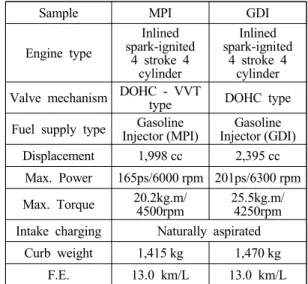
3,4)시험에 사용된 차량은 현행의 엔진방식인 MPI와 최근 개발되어 상용화된 GDI 방식의 차 량을 각각 1대씩 선정하였으며 차량제원은 Table 2와 같다.
Table 2 Specifications of test vehicle
Sample MPI GDI
Engine type
Inlined spark-ignited
4 stroke 4 cylinder
Inlined spark-ignited
4 stroke 4 cylinder Valve mechanism DOHC - VVT type DOHC type
Fuel supply type Gasoline
Injector (MPI) Gasoline Injector (GDI) Displacement 1,998 cc 2,395 cc
Max. Power 165ps/6000 rpm 201ps/6300 rpm Max. Torque 20.2kg.m/
4500rpm 25.5kg.m/
4250rpm Intake charging Naturally aspirated
Curb weight 1,415 kg 1,470 kg F.E. 13.0 km/L 13.0 km/L
2.2 시험방법
시험차량을 실 도로 상황과 동일한 부하조건을 설정하기 위해 차대동력계에서 Coast-Down을 실 시하였고. 차량의 상태를 동일한 조건으로 유지하 기 위해 본 시험 전 매회 동일 운전모드로 예비 주행하는 Preconditioning을 실시하였다. 그리고 시 험온도 조건에서 12시간 이상 Soaking시킨 후 본 시험을 수행하였다. 모든 시험은 결과의 경향성과 신뢰성을 위해 동일 드라이버로 진행되었으며, 6 가지 대기 온도조건 (35, 25, 0, -7, -15, -25 ℃) 하 에서 배출가스 측정 시험을 진행하였다.
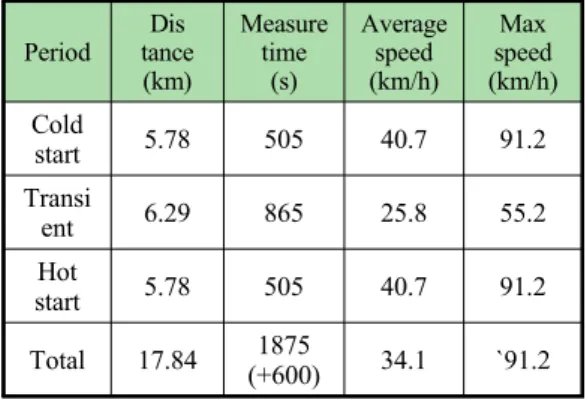
시험 모드는 국내 휘발유 차량 배출가스 및 연 비시험 모드인 FTP-75 모드로서 주행패턴과 주행 조건을 Fig. 3과 Table 3에 나타내었다.
Fig. 3 The driving pattern FTP-75 mode
Table 3 The Driving Conditions FTP-75 mode
Period Dis tance (km)
Measure time
(s)
Average speed (km/h)
Max speed (km/h) Cold
start 5.78 505 40.7 91.2 Transi
ent 6.29 865 25.8 55.2 Hot
start 5.78 505 40.7 91.2 Total 17.84 1875
(+600) 34.1 `91.2
3. 시험결과 및 고찰
3.1 시험차량 선정의 적합성
Fig. 4는 본 시험을 위해 선정한 자동차의 이상 유무를 확인하기 위해 시험차량의 배출가스허용 기준 결과와 본 시험결과를 비교하였으며, 두 차 량 모두 허용기준에 충분히 만족하는 결과를 보 였다.
(a) MPI
(b) GDI
Fig. 4 Comparison of emissions
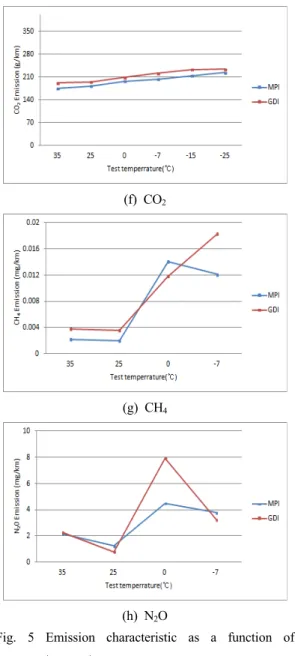
3.2 온도조건별 차량 배출가스 특성